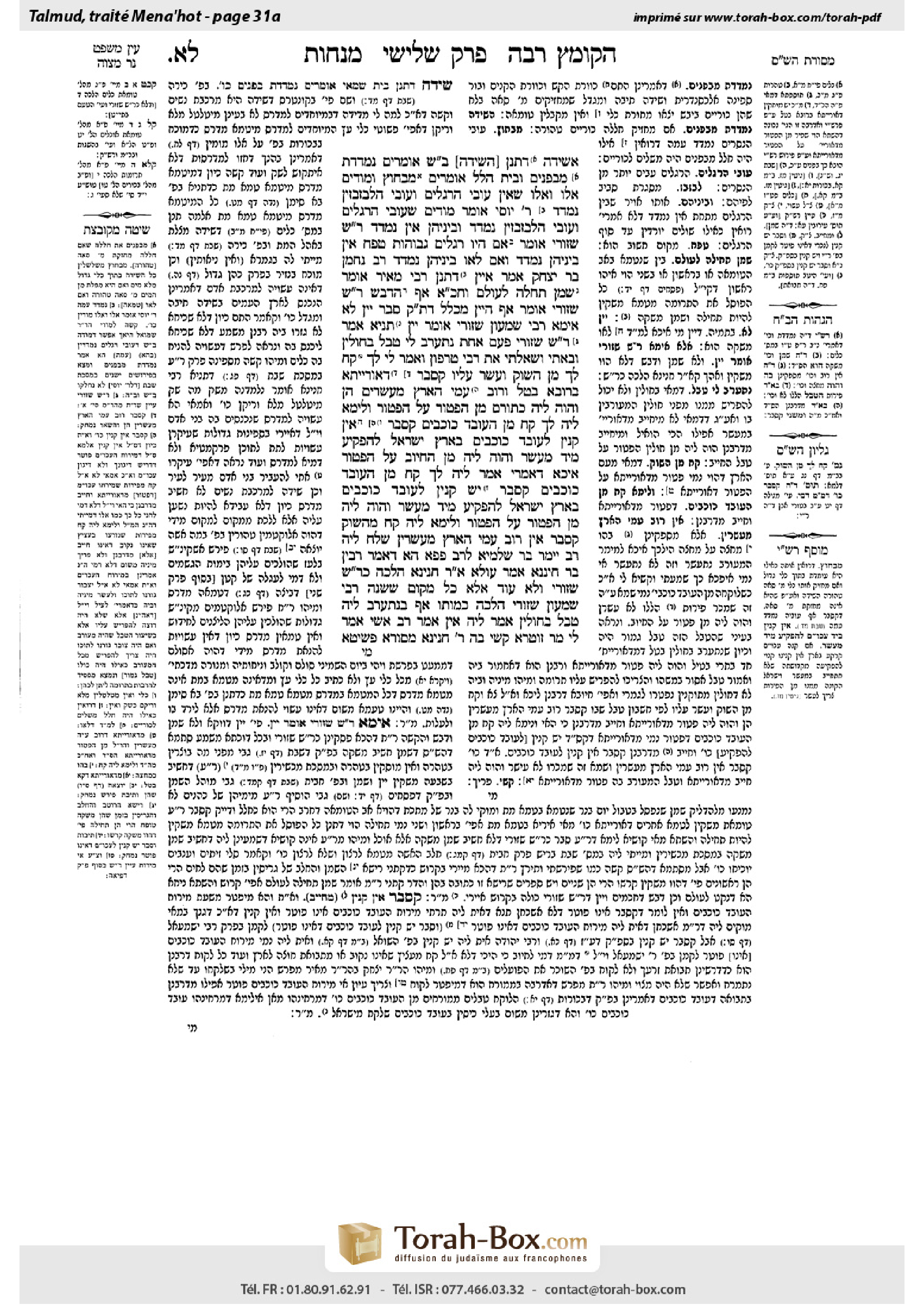
Menachot 31a: Talmud study for Daf Yomi
Daf Yomi is the daily study of one Talmud folio. Explore 37 tractates with scans, Hebrew text, Sefaria English and AI-generated French translations where annotated.
Passage selection and English or AI-generated French translation are available where the scan has annotations. Daf Study is independent of Torah-Box and Sefaria.
Browse Menachot · מנחות · All tractatesMenachot 31a text and translations
This page of Menachot includes the Aramaic text, an English translation and an AI-generated French translation, alongside the scan above.
מנחות ל״א א · Aramaic and Hebrew text
אַשִּׁידָּה, דִּתְנַן: בֵּית שַׁמַּאי אוֹמְרִים נִמְדֶּדֶת מִבִּפְנִים, וּבֵית הִלֵּל אוֹמְרִים מִבַּחוּץ, וּמוֹדִים אֵלּוּ וְאֵלּוּ שֶׁאֵין עוֹבִי הָרַגְלַיִם וְעוֹבִי הַלְּבִזְבְּזִין נִמְדָּד.
רַבִּי יוֹסֵי אוֹמֵר: מוֹדִים שֶׁעוֹבִי הָרַגְלַיִם וְעוֹבִי הַלְּבִזְבְּזִין נִמְדָּד, וּבֵינֵיהֶן אֵין נִמְדָּד. רַבִּי שִׁמְעוֹן שֵׁזוּרִי אוֹמֵר: אִם הָיוּ רַגְלַיִם גְּבוֹהוֹת טֶפַח – אֵין בֵּינֵיהֶן נִמְדָּד, וְאִם לָאו – בֵּינֵיהֶן נִמְדָּד.
רַב נַחְמָן בַּר יִצְחָק אָמַר: אַיַּיִן, דִּתְנַן: רַבִּי מֵאִיר אוֹמֵר: שֶׁמֶן תְּחִלָּה לְעוֹלָם, וַחֲכָמִים אוֹמְרִים: אַף הַדְּבָשׁ, רַבִּי שִׁמְעוֹן שֵׁזוּרִי אוֹמֵר: אַף הַיָּיִן. מִכְּלָל דְּתַנָּא קַמָּא סָבַר יַיִן לָא? אֵימָא: רַבִּי שִׁמְעוֹן שֵׁזוּרִי אוֹמֵר: יָיִן.
תַּנְיָא, אָמַר רַבִּי שִׁמְעוֹן שֵׁזוּרִי: פַּעַם אַחַת נִתְעָרֵב לִי טֶבֶל בְּחוּלִּין, וּבָאתִי וְשָׁאַלְתִּי אֶת רַבִּי טַרְפוֹן, וְאָמַר לִי: לֵךְ קַח לְךָ מִן הַשּׁוּק וְעַשֵּׂר עָלָיו.
קָסָבַר דְּאוֹרָיְיתָא בְּרוּבָּא בָּטֵל, וְרוֹב עַמֵּי הָאָרֶץ מְעַשְּׂרִים הֵן, וְהָוֵה לֵיהּ כְּתוֹרֵם מִן הַפְּטוּר עַל הַפְּטוּר.
וְלֵימָא לֵיהּ: ״לֵךְ קַח מִן הַגּוֹי״, קָסָבַר: אֵין קִנְיָן לְגוֹי בְּאֶרֶץ יִשְׂרָאֵל לְהַפְקִיעַ מִיַּד מַעֲשֵׂר, וְהָוֵה לֵיהּ מִן הַחִיּוּב עַל הַפְּטוּר.
אִיכָּא דְאָמְרִי, אֲמַר לֵיהּ: ״לֵךְ קַח מִן הַגּוֹי״, קָסָבַר יֵשׁ קִנְיָן לְגוֹי בְּאֶרֶץ יִשְׂרָאֵל לְהַפְקִיעַ מִיַּד מַעֲשֵׂר, וְהָוֵה לֵיהּ מִן הַפְּטוּר עַל הַפְּטוּר.
וְלֵימָא לֵיהּ: ״קַח מֵהַשּׁוּק״, קָסָבַר: אֵין רוֹב עַמֵּי הָאָרֶץ מְעַשְּׂרִין.
שְׁלַח לֵיהּ רַב יֵימַר בַּר שֶׁלֶמְיָא לְרַב פָּפָּא: הָא דְּאָמַר רָבִין בַּר חִינָּנָא אָמַר עוּלָּא אָמַר רַבִּי חֲנִינָא: הֲלָכָה כְּרַבִּי שִׁמְעוֹן שֵׁזוּרִי, וְלֹא עוֹד, אֶלָּא כׇּל מָקוֹם שֶׁשָּׁנָה רַבִּי שִׁמְעוֹן שֵׁזוּרִי הֲלָכָה כְּמוֹתוֹ, אַף בְּנִתְעָרֵב לֵיהּ טֶבֶל בְּחוּלִּין?
אֲמַר לֵיהּ: אִין, אָמַר רַב אָשֵׁי: אֲמַר לִי מָר זוּטְרָא, קָשֵׁי בַּהּ רַבִּי חֲנִינָא מִסּוּרָא: פְּשִׁיטָא!
Menachot 31a · English translation
that Rabbi Ḥanina’s statement was with regard to a chest, as we learned in a mishna (Kelim 18:1): A wooden chest that is large enough to contain forty se’a is not susceptible to contracting ritual impurity, since it is no longer considered a vessel. In determining its capacity, Beit Shammai say that it is measured on the inside, and Beit Hillel say that it is measured on the outside so that the volume of the walls of the chest itself is included in the measurement. And both Beit Shammai and Beit Hillel concede that the volume of the legs and the volume of the rims [halevazbazin] are not measured.
Rabbi Yosei says: They concede that the volume of the legs and the volume of the rims are measured, but the space enclosed between the rims and the legs is not measured. Rabbi Shimon Shezuri says: If the legs were one handbreadth high then the space between the legs is not measured, since the area has an independent significance, but if the space is not one handbreadth high, the space between the legs is measured as part of the chest. It is with regard to this statement that Rabbi Ḥanina said the halakha is in accordance with the opinion of Rabbi Shimon Shezuri.
Rav Naḥman bar Yitzḥak said that Rabbi Ḥanina’s statement was with regard to wine, as we learned in a mishna (Teharot 3:2): Rabbi Meir says: Oil, an example of a liquid, that contracted impurity, is always considered to have first-degree ritual impurity, even if it came into contact with an item that was impure with second-degree ritual impurity, which, according to the standard halakhot of ritual impurity, should result in it having third-degree ritual impurity. And the Rabbis say that this is the halakha even with regard to honey. Rabbi Shimon Shezuri says: This is the halakha even with regard to wine. The Gemara asks: By inference, is that to say that the first tanna holds that wine is not considered a liquid? Rather, say as follows: Rabbi Shimon Shezuri says: Wine is considered a liquid, but oil and honey are not.
§ The Gemara relates another statement of Rabbi Shimon Shezuri: It is taught in a baraita that Rabbi Shimon Shezuri said: Once, my untithed produce became mixed together with a greater quantity of non-sacred, i.e., tithed, produce, and I came and asked Rabbi Tarfon how I should separate tithes from the untithed produce that was mixed with the tithed produce. And he said to me: Go and take from the market doubtfully tithed produce, which requires the removal of tithes by rabbinic law, and separate tithes from it on behalf of the untithed produce that is mixed with the tithed produce.
The Gemara explains: Rabbi Tarfon holds that by Torah law the minority of untithed produce is nullified in the majority of tithed produce and is therefore exempt from tithes; it is by rabbinic law that it is not nullified and one is obligated to separate tithes from it. And additionally, he holds that the majority of those who are unreliable with regard to tithes [amei ha’aretz] do separate tithes, in which case by Torah law one is not obligated to separate tithes from produce purchased from the market. And therefore, if Rabbi Shimon Shezuri receives produce from an am ha’aretz, he is considered by Torah law to be separating tithes from exempt produce on behalf of exempt produce, while all of it is obligated in tithes by rabbinic law.
The Gemara suggests: But let Rabbi Tarfon say to him: Go and take produce from a gentile. Since it is exempt from tithes by Torah law but requires tithing by rabbinic law, he could then separate tithes from this produce on behalf of the untithed produce that is nullified by the tithed produce. The Gemara explains: Rabbi Tarfon holds that a gentile has no acquisition of land in Eretz Yisrael to abrogate the sanctity of the land, thereby removing it from the obligation to tithe its produce. And therefore, if Rabbi Shimon Shezuri were to take produce from a gentile, he would be considered to be separating tithes from produce that is obligated in tithes by Torah law on behalf of exempt produce, which one may not do.
There are those who say that Rabbi Tarfon said to him: Go and take produce from a gentile and separate tithes from it on behalf of the untithed produce that is intermingled in the majority of tithed produce. Accordingly, Rabbi Tarfon holds that a gentile has acquisition of land in Eretz Yisrael to abrogate the sanctity of the land, thereby removing it from the obligation to tithe its produce. And therefore, if Rabbi Shimon Shezuri takes produce from a gentile, he is considered, by Torah law, to be separating tithes from exempt produce on behalf of exempt produce, while all of it is obligated in tithes by rabbinic law.
The Gemara suggests: But let Rabbi Tarfon say to him: Go and take produce from an am ha’aretz in the market and separate tithes from it on behalf of the mixed untithed produce. The Gemara explains: Rabbi Tarfon holds that the majority of amei ha’aretz do not separate tithes, in which case he is considered to be separating tithes from produce that is obligated in tithes by Torah law on behalf of exempt produce.
Rav Yeimar bar Shelamya sent the following question to Rav Pappa: That which Ravin bar Ḥinnana said that Ulla says that Rabbi Ḥanina says: The halakha is in accordance with the opinion of Rabbi Shimon Shezuri, and moreover, any place where Rabbi Shimon Shezuri taught a halakha, the halakha is in accordance with his opinion, was that said even with regard to the case of one whose untithed produce became mixed together with non-sacred, i.e., tithed, produce, or was Rabbi Ḥanina referring only to cases where Rabbi Shimon Shezuri stated his opinion in the Mishna, but not in a baraita?
Rav Pappa said to him: Yes, the halakha is in accordance with the opinion of Rabbi Shimon Shezuri even with regard to untithed produce that was mixed together with tithed produce. Rav Ashi said: Mar Zutra said to me: Rabbi Ḥanina of Sura raised a difficulty with this: Isn’t it obvious?
Menachot 31a · Traduction française (IA)
que la déclaration de Rabbi Ḥanina concernait un coffre, comme nous l’avons appris dans une Michna (Kelim 18:1) : un coffre en bois assez grand pour contenir quarante séa n’est pas susceptible de contracter l’impureté rituelle, puisqu’il n’est plus considéré comme un ustensile. Pour déterminer sa capacité, Beit Shammaï disent qu’on la mesure à l’intérieur, tandis que Beit Hillel disent qu’on la mesure à l’extérieur, de sorte que le volume des parois du coffre lui-même soit inclus dans la mesure. Beit Shammaï et Beit Hillel reconnaissent tous deux que le volume des pieds et celui des rebords [halevazbazin] ne sont pas pris en compte.
Rabbi Yossei dit : Ils reconnaissent que le volume des pieds et celui des rebords sont pris en compte, mais que l’espace compris entre les rebords et les pieds ne l’est pas. Rabbi Shimon Shezuri dit : si les pieds ont une hauteur d’un téfa’h, l’espace entre eux n’est pas pris en compte, car cette zone a une existence indépendante ; mais si cet espace a une hauteur inférieure à un téfa’h, il est mesuré comme faisant partie du coffre. C’est à propos de cette déclaration que Rabbi Ḥanina a dit que la halakha suit l’opinion de Rabbi Shimon Shezuri.
Rav Naḥman bar Yitzḥak dit que la déclaration de Rabbi Ḥanina concernait le vin, comme nous l’avons appris dans une Michna (Teharot 3:2) : Rabbi Meïr dit : l’huile, qui est un liquide, lorsqu’elle contracte l’impureté, est toujours considérée comme ayant le premier degré d’impureté rituelle, même si elle a été en contact avec un objet impur du deuxième degré d’impureté rituelle, ce qui, selon les règles ordinaires de l’impureté rituelle, devrait lui conférer le troisième degré d’impureté rituelle. Les Sages disent que cette halakha s’applique également au miel. Rabbi Shimon Shezuri dit qu’elle s’applique également au vin. La Guemara demande : Cela signifie-t-il par déduction que le premier tanna considère que le vin n’est pas un liquide ? Il faut plutôt dire ceci : Rabbi Shimon Shezuri dit que le vin est considéré comme un liquide, mais que l’huile et le miel ne le sont pas.
§ La Guemara rapporte une autre déclaration de Rabbi Shimon Shezuri. Il est enseigné dans une baraïta que Rabbi Shimon Shezuri dit : Un jour, mes produits non soumis à la dîme se sont mélangés à une plus grande quantité de produits profanes, c’est-à-dire déjà soumis à la dîme, et je suis allé demander à Rabbi Tarfon comment prélever les dîmes sur les produits non soumis à la dîme qui s’étaient mélangés aux produits déjà soumis à la dîme. Il m’a dit : Va prendre au marché des produits dont le statut quant au prélèvement des dîmes est douteux, lesquels doivent être soumis aux dîmes en vertu d’un décret rabbinique, et prélèves-en les dîmes au titre des produits non soumis à la dîme qui sont mélangés aux produits déjà soumis à la dîme.
La Guemara explique : Rabbi Tarfon considère qu’en vertu de la Torah écrite, la quantité minoritaire de produits non soumis à la dîme est annulée dans la quantité majoritaire de produits déjà soumis à la dîme et qu’elle est donc dispensée de la dîme ; c’est en vertu d’un décret rabbinique qu’elle n’est pas annulée et qu’il faut en prélever les dîmes. De plus, il considère que la majorité des gens peu fiables en matière de dîmes [amei ha’aretz] prélèvent bien les dîmes ; par conséquent, en vertu de la Torah écrite, il n’est pas obligatoire de prélever les dîmes sur les produits achetés au marché. Ainsi, si Rabbi Shimon Shezuri reçoit des produits d’un am ha’aretz, il est considéré, en vertu de la Torah écrite, comme prélevant des dîmes sur des produits dispensés de la dîme au titre d’autres produits eux aussi dispensés de la dîme, alors que tous ces produits sont soumis à la dîme en vertu d’un décret rabbinique.
La Guemara propose : Mais Rabbi Tarfon aurait pu lui dire : Va prendre des produits chez un non-Juif. Puisqu’ils sont dispensés de la dîme en vertu de la Torah écrite, mais qu’ils doivent être soumis à la dîme en vertu d’un décret rabbinique, il aurait alors pu en prélever les dîmes au titre des produits non soumis à la dîme qui sont annulés dans les produits déjà soumis à la dîme. La Guemara explique : Rabbi Tarfon considère qu’un non-Juif ne possède pas de droit d’acquisition sur la terre d’Eretz Israël qui puisse abolir la sainteté de la terre et, de ce fait, soustraire ses produits à l’obligation de la dîme. Par conséquent, si Rabbi Shimon Shezuri prenait des produits chez un non-Juif, il serait considéré comme prélevant, sur des produits soumis à la dîme en vertu de la Torah écrite, les dîmes au titre de produits dispensés de la dîme, ce qui est interdit.
Selon une autre version, Rabbi Tarfon lui dit : Va prendre des produits chez un non-Juif et prélèves-en les dîmes au titre des produits non soumis à la dîme qui sont mélangés à la quantité majoritaire de produits déjà soumis à la dîme. Selon cette version, Rabbi Tarfon considère qu’un non-Juif possède un droit d’acquisition sur la terre d’Eretz Israël qui peut abolir la sainteté de la terre et, de ce fait, soustraire ses produits à l’obligation de la dîme. Par conséquent, si Rabbi Shimon Shezuri prend des produits chez un non-Juif, il est considéré, en vertu de la Torah écrite, comme prélevant des dîmes sur des produits dispensés de la dîme au titre d’autres produits eux aussi dispensés de la dîme, alors que tous ces produits sont soumis à la dîme en vertu d’un décret rabbinique.
La Guemara propose : Mais Rabbi Tarfon aurait pu lui dire : Va prendre au marché des produits chez un am ha’aretz et prélèves-en les dîmes au titre des produits non soumis à la dîme mélangés aux autres produits. La Guemara explique : Rabbi Tarfon considère que la majorité des amei ha’aretz ne prélèvent pas les dîmes ; il serait donc considéré comme prélevant, sur des produits soumis à la dîme en vertu de la Torah écrite, les dîmes au titre de produits dispensés de la dîme.
Rav Yeimar bar Shelamya envoya la question suivante à Rav Pappa : Lorsque Ravin bar Ḥinnana a dit au nom d’Ulla, au nom de Rabbi Ḥanina : « La halakha suit l’opinion de Rabbi Shimon Shezuri et, de plus, partout où Rabbi Shimon Shezuri a enseigné une halakha, la halakha suit son opinion », cela a-t-il été dit même au sujet du cas d’une personne dont les produits non soumis à la dîme se sont mélangés à des produits profanes, c’est-à-dire déjà soumis à la dîme, ou Rabbi Ḥanina faisait-il référence uniquement aux cas où Rabbi Shimon Shezuri a exprimé son opinion dans la Michna, mais pas dans une baraïta ?
Rav Pappa lui dit : Oui, la halakha suit l’opinion de Rabbi Shimon Shezuri même au sujet de produits non soumis à la dîme qui se sont mélangés à des produits déjà soumis à la dîme. Rav Ashi dit : Mar Zutra m’a dit que Rabbi Ḥanina de Sura a soulevé une difficulté à ce sujet : N’est-ce pas évident ?
Traduction française générée par IA à partir de l’édition anglaise de Sefaria. Vérifie toujours un passage avec le texte source.
Text from Sefaria: William Davidson Edition - Vocalized Aramaic (unknown); William Davidson Edition - English (CC BY NC).