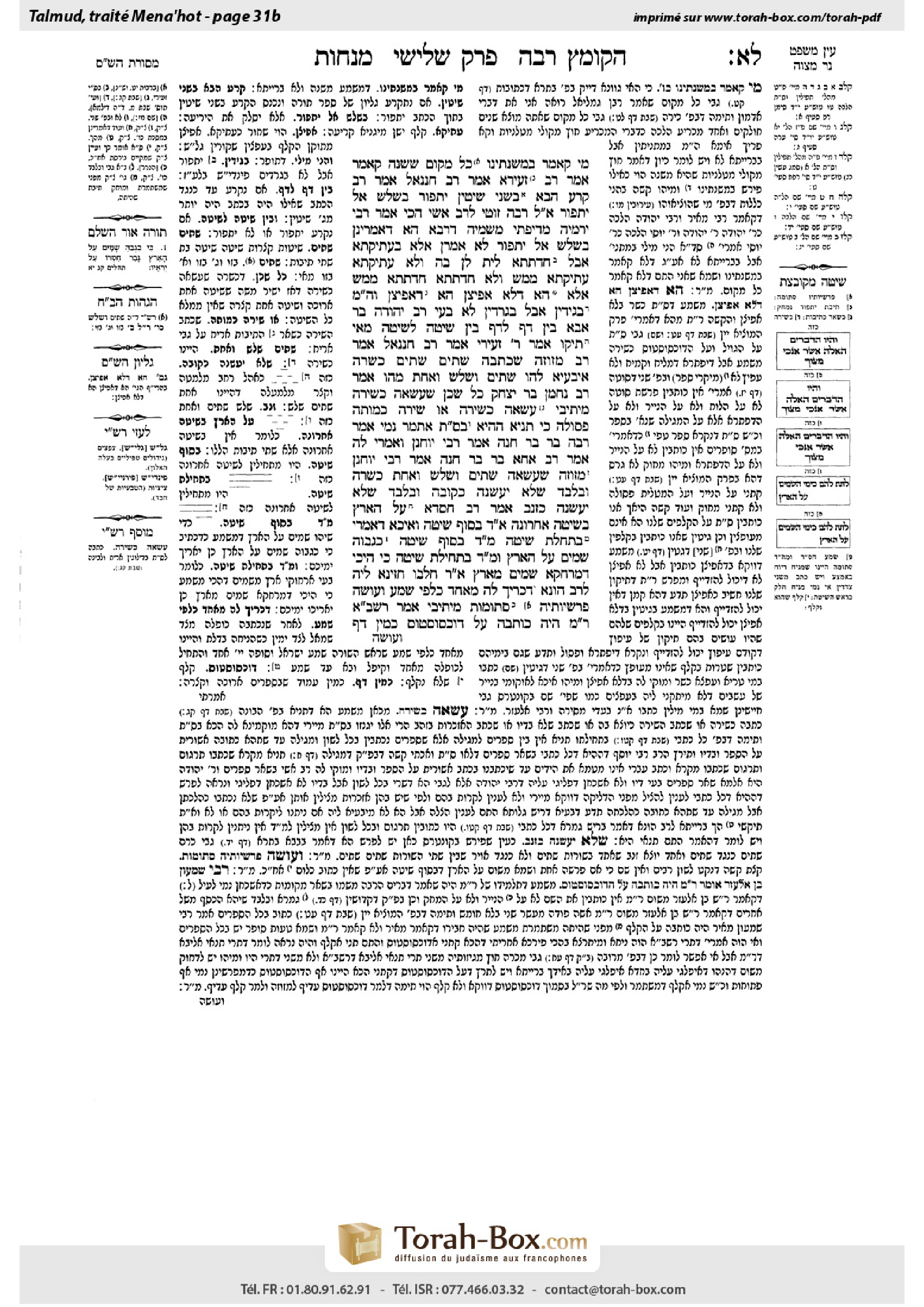
Menachot 31b: Talmud study for Daf Yomi
Daf Yomi is the daily study of one Talmud folio. Explore 37 tractates with scans, Hebrew text, Sefaria English and AI-generated French translations where annotated.
Passage selection and English or AI-generated French translation are available where the scan has annotations. Daf Study is independent of Torah-Box and Sefaria.
Browse Menachot · מנחות · All tractatesMenachot 31b text and translations
This page of Menachot includes the Aramaic text, an English translation and an AI-generated French translation, alongside the scan above.
מנחות ל״א ב · Aramaic and Hebrew text
מִי קָאָמַר בְּמִשְׁנָתֵינוּ? ״כׇּל מָקוֹם שֶׁשָּׁנָה״ קָאָמַר.
אָמַר רַב זְעֵירָא, אָמַר רַב חֲנַנְאֵל, אָמַר רַב: קֶרַע הַבָּא בִּשְׁנֵי שִׁיטִין – יִתְפּוֹר, בְּשָׁלֹשׁ – אַל יִתְפּוֹר. אֲמַר לֵיהּ רַבָּה זוּטֵי לְרַב אָשֵׁי: הָכִי אָמַר רַבִּי יִרְמְיָה מִדִּיפְתִּי מִשְּׁמֵיהּ דְּרָבָא, הָא דְּאָמְרִינַן ״בְּשָׁלֹשׁ אַל יִתְפּוֹר״ – לָא אֲמַרַן אֶלָּא בְּעַתִּיקָתָא, אֲבָל חַדְתָּתָא – לֵית לַן בַּהּ.
וְלָא עַתִּיקָתָא עַתִּיקָתָא מַמַּשׁ, וְלָא חַדְתָּתָא חַדְתָּתָא מַמַּשׁ, אֶלָּא הָא דְּלָא אֲפִיצָן, הָא דַּאֲפִיצָן, וְהָנֵי מִילֵּי בְּגִידִין, אֲבָל בִּגְרָדִין – לָא.
בָּעֵי רַב יְהוּדָה בַּר אַבָּא: בֵּין דַּף לְדַף, בֵּין שִׁיטָה לְשִׁיטָה, מַאי? תֵּיקוּ.
אָמַר רַבִּי זְעֵירִי, אָמַר רַב חֲנַנְאֵל, אָמַר רַב: מְזוּזָה שֶׁכְּתָבָהּ שְׁתַּיִם שְׁתַּיִם, כְּשֵׁרָה. אִיבַּעְיָא לְהוּ: שְׁתַּיִם וְשָׁלֹשׁ וְאַחַת, מַהוּ? אָמַר רַב נַחְמָן בַּר יִצְחָק: כׇּל שֶׁכֵּן שֶׁעֲשָׂאָהּ כְּשִׁירָה. מֵיתִיבִי: עֲשָׂאָהּ כְּשִׁירָה, אוֹ שִׁירָה כְּמוֹתָהּ – פְּסוּלָה! כִּי תַּנְיָא הָהִיא בְּסֵפֶר תּוֹרָה.
אִתְּמַר נָמֵי: אָמַר רַבָּה בַּר בַּר חָנָה אָמַר רַבִּי יוֹחָנָן, וְאָמְרִי לַהּ אָמַר רַב אַחָא בַּר בַּר חָנָה אָמַר רַבִּי יוֹחָנָן: מְזוּזָה שֶׁעֲשָׂאָהּ שְׁתַּיִם וְשָׁלֹשׁ וְאַחַת – כְּשֵׁרָה, וּבִלְבַד שֶׁלֹּא יַעֲשֶׂנָּה כְּקוּבָּה, וּבִלְבַד שֶׁלֹּא יַעֲשֶׂנָּה כְּזָנָב.
אָמַר רַב חִסְדָּא: ״עַל הָאָרֶץ״ בְּשִׁיטָה אַחֲרוֹנָה, אִיכָּא דְּאָמְרִי: בְּסוֹף שִׁיטָה, וְאִיכָּא דְּאָמְרִי: בִּתְחִלַּת שִׁיטָה.
מַאן דְּאָמַר בְּסוֹף שִׁיטָה, כִ״גְבֹהַּ שָׁמַיִם עַל הָאָרֶץ״, וּמַאן דְּאָמַר בִּתְחִילַּת שִׁיטָה, כִּי הֵיכִי דִּמְרַחֲקָא שָׁמַיִם מֵאֶרֶץ.
אָמַר רַבִּי חֶלְבּוֹ: חֲזֵינָא לֵיהּ לְרַב הוּנָא דְּכָרֵיךְ לַהּ מֵ״אֶחָד״ כְּלַפֵּי ״שְׁמַע״, וְעוֹשֶׂה פָּרָשִׁיּוֹתֶיהָ סְתוּמוֹת.
מֵיתִיבִי: אָמַר רַבִּי שִׁמְעוֹן בֶּן אֶלְעָזָר: רַבִּי מֵאִיר הָיָה כּוֹתְבָהּ עַל דּוּכְסוּסְטוֹס כְּמִין דַּף,
Menachot 31b · English translation
Does Rabbi Ḥanina say that wherever Rabbi Shimon Shezuri taught a halakha in our Mishna the halakha is in accordance with his opinion? Rather, he says that any place where he taught a halakha the halakha is in accordance with his opinion, and this applies even to baraitot.
§ Rav Ze’eira says that Rav Ḥananel says that Rav says: If a tear in the parchment of a Torah scroll extends into two lines, one can sew the parchment to render the scroll fit, but if it extends into three lines then one cannot sew it to render it fit. Rabba Zuti said to Rav Ashi: This is what Rabbi Yirmeya of Difti said in the name of Rava: That which we say, that if the tear extends into three lines one cannot sew it to render it fit, we say only with regard to old sheets of parchment. But in the case of new sheets of parchment, we have no problem with it.
The Gemara adds: And old does not mean literally old, and new does not mean literally new. Rather, those sheets of parchment that are not processed with gall are labeled as old and cannot be sewn, whereas those sheets of parchment that are processed with gall are labeled as new and can be sewn. And this statement, that one can sew the parchment and render it fit, applies to sewing it with sinew; but if one sews the parchment with thread [bigradin], it is not rendered fit.
Rav Yehuda bar Abba asks: If the tear occurred in the space between one column and another column but it was of the length that had it occurred inside a column it would have extended more than three lines, and similarly, if the tear occurred between one line and another line horizontally, but not tearing through any letters, what is the halakha? No answer was found, and therefore the dilemma shall stand unresolved.
§ Rabbi Ze’eiri says that Rav Ḥananel says that Rav says: A mezuza that one wrote two by two, i.e., two words on each line, is fit. A dilemma was raised before the Sages: If one wrote two words on one line, and three words on the following line, and one word on the line after that, what is the halakha? Rav Naḥman bar Yitzḥak said: All the more so that it is fit, as he prepared it as one writes a poem in the Torah scroll. The song sung by the Jewish people at the sea after the Exodus is written in lines whose length is not uniform. The Gemara raises an objection from a baraita: If one wrote it as one writes a poem in the Torah, or if one wrote a poem in the Torah as one writes it, it is unfit. The Gemara answers: When that baraita is taught, it is referring to a Torah scroll, not a mezuza.
It was stated by amora’im as well: Rabba bar bar Ḥana says that Rabbi Yoḥanan says, and some say it was Rav Aḥa bar bar Ḥana who says that Rabbi Yoḥanan says: With regard to a mezuza that one prepared with two words on one line, and three words on the following line, and one word on the line after that, it is fit, provided that he does not prepare it like the shape of a tent, i.e., progressively widening the lines, starting with a line of one word, then a line of two words and a line of three, and provided that he does not prepare it like the shape of a tail, progressively shortening the lines, from three words to two to one.
§ Rav Ḥisda says: One writes the last two words of a mezuza, al ha’aretz, meaning “above the earth” (Deuteronomy 11:21), by themselves on the final line, without the preceding word. The Sages disagreed as to how this is done. Some say that one writes this phrase at the end of the final line, and some say that one writes it at the beginning of the final line.
The Gemara explains their dispute: The one who says that one writes it at the end of the final line interprets the verse: “That your days may be multiplied, and the days of your children, upon the land which the Lord swore unto your fathers to give them, as the days of the heaven above the earth,” in a similar manner to the verse: “For as the heaven is high above the earth” (Psalms 103:11). Consequently, if one writes “above the earth” at the end of the final line, it will appropriately be below the term “the heaven” at the end of the previous line. And the one who says that one writes it at the beginning of the final line explains the phrase “as the days of the heaven above the earth” as meaning: Just as the heaven is far from the earth. Consequently, if one writes “above the earth” at the beginning of the final line, it is far from the term “the heaven” at the end of the previous line.
Rabbi Ḥelbo said: I saw Rav Huna wrap a written mezuza from the word eḥad to the word shema, i.e., rolling it from left to right, as the first verse written in a mezuza is: “Listen [Shema], O Israel, the Lord our God, the Lord is one [eḥad]” (Deuteronomy 6:4). And he prepared the two passages of the mezuza in the closed manner, i.e., starting the second passage (Deuteronomy 11:13–21) on the same line that he finished writing the first passage (Deuteronomy 6:4–9).
The Gemara raises an objection from a baraita: Rabbi Shimon ben Elazar said: Rabbi Meir would write a mezuza on dokhsostos, the inner layer of animal hide, not on parchment, which is from the outer layer, and he would prepare it like a column of a Torah scroll, i.e., long and narrow.
Menachot 31b · Traduction française (IA)
Rabbi Ḥanina dit-il que partout où Rabbi Shimon Shezuri a enseigné une halakha dans notre Michna, la halakha est conforme à son avis ? Il dit plutôt que partout où il a enseigné une halakha, la halakha est conforme à son avis, et cela vaut même pour les baraïtot.
§ Rav Ze’eira rapporte au nom de Rav Ḥananel, qui le rapporte au nom de Rav : si une déchirure du parchemin d’un rouleau de la Torah s’étend sur deux lignes, on peut coudre le parchemin pour rendre le rouleau apte à l’usage ; mais si elle s’étend sur trois lignes, on ne peut pas le coudre pour le rendre apte à l’usage. Rabba Zuti dit à Rav Ashi : voici ce que Rabbi Yirmeya de Difti a dit au nom de Rava : lorsque nous disons que si la déchirure s’étend sur trois lignes, on ne peut pas la coudre pour rendre le rouleau apte à l’usage, cela ne concerne que les feuilles de parchemin anciennes. Mais s’il s’agit de feuilles de parchemin neuves, cela ne pose aucun problème.
La Guemara ajoute : « Anciennes » ne signifie pas littéralement anciennes, et « neuves » ne signifie pas littéralement neuves. Les feuilles de parchemin qui ne sont pas traitées avec de la noix de galle sont plutôt considérées comme anciennes et ne peuvent pas être cousues, tandis que celles qui sont traitées avec de la noix de galle sont considérées comme neuves et peuvent être cousues. Cette affirmation, selon laquelle on peut coudre le parchemin et le rendre apte à l’usage, concerne une couture faite avec du nerf ; mais si l’on coud le parchemin avec du fil [bigradin], il n’est pas rendu apte à l’usage.
Rav Yehuda bar Abba demande : quelle est la halakha si la déchirure se trouve dans l’espace entre deux colonnes, mais qu’elle aurait dépassé trois lignes si elle s’était trouvée à l’intérieur d’une colonne ? De même, quelle est la halakha si la déchirure se trouve horizontalement entre deux lignes, sans traverser aucune lettre ? Aucune réponse n’a été trouvée ; la question reste donc sans solution.
§ Rabbi Ze’eiri rapporte au nom de Rav Ḥananel, qui le rapporte au nom de Rav : une mezouza écrite à raison de deux mots par ligne est apte à l’usage. Les Sages posèrent la question suivante : quelle est la halakha si l’on a écrit deux mots sur une ligne, trois mots sur la ligne suivante, puis un mot sur la ligne d’après ? Rav Naḥman bar Yitzḥak dit : à plus forte raison, elle est apte à l’usage, puisqu’on l’a disposée comme on écrit un poème dans un rouleau de la Torah. Le cantique chanté par le peuple juif au bord de la mer après l’Exode est écrit en lignes de longueur inégale. La Guemara soulève une objection à partir d’une baraïta : si l’on écrit une mezouza comme on écrit un poème dans la Torah, ou si l’on écrit un poème dans la Torah comme on écrit une mezouza, celle-ci est inapte à l’usage. La Guemara répond : lorsque cette baraïta est enseignée, elle se rapporte à un rouleau de la Torah, et non à une mezouza.
Les amoraïm enseignent également cette halakha : Rabba bar bar Ḥana rapporte au nom de Rabbi Yoḥanan — certains disent que c’est Rav Aḥa bar bar Ḥana qui la rapporte au nom de Rabbi Yoḥanan — qu’une mezouza disposée avec deux mots sur une ligne, trois mots sur la ligne suivante et un mot sur la ligne d’après est apte à l’usage, à condition de ne pas la disposer en forme de tente, c’est-à-dire en élargissant progressivement les lignes, en commençant par une ligne d’un mot, puis une ligne de deux mots et une ligne de trois mots, et à condition de ne pas la disposer en forme de queue, en raccourcissant progressivement les lignes, de trois mots à deux, puis à un.
§ Rav Ḥisda dit : on écrit seuls, sur la dernière ligne, les deux derniers mots d’une mezouza, al ha’aretz, c’est-à-dire « au-dessus de la terre » (Deutéronome 11:21), sans le mot qui les précède. Les Sages sont en désaccord sur la manière de procéder. Certains disent qu’on écrit cette expression à la fin de la dernière ligne ; d’autres disent qu’on l’écrit au début de la dernière ligne.
La Guemara explique leur désaccord : celui qui dit qu’on écrit l’expression à la fin de la dernière ligne interprète le verset « afin que vos jours et les jours de vos enfants se multiplient sur la terre que le Seigneur a juré à vos pères de leur donner, comme les jours du ciel au-dessus de la terre » de la même manière que le verset « car autant le ciel est élevé au-dessus de la terre » (Psaumes 103:11). Ainsi, si l’on écrit « au-dessus de la terre » à la fin de la dernière ligne, cette expression se trouvera à juste titre sous les mots « le ciel », à la fin de la ligne précédente. Celui qui dit qu’on écrit l’expression au début de la dernière ligne explique que les mots « comme les jours du ciel au-dessus de la terre » signifient : de même que le ciel est éloigné de la terre. Ainsi, si l’on écrit « au-dessus de la terre » au début de la dernière ligne, cette expression sera éloignée des mots « le ciel », à la fin de la ligne précédente.
Rabbi Ḥelbo dit : j’ai vu Rav Huna enrouler une mezouza écrite depuis le mot eḥad jusqu’au mot shema, c’est-à-dire de gauche à droite, puisque le premier verset écrit dans une mezouza est : « Écoute [Chéma], Israël, le Seigneur notre Dieu, le Seigneur est un [eḥad] » (Deutéronome 6:4). Il disposait les deux passages de la mezouza selon la forme fermée, c’est-à-dire en commençant le second passage (Deutéronome 11:13–21) sur la même ligne que celle où il avait achevé d’écrire le premier passage (Deutéronome 6:4–9).
La Guemara soulève une objection à partir d’une baraïta : Rabbi Shimon ben Elazar a dit : Rabbi Meir écrivait une mezouza sur du dokhsostos, la couche intérieure de la peau d’un animal, et non sur du parchemin, qui provient de la couche extérieure ; il la disposait comme une colonne d’un rouleau de la Torah, c’est-à-dire longue et étroite.
Traduction française générée par IA à partir de l’édition anglaise de Sefaria. Vérifie toujours un passage avec le texte source.
Text from Sefaria: William Davidson Edition - Vocalized Aramaic (unknown); William Davidson Edition - English (CC BY NC).