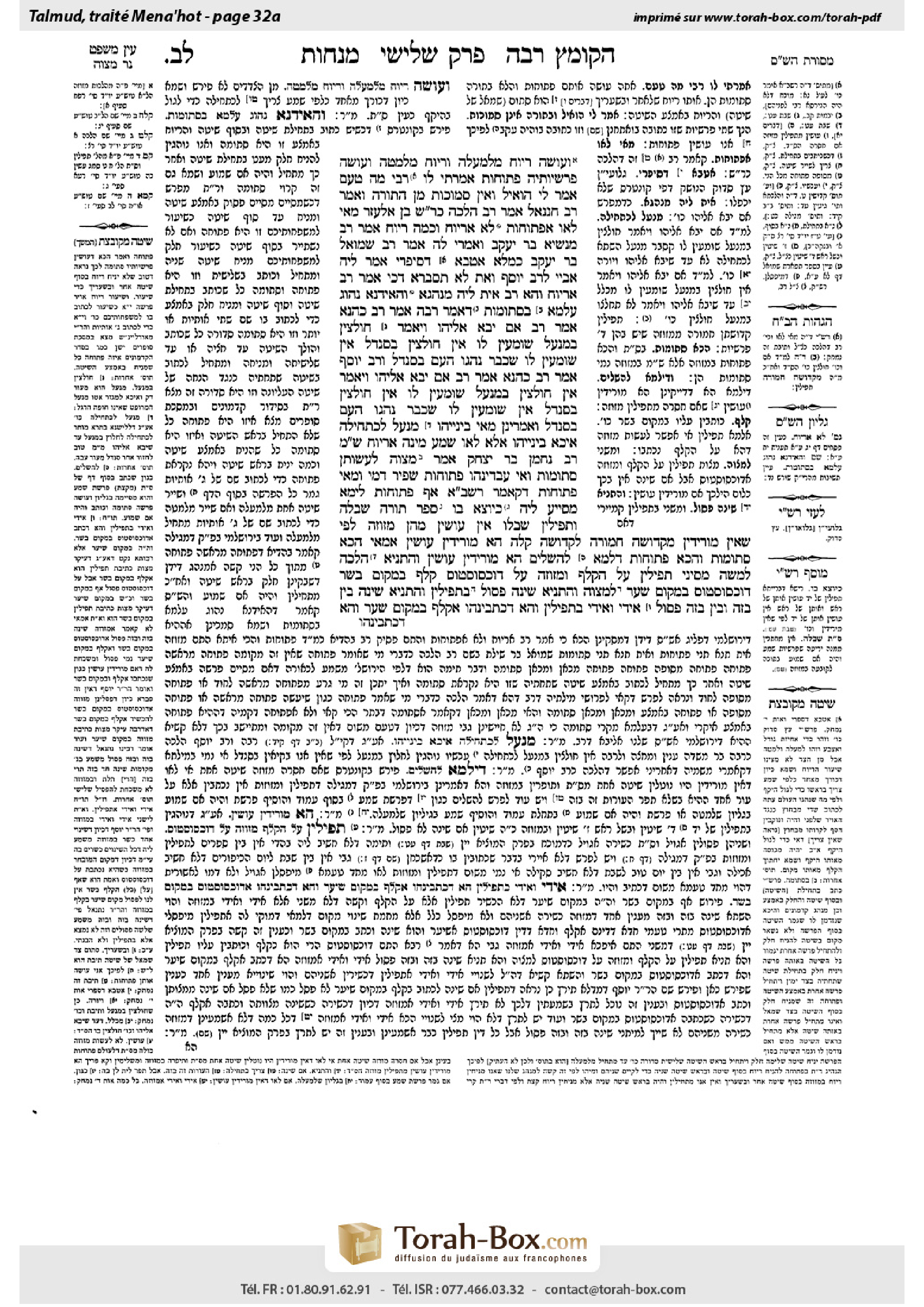
Menachot 32a: Talmud study for Daf Yomi
Daf Yomi is the daily study of one Talmud folio. Explore 37 tractates with scans, Hebrew text, Sefaria English and AI-generated French translations where annotated.
Passage selection and English or AI-generated French translation are available where the scan has annotations. Daf Study is independent of Torah-Box and Sefaria.
Browse Menachot · מנחות · All tractatesMenachot 32a text and translations
This page of Menachot includes the Aramaic text, an English translation and an AI-generated French translation, alongside the scan above.
מנחות ל״ב א · Aramaic and Hebrew text
וְעוֹשֶׂה רֶיוַח מִלְּמַעְלָה וְרֶיוַח מִלְּמַטָּה, וְעוֹשֶׂה פָּרָשִׁיּוֹתֶיהָ פְּתוּחוֹת. אָמַרְתִּי לוֹ: רַבִּי, מָה טַעַם? אָמַר לִי: הוֹאִיל וְאֵין סְמוּכוֹת מִן הַתּוֹרָה.
וְאָמַר רַב חֲנַנְאֵל, אָמַר רַב: הֲלָכָה כְּרַבִּי שִׁמְעוֹן בֶּן אֶלְעָזָר, מַאי לָאו אַפְּתוּחוֹת?
לָא, אַרֶיוַח. וְכַמָּה רֶיוַח? אָמַר רַב מְנַשְּׁיָא בַּר יַעֲקֹב, וְאָמְרִי לַהּ אָמַר רַב שְׁמוּאֵל בַּר יַעֲקֹב: כִּמְלֵא אַטְבָּא דְּסִיפְרֵי.
אֲמַר לֵיהּ אַבָּיֵי לְרַב יוֹסֵף: וְאַתְּ לָא תִּסְבְּרָא דְּכִי אָמַר רַב אַרֶיוַח, וְהָא רַב אִית לֵיהּ מִנְהֲגָא, וְהָאִידָּנָא נְהוּג עָלְמָא בִּסְתוּמוֹת!
דְּאָמַר רַבָּה, אָמַר רַב כָּהֲנָא, אָמַר רַב: אִם יָבֹא אֵלִיָּהוּ וְיֹאמַר חוֹלְצִין בְּמִנְעָל – שׁוֹמְעִין לוֹ, אֵין חוֹלְצִין בְּסַנְדָּל – אֵין שׁוֹמְעִין לוֹ, שֶׁכְּבָר נָהֲגוּ הָעָם בְּסַנְדָּל.
וְרַב יוֹסֵף אָמַר רַב כָּהֲנָא, אָמַר רַב: אִם יָבֹא אֵלִיָּהוּ וְיֹאמַר אֵין חוֹלְצִין בְּמִנְעָל – שׁוֹמְעִין לוֹ, אֵין חוֹלְצִין בְּסַנְדָּל – אֵין שׁוֹמְעִין לוֹ, שֶׁכְּבָר נָהֲגוּ הָעָם בְּסַנְדָּל.
וְאָמְרִינַן: מַאי בֵּינַיְיהוּ? מִנְעָל לְכַתְּחִילָּה אִיכָּא בֵּינַיְיהוּ, אֶלָּא לָאו שְׁמַע מִינַּהּ אַרֶיוַח? שְׁמַע מִינַּהּ.
רַב נַחְמָן בַּר יִצְחָק אָמַר: מִצְוָה לַעֲשׂוֹתָן סְתוּמוֹת, וְאִי עַבְדִינְהוּ פְּתוּחוֹת – שַׁפִּיר דָּמֵי, וּמַאי פְּתוּחוֹת דְּקָאָמַר רַבִּי שִׁמְעוֹן בֶּן אֶלְעָזָר – אַף פְּתוּחוֹת.
לֵימָא מְסַיַּיע לֵיהּ, כַּיּוֹצֵא בּוֹ: סֵפֶר תּוֹרָה שֶׁבָּלָה וּתְפִילִּין שֶׁבָּלוּ – אֵין עוֹשִׂין מֵהֶן מְזוּזָה, לְפִי שֶׁאֵין מוֹרִידִין מִקְּדוּשָּׁה חֲמוּרָה לִקְדוּשָּׁה קַלָּה. הָא מוֹרִידִין – עוֹשִׂין.
אַמַּאי? הָכָא סְתוּמוֹת וְהָכָא פְּתוּחוֹת! דִּלְמָא לְהַשְׁלִים.
הָא מוֹרִידִין עוֹשִׂין? וְהָתַנְיָא: הֲלָכָה לְמֹשֶׁה מִסִּינַי – תְּפִילִּין עַל הַקְּלָף, וּמְזוּזָה עַל דּוּכְסוּסְטוֹס; קְלָף בִּמְקוֹם בָּשָׂר, דּוּכְסוּסְטוֹס בִּמְקוֹם שֵׂעָר! לְמִצְוָה.
וְהָתַנְיָא: שִׁינָּה פָּסוּל בִּתְפִילִּין! וְהָתַנְיָא: שִׁינָּה בֵּין בָּזֶה וּבֵין בְּזֶה פָּסוּל! אִידֵּי וְאִידֵּי בִּתְפִילִּין, וְהָא דְּכַתְבִינְהוּ אַקְּלָף בִּמְקוֹם שֵׂעָר, וְהָא
Menachot 32a · English translation
And he would make a space above and a space below the text and would prepare the passages of the mezuza in the open manner, i.e., he would begin the second passage on the line following the end of the first passage. I said to him: My teacher, for what reason do you prepare the passages in the open manner, when in a Torah scroll those same passages are written in the closed manner? He said to me: Since the passages are not adjacent to one another in the Torah, as the first passage is Deuteronomy 6:4–9 and the second is Deuteronomy 11:13–21, I prepare them as open passages.
The Gemara continues: And Rav Ḥananel says that Rav says: The halakha is in accordance with the opinion of Rabbi Shimon ben Elazar. What, is it not correct that Rav stated this with regard to Rabbi Shimon ben Elazar’s opinion that one prepares the passages in the open manner? This would present a difficulty to the opinion of Rav Huna, Rav’s student, who wrote them in the closed manner.
The Gemara answers: No; he meant that the halakha is in accordance with the opinion of Rabbi Shimon ben Elazar with regard to the space that one must leave above and below the text. The Gemara asks: And how much space must one leave? Rav Menashya bar Ya’akov says, and some say it is Rav Shmuel bar Ya’akov who says: The space of a full scribe’s clip [atba], with which the sheets of parchment are held.
Abaye said to Rav Yosef: And you, do you not hold that when Rav said that the halakha is in accordance with the opinion of Rabbi Shimon ben Elazar he was referring to the space, not the manner of writing the passages? But Rav is of the opinion that an established custom must be observed, and nowadays the general custom is to write the passages of the mezuza in the closed manner.
The Gemara provides the source that according to Rav one must observe established customs. Ḥalitza is the ritual that frees the widow of a childless man from the obligation to enter into levirate marriage with her late husband’s brother. This ceremony involves the widow removing her brother-in-law’s sandal from his foot. Rabba spoke of the importance of observing customs in that context, as Rabba says that Rav Kahana says that Rav says: If Elijah comes and says that one performs ḥalitza with a shoe, the Sages listen to him. But if he says that one may not perform ḥalitza with a sandal, they do not listen to him, as the people are already accustomed to performing ḥalitza with a sandal.
The Gemara presents another version of Rav’s statement: And Rav Yosef says that Rav Kahana says that Rav says: If Elijah comes and says that one may not perform ḥalitza with a shoe, the Sages listen to him; if he says that one may not perform ḥalitza with a sandal, they do not listen to him, as the people are already accustomed to performing ḥalitza with a sandal.
Abaye continues: And we say, when discussing these versions of his statement: What is the difference between these two versions of his statement? The difference is whether one may use a shoe ab initio. In any case, according to both statements Rav maintains that a custom must be observed, and the custom in this case is to write the passages in a closed manner. Rather, must one not conclude from it that when Rav says that the halakha is in accordance with the opinion of Rabbi Shimon ben Elazar he was speaking of the space, not the manner of preparing the passages? The Gemara affirms: Conclude from it that this is correct.
§ Rav Naḥman bar Yitzḥak said: It is a mitzva ab initio to prepare the passages of a mezuza in the closed manner, but if one prepared them in the open manner, it is permitted to use the mezuza. And what is Rabbi Shimon ben Elazar saying when he says that Rabbi Meir would prepare the passages in the open manner? He means that one may prepare them even in the open manner.
The Gemara suggests: Let us say that a baraita supports his opinion: Similarly, just as one may not convert phylacteries of the head into phylacteries of the arm, with regard to a Torah scroll that became worn and parchment of phylacteries that became worn, one may not fashion them into a mezuza by excising the relevant passages, despite the fact that the Torah passages of a mezuza appear in them. This is prohibited because one does not reduce the sanctity of an item from a level of greater sanctity, that of a Torah scroll or phylacteries, to a level of lesser sanctity, that of a mezuza. The Gemara infers from this baraita: If it were permitted to reduce the sanctity of an item from a level of greater sanctity to a level of lesser sanctity, one could fashion a mezuza from a Torah scroll.
The Gemara explains the proof: But why is that the halakha, when here, in a Torah scroll, the passages are prepared in the closed manner, but there, in a mezuza, the passages are prepared in the open manner? Evidently, it is permitted to write a mezuza with the passages prepared in the closed manner. The Gemara refutes this proof: Perhaps one should infer from the baraita that were it not for the fact that it is prohibited to reduce the sanctity of an item from a level of greater sanctity to a level of lesser sanctity, one would be allowed to complete a line or two of a mezuza by sewing to it those lines from a Torah scroll or parchment of phylacteries that became worn, but one may not fashion an entire mezuza from a sheet of a Torah scroll or parchment of phylacteries, as the passages in a Torah scroll and phylacteries are prepared in the closed manner.
The Gemara asks another question: The baraita indicates that if it were permitted to reduce the sanctity of an item from a level of greater sanctity to a level of lesser sanctity, one could fashion a mezuza from phylacteries. But isn’t it taught in a baraita that it is a halakha transmitted to Moses from Sinai that the passages of phylacteries are written on parchment, the outer layer of an animal’s hide, and the passages of a mezuza are written on dokhsostos, the inner layer, and when writing on parchment, one writes on the side of the hide that faced the flesh; when writing on dokhsostos, one writes on the side of the hide on which there was hair? How, then, can one use the other side of the hide for a mezuza? The Gemara answers that this requirement of dokhsostos for a mezuza is stated as a mitzva, but it is not indispensable.
The Gemara asks: But isn’t it taught in a baraita that if one changed between parchment and dokhsostos, the item is unfit? The Gemara responds that this baraita is referring to phylacteries that one wrote on dokhsostos in the manner of a mezuza, not to a mezuza which one wrote on parchment. The Gemara raises a further difficulty: But isn’t it taught in a baraita that if one changed whether in this manner or in that manner, it is unfit? The Gemara explains that this baraita does not mean that one changed either in the case of phylacteries or a mezuza. Rather, both this manner and that manner are referring to phylacteries, and this case is where one wrote them on parchment but on the side of the hide on which there was hair, not on the side that faced the flesh, and that
Menachot 32a · Traduction française (IA)
Il laissait un espace au-dessus et au-dessous du texte et disposait les passages de la mezouza de manière ouverte, c’est-à-dire qu’il commençait le second passage à la ligne suivant la fin du premier. Je lui dis : « Mon maître, pourquoi disposes-tu les passages de manière ouverte, alors que ces mêmes passages sont écrits de manière fermée dans un rouleau de la Torah ? » Il me répondit : « Puisque les passages ne se suivent pas dans la Torah — le premier étant Deutéronome 6,4–9 et le second Deutéronome 11,13–21 —, je les dispose comme des passages ouverts. »
La Guemara poursuit : Rav Ḥananel dit au nom de Rav : « La halakha suit l’avis de Rabbi Shimon ben Elazar. » Ne faut-il pas comprendre que Rav disait cela à propos de l’avis de Rabbi Shimon ben Elazar selon lequel on dispose les passages de manière ouverte ? Cela poserait une difficulté à l’avis de Rav Houna, disciple de Rav, qui les écrivait de manière fermée.
La Guemara répond : Non ; il voulait dire que la halakha suit l’avis de Rabbi Shimon ben Elazar concernant l’espace à laisser au-dessus et au-dessous du texte. La Guemara demande : Quelle doit être la taille de cet espace ? Rav Menashya bar Ya’akov dit — et certains attribuent cette parole à Rav Shmuel bar Ya’akov — : l’espace d’une agrafe de scribe entière [atba], qui sert à maintenir les feuilles de parchemin.
Abayé dit à Rav Yossef : « Et toi, ne considères-tu pas que lorsque Rav a dit que la halakha suit l’avis de Rabbi Shimon ben Elazar, il parlait de l’espace, et non de la manière d’écrire les passages ? Pourtant, Rav estime qu’il faut respecter une coutume établie, et de nos jours, la coutume générale est d’écrire les passages de la mezouza de manière fermée. »
La Guemara apporte la source indiquant que, selon Rav, il faut respecter les coutumes établies. La ḥalitsa est le rituel qui libère la veuve d’un homme mort sans enfant de l’obligation de contracter un mariage léviratique avec le frère de son défunt mari. Au cours de cette cérémonie, la veuve retire la sandale de son beau-frère. Rabba évoqua l’importance du respect des coutumes dans ce contexte, car Rabba dit au nom de Rav Kahana, qui dit au nom de Rav : « Si Élie vient et dit qu’on accomplit la ḥalitsa avec une chaussure, les Sages l’écoutent. Mais s’il dit qu’on ne peut pas accomplir la ḥalitsa avec une sandale, ils ne l’écoutent pas, car les gens ont déjà pris l’habitude d’accomplir la ḥalitsa avec une sandale. »
La Guemara présente une autre version de la déclaration de Rav : Rav Yossef dit au nom de Rav Kahana, qui dit au nom de Rav : « Si Élie vient et dit qu’on ne peut pas accomplir la ḥalitsa avec une chaussure, les Sages l’écoutent ; s’il dit qu’on ne peut pas accomplir la ḥalitsa avec une sandale, ils ne l’écoutent pas, car les gens ont déjà pris l’habitude d’accomplir la ḥalitsa avec une sandale. »
Abayé poursuit : Nous disons, à propos de ces différentes versions de sa déclaration : « Quelle est la différence entre les deux versions ? » La différence porte sur la question de savoir si l’on peut utiliser une chaussure a priori. Quoi qu’il en soit, selon les deux versions, Rav estime qu’il faut respecter une coutume, et dans ce cas, la coutume est d’écrire les passages de manière fermée. Dès lors, ne faut-il pas en conclure que, lorsque Rav dit que la halakha suit l’avis de Rabbi Shimon ben Elazar, il parlait de l’espace, et non de la manière de disposer les passages ? La Guemara confirme : Il faut en conclure que c’est bien le cas.
§ Rav Naḥman bar Yitzḥak dit : C’est une mitsva, a priori, de disposer les passages d’une mezouza de manière fermée, mais si on les a disposés de manière ouverte, la mezouza peut être utilisée. Que veut dire Rabbi Shimon ben Elazar lorsqu’il rapporte que Rabbi Meïr disposait les passages de manière ouverte ? Il veut dire qu’on peut les disposer même de manière ouverte.
La Guemara propose : « Disons qu’une baraïta appuie son avis : de même que l’on ne peut pas transformer des téfilines de la tête en téfilines du bras, de même, dans le cas d’un rouleau de la Torah devenu usé ou de parchemins de téfilines devenus usés, on ne peut pas les transformer en mezouza en découpant les passages concernés, bien que les passages de la Torah destinés à une mezouza y figurent. Cela est interdit, car on ne fait pas passer un objet d’un degré de sainteté supérieur — celui d’un rouleau de la Torah ou de téfilines — à un degré de sainteté inférieur, celui d’une mezouza. » La Guemara déduit de cette baraïta : s’il était permis de faire passer un objet d’un degré de sainteté supérieur à un degré inférieur, on pourrait fabriquer une mezouza à partir d’un rouleau de la Torah.
La Guemara explique la preuve : Mais pourquoi en est-il ainsi, alors qu’ici, dans un rouleau de la Torah, les passages sont disposés de manière fermée, tandis que là, dans une mezouza, ils sont disposés de manière ouverte ? Il est donc évident qu’il est permis d’écrire une mezouza avec des passages disposés de manière fermée. La Guemara réfute cette preuve : Peut-être faut-il déduire de la baraïta que, n’était l’interdiction de faire passer un objet d’un degré de sainteté supérieur à un degré inférieur, on aurait le droit de compléter une ou deux lignes d’une mezouza en y cousant des lignes prélevées d’un rouleau de la Torah ou de parchemins de téfilines devenus usés ; mais on ne peut pas fabriquer une mezouza entière à partir d’une feuille d’un rouleau de la Torah ou de parchemins de téfilines, car les passages d’un rouleau de la Torah et des téfilines sont disposés de manière fermée.
La Guemara soulève une autre question : La baraïta indique que, s’il était permis de faire passer un objet d’un degré de sainteté supérieur à un degré inférieur, on pourrait fabriquer une mezouza à partir de téfilines. Mais n’est-il pas enseigné dans une baraïta que c’est une halakha transmise à Moïse au Sinaï : les passages des téfilines sont écrits sur du parchemin, la couche extérieure de la peau d’un animal, tandis que ceux de la mezouza sont écrits sur du dokhsostos, la couche intérieure ; lorsqu’on écrit sur du parchemin, on écrit du côté de la peau qui faisait face à la chair ; lorsqu’on écrit sur du dokhsostos, on écrit du côté de la peau où se trouvaient les poils. Comment, dès lors, pourrait-on utiliser l’autre côté de la peau pour une mezouza ? La Guemara répond que l’exigence du dokhsostos pour une mezouza est formulée comme une mitsva, mais qu’elle n’est pas indispensable.
La Guemara demande : Mais n’est-il pas enseigné dans une baraïta que si l’on inverse l’emploi du parchemin et du dokhsostos, l’objet est impropre ? La Guemara répond que cette baraïta parle de téfilines écrites sur du dokhsostos à la manière d’une mezouza, et non d’une mezouza écrite sur du parchemin. La Guemara soulève une autre difficulté : Mais n’est-il pas enseigné dans une baraïta que si l’on inverse les choses, d’une manière ou de l’autre, l’objet est impropre ? La Guemara explique que cette baraïta ne signifie pas qu’on a inversé les choses entre les téfilines et la mezouza. Au contraire, les deux manières dont il est question concernent les téfilines : dans ce cas, on les a écrites sur du parchemin, mais du côté de la peau où se trouvaient les poils, et non du côté qui faisait face à la chair, et que
Traduction française générée par IA à partir de l’édition anglaise de Sefaria. Vérifie toujours un passage avec le texte source.
Text from Sefaria: William Davidson Edition - Vocalized Aramaic (unknown); William Davidson Edition - English (CC BY NC).