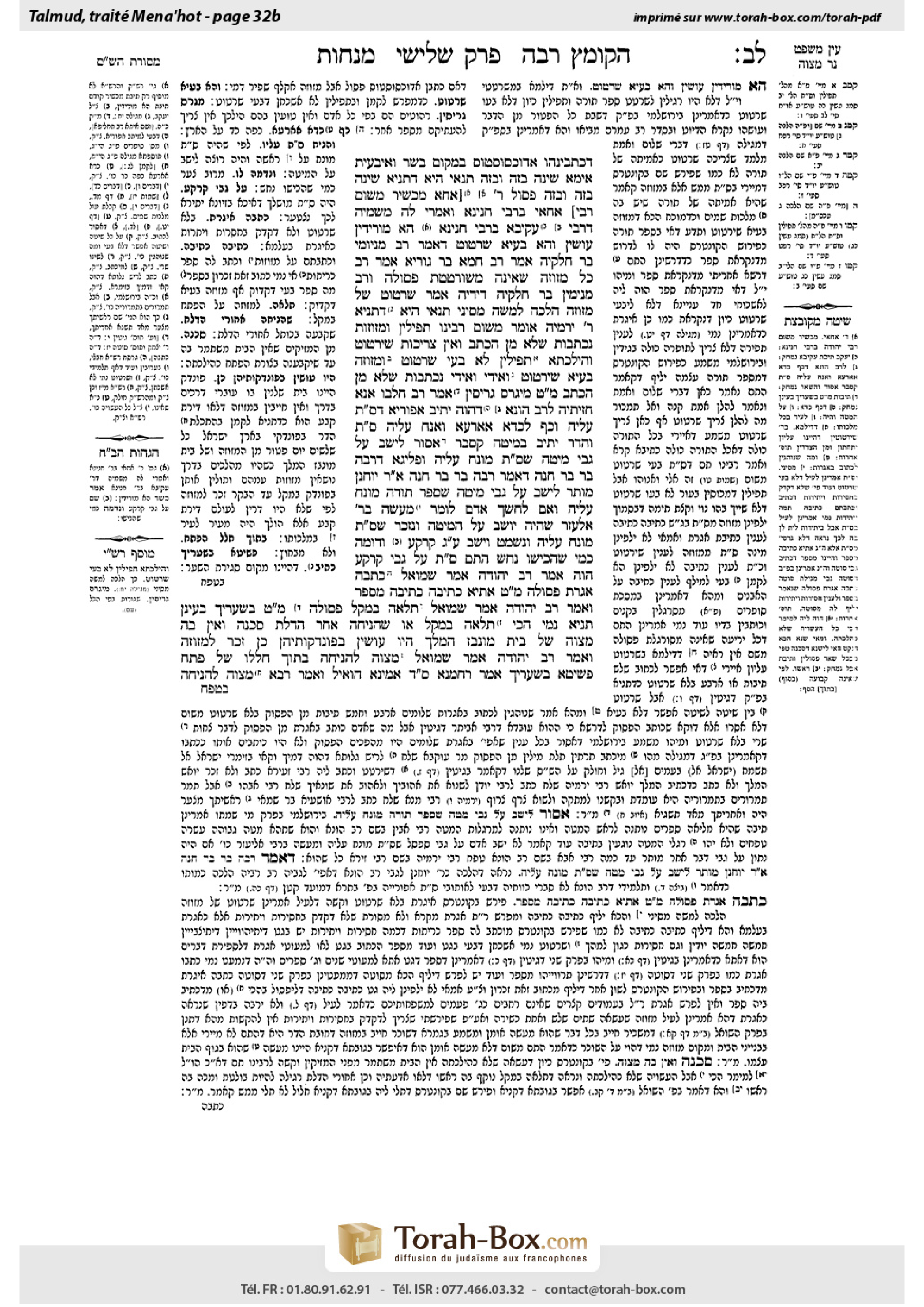
Menachot 32b: Talmud study for Daf Yomi
Daf Yomi is the daily study of one Talmud folio. Explore 37 tractates with scans, Hebrew text, Sefaria English and AI-generated French translations where annotated.
Passage selection and English or AI-generated French translation are available where the scan has annotations. Daf Study is independent of Torah-Box and Sefaria.
Browse Menachot · מנחות · All tractatesMenachot 32b text and translations
This page of Menachot includes the Aramaic text, an English translation and an AI-generated French translation, alongside the scan above.
מנחות ל״ב ב · Aramaic and Hebrew text
דְּכַתְבִינְהוּ אַדּוּכְסוּסְטוֹס בִּמְקוֹם בָּשָׂר.
וְאִיבָּעֵית אֵימָא: שִׁינָּה בָּזֶה וּבָזֶה תַּנָּאֵי הִיא, דְּתַנְיָא: שִׁינָּה בָּזֶה וּבָזֶה – פָּסוּל, רַבִּי [אַחָא מַכְשִׁיר מִשּׁוּם רַבִּי] אַחַאי בְּרַבִּי חֲנִינָא, וְאָמְרִי לַהּ מִשְּׁמֵיהּ דְּרַבִּי עֲקִיבָא בְּרַבִּי חֲנִינָא.
הָא מוֹרִידִין עוֹשִׂין – וְהָא בָּעֲיָא שִׂרְטוּט, דְּאָמַר רַב מִנְיוֹמֵי בַּר חִלְקִיָּה, אָמַר רַב חָמָא בַּר גּוּרְיָא אָמַר רַב: כׇּל מְזוּזָה שֶׁאֵינָהּ מְשׂוּרְטֶטֶת פְּסוּלָה, וְרַב מִנְיָמִין בַּר חִלְקִיָּה דִּידֵיהּ אָמַר: שִׂרְטוּט שֶׁל מְזוּזָה הֲלָכָה לְמֹשֶׁה מִסִּינַי.
תַּנָּאֵי הִיא, דְּתַנְיָא: רַבִּי יִרְמְיָה אוֹמֵר מִשּׁוּם רַבֵּינוּ: תְּפִילִּין וּמְזוּזוֹת נִכְתָּבוֹת שֶׁלֹּא מִן הַכְּתָב, וְאֵין צְרִיכוֹת שִׂירְטוּט.
וְהִילְכְתָא: תְּפִילִּין לָא בָּעֵי שִׂרְטוּט, וּמְזוּזָה בָּעֲיָא שִׂירְטוּט, וְאִידֵּי וְאִידֵּי נִכְתָּבוֹת שֶׁלֹּא מִן הַכְּתָב. מַאי טַעְמָא? מִיגְרָס גְּרִיסִין.
אָמַר רַב חֶלְבּוֹ: אֲנָא חֲזֵיתֵיהּ לְרַב הוּנָא, דַּהֲוָה יָתֵיב אַפּוּרְיָא דְּסֵפֶר תּוֹרָה עֲלֵיהּ, וְכַף לְכַדָּא אַאַרְעָא, וְאַנַּח עֲלֵיהּ סֵפֶר תּוֹרָה, וַהֲדַר יְתֵיב בְּמִיטָּה. קָסָבַר: אָסוּר לֵישֵׁב עַל גַּבֵּי מִיטָּה שֶׁסֵּפֶר תּוֹרָה מוּנָּח עָלֶיהָ.
וּפְלִיגָא דְּרַבָּה בַּר בַּר חָנָה, דְּאָמַר רַבָּה בַּר בַּר חָנָה אָמַר רַבִּי יוֹחָנָן: מוּתָּר לֵישֵׁב עַל גַּבֵּי מִיטָּה שֶׁסֵּפֶר תּוֹרָה מוּנָּח עָלֶיהָ. וְאִם לְחָשְׁךָ אָדָם לוֹמַר: מַעֲשֶׂה בְּרַבִּי אֶלְעָזָר שֶׁהָיָה יוֹשֵׁב עַל הַמִּיטָּה וְנִזְכַּר שֶׁסֵּפֶר תּוֹרָה מוּנָּח עָלֶיהָ, וְנִשְׁמַט וְיָשַׁב עַל גַּבֵּי קַרְקַע, וְדוֹמֶה כְּמִי שֶׁהִכִּישׁוֹ נָחָשׁ – הָתָם סֵפֶר תּוֹרָה עַל גַּבֵּי קַרְקַע הֲוָה.
אָמַר רַב יְהוּדָה, אָמַר שְׁמוּאֵל: כְּתָבָהּ אִגֶּרֶת – פְּסוּלָה. מַאי טַעְמָא? אָתְיָא ״כְּתִיבָה״ ״כְּתִיבָה״ מִסֵּפֶר.
וְאָמַר רַב יְהוּדָה, אָמַר שְׁמוּאֵל: תְּלָאָהּ בְּמַקֵּל – פְּסוּלָה. מַאי טַעְמָא? ״בִּשְׁעָרֶיךָ״ בָּעֵינַן. תַּנְיָא נָמֵי הָכִי: תְּלָאָהּ בְּמַקֵּל, אוֹ שֶׁהִנִּיחָהּ אַחַר הַדֶּלֶת – סַכָּנָה וְאֵין בָּהּ מִצְוָה.
שֶׁל בֵּית מוֹנְבַּז הַמֶּלֶךְ הָיוּ עוֹשִׂין בְּפוּנְדְּקוֹתֵיהֶן כֵּן, זֵכֶר לִמְזוּזָה.
וְאָמַר רַב יְהוּדָה, אָמַר שְׁמוּאֵל: מִצְוָה לְהַנִּיחָהּ בְּתוֹךְ חֲלָלוֹ שֶׁל פֶּתַח. פְּשִׁיטָא, ״בִּשְׁעָרֶיךָ״ אָמַר רַחֲמָנָא! סָלְקָא דַּעְתָּךְ אָמֵינָא, הוֹאִיל וְאָמַר רָבָא: מִצְוָה לְהַנִּיחָהּ
Menachot 32b · English translation
case is where one wrote them on dokhsostos on the side that faced the flesh. In both of these situations the phylacteries are unfit, but a mezuza that one wrote on parchment is fit.
And if you wish, say instead that the ruling of the baraita that if one changed whether in this manner or in that manner it is unfit is in fact referring to a mezuza that one wrote on parchment, and this is a dispute between tanna’im, as it is taught in a baraita: If one changed in this manner or in that manner it is unfit. Rabbi Aḥa, in the name of Rabbi Aḥai, son of Rabbi Ḥanina, deems it fit; and some say he said this ruling in the name of Rabbi Akiva, son of Rabbi Ḥanina.
§ The baraita indicates that if it were permitted to reduce the sanctity of an item from a level of greater sanctity to a level of lesser sanctity, one could make a mezuza from phylacteries that became worn. The Gemara raises a difficulty: But a mezuza requires scoring, i.e., the parchment must have lines etched in it before writing, as Rav Minyumi bar Ḥilkiya says that Rav Ḥama bar Gurya says that Rav says: Any mezuza that is not scored is unfit, and Rav Minyumi bar Ḥilkiya himself says concerning this: The scoring of a mezuza is a halakha transmitted to Moses from Sinai. With regard to phylacteries, by contrast, he does not teach that their parchment requires scoring.
The Gemara answers that this is a dispute between tanna’im, as it is taught in a baraita that Rabbi Yirmeya says in the name of our teacher, Rav: Phylacteries and mezuzot may be written when the scribe is not copying from a written text, and their parchment does not require scoring.
The Gemara concludes: And the halakha is that the parchment of phylacteries does not require scoring, but the parchment of a mezuza requires scoring. And unlike a Torah scroll, both these and those, phylacteries and mezuzot, may be written when the scribe is not copying from a written text. What is the reason for this leniency? These short texts are well known to all scribes, and therefore it is permitted to write them by heart.
In connection to Rav Ḥelbo relating the customs of Rav Huna, the Gemara cites that Rav Ḥelbo says: I myself saw Rav Huna as he wished to sit on his bed, which had a Torah scroll placed on it. And he overturned a jug on the ground and placed the Torah scroll on it, and only then sat on the bed. The reason he did so is that he holds that it is prohibited to sit on a bed upon which a Torah scroll is placed.
The Gemara notes: And this halakha disagrees with a ruling of Rabba bar bar Ḥana, as Rabba bar bar Ḥana says that Rabbi Yoḥanan says: It is permitted to sit on a bed upon which a Torah scroll is placed. And if a person whispers to you, saying: There was an incident involving Rabbi Elazar, who was sitting on a bed and realized that a Torah scroll was placed on it, and he immediately slipped off the bed and sat upon the ground, and in doing so he looked like one who had been bitten by a snake, i.e., he jumped up in a panic, that incident is no proof. There, the Torah scroll was placed on the ground. It is certainly disgraceful for one to sit on a bed while a Torah scroll is on the ground.
The Gemara returns to the discussion about the halakhot of writing a mezuza. Rav Yehuda says that Shmuel says: If one wrote a mezuza in the manner of a missive that one composes to a friend, i.e., without being exact about the lettering of each word, it is unfit. What is the reason? This is derived by a verbal analogy between “writing,” and “writing,” from a scroll, which must be written in precisely the correct manner.
And Rav Yehuda says that Shmuel says: If one hung a mezuza on a stick in the entranceway, without affixing it to the doorpost, it is unfit. What is the reason? We require the fulfillment of the verse: “And you shall write them upon the doorposts of your house, and upon your gates” (Deuteronomy 6:9). This ruling is also taught in a baraita: If one hung a mezuza on a stick, or placed it so that it was affixed behind the door within the house, he exposes himself to danger, and it does not enable him to fulfill the mitzva.
The Gemara relates: The members of the household of King Munbaz would do so, i.e., hang mezuzot on sticks, in their inns, i.e., when they would sleep in an inn. They would not do this in order to fulfill the mitzva, as one who sleeps in an inn is exempt from placing a mezuza, but in remembrance of the mezuza. Since they would travel frequently, they wanted to remember the mitzva of mezuza, which they did not fulfill often.
And Rav Yehuda says that Shmuel says: It is a mitzva to place the mezuza within the airspace of the entrance, not on the outside. The Gemara asks: Isn’t this obvious? After all, the Merciful One states: “And upon your gates,” which indicates that it must be within the area of the gate, rather than the outside. The Gemara explains that it might enter your mind to say that since Rava says: It is a mitzva to place the mezuza
Menachot 32b · Traduction française (IA)
Le cas est celui où on les a écrites sur du dokhsostos, du côté tourné vers la chair. Dans ces deux situations, les tefillin ne sont pas valides, mais une mezouza écrite sur du parchemin est valide.
Et si tu le souhaites, dis plutôt que la règle de la baraïta selon laquelle, si l’on a modifié les choses de l’une ou l’autre manière, l’objet n’est pas valide concerne en fait une mezouza écrite sur du parchemin, et qu’il s’agit d’une controverse entre tannaïm. En effet, il est enseigné dans une baraïta : « Si l’on a modifié les choses de l’une ou l’autre manière, l’objet n’est pas valide. » Rabbi Aḥa, au nom de Rabbi Aḥai, fils de Rabbi Ḥanina, le déclare valide ; certains disent qu’il a énoncé cette règle au nom de Rabbi Akiva, fils de Rabbi Ḥanina.
§ La baraïta indique que, s’il était permis de faire passer un objet d’un degré de sainteté supérieur à un degré inférieur, on pourrait fabriquer une mezouza à partir de tefillin usés. La Guemara soulève une difficulté : mais une mezouza exige un lignage, c’est-à-dire que des lignes soient tracées sur le parchemin avant l’écriture, comme le dit Rav Minyumi bar Ḥilkiya, qui rapporte que Rav Ḥama bar Gurya rapporte au nom de Rav : « Toute mezouza dont le parchemin n’a pas été ligné n’est pas valide. » Et Rav Minyumi bar Ḥilkiya lui-même dit à ce sujet : « Le lignage d’une mezouza est une halakha transmise à Moïse au Sinaï. » En revanche, il n’enseigne pas que le parchemin des tefillin doit être ligné.
La Guemara répond qu’il s’agit d’une controverse entre tannaïm, comme l’enseigne une baraïta : Rabbi Yirmeya dit au nom de notre maître, Rav : « Les tefillin et les mezouzot peuvent être écrites sans que le scribe copie un texte écrit, et leur parchemin n’a pas besoin d’être ligné. »
La Guemara conclut : La halakha est que le parchemin des tefillin n’a pas besoin d’être ligné, tandis que celui d’une mezouza doit l’être. Et, contrairement à un rouleau de Torah, les uns comme les autres, les tefillin et les mezouzot, peuvent être écrits sans que le scribe copie un texte écrit. Pourquoi cette permission ? Ces textes courts sont bien connus de tous les scribes ; il est donc permis de les écrire de mémoire.
À propos du récit par Rav Ḥelbo des pratiques de Rav Huna, la Guemara cite les paroles de Rav Ḥelbo : « J’ai vu moi-même Rav Huna alors qu’il s’apprêtait à s’asseoir sur son lit, sur lequel se trouvait un rouleau de Torah. Il retourna une cruche sur le sol, posa le rouleau de Torah dessus, puis s’assit sur le lit. » Il agit ainsi parce qu’il estime qu’il est interdit de s’asseoir sur un lit sur lequel se trouve un rouleau de Torah.
La Guemara relève que cette halakha contredit une décision de Rabba bar bar Ḥana, car Rabba bar bar Ḥana rapporte au nom de Rabbi Yoḥanan : « Il est permis de s’asseoir sur un lit sur lequel se trouve un rouleau de Torah. » Et si quelqu’un te souffle : « Il est arrivé que Rabbi Elazar, alors qu’il était assis sur un lit, s’aperçoive qu’un rouleau de Torah s’y trouvait ; il descendit aussitôt du lit et s’assit par terre, donnant l’impression d’avoir été mordu par un serpent », c’est-à-dire qu’il bondit dans la panique, cet épisode ne constitue pas une preuve. Dans ce cas, le rouleau de Torah était posé par terre. Il est certainement irrespectueux de s’asseoir sur un lit alors qu’un rouleau de Torah se trouve au sol.
La Guemara revient à la discussion sur les lois de l’écriture d’une mezouza. Rav Yehuda rapporte au nom de Shmuel : « Si quelqu’un écrit une mezouza comme une lettre adressée à un ami, c’est-à-dire sans veiller à tracer exactement les lettres de chaque mot, elle n’est pas valide. » Pour quelle raison ? Cela se déduit par une analogie verbale entre « écrire » et « écrire », à partir d’un rouleau qui doit être écrit exactement comme il convient.
Et Rav Yehuda rapporte au nom de Shmuel : « Si quelqu’un suspend une mezouza à un bâton dans l’entrée, sans la fixer au montant de la porte, elle n’est pas valide. » Pour quelle raison ? Nous devons accomplir le verset : « Tu les écriras sur les montants de ta maison et sur tes portes » (Deutéronome 6:9). Cette règle est également enseignée dans une baraïta : « Si quelqu’un suspend une mezouza à un bâton, ou la fixe derrière la porte, à l’intérieur de la maison, il s’expose au danger et ne s’acquitte pas de la mitsva. »
La Guemara rapporte : Les membres de la maison du roi Munbaz agissaient ainsi, c’est-à-dire qu’ils suspendaient des mezouzot à des bâtons dans leurs auberges lorsqu’ils y passaient la nuit. Ils ne le faisaient pas pour accomplir la mitsva, car celui qui dort dans une auberge est dispensé d’y fixer une mezouza, mais en souvenir de la mezouza. Comme ils voyageaient souvent, ils voulaient se rappeler la mitsva de la mezouza, qu’ils n’accomplissaient pas fréquemment.
Et Rav Yehuda rapporte au nom de Shmuel : « C’est une mitsva de placer la mezouza dans l’embrasure de l’entrée, et non à l’extérieur. » La Guemara demande : « N’est-ce pas évident ? Après tout, le Miséricordieux dit : “Et sur tes portes”, ce qui indique qu’elle doit se trouver dans l’embrasure de la porte, et non à l’extérieur. » La Guemara explique qu’on aurait pu penser que, puisque Rava dit : « C’est une mitsva de placer la mezouza
Traduction française générée par IA à partir de l’édition anglaise de Sefaria. Vérifie toujours un passage avec le texte source.
Text from Sefaria: William Davidson Edition - Vocalized Aramaic (unknown); William Davidson Edition - English (CC BY NC).