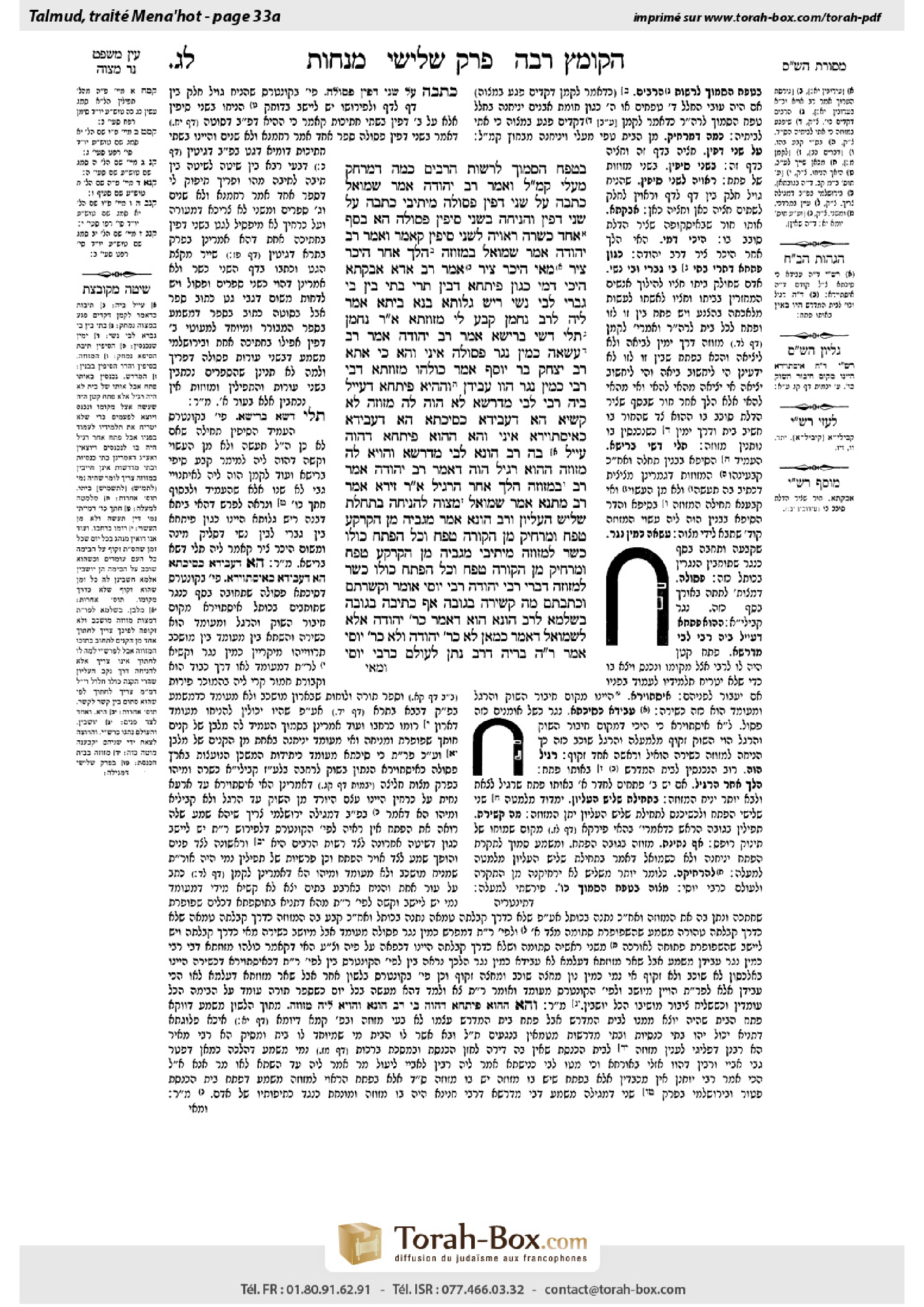
Menachot 33a: Talmud study for Daf Yomi
Daf Yomi is the daily study of one Talmud folio. Explore 37 tractates with scans, Hebrew text, Sefaria English and AI-generated French translations where annotated.
Passage selection and English or AI-generated French translation are available where the scan has annotations. Daf Study is independent of Torah-Box and Sefaria.
Browse Menachot · מנחות · All tractatesMenachot 33a text and translations
This page of Menachot includes the Aramaic text, an English translation and an AI-generated French translation, alongside the scan above.
מנחות ל״ג א · Aramaic and Hebrew text
בְּטֶפַח הַסָּמוּךְ לִרְשׁוּת הָרַבִּים, כַּמָּה דִּמְרַחַק מְעַלֵּי, קָא מַשְׁמַע לַן.
וְאָמַר רַב יְהוּדָה, אָמַר שְׁמוּאֵל: כְּתָבָהּ עַל שְׁנֵי דַּפִּין – פְּסוּלָה. מֵיתִיבִי: כְּתָבָהּ עַל שְׁנֵי דַּפִּין וְהִנִּיחָה בִּשְׁנֵי סִיפִּין – פְּסוּלָה, הָא בְּסַף אֶחָד – כְּשֵׁרָה! רְאוּיָה לִשְׁנֵי סִיפִּין קָאָמַר.
וְאָמַר רַב יְהוּדָה, אָמַר שְׁמוּאֵל: בִּמְזוּזָה, הַלֵּךְ אַחַר הֶיכֵּר צִיר. מַאי הֶיכֵּר צִיר? אָמַר רַב אַדָּא: אֲבַקְתָּא. הֵיכִי דָּמֵי? כְּגוֹן פִּיתְחָא דְּבֵין תְּרֵי בָּתֵּי, בֵּין בֵּי גַבְרֵי לְבֵי נְשֵׁי.
רֵישׁ גָּלוּתָא בְּנָא בֵּיתָא, אֲמַר לֵיהּ לְרַב נַחְמָן: ״קְבַע לִי מְזוּזְתָּא״, אָמַר רַב נַחְמָן: ״תְּלִי דַּשֵּׁי בְּרֵישָׁא״.
אָמַר רַב יְהוּדָה, אָמַר רַב: עֲשָׂאָהּ כְּמִין נֶגֶר – פְּסוּלָה. אִינִי? וְהָא כִּי אֲתָא רַב יִצְחָק בַּר יוֹסֵף אָמַר: כּוּלְּהוּ מְזוּזָתָא דְּבֵי רַבִּי כְּמִין נֶגֶר הֲווֹ עֲבִידָן, וְהַהִיא פִּיתְחָא דְּעָיֵיל בֵּיהּ רַבִּי לְבֵי מִדְרְשָׁא לָא הֲוָה לַהּ מְזוּזָה! לָא קַשְׁיָא: הָא דַּעֲבִידָא כְּסִיכְּתָא, הָא דַּעֲבִידָא כְּאִיסְתָּוִירָא.
אִינִי? וְהָא הָהוּא פִּיתְחָא דַּהֲוָה עָיֵיל בַּהּ רַב הוּנָא לְבֵי מִדְרְשָׁא, וְהַוְיָא לֵהּ מְזוּזָה! הָהוּא רְגִיל הֲוָה, דְּאָמַר רַב יְהוּדָה אָמַר רַב: בִּמְזוּזָה הַלֵּךְ אַחַר הָרָגִיל.
אָמַר רַבִּי זֵירָא אָמַר רַב מַתְנָא אָמַר שְׁמוּאֵל: מִצְוָה לְהַנִּיחָהּ בִּתְחִלַּת שְׁלִישׁ הָעֶלְיוֹן, וְרַב הוּנָא אָמַר: מַגְבִּיהַּ מִן הַקַּרְקַע טֶפַח, וּמַרְחִיק מִן הַקּוֹרָה טֶפַח, וְכׇל הַפֶּתַח כּוּלּוֹ כָּשֵׁר לִמְזוּזָה.
מֵיתִיבִי: מַגְבִּיהַּ מִן הַקַּרְקַע טֶפַח, וּמַרְחִיק מִן הַקּוֹרָה טֶפַח, וְכׇל הַפֶּתַח כּוּלּוֹ כָּשֵׁר לִמְזוּזָה, דִּבְרֵי רַבִּי יְהוּדָה. רַבִּי יוֹסֵי אוֹמֵר: ״וּקְשַׁרְתָּם״ ״וּכְתַבְתָּם״, מָה קְשִׁירָה בְּגוֹבַהּ – אַף כְּתִיבָה בְּגוֹבַהּ.
בִּשְׁלָמָא לְרַב הוּנָא, הוּא דְּאָמַר כְּרַבִּי יְהוּדָה, אֶלָּא לִשְׁמוּאֵל דְּאָמַר – כְּמַאן? לֹא כְּרַבִּי יְהוּדָה וְלֹא כְּרַבִּי יוֹסֵי!
אָמַר רַב הוּנָא בְּרֵיהּ דְּרַב נָתָן: לְעוֹלָם כְּרַבִּי יוֹסֵי,
Menachot 33a · English translation
in the handbreadth adjacent to the public domain, perhaps the further the mezuza is from the inside of the house the better, and one may affix it even fully outside the airspace of the entrance. To counter this, Shmuel teaches us that the mezuza must be within the airspace of the entrance itself.
And Rav Yehuda says that Shmuel says: If one wrote a mezuza on two sheets it is unfit. The Gemara raises an objection from a baraita that teaches: If one wrote a mezuza on two sheets and placed it on the two doorposts of the entrance, it is unfit. The Gemara states the objection: By inference, if the mezuza was affixed on one doorpost, it is fit, despite the fact that it is written on two sheets. The Gemara answers: The baraita is not referring to a case where one affixed the mezuza on two doorposts. Rather, the baraita is saying that if it was written on two sheets in such a manner that it is fit to be affixed to two doorposts, i.e., there is a space between the writing of the first and second passages, so that one can separate the two sheets for different doorposts, it is unfit. This is in accordance with the statement of Rav Yehuda, citing Shmuel.
And Rav Yehuda says that Shmuel says: The halakha is that a mezuza must be affixed to the doorpost on its right side, and the right side is determined by the direction from which one enters the room. With regard to a mezuza, when deciding which side is the right side, one should follow the indication of the hinge. The Gemara asks: What is the indication of the hinge? Rav Adda said: The socket into which the hinge is inserted. The room with the socket is considered the inside room, and the mezuza is affixed to the side which is on one’s right when entering that room. The Gemara asks: What are the circumstances, i.e., in what kind of case was this guideline to follow the indication of the hinge necessary? The Gemara answers: This indication is necessary in a case where there is an entrance that is between two houses, e.g., between a room for men and a room for women, as in such a situation the direction of the entrance is unclear.
The Gemara relates: The Exilarch built a new house. He said to Rav Naḥman: Affix mezuzot for me in the house. Rav Naḥman said: First erect the doors, so that I can affix the mezuzot in the appropriate places, according to the placement of the hinges.
Rav Yehuda says that Rav says: If one fashioned a mezuza like a bolt, i.e., he wedged it into a hole in the doorpost of a gate, or affixed it to the doorpost horizontally, it is unfit. The Gemara raises a difficulty: Is that so? But when Rav Yitzḥak bar Yosef came from Eretz Yisrael to Babylonia, he said: All the mezuzot in the house of Rabbi Yehuda HaNasi were fashioned like a bolt, and he also said: That entrance by which Rabbi Yehuda HaNasi entered the study hall did not have a mezuza. The Gemara answers: This is not difficult. This ruling, that it is unfit, is referring to a case where it is prepared like a peg, i.e., he inserted it deep into the doorpost while it was lying horizontally. That ruling, that it is fit, is referring to a case where it is prepared like an ankle [ke’istevira], i.e., it is vertical.
With regard to the second element of Rav Yitzḥak bar Yosef’s statement, that the entrance by which Rabbi Yehuda HaNasi entered the study hall did not have a mezuza, the Gemara asks: Is that so? But what of that entrance by which Rav Huna would enter the study hall, which had a mezuza? The Gemara answers: That entrance was the one through which all were accustomed to enter the study hall. By contrast, the entrance that Rabbi Yehuda HaNasi used was a side entrance, which was designated for him alone. Consequently, it was exempt from the obligation to affix a mezuza, as Rav Yehuda says that Rav says: With regard to a mezuza, follow the entrance that people are accustomed to using.
§ Rabbi Zeira says that Rav Mattana says that Shmuel says: It is a mitzva to place the mezuza at the beginning of the upper third of the doorpost. And Rav Huna says: One raises the mezuza a handbreadth from the ground, or one distances it from the cross beam, i.e., the lintel, a handbreadth, and the entire entrance between those two handbreadths is fit for the placement of the mezuza.
The Gemara raises an objection from a baraita: One raises the mezuza a handbreadth from the ground, or one distances it from the cross beam a handbreadth, and the entire entrance between those two handbreadths is fit for the placement of the mezuza; this is the statement of Rabbi Yehuda. Rabbi Yosei says: The verse states: “And you shall bind them for a sign upon your arm” (Deuteronomy 6:8), and then it states: “And you shall write them upon the doorposts of your house” (Deuteronomy 6:9). Just as the binding of the phylacteries is performed on the upper part of the arm, so too, the writing, i.e., the placement, of a mezuza must be specifically on the upper part of the entrance.
The Gemara explains the objection: Granted, according to Rav Huna, he states his ruling in accordance with the opinion of Rabbi Yehuda; but according to Shmuel, in accordance with whose opinion does he state his ruling? It is not in accordance with the opinion of Rabbi Yehuda, and it is not in accordance with the opinion of Rabbi Yosei.
Rav Huna, son of Rav Natan, said: Actually, Shmuel’s ruling is in accordance with the opinion of Rabbi Yosei,
Menachot 33a · Traduction française (IA)
dans le téfaḥ qui jouxte le domaine public. Peut-être que plus la mezouza est éloignée de l’intérieur de la maison, mieux c’est, et qu’on peut même la fixer entièrement en dehors de l’espace de l’entrée. Pour écarter cette possibilité, Chmouel nous enseigne que la mezouza doit se trouver dans l’espace même de l’entrée.
Et Rav Yehouda dit au nom de Chmouel : Si quelqu’un écrit une mezouza sur deux feuilles, elle est impropre. La Guemara soulève une objection à partir d’une baraïta qui enseigne : Si quelqu’un écrit une mezouza sur deux feuilles et la place sur les deux montants de l’entrée, elle est impropre. La Guemara formule l’objection : Cela implique que si la mezouza était fixée sur un seul montant, elle serait apte, bien qu’elle soit écrite sur deux feuilles. La Guemara répond : La baraïta ne parle pas d’un cas où l’on a fixé la mezouza sur deux montants. Elle dit plutôt que si elle a été écrite sur deux feuilles de telle façon qu’elle puisse être fixée sur deux montants — c’est-à-dire qu’il y a un espace entre l’écriture du premier et du second passage, de sorte que l’on peut séparer les deux feuilles pour les placer sur des montants différents — elle est impropre. Cela concorde avec l’enseignement de Rav Yehouda au nom de Chmouel.
Et Rav Yehouda dit au nom de Chmouel : La halakha est qu’une mezouza doit être fixée sur le montant droit de la porte, le côté droit étant déterminé selon le sens dans lequel on entre dans la pièce. Pour déterminer quel côté est le côté droit où fixer une mezouza, il faut se guider d’après la charnière. La Guemara demande : Quel est le signe fourni par la charnière ? Rav Adda dit : Le logement dans lequel s’insère la charnière. La pièce où se trouve ce logement est considérée comme la pièce intérieure, et la mezouza est fixée du côté qui se trouve à droite lorsqu’on entre dans cette pièce. La Guemara demande : Dans quelles circonstances, c’est-à-dire dans quel genre de cas, faut-il suivre le signe de la charnière ? La Guemara répond : Cette indication est nécessaire lorsqu’une entrée se trouve entre deux maisons, par exemple entre une pièce réservée aux hommes et une pièce réservée aux femmes, car dans une telle situation le sens de l’entrée n’est pas clair.
La Guemara rapporte : L’Exilarque fit construire une nouvelle maison. Il dit à Rav Naḥman : Fixe-moi des mezouzot dans la maison. Rav Naḥman lui dit : Installe d’abord les portes, afin que je puisse fixer les mezouzot aux endroits appropriés, en fonction de l’emplacement des charnières.
Rav Yehouda dit au nom de Rav : Si quelqu’un façonne une mezouza comme un verrou, c’est-à-dire s’il l’enfonce dans un trou du montant d’une porte ou s’il la fixe horizontalement sur le montant, elle est impropre. La Guemara soulève une difficulté : En est-il ainsi ? Pourtant, lorsque Rav Yitzḥak bar Yosef vint d’Eretz Israël en Babylonie, il dit : Toutes les mezouzot de la maison de Rabbi Yehouda HaNassi étaient façonnées comme un verrou. Il dit aussi : L’entrée par laquelle Rabbi Yehouda HaNassi entrait dans la maison d’étude n’avait pas de mezouza. La Guemara répond : Il n’y a pas de difficulté. Le premier enseignement, selon lequel elle est impropre, concerne un cas où elle est disposée comme une cheville, c’est-à-dire qu’on l’a insérée profondément dans le montant alors qu’elle était couchée horizontalement. Le second enseignement, selon lequel elle est apte, concerne un cas où elle est disposée comme une cheville [ke’istevira], c’est-à-dire à la verticale.
À propos du second élément de la déclaration de Rav Yitzḥak bar Yosef, selon lequel l’entrée par laquelle Rabbi Yehouda HaNassi entrait dans la maison d’étude n’avait pas de mezouza, la Guemara demande : En est-il ainsi ? Pourtant, l’entrée par laquelle Rav Houna entrait dans la maison d’étude avait une mezouza. La Guemara répond : C’était l’entrée par laquelle tout le monde avait l’habitude d’entrer dans la maison d’étude. En revanche, l’entrée qu’empruntait Rabbi Yehouda HaNassi était une entrée latérale, réservée à lui seul. Elle était donc dispensée de l’obligation de fixer une mezouza, car Rav Yehouda dit au nom de Rav : Pour la mezouza, il faut suivre l’entrée que les gens ont l’habitude d’emprunter.
§ Rabbi Zeïra dit au nom de Rav Mattana, au nom de Chmouel : C’est une mitsva de placer la mezouza au début du tiers supérieur du montant. Et Rav Houna dit : On place la mezouza à un téfaḥ du sol, ou à un téfaḥ de la traverse supérieure, c’est-à-dire du linteau, et toute la partie de l’entrée comprise entre ces deux distances d’un téfaḥ convient pour placer la mezouza.
La Guemara soulève une objection à partir d’une baraïta : On place la mezouza à un téfaḥ du sol, ou à un téfaḥ de la traverse supérieure, et toute la partie de l’entrée comprise entre ces deux distances d’un téfaḥ convient pour placer la mezouza ; telle est l’opinion de Rabbi Yehouda. Rabbi Yossei dit : Le verset déclare : « Et tu les attacheras comme un signe sur ton bras » (Deutéronome 6,8), puis : « Et tu les écriras sur les montants de ta maison » (Deutéronome 6,9). De même que les téfilines sont attachées sur la partie supérieure du bras, de même l’écriture, c’est-à-dire le placement, d’une mezouza doit se faire précisément dans la partie supérieure de l’entrée.
La Guemara explique l’objection : Certes, Rav Houna énonce son enseignement conformément à l’opinion de Rabbi Yehouda ; mais Chmouel, conformément à l’opinion de qui énonce-t-il son enseignement ? Ce n’est conforme ni à l’opinion de Rabbi Yehouda ni à celle de Rabbi Yossei.
Rav Houna, fils de Rav Natan, dit : En réalité, l’enseignement de Chmouel est conforme à l’opinion de Rabbi Yossei,
Traduction française générée par IA à partir de l’édition anglaise de Sefaria. Vérifie toujours un passage avec le texte source.
Text from Sefaria: William Davidson Edition - Vocalized Aramaic (unknown); William Davidson Edition - English (CC BY NC).