Menachot 33b: Talmud study for Daf Yomi
Daf Yomi is the daily study of one Talmud folio. Explore 37 tractates with scans, Hebrew text, Sefaria English and AI-generated French translations where annotated.
Passage selection and English or AI-generated French translation are available where the scan has annotations. Daf Study is independent of Torah-Box and Sefaria.
Browse Menachot · מנחות · All tractatesMenachot 33b text and translations
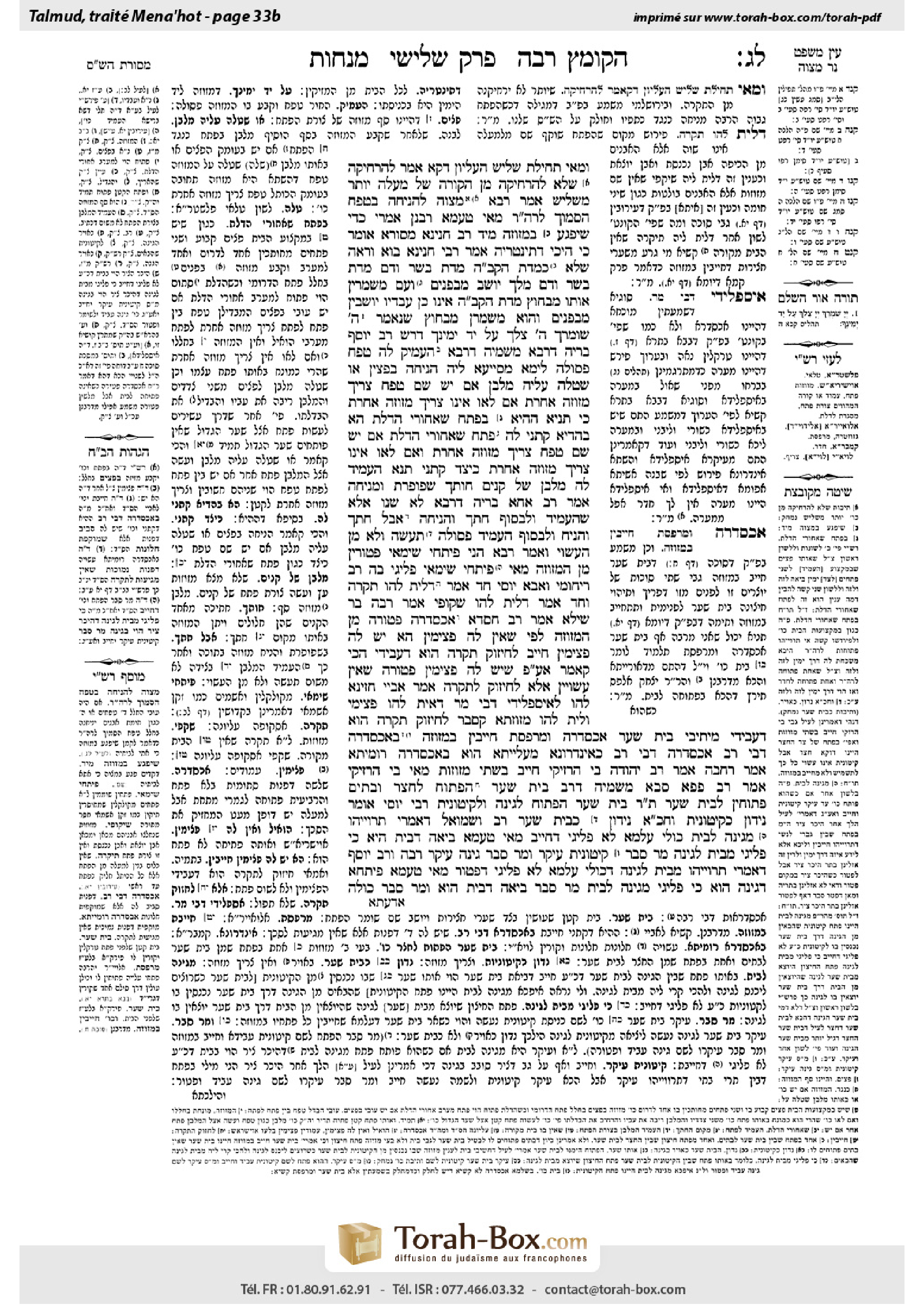
This page of Menachot includes the Aramaic text, an English translation and an AI-generated French translation, alongside the scan above.
מנחות ל״ג ב · Aramaic and Hebrew text
וּמַאי תְּחִילַּת שְׁלִישׁ הָעֶלְיוֹן דְּקָא אָמַר? לְהַרְחִיקָהּ (שֶׁלֹּא לְהַרְחִיקָהּ מִן הַקּוֹרָה שֶׁל מַעְלָה יוֹתֵר מִשְּׁלִישׁ).
אָמַר רָבָא: מִצְוָה לְהַנִּיחָהּ בְּטֶפַח הַסָּמוּךְ לִרְשׁוּת הָרַבִּים. מַאי טַעְמָא? רַבָּנַן אָמְרִי: כְּדֵי שֶׁיִּפְגַּע בַּמְּזוּזָה מִיָּד. רַב חֲנִינָא מִסּוּרָא אוֹמֵר: כִּי הֵיכִי דְּתִינְטְרֵיהּ.
אָמַר רַבִּי חֲנִינָא: בּוֹא וּרְאֵה שֶׁלֹּא כְּמִדַּת הַקָּדוֹשׁ בָּרוּךְ הוּא מִדַּת בָּשָׂר וְדָם, מִדַּת בָּשָׂר וָדָם – מֶלֶךְ יוֹשֵׁב מִבִּפְנִים וְעַם מְשַׁמְּרִין אוֹתוֹ מִבַּחוּץ, מִדַּת הַקָּדוֹשׁ בָּרוּךְ הוּא אֵינוֹ כֵּן, עֲבָדָיו יוֹשְׁבִין מִבִּפְנִים וְהוּא מְשַׁמְּרָן מִבַּחוּץ, שֶׁנֶּאֱמַר: ״ה׳ שׁוֹמְרֶךָ ה׳ צִלְּךָ עַל יַד יְמִינֶךָ״.
דָּרֵשׁ רַב יוֹסֵף בְּרֵיהּ דְּרָבָא מִשְּׁמֵיהּ דְּרָבָא: הֶעֱמִיק לָהּ טֶפַח – פְּסוּלָה. לֵימָא מְסַיְּיעָא לֵיהּ: הַנִּיחָה בְּפַצִּין, אוֹ שֶׁטָּלָה עָלֶיהָ מַלְבֵּן, אִם יֵשׁ שָׁם טֶפַח – צָרִיךְ מְזוּזָה אַחֶרֶת, אִם לָאו – אֵינוֹ צָרִיךְ מְזוּזָה אַחֶרֶת.
כִּי תַּנְיָא הָהִיא, בְּפֶתַח שֶׁאֲחוֹרֵי הַדֶּלֶת.
הָא בְּהֶדְיָא קָתָנֵי לַהּ: פֶּתַח שֶׁאֲחוֹרֵי הַדֶּלֶת, אִם יֵשׁ שָׁם טֶפַח – צָרִיךְ מְזוּזָה אַחֶרֶת, וְאִם לָאו – אֵינוֹ צָרִיךְ מְזוּזָה אַחֶרֶת! כֵּיצַד קָתָנֵי.
תָּנָא: הֶעֱמִיד לָהּ מַלְבֵּן שֶׁל קָנִים, חוֹתֵךְ שְׁפוֹפֶרֶת וּמַנִּיחָהּ. אָמַר רַב אַחָא בְּרֵיהּ דְּרָבָא: לֹא שָׁנוּ אֶלָּא שֶׁהֶעֱמִיד וּלְבַסּוֹף חָתַךְ וְהִנִּיחָהּ, אֲבָל חָתַךְ וְהִנִּיחַ וּלְבַסּוֹף הֶעֱמִיד – פְּסוּלָה, ״תַּעֲשֶׂה״ וְלֹא מִן הֶעָשׂוּי.
וְאָמַר רָבָא: הָנֵי פִּיתְחֵי שִׁימָאֵי פְּטוּרִין מִן הַמְּזוּזָה. מַאי פִּיתְחֵי שִׁימָאֵי? פְּלִיגִי בַּהּ רַב רִיחוּמִי וְאַבָּא יוֹסֵי, חַד אָמַר: דְּלֵית לְהוּ תִּקְרָה, וְחַד אָמַר: דְּלֵית לְהוּ שְׁקוֹפֵי.
אָמַר רַבָּה בַּר שֵׁילָא, אָמַר רַב חִסְדָּא: אַכְסַדְרָה פְּטוּרָה מִן הַמְּזוּזָה, לְפִי שֶׁאֵין לָהּ פַּצִּימִין. הָא יֵשׁ לָהּ פַּצִּימִין חַיָּיב? לְחִיזּוּק תִּקְרָה הוּא דַּעֲבִידִי!
הָכִי קָאָמַר: אַף עַל פִּי שֶׁיֵּשׁ לָהּ פַּצִּימִין – פְּטוּרָה, שֶׁאֵין עֲשׂוּיִין אֶלָּא לְחִיזּוּק לַתִּקְרָה. אָמַר אַבָּיֵי: חֲזֵינָא לְהוּ לְאִיסְפְּלִידִי דְּבֵי מָר, דְּאִית לְהוּ פַּצִּימֵי וְלֵית לְהוּ מְזוּזָתָא. קָסָבַר: לְחִיזּוּק תִּקְרָה הוּא דַּעֲבִידִי.
מֵיתִיבִי: בֵּית שַׁעַר, אַכְסַדְרָה וּמִרְפֶּסֶת – חַיָּיבִין בִּמְזוּזָה! בְּאַכְסַדְרָה דְּבֵי רַב. אַכְסַדְרָה דְּבֵי רַב כְּאִינְדְּרוֹנָא מְעַלַּיְיתָא הוּא! בְּאַכְסַדְרָה רוֹמְיָתָא.
אָמַר רַחֲבָה, אָמַר רַב יְהוּדָה: בֵּי הַרְזִיקֵי חַיָּיב בִּשְׁתֵּי מְזוּזוֹת. מַאי בֵּי הַרְזִיקֵי? אָמַר רַב פָּפָּא סָבָא מִשְּׁמֵיהּ דְּרַב: בֵּית שַׁעַר הַפָּתוּחַ לְחָצֵר, וּבָתִּים פְּתוּחִין לְבֵית שַׁעַר.
תָּנוּ רַבָּנַן: בֵּית שַׁעַר הַפָּתוּחַ לְגִינָּה וּלְקִיטוֹנִית – רַבִּי יוֹסֵי אוֹמֵר: נִידּוֹן כְּקִיטוֹנִית, וַחֲכָמִים אוֹמְרִים: נִידּוֹן כְּבֵית שַׁעַר. רַב וּשְׁמוּאֵל דְּאָמְרִי תַּרְוַיְיהוּ: מִגִּינָּה לְבַיִת – כּוּלֵּי עָלְמָא לָא פְּלִיגִי דְּחַיָּיב, מַאי טַעְמָא? בִּיאָה דְּבַיִת הִיא.
כִּי פְּלִיגִי מִבַּיִת לְגִינָּה, מָר סָבַר: קִיטוֹנִית עִיקָּר, וּמָר סָבַר: גִּינָּה עִיקָּר.
רַבָּה וְרַב יוֹסֵף דְּאָמְרִי תַּרְוַיְיהוּ: מִבַּיִת לְגִינָּה, דְּכוּלֵּי עָלְמָא לָא פְּלִיגִי דְּפָטוּר. מַאי טַעְמָא? פִּיתְחָא דְּגִינָּה הוּא. כִּי פְּלִיגִי – מִגִּינָּה לְבַיִת, מָר סָבַר: בִּיאָה דְּבַיִת הוּא, וּמָר סָבַר: כּוּלַּהּ
Menachot 33b · English translation
and what is the meaning of the phrase: The beginning of the upper third of the entrance, that Shmuel says? This is referring to the maximum distancing of the mezuza from the doorframe, i.e., that one should not distance it from the upper cross beam more than one-third of the height of the entrance.
§ Rava says: It is a mitzva to place the mezuza in the handbreadth adjacent to the public domain. The Gemara asks: What is the reason for this? The Rabbis say that it is in order that one encounter the mezuza immediately upon one’s entrance to the house. Rav Ḥanina from Sura says: It is in order that the mezuza protect the entire house, by placing it as far outside as one can.
The Gemara adds: Rabbi Ḥanina says: Come and see that the attribute of flesh and blood is not like the attribute of the Holy One, Blessed be He. The attribute of flesh and blood is that a king sits inside his palace, and the people protect him from the outside, whereas with regard to the attribute of the Holy One, Blessed be He, it is not so. Rather, His servants, the Jewish people, sit inside their homes, and He protects them from the outside. As it is stated: “The Lord is your keeper, the Lord is your shade upon your right hand” (Psalms 121:5).
Rav Yosef, son of Rava, taught in the name of Rava: If one dug one handbreadth deep into the doorpost and placed a mezuza there, it is unfit. The Gemara suggests: Let us say that the following baraita supports his ruling: In a case where one affixed a mezuza deep in the wooden doorpost of an entrance, or after placing it in the entrance one added [tala] an inner framework [malben] to it that covers the doorpost, if there is a depth of one handbreadth there, one requires another mezuza, but if not, one does not require another mezuza.
The Gemara deflects the support: When that baraita is taught, it is referring to an entrance that is behind the door, i.e., there is another entrance on the other side of the framework, which serves for both entrances. The baraita is teaching that if the framework is one handbreadth thick, then each side is considered a separate entrance, and each requires its own mezuza.
The Gemara raises a difficulty: But the same baraita teaches explicitly this ruling of the case of another entrance: With regard to an entrance that is behind the door, if there is a depth of one handbreadth there, one requires another mezuza, but if not, one does not require another mezuza. The Gemara explains: This clause of the baraita is teaching which case is the subject of the previous clause, i.e., the baraita does not state two halakhot but only one, which it explains as it proceeds: In what case is it taught that if there is a depth of a handbreadth there, one requires another mezuza? It is taught in the case of an entrance that is behind the door.
§ It is taught in a baraita with regard to the affixing of a mezuza: If one positions a mezuza in an entrance which was a framework of reeds, to which one cannot affix the mezuza with nails, he carves a kind of tube from the reed on the right side and places the mezuza in that tube. Rav Aḥa, son of Rava, says: They taught that one may affix the mezuza in this manner only in a case where one positioned the framework in its place first, and ultimately carved a tube and then placed the mezuza in it. But if before positioning the framework one carved a tube and placed the mezuza in it, and ultimately positioned the framework, the mezuza is unfit. This in accordance with the principle stated with regard to objects used for mitzvot: Prepare it, and not from what has already been prepared. In this case he affixed the mezuza before the obligation took effect with regard to the framework.
And Rava says: With regard to these broken entrances [pitḥei shima’ei], which lack the proper form of doorways, one is exempt from the obligation of placing a mezuza. The Gemara asks: What are broken entrances? Rav Riḥumi and Abba Yosei disagree with regard to this. One says that they do not have a proper ceiling, and one says that they do not have lintels [shakofei] above the openings.
Rabba bar Sheila says that Rav Ḥisda says: With regard to a portico, i.e., a structure at the entrance to a house that is entirely open on its front side, one is exempt from the obligation of placing a mezuza, because it does not have doorposts [patzimin] on its sides. The Gemara questions this reason: This indicates that if it has doorposts, one would be obligated to place a mezuza. But that is not logical, as these doorposts are not there to serve as an entrance; rather, they are made to strengthen the ceiling. In that case, why should one be obligated?
The Gemara answers: This is what Rav Ḥisda is saying: Even if it has doorposts, one is exempt from the obligation to place a mezuza there, because they are made only to strengthen the ceiling, not as an entrance. Similarly, Abaye said: I saw the porticos [le’ispelidei] of the house of the Master, Rabba, that they had doorposts but they did not have mezuzot. Rabba evidently holds that its doorposts are made to strengthen the ceiling.
The Gemara raises an objection from a baraita: With regard to a gatehouse, a portico, and a balcony, one is obligated to place a mezuza. The Gemara answers: The halakha of the baraita is stated with regard to a specific type of portico, the portico of a study hall, which is closed on all sides, but its walls do not reach the ceiling. The Gemara raises a difficulty: A portico of a study hall is like a full-fledged room [inderona], and therefore it should not be labeled a portico with regard to the halakhot of mezuza. The Gemara answers: The halakha of the baraita is stated with regard to a Roman portico, which is more open than the portico of a study hall, as it is built with many windows instead of proper walls. The baraita is teaching that one is obligated to place a mezuza on this type of portico.
§ Raḥava says that Rav Yehuda says: With regard to a bei harziki, one is obligated to place two mezuzot. The Gemara asks: What is a bei harziki? Rav Pappa the Elder says in the name of Rav: It is a gatehouse that opens to a courtyard, and houses also open directly to the gatehouse. It requires two mezuzot, one for the entrance from the courtyard to the gatehouse, and one for the entrance from the gatehouse to the houses.
The Sages taught in a baraita: With regard to a gatehouse that has two entrances, as it opens both to a garden, which is exempt from a mezuza, and to a small room [ulekitonit], Rabbi Yosei says: Its halakhic status is like that of a small room, and it requires a mezuza, and the Rabbis say: Its halakhic status is like that of a gatehouse, and it does not require a mezuza. There is a difference of opinion among amora’im with regard to this dispute. Rav and Shmuel both say: With regard to the entrance through which one enters from the garden to the house, i.e., the entrance of the gatehouse to the small room, everyone agrees that one is obligated to place a mezuza. What is the reason? It is the way of entering the house, and the house requires a mezuza.
Rav and Shmuel continue: When they disagree it is with regard to the entrance through which one enters from the house to the garden, i.e., the entrance of the gatehouse to the garden. One Sage, Rabbi Yosei, holds that the small room into which the gatehouse opens is the main area, and therefore the gatehouse, which is used for entering the small room, is considered like a regular gatehouse to a house, and all its entrances require a mezuza. And one Sage, the Rabbis, hold that the garden is the main area, and therefore this entrance does not require a mezuza.
Conversely, Rabba and Rav Yosef both say: With regard to the entrance through which one enters from the house to the garden, i.e., the entrance between the gatehouse and the garden, everyone agrees that one is exempt from placing a mezuza. What is the reason? It is the entrance to the garden, and the garden does not require a mezuza. When they disagree it is with regard to the entrance from the garden to the house, i.e., the entrance between the gatehouse and the small room. One Sage, Rabbi Yosei, holds that it is the way of entering the house, and the house requires a mezuza, and one Sage, the Rabbis, holds that the entire
Menachot 33b · Traduction française (IA)
Et que signifie l’expression « au début du tiers supérieur de l’entrée », employée par Chmouel ? Elle désigne la distance maximale à laquelle on peut éloigner la mezouza du montant de la porte : on ne doit pas l’éloigner du linteau supérieur de plus d’un tiers de la hauteur de l’entrée.
§ Rava dit : C’est une mitsva de placer la mezouza dans le téfa’h le plus proche du domaine public. La Guemara demande : Pourquoi ? Les Sages disent que c’est afin que l’on rencontre immédiatement la mezouza en entrant dans la maison. Rav ‘Hanina de Soura dit que c’est afin que la mezouza protège toute la maison, en la plaçant aussi loin que possible vers l’extérieur.
La Guemara ajoute : Rabbi ‘Hanina dit : « Viens et vois que la conduite des êtres de chair et de sang n’est pas celle du Saint, béni soit-Il. La conduite des êtres de chair et de sang est qu’un roi s’assied à l’intérieur de son palais et que les gens le protègent de l’extérieur ; mais il n’en va pas ainsi pour le Saint, béni soit-Il. Au contraire, Ses serviteurs, le peuple juif, s’assoient à l’intérieur de leurs maisons, et Lui les protège de l’extérieur. Comme il est dit : “L’Éternel est celui qui te garde, l’Éternel est ton ombre à ta droite” » (Psaumes 121:5).
Rav Yossef, fils de Rava, enseigna au nom de Rava : Si quelqu’un creuse à une profondeur d’un téfa’h dans le montant de la porte et y place une mezouza, celle-ci est invalide. La Guemara suggère : Disons que la baraïta suivante appuie sa décision : si quelqu’un fixe une mezouza profondément dans le montant en bois d’une entrée, ou si, après l’avoir placée dans l’entrée, il lui ajoute [tala] un cadre intérieur [malben] qui recouvre le montant de la porte, alors, si la profondeur à cet endroit est d’un téfa’h, il faut une autre mezouza ; sinon, il n’en faut pas d’autre.
La Guemara écarte cet appui : Lorsqu’on enseigne cette baraïta, il s’agit d’une entrée située derrière la porte, c’est-à-dire qu’il y a une autre entrée de l’autre côté du cadre, lequel sert aux deux entrées. La baraïta enseigne que si le cadre a une épaisseur d’un téfa’h, chaque côté est considéré comme une entrée distincte, et chacun requiert sa propre mezouza.
La Guemara soulève une difficulté : Mais cette même baraïta enseigne explicitement cette règle au sujet d’une autre entrée : pour une entrée située derrière la porte, si la profondeur à cet endroit est d’un téfa’h, il faut une autre mezouza ; sinon, il n’en faut pas d’autre. La Guemara explique : Cette clause de la baraïta précise le cas visé par la clause précédente. Autrement dit, la baraïta n’énonce pas deux halakhot, mais une seule, qu’elle précise au fil de son exposé : dans quel cas enseigne-t-on que, si la profondeur à cet endroit est d’un téfa’h, il faut une autre mezouza ? Dans le cas d’une entrée située derrière la porte.
§ Une baraïta enseigne, au sujet de la fixation d’une mezouza : si quelqu’un souhaite placer une mezouza dans une entrée dont le cadre est fait de roseaux, auxquels il est impossible de fixer la mezouza avec des clous, il creuse une sorte de tube dans le roseau du côté droit et y place la mezouza. Rav A’ha, fils de Rava, dit : On n’a enseigné qu’on pouvait fixer la mezouza de cette manière que dans le cas où l’on a d’abord installé le cadre à sa place, puis creusé un tube et y placé la mezouza. Mais si, avant d’installer le cadre, on a creusé un tube et y placé la mezouza, puis installé le cadre, la mezouza est invalide. Cela est conforme au principe énoncé au sujet des objets servant aux mitsvot : « Prépare-la », et non à partir de ce qui a déjà été préparé. Dans ce cas, il a fixé la mezouza avant que l’obligation ne s’applique au cadre.
Et Rava dit : Pour ces entrées défectueuses [pitḥei shima’ei], qui n’ont pas la forme requise d’une porte, on est dispensé de l’obligation de placer une mezouza. La Guemara demande : Que sont ces entrées défectueuses ? Rav Riḥoumi et Abba Yossei sont en désaccord à ce sujet. Selon l’un, elles n’ont pas de plafond adéquat ; selon l’autre, elles n’ont pas de linteaux [shakofei] au-dessus des ouvertures.
Rabba bar Sheila rapporte au nom de Rav Ḥisda : Pour un portique, c’est-à-dire une construction à l’entrée d’une maison, entièrement ouverte sur sa face avant, on est dispensé de l’obligation de placer une mezouza, car il n’a pas de montants de porte [patzimin] sur les côtés. La Guemara conteste cette raison : Cela implique que s’il a des montants de porte, on serait tenu d’y placer une mezouza. Mais cela n’est pas logique, car ces montants ne servent pas d’entrée ; ils sont là pour renforcer le plafond. Dans ce cas, pourquoi serait-on tenu d’y placer une mezouza ?
La Guemara répond : Voici ce que dit Rav Ḥisda : même si le portique a des montants de porte, on est dispensé de l’obligation d’y placer une mezouza, car ils servent uniquement à renforcer le plafond et non à former une entrée. De même, Abayé dit : J’ai vu les portiques [le’ispelidei] de la maison de mon maître Rabba ; ils avaient des montants de porte, mais pas de mezouzot. Rabba considère manifestement que leurs montants servent à renforcer le plafond.
La Guemara soulève une objection à partir d’une baraïta : pour une loge de gardien, un portique et un balcon, on est tenu de placer une mezouza. La Guemara répond : La halakha de la baraïta concerne un type particulier de portique, celui d’une maison d’étude, fermé de tous côtés, mais dont les murs ne montent pas jusqu’au plafond. La Guemara soulève une difficulté : un portique de maison d’étude est comme une véritable pièce [inderona] ; il ne devrait donc pas être qualifié de portique pour les halakhot de la mezouza. La Guemara répond : La halakha de la baraïta concerne un portique romain, plus ouvert que celui d’une maison d’étude, car il est construit avec de nombreuses fenêtres plutôt qu’avec de véritables murs. La baraïta enseigne qu’on est tenu de placer une mezouza sur ce type de portique.
§ Raḥava rapporte au nom de Rav Yehouda : Pour un bei harziki, on est tenu de placer deux mezouzot. La Guemara demande : Qu’est-ce qu’un bei harziki ? Rav Pappa l’Ancien rapporte au nom de Rav : C’est une loge de gardien qui donne sur une cour, et sur laquelle des maisons donnent également directement. Il faut deux mezouzot : l’une à l’entrée de la cour vers la loge, et l’autre à l’entrée de la loge vers les maisons.
Les Sages enseignent dans une baraïta : pour une loge de gardien ayant deux entrées, l’une donnant sur un jardin, qui est dispensé de mezouza, et l’autre sur une petite pièce [ulekitonit], Rabbi Yossei dit : son statut halakhique est celui d’une petite pièce et elle requiert une mezouza. Les Sages disent : son statut halakhique est celui d’une loge de gardien et elle ne requiert pas de mezouza. Les amoraïm sont en désaccord sur cette controverse. Rav et Chmouel disent tous deux : pour l’entrée par laquelle on passe du jardin à la maison, c’est-à-dire l’entrée de la loge de gardien vers la petite pièce, tous s’accordent qu’on est tenu de placer une mezouza. Pourquoi ? C’est le passage permettant d’entrer dans la maison, et la maison requiert une mezouza.
Rav et Chmouel poursuivent : leur désaccord porte sur l’entrée par laquelle on passe de la maison au jardin, c’est-à-dire l’entrée de la loge de gardien vers le jardin. L’un des Sages, Rabbi Yossei, considère que la petite pièce sur laquelle donne la loge de gardien est l’espace principal ; par conséquent, la loge, qui sert à entrer dans la petite pièce, est considérée comme une loge ordinaire donnant sur une maison, et toutes ses entrées requièrent une mezouza. L’autre Sage, les Sages, considère que le jardin est l’espace principal ; par conséquent, cette entrée ne requiert pas de mezouza.
À l’inverse, Rabba et Rav Yossef disent tous deux : pour l’entrée par laquelle on passe de la maison au jardin, c’est-à-dire l’entrée entre la loge de gardien et le jardin, tous s’accordent qu’on est dispensé d’y placer une mezouza. Pourquoi ? C’est l’entrée du jardin, et le jardin ne requiert pas de mezouza. Leur désaccord porte sur l’entrée du jardin vers la maison, c’est-à-dire l’entrée entre la loge de gardien et la petite pièce. L’un des Sages, Rabbi Yossei, considère que c’est le passage permettant d’entrer dans la maison, et que la maison requiert une mezouza ; l’autre Sage, les Sages, considère que l’ensemble
Traduction française générée par IA à partir de l’édition anglaise de Sefaria. Vérifie toujours un passage avec le texte source.
Text from Sefaria: William Davidson Edition - Vocalized Aramaic (unknown); William Davidson Edition - English (CC BY NC).