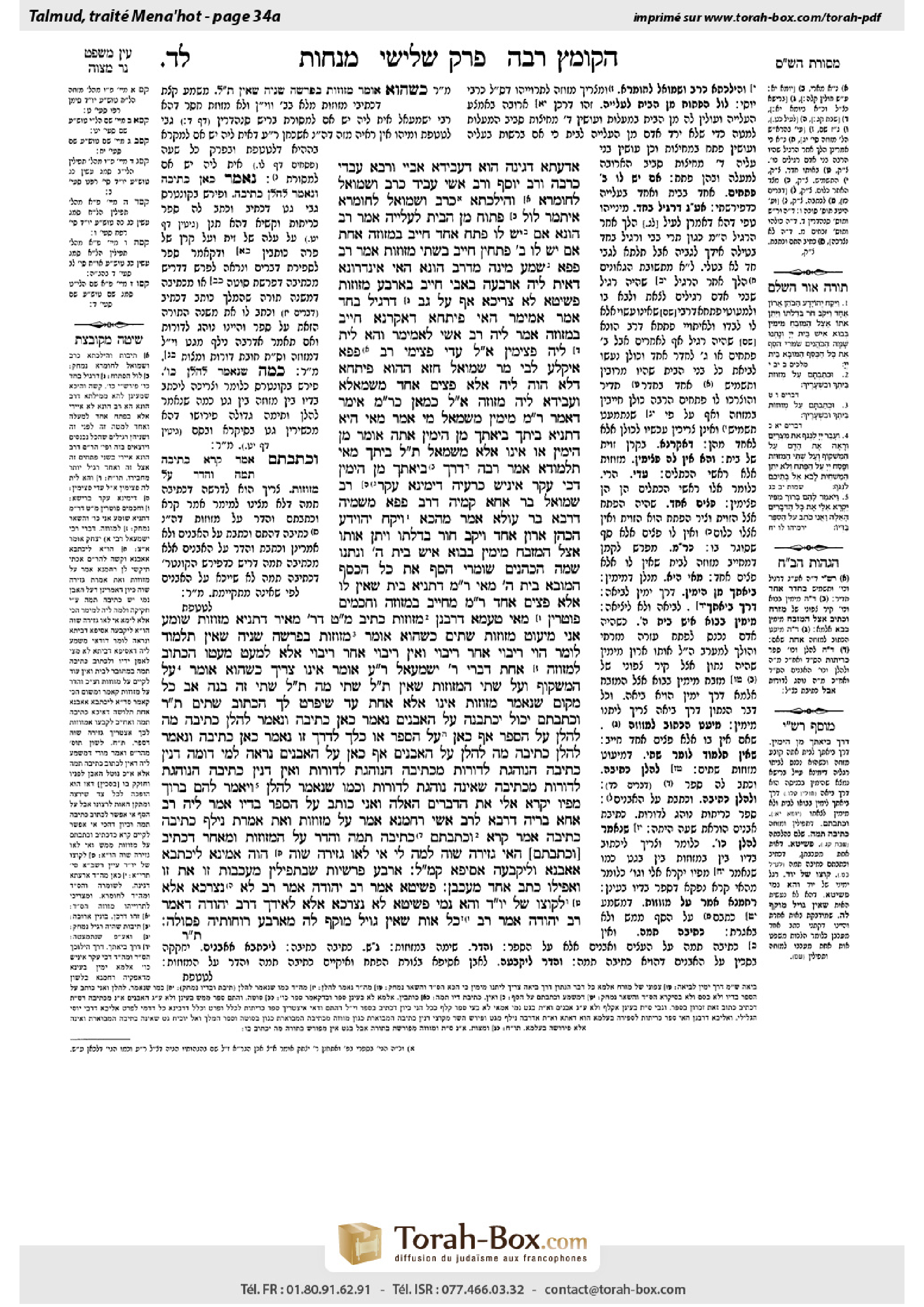
Menachot 34a: Talmud study for Daf Yomi
Daf Yomi is the daily study of one Talmud folio. Explore 37 tractates with scans, Hebrew text, Sefaria English and AI-generated French translations where annotated.
Passage selection and English or AI-generated French translation are available where the scan has annotations. Daf Study is independent of Torah-Box and Sefaria.
Browse Menachot · מנחות · All tractatesMenachot 34a text and translations
This page of Menachot includes the Aramaic text, an English translation and an AI-generated French translation, alongside the scan above.
מנחות ל״ד א · Aramaic and Hebrew text
אַדַּעְתָּא דְּגִינָּה הוּא דַּעֲבִידָא.
אַבָּיֵי וְרָבָא עָבְדִי כְּרַבָּה וְרַב יוֹסֵף, וְרַב אָשֵׁי עָבֵיד כְּרַב וּשְׁמוּאֵל לְחוּמְרָא, וְהִילְכְתָא כְּרַב וּשְׁמוּאֵל לְחוּמְרָא.
אִיתְּמַר: לוּל פָּתוּחַ מִן הַבַּיִת לַעֲלִיָּיה, אָמַר רַב הוּנָא: אִם יֵשׁ לוֹ פֶּתַח אֶחָד – חַיָּיב בִּמְזוּזָה אַחַת, אִם יֵשׁ לוֹ שְׁנֵי פְּתָחִין – חַיָּיב בִּשְׁתֵּי מְזוּזוֹת. אָמַר רַב פָּפָּא: שְׁמַע מִינַּהּ מִדְּרַב הוּנָא, הַאי אִינְדְּרוֹנָא דְּאִית לֵיהּ אַרְבְּעָה בָּאבֵי – חַיָּיב בְּאַרְבַּע מְזוּזוֹת. פְּשִׁיטָא! לָא צְרִיכָא, אַף עַל גַּב דִּרְגִיל בְּחַד.
אָמַר אַמֵּימָר: הַאי פִּיתְחָא דְּאַקַּרְנָא חַיָּיב בִּמְזוּזָה. אֲמַר לֵיהּ רַב אָשֵׁי לְאַמֵּימָר: וְהָא לֵית לֵיהּ פַּצִּימִין! אֲמַר לֵיהּ: עָדֵי פַּצִּימֵי.
רַב פָּפָּא אִיקְּלַע לְבֵי מָר שְׁמוּאֵל, חֲזָא הָהוּא פִּיתְחָא דְּלָא הֲוָה לֵיהּ אֶלָּא (פַּצִּים אֶחָד) [חַד פַּצִּימָא] מִשְּׂמָאלָא, וַעֲבִידָא לֵיהּ מְזוּזָה. אֲמַר לֵיהּ: כְּמַאן? כְּרַבִּי מֵאִיר? אֵימַר דְּאָמַר רַבִּי מֵאִיר מִיָּמִין, מִשְּׂמֹאל מִי אָמַר?
מַאי הִיא? דְּתַנְיָא: ״בֵּיתֶךָ״ – ״בִּיאָתְךָ״, מִן הַיָּמִין. אַתָּה אוֹמֵר מִן הַיָּמִין, אוֹ אֵינוֹ אֶלָּא מִשְּׂמֹאל? תַּלְמוּד לוֹמַר: ״בֵּיתֶךָ״. מַאי תַּלְמוּדָא? אָמַר רַבָּה: דֶּרֶךְ בִּיאָתְךָ מִן הַיָּמִין, דְּכִי עָקַר אִינִישׁ כַּרְעֵיהּ דְּיַמִּינָא עָקַר.
רַב שְׁמוּאֵל בַּר אַחָא קַמֵּיהּ דְּרַב פָּפָּא מִשְּׁמֵיהּ דְּרָבָא בַּר עוּלָּא אָמַר, מֵהָכָא: ״וַיִּקַּח יְהוֹיָדָע הַכֹּהֵן אֲרוֹן אֶחָד וַיִּקֹּב חֹר בְּדַלְתּוֹ וַיִּתֵּן אוֹתוֹ אֵצֶל הַמִּזְבֵּחַ מִיָּמִין בְּבוֹא אִישׁ בֵּית ה׳ וְנָתְנוּ שָׁמָּה הַכֹּהֲנִים שׁוֹמְרֵי הַסַּף אֶת כׇּל הַכֶּסֶף הַמּוּבָא בֵית ה׳״.
מַאי רַבִּי מֵאִיר? דְּתַנְיָא: בַּיִת שֶׁאֵין לוֹ אֶלָּא פַּצִּים אֶחָד, רַבִּי מֵאִיר מְחַיֵּיב בִּמְזוּזָה, וַחֲכָמִים פּוֹטְרִין. מַאי טַעְמָא דְּרַבָּנַן? ״מְזוּזוֹת״ כְּתִיב.
מַאי טַעְמָא דְּרַבִּי מֵאִיר? דְּתַנְיָא: ״מְזוּזוֹת״ – שׁוֹמֵעַ אֲנִי מִיעוּט מְזוּזוֹת שְׁתַּיִם, כְּשֶׁהוּא אוֹמֵר ״מְזוּזוֹת״ בְּפָרָשָׁה שְׁנִיָּה, שֶׁאֵין תַּלְמוּד לוֹמַר, הָוֵי רִיבּוּי אַחַר רִיבּוּי, וְאֵין רִיבּוּי אַחַר רִיבּוּי אֶלָּא לְמַעֵט, מִעֲטוֹ הַכָּתוּב לִמְזוּזָה אַחַת, דִּבְרֵי רַבִּי יִשְׁמָעֵאל.
רַבִּי עֲקִיבָא אוֹמֵר: אֵינוֹ צָרִיךְ, כְּשֶׁהוּא אוֹמֵר: ״עַל הַמַּשְׁקוֹף וְעַל שְׁתֵּי הַמְּזוּזֹת״, שֶׁאֵין תַּלְמוּד לוֹמַר ״שְׁתֵּי״, מָה תַּלְמוּד לוֹמַר ״שְׁתֵּי״? זֶה בָּנָה אָב, כׇּל מָקוֹם שֶׁנֶּאֱמַר ״מְזוּזוֹת״ אֵינוֹ אֶלָּא אַחַת, עַד שֶׁיִּפְרֹט לְךָ הַכָּתוּב שְׁתַּיִם.
תָּנוּ רַבָּנַן: ״וּכְתַבְתָּם״ – יָכוֹל יִכְתְּבֶנָּה עַל הָאֲבָנִים? נֶאֱמַר כָּאן כְּתִיבָה, וְנֶאֱמַר לְהַלָּן כְּתִיבָה – מָה לְהַלָּן עַל הַסֵּפֶר, אַף כָּאן עַל הַסֵּפֶר.
אוֹ כְּלָךְ לְדֶרֶךְ זוֹ: נֶאֱמַר כָּאן כְּתִיבָה, וְנֶאֱמַר לְהַלָּן כְּתִיבָה, מָה לְהַלָּן עַל הָאֲבָנִים, אַף כָּאן עַל הָאֲבָנִים!
נִרְאֶה לְמִי דּוֹמֶה? דָּנִין כְּתִיבָה הַנּוֹהֶגֶת לְדוֹרוֹת מִכְּתִיבָה הַנּוֹהֶגֶת לְדוֹרוֹת, וְאֵין דָּנִין כְּתִיבָה הַנּוֹהֶגֶת לְדוֹרוֹת מִכְּתִיבָה שֶׁאֵינָהּ נוֹהֶגֶת לְדוֹרוֹת, וּכְמוֹ שֶׁנֶּאֱמַר לְהַלָּן: ״וַיֹּאמֶר לָהֶם בָּרוּךְ מִפִּיו יִקְרָא אֵלַי אֵת הַדְּבָרִים הָאֵלֶּה וַאֲנִי כֹּתֵב עַל הַסֵּפֶר בַּדְּיוֹ״.
אֲמַר לֵיהּ רַב אַחָא בְּרֵיהּ דְּרָבָא לְרַב אָשֵׁי: רַחֲמָנָא אָמַר ״עַל מְזוּזוֹת״, וְאַתְּ אָמְרַתְּ נֵילַף כְּתִיבָה כְּתִיבָה? אָמַר קְרָא ״וּכְתַבְתָּם״ – כְּתִיבָה תַּמָּה, וַהֲדַר ״עַל הַמְּזוּזוֹת״.
וּמֵאַחַר דִּכְתִיב [״וּכְתַבְתָּם״], הַאי גְּזֵירָה שָׁוָה לְמָה לִי? אִי לָאו גְּזֵירָה שָׁוָה, הֲוָה אָמֵינָא לִיכְתְּבַהּ אַאַבְנָא וְלִיקְבְּעַהּ אַסִּיפָּא, קָא מַשְׁמַע לַן.
אַרְבַּע פָּרָשִׁיּוֹת שֶׁבַּתְּפִילִּין מְעַכְּבוֹת זוֹ אֶת זוֹ, וַאֲפִילּוּ כְּתָב אֶחָד מְעַכְּבָן. פְּשִׁיטָא!
אָמַר רַב יְהוּדָה, אָמַר רַב: לֹא נִצְרְכָא אֶלָּא לְקוֹצוֹ שֶׁל יוּד. וְהָא נָמֵי פְּשִׁיטָא! לֹא נִצְרְכָה אֶלָּא לְאִידַּךְ דְּרַב יְהוּדָה, דְּאָמַר רַב יְהוּדָה אָמַר רַב: כׇּל אוֹת שֶׁאֵין גְּוִיל מוּקָּף לָהּ מֵאַרְבַּע רוּחוֹתֶיהָ, פְּסוּלָה.
Menachot 34a · English translation
area is made for the purpose of reaching the garden, not for entering the house, and therefore even with regard to the entrance between the gatehouse and small room, one is exempt from placing a mezuza at the entrance of the small room.
The Gemara relates that Abaye and Rava would act in accordance with the explanation of Rabba and Rav Yosef, i.e., they would not place a mezuza on the two entrances of a gatehouse, neither to the garden nor to the small room, in accordance with the ruling of the Rabbis. And Rav Ashi would act in accordance with the explanation of Rav and Shmuel, stringently, i.e., following the ruling of Rabbi Yosei that both entrances require a mezuza. The Gemara concludes: And the halakha is in accordance with the explanation of Rav and Shmuel, stringently.
§ It was stated: With regard to an aperture that opens from the ceiling of a house occupied by one person to a loft occupied by another, with a walled staircase leading from the lower floor to the loft, Rav Huna says: If the staircase has one entrance, i.e., one doorway, either from the house or from the upper story, one is obligated to affix one mezuza; if it has two entrances, both from below and above, one is obligated to affix two mezuzot. Rav Pappa says: One can learn from that statement of Rav Huna that with regard to this type of room that has four gates, one is obligated to affix four mezuzot. The Gemara asks: Isn’t it obvious? The Gemara explains: No, it is necessary to teach that even though one is accustomed to using one particular gate, nevertheless, all four require a mezuza.
Ameimar said: With regard to this entrance which is located at the corner of a house, one is obligated to affix a mezuza. Rav Ashi said to Ameimar: But it does not have doorposts. Ameimar said to him: These [adei] are its doorposts, i.e., the end of the walls serve as its doorposts.
The Gemara relates: Rav Pappa happened to come to the house of Mar Shmuel, where he saw a certain entrance that had only one doorpost to the left of the entrance, and yet Mar Shmuel had affixed a mezuza to that doorpost. Rav Pappa said to him: In accordance with whose opinion did you do this? Did you act in accordance with the opinion of Rabbi Meir, who deems one obligated to affix a mezuza to an entrance that has only one doorpost? But one can say that Rabbi Meir says that one must do so only in a case where the doorpost is to the right of the entrance. Does he say that it requires a mezuza if the entrance is to the left?
The Gemara asks: What is the source for this requirement that the mezuza be affixed to the right side? As it is taught in a baraita: When the verse states: “And you shall write them upon the doorposts of your house [beitekha]” (Deuteronomy 6:9), the word beitekha is interpreted as biatekha, your entry, i.e., the mezuza must be affixed to the side by which you enter, which is from the right. Do you say it is from the right, or is it only from the left? Therefore, the verse states: Your house [beitekha]. The Gemara asks: What is the biblical derivation here? Rabba says: The mezuza is affixed in the way that you enter the house, which is from the right, as when a person lifts his foot to begin walking, he lifts his right foot first. Therefore, the mezuza is affixed to the right side of the doorway.
Rav Shmuel bar Aḥa said before Rav Pappa in the name of Rava bar Ulla that the requirement that the mezuza be affixed to the right of the entrance is derived from here: “And Jehoiada the priest took a chest, and bored a hole in the lid of it, and set it beside the altar, on the right side as one comes into the House of the Lord; and the priests that kept the threshold put in there all the money that was brought into the House of the Lord” (II Kings 12:10). This indicates that an object designed for those entering a house is placed to the right of the one entering.
The Gemara further inquires: What is this statement of Rabbi Meir, referred to by Rav Pappa, that he deems one obligated to place a mezuza on an entrance that has only one doorpost? As it is taught in a baraita: With regard to a house that has only one doorpost, Rabbi Meir deems one obligated to affix a mezuza, and the Rabbis deem him exempt from affixing a mezuza. The Gemara asks: What is the reasoning of the Rabbis? It is written: “And you shall write them upon the doorposts of your house” (Deuteronomy 6:9), in the plural, which indicates that there must be two doorposts.
The Gemara asks: What is the reason of Rabbi Meir, that one doorpost suffices to obligate one to affix a mezuza? As it is taught in a baraita: When it states “doorposts” (Deuteronomy 6:9), I would derive the minimum number of doorposts, which is two. When it says “doorposts” in the second passage (Deuteronomy 11:20), this also serves to teach a halakha, as otherwise there is no need for the verse to state this. This is one amplification following another amplification, and the principle is that an amplification following an amplification is stated only in order to restrict its extent. In this manner the verse restricted the minimum number to one doorpost. This is the statement of Rabbi Yishmael.
Rabbi Akiva says: This proof is not necessary. Rather, when the verse states: “And strike the lintel and the two doorposts” (Exodus 12:22), one can claim that there is a superfluous word in this verse, as there is no need for the verse to state “two,” since the minimum of doorposts is two. What is the meaning when the verse states “two”? This established a paradigm that anywhere where it is stated “doorposts,” it means only one doorpost, unless the verse specifies that it is referring to two doorposts.
The Sages taught in a baraita: The verse states: “And you shall write them upon the doorposts of your house, and upon your gates” (Deuteronomy 6:9). One might have thought that one writes a mezuza on the stones of the entrance. To counter this, an expression of writing is stated here, with regard to a mezuza, and an expression of writing is stated there. Just as there the mitzva of writing means on a book, i.e., parchment, so too, a mezuza must be written on a book.
The baraita suggests: Or perhaps, go [kalekh] this way, i.e., one can suggest a different interpretation: An expression of writing is stated here, with regard to a mezuza, and writing is stated there, with regard to the mitzva of writing the words of the Torah on stones upon the entry to Eretz Yisrael (Deuteronomy 27:3). Just as there, the words are written on the stones themselves, so too here, the mezuza should be written on the stones.
The baraita continues: Let us see to which it is similar, i.e., which comparison appears more apt. We derive writing that is performed in all generations, i.e., that of a mezuza, from another writing that is performed in all generations, but we do not derive writing that is performed in all generations from writing that is not performed in all generations. And furthermore, a mezuza must be written with ink, as it is stated below: “And Baruch said to them: He dictated all these words to me, and I wrote them with ink in the scroll” (Jeremiah 36:18).
Rav Aḥa, son of Rava, said to Rav Ashi: The Merciful One states: “Upon the doorposts,” which indicates that a mezuza should be written on the doorposts themselves, and yet you say: Let us derive a verbal analogy between “writing” and “writing,” to teach that one writes it on parchment. Why isn’t the verse interpreted in accordance with its straightforward meaning? Rav Ashi said to him: The verse states: “And you shall write them [ukhtavtam],” which means that it should first be complete writing [ketiva tamma], i.e., the full passages written down, and only then should one place them “upon the doorposts” of the house.
The Gemara asks: And since it is written: “And you shall write them,” from which it is derived that the mezuza should be written first and then placed on the doorpost, why do I need this verbal analogy between “writing” and “writing”? The Gemara explains that were it not for the verbal analogy, I would say that one should write the passages of a mezuza on a stone, and afterward affix the stone to the doorpost. To counter this, the verbal analogy teaches us that a mezuza must be written on a scroll.
§ The mishna teaches: With regard to the four passages that are in the phylacteries, i.e., the two passages that are written in the mezuza and two additional passages (Exodus 13:1–9, 11–16), the absence of each prevents fulfillment of the mitzva with the others, and the absence of even one letter prevents fulfillment of the mitzva with the rest of them. The Gemara asks: Isn’t it obvious that the inclusion of every letter is necessary?
Rav Yehuda says that Rav says: It is necessary to state this ruling only to teach that even the absence of the thorn, i.e., a small stroke, of a letter yod prevents fulfillment of the mitzva. The Gemara asks: But isn’t this also obvious, since the letter is not formed properly? Rather, it is necessary only according to another statement that Rav Yehuda says. As Rav Yehuda says that Rav says: Any letter that is not encircled with blank parchment on all four of its sides, as its ink connects to the letter above it, below it, preceding it, or succeeding it, is unfit.
Menachot 34a · Traduction française (IA)
Cette zone est aménagée pour accéder au jardin, et non pour entrer dans la maison. Par conséquent, même à l’entrée entre le vestibule et la petite pièce, on n’est pas tenu de fixer une mezouza à l’entrée de la petite pièce.
La Guemara rapporte qu’Abayé et Rava agissaient conformément à l’explication de Rabba et de Rav Yossef : conformément à l’avis des Sages, ils ne plaçaient de mezouza à aucune des deux entrées du vestibule, ni du côté du jardin ni du côté de la petite pièce. Rav Achi, lui, agissait conformément à l’explication de Rav et Chmouel, par rigueur, c’est-à-dire selon l’avis de Rabbi Yossé, d’après lequel les deux entrées nécessitent une mezouza. La Guemara conclut : la halakha suit l’explication de Rav et Chmouel, par rigueur.
§ Il a été enseigné : au sujet d’une ouverture aménagée dans le plafond d’une maison occupée par une personne, donnant sur un grenier occupé par une autre, et dotée d’un escalier clos reliant le rez-de-chaussée au grenier, Rav Houna dit : si l’escalier a une seule entrée, c’est-à-dire une seule porte, soit depuis la maison, soit depuis l’étage supérieur, on est tenu de fixer une mezouza ; s’il a deux entrées, l’une en bas et l’autre en haut, on est tenu de fixer deux mezouzot. Rav Pappa dit : on peut déduire de cette déclaration de Rav Houna que, pour ce type de pièce qui a quatre portes, on est tenu de fixer quatre mezouzot. La Guemara demande : cela n’est-il pas évident ? La Guemara explique : non, il fallait l’enseigner pour établir que, même si l’on a l’habitude d’utiliser une porte en particulier, les quatre nécessitent néanmoins une mezouza.
Ameimar dit : on est tenu de fixer une mezouza à cette entrée située à l’angle d’une maison. Rav Achi lui dit : mais elle n’a pas de montants. Ameimar lui répond : ceux-ci [adei] sont ses montants, c’est-à-dire que les extrémités des murs lui servent de montants.
La Guemara rapporte : Rav Pappa se rendit par hasard chez Mar Chmouel, où il vit une entrée qui n’avait qu’un seul montant, à gauche de l’entrée, et à laquelle Mar Chmouel avait pourtant fixé une mezouza. Rav Pappa lui dit : selon l’opinion de qui as-tu agi ainsi ? As-tu suivi l’opinion de Rabbi Meïr, qui estime qu’on est tenu de fixer une mezouza à une entrée qui n’a qu’un seul montant ? Mais on peut dire que Rabbi Meïr ne l’enseigne que lorsque le montant se trouve à droite de l’entrée. Dit-il qu’une mezouza est nécessaire si le montant se trouve à gauche ?
La Guemara demande : quelle est la source de l’obligation de fixer la mezouza du côté droit ? On l’enseigne dans une baraïta : lorsque le verset dit : « Tu les inscriras sur les montants de ta maison [beitekha] » (Deutéronome 6, 9), le mot beitekha est interprété comme biatekha, « ton entrée », c’est-à-dire que la mezouza doit être fixée du côté par lequel on entre, à droite. Peut-on dire qu’il s’agit du côté droit, ou bien seulement du côté gauche ? C’est pourquoi le verset dit : « ta maison [beitekha] ». La Guemara demande : quelle est ici la déduction scripturaire ? Rabba dit : la mezouza est fixée du côté par lequel on entre dans la maison, c’est-à-dire à droite, car lorsqu’une personne lève le pied pour commencer à marcher, elle lève d’abord le pied droit. Par conséquent, la mezouza est fixée à droite de l’embrasure.
Rav Chmouel bar Aḥa dit devant Rav Pappa, au nom de Rava bar Oulla, que l’obligation de fixer la mezouza à droite de l’entrée se déduit de ce passage : « Le prêtre Yehoyada prit un coffre, perça un trou dans son couvercle et le plaça à côté de l’autel, à droite de l’entrée de la Maison de l’Éternel ; et les prêtres qui gardaient le seuil y déposaient tout l’argent apporté à la Maison de l’Éternel » (II Rois 12, 10). Cela indique qu’un objet destiné à ceux qui entrent dans une maison est placé à droite de la personne qui entre.
La Guemara demande en outre : à quelle déclaration de Rabbi Meïr Rav Pappa fait-il référence lorsqu’il dit que celui-ci estime qu’on est tenu de fixer une mezouza à une entrée qui n’a qu’un seul montant ? On l’enseigne dans une baraïta : au sujet d’une maison qui n’a qu’un seul montant, Rabbi Meïr estime qu’on est tenu de fixer une mezouza, tandis que les Sages dispensent de cette obligation. La Guemara demande : quel est le raisonnement des Sages ? Il est écrit : « Tu les inscriras sur les montants de ta maison » (Deutéronome 6, 9), au pluriel, ce qui indique qu’il faut deux montants.
La Guemara demande : quel est le raisonnement de Rabbi Meïr, selon lequel un seul montant suffit pour obliger à fixer une mezouza ? On l’enseigne dans une baraïta : lorsque le verset dit « montants » (Deutéronome 6, 9), j’en déduirais le nombre minimal de montants, soit deux. Lorsque le mot « montants » apparaît dans le second passage (Deutéronome 11, 20), cela enseigne également une halakha, car sinon le verset n’aurait pas besoin de le mentionner. Il s’agit d’une amplification suivie d’une autre amplification, et le principe veut qu’une amplification après une amplification ne soit formulée que pour en restreindre la portée. Ainsi, le verset a réduit le nombre minimal à un seul montant. Telle est l’opinion de Rabbi Yichmaël.
Rabbi Akiva dit : cette preuve n’est pas nécessaire. En effet, lorsque le verset dit : « Vous frapperez le linteau et les deux montants » (Exode 12, 22), on peut soutenir que le mot « deux » est superflu, car le nombre minimal de montants est deux. Que vient donc enseigner le verset en disant « deux » ? Il établit que partout où il est question de « montants », il ne s’agit que d’un seul montant, à moins que le verset ne précise qu’il en vise deux.
Les Sages ont enseigné dans une baraïta : le verset dit : « Tu les inscriras sur les montants de ta maison et sur tes portes » (Deutéronome 6, 9). On aurait pu penser qu’on inscrit la mezouza sur les pierres de l’entrée. Pour l’exclure, une expression relative à l’écriture est employée ici, à propos de la mezouza, et une autre expression relative à l’écriture est employée là. De même que là, l’obligation d’écrire signifie écrire sur un livre, c’est-à-dire sur du parchemin, de même, la mezouza doit être écrite sur un livre.
La baraïta suggère : ou peut-être, allons [kalekh] dans cette direction, c’est-à-dire qu’on peut proposer une autre interprétation : une expression relative à l’écriture est employée ici, à propos de la mezouza, et une expression relative à l’écriture est employée là, à propos de l’obligation d’inscrire les paroles de la Torah sur des pierres, à l’entrée du pays d’Israël (Deutéronome 27, 3). De même que là, les paroles sont inscrites sur les pierres elles-mêmes, de même, ici, la mezouza devrait être inscrite sur les pierres.
La baraïta poursuit : examinons laquelle de ces comparaisons est la plus pertinente. Nous déduisons une écriture qui s’applique à toutes les générations, celle de la mezouza, d’une autre écriture qui s’applique à toutes les générations ; mais nous ne déduisons pas une écriture qui s’applique à toutes les générations d’une écriture qui ne s’applique pas à toutes les générations. De plus, une mezouza doit être écrite à l’encre, comme il est dit plus loin : « Baruch leur dit : Il m’a dicté toutes ces paroles, et je les ai écrites à l’encre sur le rouleau » (Jérémie 36, 18).
Rav Aḥa, fils de Rava, dit à Rav Achi : le Miséricordieux dit : « sur les montants », ce qui indique que la mezouza doit être inscrite sur les montants eux-mêmes ; pourtant, tu dis qu’il faut déduire, par une analogie verbale entre « écrire » et « écrire », qu’on l’inscrit sur du parchemin. Pourquoi le verset n’est-il pas interprété selon son sens littéral ? Rav Achi lui répond : le verset dit : « Et tu les inscriras [ukhtavtam] », ce qui signifie que l’écriture doit d’abord être complète [ketiva tamma], c’est-à-dire que les passages entiers doivent être écrits, et ce n’est qu’ensuite qu’on les place « sur les montants » de la maison.
La Guemara demande : puisque le verset dit : « Et tu les inscriras », d’où l’on déduit que la mezouza doit d’abord être écrite, puis placée sur le montant, pourquoi faut-il cette analogie verbale entre « écrire » et « écrire » ? La Guemara explique : sans cette analogie verbale, j’aurais dit qu’il faut inscrire les passages de la mezouza sur une pierre, puis fixer la pierre au montant. Pour l’exclure, l’analogie verbale nous enseigne que la mezouza doit être écrite sur un rouleau.
§ La Michna enseigne : au sujet des quatre passages qui se trouvent dans les tefillin, c’est-à-dire les deux passages écrits dans la mezouza et deux passages supplémentaires (Exode 13, 1–9 et 11–16), l’absence de chacun empêche d’accomplir la mitsva avec les autres, et l’absence d’une seule lettre empêche d’accomplir la mitsva avec les autres lettres. La Guemara demande : n’est-il pas évident que toutes les lettres sont nécessaires ?
Rav Yehouda dit au nom de Rav : cette règle devait être énoncée uniquement pour enseigner que même l’absence du petit trait d’une lettre yod empêche d’accomplir la mitsva. La Guemara demande : cela aussi n’est-il pas évident, puisque la lettre n’est pas correctement formée ? En réalité, cette règle était nécessaire uniquement à la lumière d’une autre déclaration de Rav Yehouda. En effet, Rav Yehouda dit au nom de Rav : toute lettre qui n’est pas entourée de parchemin vierge sur ses quatre côtés, parce que son encre touche la lettre qui la précède, la suit, se trouve au-dessus ou au-dessous, est impropre.
Traduction française générée par IA à partir de l’édition anglaise de Sefaria. Vérifie toujours un passage avec le texte source.
Text from Sefaria: William Davidson Edition - Vocalized Aramaic (unknown); William Davidson Edition - English (CC BY NC).