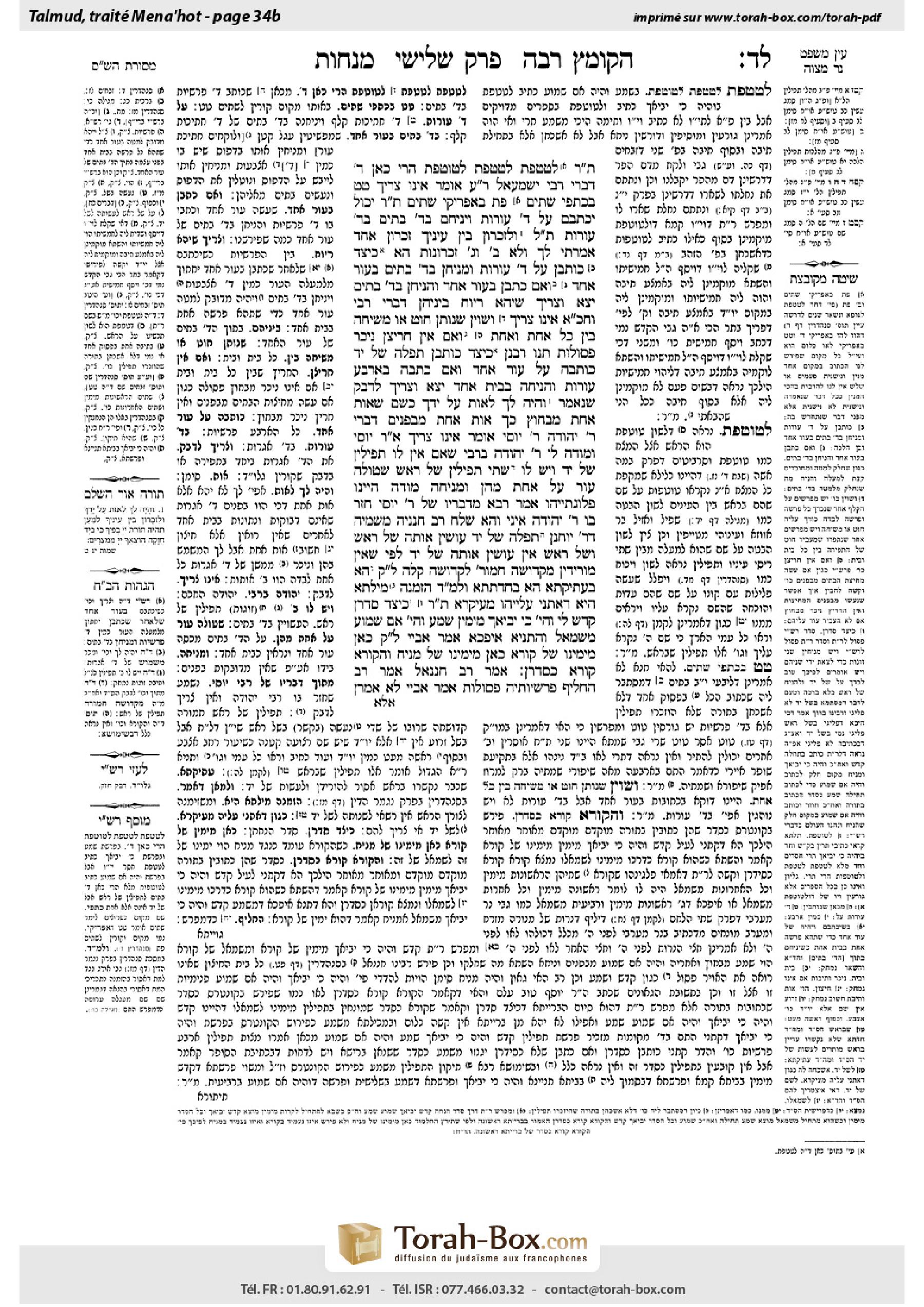
Menachot 34b: Talmud study for Daf Yomi
Daf Yomi is the daily study of one Talmud folio. Explore 37 tractates with scans, Hebrew text, Sefaria English and AI-generated French translations where annotated.
Passage selection and English or AI-generated French translation are available where the scan has annotations. Daf Study is independent of Torah-Box and Sefaria.
Browse Menachot · מנחות · All tractatesMenachot 34b text and translations
This page of Menachot includes the Aramaic text, an English translation and an AI-generated French translation, alongside the scan above.
מנחות ל״ד ב · Aramaic and Hebrew text
תָּנוּ רַבָּנַן: ״לְטֹטֶפֶת״ ״לְטֹטֶפֶת״ ״לְטוֹטָפוֹת״ – הֲרֵי כָּאן אַרְבַּע, דִּבְרֵי רַבִּי יִשְׁמָעֵאל.
רַבִּי עֲקִיבָא אוֹמֵר: אֵינוֹ צָרִיךְ, ״טַט״ בְּכַתְפִּי שְׁתַּיִם, ״פַּת״ בְּאַפְרִיקִי שְׁתַּיִם.
תָּנוּ רַבָּנַן: יָכוֹל יִכְתְּבֵם עַל אַרְבָּעָה עוֹרוֹת, וְיַנִּיחֵם בְּאַרְבָּעָה בָּתִּים בְּאַרְבָּעָה עוֹרוֹת? תַּלְמוּד לוֹמַר: ״וּלְזִכָּרוֹן בֵּין עֵינֶיךָ״, זִכָּרוֹן אֶחָד אָמַרְתִּי לָךְ, וְלֹא שְׁנַיִם וּשְׁלֹשָׁה זִכְרוֹנוֹת. הָא כֵּיצַד? כּוֹתְבָן עַל אַרְבָּעָה עוֹרוֹת וּמַנִּיחָן בְּאַרְבָּעָה בָּתִּים בְּעוֹר אֶחָד.
וְאִם כְּתָבָן בְּעוֹר אֶחָד, וְהִנִּיחָן בְּאַרְבָּעָה בָּתִּים – יָצָא, וְצָרִיךְ שֶׁיְּהֵא רֶיוַח בֵּינֵיהֶן, דִּבְרֵי רַבִּי. וַחֲכָמִים אוֹמְרִים: אֵינוֹ צָרִיךְ. וְשָׁוִין, שֶׁנּוֹתֵן חוּט אוֹ מְשִׁיחָה בֵּין כׇּל אַחַת וְאַחַת. וְאִם אֵין חֲרִיצָן נִיכָּר – פְּסוּלוֹת.
תָּנוּ רַבָּנַן: כֵּיצַד כּוֹתְבָן? תְּפִלָּה שֶׁל יָד כּוֹתְבָהּ עַל עוֹר אֶחָד, וְאִם כְּתָבָהּ בְּאַרְבַּע עוֹרוֹת וְהִנִּיחָה בְּבַיִת אֶחָד – יָצָא. וְצָרִיךְ לְדַבֵּק, שֶׁנֶּאֱמַר: ״וְהָיָה לְךָ לְאוֹת עַל יָדְךָ״, כְּשֵׁם שֶׁאוֹת אַחַת מִבַּחוּץ – כָּךְ אוֹת אַחַת מִבִּפְנִים, דִּבְרֵי רַבִּי יְהוּדָה. רַבִּי יוֹסֵי אוֹמֵר: אֵינוֹ צָרִיךְ.
אָמַר רַבִּי יוֹסֵי: וּמוֹדֶה לִי רַבִּי יְהוּדָה בְּרִיבִּי, שֶׁאִם אֵין לוֹ תְּפִילִּין שֶׁל יָד וְיֵשׁ לוֹ שְׁתֵּי תְּפִילִּין שֶׁל רֹאשׁ, שֶׁטּוֹלֶה עוֹר עַל אַחַת מֵהֶן וּמַנִּיחָהּ. מוֹדֶה? הַיְינוּ פְּלוּגְתַּיְיהוּ! אָמַר רָבָא: מִדְּבָרָיו שֶׁל רַבִּי יוֹסֵי חָזַר בּוֹ רַבִּי יְהוּדָה.
אִינִי? וְהָא שְׁלַח רַב חֲנַנְיָה מִשְּׁמֵיהּ דְּרַבִּי יוֹחָנָן: תְּפִלָּה שֶׁל יָד עוֹשִׂין אוֹתָהּ שֶׁל רֹאשׁ, וְשֶׁל רֹאשׁ אֵין עוֹשִׂין אוֹתָהּ שֶׁל יָד, לְפִי שֶׁאֵין מוֹרִידִין מִקְּדוּשָּׁה חֲמוּרָה לִקְדוּשָּׁה קַלָּה.
לָא קַשְׁיָא, הָא בְּעַתִּיקָתָא, הָא בְּחַדְתָּתָא. וּלְמַאן דְּאָמַר הַזְמָנָה מִילְּתָא הִיא, דְּאַתְנִי עֲלַיְיהוּ מֵעִיקָּרָא.
תָּנוּ רַבָּנַן: כֵּיצַד סִדְרָן? ״קַדֶּשׁ לִי״ ״וְהָיָה כִּי יְבִיאֲךָ״ מִיָּמִין, ״שְׁמַע״ ״וְהָיָה אִם שָׁמוֹעַ״ מִשְּׂמֹאל.
וְהָתַנְיָא אִיפְּכָא? אָמַר אַבָּיֵי: לָא קַשְׁיָא, כָּאן מִימִינוֹ שֶׁל קוֹרֵא, כָּאן מִימִינוֹ שֶׁל מַנִּיחַ, וְהַקּוֹרֵא קוֹרֵא כְּסִדְרָן.
אָמַר רַב חֲנַנְאֵל אָמַר רַב: הֶחְלִיף פָּרָשִׁיּוֹתֶיהָ פְּסוּלוֹת. אָמַר אַבָּיֵי: לָא אֲמַרַן
Menachot 34b · English translation
§ The Sages taught in a baraita: With regard to the number of compartments in the phylacteries of the head, the verse states: “It shall be for a sign upon your hand, and for totafot between your eyes” (Exodus 13:16), with the word totafot spelled deficient, without a vav before the final letter, in a way that can be read as singular; and again: “They shall be for totafot between your eyes” (Deuteronomy 6:8), spelled as a singular word; and again: “They shall be for totafot between your eyes” (Deuteronomy 11:18), this time spelled plene, with a vav before the final letter, in a manner that must be plural. There are four mentions of totafot here, as the third one is written in the plural and therefore counts as two. Consequently, it is derived that the phylacteries of the head must have four compartments. This is the statement of Rabbi Yishmael.
Rabbi Akiva says: There is no need for this proof, as the requirement of four compartments can be derived from the word totafot itself: The word tot in the language of Katfei means two, and the word pat in the language of Afriki also means two, and therefore totafot can be understood as a compound word meaning four.
The Sages taught in a baraita: One might have thought that a scribe should write the passages of the phylacteries of the head on four separate hides, i.e., parchments, and place them in four compartments of four hides, one passage in each compartment. Therefore, the verse states: “And for a memorial between your eyes” (Exodus 13:9). This teaches: I said to you that the phylacteries are one memorial, but not that they are two or three memorials, i.e., the phylacteries themselves must be one unit. How so? One writes the passages on four hides and places them in four compartments fashioned of one hide.
And if a scribe wrote all four of them on one hide and placed them in four compartments by slitting the parchment between each of the passages, one who dons these phylacteries has fulfilled his obligation. And in such a case it is necessary for there to be a space between each of the passages, so that each can be placed in a separate compartment; this is the statement of Rabbi Yehuda HaNasi. And the Rabbis say: It is not necessary for there to be a space between them. And Rabbi Yehuda HaNasi and the Rabbis agree that one places a string or a thicker band between each and every one of the four compartments. The baraita adds: And if their furrows, i.e., the lines marking the separation between the compartments, are not noticeable from the outside, the phylacteries are unfit.
The Sages taught in a baraita: How does a scribe write them? With regard to the phylacteries of the arm, he writes it on one hide. But if he wrote it on four separate hides and placed it in one compartment, one who wears it has fulfilled his obligation. And in such a case it is necessary to attach the four parchments, as it is stated: “And it shall be for a sign for you upon your arm” (Exodus 13:9). This teaches that just as the phylacteries of the arm are one sign on the outside, as the compartment is fashioned from a single hide, so too, they must be one sign on the inside, i.e., the four passages must be on a single parchment. This is the statement of Rabbi Yehuda. Rabbi Yosei says: It is not necessary to attach the passages.
Rabbi Yosei says: And Rabbi Yehuda the Distinguished [Beribbi] concedes to me that if one does not have phylacteries of the arm but has two phylacteries of the head, that he covers one of them with patches of hide, to render it like one compartment, and places it on his arm. The Gemara asks: How can Rabbi Yosei say that Rabbi Yehuda concedes to him in this case? This is the very situation in which their dispute applies, as they disagree over whether or not the passages of the phylacteries of the arm may be written on separate parchments. Rava said: From Rabbi Yosei’s statement one can infer that Rabbi Yehuda retracted his opinion and accepted Rabbi Yosei’s ruling.
Rabbi Yosei said that all agree that one can convert phylacteries of the head into phylacteries of the arm. The Gemara asks: Is that so? But Rav Ḥananya sent the following ruling in the name of Rabbi Yoḥanan: If one has phylacteries of the arm, he can convert it to phylacteries of the head, but if one has phylacteries of the head, he cannot convert it to phylacteries of the arm, because one does not reduce the sanctity of an item from a level of greater sanctity of phylacteries of the head to a level of lesser sanctity of phylacteries of the arm.
The Gemara answers: This is not difficult, as this ruling is stated with regard to old phylacteries, which have already been worn on one’s head and therefore have a greater level of sanctity, whereas that ruling is stated with regard to new phylacteries, which have not yet been used. The Gemara adds: And according to the one who says that designation is significant, i.e., once one designates an item for use in fulfilling a particular mitzva, it assumes the sanctity of an item used for mitzvot, this ruling is stated with regard to a case where he stipulated with regard to them from the outset that he may convert it from phylacteries of the head to phylacteries of the arm, and only in this circumstance it is permitted to convert them.
§ The Sages taught in a baraita: How does one arrange the four passages inside the phylacteries? The passage of: “Sanctify unto Me” (Exodus 13:1–10), and the passage of: “And it shall be when He shall bring you” (Exodus 13:11–16), are placed on the right; the passage of: “Listen, O Israel” (Deuteronomy 6:4–9), and the passage of: “And it shall come to pass, if you shall hearken diligently” (Deuteronomy 11:13–21), are placed on the left.
The Gemara asks: But isn’t it taught in a baraita that one places them in the opposite manner, with the first two passages on the left and the latter two on the right? Abaye said that it is not difficult: Here it means to the right of the reader, i.e., one who is standing opposite the one donning the phylacteries, whereas there it means to the right of the one who is donning the phylacteries. And in this manner the reader reads the passages in their order, as they appear in the Torah, starting with Exodus 13:1–10 to his right.
Rav Ḥananel says that Rav says: If one exchanged its passages, i.e., placed them in a different order within the compartment, the phylacteries are unfit. Abaye said: We did not say this
Menachot 34b · Traduction française (IA)
§ Les Sages ont enseigné dans une baraïta : Au sujet du nombre de compartiments des tefillin de la tête, le verset dit : « Ce sera un signe sur ta main et des totafot entre tes yeux » (Exode 13:16), le mot totafot étant écrit de manière défective, sans vav avant la dernière lettre, de sorte qu’il peut se lire au singulier ; puis : « Elles seront des totafot entre tes yeux » (Deutéronome 6:8), écrit au singulier ; et encore : « Elles seront des totafot entre tes yeux » (Deutéronome 11:18), cette fois écrit de manière pleine, avec un vav avant la dernière lettre, ce qui impose une lecture au pluriel. Il y a donc ici quatre occurrences de totafot, puisque la troisième est écrite au pluriel et compte ainsi pour deux. On en déduit que les tefillin de la tête doivent comporter quatre compartiments. Telle est l’opinion de Rabbi Yishmaël.
Rabbi Akiva dit : Il n’est pas nécessaire de recourir à cette preuve, car l’exigence de quatre compartiments se déduit du mot totafot lui-même : le mot tot, dans la langue de Katfei, signifie deux, et le mot pat, dans la langue d’Afriki, signifie également deux ; totafot peut donc être compris comme un mot composé signifiant quatre.
Les Sages ont enseigné dans une baraïta : On aurait pu penser que le scribe devait écrire les passages des tefillin de la tête sur quatre peaux distinctes, c’est-à-dire quatre parchemins, et les placer dans quatre compartiments faits de quatre peaux, un passage dans chaque compartiment. Le verset dit donc : « Et ce sera un mémorial entre tes yeux » (Exode 13:9). Cela enseigne : Je vous ai dit que les tefillin constituent un seul mémorial, et non deux ou trois mémoriaux, c’est-à-dire que les tefillin eux-mêmes doivent former une seule unité. Comment cela ? On écrit les passages sur quatre peaux et on les place dans quatre compartiments façonnés à partir d’une seule peau.
Et si un scribe les a tous les quatre écrits sur une seule peau et les a placés dans quatre compartiments en incisant le parchemin entre chaque passage, celui qui porte ces tefillin s’est acquitté de son obligation. Dans ce cas, il faut qu’il y ait un espace entre chaque passage, afin que chacun puisse être placé dans un compartiment distinct ; telle est l’opinion de Rabbi Yehouda HaNassi. Les Sages disent : Il n’est pas nécessaire qu’il y ait un espace entre eux. Rabbi Yehouda HaNassi et les Sages conviennent qu’on place un fil ou une bande plus épaisse entre chacun des quatre compartiments. La baraïta ajoute : Si leurs sillons, c’est-à-dire les lignes marquant la séparation entre les compartiments, ne sont pas visibles de l’extérieur, les tefillin sont impropres.
Les Sages ont enseigné dans une baraïta : Comment le scribe les écrit-il ? Pour les tefillin du bras, il écrit le passage sur une seule peau. Mais s’il l’a écrit sur quatre peaux distinctes et les a placées dans un seul compartiment, celui qui les porte s’est acquitté de son obligation. Dans ce cas, il faut attacher les quatre parchemins, comme il est dit : « Et ce sera pour toi un signe sur ton bras » (Exode 13:9). Cela enseigne que, de même que les tefillin du bras constituent un seul signe à l’extérieur, puisque le compartiment est façonné à partir d’une seule peau, ils doivent aussi constituer un seul signe à l’intérieur, c’est-à-dire que les quatre passages doivent se trouver sur un seul parchemin. Telle est l’opinion de Rabbi Yehouda. Rabbi Yosei dit : Il n’est pas nécessaire d’attacher les passages.
Rabbi Yosei dit : Et Rabbi Yehouda le Distingué [Beribbi] reconnaît que, si quelqu’un n’a pas de tefillin du bras mais possède deux tefillin de la tête, il recouvre l’un d’eux de morceaux de peau pour en faire un compartiment unique, puis le place sur son bras. La Guemara demande : Comment Rabbi Yosei peut-il dire que Rabbi Yehouda reconnaît ce principe dans ce cas ? C’est précisément la situation au sujet de laquelle ils sont en désaccord, puisqu’ils discutent de la possibilité d’écrire les passages des tefillin du bras sur des parchemins distincts. Rava dit : On peut déduire de la déclaration de Rabbi Yosei que Rabbi Yehouda est revenu sur son opinion et a accepté la décision de Rabbi Yosei.
Rabbi Yosei a dit que tous conviennent qu’on peut transformer les tefillin de la tête en tefillin du bras. La Guemara demande : Est-ce vraiment le cas ? Rav Ḥananya a pourtant transmis la décision suivante au nom de Rabbi Yoḥanan : Si quelqu’un possède des tefillin du bras, il peut les transformer en tefillin de la tête, mais s’il possède des tefillin de la tête, il ne peut pas les transformer en tefillin du bras, car on ne fait pas passer un objet sacré d’un degré de sainteté supérieur, celui des tefillin de la tête, à un degré de sainteté inférieur, celui des tefillin du bras.
La Guemara répond : Il n’y a pas de difficulté, car cette décision concerne de vieux tefillin, qui ont déjà été portés sur la tête et ont donc acquis un degré de sainteté supérieur, tandis que l’autre décision concerne de nouveaux tefillin, qui n’ont pas encore été utilisés. La Guemara ajoute : Selon celui qui dit que la désignation a une portée, c’est-à-dire que dès qu’on désigne un objet pour accomplir une mitsva particulière, il acquiert la sainteté d’un objet destiné aux mitsvot, cette décision concerne un cas où la personne a stipulé dès le départ qu’elle pourrait les transformer de tefillin de la tête en tefillin du bras ; et c’est uniquement dans cette situation que leur transformation est permise.
§ Les Sages ont enseigné dans une baraïta : Comment dispose-t-on les quatre passages à l’intérieur des tefillin ? Le passage « Sanctifie-Moi » (Exode 13:1–10) et le passage « Et il arrivera, lorsque le Seigneur te fera entrer » (Exode 13:11–16) sont placés à droite ; le passage « Écoute, Israël » (Deutéronome 6:4–9) et le passage « Et il arrivera, si vous écoutez attentivement » (Deutéronome 11:13–21) sont placés à gauche.
La Guemara demande : Mais n’est-il pas enseigné dans une baraïta qu’on les place dans l’ordre inverse, les deux premiers passages à gauche et les deux derniers à droite ? Abayé dit qu’il n’y a pas de difficulté : ici, il s’agit de la droite du lecteur, c’est-à-dire de celui qui se tient en face de la personne qui porte les tefillin ; là, il s’agit de la droite de celui qui porte les tefillin. Ainsi, le lecteur lit les passages dans leur ordre, tel qu’ils apparaissent dans la Torah, en commençant par Exode 13:1–10, qui se trouve à sa droite.
Rav Ḥananel dit au nom de Rav : Si quelqu’un a interverti les passages, c’est-à-dire les a placés dans un ordre différent à l’intérieur du compartiment, les tefillin sont impropres. Abayé dit : Nous n’avons pas dit cela
Traduction française générée par IA à partir de l’édition anglaise de Sefaria. Vérifie toujours un passage avec le texte source.
Text from Sefaria: William Davidson Edition - Vocalized Aramaic (unknown); William Davidson Edition - English (CC BY NC).