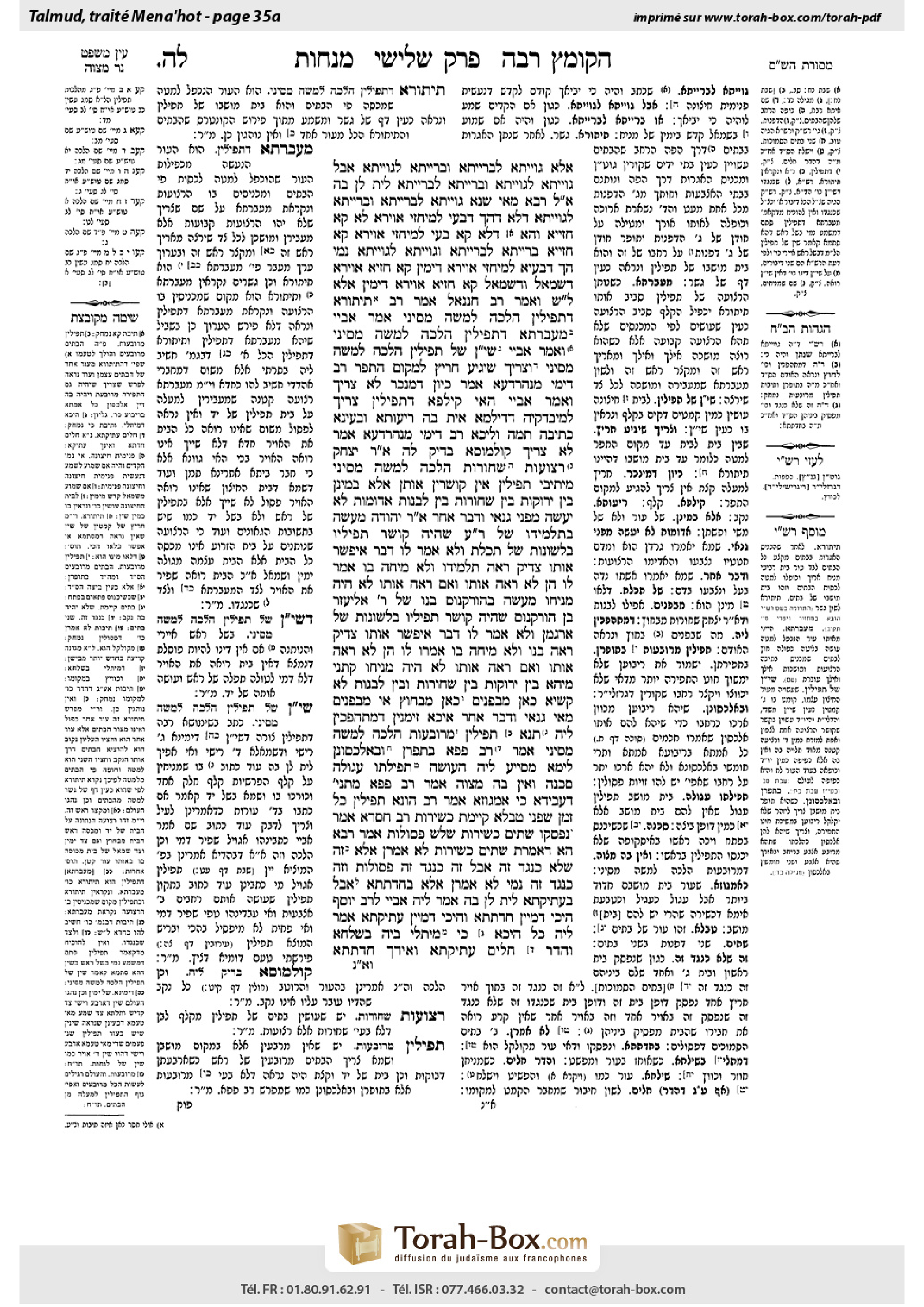
Menachot 35a: Talmud study for Daf Yomi
Daf Yomi is the daily study of one Talmud folio. Explore 37 tractates with scans, Hebrew text, Sefaria English and AI-generated French translations where annotated.
Passage selection and English or AI-generated French translation are available where the scan has annotations. Daf Study is independent of Torah-Box and Sefaria.
Browse Menachot · מנחות · All tractatesMenachot 35a text and translations
This page of Menachot includes the Aramaic text, an English translation and an AI-generated French translation, alongside the scan above.
מנחות ל״ה א · Aramaic and Hebrew text
אֶלָּא גַּוָּיְיתָא לְבָרַיְיתָא וּבָרַיְיתָא לְגַוָּיְיתָא, אֲבָל גַּוָּיְיתָא לְגַוָּיְיתָא וּבָרַיְיתָא לְבָרַיְיתָא – לֵית לַן בַּהּ.
אֲמַר לֵיהּ רָבָא: מַאי שְׁנָא גַּוָּיְיתָא לְבָרַיְיתָא וּבָרַיְיתָא לְגַוָּיְיתָא דְּלָא, דְּהָךְ דְּבָעֵי לְמִיחְזֵי אַוֵּירָא לָא קָא חָזְיָיא, וְהָא דְּלָא קָא בָעֵי לְמִיחְזֵי אַוֵּירָא קָא חָזְיָיא? בָּרַיְיתָא לְבָרַיְיתָא וְגַוָּיְיתָא לְגַוָּיְיתָא נָמֵי – הָךְ דְּבָעֲיָא לְמִיחְזֵי אַוֵּירָא דְּיָמִין קָא חָזְיָא אַוֵּירָא דִּשְׂמֹאל, וְדִשְׂמֹאל קָא חָזְיָא אַוֵּירָא דְּיָמִין! אֶלָּא לָא שְׁנָא.
וְאָמַר רַב חֲנַנְאֵל, אָמַר רַב: תִּיתּוּרָא דִּתְפִילִּין הֲלָכָה לְמֹשֶׁה מִסִּינַי. אָמַר אַבָּיֵי: מַעְבַּרְתָּא דִּתְפִילִּין הֲלָכָה לְמֹשֶׁה מִסִּינַי. וְאָמַר אַבָּיֵי: שִׁי״ן שֶׁל תְּפִילִּין הֲלָכָה לְמֹשֶׁה מִסִּינַי.
וְצָרִיךְ שֶׁיַּגִּיעַ חָרִיץ לִמְקוֹם הַתֶּפֶר, רַב דִּימִי מִנְּהַרְדְּעָא אָמַר: כֵּיוָן דְּמִנְּכַר, לָא צְרִיךְ.
וְאָמַר אַבָּיֵי: הַאי קִילְפָּא דִּתְפִילִּין צָרִיךְ לְמִיבְדְּקֵיהּ, דְּדִילְמָא אִית בַּהּ רֵיעוּתָא, וּבָעֵינָא כְּתִיבָה תַּמָּה וְלֵיכָּא. רַב דִּימִי מִנְּהַרְדְּעָא אָמַר: לָא צְרִיךְ, קוּלְמוֹסָא בָּדֵיק לַהּ.
אָמַר רַבִּי יִצְחָק: רְצוּעוֹת שְׁחוֹרוֹת הֲלָכָה לְמֹשֶׁה מִסִּינַי. מֵיתִיבִי: תְּפִילִּין אֵין קוֹשְׁרִין אוֹתָן אֶלָּא בְּמִינָן, בֵּין יְרוּקּוֹת בֵּין שְׁחוֹרוֹת בֵּין לְבָנוֹת, אֲדוּמּוֹת לֹא יַעֲשֶׂה, מִפְּנֵי גְּנַאי וְדָבָר אַחֵר.
אָמַר רַבִּי יְהוּדָה: מַעֲשֶׂה בְּתַלְמִידוֹ שֶׁל רַבִּי עֲקִיבָא שֶׁהָיָה קוֹשֵׁר תְּפִילָּיו בִּלְשׁוֹנוֹת שֶׁל תְּכֵלֶת, וְלָא אָמַר לוֹ דָּבָר. אִיפְשָׁר אוֹתוֹ צַדִּיק רָאָה תַּלְמִידוֹ וְלֹא מִיחָה בּוֹ? אָמַר לוֹ: הֵן, לֹא רָאָה אוֹתוֹ, וְאִם רָאָה אוֹתוֹ לֹא הָיָה מַנִּיחוֹ.
מַעֲשֶׂה בְּהוּרְקָנוֹס בְּנוֹ שֶׁל רַבִּי אֱלִיעֶזֶר בֶּן הוּרְקָנוֹס, שֶׁהָיָה קוֹשֵׁר תְּפִילָּיו בִּלְשׁוֹנוֹת שֶׁל אַרְגָּמָן, וְלֹא אָמַר לוֹ דָּבָר. אִיפְשָׁר אוֹתוֹ צַדִּיק רָאָה בְּנוֹ וְלֹא מִיחָה בּוֹ? אָמְרוּ לוֹ: הֵן, לֹא רָאָה אוֹתוֹ, וְאִם רָאָה אוֹתוֹ לֹא הָיָה מַנִּיחוֹ.
קָתָנֵי מִיהָא, בֵּין יְרוּקּוֹת בֵּין שְׁחוֹרוֹת וּבֵין לְבָנוֹת. לָא קַשְׁיָא: כָּאן – מִבִּפְנִים, כָּאן – מִבַּחוּץ.
אִי מִבִּפְנִים, מַאי גְּנַאי וְדָבָר אַחֵר אִיכָּא? זִימְנִין דְּמִתְהַפְכִין לֵיהּ.
תָּנָא: תְּפִילִּין מְרוּבָּעוֹת – הֲלָכָה לְמֹשֶׁה מִסִּינַי. אָמַר רַב פָּפָּא: בְּתִפְרָן וּבַאֲלַכְסוֹנָן.
לֵימָא מְסַיַּיע לֵיהּ: הָעוֹשֶׂה תְּפִילָּתוֹ עֲגוּלָּה – סַכָּנָה וְאֵין בָּהּ מִצְוָה. אָמַר רַב פָּפָּא: מַתְנִיתִין דַּעֲבִידָא כִּי אַמְגּוּזָא.
אָמַר רַב הוּנָא: תְּפִילִּין, כָּל זְמַן שֶׁפְּנֵי טַבְלָא קַיֶּימֶת – כְּשֵׁירוֹת. רַב חִסְדָּא אָמַר: נִפְסְקוּ שְׁתַּיִם – כְּשֵׁירוֹת, שָׁלֹשׁ – פְּסוּלוֹת.
אָמַר רָבָא: הָא דְּאָמְרַתְּ שְׁתַּיִם כְּשֵׁירוֹת, לָא אֲמַרַן אֶלָּא זֶה שֶׁלֹּא כְּנֶגֶד זֶה, אֲבָל זֶה כְּנֶגֶד זֶה – פְּסוּלוֹת. וְזֶה כְּנֶגֶד זֶה נָמֵי לָא אֲמַרַן אֶלָּא בְּחַדְתָּתָא, אֲבָל בְּעַתִּיקָתָא לֵית לַן בַּהּ.
אֲמַר לֵיהּ אַבָּיֵי לְרַב יוֹסֵף: הֵיכִי דָּמְיָין חַדְתָּתָא, וְהֵיכִי דָּמְיָין עַתִּיקָתָא? אֲמַר לֵיהּ: כֹּל הֵיכָא כִּי מִיתְּלֵי בֵּיהּ בְּשִׁלְחָא וַהֲדַר חָלֵים – עַתִּיקָתָא, וְאִידַּךְ – חַדְתָּתָא.
Menachot 35a · English translation
unless it is a case where one exchanges an inner passage for an outer one, e.g., he placed the passage of Exodus 13:11–16 to the right of Exodus 13:1–10, or an outer passage for an inner one, e.g., he placed the passage of Deuteronomy 11:13–21 to the right of Deuteronomy 6:4–9. But if one exchanges an inner passage for the other inner one, i.e., he exchanges Exodus 13:11–16 with Deuteronomy 6:4–9, or an outer passage for the other outer one, i.e., he exchanges Exodus 13:1–10 with Deuteronomy 11:13–21, we have no problem with it.
Rava said to Abaye: What is different about the cases of exchanging an inner passage for an outer one, and an outer passage for an inner one, such that the phylacteries are not fit? The reason is that this passage, which needs to see the air, i.e., to be placed on the outer side, does not see it, and that passage, which does not need to see the air, does see it. But in a case where one exchanges an outer passage for the other outer one or an inner passage for the other inner one, it should be unfit as well, as this passage, which needs to see the air of the right side, sees the air of the left side, and that passage, which requires to see the air of the left side, sees the air of the right side. Rather, there is no difference between any of these cases, and any change in the order renders the phylacteries unfit.
§ And Rav Ḥananel says that Rav says: The requirement to have the titora of phylacteries, i.e., the base of phylacteries upon which the compartments rest, is a halakha transmitted to Moses from Sinai. Abaye said: The requirement to have the ma’ebarta of phylacteries, i.e., the passageway through which the straps are inserted, is a halakha transmitted to Moses from Sinai. And Abaye says: The requirement to have a letter shin protruding on the phylacteries of one’s head, which is achieved by pressing the hide into the shape of that letter, is a halakha transmitted to Moses from Sinai.
Abaye further says: And there is a requirement that the furrow between each of the compartments of phylacteries of the head reach the place of the stitches, i.e., the titora, to which the compartments are sewn. Rav Dimi of Neharde’a says: Once it is noticeable that there is a furrow between each of the compartments, it is not necessary for them to reach all the way to the titora.
And Abaye says: With regard to this parchment upon which one writes the passages of phylacteries, the scribe must examine it before writing, as perhaps it has a flaw, i.e., a perforation, and complete writing is required, and that requirement would not be fulfilled if a letter were perforated. Rav Dimi of Neharde’a says: No prior examination is required; rather, the quill examines it as one writes, as any perforation which the ink covers is disregarded.
Rabbi Yitzḥak says: The requirement that the straps of the phylacteries be black is a halakha transmitted to Moses from Sinai. The Gemara raises an objection from a baraita: One may tie phylacteries only with straps of their same type, i.e., the straps must be made from hide, and it does not matter whether they are green, or black, or white. Nevertheless, one should not make red straps, because this is deprecatory to him, as it looks like he has wounds on his head, and also due to something else, i.e., lest people suspect him of engaging in sexual intercourse with a menstruating woman and getting blood on the straps.
The Gemara cites the continuation of that baraita. Rabbi Yehuda said: There was an incident involving Rabbi Akiva’s student, who would tie his phylacteries with strips of sky-blue wool rather than hide, and Rabbi Akiva did not say anything to him. Is it possible that that righteous man saw his student doing something improper and he did not object to his conduct? Another Sage said to Rabbi Yehuda: Yes, it is possible that the student acted improperly, as Rabbi Akiva did not see him, and if he had seen him, he would not have allowed him to do so.
The baraita continues: There was an incident involving Hyrcanus, the son of Rabbi Eliezer ben Hyrcanus, who would tie his phylacteries with strips of purple wool, and his father did not say anything to him. Is it possible that that righteous man saw his son doing something improper and he did not object to his conduct? The Sages said to him: Yes, it is possible that his son acted improperly, as Rabbi Eliezer did not see him, and if he had seen him, he would not have allowed him to do so. This concludes the baraita.
The Gemara explains the objection from the baraita: In any event, the baraita teaches that it does not matter whether the straps are green, or black, or white, whereas Rabbi Yitzḥak maintains that it is a halakha transmitted to Moses from Sinai that the straps of the phylacteries must be black. The Gemara answers that it is not difficult. Here, the baraita is referring to the inside of the straps, which touch the body. These may be any color other than red. Conversely, there, when Rabbi Yitzḥak says that the straps of the phylacteries must be black, he is speaking of the outside of the straps.
The Gemara raises a difficulty: If the baraita is discussing the inside of the straps, what deprecatory matter or problem of something else is there with straps that are red on the inside? After all, this side is not seen. The Gemara answers: Sometimes his straps become reversed, and therefore these concerns are applicable.
It is taught in a baraita: The requirement that phylacteries be square is a halakha transmitted to Moses from Sinai. Rav Pappa says about this halakha: Square means along their seams and their diagonals, i.e., they must be perfectly square where the compartments are sewn to the titora.
The Gemara suggests: Let us say that a mishna supports this opinion (Megilla 24b): One who fashions his phylacteries in a round shape exposes himself to danger, and it does not enable him to fulfill the mitzva of phylacteries. Rav Pappa said: This is no support, as one can say that the mishna is referring to phylacteries that are fashioned like a nut, i.e., their underside is rounded, and therefore there is a danger that if he strikes his head on a wall the underside will press into his head and injure him. By contrast, if the underside is flat one might have thought that it is fit despite the fact that it is not square. Therefore, the baraita teaches that phylacteries must be square.
§ Rav Huna says: With regard to phylacteries of the head, as long as the surface of outer hide is intact, i.e., it is not torn, they are fit, even if the hide between the compartments has torn. Rav Ḥisda says: If two of the walls between the compartments tore, such phylacteries are fit, but if three of these inner walls tore, they are unfit.
Rava said: Concerning that which you said, that if two of the walls between the compartments tore they are fit, we said this only if the inner walls that tore are not aligned with each other, i.e., they are not adjacent to one another. But if the torn walls are aligned with each other, the phylacteries are unfit. And furthermore, even in a case where the torn walls are aligned with each other, we said that they are unfit only with regard to new phylacteries, as the hide is certainly defective. But with regard to old phylacteries, we have no problem with it, as they tore due to aging.
Abaye said to Rav Yosef: What are the circumstances of new phylacteries, and what are the circumstances of old phylacteries? Rav Yosef said to him: In any case where if one holds the hide and pulls it, it returns to its place [ḥaleim], these phylacteries are considered old; and in the other case, where hide that was pulled does not return to its place, they are considered new.
Menachot 35a · Traduction française (IA)
sauf lorsqu’on intervertit un passage intérieur et un passage extérieur, par exemple si l’on place le passage d’Exode 13,11-16 à droite de celui d’Exode 13,1-10, ou un passage extérieur et un passage intérieur, par exemple si l’on place le passage de Deutéronome 11,13-21 à droite de celui de Deutéronome 6,4-9. En revanche, si l’on intervertit un passage intérieur avec l’autre passage intérieur, c’est-à-dire si l’on échange Exode 13,11-16 et Deutéronome 6,4-9, ou un passage extérieur avec l’autre passage extérieur, c’est-à-dire si l’on échange Exode 13,1-10 et Deutéronome 11,13-21, cela ne pose pas de problème.
Rava dit à Abayé : En quoi les cas où l’on intervertit un passage intérieur et un passage extérieur, ou un passage extérieur et un passage intérieur, diffèrent-ils, au point que les téfilines ne soient pas valides ? La raison en est que le passage qui doit voir l’air, c’est-à-dire être placé du côté extérieur, ne le voit pas, tandis que l’autre passage, qui n’a pas besoin de voir l’air, le voit. Mais si l’on intervertit un passage extérieur avec l’autre passage extérieur, ou un passage intérieur avec l’autre passage intérieur, les téfilines devraient également être invalides : le passage qui doit voir l’air du côté droit voit l’air du côté gauche, tandis que celui qui doit voir l’air du côté gauche voit l’air du côté droit. Il faut donc dire qu’il n’y a aucune différence entre ces cas et que toute modification de l’ordre rend les téfilines invalides.
§ Rav Ḥananel dit au nom de Rav : L’obligation d’avoir une titora pour les téfilines, c’est-à-dire la base sur laquelle reposent les compartiments, est une halakha transmise à Moïse au Sinaï. Abayé dit : L’obligation d’avoir une ma’avarta pour les téfilines, c’est-à-dire le passage par lequel on introduit les lanières, est une halakha transmise à Moïse au Sinaï. Abayé dit également : L’obligation d’avoir une lettre shin en relief sur les téfilines de la tête, obtenue en pressant le cuir pour lui donner la forme de cette lettre, est une halakha transmise à Moïse au Sinaï.
Abayé dit encore : Le sillon entre chacun des compartiments des téfilines de la tête doit atteindre l’endroit des coutures, c’est-à-dire la titora à laquelle les compartiments sont cousus. Rav Dimi de Nehardea dit : Dès lors qu’un sillon est visible entre chacun des compartiments, il n’est pas nécessaire qu’il atteigne la titora.
Abayé dit également : Avant d’écrire les passages des téfilines sur ce parchemin, le scribe doit l’examiner, car il pourrait présenter un défaut, c’est-à-dire une perforation, et l’écriture doit être complète ; cette exigence ne serait pas satisfaite si une lettre était perforée. Rav Dimi de Nehardea dit : Il n’est pas nécessaire de l’examiner au préalable ; c’est la plume qui l’examine pendant l’écriture, car toute perforation recouverte par l’encre n’est pas prise en compte.
Rabbi Yitsḥak dit : L’obligation que les lanières des téfilines soient noires est une halakha transmise à Moïse au Sinaï. La Guemara soulève une objection à partir d’une baraïta : On ne peut attacher les téfilines qu’avec des lanières faites de la même matière, c’est-à-dire en cuir ; leur couleur importe peu, qu’elles soient vertes, noires ou blanches. Toutefois, il ne faut pas faire de lanières rouges, car cela lui porte préjudice : on dirait qu’il a des blessures à la tête ; il y a aussi une autre raison, à savoir éviter que les gens le soupçonnent d’avoir eu des relations sexuelles avec une femme menstruée et d’avoir taché les lanières de sang.
La Guemara cite la suite de cette baraïta. Rabbi Yehouda dit : Un élève de Rabbi Akiva nouait ses téfilines avec des bandes de laine bleu ciel plutôt qu’avec du cuir, et Rabbi Akiva ne lui disait rien. Est-il possible que ce juste ait vu son élève faire quelque chose d’inconvenant sans s’opposer à sa conduite ? Un autre Sage dit à Rabbi Yehouda : Oui, il est possible que l’élève ait agi de manière inconvenante, car Rabbi Akiva ne l’a pas vu ; s’il l’avait vu, il ne l’aurait pas laissé faire.
La baraïta poursuit : Hyrcanus, fils de Rabbi Eliezer ben Hyrcanus, nouait ses téfilines avec des bandes de laine pourpre, et son père ne lui disait rien. Est-il possible que ce juste ait vu son fils faire quelque chose d’inconvenant sans s’opposer à sa conduite ? Les Sages lui dirent : Oui, il est possible que son fils ait agi de manière inconvenante, car Rabbi Eliezer ne l’a pas vu ; s’il l’avait vu, il ne l’aurait pas laissé faire. C’est la fin de la baraïta.
La Guemara explique l’objection tirée de la baraïta : Quoi qu’il en soit, la baraïta enseigne que la couleur des lanières importe peu, qu’elles soient vertes, noires ou blanches, tandis que Rabbi Yitsḥak soutient que l’obligation que les lanières des téfilines soient noires est une halakha transmise à Moïse au Sinaï. La Guemara répond qu’il n’y a pas de difficulté : ici, la baraïta parle de la face intérieure des lanières, celle qui touche le corps ; celle-ci peut être de n’importe quelle couleur sauf rouge. Là, en revanche, lorsque Rabbi Yitsḥak dit que les lanières des téfilines doivent être noires, il parle de leur face extérieure.
La Guemara soulève une difficulté : Si la baraïta parle de la face intérieure des lanières, quel préjudice ou quel problème lié à l’autre raison y aurait-il à avoir des lanières rouges à l’intérieur ? Après tout, cette face n’est pas visible. La Guemara répond : Il arrive que les lanières se retournent ; ces préoccupations sont donc pertinentes.
Il est enseigné dans une baraïta : L’obligation que les téfilines soient carrées est une halakha transmise à Moïse au Sinaï. Rav Pappa dit à propos de cette halakha : « Carrées » signifie qu’elles doivent être carrées au niveau de leurs coutures et de leurs diagonales, c’est-à-dire parfaitement carrées à l’endroit où les compartiments sont cousus à la titora.
La Guemara propose : Disons qu’une Michna appuie cette opinion (Meguila 24b) : Celui qui façonne ses téfilines en forme arrondie s’expose au danger et ne peut pas accomplir la mitsva des téfilines. Rav Pappa dit : Cela ne constitue pas une preuve, car on peut dire que la Michna parle de téfilines façonnées comme une noix, c’est-à-dire dont le dessous est arrondi ; il y a alors un risque que, s’il se cogne la tête contre un mur, le dessous s’enfonce dans sa tête et le blesse. En revanche, si le dessous est plat, on aurait pu penser qu’elles sont valides bien qu’elles ne soient pas carrées. La baraïta enseigne donc que les téfilines doivent être carrées.
§ Rav Houna dit : Pour les téfilines de la tête, tant que la surface du cuir extérieur est intacte, c’est-à-dire non déchirée, elles sont valides, même si le cuir entre les compartiments s’est déchiré. Rav Ḥisda dit : Si deux des parois séparant les compartiments se sont déchirées, les téfilines sont valides ; si trois de ces parois intérieures se sont déchirées, elles sont invalides.
Rava dit : À propos de ce que tu as dit, à savoir que si deux des parois séparant les compartiments se sont déchirées, les téfilines sont valides, cela n’est vrai que si les parois intérieures déchirées ne sont pas alignées, c’est-à-dire qu’elles ne sont pas adjacentes. Mais si les parois déchirées sont alignées, les téfilines sont invalides. De plus, même lorsqu’elles sont alignées, nous avons dit qu’elles sont invalides uniquement s’il s’agit de téfilines neuves, car le cuir est certainement défectueux. Pour des téfilines anciennes, en revanche, cela ne pose pas de problème, car elles se sont déchirées sous l’effet du vieillissement.
Abayé dit à Rav Yossef : Qu’est-ce qui caractérise des téfilines neuves, et qu’est-ce qui caractérise des téfilines anciennes ? Rav Yossef lui dit : Lorsque, si l’on saisit le cuir et qu’on le tire, il reprend sa place [ḥaleim], les téfilines sont considérées comme anciennes ; dans l’autre cas, lorsque le cuir tiré ne reprend pas sa place, elles sont considérées comme neuves.
Traduction française générée par IA à partir de l’édition anglaise de Sefaria. Vérifie toujours un passage avec le texte source.
Text from Sefaria: William Davidson Edition - Vocalized Aramaic (unknown); William Davidson Edition - English (CC BY NC).