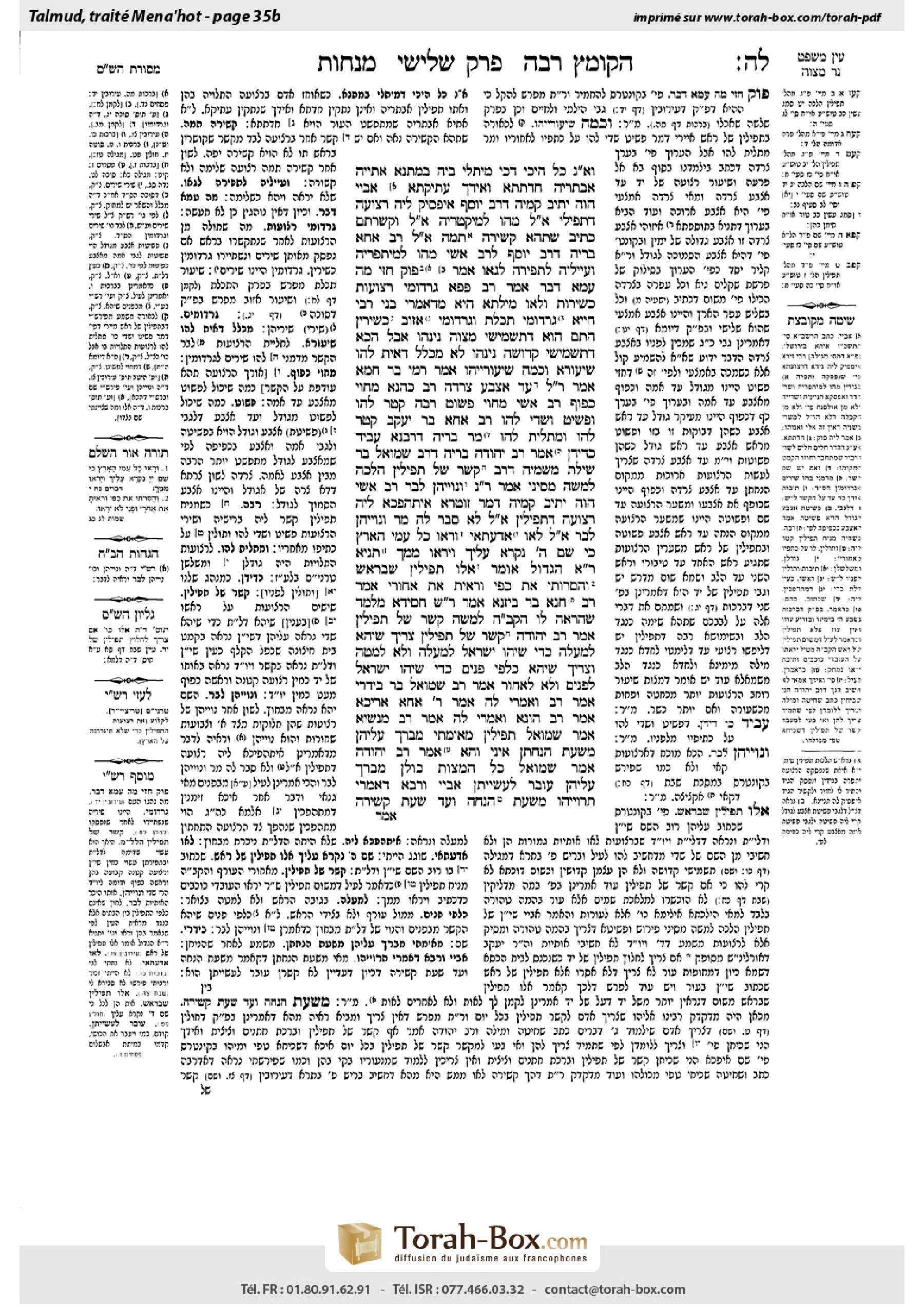
Menachot 35b: Talmud study for Daf Yomi
Daf Yomi is the daily study of one Talmud folio. Explore 37 tractates with scans, Hebrew text, Sefaria English and AI-generated French translations where annotated.
Passage selection and English or AI-generated French translation are available where the scan has annotations. Daf Study is independent of Torah-Box and Sefaria.
Browse Menachot · מנחות · All tractatesMenachot 35b text and translations
This page of Menachot includes the Aramaic text, an English translation and an AI-generated French translation, alongside the scan above.
מנחות ל״ה ב · Aramaic and Hebrew text
וְאִי נָמֵי כֹּל הֵיכִי דְּכִי מִיתְּלֵי בֵּיהּ בְּמִתְנָא אַתְיֵיהּ אַבָּתְרֵיהּ – חַדְתָּתָא, וְאִידָּךְ – עַתִּיקָתָא.
אַבָּיֵי הֲוָה יָתֵיב קַמֵּיהּ דְּרַב יוֹסֵף, אִיפְּסִיק לֵיהּ רְצוּעָה דִּתְפִילֵּי, אֲמַר לֵיהּ: מַהוּ לְמִיקְטְרֵיהּ? אֲמַר לֵיהּ: ״וּקְשַׁרְתָּם״ כְּתִיב, שֶׁתְּהֵא קְשִׁירָה תַּמָּה.
אֲמַר לֵיהּ רַב אַחָא בְּרֵיהּ דְּרַב יוֹסֵף לְרַב אָשֵׁי: מַהוּ לְמִיתְפְּרֵיהּ וְעַיֹּילֵיהּ לִתְפִירָה לְגָאו? אֲמַר: פּוֹק חֲזִי מָה עַמָּא דָּבַר.
אָמַר רַב פָּפָּא: גַּרְדּוּמֵּי רְצוּעוֹת כְּשֵׁירוֹת, וְלָאו מִילְּתָא הִיא, מִדְּאָמְרִי בְּנֵי רַבִּי חִיָּיא: גַּרְדּוּמֵּי תְכֵלֶת וְגַרְדּוּמֵּי אֵזוֹב כְּשֵׁירִין. הָתָם הוּא דְּתַשְׁמִישֵׁי מִצְוָה נִינְהוּ, אֲבָל הָכָא דְּתַשְׁמִישֵׁי קְדוּשָּׁה נִינְהוּ – לָא.
מִכְּלָל דְּאִית לְהוּ שִׁיעוּרָא, וְכַמָּה שִׁיעוּרַיְיהוּ? אָמַר רָמֵי בַּר חָמָא אָמַר רֵישׁ לָקִישׁ: עַד אֶצְבַּע צְרֵדָה. רַב כָּהֲנָא מַחְוֵי כָּפוּף, רַב אָשֵׁי מַחְוֵי פָּשׁוּט.
רַבָּה קָטַר לְהוּ וּפָשֵׁיט וְשָׁדֵי לְהוּ, רַב אַחָא בַּר יַעֲקֹב קָטַר לְהוּ וּמְתַלֵּית לְהוּ, מָר בְּרֵיהּ דְּרַבְנָא עָבֵיד כְּדִידַן.
אָמַר רַב יְהוּדָה בְּרֵיהּ דְּרַב שְׁמוּאֵל בַּר שִׁילַת מִשְּׁמֵיהּ דְּרַב: קֶשֶׁר שֶׁל תְּפִילִּין הֲלָכָה לְמֹשֶׁה מִסִּינַי. אָמַר רַב נַחְמָן: וְנוֹיֵיהֶן לְבַר. רַב אָשֵׁי הֲוָה יָתֵיב קַמֵּיהּ דְּמָר זוּטְרָא, אִיתְהַפְכָא לֵיהּ רְצוּעָה דִתְפִילִּין. אֲמַר לֵיהּ: לָא סָבַר לַהּ מָר וְנוֹיֵיהֶן לְבַר? אֲמַר לֵיהּ: לָאו אַדַּעְתַּאי.
״וְרָאוּ כׇּל עַמֵּי הָאָרֶץ כִּי שֵׁם ה׳ נִקְרָא עָלֶיךָ וְיָרְאוּ מִמֶּךָּ״, תַּנְיָא, רַבִּי אֱלִיעֶזֶר הַגָּדוֹל אוֹמֵר: אֵלּוּ תְּפִילִּין שֶׁבָּרֹאשׁ. ״וַהֲסִרֹתִי אֶת כַּפִּי וְרָאִיתָ אֶת אֲחֹרָי״, אָמַר רַב חָנָא בַּר בִּיזְנָא אָמַר רַבִּי שִׁמְעוֹן חֲסִידָא: מְלַמֵּד שֶׁהֶרְאָה לוֹ הַקָּדוֹשׁ בָּרוּךְ הוּא לְמֹשֶׁה קֶשֶׁר שֶׁל תְּפִילִּין.
אָמַר רַב יְהוּדָה: קֶשֶׁר שֶׁל תְּפִילִּין צָרִיךְ שֶׁיְּהֵא לְמַעְלָה, כְּדֵי שֶׁיְּהוּ יִשְׂרָאֵל לְמַעְלָה וְלֹא לְמַטָּה, וְצָרִיךְ שֶׁיְּהֵא כְּלַפֵּי פָּנִים, כְּדֵי שֶׁיְּהוּ יִשְׂרָאֵל לְפָנִים וְלֹא לְאָחוֹר.
אָמַר רַב שְׁמוּאֵל בַּר בֵּידָרֵי אָמַר רַב, וְאָמְרִי לַהּ אָמַר רַבִּי אַחָא אֲרִיכָא אָמַר רַב הוּנָא, וְאָמְרִי לַהּ אָמַר רַב מְנַשְּׁיָא אָמַר שְׁמוּאֵל: תְּפִילִּין מֵאֵימָתַי מְבָרֵךְ עֲלֵיהֶן? מִשְּׁעַת הַנָּחָתָן. אִינִי? וְהָא אָמַר רַב יְהוּדָה אָמַר שְׁמוּאֵל: כׇּל הַמִּצְוֹת כּוּלָּן מְבָרֵךְ עֲלֵיהֶן עוֹבֵר לַעֲשִׂיָּיתָן! אַבָּיֵי וְרָבָא דְּאָמְרִי תַּרְוַיְיהוּ: מִשְּׁעַת הַנָּחָה וְעַד שְׁעַת קְשִׁירָה.
Menachot 35b · English translation
Alternatively, in any case where if the phylacteries are hanging by the strap the compartment follows the strap, i.e., it remains attached, these phylacteries are considered new; and in the other case, where the phylacteries would fall off, they are considered old.
§ The Gemara relates: Abaye was sitting before Rav Yosef when the strap of his phylacteries tore. Abaye said to Rav Yosef: What is the halakha as to whether one may tie the strap? Rav Yosef said to him: It is written with regard to phylacteries: “And you shall bind them [ukshartam] for a sign upon your arm” (Deuteronomy 6:8), which teaches that the binding must be complete [keshira tamma], whole and beautiful, and that would not be the case with a makeshift knot.
Rav Aḥa, son of Rav Yosef, said to Rav Ashi: What is the halakha as to whether one may sew a strap that tore and insert the stitching inside, so that it is not visible from the outside? Rav Ashi said to him: Go out and see what the people are doing. If the common custom is to do this, it is permitted.
Rav Pappa says: The remnants of straps, i.e., what remains when part of the strap has been cut off, are fit. The Gemara comments: And it is not so, as can be derived from the fact that the sons of Rabbi Ḥiyya say: The remnants of the sky-blue wool of ritual fringes, when only a small thread remains, and likewise the remnants of the hyssop, used for the sprinkling of the purification water of the red heifer, are fit. They did not include the remnants of straps of phylacteries in this halakha. The reason for this difference is that it is there that the remnants are fit, as they are mere articles used in the performance of a mitzva; but here, phylacteries are articles of sanctity, which are of greater sanctity, and therefore their remnants are not fit.
The Gemara states: From this line of inquiry one can conclude by inference that the straps of phylacteries have a minimum requisite measure. And how much is their measure? Rami bar Ḥama says that Reish Lakish says: It is until the index finger. In explanation of this size, Rav Kahana would demonstrate a bowed measure, i.e., from the tip of the middle finger until the tip of the index finger, with the fingers spread. Rav Ashi would demonstrate a straight measure, from the tip of the thumb until the tip of the index finger, with the fingers spread.
The Gemara relates: Rabba would tie the straps and release them and let them fall behind him. Rav Aḥa bar Ya’akov would tie them and plait them together like a braid. Mar, son of Rabbana, would act like we do, i.e., he would let the straps fall and hang over the front of his body.
Rav Yehuda, son of Rav Shmuel bar Sheilat, says in the name of Rav: The form of the knot of phylacteries, i.e., that there must be the form of a letter dalet in the knot of the phylacteries of the head and the letter yod in the knot of the phylacteries of the arm, is a halakha transmitted to Moses from Sinai. Rav Naḥman says: And their decorative side, the black side of the knot where the shape of the letter is visible, must face outward. The Gemara relates: Rav Ashi was sitting before Mar Zutra when the strap of his phylacteries became reversed. Mar Zutra said to him: Doesn’t the Master hold in accordance with the ruling that their decorative side must face outward? Rav Ashi said to him: It did not enter my mind, i.e., I did not notice.
With regard to the verse: “And all the nations of the land shall see that the name of the Lord is called upon you, and they shall be afraid of you” (Deuteronomy 28:10), it is taught in a baraita that Rabbi Eliezer the Great says: This is a reference to the phylacteries of the head, upon which the name of God is written, as they demonstrate to all that the name of God is called upon the Jewish people. With regard to the statement of God to Moses: “And I will remove My hand, and you will see My back” (Exodus 33:23), Rav Ḥana bar Bizna says that Rabbi Shimon Ḥasida says: This teaches that the Holy One, Blessed be He, showed Moses the knot of the phylacteries of the head.
Rav Yehuda says: The knot of phylacteries must be above, i.e., it must rest on the head rather than on the neck, in order that the Jewish people should be above and not below. And likewise it must be placed toward the front [panim], i.e., not on the sides of the head, in order that the Jewish people should be in front [lefanim] and not behind.
§ Rav Shmuel bar Bideri says that Rav says, and some say that Rabbi Aḥa Arikha, i.e., Rabbi Aḥa the Tall, says that Rav Huna says, and some say that Rav Menashya says that Shmuel says: With regard to phylacteries, from when does one recite a blessing over them? From the time when one dons them on the arm and onward. The Gemara raises a difficulty: Is that so? But doesn’t Rav Yehuda say that Shmuel says: With regard to all the mitzvot, one recites a blessing over them prior to their performance? How, then, can one recite a blessing over phylacteries after donning them? Abaye and Rava both say: One recites the blessing from the time of donning the phylacteries until the time of binding them, as the binding constitutes the performance of the mitzva.
Menachot 35b · Traduction française (IA)
Autre explication : dans tous les cas où, si les téfilines sont suspendues par la lanière, le boîtier suit la lanière, c’est-à-dire qu’il y reste attaché, elles sont considérées comme neuves. Dans le cas contraire, où les téfilines se détacheraient et tomberaient, elles sont considérées comme usagées.
§ La Guemara rapporte qu’Abayé était assis devant Rav Yossef lorsque la lanière de ses téfilines se déchira. Abayé demanda à Rav Yossef : « Quelle est la halakha concernant le fait de nouer la lanière ? » Rav Yossef lui répondit : « À propos des téfilines, il est écrit : “Tu les attacheras [ukshartam] comme un signe sur ton bras” (Deutéronome 6, 8). Cela enseigne que le nouage doit être complet [keshira tamma], intact et beau, ce qui ne serait pas le cas avec un nœud de fortune. »
Rav Aḥa, fils de Rav Yossef, demanda à Rav Achi : « Quelle est la halakha concernant le fait de coudre une lanière déchirée en faisant passer la couture à l’intérieur, de sorte qu’elle ne soit pas visible de l’extérieur ? » Rav Achi lui répondit : « Sors et regarde ce que font les gens. Si c’est l’usage courant, c’est permis. »
Rav Pappa dit : Les restes des lanières, c’est-à-dire ce qui subsiste lorsqu’une partie de la lanière a été coupée, sont utilisables. La Guemara fait remarquer que ce n’est pas le cas : en effet, les fils de Rabbi Ḥiyya disent que les restes de laine bleu azur des franges rituelles, lorsqu’il ne reste qu’un petit fil, ainsi que les restes de l’hysope utilisée pour l’aspersion de l’eau de purification de la vache rousse, sont utilisables. Ils n’ont pas inclus les restes des lanières des téfilines dans cette halakha. La différence tient au fait que, dans ces cas-là, les restes sont utilisables parce qu’il ne s’agit que d’objets servant à l’accomplissement d’une mitsva ; ici, en revanche, les téfilines sont des objets saints, d’un degré de sainteté supérieur, et leurs restes ne sont donc pas utilisables.
La Guemara déclare : On peut déduire de cette discussion que les lanières des téfilines doivent avoir une longueur minimale. Quelle est cette longueur ? Rami bar Ḥama dit au nom de Rech Lakich : jusqu’à l’index. Pour montrer cette mesure, Rav Kahana indiquait une mesure en arc, de la pointe du majeur à celle de l’index, les doigts écartés. Rav Achi indiquait une mesure en ligne droite, de la pointe du pouce à celle de l’index, les doigts écartés.
La Guemara rapporte que Rabba nouait les lanières, les relâchait et les laissait tomber dans son dos. Rav Aḥa bar Ya’akov les nouait et les tressait comme une natte. Mar, fils de Rabbana, faisait comme nous : il laissait les lanières tomber et pendre devant lui.
Rav Yehouda, fils de Rav Chmouel bar Cheilat, dit au nom de Rav : La forme du nœud des téfilines — un dalet pour les téfilines de la tête et un yod pour celles du bras — relève d’une halakha transmise à Moïse depuis le Sinaï. Rav Naḥman dit : Le côté ornemental du nœud, c’est-à-dire sa face noire, sur laquelle la forme de la lettre est visible, doit également être tourné vers l’extérieur. La Guemara rapporte que Rav Achi était assis devant Mar Zutra lorsque la lanière de ses téfilines se retourna. Mar Zutra lui dit : « Le Maître ne tient-il pas que le côté ornemental doit être tourné vers l’extérieur ? » Rav Achi lui répondit : « Je n’y ai pas pensé », c’est-à-dire que je ne l’avais pas remarqué.
À propos du verset : « Toutes les nations de la terre verront que le nom du Seigneur est invoqué sur toi, et elles te craindront » (Deutéronome 28, 10), une baraïta enseigne que Rabbi Eliezer le Grand dit : « Cela désigne les téfilines de la tête, sur lesquelles le nom de Dieu est écrit, car elles montrent à tous que le nom de Dieu est invoqué sur le peuple juif. » À propos de la parole de Dieu à Moïse : « Je retirerai ma main et tu verras mon dos » (Exode 33, 23), Rav Ḥana bar Bizna dit au nom de Rabbi Chimon Ḥasida : « Cela enseigne que le Saint, béni soit-Il, montra à Moïse le nœud des téfilines de la tête. »
Rav Yehouda dit : Le nœud des téfilines doit être placé en haut, c’est-à-dire sur la tête plutôt que sur la nuque, afin que le peuple juif soit en haut et non en bas. De même, il doit être placé vers l’avant [panim], c’est-à-dire non sur les côtés de la tête, afin que le peuple juif soit devant [lefanim] et non derrière.
§ Rav Chmouel bar Bideri dit au nom de Rav — certains disent que Rabbi Aḥa Arikha, c’est-à-dire Rabbi Aḥa le Grand, dit au nom de Rav Houna, et d’autres que Rav Menachya dit au nom de Chmouel : « À partir de quand récite-t-on une bénédiction sur les téfilines ? À partir du moment où on les met sur le bras. » La Guemara soulève une difficulté : Est-ce bien le cas ? Rav Yehouda ne dit-il pas au nom de Chmouel que, pour toutes les mitsvot, on récite la bénédiction avant de les accomplir ? Comment peut-on alors réciter une bénédiction sur les téfilines après les avoir mises ? Abayé et Rava disent tous deux : « On récite la bénédiction à partir du moment où l’on met les téfilines et jusqu’à celui où on les noue, car le nouage constitue l’accomplissement de la mitsva. »
Traduction française générée par IA à partir de l’édition anglaise de Sefaria. Vérifie toujours un passage avec le texte source.
Text from Sefaria: William Davidson Edition - Vocalized Aramaic (unknown); William Davidson Edition - English (CC BY NC).