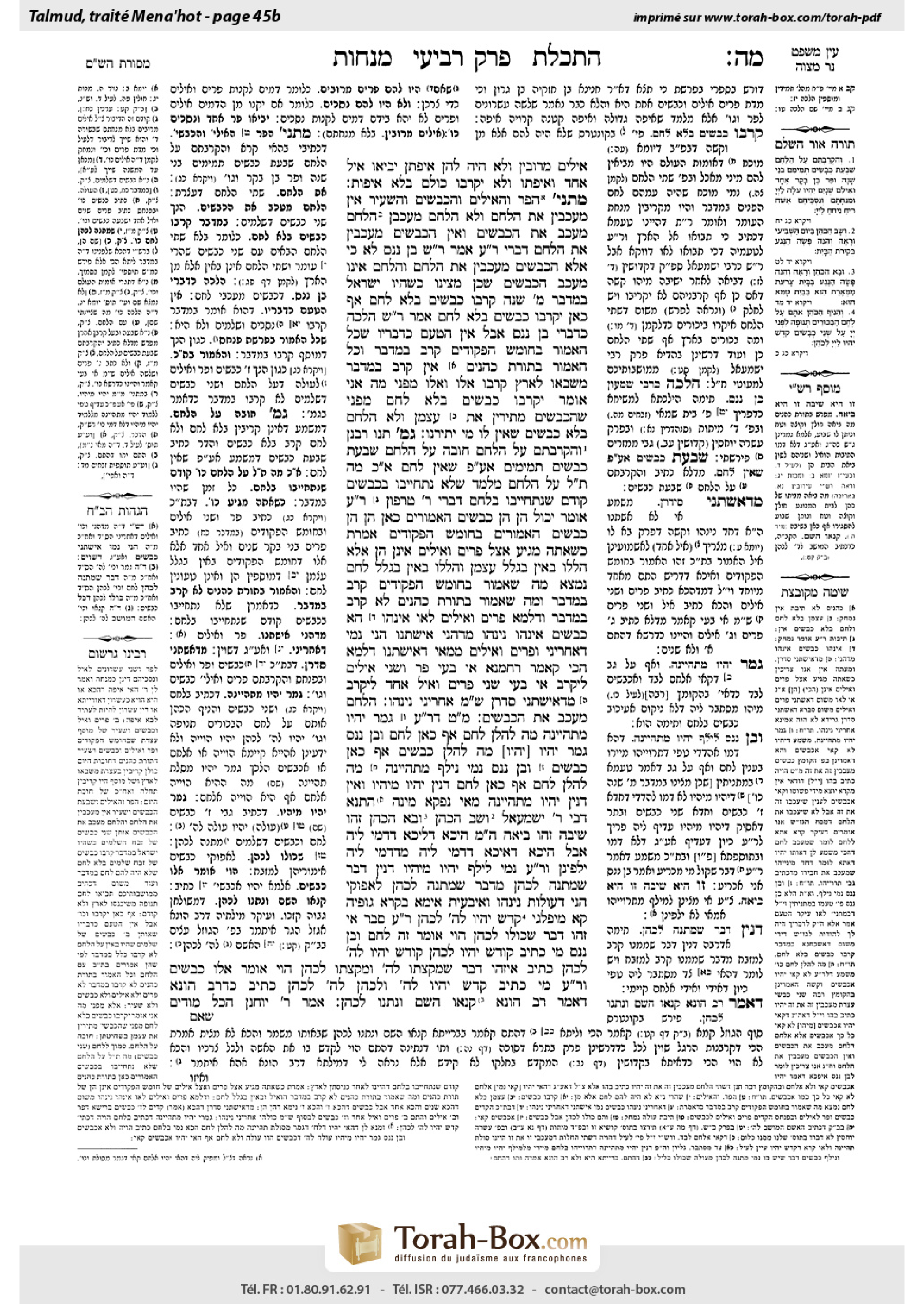
Menachot 45b: Talmud study for Daf Yomi
Daf Yomi is the daily study of one Talmud folio. Explore 37 tractates with scans, Hebrew text, Sefaria English and AI-generated French translations where annotated.
Passage selection and English or AI-generated French translation are available where the scan has annotations. Daf Study is independent of Torah-Box and Sefaria.
Browse Menachot · מנחות · All tractatesMenachot 45b text and translations
This page of Menachot includes the Aramaic text, an English translation and an AI-generated French translation, alongside the scan above.
מנחות מ״ה ב · Aramaic and Hebrew text
אֵילִים מְרוּבִּין וְלֹא הָיָה לָהֶן אֵיפָתָן – יָבִיאוּ אַיִל אֶחָד וְאֵיפָתוֹ, וְלֹא יִקְרְבוּ כּוּלָּם בְּלֹא אֵיפוֹת.
מַתְנִי׳ הַפָּר וְהָאֵילִים וְהַכְּבָשִׂים וְהַשָּׂעִיר – אֵין מְעַכְּבִין אֶת הַלֶּחֶם, וְלֹא הַלֶּחֶם מְעַכְּבָן.
הַלֶּחֶם מְעַכֵּב אֶת הַכְּבָשִׂים, וְאֵין הַכְּבָשִׂים מְעַכְּבִין אֶת הַלֶּחֶם, דִּבְרֵי רַבִּי עֲקִיבָא.
אָמַר רַבִּי שִׁמְעוֹן בֶּן נַנָּס: לֹא כִּי, אֶלָּא הַכְּבָשִׂים מְעַכְּבִין אֶת הַלֶּחֶם, וְהַלֶּחֶם אֵינוֹ מְעַכֵּב הַכְּבָשִׂים, שֶׁכֵּן מָצִינוּ כְּשֶׁהָיוּ יִשְׂרָאֵל בְּמִדְבָּר אַרְבָּעִים שָׁנָה קָרְבוּ כְּבָשִׂים בְּלֹא לֶחֶם, אַף כָּאן יִקְרְבוּ כְּבָשִׂים בְּלֹא לֶחֶם.
אָמַר רַבִּי שִׁמְעוֹן: הֲלָכָה כְּדִבְרֵי בֶּן נַנָּס, אֲבָל אֵין הַטַּעַם כִּדְבָרָיו.
שֶׁכׇּל הָאָמוּר בְּחוֹמֶשׁ הַפְּקוּדִים קָרֵב בַּמִּדְבָּר, וְכׇל הָאָמוּר בְּתוֹרַת כֹּהֲנִים אֵין קָרֵב בַּמִּדְבָּר, מִשֶּׁבָּאוּ לָאָרֶץ קָרְבוּ אֵלּוּ וָאֵלּוּ.
מִפְּנֵי מָה אֲנִי אוֹמֵר יִקְרְבוּ כְּבָשִׂים בְּלֹא לֶחֶם? מִפְּנֵי שֶׁהַכְּבָשִׁים מַתִּירִין אֶת עַצְמָן, וְלֹא הַלֶּחֶם בְּלֹא כְּבָשִׂים – שֶׁאֵין לוֹ מִי יַתִּירֶנּוּ.
גְּמָ׳ תָּנוּ רַבָּנַן: ״וְהִקְרַבְתֶּם עַל הַלֶּחֶם״ – חוֹבָה עַל הַלֶּחֶם, ״שִׁבְעַת כְּבָשִׂים תְּמִימִים״ – אַף עַל פִּי שֶׁאֵין לֶחֶם.
אִם כֵּן, מָה תַּלְמוּד לוֹמַר ״עַל הַלֶּחֶם״? מְלַמֵּד שֶׁלֹּא נִתְחַיְּיבוּ בַּכְּבָשִׂים קוֹדֶם שֶׁנִּתְחַיְּיבוּ בַּלֶּחֶם, דִּבְרֵי רַבִּי טַרְפוֹן.
רַבִּי עֲקִיבָא אוֹמֵר: יָכוֹל הֵן הֵן כְּבָשִׂים הָאֲמוּרִים כָּאן הֵן הֵן כְּבָשִׂים הָאֲמוּרִים בְּחוֹמֶשׁ הַפְּקוּדִים? אָמַרְתָּ, כְּשֶׁאַתָּה מַגִּיעַ אֵצֶל פָּרִים וְאֵילִים אֵינָן הֵן, אֶלָּא הַלָּלוּ בָּאִין בִּגְלַל עַצְמָן, וְהַלָּלוּ בָּאִין בִּגְלַל לֶחֶם.
נִמְצָא, מַה שֶּׁאָמוּר בְּחוֹמֶשׁ הַפְּקוּדִים – קָרֵב בַּמִּדְבָּר, וּמַה שֶּׁאָמוּר בְּתוֹרַת כֹּהֲנִים – לֹא קָרֵב בַּמִּדְבָּר.
וְדִלְמָא פָּרִים וְאֵילִים לָאו אִינְהוּ, הָא כְּבָשִׂים אִינְהוּ נִינְהוּ? מִדְּהָנֵי אִישְׁתַּנּוֹ, הָנֵי נָמֵי דְּאַחֲרִינֵי.
וּפָרִים וְאֵילִים, מִמַּאי דְּאִישְׁתַּנּוֹ? דִּלְמָא הָכִי קָאָמַר רַחֲמָנָא: אִי בָּעֵי פַּר וּשְׁנֵי אֵילִים לִיקְרַב, אִי בָּעֵי שְׁנֵי פָּרִים וְאַיִל אֶחָד לִיקְרַב! מִדְּאִישְׁתַּנִּי סִדְרָן, שְׁמַע מִינַּהּ אַחֲרִינֵי נִינְהוּ.
הַלֶּחֶם מְעַכֵּב אֶת הַכְּבָשִׂים, מַאי טַעְמָא דְּרַבִּי עֲקִיבָא?
גָּמַר ״יִהְיוּ״ מִ״תִּהְיֶינָה״.
מָה לְהַלָּן לֶחֶם, אַף כָּאן לֶחֶם.
וּבֶן נַנָּס, גָּמַר ״יִהְיוּ״ ״יִהְיוּ״, מָה לְהַלָּן כְּבָשִׂים, אַף כָּאן כְּבָשִׂים.
וּבֶן נַנָּס נָמֵי נֵילַף מִ״תִּהְיֶינָה״, מָה לְהַלָּן לֶחֶם אַף כָּאן לֶחֶם? דָּנִין ״יִהְיוּ״ מִ״יִּהְיוּ״, וְאֵין דָּנִין ״יִהְיוּ״ מִ״תִּהְיֶינָה״.
מַאי נָפְקָא מִינַּהּ? הָתָנָא דְּבֵי רַבִּי יִשְׁמָעֵאל: ״וְשָׁב הַכֹּהֵן״ ״וּבָא הַכֹּהֵן״ – זֶהוּ שִׁיבָה, זֶהוּ בִּיאָה.
הָנֵי מִילֵּי הֵיכָא דְּלֵיכָּא דְּדָמֵי לֵיהּ, אֲבָל הֵיכָא דְּאִיכָּא דְּדָמֵי לֵיהּ – מִדְּדָמֵי לֵיהּ יָלְפִינַן.
וְרַבִּי עֲקִיבָא נָמֵי לֵילַף ״יִהְיוּ״ מִ״יִּהְיוּ״? דָּנִין דָּבָר שֶׁמַּתָּנָה לַכֹּהֵן מִדָּבָר שֶׁמַּתָּנָה לַכֹּהֵן, לְאַפּוֹקֵי הָנֵי דְּעוֹלוֹת נִינְהוּ.
וְאִיבָּעֵית אֵימָא, בִּקְרָא גּוּפֵיהּ קָא מִיפַּלְגִי: ״קֹדֶשׁ יִהְיוּ לַה׳ לַכֹּהֵן״, רַבִּי עֲקִיבָא סָבַר: אֵי זֶהוּ דָּבָר שֶׁכּוּלּוֹ לַכֹּהֵן? הֱוֵי אוֹמֵר: זֶה לֶחֶם.
וּבֶן נַנָּס: מִי כְּתִיב ״קֹדֶשׁ יִהְיוּ לַכֹּהֵן״?! ״קֹדֶשׁ יִהְיוּ לַה׳ לַכֹּהֵן״ כְּתִיב, אֵיזֶהוּ דָּבָר שֶׁמִּקְצָתוֹ לַה׳ וּמִקְצָתוֹ לַכֹּהֵן? הֱוֵי אוֹמֵר: אֵלּוּ כְּבָשִׂים.
וְרַבִּי עֲקִיבָא, מִי כְּתִיב ״קֹדֶשׁ יִהְיוּ לַה׳ וְלַכֹּהֵן״? ״לַה׳ לַכֹּהֵן״ כְּתִיב, כִּדְרַב הוּנָא, דְּאָמַר רַב הוּנָא: קְנָאוֹ הַשֵּׁם וּנְתָנוֹ לַכֹּהֵן.
אָמַר רַבִּי יוֹחָנָן: הַכֹּל מוֹדִים
Menachot 45b · English translation
the numerous rams that are required to be sacrificed on that day and they did not also have sufficient funds for the ephah, i.e., the prescribed measure, of flour for all of the rams, they should bring one ram and its ephah of flour, and they should not sacrifice all of them without their ephahs of flour.
MISHNA: On Shavuot there is an obligation to sacrifice burnt offerings, a sin offering, and peace offerings together with the offering of the two loaves. The burnt offerings consist of a bull, two rams, and seven sheep. A goat is brought for the sin offering. Two sheep are brought as peace offerings and waved together with the two loaves. Failure to sacrifice the bull, the rams, and the sheep, which are all brought as burnt offerings, and the goat that is brought as a sin offering, does not prevent the bringing of the two loaves, and they are sacrificed nevertheless. Failure to bring the two loaves does not prevent sacrifice of the accompanying animal offerings.
Failure to bring the two loaves prevents sacrifice of the accompanying peace offering of two sheep, but failure to sacrifice the two sheep does not prevent the bringing of the two loaves; this is the statement of Rabbi Akiva.
Rabbi Shimon ben Nannas says: No, rather the opposite is true. Failure to sacrifice the peace offering of two sheep prevents the bringing of the two loaves, but failure to bring the two loaves does not prevent sacrifice of the accompanying peace offering of two sheep. As we found that when the Jewish people were in the wilderness for forty years after the exodus from Egypt, they sacrificed the two sheep as a peace offering on Shavuot without the two loaves, as the two loaves may be brought only from wheat grown in Eretz Yisrael after the Jewish people entered the land. Here too, whenever wheat is unavailable, they should sacrifice the two sheep without the two loaves. However, the two loaves are not sacrificed without the peace offering of two sheep.
Rabbi Shimon says: The halakha is in accordance with the statement of Rabbi Shimon ben Nannas that failure to sacrifice the two sheep prevents the bringing of the two loaves but failure to bring the two loaves does not prevent sacrifice of the accompanying peace offering of two sheep, but the reason for that ruling is not in accordance with his statement.
As all the offerings that must be sacrificed on Shavuot that are stated in the book of Numbers (see 28:27), i.e., two bulls, one ram, and seven sheep as additional offerings and a goat as a sin offering, were sacrificed when the Jewish people were in the wilderness. But all the offerings stated in Leviticus (see 23:18–20), i.e., the offerings accompanying the two loaves, were not sacrificed when the Jewish people were in the wilderness. Not only were the two loaves not sacrificed, but the accompanying offerings, including the peace offering of the two sheep, were also not sacrificed, because it was only when they arrived in Eretz Yisrael that these additional offerings and those offerings accompanying the two loaves were sacrificed. Neither the additional offerings of Shavuot nor the two loaves, and the offerings that accompany them, were sacrificed in the wilderness, contrary to the opinion of Rabbi Shimon ben Nannas.
Rather, for what reason do I nevertheless say that the sheep should be sacrificed without the loaves, in accordance with the opinion of Rabbi Shimon ben Nannas? It is due to the fact that the sheep permit themselves, as the sprinkling of their blood and the burning of the portions consumed on the altar renders it permitted to partake of their meat. And why are the loaves not sacrificed without the sheep? It is because there is no item to permit the loaves, as the loaves are permitted only after the sheep are sacrificed.
GEMARA: The mishna teaches the halakhot of the sacrifices that generally accompany the two loaves on Shavuot in a case when the two loaves are not available. The Gemara cites a relevant baraita. The Sages taught: The verse that mandates these offerings states: “And you shall sacrifice with the bread seven lambs without blemish of the first year, and one young bull, and two rams” (Leviticus 23:18). The phrase “and you shall sacrifice with the bread” indicates that it is obligatory to sacrifice these burnt offerings with the loaves of bread, and if the loaves are not available, then these offerings are not sacrificed. The continuation of the verse: “Seven lambs without blemish,” teaches that the lambs are sacrificed even if there are no loaves available.
If so, that the animal offerings may be sacrificed even without loaves, what is the meaning when the verse states “with the bread”? It teaches that they were not obligated to sacrifice the sheep before they were obligated to sacrifice loaves, i.e., they became obligated to sacrifice all of these offerings only when they entered Eretz Yisrael. This is the statement of Rabbi Tarfon.
Rabbi Akiva says: One might have thought that the sheep mentioned here in Leviticus, which accompany the two loaves, are the very same ones mentioned in the book of Numbers (see 28:27), in the passage prescribing the additional offerings. You must say when you reach the bulls and rams that are enumerated in the two passages that the offerings mentioned in one are not those mentioned in the other, as the number of bulls and rams are not equal. Whereas in Leviticus the verse requires the sacrifice of one bull and two rams, in Numbers the verse requires the sacrifice of two bulls and one ram. Rather, the two passages are referring to different offerings. These mentioned in Numbers come upon the altar for their own sake, and those mentioned in Leviticus come upon the altar for the sake of the two loaves.
It is therefore found that the offerings that are mentioned in the book of Numbers were sacrificed even when the Jewish people were in the wilderness and could not bring the offering of the two loaves, but the offerings that are mentioned in Leviticus were not sacrificed in the wilderness, due to the fact that the two loaves could not be sacrificed in the wilderness.
The Gemara challenges: But perhaps the bulls and rams mentioned in Numbers are not those mentioned in Leviticus, but the sheep mentioned in Numbers are the same as those mentioned in Leviticus. The Gemara explains: From the fact that these bulls and rams are different, it is apparent that those sheep are also different offerings.
The Gemara asks: But from where is it proven that the bulls and rams in Numbers are different offerings than the bulls and rams mentioned in Leviticus? Perhaps they are actually the same offerings, and this is what the Merciful One is saying: If you want, sacrifice a bull and two rams, as the verse states in Leviticus; and if you want, sacrifice two bulls and one ram, as the verse states in Numbers. The Gemara answers: From the fact that the order of the offerings is different in the two passages, as the verse in Leviticus mentions the sheep, then the bull, and then the rams, whereas the verse in Numbers mentions the bulls, then the ram, and then the sheep, one may conclude from it that they are different offerings.
§ The mishna teaches: Failure to bring the two loaves prevents sacrifice of the accompanying peace offering of two sheep, but failure to sacrifice the two sheep does not prevent the bringing of the two loaves; this is the statement of Rabbi Akiva. The Gemara asks: What is the reasoning of Rabbi Akiva?
The Gemara answers: He derived the halakha based upon a verbal analogy between two verses. One verse states: “And the priest shall wave them with the bread of the first fruits for a wave offering before the Lord, with the two lambs; they shall be [yihyu] holy to the Lord for the priest” (Leviticus 23:20). The term “they shall be” indicates that it is essential that the offering be brought precisely as commanded, but it is unclear whether this is referring to the loaves or to the sheep brought as peace offerings. This is clarified by means of a verbal analogy from the verse: “You shall bring out of your dwellings two loaves of waving of two tenth parts of an ephah; they shall be [tihyena] of fine flour” (Leviticus 23:17).
The verbal analogy teaches that just as there the requirement that it be done as prescribed is referring to the loaves rather than the sheep, so too here it is referring to the loaves rather than the sheep. Consequently, failure to bring the loaves prevents sacrifice of the sheep, but failure to sacrifice the sheep does not prevent the bringing of the loaves.
The Gemara asks: And how did Rabbi Shimon ben Nannas, who holds that failure to sacrifice the sheep prevents the bringing of the loaves but failure to bring the loaves does not prevent sacrifice of the sheep, derive his ruling? He derived the halakha through a verbal analogy between the verse: “They shall be [yihyu] holy to the Lord for the priest,” and the verse that states, concerning the seven sheep brought as burnt offerings: “They shall be [yihyu] a burnt offering to the Lord” (Leviticus 23:18). Just as there the requirement that it be done as prescribed is referring to the sheep, so too here it is referring to sheep rather than loaves.
The Gemara challenges: And according to Rabbi Shimon ben Nannas also, we should derive the halakha based upon a verbal analogy from the word tihyena as Rabbi Akiva does, and conclude that just as there it is referring to the loaves, so too here it is referring to the loaves. The Gemara responds: It is preferable to derive the meaning of the term yihyu from a verbal analogy using the identical form yihyu, and one should not derive the meaning of the term yihyu from a verbal analogy using the term tihyena.
The Gemara asks: What difference is there whether or not the words are identical? Didn’t the school of Rabbi Yishmael teach a verbal analogy with regard to leprosy of houses? The verse states: “And the priest shall return [veshav] on the seventh day” (Leviticus 14:39), and another verse with regard to the priest’s visit seven days later states: “And the priest shall come [uva] and look” (Leviticus 14:44). This returning and this coming have the same meaning, and one can therefore derive by verbal analogy that the halakha which applies if the leprosy had spread at the conclusion of the first week likewise applies if it had spread again by the end of the following week. Certainly, if the halakha can be derived via a verbal analogy with the words veshav and uva, the even slighter difference in form between yihyu and tihyena should not prevent the application of a verbal analogy.
The Gemara answers: This matter applies only when there are no terms that are identical to it. But where there are terms that are identical to it, we derive the verbal analogy from terms identical to it rather than from the terms that are not precisely identical. Consequently, it is preferable to derive the meaning of the term yihyu from the identical term rather than from tihyena.
The Gemara challenges: And let Rabbi Akiva also derive the meaning of the term yihyu from a verbal analogy to the identical term yihyu, as Rabbi Shimon ben Nannas does. The Gemara responds: Rabbi Akiva holds that it is preferable to derive the halakha concerning an item that is given as a gift to the priest, such as the loaves or the sheep brought as peace offerings, which are the subject of Leviticus 23:20, from the halakha concerning an item that is also a gift to the priest, i.e., the two loaves, which are the subject of Leviticus 23:17. This is to the exclusion of these seven sheep that are mentioned in Leviticus 23:18, which are burnt offerings and wholly consumed by the altar, and are not a gift to the priest. Consequently, it is preferable to derive the meaning of the term yihyu in verse 20 from the term tihyena in verse 17, rather than from the term yihyu in verse 18.
The Gemara presents an alternative explanation for the basis of their divergent opinions: And if you wish, say instead that they disagree about the interpretation of the verse itself: “They shall be [yihyu] holy to the Lord for the priest” (Leviticus 23:20). Rabbi Akiva holds: Which item is entirely given to the priest? You must say that it is the loaves of bread. Therefore he concludes that the word yihyu is referring to the loaves of bread, and if they are not sacrificed, the two sheep cannot be sacrificed as peace offerings.
The Gemara asks: And how would Rabbi Shimon ben Nannas respond to this? He would say: Is it in fact written: They shall be [yihyu] holy for the priest, in which case one should interpret it as Rabbi Akiva does? It is written in the verse: “They shall be [yihyu] holy to the Lord for the priest.” Therefore, it should be understood in the following manner: Which item is partially given to the Lord and partially given to the priest? You must say that it is the sheep, which are sacrificed as a peace offering, part of which is burned on the altar and part of which is consumed by the priests. Consequently, the word yihyu should be understood as referring to the sheep, and if they are not sacrificed, the two loaves cannot be sacrificed either.
The Gemara asks: And how would Rabbi Akiva respond to this? He would say: Is it in fact written: They shall be [yihyu] holy for the Lord and for the priest? It is written in the verse: “They shall be [yihyu] holy to the Lord for the priest.” Therefore, it should be understood to mean that it is given to the Lord, and it is then given by Him entirely to the priests, in accordance with the statement of Rav Huna, as Rav Huna says: The Lord acquired it initially and then gave it to the priest.
§ With regard to the dispute in the mishna about whether failure to sacrifice the two sheep as peace offerings prevents the bringing of the two loaves or vice versa, Rabbi Yoḥanan says: Everyone concedes
Menachot 45b · Traduction française (IA)
les nombreux béliers qui doivent être sacrifiés ce jour-là et qu’ils ne disposent pas non plus de fonds suffisants pour acheter la mesure prescrite de farine, l’épha, pour tous les béliers, qu’ils apportent un seul bélier avec son épha de farine et ne sacrifient pas tous les béliers sans leur épha de farine.
MICHNA : À Chavouot, il faut sacrifier des holocaustes, un sacrifice expiatoire et des sacrifices de paix avec l’offrande des deux pains. Les holocaustes consistent en un taureau, deux béliers et sept agneaux. Un bouc est apporté comme sacrifice expiatoire. Deux agneaux sont apportés comme sacrifices de paix et balancés avec les deux pains. Le fait de ne pas sacrifier le taureau, les béliers et les agneaux, qui sont tous apportés comme holocaustes, ainsi que le bouc apporté comme sacrifice expiatoire, n’empêche pas d’apporter les deux pains, qui sont néanmoins sacrifiés. Le fait de ne pas apporter les deux pains n’empêche pas le sacrifice des offrandes animales qui les accompagnent.
Le fait de ne pas apporter les deux pains empêche le sacrifice de l’offrande de paix composée de deux agneaux, mais le fait de ne pas sacrifier les deux agneaux n’empêche pas d’apporter les deux pains. Telle est la déclaration de Rabbi Akiva.
Rabbi Shimon ben Nannas dit : Non, c’est plutôt l’inverse. Le fait de ne pas sacrifier l’offrande de paix composée de deux agneaux empêche d’apporter les deux pains, mais le fait de ne pas apporter les deux pains n’empêche pas le sacrifice de l’offrande de paix composée de deux agneaux. En effet, nous avons constaté que, lorsque le peuple juif se trouvait dans le désert pendant les quarante années qui suivirent l’Exode d’Égypte, il sacrifiait les deux agneaux comme offrande de paix à Chavouot sans les deux pains, puisque ceux-ci ne peuvent être apportés qu’à partir du blé cultivé en Eretz Israël, après l’entrée du peuple juif dans le pays. De même, chaque fois que le blé fait défaut, ils doivent sacrifier les deux agneaux sans les deux pains. Cependant, les deux pains ne sont pas sacrifiés sans l’offrande de paix composée de deux agneaux.
Rabbi Shimon dit : La halakha suit la déclaration de Rabbi Shimon ben Nannas, selon laquelle le fait de ne pas sacrifier les deux agneaux empêche d’apporter les deux pains, mais le fait de ne pas apporter les deux pains n’empêche pas le sacrifice de l’offrande de paix composée de deux agneaux. Toutefois, la raison de cette décision n’est pas celle qu’il a avancée.
En effet, toutes les offrandes qui doivent être sacrifiées à Chavouot et qui sont mentionnées dans le livre des Nombres (voir 28:27), à savoir deux taureaux, un bélier et sept agneaux comme offrandes supplémentaires, ainsi qu’un bouc comme sacrifice expiatoire, furent sacrifiées lorsque le peuple juif se trouvait dans le désert. Mais les offrandes mentionnées dans le Lévitique (voir 23:18–20), c’est-à-dire celles qui accompagnent les deux pains, ne furent pas sacrifiées lorsque le peuple juif se trouvait dans le désert. Non seulement les deux pains ne furent pas sacrifiés, mais les offrandes qui les accompagnaient, y compris l’offrande de paix composée de deux agneaux, ne le furent pas non plus, car ces offrandes supplémentaires et celles qui accompagnent les deux pains ne furent sacrifiées qu’une fois le peuple arrivé en Eretz Israël. Ni les offrandes supplémentaires de Chavouot, ni les deux pains ni les offrandes qui les accompagnent ne furent sacrifiés dans le désert, contrairement à l’opinion de Rabbi Shimon ben Nannas.
Alors, pour quelle raison dis-je néanmoins que les agneaux doivent être sacrifiés sans les pains, conformément à l’opinion de Rabbi Shimon ben Nannas ? C’est parce que les agneaux rendent eux-mêmes leur viande permise à la consommation : l’aspersion de leur sang et la combustion sur l’autel des portions qui lui sont destinées rendent leur viande permise. Et pourquoi les pains ne sont-ils pas sacrifiés sans les agneaux ? Parce qu’il n’y a rien qui puisse rendre les pains permis, puisque ceux-ci ne le deviennent qu’après le sacrifice des agneaux.
GUEMARA : La Michna enseigne les halakhot relatives aux sacrifices qui accompagnent habituellement les deux pains à Chavouot, dans le cas où les deux pains ne sont pas disponibles. La Guemara cite une baraïta pertinente. Les Sages ont enseigné : Le verset qui prescrit ces offrandes dit : « Et vous sacrifierez avec le pain sept agneaux sans défaut, âgés d’un an, un jeune taureau et deux béliers » (Lévitique 23:18). L’expression « et vous sacrifierez avec le pain » indique qu’il est obligatoire de sacrifier ces holocaustes avec les pains ; si les pains ne sont pas disponibles, ces offrandes ne sont pas sacrifiées. La suite du verset, « sept agneaux sans défaut », enseigne que les agneaux sont sacrifiés même si aucun pain n’est disponible.
Si tel est le cas, et que les offrandes animales peuvent être sacrifiées même sans les pains, que signifie l’expression « avec le pain » dans le verset ? Elle enseigne qu’ils n’étaient pas tenus de sacrifier les agneaux avant d’être tenus d’apporter les pains ; autrement dit, ils ne furent tenus de sacrifier toutes ces offrandes qu’à leur entrée en Eretz Israël. Telle est la déclaration de Rabbi Tarfon.
Rabbi Akiva dit : On aurait pu penser que les agneaux mentionnés ici dans le Lévitique, qui accompagnent les deux pains, sont les mêmes que ceux mentionnés dans le livre des Nombres (voir 28:27), dans le passage qui prescrit les offrandes supplémentaires. Mais, lorsque l’on en vient aux taureaux et aux béliers énumérés dans les deux passages, il faut conclure que les offrandes mentionnées dans l’un ne sont pas celles mentionnées dans l’autre, puisque le nombre de taureaux et de béliers n’est pas le même. Alors que le verset du Lévitique prescrit le sacrifice d’un taureau et de deux béliers, celui des Nombres prescrit le sacrifice de deux taureaux et d’un bélier. Les deux passages parlent donc d’offrandes différentes. Celles qui sont mentionnées dans les Nombres sont offertes sur l’autel pour elles-mêmes, tandis que celles qui sont mentionnées dans le Lévitique sont offertes sur l’autel en raison des deux pains.
Il s’ensuit que les offrandes mentionnées dans le livre des Nombres furent sacrifiées même lorsque le peuple juif se trouvait dans le désert et ne pouvait pas apporter l’offrande des deux pains, tandis que les offrandes mentionnées dans le Lévitique ne furent pas sacrifiées dans le désert, car les deux pains ne pouvaient pas y être sacrifiés.
La Guemara objecte : Mais peut-être les taureaux et les béliers mentionnés dans les Nombres ne sont-ils pas les mêmes que ceux mentionnés dans le Lévitique, tandis que les agneaux mentionnés dans les Nombres sont les mêmes que ceux mentionnés dans le Lévitique. La Guemara explique : Puisque ces taureaux et ces béliers sont différents, il apparaît que ces agneaux aussi sont des offrandes différentes.
La Guemara demande : Mais d’où sait-on que les taureaux et les béliers mentionnés dans les Nombres sont des offrandes différentes de ceux mentionnés dans le Lévitique ? Peut-être s’agit-il en réalité des mêmes offrandes, et voici ce que dit le Miséricordieux : si vous le voulez, sacrifiez un taureau et deux béliers, comme le prescrit le verset du Lévitique ; et si vous le voulez, sacrifiez deux taureaux et un bélier, comme le prescrit le verset des Nombres. La Guemara répond : Puisque l’ordre des offrandes diffère dans les deux passages — le verset du Lévitique mentionne les agneaux, puis le taureau, puis les béliers, tandis que celui des Nombres mentionne les taureaux, puis le bélier, puis les agneaux — on peut en conclure qu’il s’agit d’offrandes différentes.
§ La Michna enseigne : Le fait de ne pas apporter les deux pains empêche le sacrifice de l’offrande de paix composée de deux agneaux, mais le fait de ne pas sacrifier les deux agneaux n’empêche pas d’apporter les deux pains. Telle est la déclaration de Rabbi Akiva. La Guemara demande : Quel est le raisonnement de Rabbi Akiva ?
La Guemara répond : Il a déduit la halakha par analogie verbale entre deux versets. Un verset dit : « Le prêtre les balancera avec le pain des prémices, en offrande balancée devant le Seigneur, avec les deux agneaux ; ils seront [yihyu] saints pour le Seigneur, destinés au prêtre » (Lévitique 23:20). L’expression « ils seront » indique qu’il est essentiel que l’offrande soit apportée exactement comme prescrit, mais on ne sait pas si cela se rapporte aux pains ou aux agneaux apportés comme sacrifices de paix. Cela est précisé au moyen d’une analogie verbale avec le verset : « Vous apporterez de vos lieux d’habitation deux pains à balancer, faits de deux dixièmes d’épha ; ils seront [tihyena] de fleur de farine » (Lévitique 23:17).
L’analogie verbale enseigne que, de même que, dans ce verset, l’exigence de procéder conformément à la prescription se rapporte aux pains plutôt qu’aux agneaux, de même, ici, elle se rapporte aux pains plutôt qu’aux agneaux. Par conséquent, le fait de ne pas apporter les pains empêche le sacrifice des agneaux, mais le fait de ne pas sacrifier les agneaux n’empêche pas d’apporter les pains.
La Guemara demande : Et comment Rabbi Shimon ben Nannas, selon qui le fait de ne pas sacrifier les agneaux empêche d’apporter les pains, tandis que le fait de ne pas apporter les pains n’empêche pas le sacrifice des agneaux, a-t-il déduit sa décision ? Il a déduit la halakha par analogie verbale entre le verset « Ils seront [yihyu] saints pour le Seigneur, destinés au prêtre » et le verset qui dit, à propos des sept agneaux apportés comme holocaustes : « Ils seront [yihyu] un holocauste pour le Seigneur » (Lévitique 23:18). De même que, dans ce verset, l’exigence de procéder conformément à la prescription se rapporte aux agneaux, de même, ici, elle se rapporte aux agneaux plutôt qu’aux pains.
La Guemara objecte : Selon Rabbi Shimon ben Nannas aussi, on devrait déduire la halakha par analogie verbale à partir du mot tihyena, comme le fait Rabbi Akiva, et conclure que, de même que ce mot se rapporte aux pains, de même, ici, il se rapporte aux pains. La Guemara répond : Il est préférable de déduire le sens du terme yihyu par analogie verbale avec la forme identique yihyu, plutôt que par analogie verbale avec le terme tihyena.
La Guemara demande : Quelle différence cela fait-il que les mots soient identiques ou non ? L’école de Rabbi Yishmael n’a-t-elle pas enseigné une analogie verbale à propos de la lèpre des maisons ? Le verset dit : « Le prêtre reviendra [veshav] le septième jour » (Lévitique 14:39), et un autre verset, à propos de la visite du prêtre sept jours plus tard, dit : « Le prêtre viendra [uva] et regardera » (Lévitique 14:44). Ce retour et cette venue ont le même sens ; on peut donc déduire par analogie verbale que la halakha applicable si la lèpre s’est étendue à la fin de la première semaine s’applique également si elle s’est de nouveau étendue à la fin de la semaine suivante. Assurément, si la halakha peut être déduite par analogie verbale à partir des mots veshav et uva, la différence de forme, encore plus légère, entre yihyu et tihyena ne devrait pas empêcher l’application d’une analogie verbale.
La Guemara répond : Cela ne s’applique que lorsqu’il n’existe aucun terme identique. Mais lorsqu’il existe des termes identiques, nous établissons l’analogie verbale à partir de termes identiques plutôt qu’à partir de termes qui ne le sont pas exactement. Par conséquent, il est préférable de déduire le sens du terme yihyu à partir du terme identique plutôt qu’à partir de tihyena.
La Guemara objecte : Rabbi Akiva aussi devrait déduire le sens du terme yihyu par analogie verbale avec le terme identique yihyu, comme le fait Rabbi Shimon ben Nannas. La Guemara répond : Rabbi Akiva estime qu’il est préférable de déduire la halakha concernant un élément donné en cadeau au prêtre, comme les pains ou les agneaux apportés comme sacrifices de paix, qui font l’objet de Lévitique 23:20, de la halakha concernant un élément qui est également donné en cadeau au prêtre, à savoir les deux pains, qui font l’objet de Lévitique 23:17. Cela exclut les sept agneaux mentionnés en Lévitique 23:18, qui sont des holocaustes entièrement consumés sur l’autel et ne constituent pas un cadeau au prêtre. Par conséquent, il est préférable de déduire le sens du terme yihyu au verset 20 à partir du terme tihyena au verset 17, plutôt qu’à partir du terme yihyu au verset 18.
La Guemara présente une autre explication du fondement de leurs opinions divergentes : et si tu le souhaites, dis plutôt qu’ils ne sont pas d’accord sur l’interprétation du verset lui-même : « Ils seront [yihyu] saints pour le Seigneur, destinés au prêtre » (Lévitique 23:20). Rabbi Akiva estime : Quel élément est entièrement donné au prêtre ? Il faut dire que ce sont les pains. Il en conclut donc que le mot yihyu se rapporte aux pains et que, s’ils ne sont pas apportés, les deux agneaux ne peuvent pas être sacrifiés comme sacrifices de paix.
La Guemara demande : Et que répondrait Rabbi Shimon ben Nannas ? Il dirait : Est-il effectivement écrit : « Ils seront [yihyu] saints pour le prêtre », ce qui justifierait de l’interpréter comme le fait Rabbi Akiva ? Le verset dit : « Ils seront [yihyu] saints pour le Seigneur, destinés au prêtre. » Il faut donc le comprendre ainsi : Quel élément est donné en partie au Seigneur et en partie au prêtre ? Il faut dire que ce sont les agneaux, qui sont sacrifiés comme sacrifices de paix, dont une partie est brûlée sur l’autel et une autre consommée par les prêtres. Par conséquent, le mot yihyu doit être compris comme se rapportant aux agneaux et, s’ils ne sont pas sacrifiés, les deux pains ne peuvent pas l’être non plus.
La Guemara demande : Et que répondrait Rabbi Akiva ? Il dirait : Est-il effectivement écrit : « Ils seront [yihyu] saints pour le Seigneur et pour le prêtre » ? Le verset dit : « Ils seront [yihyu] saints pour le Seigneur, destinés au prêtre. » Il faut donc comprendre que l’élément est donné au Seigneur, puis que Celui-ci le donne intégralement aux prêtres, conformément à la déclaration de Rav Houna. Car Rav Houna dit : Le Seigneur l’acquiert d’abord, puis le donne au prêtre.
§ À propos de la controverse de la Michna sur la question de savoir si le fait de ne pas sacrifier les deux agneaux comme sacrifices de paix empêche d’apporter les deux pains, ou inversement, Rabbi Yoḥanan dit : Tous reconnaissent
Traduction française générée par IA à partir de l’édition anglaise de Sefaria. Vérifie toujours un passage avec le texte source.
Text from Sefaria: William Davidson Edition - Vocalized Aramaic (unknown); William Davidson Edition - English (CC BY NC).