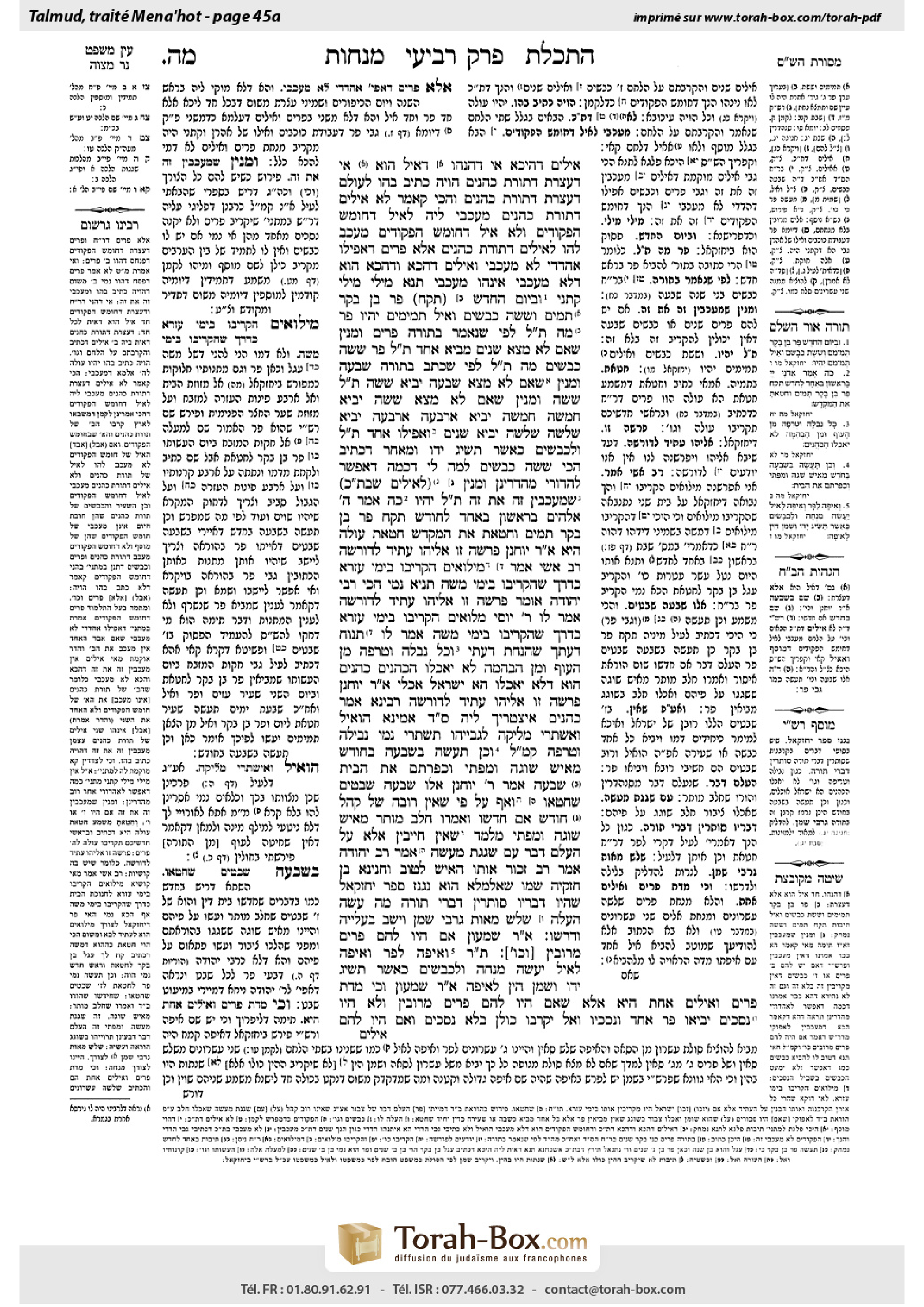
Menachot 45a: Talmud study for Daf Yomi
Daf Yomi is the daily study of one Talmud folio. Explore 37 tractates with scans, Hebrew text, Sefaria English and AI-generated French translations where annotated.
Passage selection and English or AI-generated French translation are available where the scan has annotations. Daf Study is independent of Torah-Box and Sefaria.
Browse Menachot · מנחות · All tractatesMenachot 45a text and translations
This page of Menachot includes the Aramaic text, an English translation and an AI-generated French translation, alongside the scan above.
מנחות מ״ה א · Aramaic and Hebrew text
אֵילִים דְּהֵיכָא? אִי דְּהָנְהוּ – דְּאַיִל הוּא, אִי דַּעֲצֶרֶת דְּתוֹרַת כֹּהֲנִים – הֲוָיָה כְּתִיב בְּהוּ.
לְעוֹלָם דַּעֲצֶרֶת דְּתוֹרַת כֹּהֲנִים, וְהָכִי קָאָמַר: לָא אֵילִים דְּתוֹרַת כֹּהֲנִים מְעַכְּבִי לֵיהּ לְאַיִל דְּחוֹמֶשׁ הַפְּקוּדִים, וָלֹא אַיִל דְּחוֹמֶשׁ הַפְּקוּדִים מְעַכֵּב לְהוּ לְאֵילִים דְּתוֹרַת כֹּהֲנִים.
אֶלָּא, פָּרִים – דַּאֲפִילּוּ אַהֲדָדֵי לָא מְעַכְּבִי, וְאֵילִים – דְּהָכָא וּדְהָכָא הוּא דְּלָא מְעַכְּבִי, אִינְהוּ מְעַכְּבִי.
תַּנָּא מִילֵּי מִילֵּי קָתָנֵי.
״וּבְיוֹם הַחֹדֶשׁ (תִּקַּח) פַּר בֶּן בָּקָר תָּמִים וְשִׁשָּׁה כְּבָשִׂים וָאַיִל תְּמִימִים יִהְיוּ״, ״פַּר״ – מָה תַּלְמוּד לוֹמַר?
לְפִי שֶׁנֶּאֱמַר בַּתּוֹרָה ״פָּרִים״, וּמִנַּיִן שֶׁאִם לֹא מָצָא שְׁנַיִם מֵבִיא אֶחָד? תַּלְמוּד לוֹמַר ״פַּר״.
״שִׁשָּׁה כְּבָשִׂים״ – מָה תַּלְמוּד לוֹמַר? לְפִי שֶׁכָּתוּב בַּתּוֹרָה ״שִׁבְעָה״, וּמִנַּיִן שֶׁאִם לֹא מָצָא שִׁבְעָה יָבִיא שִׁשָּׁה? תַּלְמוּד לוֹמַר ״שִׁשָּׁה״.
וּמִנַּיִן שֶׁאִם לֹא מָצָא שִׁשָּׁה, יָבִיא חֲמִשָּׁה, חֲמִשָּׁה יָבִיא אַרְבָּעָה, אַרְבָּעָה יָבִיא שְׁלֹשָׁה, שְׁלֹשָׁה יָבִיא שְׁנַיִם, וַאֲפִילּוּ אֶחָד? תַּלְמוּד לוֹמַר ״וְלַכְּבָשִׂים כַּאֲשֶׁר תַּשִּׂיג יָדוֹ״.
וּמֵאַחַר דִּכְתִיב הָכִי, ״שִׁשָּׁה כְּבָשִׂים״ לְמָה לִי? דְּכַמָּה דְּאֶפְשָׁר לְהַדּוֹרֵי, מְהַדְּרִינַן.
וּמִנַּיִן (לְאֵילִים שֶׁבְּתוֹרַת כֹּהֲנִים) שֶׁמְּעַכְּבִין זֶה אֶת זֶה? תַּלְמוּד לוֹמַר ״יִהְיוּ״.
״כֹּה אָמַר ה׳ אֱלֹהִים בָּרִאשׁוֹן בְּאֶחָד לַחוֹדֶשׁ תִּקַּח פַּר בֶּן בָּקָר תָּמִים וְחִטֵּאתָ אֶת הַמִּקְדָּשׁ״. ״חַטָּאת״ – עוֹלָה הִיא! אָמַר רַבִּי יוֹחָנָן: פָּרָשָׁה זוֹ אֵלִיָּהוּ עָתִיד לְדוֹרְשָׁהּ.
רַב אָשֵׁי אָמַר: מִילּוּאִים הִקְרִיבוּ בִּימֵי עֶזְרָא, כְּדֶרֶךְ שֶׁהִקְרִיבוּ בִּימֵי מֹשֶׁה.
תַּנְיָא נָמֵי הָכִי, רַבִּי יְהוּדָה אוֹמֵר: פָּרָשָׁה זוֹ אֵלִיָּהוּ עָתִיד לְדוֹרְשָׁהּ. אָמַר לוֹ רַבִּי יוֹסֵי: מִלּוּאִים הִקְרִיבוּ בִּימֵי עֶזְרָא, כְּדֶרֶךְ שֶׁהִקְרִיבוּ בִּימֵי מֹשֶׁה. אָמַר לוֹ: תָּנוּחַ דַּעְתְּךָ שֶׁהִנַּחְתָּ דַּעְתִּי.
״וְכׇל נְבֵלָה וּטְרֵפָה מִן הָעוֹף וּמִן הַבְּהֵמָה לֹא יֹאכְלוּ הַכֹּהֲנִים״ – כֹּהֲנִים הוּא דְּלֹא יֹאכְלוּ, הָא יִשְׂרָאֵל אָכְלִי? אָמַר רַבִּי יוֹחָנָן: פָּרָשָׁה זוֹ אֵלִיָּהוּ עָתִיד לְדוֹרְשָׁהּ.
רָבִינָא אָמַר: כֹּהֲנִים אִיצְטְרִיךְ לֵיהּ, סָלְקָא דַּעְתָּךְ אָמֵינָא: הוֹאִיל וְאִשְׁתְּרִי מְלִיקָה לְגַבַּיְיהוּ, תִּשְׁתְּרֵי נָמֵי נְבֵילָה וּטְרֵפָה, קָא מַשְׁמַע לַן.
״וְכֵן תַּעֲשֶׂה בְּשִׁבְעָה בַחֹדֶשׁ מֵאִישׁ שֹׁגֶה וּמִפֶּתִי וְכִפַּרְתֶּם אֶת הַבָּיִת״, ״שִׁבְעָה״?
אָמַר רַבִּי יוֹחָנָן: אֵלּוּ שִׁבְעָה שְׁבָטִים שֶׁחָטְאוּ, וְאַף עַל פִּי שֶׁאֵין רוּבָּהּ שֶׁל קָהָל.
״חֹדֶשׁ״ – אִם חִדְּשׁוּ וְאָמְרוּ חֵלֶב מוּתָּר, ״מֵאִישׁ שֹׁגֶה וּמִפֶּתִי״ – מְלַמֵּד שֶׁאֵין חַיָּיבִין אֶלָּא עַל הֶעְלֵם דָּבָר עִם שִׁגְגַת מַעֲשֶׂה.
אָמַר רַב יְהוּדָה אָמַר רַב: זָכוּר אוֹתוֹ הָאִישׁ לַטּוֹב, וַחֲנִינָא בֶּן חִזְקִיָּה שְׁמוֹ, שֶׁאִלְמָלֵא הוּא נִגְנַז סֵפֶר יְחֶזְקֵאל, שֶׁהָיוּ דְּבָרָיו סוֹתְרִין דִּבְרֵי תוֹרָה. מֶה עָשָׂה? הֶעֱלָה שְׁלֹשׁ מֵאוֹת גַּרְבֵי שֶׁמֶן, וְיָשַׁב בַּעֲלִיָּיה וּדְרָשׁוֹ.
אָמַר רַבִּי שִׁמְעוֹן: אִם הָיוּ לָהֶם פָּרִים מְרוּבִּין [וְכוּ׳].
תָּנוּ רַבָּנַן: ״וְאֵיפָה לַפָּר וְאֵיפָה לָאַיִל יַעֲשֶׂה מִנְחָה וְלַכְּבָשִׂים כַּאֲשֶׁר תַּשִּׂיג יָדוֹ וְשֶׁמֶן הִין לָאֵיפָה״. אָמַר רַבִּי שִׁמְעוֹן: וְכִי מִדַּת פָּרִים וְאֵילִים אַחַת הִיא?
אֶלָּא, שֶׁאִם הָיוּ לָהֶם פָּרִים מְרוּבִּין וְלֹא הָיוּ נְסָכִים – יָבִיאוּ פַּר אֶחָד וּנְסָכָיו, וְאַל יִקְרְבוּ כּוּלָּן בְּלֹא נְסָכִים. וְאִם הָיוּ לָהֶם
Menachot 45a · English translation
The Gemara asks: The mishna mentioned rams, in plural; on which festival are multiple rams offered? If the mishna is referring to the additional offerings sacrificed on those days of the new moon and Shavuot as prescribed in the book of Numbers, these offerings include only one ram and not two. And if it is referring to the two rams of Shavuot that accompany the two loaves, as prescribed in Leviticus, a term of being is written about them in the verse: “They shall be a burnt offering to the Lord” (Leviticus 23:18). This term indicates that the offerings must be sacrificed exactly as prescribed in order to be valid. Consequently, one may not sacrifice fewer than two rams.
The Gemara answers: Actually, it is referring to the two rams of Shavuot that are prescribed in Leviticus, and this is what the mishna is saying: Failure to sacrifice the rams that accompany the two loaves, as prescribed in Leviticus, does not prevent the sacrifice of the ram of the additional offering prescribed in the book of Numbers. Similarly, failure to sacrifice the ram of the additional offering, prescribed in the book of Numbers, does not prevent the sacrifice of the rams that accompany the two loaves, as prescribed in Leviticus.
The Gemara challenges: But if that is the explanation, then when the mishna mentions bulls and sheep it means that even the bulls or sheep of the additional offering prescribed in the book of Numbers do not prevent each other from being sacrificed, i.e., the inability to sacrifice one of the bulls or sheep does not prevent one from sacrificing the rest. But when the mishna mentions rams, it is the rams mentioned here in Leviticus that do not prevent sacrifice of the rams mentioned there, in Numbers, and vice versa; but the failure to sacrifice one of those rams in Leviticus does prevent sacrifice of the other. Consequently, although the mishna mentions bulls, rams, and sheep together, the halakha is not the same with regard to these different animals.
The Gemara responds: The tanna of the mishna teaches each statement individually, i.e., the halakha applies to each of the animals listed in a different manner.
§ The Gemara cites a baraita with regard to the offerings sacrificed on the New Moon: The verse states: “And on the day of the new moon, a young bull without blemish; and six lambs, and a ram; they shall be without blemish” (Ezekiel 46:6) The baraita asks: Why does the verse state “a bull” when the verse in the Torah requires two bulls, as it is stated: “And on your New Moons you shall present a burnt offering to the Lord: Two young bulls, and one ram, seven lambs of the first year without blemish” (Numbers 28:11)?
The baraita answers: Since it is stated in the Torah with regard to the offering of the New Moon: “Two young bulls,” one might think that it is not acceptable to bring fewer than two bulls under any circumstances. From where is it derived that if one did not find two bulls, he brings one? Therefore, the verse states: “A young bull,” in the singular, to teach that even if one has only one bull it should be sacrificed.
The baraita discusses the continuation of the verse in Ezekiel, which mentions “six lambs.” Why does the verse state only six lambs when the verse in the Torah requires seven? The baraita answers: Since it is stated in the Torah with regard to the offering of the New Moon: “Seven lambs,” one might think that it is not acceptable to bring fewer than seven lambs under any circumstances. From where is it derived that if one did not find seven lambs, he should bring six? Therefore, the verse in Ezekiel states: “Six lambs,” to teach that in the absence of all seven lambs one should sacrifice six.
And from where is it derived that if he did not find six lambs, he should bring five; and that if he did not find five lambs, he should bring four; and that if he did not find four lambs, he should bring three; and that if he did not find three lambs, he should bring two; and that if he could not find even two lambs, he should bring even one lamb? Therefore, the next verse in Ezekiel states: “And for the lambs as his means suffice” (Ezekiel 46:7), indicating that one should bring however many lambs one is able to bring.
The Gemara asks: But once this is written, why do I need the previous verse to state “six lambs,” indicating that if one does not have seven lambs he should bring six? The Gemara answers: It teaches that although the minimal obligation is satisfied with even one lamb, nevertheless, to the degree that it is possible to seek more lambs, we seek them.
The Gemara presents another halakha derived from these verses: And from where is it derived that failure to slaughter some of the required two bulls and seven sheep of the additional offering on Shavuot prevents fulfillment of the mitzva with the others? The Gemara answers that the verse states: “They shall be” (Numbers 28:31); the term “they shall be” indicates that the offerings must be brought precisely as prescribed.
§ The Gemara discusses the meaning of another difficult verse in Ezekiel: “So says the Lord God: In the first month, on the first day of the month, you shall take a young bull without blemish; and you shall purify [veḥitteita] the Sanctuary” (Ezekiel 45:18). The Gemara asks: Since this verse speaks of the first of Nisan, which is a New Moon, why does it state “you shall purify [ḥitteita],” which indicates the sacrifice of a sin offering [ḥatat], when in fact each of the two bulls sacrificed on the New Moon is a burnt offering (see Numbers 28:11)? Rabbi Yoḥanan says: This passage is indeed difficult, and in the future Elijah the prophet will interpret it.
Rav Ashi says: It is possible to explain that this verse is not referring to the additional offerings sacrificed on the New Moon but rather to the offerings of the inauguration that they sacrificed later in the days of Ezra, similar to the offerings that were sacrificed during the period of inauguration of the Tabernacle in the days of Moses. When the Temple service was restored in the Second Temple, the Jewish people observed eight days of inauguration, initiating the priests in the Temple service, from the twenty-third of Adar through the New Moon of Nisan. During these eight days, they offered a bull for a sin offering in addition to the offerings of the inauguration, just as had been done at the inauguration of the Tabernacle (see Leviticus 9:2).
The Gemara comments that this discussion with regard to the interpretation of the verse in Ezekiel is also taught in a baraita: Rabbi Yehuda says: This passage is indeed difficult, but in the future Elijah the prophet will interpret it. Rabbi Yosei said to Rabbi Yehuda: This verse is referring to the offerings of the inauguration that they sacrificed later in the days of Ezra, similar to the offerings that were sacrificed during the period of inauguration in the days of Moses. Rabbi Yehuda said to Rabbi Yosei: May your mind be at ease, as you have put my mind at ease with this interpretation of the verse.
§ The Gemara discusses the meaning of another difficult verse in Ezekiel: “The priests shall not eat of anything that dies of itself, or is torn, whether it be fowl or beast” (Ezekiel 44:31). The Gemara asks: Is it only the priests who may not eat an unslaughtered animal carcass or an animal that was torn and now has a wound that will cause it to die within twelve months [tereifa], but an ordinary Jew may eat them? In fact, these items are prohibited for consumption by all. Rabbi Yoḥanan says: This passage is indeed difficult, but in the future Elijah the prophet will interpret it.
Ravina said that it was necessary for the verse to emphasize that these prohibitions apply to priests for the following reason: It might enter your mind to say that since pinching is permitted with regard to priests, therefore an animal carcass or a tereifa should also be permitted for them. A bird sin offering is killed by a priest pinching the nape of its neck. This is not a valid method of slaughter and would generally render a bird or animal an unslaughtered carcass, yet the priests are permitted to partake of the bird sin offering. Consequently, one might think that the prohibitions against eating an animal carcass or a tereifa in general do not apply to priests. Therefore, the verse teaches us that these prohibitions apply to priests as well.
§ The Gemara discusses the meaning of another difficult verse in Ezekiel: “And so shall you do on the seventh of the month for every one that errs, and for him that is simple; so shall you make atonement for the house” (Ezekiel 45:20). The Gemara asks: What is the meaning of the expression “on the seventh of the month”? There are no special offerings that are sacrificed on the seventh day of any month.
Rabbi Yoḥanan says: The verse must be reinterpreted as referring to the bull for an unwitting communal sin, which is brought when the majority of the Jewish people have sinned as a result of following a mistaken ruling of the Sanhedrin. These seven alluded to in the verse are seven tribes who sinned. In such a case, a bull for an unwitting communal sin is brought even though the number of individuals who sinned are not the majority of the congregation. Because the majority of the individuals in the majority of the tribes have sinned, it is considered a sin of the congregation and not sins of many individuals.
Similarly, the word “month [ḥodesh]” is to be interpreted as meaning that a bull for an unwitting communal sin is brought if the court innovated [ḥiddeshu] a new halakha contradicting the Torah, e.g., if they said that eating forbidden fat is permitted. The continuation of the verse: “For every one that errs, and for him that is simple,” teaches that the Sanhedrin is liable to sacrifice the bull for unwitting communal sin only for a matter that was hidden from the Sanhedrin, i.e., about which the Sanhedrin issued a mistaken ruling, and accompanied by unwitting action by the majority of the community, who relied on the mistaken ruling.
The Gemara concludes the discussion of specific difficult verses in Ezekiel with the following general statement: Rav Yehuda says that Rav says: That man is remembered for good, and Ḥanina ben Ḥizkiyya is his name. As were it not for him, the book of Ezekiel would have been suppressed and not included in the biblical canon, because various details of its contents appear to contradict statements of the Torah. What did Ḥanina ben Ḥizkiyya do? He brought up to his upper story three hundred jugs [garbei] of oil for light so that he could study even at night, and he sat isolated in the upper story and did not move from there until he homiletically interpreted all of those verses in the book of Ezekiel that seemed to contradict verses in the Torah.
§ The mishna teaches that Rabbi Shimon says: If the Temple treasurers had sufficient funds for the numerous bulls that are required to be sacrificed on that day but they did not also have sufficient funds for the accompanying libations, they should rather bring one bull and its libations, and they should not sacrifice all of them without libations.
Concerning this, the Sages taught in a baraita: The verse states: “And he shall prepare a meal offering, an ephah for the bull, and an ephah for the ram, and for the lambs as his means suffice, and a hin of oil to an ephah” (Ezekiel 46:7). Rabbi Shimon says: Is the measure of the meal offering accompanying bulls and rams the same, as stated in this verse that it is an ephah for each? In fact, this is not the halakha, as the meal offering accompanying a bull is three-tenths of an ephah of fine flour (see Numbers 15:9), whereas the meal offering accompanying a ram is only two-tenths of an ephah (see Numbers 15:6).
Rather, the verse teaches that if the Temple treasurers had sufficient funds for the numerous bulls that are required to be sacrificed on that day but they did not also have sufficient funds for the accompanying libations, they should bring one bull and its libations, and they should not sacrifice all of them without libations. And similarly, if the Temple treasurers had sufficient funds for
Menachot 45a · Traduction française (IA)
La Guemara demande : La Michna a mentionné des béliers au pluriel ; lors de quelle fête offre-t-on plusieurs béliers ? Si la Michna fait référence aux offrandes supplémentaires sacrifiées ces jours-là, à la néoménie et à Chavouot, conformément aux prescriptions du livre des Nombres, ces offrandes ne comprennent qu’un seul bélier, et non deux. Et si elle fait référence aux deux béliers de Chavouot qui accompagnent les deux pains, conformément aux prescriptions du Lévitique, le verset emploie à leur sujet une expression qui indique qu’ils doivent être ainsi : « Ils seront un holocauste pour le Seigneur » (Lévitique 23:18). Cette expression indique que les offrandes doivent être sacrifiées exactement comme prescrit pour être valides. Par conséquent, on ne peut pas sacrifier moins de deux béliers.
La Guemara répond : En réalité, il est question des deux béliers de Chavouot prescrits dans le Lévitique, et voici ce que dit la Michna : Le fait de ne pas sacrifier les béliers qui accompagnent les deux pains, conformément aux prescriptions du Lévitique, n’empêche pas de sacrifier le bélier de l’offrande supplémentaire prescrite dans le livre des Nombres. De même, le fait de ne pas sacrifier le bélier de l’offrande supplémentaire prescrite dans le livre des Nombres n’empêche pas de sacrifier les béliers qui accompagnent les deux pains, conformément aux prescriptions du Lévitique.
La Guemara objecte : Mais si telle est l’explication, lorsque la Michna mentionne des taureaux et des moutons, cela signifie que même les taureaux ou les moutons de l’offrande supplémentaire prescrite dans le livre des Nombres ne sont pas mutuellement indispensables, c’est-à-dire que l’impossibilité de sacrifier l’un des taureaux ou des moutons n’empêche pas de sacrifier les autres. Mais lorsque la Michna mentionne des béliers, il s’agit des béliers mentionnés ici, dans le Lévitique, dont le sacrifice n’empêche pas celui des béliers mentionnés là, dans les Nombres, et inversement ; en revanche, le fait de ne pas sacrifier l’un de ces béliers prescrits dans le Lévitique empêche de sacrifier l’autre. Par conséquent, bien que la Michna mentionne ensemble des taureaux, des béliers et des moutons, la halakha n’est pas la même pour ces différents animaux.
La Guemara répond : Le tanna de la Michna enseigne chaque règle séparément, c’est-à-dire que la halakha s’applique différemment à chacun des animaux énumérés.
§ La Guemara cite une baraïta concernant les offrandes sacrifiées à la néoménie : Le verset dit : « Le jour de la néoménie, un jeune taureau sans défaut, six agneaux et un bélier ; ils seront sans défaut » (Ézéchiel 46:6). La baraïta demande : Pourquoi le verset dit-il « un taureau », alors que le verset de la Torah en exige deux, comme il est dit : « À vos néoménies, vous présenterez au Seigneur un holocauste : deux jeunes taureaux, un bélier et sept agneaux d’un an sans défaut » (Nombres 28:11) ?
La baraïta répond : Puisque la Torah dit, au sujet de l’offrande de la néoménie : « deux jeunes taureaux », on pourrait penser qu’il n’est en aucun cas valable d’en apporter moins de deux. D’où apprend-on que, si l’on n’a pas trouvé deux taureaux, on en apporte un ? Le verset dit donc « un jeune taureau », au singulier, pour enseigner que, même si l’on n’a qu’un seul taureau, il faut le sacrifier.
La baraïta examine la suite du verset d’Ézéchiel, qui mentionne « six agneaux ». Pourquoi le verset ne mentionne-t-il que six agneaux, alors que le verset de la Torah en exige sept ? La baraïta répond : Puisque la Torah dit, au sujet de l’offrande de la néoménie : « sept agneaux », on pourrait penser qu’il n’est en aucun cas valable d’en apporter moins de sept. D’où apprend-on que, si l’on n’a pas trouvé sept agneaux, on en apporte six ? Le verset d’Ézéchiel dit donc « six agneaux », pour enseigner qu’en l’absence des sept agneaux, on en sacrifie six.
Et d’où apprend-on que, s’il n’a pas trouvé six agneaux, il en apporte cinq ; que, s’il n’en a pas trouvé cinq, il en apporte quatre ; que, s’il n’en a pas trouvé quatre, il en apporte trois ; que, s’il n’en a pas trouvé trois, il en apporte deux ; et que, s’il n’a même pas pu trouver deux agneaux, il en apporte un seul ? Le verset suivant d’Ézéchiel dit donc : « et pour les agneaux, selon ses moyens » (Ézéchiel 46:7), ce qui indique qu’on apporte autant d’agneaux qu’on est en mesure d’en apporter.
La Guemara demande : Mais puisque cela est écrit, pourquoi le verset précédent doit-il préciser « six agneaux », indiquant que si l’on n’a pas sept agneaux, on en apporte six ? La Guemara répond : Cela enseigne que, bien que l’obligation minimale soit satisfaite même avec un seul agneau, on cherche néanmoins à en obtenir davantage dans la mesure du possible.
La Guemara présente une autre halakha déduite de ces versets : D’où apprend-on que le fait de ne pas sacrifier certains des deux taureaux et des sept moutons requis pour l’offrande supplémentaire de Chavouot empêche d’accomplir la mitsva avec les autres ? La Guemara répond que le verset dit : « Ils seront » (Nombres 28:31) ; cette expression indique que les offrandes doivent être apportées exactement comme prescrit.
§ La Guemara examine le sens d’un autre verset difficile d’Ézéchiel : « Ainsi parle le Seigneur Dieu : Au premier mois, le premier jour du mois, tu prendras un jeune taureau sans défaut et tu purifieras [veḥitteita] le Sanctuaire » (Ézéchiel 45:18). La Guemara demande : Puisque ce verset parle du premier jour de Nissan, qui est une néoménie, pourquoi dit-il « tu purifieras [ḥitteita] », ce qui indique le sacrifice d’un sacrifice expiatoire [ḥatat], alors qu’en réalité chacun des deux taureaux sacrifiés à la néoménie est un holocauste (voir Nombres 28:11) ? Rabbi Yoḥanan dit : Ce passage est effectivement difficile, et le prophète Élie l’interprétera à l’avenir.
Rav Ashi dit : Il est possible d’expliquer que ce verset ne fait pas référence aux offrandes supplémentaires sacrifiées à la néoménie, mais plutôt aux offrandes d’inauguration qu’ils sacrifièrent plus tard, à l’époque d’Ezra, semblables aux offrandes sacrifiées lors de l’inauguration du Tabernacle, au temps de Moïse. Lorsque le service du Temple fut rétabli dans le Second Temple, le peuple juif observa huit jours d’inauguration, du vingt-trois Adar jusqu’à la néoménie de Nissan, au cours desquels les prêtres furent initiés au service du Temple. Pendant ces huit jours, ils offrirent un taureau en sacrifice expiatoire, en plus des offrandes d’inauguration, comme cela avait été fait lors de l’inauguration du Tabernacle (voir Lévitique 9:2).
La Guemara signale que cette discussion sur l’interprétation du verset d’Ézéchiel est également enseignée dans une baraïta : Rabbi Yehouda dit : Ce passage est effectivement difficile, mais le prophète Élie l’interprétera à l’avenir. Rabbi Yosei dit à Rabbi Yehouda : Ce verset fait référence aux offrandes d’inauguration qu’ils sacrifièrent plus tard, à l’époque d’Ezra, semblables aux offrandes sacrifiées lors de l’inauguration, au temps de Moïse. Rabbi Yehouda dit à Rabbi Yosei : Que ton esprit soit en paix, car tu as apaisé mon esprit par cette interprétation du verset.
§ La Guemara examine le sens d’un autre verset difficile d’Ézéchiel : « Les prêtres ne mangeront rien de ce qui est mort de soi-même ou a été déchiré, que ce soit un oiseau ou une bête » (Ézéchiel 44:31). La Guemara demande : Seuls les prêtres ne peuvent-ils pas manger une carcasse d’animal qui n’a pas été abattu rituellement, ou un animal qui a été déchiré et présente désormais une blessure qui le fera mourir dans les douze mois [tereifa], alors qu’un Juif ordinaire peut les manger ? En réalité, ces aliments sont interdits à tous. Rabbi Yoḥanan dit : Ce passage est effectivement difficile, mais le prophète Élie l’interprétera à l’avenir.
Ravina dit qu’il était nécessaire que le verset souligne que ces interdictions s’appliquent également aux prêtres, pour la raison suivante : On pourrait penser que, puisque la mélika est permise aux prêtres, une carcasse d’animal ou une tereifa devrait également leur être permise. Un oiseau offert en sacrifice expiatoire est mis à mort par un prêtre, qui lui pratique la mélika à la nuque. Ce n’est pas une méthode d’abattage rituel valable et, en général, cela rendrait l’oiseau ou l’animal impropre à la consommation, puisqu’il n’a pas été abattu rituellement ; pourtant, les prêtres sont autorisés à consommer l’oiseau offert en sacrifice expiatoire. On pourrait donc penser que les interdictions générales de consommer une carcasse d’animal ou une tereifa ne s’appliquent pas aux prêtres. Le verset nous enseigne donc que ces interdictions s’appliquent également aux prêtres.
§ La Guemara examine le sens d’un autre verset difficile d’Ézéchiel : « Et tu feras ainsi le septième jour du mois pour quiconque se trompe et pour celui qui est simple ; ainsi tu feras expiation pour la Maison » (Ézéchiel 45:20). La Guemara demande : Quel est le sens de l’expression « le septième jour du mois » ? Aucune offrande particulière n’est sacrifiée le septième jour d’un mois quelconque.
Rabbi Yoḥanan dit : Le verset doit être réinterprété comme faisant référence au taureau offert pour une faute involontaire de la communauté, lorsque la majorité du peuple juif a péché à la suite d’une décision erronée du Sanhédrin. Les sept dont parle le verset désignent sept tribus qui ont péché. Dans un tel cas, un taureau est offert pour une faute involontaire de la communauté, même si les individus ayant péché ne constituent pas la majorité de l’assemblée. Puisque la majorité des individus appartenant à la majorité des tribus a péché, il s’agit d’une faute de la communauté, et non des fautes de nombreux individus.
De même, le mot « mois [ḥodesh] » doit être interprété comme indiquant qu’un taureau est offert pour une faute involontaire de la communauté si le tribunal a innové [ḥiddeshu] une nouvelle halakha contredisant la Torah, par exemple s’il a déclaré que la consommation de graisse interdite était permise. La suite du verset, « pour quiconque se trompe et pour celui qui est simple », enseigne que le Sanhédrin n’est tenu d’offrir le taureau pour une faute involontaire de la communauté que pour une question qui lui avait échappé, c’est-à-dire au sujet de laquelle il a rendu une décision erronée, et à la suite de laquelle la majorité de la communauté a agi par inadvertance en se fiant à cette décision.
La Guemara conclut la discussion des versets difficiles particuliers d’Ézéchiel par la déclaration générale suivante : Rav Yehouda dit au nom de Rav : Cet homme mérite qu’on se souvienne de lui en bien, et il s’appelait Ḥanina ben Ḥizkiyya. En effet, sans lui, le livre d’Ézéchiel aurait été écarté et n’aurait pas été inclus dans le canon biblique, car certains détails de son contenu semblent contredire des passages de la Torah. Qu’a fait Ḥanina ben Ḥizkiyya ? Il fit monter dans sa chambre haute trois cents cruches [garbei] d’huile pour l’éclairage, afin de pouvoir étudier même la nuit, puis il s’isola dans cette chambre et n’en bougea pas jusqu’à ce qu’il ait interprété par exégèse tous les versets du livre d’Ézéchiel qui semblaient contredire des versets de la Torah.
§ La Michna enseigne que Rabbi Shimon dit : Si les trésoriers du Temple disposaient de fonds suffisants pour acheter les nombreux taureaux qui doivent être sacrifiés ce jour-là, mais pas de fonds suffisants pour les libations qui les accompagnent, qu’ils apportent plutôt un seul taureau et ses libations, et qu’ils ne les sacrifient pas tous sans libations.
À ce sujet, les Sages ont enseigné dans une baraïta : Le verset dit : « Il préparera une offrande de céréales : un épha pour le taureau, un épha pour le bélier, et pour les agneaux selon ses moyens, ainsi qu’un hin d’huile par épha » (Ézéchiel 46:7). Rabbi Shimon dit : La mesure de l’offrande de céréales accompagnant les taureaux est-elle identique à celle accompagnant les béliers, comme l’indique ce verset, un épha pour chacun ? En réalité, telle n’est pas la halakha, car l’offrande de céréales accompagnant un taureau est de trois dixièmes d’épha de farine fine (voir Nombres 15:9), tandis que celle accompagnant un bélier n’est que de deux dixièmes d’épha (voir Nombres 15:6).
Au contraire, le verset enseigne que, si les trésoriers du Temple disposaient de fonds suffisants pour acheter les nombreux taureaux qui doivent être sacrifiés ce jour-là, mais pas de fonds suffisants pour les libations qui les accompagnent, ils doivent apporter un seul taureau et ses libations, et ne pas les sacrifier tous sans libations. De même, si les trésoriers du Temple disposaient de fonds suffisants pour
Traduction française générée par IA à partir de l’édition anglaise de Sefaria. Vérifie toujours un passage avec le texte source.
Text from Sefaria: William Davidson Edition - Vocalized Aramaic (unknown); William Davidson Edition - English (CC BY NC).