Menachot 44b: Talmud study for Daf Yomi
Daf Yomi is the daily study of one Talmud folio. Explore 37 tractates with scans, Hebrew text, Sefaria English and AI-generated French translations where annotated.
Passage selection and English or AI-generated French translation are available where the scan has annotations. Daf Study is independent of Torah-Box and Sefaria.
Browse Menachot · מנחות · All tractatesMenachot 44b text and translations
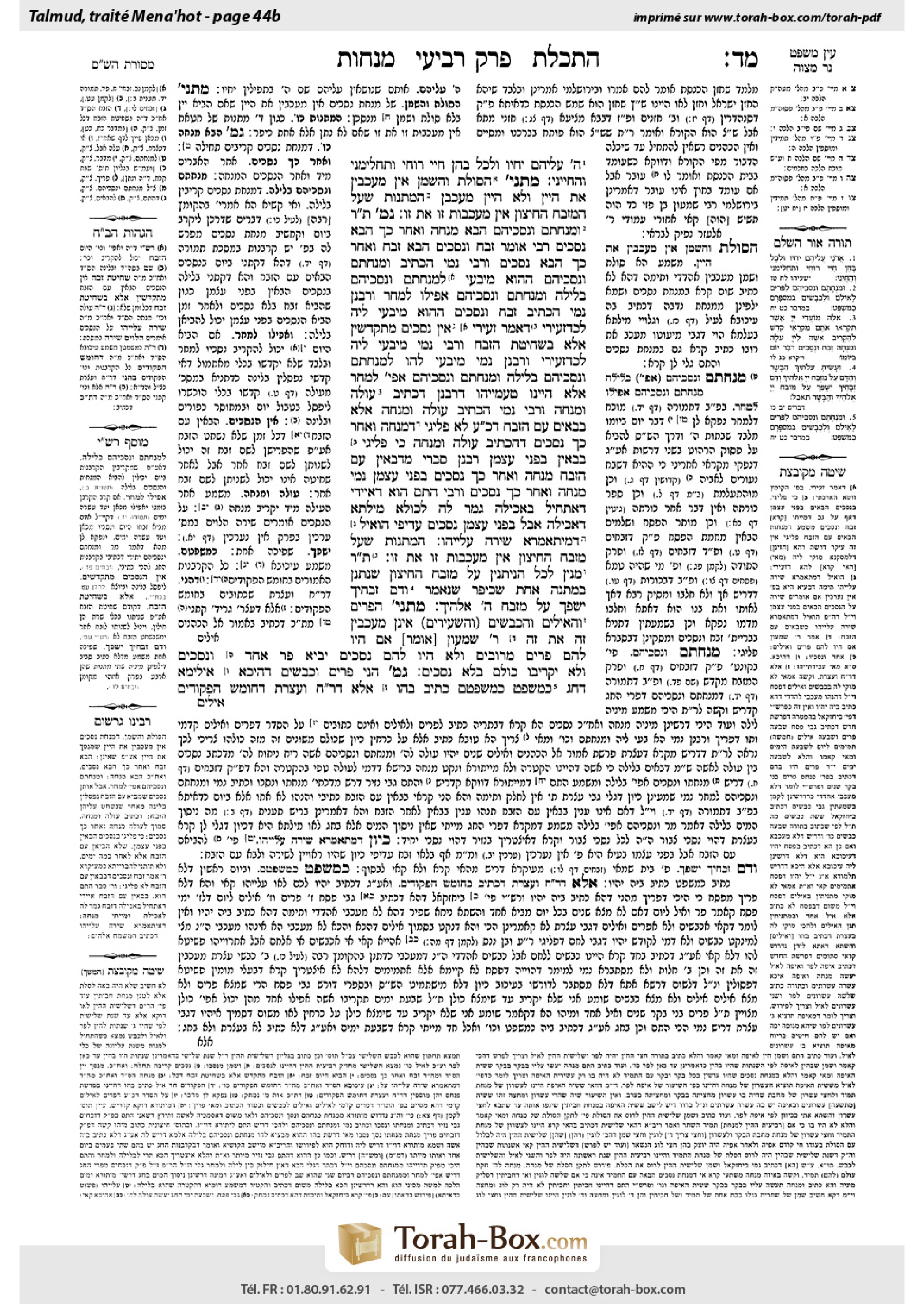
This page of Menachot includes the Aramaic text, an English translation and an AI-generated French translation, alongside the scan above.
מנחות מ״ד ב · Aramaic and Hebrew text
״ה׳ עֲלֵיהֶם יִחְיוּ וּלְכׇל בָּהֶן חַיֵּי רוּחִי וְתַחֲלִימֵנִי וְהַחֲיֵנִי״.
מַתְנִי׳ הַסּוֹלֶת וְהַשֶּׁמֶן אֵין מְעַכְּבִין אֶת הַיַּיִן, וְלֹא הַיַּיִן מְעַכְּבָן. הַמַּתָּנוֹת שֶׁעַל הַמִּזְבֵּחַ הַחִיצוֹן אֵין מְעַכְּבוֹת זוֹ אֶת זוֹ.
גְּמָ׳ תָּנוּ רַבָּנַן: ״וּמִנְחָתָם וְנִסְכֵּיהֶם״ – הָבֵא מִנְחָה, וְאַחַר כָּךְ הָבֵא נְסָכִים. רַבִּי אוֹמֵר: ״זֶבַח וּנְסָכִים״ – הָבֵא זֶבַח, וְאַחַר כָּךְ הָבֵא נְסָכִים.
וְרַבִּי נָמֵי הָכְתִיב ״וּמִנְחָתָם וְנִסְכֵּיהֶם״? הָהוּא מִיבְּעֵי לְ״מִנְחָתָם וְנִסְכֵּיהֶם״ בַּלַּיְלָה, וּ״מִנְחָתָם וְנִסְכֵּיהֶם״ אֲפִילּוּ לְמָחָר.
וְרַבָּנַן נָמֵי, הָכְתִיב ״זֶבַח וּנְסָכִים״? הָהוּא מִיבְּעֵי לֵיהּ לִכְדִזְעֵירִי, דְּאָמַר זְעֵירִי: אֵין נְסָכִים מִתְקַדְּשִׁין אֶלָּא בִּשְׁחִיטַת הַזֶּבַח.
וְרַבִּי נָמֵי מִיבְּעֵי לֵיהּ לִכְדִזְעֵירִי, וְרַבָּנַן נָמֵי מִיבְּעֵי לְהוּ לְ״מִנְחָתָם וְנִסְכֵּיהֶם״ בַּלַּיְלָה, וּ״מִנְחָתָם וְנִסְכֵּיהֶם״ אֲפִילּוּ לְמָחָר!
אֶלָּא, הַיְינוּ טַעְמַיְיהוּ דְּרַבָּנַן, דִּכְתִיב ״עֹלָה וּמִנְחָה״, וְרַבִּי נָמֵי הָכְתִיב ״עֹלָה וּמִנְחָה״?
אֶלָּא, בְּבָאִים עִם הַזֶּבַח דְּכוּלֵּי עָלְמָא לָא פְּלִיגִי דְּמִנְחָה וְאַחַר כָּךְ נְסָכִים, דְּהָכְתִיב ״עֹלָה וּמִנְחָה״. כִּי פְּלִיגִי בְּבָאִין בִּפְנֵי עַצְמָן, רַבָּנַן סָבְרִי: מִדְּבָאִין עִם הַזֶּבַח – מִנְחָה וְאַחַר כָּךְ נְסָכִים, בִּפְנֵי עַצְמָן נָמֵי – מִנְחָה וְאַחַר כָּךְ נְסָכִים.
וְרַבִּי, הָתָם הוּא דְּאַיְּידֵי דְּאַתְחֵיל בַּאֲכִילָה, גָּמַר לַהּ לְכוֹלָּא מִילְּתָא דַּאֲכִילָה, אֲבָל בִּפְנֵי עַצְמָן – נְסָכִים עֲדִיפִי, הוֹאִיל דְּמִיתְאַמְרָא שִׁירָה עֲלַיְיהוּ.
הַמַּתָּנוֹת שֶׁעַל מִזְבֵּחַ הַחִיצוֹן אֵין מְעַכְּבוֹת זוֹ אֶת זוֹ.
תָּנוּ רַבָּנַן: מִנַּיִן לְכׇל הַנִּיתָּנִין עַל מִזְבֵּחַ הַחִיצוֹן שֶׁנְּתָנָן בְּמַתָּנָה אַחַת שֶׁכִּיפֵּר? שֶׁנֶּאֱמַר: ״וְדַם זְבָחֶיךָ יִשָּׁפֵךְ עַל מִזְבַּח ה׳ אֱלֹהֶיךָ״.
מַתְנִי׳ הַפָּרִים וְהָאֵילִים וְהַכְּבָשִׂים וְהַשְּׂעִירִים – אֵינָן מְעַכְּבִין זֶה אֶת זֶה. רַבִּי שִׁמְעוֹן אוֹמֵר: אִם הָיוּ לָהֶם פָּרִים מְרוּבִּים, וְלֹא הָיוּ לָהֶם נְסָכִים – יָבִיא פַּר אֶחָד וּנְסָכִים, וְלֹא יַקְרִיבוּ כּוּלָּם בְּלֹא נְסָכִים.
גְּמָ׳ הָנֵי פָּרִים וּכְבָשִׂים דְּהֵיכָא? אִילֵּימָא דְּחַג – ״כַּמִּשְׁפָּט״, ״כְּמִשְׁפָּטָם״ כְּתִיב בְּהוּ!
אֶלָּא דְּרֹאשׁ חֹדֶשׁ וַעֲצֶרֶת דְּחוֹמֶשׁ הַפְּקוּדִים.
Menachot 44b · English translation
“The Lord is upon them, they will live, and altogether therein is the life of my spirit; and have me recover, and make me to live” (Isaiah 38:16). This is interpreted as referring to those who don phylacteries, which contain the name of the Lord, on their heads; as a result, they will live, be healed and merit long life.
MISHNA: The mishna returns to discussing the halakhot of meal offerings, which are the central theme of this tractate. The absence of the fine flour and the oil for the meal offering accompanying burnt offerings and peace offerings does not prevent libation of the wine, and the absence of the wine for libation does not prevent sacrifice of the flour and the oil. Failure to perform some of the placements of blood on the external altar does not prevent fulfillment of the mitzva with the other placements, as even if the priest performed only one placement of blood, the offering effects atonement after the fact.
GEMARA: The Sages taught in a baraita: The verse concerning the additional offerings sacrificed on Sukkot and the Eighth Day of Assembly states: “And their meal offering and their libations for the bulls, for the rams and for the lambs” (Numbers 29:18). This indicates that after the animal is sacrificed, one must bring the meal offering and then bring the libations. Rabbi Yehuda HaNasi says that since the verse states: “To bring an offering made by fire to the Lord, a burnt offering, and a meal offering, an animal offering, and libations, each on its own day” (Leviticus 23:37), one must bring the animal offering and then bring the libations, and only then bring the meal offering.
The Gemara asks: But according to Rabbi Yehuda HaNasi also, isn’t it written: “And their meal offering and their libations,” indicating that the meal offering precedes the libations? The Gemara answers: That verse is necessary in order to teach that once the animals have been sacrificed during the day, their meal offering and their libations may be offered even at night, and similarly, their meal offering and their libations may be offered even the next day.
The Gemara asks: But according to the Rabbis also, isn’t it written: “An animal offering, and libations,” indicating that the libations immediately follow the animal offering and precede the meal offering? The Gemara answers: That verse is necessary to teach that the halakha is in accordance with the statement of Ze’eiri, as Ze’eiri says: The libations that accompany animal offerings are consecrated only through the slaughter of the animal offering. This means that once the animal is slaughtered, the libations that were set aside to be brought with that animal offering cannot be diverted to accompany a different animal offering.
The Gemara points out that both opinions remain difficult: But Rabbi Yehuda HaNasi should also require the phrase “an animal offering, and libations” to teach that the halakha is in accordance with the statement of Ze’eiri. And the Rabbis should also require the phrase “and their meal offering and their libations” to indicate that their meal offering and their libations may be offered even at night, and their meal offering and their libations may be offered even the next day.
The Gemara offers a different explanation of the dispute in the baraita: Rather, this is the reasoning of the Rabbis, as it is written in the verse: “To bring an offering made by fire to the Lord, a burnt offering, and a meal offering, an animal offering, and libations, each on its own day.” The Rabbis derive from this that the meal offering should be offered immediately following the animal burnt offering. The Gemara asks: But according to Rabbi Yehuda HaNasi also, isn’t it written: “A burnt offering, and a meal offering”?
Rather, with regard to libations that accompany an animal offering, everyone agrees that the meal offering should be brought and afterward the libations should be brought, as it is written: “A burnt offering, and a meal offering.” When they disagree it is with regard to meal offerings and libations that are brought by themselves. The Rabbis hold that from the fact that when meal offerings and libations accompany offerings, the meal offerings are brought and then the libations are brought, it can be derived that when they are brought by themselves also, first the meal offering is brought and then the libations are brought.
And Rabbi Yehuda HaNasi holds that it is specifically there, in the case of meal offerings and libations that accompany an animal offering, that the meal offering is burned on the altar before the wine libation is poured on the altar. This is because since the altar has started to eat, i.e., consume, the animal offering, one must first complete the entire matter of the altar’s eating, including the meal offering. The pouring of the wine on the altar is likened more to drinking than to eating. But when the meal offering and the libations are brought by themselves, the libations are considered preferable, because the song of the Levites is recited over them. Consequently, the pouring of the libations precedes the burning of the meal offering on the altar.
§ The mishna teaches: Failure to perform some of the placements of blood on the external altar does not prevent fulfillment of the mitzva with the other placements, as even if the priest performed only one placement, the offering effects atonement after the fact.
Apropos this statement, the Sages taught in a baraita: From where is it derived with regard to all offerings whose blood is to be placed on the external altar that if one placed their blood with one act of placement, as opposed to the two or four that are required depending upon the offering, that the offering has nevertheless effected atonement after the fact, i.e., one has fulfilled his obligation to bring the offering? As it is stated: “And the blood of your offerings shall be poured out against the altar of the Lord your God” (Deuteronomy 12:27).
MISHNA: Failure to sacrifice one of the bulls, the rams, the sheep, or the goats of the additional offerings brought on Festivals does not prevent the sacrifice of the others. Rabbi Shimon says: If the Temple treasurers had sufficient funds for the numerous bulls that are required to be sacrificed on that day but they did not also have sufficient funds for the accompanying libations, they should rather bring one bull and its libations, and they should not sacrifice all of them without libations.
GEMARA: The Gemara asks: With regard to these bulls, rams, and sheep mentioned in the mishna, on which festival are they offered? If we say that these are the offerings of the festival of Sukkot, this is difficult: It is written with regard to those days that their offerings must be brought: “According to the ordinance” (see, e.g., Numbers 29:18), and: “According to their ordinance” (Numbers 29:33). This indicates that no deviation from the Torah’s prescription is possible.
Rather, the mishna must be referring to the two bulls, one ram, and seven sheep of the New Moon and Shavuot, as mentioned in the book of Numbers (28:11, 27).
Menachot 44b · Traduction française (IA)
« Le Seigneur est sur eux, ils vivront, et c’est en tout cela que réside la vie de mon esprit ; fais-moi recouvrer la santé et rends-moi la vie » (Isaïe 38,16). Ce verset est interprété comme faisant référence à ceux qui portent sur la tête les tefillin, qui contiennent le nom du Seigneur : ainsi, ils vivront, seront guéris et mériteront une longue vie.
MICHNA : La Michna revient à l’examen des halakhot des offrandes de farine, qui constituent le thème central de ce traité. L’absence de farine fine et d’huile pour l’offrande de farine accompagnant les holocaustes et les sacrifices de paix n’empêche pas les libations de vin, et l’absence de vin pour les libations n’empêche pas d’offrir la farine et l’huile. L’omission de certaines aspersions de sang sur l’autel extérieur n’empêche pas d’accomplir la mitsva par les autres aspersions, car même si le prêtre n’effectue qu’une seule aspersion de sang, l’offrande produit néanmoins l’expiation après coup.
GUEMARA : Les Sages ont enseigné dans une baraïta : au sujet des sacrifices supplémentaires offerts à Soukkot et le huitième jour de l’Assemblée, le verset dit : « Et leur offrande de farine et leurs libations, pour les taureaux, pour les béliers et pour les agneaux » (Nombres 29,18). Cela indique qu’après le sacrifice de l’animal, il faut apporter l’offrande de farine, puis les libations. Rabbi Yehouda HaNassi dit que, puisque le verset dit : « Pour présenter une offrande consumée par le feu au Seigneur, un holocauste et une offrande de farine, une offrande animale et des libations, chacune en son jour » (Lévitique 23,37), il faut apporter l’offrande animale, puis les libations, et seulement ensuite l’offrande de farine.
La Guemara demande : Mais, selon Rabbi Yehouda HaNassi aussi, n’est-il pas écrit : « Et leur offrande de farine et leurs libations », ce qui indique que l’offrande de farine précède les libations ? La Guemara répond : Ce verset est nécessaire pour enseigner qu’une fois les animaux sacrifiés pendant la journée, leur offrande de farine et leurs libations peuvent être offertes même la nuit ; de même, elles peuvent être offertes le lendemain.
La Guemara demande : Mais, selon les Rabbins aussi, n’est-il pas écrit : « Une offrande animale et des libations », ce qui indique que les libations suivent immédiatement l’offrande animale et précèdent l’offrande de farine ? La Guemara répond : Ce verset est nécessaire pour enseigner que la halakha suit l’opinion de Ze’eiri. En effet, Ze’eiri dit : les libations qui accompagnent les offrandes animales ne sont consacrées que par l’abattage de l’offrande animale. Cela signifie qu’une fois l’animal abattu, les libations mises de côté pour être apportées avec cette offrande animale ne peuvent pas être affectées à une autre offrande animale.
La Guemara relève que les deux opinions restent difficiles : Rabbi Yehouda HaNassi aussi devrait avoir besoin de l’expression « une offrande animale et des libations » pour enseigner que la halakha suit l’opinion de Ze’eiri. Et les Rabbins aussi devraient avoir besoin de l’expression « et leur offrande de farine et leurs libations » pour indiquer que leur offrande de farine et leurs libations peuvent être offertes même la nuit, et qu’elles peuvent aussi être offertes le lendemain.
La Guemara propose une autre explication de la controverse dans la baraïta : l’opinion des Rabbins repose plutôt sur le verset qui dit : « Pour présenter une offrande consumée par le feu au Seigneur, un holocauste et une offrande de farine, une offrande animale et des libations, chacune en son jour. » Les Rabbins en déduisent que l’offrande de farine doit être offerte immédiatement après l’holocauste animal. La Guemara demande : Mais, selon Rabbi Yehouda HaNassi aussi, n’est-il pas écrit : « Un holocauste et une offrande de farine » ?
En réalité, concernant les libations qui accompagnent une offrande animale, tous conviennent qu’il faut apporter l’offrande de farine, puis les libations, comme il est écrit : « Un holocauste et une offrande de farine. » Leur désaccord porte sur les offrandes de farine et les libations apportées séparément. Les Rabbins soutiennent que, puisque lorsque les offrandes de farine et les libations accompagnent des sacrifices, les offrandes de farine sont apportées avant les libations, on peut en déduire que, lorsqu’elles sont apportées séparément aussi, on apporte d’abord l’offrande de farine, puis les libations.
Rabbi Yehouda HaNassi soutient que c’est précisément dans le cas des offrandes de farine et des libations qui accompagnent une offrande animale que l’offrande de farine est brûlée sur l’autel avant que la libation de vin y soit versée. En effet, puisque l’autel a commencé à manger, c’est-à-dire à consommer, l’offrande animale, il faut d’abord achever entièrement ce qui relève de son alimentation, y compris l’offrande de farine. Le versement du vin sur l’autel s’apparente davantage à une boisson qu’à un aliment. Mais lorsque l’offrande de farine et les libations sont apportées séparément, les libations sont considérées comme préférables, car le chant des Lévites est récité à leur propos. Par conséquent, les libations sont versées avant que l’offrande de farine ne soit brûlée sur l’autel.
§ La Michna enseigne : l’omission de certaines aspersions de sang sur l’autel extérieur n’empêche pas d’accomplir la mitsva par les autres aspersions, car même si le prêtre n’effectue qu’une seule aspersion, l’offrande produit néanmoins l’expiation après coup.
À propos de cette affirmation, les Sages ont enseigné dans une baraïta : d’où déduit-on que, pour toutes les offrandes dont le sang doit être aspergé sur l’autel extérieur, si l’on n’effectue qu’une seule aspersion de leur sang, au lieu des deux ou des quatre requises selon l’offrande, l’offrande a néanmoins produit l’expiation après coup, c’est-à-dire que l’on a accompli son obligation d’apporter l’offrande ? Car il est dit : « Le sang de tes sacrifices sera répandu contre l’autel du Seigneur ton Dieu » (Deutéronome 12,27).
MICHNA : L’omission du sacrifice de l’un des taureaux, des béliers, des moutons ou des boucs des sacrifices supplémentaires offerts lors des fêtes n’empêche pas le sacrifice des autres. Rabbi Shimon dit : si les trésoriers du Temple disposaient de fonds suffisants pour les nombreux taureaux qui doivent être sacrifiés ce jour-là, mais pas pour les libations qui les accompagnent, ils devraient plutôt offrir un seul taureau avec ses libations et ne pas sacrifier tous les taureaux sans libations.
GUEMARA : La Guemara demande : lors de quelle fête ces taureaux, béliers et moutons mentionnés dans la Michna sont-ils offerts ? Si l’on dit qu’il s’agit des sacrifices de la fête de Soukkot, cela pose une difficulté : au sujet de ces jours, il est écrit que leurs sacrifices doivent être offerts « selon l’ordonnance » (voir, par exemple, Nombres 29,18) et « selon leur ordonnance » (Nombres 29,33). Cela indique qu’aucune dérogation à la prescription de la Torah n’est possible.
Il faut plutôt comprendre que la Michna fait référence aux deux taureaux, au bélier et aux sept moutons de la nouvelle lune et de Chavouot, mentionnés dans le livre des Nombres (28,11.27).
Traduction française générée par IA à partir de l’édition anglaise de Sefaria. Vérifie toujours un passage avec le texte source.
Text from Sefaria: William Davidson Edition - Vocalized Aramaic (unknown); William Davidson Edition - English (CC BY NC).