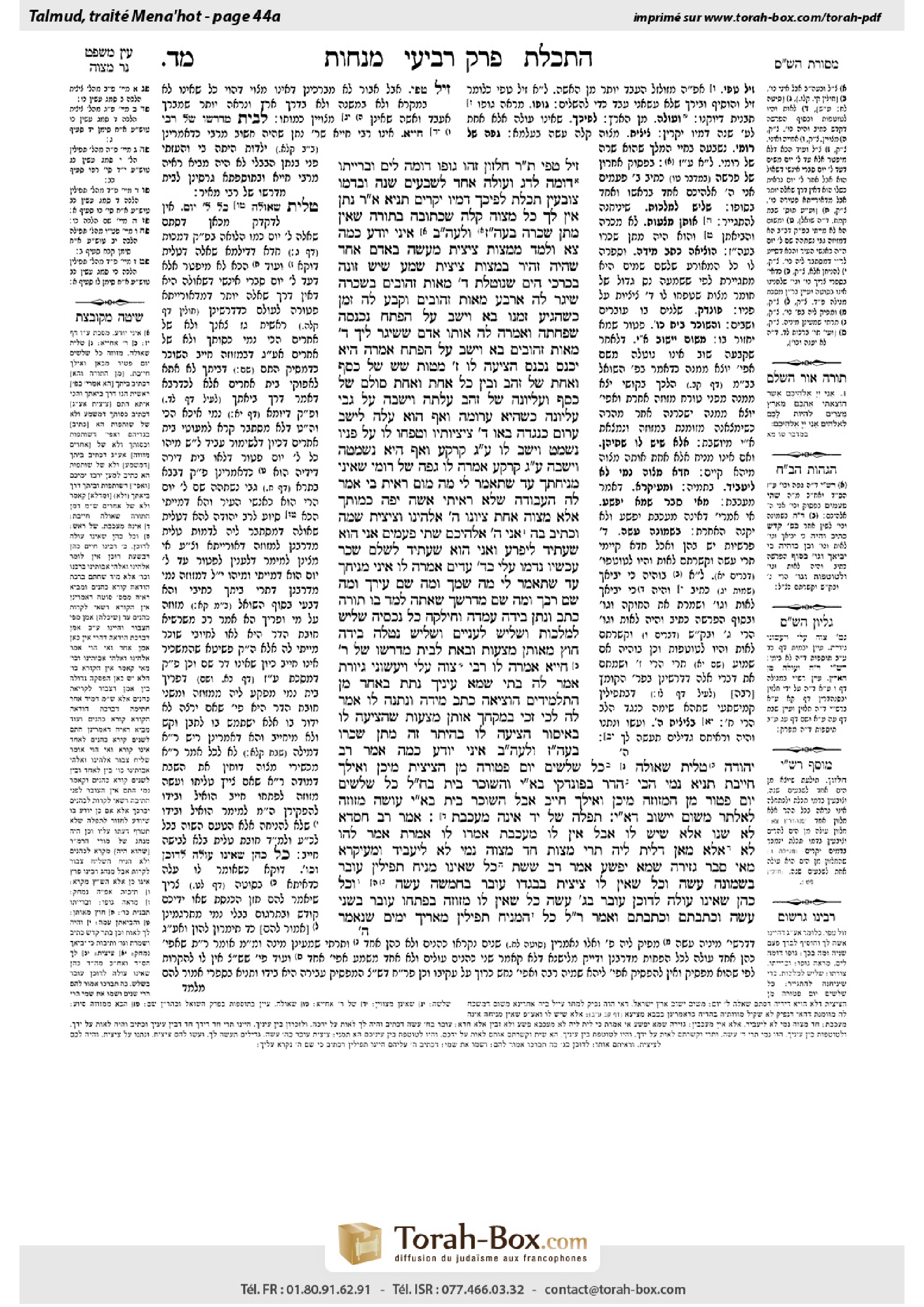
Menachot 44a: Talmud study for Daf Yomi
Daf Yomi is the daily study of one Talmud folio. Explore 37 tractates with scans, Hebrew text, Sefaria English and AI-generated French translations where annotated.
Passage selection and English or AI-generated French translation are available where the scan has annotations. Daf Study is independent of Torah-Box and Sefaria.
Browse Menachot · מנחות · All tractatesMenachot 44a text and translations
This page of Menachot includes the Aramaic text, an English translation and an AI-generated French translation, alongside the scan above.
מנחות מ״ד א · Aramaic and Hebrew text
זִיל טְפֵי.
תָּנוּ רַבָּנַן: חִלָּזוֹן זֶה, גּוּפוֹ דּוֹמֶה לַיָּם, וּבְרִיָּיתוֹ דּוֹמָה לְדָג, וְעוֹלֶה אֶחָד לְשִׁבְעִים שָׁנָה, וּבְדָמוֹ צוֹבְעִין תְּכֵלֶת, לְפִיכָךְ דָּמָיו יְקָרִים.
תַּנְיָא, אָמַר רַבִּי נָתָן: אֵין לָךְ כׇּל מִצְוָה קַלָּה שֶׁכְּתוּבָה בְּתוֹרָה, שֶׁאֵין מַתַּן שְׂכָרָהּ בְּעוֹלָם הַזֶּה, וְלָעוֹלָם הַבָּא אֵינִי יוֹדֵעַ כַּמָּה. צֵא וּלְמַד מִמִּצְוַת צִיצִית.
מַעֲשֶׂה בְּאָדָם אֶחָד שֶׁהָיָה זָהִיר בְּמִצְוַת צִיצִית, שָׁמַע שֶׁיֵּשׁ זוֹנָה בִּכְרַכֵּי הַיָּם שֶׁנּוֹטֶלֶת אַרְבַּע מֵאוֹת זְהוּבִים בִּשְׂכָרָהּ, שִׁיגֵּר לָהּ אַרְבַּע מֵאוֹת זְהוּבִים וְקָבַע לָהּ זְמַן, כְּשֶׁהִגִּיעַ זְמַנּוֹ, בָּא וְיָשַׁב עַל הַפֶּתַח.
נִכְנְסָה שִׁפְחָתָהּ וְאָמְרָה לָהּ: אוֹתוֹ אָדָם שֶׁשִּׁיגֵּר לִיךְ אַרְבַּע מֵאוֹת זְהוּבִים בָּא וְיָשַׁב עַל הַפֶּתַח. אָמְרָה הִיא: יִכָּנֵס. נִכְנַס, הִצִּיעָה לוֹ שֶׁבַע מִטּוֹת, שֵׁשׁ שֶׁל כֶּסֶף וְאַחַת שֶׁל זָהָב, וּבֵין כׇּל אַחַת וְאַחַת סוּלָּם שֶׁל כֶּסֶף, וְעֶלְיוֹנָה שֶׁל זָהָב.
עָלְתָה וְיָשְׁבָה עַל גַּבֵּי עֶלְיוֹנָה כְּשֶׁהִיא עֲרוּמָּה, וְאַף הוּא עָלָה לֵישֵׁב עָרוֹם כְּנֶגְדָּהּ, בָּאוּ אַרְבַּע צִיצִיּוֹתָיו וְטָפְחוּ לוֹ עַל פָּנָיו, נִשְׁמַט וְיָשַׁב לוֹ עַל גַּבֵּי קַרְקַע, וְאַף הִיא נִשְׁמְטָה וְיָשְׁבָה עַל גַּבֵּי קַרְקַע. אָמְרָה לוֹ: גַּפָּהּ שֶׁל רוֹמִי, שֶׁאֵינִי מַנִּיחָתְךָ עַד שֶׁתֹּאמַר לִי מָה מוּם רָאִיתָ בִּי.
אָמַר לָהּ: הָעֲבוֹדָה, שֶׁלֹּא רָאִיתִי אִשָּׁה יָפֶה כְּמוֹתֵךְ, אֶלָּא מִצְוָה אַחַת צִיוָּנוּ ה׳ אֱלֹהֵינוּ וְצִיצִית שְׁמָהּ, וּכְתִיב בָּהּ: ״אֲנִי ה׳ אֱלֹהֵיכֶם״ שְׁתֵּי פְעָמִים – אֲנִי הוּא שֶׁעָתִיד לִיפָּרַע, וַאֲנִי הוּא שֶׁעָתִיד לְשַׁלֵּם שָׂכָר. עַכְשָׁיו נִדְמוּ עָלַי כְּאַרְבָּעָה עֵדִים.
אָמְרָה לוֹ: אֵינִי (מניחך) [מַנִּיחָתְךָ] עַד שֶׁתֹּאמַר לִי מָה שִׁמְךָ, וּמָה שֵׁם עִירְךָ, וּמָה שֵׁם רַבְּךָ, וּמָה שֵׁם מִדְרָשְׁךָ שֶׁאַתָּה לָמֵד בּוֹ תּוֹרָה. כָּתַב וְנָתַן בְּיָדָהּ.
עָמְדָה וְחִילְּקָהּ כׇּל נְכָסֶיהָ, שְׁלִישׁ לַמַּלְכוּת, וּשְׁלִישׁ לַעֲנִיִּים, וּשְׁלִישׁ נָטְלָה בְּיָדָהּ, חוּץ מֵאוֹתָן מַצָּעוֹת.
וּבָאת לְבֵית מִדְרָשׁוֹ שֶׁל רַבִּי חִיָּיא. אָמְרָה לוֹ: רַבִּי, צַוֵּה עָלַי וְיַעֲשׂוּנִי גִּיּוֹרֶת. אָמַר לָהּ: בִּתִּי, שֶׁמָּא עֵינַיִךְ נָתַתְּ בְּאֶחָד מִן הַתַּלְמִידִים. הוֹצִיאָהּ כְּתָב מִיָּדָהּ וְנָתְנָה לוֹ. אָמַר לָהּ: לְכִי זְכִי בְּמִקָּחִךְ.
אוֹתָן מַצָּעוֹת שֶׁהִצִּיעָה לוֹ בְּאִיסּוּר, הִצִּיעָה לוֹ בְּהֶיתֵּר. זֶה מַתַּן שְׂכָרוֹ בָּעוֹלָם הַזֶּה, וְלָעוֹלָם הַבָּא אֵינִי יוֹדֵעַ כַּמָּה.
אָמַר רַב יְהוּדָה: טַלִּית שְׁאוּלָה, כׇּל שְׁלֹשִׁים יוֹם פְּטוּרָה מִן הַצִּיצִית, מִיכָּן וְאֵילָךְ חַיֶּיבֶת.
תַּנְיָא נָמֵי הָכִי: הַדָּר בְּפוּנְדְּקִי בְּאֶרֶץ יִשְׂרָאֵל, וְהַשּׂוֹכֵר בַּיִת בְּחוּץ לָאָרֶץ – כׇּל שְׁלֹשִׁים יוֹם פָּטוּר מִן הַמְּזוּזָה, מִיכָּן וְאֵילָךְ חַיָּיב. אֲבָל הַשּׂוֹכֵר בַּיִת בְּאֶרֶץ יִשְׂרָאֵל – עוֹשֶׂה מְזוּזָה לְאַלְתַּר, מִשּׁוּם יִישּׁוּב דְּאֶרֶץ יִשְׂרָאֵל.
תְּפִלָּה שֶׁל יָד אֵינָהּ מְעַכֶּבֶת. אָמַר רַב חִסְדָּא: לֹא שָׁנוּ אֶלָּא שֶׁיֵּשׁ לוֹ, אֲבָל אֵין לוֹ – מְעַכֶּבֶת.
אָמְרוּ לוֹ: אָמַרְתָּ? אֲמַר לְהוּ: לָא, אֶלָּא מַאן דְּלֵית לֵיהּ תְּרֵי מִצְוֹת, חַד מִצְוָה נָמֵי לָא לֶיעְבֵּיד?! וּמֵעִיקָּרָא מַאי סְבַר? גְּזֵירָה שֶׁמָּא יִפְשַׁע.
אָמַר רַב שֵׁשֶׁת: כֹּל שֶׁאֵינוֹ מַנִּיחַ תְּפִילִּין עוֹבֵר בִּשְׁמוֹנָה עֲשֵׂה.
וְכֹל שֶׁאֵין לוֹ צִיצִית בְּבִגְדוֹ עוֹבֵר בַּחֲמִשָּׁה עֲשֵׂה.
וְכׇל כֹּהֵן שֶׁאֵינוֹ עוֹלֶה לַדּוּכָן, עוֹבֵר בִּשְׁלֹשָׁה עֲשֵׂה.
כֹּל שֶׁאֵין לוֹ מְזוּזָה בְּפִתְחוֹ עוֹבֵר בִּשְׁנֵי עֲשֵׂה, ״וּכְתַבְתָּם״ ״וּכְתַבְתָּם״.
וְאָמַר רֵישׁ לָקִישׁ: כׇּל הַמַּנִּיחַ תְּפִילִּין מַאֲרִיךְ יָמִים, שֶׁנֶּאֱמַר:
Menachot 44a · English translation
is more lowly than a woman, and therefore it is appropriate to recite an additional blessing on not having been born a slave.
§ The Sages taught: This ḥilazon, which is the source of the sky-blue dye used in ritual fringes, has the following characteristics: Its body resembles the sea, its form resembles that of a fish, it emerges once in seventy years, and with its blood one dyes wool sky-blue for ritual fringes. It is scarce, and therefore it is expensive.
It is taught in a baraita that Rabbi Natan says: There is no mitzva, however minor, that is written in the Torah, for which there is no reward given in this world; and in the World-to-Come I do not know how much reward is given. Go and learn from the following incident concerning the mitzva of ritual fringes.
There was an incident involving a certain man who was diligent about the mitzva of ritual fringes. This man heard that there was a prostitute in one of the cities overseas who took four hundred gold coins as her payment. He sent her four hundred gold coins and fixed a time to meet with her. When his time came, he came and sat at the entrance to her house.
The maidservant of that prostitute entered and said to her: That man who sent you four hundred gold coins came and sat at the entrance. She said: Let him enter. He entered. She arranged seven beds for him, six of silver and one of gold. Between each and every one of them there was a ladder made of silver, and the top bed was the one that was made of gold.
She went up and sat naked on the top bed, and he too went up in order to sit naked facing her. In the meantime, his four ritual fringes came and slapped him on his face. He dropped down and sat himself on the ground, and she also dropped down and sat on the ground. She said to him: I take an oath by the gappa of Rome that I will not allow you to go until you tell me what defect you saw in me.
He said to her: I take an oath by the Temple service that I never saw a woman as beautiful as you. But there is one mitzva that the Lord, our God, commanded us, and its name is ritual fringes, and in the passage where it is commanded, it is written twice: “I am the Lord your God” (Numbers 15:41). The doubling of this phrase indicates: I am the one who will punish those who transgress My mitzvot, and I am the one who will reward those who fulfill them. Now, said the man, the four sets of ritual fringes appeared to me as if they were four witnesses who will testify against me.
She said to him: I will not allow you to go until you tell me: What is your name, and what is the name of your city, and what is the name of your teacher, and what is the name of the study hall in which you studied Torah? He wrote the information and placed it in her hand.
She arose and divided all of her property, giving one-third as a bribe to the government, one-third to the poor, and she took one-third with her in her possession, in addition to those beds of gold and silver.
She came to the study hall of Rabbi Ḥiyya and said to him: My teacher, instruct your students concerning me and have them make me a convert. Rabbi Ḥiyya said to her: My daughter, perhaps you set your sights on one of the students and that is why you want to convert? She took the note the student had given her from her hand and gave it to Rabbi Ḥiyya. He said to her: Go take possession of your purchase.
Those beds that she had arranged for him in a prohibited fashion, she now arranged for him in a permitted fashion. The Gemara completes its point about the reward of mitzvot and points out how this story illustrates the concept: This is the reward given to him in this world, and with regard to the World-to-Come, I do not know how much reward he will be given.
§ Rav Yehuda says: In the case of a borrowed cloak, for the first thirty days it is exempt from ritual fringes; from then on it is obligated.
The Gemara notes: That distinction is also taught in a baraita: In the case of one who resides in a guesthouse [pundaki] in Eretz Yisrael, or one who rents a house outside of Eretz Yisrael, for the first thirty days he is exempt from the mitzva of mezuza; from then on he is obligated. But one who rents a house in Eretz Yisrael must affix a mezuza immediately, due to the settlement of Eretz Yisrael.
§ The mishna teaches: Absence of the phylacteries of the arm does not prevent fulfillment of the mitzva of the phylacteries of the head, and absence of the phylacteries of the head does not prevent fulfillment of the mitzva of the phylacteries of the arm. Rav Ḥisda said: They taught this only in a case where one has the other phylacteries, but they are not with him or he is unable to wear them for some reason. But if he does not have the other phylacteries at all, then their absence does prevent the fulfillment of the mitzva to don the phylacteries that he has.
Later on, the students said to him: Do you still say that? Rav Ḥisda said to them: No, rather I would say the opposite: Concerning one who does not have the ability to fulfill two mitzvot, should he also not perform the one mitzva that he does have the ability to fulfill? The Gemara asks: And what did he hold initially when he said not to don one of the phylacteries in the absence of the other? The Gemara answers: He held that it was due to a rabbinic decree, lest he be negligent and not try to acquire the phylacteries that he lacks.
Rav Sheshet says: Anyone who does not don phylacteries violates eight positive mitzvot. This is referring to the mitzva to don phylacteries of the arm and head, each of which is mentioned in four different passages (Exodus 13:9; Exodus 13:16; Deuteronomy 6:8; Deuteronomy 11:18).
And anyone who does not have ritual fringes on his garments violates five positive mitzvot. This is because the mitzva of ritual fringes is stated four times in the primary passage concerning ritual fringes in Numbers: “That they prepare for themselves strings…and they shall put on the fringe of the corner a sky-blue thread. And it shall be to you for a fringe that you may look upon it and remember all the commandments of the Lord” (Numbers 15:38–39). An additional command appears in the verse: “You shall prepare yourself twisted cords” (Deuteronomy 22:12).
And any priest who does not ascend the platform to recite the Priestly Benediction violates three positive mitzvot expressed in the verses: “So you shall bless the children of Israel; you shall say to them” (Numbers 6:23), and: “And they shall put My name upon the children of Israel” (Numbers 6:27).
Anyone who does not have a mezuza in his doorway violates two positive mitzvot, stated in the verses: “And you shall write them on the doorposts of your house” (Deuteronomy 6:9), and: “And you shall write them on the doorposts of your house” (Deuteronomy 11:20).
And Reish Lakish says: Anyone who dons phylacteries lives a long life, as it is stated:
Menachot 44a · Traduction française (IA)
est plus méprisable qu’une femme ; il convient donc de réciter une bénédiction supplémentaire pour ne pas être né esclave.
§ Les Sages ont enseigné : Ce ḥilazon, qui est la source de la teinture bleu azur utilisée pour les franges rituelles, présente les caractéristiques suivantes : son corps ressemble à la mer, sa forme à celle d’un poisson, il apparaît une fois tous les soixante-dix ans, et son sang sert à teindre en bleu azur la laine destinée aux franges rituelles. Il est rare et, par conséquent, coûteux.
Il est enseigné dans une baraïta que Rabbi Natan dit : Il n’est pas de mitsva, si mineure soit-elle, qui soit écrite dans la Torah et pour laquelle aucune récompense ne soit accordée en ce monde ; quant au Monde à venir, je ne sais pas quelle récompense est accordée. Va et apprends-le de l’incident suivant concernant la mitsva des franges rituelles.
Un incident est arrivé à un certain homme qui s’appliquait à accomplir la mitsva des franges rituelles. Il apprit qu’une prostituée, dans l’une des villes d’outre-mer, demandait quatre cents pièces d’or pour ses services. Il lui envoya quatre cents pièces d’or et fixa avec elle un rendez-vous. À l’heure convenue, il vint et s’assit à l’entrée de sa maison.
La servante de cette prostituée entra et lui dit : L’homme qui t’a envoyé quatre cents pièces d’or est venu et s’est assis à l’entrée. Elle dit : Qu’il entre. Il entra. Elle avait disposé sept lits à son intention, six en argent et un en or. Entre chaque lit se trouvait une échelle en argent, et le lit le plus élevé était celui en or.
Elle monta et s’assit nue sur le lit le plus élevé, et lui aussi monta afin de s’asseoir nu face à elle. Entre-temps, ses quatre franges rituelles vinrent le frapper au visage. Il descendit et s’assit à même le sol, et elle aussi descendit et s’assit à même le sol. Elle lui dit : Je jure par le gappa de Rome que je ne te laisserai pas partir avant que tu m’aies dit quel défaut tu as vu en moi.
Il lui dit : Je le jure par le service du Temple : je n’ai jamais vu de femme aussi belle que toi. Mais il est une mitsva que le Seigneur, notre Dieu, nous a ordonné d’accomplir ; elle s’appelle les franges rituelles, et dans le passage où elle est prescrite, il est écrit deux fois : « Je suis le Seigneur votre Dieu » (Nombres 15:41). La répétition de cette formule indique : C’est Moi qui punirai ceux qui transgressent Mes mitsvot, et c’est Moi qui récompenserai ceux qui les accomplissent. À présent, dit l’homme, les quatre franges rituelles m’apparurent comme quatre témoins qui allaient témoigner contre moi.
Elle lui dit : Je ne te laisserai pas partir avant que tu m’aies dit : Quel est ton nom, quel est le nom de ta ville, quel est le nom de ton maître et quel est le nom de la maison d’étude où tu as étudié la Torah ? Il écrivit ces renseignements et les lui remit.
Elle se leva et partagea tous ses biens : elle en donna un tiers comme pot-de-vin au gouvernement, un tiers aux pauvres, et emporta avec elle le dernier tiers, en plus de ces lits d’or et d’argent.
Elle se rendit à la maison d’étude de Rabbi Ḥiyya et lui dit : Mon maître, enseigne à tes élèves ce qui me concerne et fais de moi une convertie. Rabbi Ḥiyya lui dit : Ma fille, peut-être as-tu jeté ton dévolu sur l’un des élèves, et est-ce pour cela que tu veux te convertir ? Elle prit le billet que l’élève lui avait remis et le tendit à Rabbi Ḥiyya. Il lui dit : Va prendre possession de ton achat.
Les lits qu’elle avait disposés pour lui d’une manière interdite, elle les disposa désormais pour lui d’une manière permise. La Guemara achève son propos sur la récompense des mitsvot et souligne comment cette histoire illustre le principe : Telle est la récompense qui lui est accordée en ce monde ; quant au Monde à venir, je ne sais pas quelle récompense lui sera accordée.
§ Rav Yehuda dit : Un manteau emprunté est dispensé des franges rituelles pendant les trente premiers jours ; à partir de là, il y est astreint.
La Guemara relève : Cette distinction est également enseignée dans une baraïta : Celui qui réside dans une auberge [pundaki] en Eretz Israël, ou celui qui loue une maison hors d’Eretz Israël, est dispensé de la mitsva de la mezouza pendant les trente premiers jours ; à partir de là, il y est astreint. Mais celui qui loue une maison en Eretz Israël doit poser une mezouza immédiatement, en raison de l’établissement en Eretz Israël.
§ La Michna enseigne : L’absence des téfilines du bras n’empêche pas l’accomplissement de la mitsva des téfilines de la tête, et l’absence des téfilines de la tête n’empêche pas l’accomplissement de la mitsva des téfilines du bras. Rav Ḥisda dit : Cela n’a été enseigné que dans le cas où l’on possède les autres téfilines, mais qu’elles ne sont pas avec soi ou que l’on ne peut les porter pour une raison quelconque. Mais si l’on ne possède pas du tout les autres téfilines, leur absence empêche l’accomplissement de la mitsva consistant à mettre les téfilines que l’on a.
Plus tard, les élèves lui dirent : Soutiens-tu toujours cette position ? Rav Ḥisda leur répondit : Non, je dirais plutôt le contraire : Celui qui n’a pas la possibilité d’accomplir deux mitsvot devrait-il également s’abstenir d’accomplir l’unique mitsva qu’il peut accomplir ? La Guemara demande : Quelle était donc sa position initiale, lorsqu’il disait de ne pas mettre l’une des paires de téfilines en l’absence de l’autre ? La Guemara répond : Il pensait que cela relevait d’un décret rabbinique, de peur que l’intéressé ne fasse preuve de négligence et ne cherche pas à se procurer les téfilines qui lui manquent.
Rav Sheshet dit : Quiconque ne met pas les téfilines transgresse huit mitsvot positives. Il s’agit de la mitsva de mettre les téfilines du bras et de la tête, chacune étant mentionnée dans quatre passages distincts (Exode 13:9 ; Exode 13:16 ; Deutéronome 6:8 ; Deutéronome 11:18).
Et quiconque ne porte pas de franges rituelles sur ses vêtements transgresse cinq mitsvot positives. En effet, la mitsva des franges rituelles est énoncée quatre fois dans le passage principal qui leur est consacré dans les Nombres : « Qu’ils se fassent des fils […] et qu’ils mettent sur la frange du coin un fil bleu azur. Ce sera pour vous une frange, afin que vous la regardiez et que vous vous souveniez de tous les commandements du Seigneur » (Nombres 15:38–39). Un commandement supplémentaire figure dans le verset : « Tu te feras des cordons torsadés » (Deutéronome 22:12).
Et tout prêtre qui ne monte pas sur l’estrade pour réciter la bénédiction sacerdotale transgresse trois mitsvot positives exprimées dans les versets : « Ainsi bénirez-vous les enfants d’Israël ; vous leur direz » (Nombres 6:23), et : « Ils mettront ainsi Mon nom sur les enfants d’Israël » (Nombres 6:27).
Quiconque n’a pas de mezouza à sa porte transgresse deux mitsvot positives, énoncées dans les versets : « Tu les écriras sur les montants de ta maison » (Deutéronome 6:9), et : « Tu les écriras sur les montants de ta maison » (Deutéronome 11:20).
Et Reish Lakish dit : Quiconque met les téfilines vit longtemps, comme il est dit :
Traduction française générée par IA à partir de l’édition anglaise de Sefaria. Vérifie toujours un passage avec le texte source.
Text from Sefaria: William Davidson Edition - Vocalized Aramaic (unknown); William Davidson Edition - English (CC BY NC).