Menachot 43b: Talmud study for Daf Yomi
Daf Yomi is the daily study of one Talmud folio. Explore 37 tractates with scans, Hebrew text, Sefaria English and AI-generated French translations where annotated.
Passage selection and English or AI-generated French translation are available where the scan has annotations. Daf Study is independent of Torah-Box and Sefaria.
Browse Menachot · מנחות · All tractatesMenachot 43b text and translations
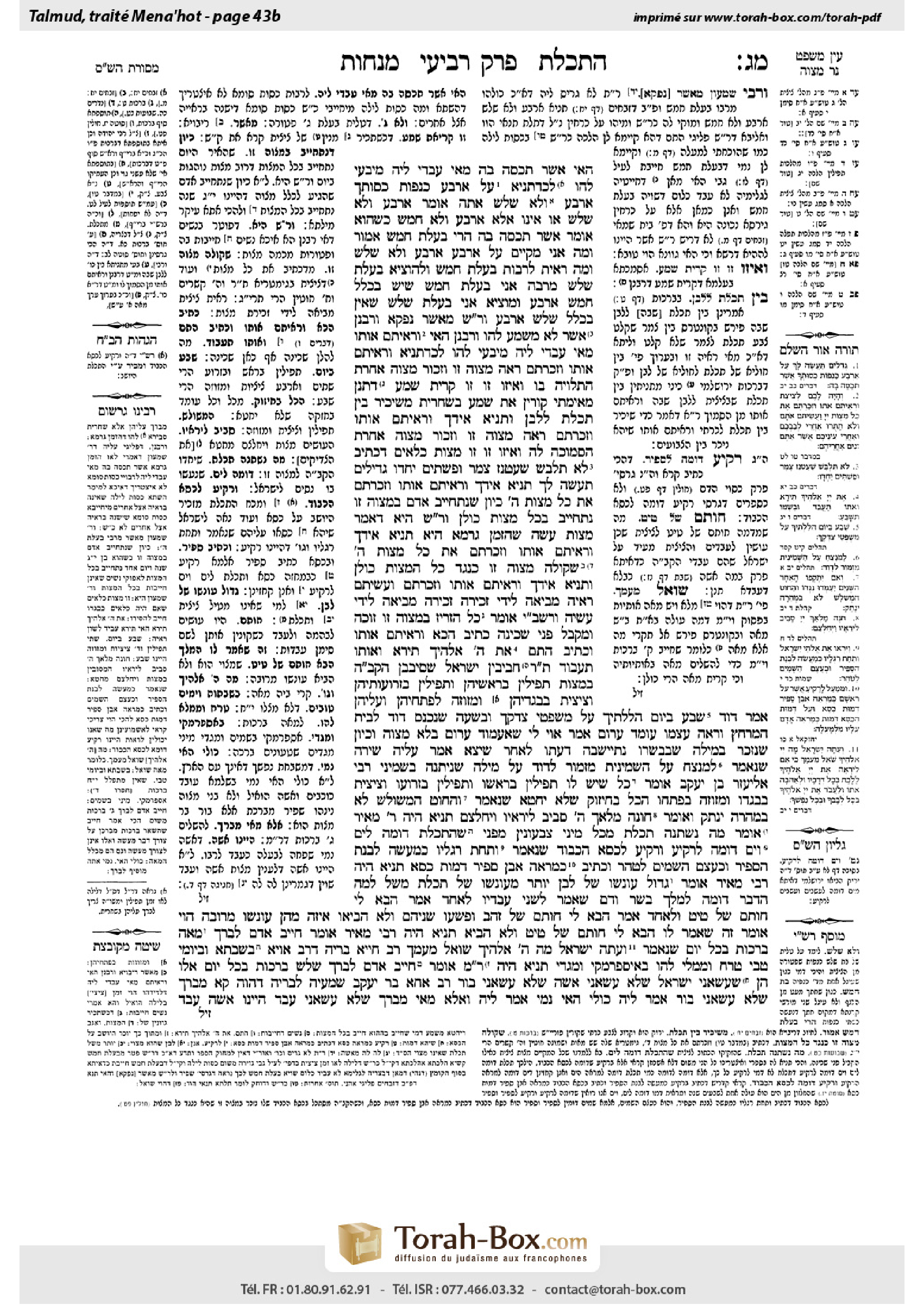
This page of Menachot includes the Aramaic text, an English translation and an AI-generated French translation, alongside the scan above.
מנחות מ״ג ב · Aramaic and Hebrew text
הַאי ״אֲשֶׁר תְּכַסֶּה בָּהּ״ מַאי עָבְדִי לֵיהּ? מִיבְּעֵי לְהוּ לְכִדְתַנְיָא: ״עַל אַרְבַּע כַּנְפוֹת כְּסוּתְךָ״ – אַרְבַּע וְלֹא שָׁלֹשׁ.
אַתָּה אוֹמֵר אַרְבַּע וְלֹא שָׁלֹשׁ, אוֹ אֵינוֹ אֶלָּא אַרְבַּע וְלֹא חָמֵשׁ? כְּשֶׁהוּא אוֹמֵר ״אֲשֶׁר תְּכַסֶּה בָּהּ״, הֲרֵי בַּעֲלַת חָמֵשׁ אָמוּר, וּמָה אֲנִי מְקַיֵּים ״עַל אַרְבַּע״? אַרְבַּע וְלֹא שָׁלֹשׁ.
וּמָה רָאִיתָ לְרַבּוֹת בַּעֲלַת חָמֵשׁ וּלְהוֹצִיא בַּעֲלַת שָׁלֹשׁ? מְרַבֶּה אֲנִי בַּעֲלַת חָמֵשׁ, שֶׁיֵּשׁ בִּכְלַל חָמֵשׁ אַרְבַּע, וּמוֹצִיא אֲנִי בַּעֲלַת שָׁלֹשׁ, שֶׁאֵין בִּכְלַל שָׁלֹשׁ אַרְבַּע.
וְרַבִּי שִׁמְעוֹן, מֵ״אֲשֶׁר״ נָפְקָא. וְרַבָּנַן, ״אֲשֶׁר״ לָא מַשְׁמַע לְהוּ.
וְרַבָּנַן, הַאי ״וּרְאִיתֶם אֹתוֹ״ מַאי עָבְדִי לֵיהּ? מִיבְּעֵי לְהוּ לְכִדְתַנְיָא: ״וּרְאִיתֶם אֹתוֹ וּזְכַרְתֶּם״, רְאֵה מִצְוָה זוֹ וּזְכוֹר מִצְוָה אַחֶרֶת הַתְּלוּיָה (בּוֹ) [בָּהּ], וְאֵיזוֹ זוֹ? זוֹ קְרִיַּת שְׁמַע, דִּתְנַן: מֵאֵימָתַי קוֹרִין אֶת שְׁמַע בְּשַׁחֲרִית? מִשֶּׁיַּכִּיר בֵּין תְּכֵלֶת לְלָבָן.
וְתַנְיָא אִידַּךְ: ״וּרְאִיתֶם אוֹתוֹ וּזְכַרְתֶּם״ – רְאֵה מִצְוָה זוֹ וּזְכוֹר מִצְוָה אַחֶרֶת הַסְּמוּכָה לָהּ, וְאֵיזוֹ זוֹ? זוֹ מִצְוַת כִּלְאַיִם, דִּכְתִיב: ״לֹא תִלְבַּשׁ שַׁעַטְנֵז צֶמֶר וּפִשְׁתִּים יַחְדָּו. גְּדִילִים תַּעֲשֶׂה לָךְ״.
תַּנְיָא אִידַּךְ: ״וּרְאִיתֶם אֹתוֹ וּזְכַרְתֶּם אֶת כׇּל מִצְוֹת ה׳״, כֵּיוָן שֶׁנִּתְחַיֵּיב אָדָם בְּמִצְוָה זוֹ נִתְחַיֵּיב בְּכׇל מִצְוֹת כּוּלָּן, וְרַבִּי שִׁמְעוֹן הִיא, דְּאָמַר: מִצְוַת עֲשֵׂה שֶׁהַזְּמַן גְּרָמָאּ הִיא.
תַּנְיָא אִידַּךְ: ״וּרְאִיתֶם אֹתוֹ וּזְכַרְתֶּם אֶת כׇּל מִצְוֹת ה׳״, שְׁקוּלָה מִצְוָה זוֹ כְּנֶגֶד כׇּל הַמִּצְוֹת כּוּלָּן.
וְתַנְיָא אִידַּךְ: ״וּרְאִיתֶם אֹתוֹ וּזְכַרְתֶּם... וַעֲשִׂיתֶם״ – רְאִיָּה מְבִיאָה לִידֵי זְכִירָה, זְכִירָה מְבִיאָה לִידֵי עֲשִׂיָּה. וְרַבִּי שִׁמְעוֹן בַּר יוֹחַאי אוֹמֵר: כׇּל הַזָּרִיז בְּמִצְוָה זוֹ זוֹכֶה וּמְקַבֵּל פְּנֵי שְׁכִינָה. כְּתִיב הָכָא: ״וּרְאִיתֶם אֹתוֹ״, וּכְתִיב הָתָם: ״אֶת ה׳ אֱלֹהֶיךָ תִּירָא וְאֹתוֹ תַעֲבֹד״.
תָּנוּ רַבָּנַן: חֲבִיבִין יִשְׂרָאֵל שֶׁסִּיבְּבָן הַקָּדוֹשׁ בָּרוּךְ הוּא בְּמִצְוֹת, תְּפִילִּין בְּרָאשֵׁיהֶן וּתְפִילִּין בִּזְרוֹעוֹתֵיהֶן וְצִיצִית בְּבִגְדֵיהֶן וּמְזוּזָה לְפִתְחֵיהֶן, וַעֲלֵיהֶן אָמַר דָּוִד: ״שֶׁבַע בַּיּוֹם הִלַּלְתִּיךָ עַל מִשְׁפְּטֵי צִדְקֶךָ״.
וּבְשָׁעָה שֶׁנִּכְנַס דָּוִד לְבֵית הַמֶּרְחָץ וְרָאָה עַצְמוֹ עוֹמֵד עָרוֹם, אָמַר: אוֹי לִי שֶׁאֶעֱמוֹד עָרוֹם בְּלֹא מִצְוָה! וְכֵיוָן שֶׁנִּזְכַּר בַּמִּילָה שֶׁבִּבְשָׂרוֹ, נִתְיַישְּׁבָה דַּעְתּוֹ. לְאַחַר שֶׁיָּצָא, אָמַר עָלֶיהָ שִׁירָה, שֶׁנֶּאֱמַר: ״לַמְנַצֵּחַ עַל הַשְּׁמִינִית מִזְמוֹר לְדָוִד״, עַל מִילָה שֶׁנִּיתְּנָה בַּשְּׁמִינִי.
רַבִּי אֱלִיעֶזֶר בֶּן יַעֲקֹב אוֹמֵר: כֹּל שֶׁיֵּשׁ לוֹ תְּפִילִּין בְּרֹאשׁוֹ וּתְפִילִּין בִּזְרוֹעוֹ וְצִיצִית בְּבִגְדוֹ וּמְזוּזָה בְּפִתְחוֹ, הַכֹּל בְּחִיזּוּק שֶׁלֹּא יֶחֱטָא, שֶׁנֶּאֱמַר: ״וְהַחוּט הַמְשֻׁלָּשׁ לֹא בִמְהֵרָה יִנָּתֵק״, וְאוֹמֵר: ״חֹנֶה מַלְאַךְ ה׳ סָבִיב לִירֵאָיו וַיְחַלְּצֵם״.
תַּנְיָא, הָיָה רַבִּי מֵאִיר אוֹמֵר: מָה נִשְׁתַּנָּה תְּכֵלֶת מִכׇּל מִינֵי צִבְעוֹנִין? מִפְּנֵי שֶׁהַתְּכֵלֶת דּוֹמֶה לַיָּם, וְיָם דּוֹמֶה לָרָקִיעַ, וְרָקִיעַ לְכִסֵּא הַכָּבוֹד, שֶׁנֶּאֱמַר: ״וְתַחַת רַגְלָיו כְּמַעֲשֵׂה לִבְנַת הַסַּפִּיר וּכְעֶצֶם הַשָּׁמַיִם לָטֹהַר״, וּכְתִיב: ״כְּמַרְאֵה אֶבֶן סַפִּיר דְּמוּת כִּסֵּא״.
תַּנְיָא, הָיָה רַבִּי מֵאִיר אוֹמֵר: גָּדוֹל עוֹנְשׁוֹ שֶׁל לָבָן יוֹתֵר מֵעוֹנְשׁוֹ שֶׁל תְּכֵלֶת, מָשָׁל לְמָה הַדָּבָר דּוֹמֶה? לְמֶלֶךְ בָּשָׂר וָדָם שֶׁאָמַר לִשְׁנֵי עֲבָדָיו, לְאֶחָד אָמַר: ״הָבֵא לִי חוֹתָם שֶׁל טִיט״, וּלְאֶחָד אָמַר: ״הָבֵא לִי חוֹתָם שֶׁל זָהָב״, וּפָשְׁעוּ שְׁנֵיהֶם וְלֹא הֵבִיאוּ, אֵיזֶה מֵהֶן עוֹנְשׁוֹ מְרוּבֶּה? הֱוֵי אוֹמֵר: זֶה שֶׁאָמַר לוֹ ״הָבֵא לִי חוֹתָם שֶׁל טִיט״ וְלֹא הֵבִיא.
תַּנְיָא, הָיָה רַבִּי מֵאִיר אוֹמֵר: חַיָּיב אָדָם לְבָרֵךְ מֵאָה בְּרָכוֹת בְּכׇל יוֹם, שֶׁנֶּאֱמַר: ״וְעַתָּה יִשְׂרָאֵל מָה ה׳ אֱלֹהֶיךָ שֹׁאֵל מֵעִמָּךְ״.
רַב חִיָּיא בְּרֵיהּ דְּרַב אַוְיָא, בְּשַׁבְּתָא וּבְיוֹמֵי טָבֵי, טָרַח וּמְמַלֵּי לְהוּ בְּאִיסְפַּרְמָקֵי וּמַגְדֵי.
תַּנְיָא, הָיָה רַבִּי מֵאִיר אוֹמֵר: חַיָּיב אָדָם לְבָרֵךְ שָׁלֹשׁ בְּרָכוֹת בְּכׇל יוֹם, אֵלוּ הֵן: ״שֶׁלֹּא עֲשָׂאַנִי גּוֹי״, ״שֶׁלֹּא עֲשָׂאַנִי אִשָּׁה״, ״שֶׁלֹּא עֲשָׂאַנִי בּוּר״.
רַב אַחָא בַּר יַעֲקֹב שַׁמְעֵיהּ לִבְרֵיהּ דַּהֲוָה קָא מְבָרֵךְ ״שֶׁלֹּא עֲשָׂאַנִי בּוּר״, אֲמַר לֵיהּ: כּוּלֵּי הַאי נָמֵי? אֲמַר לֵיהּ: וְאֶלָּא מַאי מְבָרֵךְ? ״שֶׁלֹּא עֲשָׂאַנִי עֶבֶד״? הַיְינוּ אִשָּׁה! עֶבֶד
Menachot 43b · English translation
what do they do with, i.e., how do they interpret, this verse: “With which you cover yourself” (Deuteronomy 22:12)? The Gemara answers that the Rabbis require it for that which is taught in a baraita: The phrase “on the four corners of your garment” (Deuteronomy 22:12) indicates that one is required to attach ritual fringes to a garment that has four corners, but not to one that has three corners.
The baraita continues: Do you say that a garment with four corners is obligated but not a garment with three corners? Or is it teaching only that a garment with four corners is obligated but not a garment that has five corners? When the verse states: “With which you cover yourself,” a garment with five corners is thereby mentioned in the verse as being obligated. Then how do I realize the meaning of: “On the four corners of your garment”? It teaches that this obligation is limited to a garment that has four corners, but not to one that has three corners.
The Gemara asks: But what did you see that led you to include a garment with five corners and to exclude a garment with three corners, rather than including a garment with three corners and excluding a garment with five corners? The Gemara answers: I include a garment with five corners, as five includes four, and I exclude a garment with three corners, as three does not include four.
The Gemara asks: And how does Rabbi Shimon derive the halakha that a five-cornered garment is required to have ritual fringes? The Gemara answers: He derives it from the seemingly extraneous word: “With which [asher] you cover yourself” (Deuteronomy 22:12). The Gemara asks: And what do the Rabbis derive from this word? The Gemara answers: They do not learn any new halakhot from the word “which [asher].”
The Gemara asks: And as for the Rabbis, what do they do with this phrase: “That you may look upon it” (Numbers 15:39), from which Rabbi Shimon derives that a nighttime garment is exempt? The Gemara answers: They require it for that which is taught in a baraita: The verse: “That you may look upon it and remember” (Numbers 15:39), teaches that one should see this mitzva of ritual fringes and remember another mitzva that is contingent on it. And which mitzva is that? It is the mitzva of the recitation of Shema. As we learned in a mishna (Berakhot 9b): From when may one recite Shema in the morning? From when one can distinguish between the sky-blue strings and the white strings of his ritual fringes.
And it is taught in another baraita: The phrase “that you may look upon it and remember” teaches that one should see this mitzva of ritual fringes and remember another mitzva that is adjacent to it in the Torah. And which mitzva is that? It is the mitzva of diverse kinds of wool and linen, as it is written: “You shall not wear diverse kinds, wool and linen together. You shall prepare yourself twisted cords” (Deuteronomy 22:11–12).
It is taught in another baraita: The verse states: “That you may look upon it and remember all the commandments of the Lord” (Numbers 15:39). This indicates that once a person is obligated in this mitzva of ritual fringes, he is obligated in all of the mitzvot. The Gemara comments: And this is in accordance with the opinion of Rabbi Shimon, who says that ritual fringes are a positive, time-bound mitzva, and women are exempt from it. Only men are obligated in all mitzvot, including positive, time-bound mitzvot, just as they are obligated in the mitzva of ritual fringes.
It is taught in another baraita: The verse states: “That you may look upon it and remember all the commandments of the Lord”; this teaches that this mitzva of ritual fringes is equivalent to all the mitzvot of the Torah.
And it is taught in another baraita: The verse states: “That you may look upon it and remember all the commandments of the Lord and do them.” This teaches that looking at the ritual fringes leads to remembering the mitzvot, and remembering them leads to doing them. And Rabbi Shimon bar Yoḥai says: Anyone who is diligent in this mitzva of ritual fringes merits receiving the Divine Presence. It is written here: “That you may look upon it [oto]” (Numbers 15:39), and it is written there: “You shall fear the Lord your God; and Him [oto] shall you serve” (Deuteronomy 6:13). Just as oto in that verse is referring to the Divine Presence, so too in this verse it is referring to the Divine Presence.
The Sages taught in a baraita: The Jewish people are beloved, as the Holy One, Blessed be He, surrounded them with mitzvot: They have phylacteries on their heads, and phylacteries on their arms, and ritual fringes on their garments, and a mezuza for their doorways. Concerning them David said: “Seven times a day I praise You, because of Your righteous ordinances” (Psalms 119:164). This alludes to the two phylacteries, the four ritual fringes, and the mezuza, which total seven.
And when David entered the bathhouse and saw himself standing naked, he said: Woe to me that that I stand naked without any mitzva. But once he remembered the mitzva of circumcision that was in his flesh his mind was put at ease, as he realized he was still accompanied by this mitzva. After he left the bathhouse, he recited a song about the mitzva of circumcision, as it is stated in the verse: “For the leader, on the Sheminith: A Psalm of David” (Psalms 12:1). This is interpreted as a psalm about circumcision, which was given to be performed on the eighth [bashemini] day of the baby’s life.
Rabbi Eliezer ben Ya’akov says: Anyone who has phylacteries on his head, phylacteries on his arm, ritual fringes on his garment, and a mezuza on his doorway is strengthened from all sides so that he will not sin, as it is stated in the verse: “And a threefold cord is not quickly broken” (Ecclesiastes 4:12). This is interpreted as an allusion to the three mitzvot of phylacteries, ritual fringes, and mezuza. And the verse states: “The angel of the Lord encamps round about them that fear Him, and delivers them” (Psalms 34:8). This is interpreted to mean that the angel of the Lord surrounds those who fulfill the mitzvot and saves them from sin.
It is taught in a baraita that Rabbi Meir would say: What is different about tekhelet from all other types of colors such that it was chosen for the mitzva of ritual fringes? It is because tekhelet is similar in its color to the sea, and the sea is similar to the sky, and the sky is similar to the Throne of Glory, as it is stated: “And they saw the God of Israel; and there was under His feet the like of a paved work of sapphire stone, and the like of the very heaven for clearness” (Exodus 24:10), indicating that the sky is like a sapphire brickwork. And it is written: “The likeness of a throne, as the appearance of a sapphire stone” (Ezekiel 1:26).
It is taught in a baraita that Rabbi Meir would say: The punishment for not attaching white strings is greater than the punishment for not attaching sky-blue strings, despite the fact that the sky-blue strings are more important. Rabbi Meir illustrates this with a parable: To what is this matter comparable? It is comparable to a king of flesh and blood who said to his two subjects that they must bring him a seal. The king said to one of them: Bring me a seal of clay, and he said to the other one: Bring me a seal of gold. And both of them were negligent and did not bring the seals. Which of them will have a greater punishment? You must say that it is this one to whom he said: Bring me a seal of clay, and despite its availability and low cost, he did not bring it.
It is taught in a baraita that Rabbi Meir would say: A person is obligated to recite one hundred blessings every day, as it is stated in the verse: “And now, Israel, what [ma] does the Lord your God require of you” (Deuteronomy 10:12). Rabbi Meir interprets the verse as though it said one hundred [me’a], rather than ma.
The Gemara relates that on Shabbat and Festivals, when the prayers contain fewer blessings, Rav Ḥiyya, son of Rav Avya, made an effort to fill this quota of blessings with blessings on spices [be’isparmakei] and sweet fruit, of which he would partake in order to recite extra blessings.
It is taught in a baraita that Rabbi Meir would say: A man is obligated to recite three blessings every day praising God for His kindnesses, and these blessings are: Who did not make me a gentile; Who did not make me a woman; and Who did not make me an ignoramus.
Rav Aḥa bar Ya’akov heard his son reciting the blessing: Who did not make me an ignoramus. Rav Aḥa bar Ya’akov said to him: Is it in fact proper to go this far in reciting blessings? Rav Aḥa bar Ya’akov’s son said to him: Rather, what blessing should one recite? If you will say that one should recite: Who did not make me a slave, that is the same as a woman; why should one recite two blessings about the same matter? Rav Aḥa bar Ya’akov answered: Nevertheless, a slave
Menachot 43b · Traduction française (IA)
Que font-ils de ce verset, c’est-à-dire comment l’interprètent-ils : « dont tu te couvres » (Deutéronome 22:12) ? La Guemara répond que les Rabbins en ont besoin pour ce qui est enseigné dans une baraïta : l’expression « aux quatre coins de ton vêtement » (Deutéronome 22:12) indique qu’on doit attacher des franges rituelles à un vêtement qui a quatre coins, mais non à un vêtement qui en a trois.
La baraïta poursuit : Faut-il comprendre qu’un vêtement à quatre coins est soumis à cette obligation, mais non un vêtement à trois coins ? Ou enseigne-t-elle seulement qu’un vêtement à quatre coins y est soumis, mais non un vêtement à cinq coins ? Lorsque le verset dit : « dont tu te couvres », un vêtement à cinq coins est ainsi mentionné dans le verset comme étant soumis à cette obligation. Comment faut-il donc comprendre l’expression : « aux quatre coins de ton vêtement » ? Elle enseigne que cette obligation est limitée à un vêtement à quatre coins, mais ne s’applique pas à un vêtement à trois coins.
La Guemara demande : Mais qu’est-ce qui t’a conduit à inclure un vêtement à cinq coins et à exclure un vêtement à trois coins, plutôt qu’à inclure un vêtement à trois coins et à exclure un vêtement à cinq coins ? La Guemara répond : J’inclus un vêtement à cinq coins, car cinq comprend quatre, et j’exclus un vêtement à trois coins, car trois ne comprend pas quatre.
La Guemara demande : Et comment Rabbi Shimon déduit-il la halakha selon laquelle un vêtement à cinq coins doit porter des franges rituelles ? La Guemara répond : Il la déduit du mot apparemment superflu « dont [asher] tu te couvres » (Deutéronome 22:12). La Guemara demande : Et que déduisent les Rabbins de ce mot ? La Guemara répond : Ils ne tirent aucune nouvelle halakha du mot « dont [asher] ».
La Guemara demande : Et que font les Rabbins de cette expression : « afin que vous le regardiez » (Nombres 15:39), dont Rabbi Shimon déduit qu’un vêtement de nuit est exempt ? La Guemara répond qu’ils en ont besoin pour ce qui est enseigné dans une baraïta : le verset « afin que vous le regardiez et vous en souveniez » (Nombres 15:39) enseigne qu’on doit voir cette mitsva des franges rituelles et se souvenir d’une autre mitsva qui lui est liée. Et de quelle mitsva s’agit-il ? De la mitsva de la récitation du Chéma. Car nous avons appris dans une Michna (Berakhot 9b) : À partir de quand peut-on réciter le Chéma le matin ? À partir du moment où l’on peut distinguer les fils bleu azur des fils blancs de ses franges rituelles.
Une autre baraïta enseigne : l’expression « afin que vous le regardiez et vous en souveniez » enseigne qu’on doit voir cette mitsva des franges rituelles et se souvenir d’une autre mitsva qui lui est contiguë dans la Torah. Et de quelle mitsva s’agit-il ? De la mitsva de l’interdiction des mélanges de laine et de lin, comme il est écrit : « Tu ne porteras pas de vêtements tissés de laine et de lin ensemble. Tu te feras des cordons torsadés » (Deutéronome 22:11–12).
Une autre baraïta enseigne : le verset dit : « afin que vous le regardiez et vous souveniez de tous les commandements de l’Éternel » (Nombres 15:39). Cela indique que, dès lors qu’une personne est soumise à cette mitsva des franges rituelles, elle est soumise à toutes les mitsvot. La Guemara fait remarquer que cela correspond à l’opinion de Rabbi Shimon, qui affirme que les franges rituelles constituent une mitsva positive liée au temps, dont les femmes sont exemptées. Seuls les hommes sont soumis à toutes les mitsvot, y compris les mitsvot positives liées au temps, de même qu’ils sont soumis à la mitsva des franges rituelles.
Une autre baraïta enseigne : le verset dit : « afin que vous le regardiez et vous souveniez de tous les commandements de l’Éternel » ; cela enseigne que cette mitsva des franges rituelles équivaut à toutes les mitsvot de la Torah.
Une autre baraïta enseigne : le verset dit : « afin que vous le regardiez et vous souveniez de tous les commandements de l’Éternel et que vous les accomplissiez ». Cela enseigne que regarder les franges rituelles conduit à se souvenir des mitsvot, et que s’en souvenir conduit à les accomplir. Rabbi Shimon bar Yoḥai dit : Quiconque s’applique à accomplir cette mitsva des franges rituelles mérite de recevoir la Présence divine. Il est écrit ici : « afin que vous le regardiez [oto] » (Nombres 15:39), et il est écrit là : « Tu craindras l’Éternel ton Dieu, et c’est Lui [oto] que tu serviras » (Deutéronome 6:13). De même que [oto] dans ce verset fait référence à la Présence divine, de même, ici, il fait référence à la Présence divine.
Les Sages enseignèrent dans une baraïta : le peuple juif est aimé, car le Saint, béni soit-Il, l’a entouré de mitsvot : ses membres portent des tefilin sur la tête et au bras, des franges rituelles sur leurs vêtements, et une mezouza à leurs portes. À leur sujet, David dit : « Sept fois par jour, je Te loue, à cause de Tes justes décrets » (Psaumes 119:164). Cela fait allusion aux deux tefilin, aux quatre franges rituelles et à la mezouza, soit sept éléments au total.
Lorsque David entra dans les bains et se vit debout, nu, il dit : « Malheur à moi, je me tiens nu, sans aucune mitsva. » Mais lorsqu’il se souvint de la mitsva de la circoncision présente dans sa chair, son esprit s’apaisa, car il comprit qu’il était toujours accompagné par cette mitsva. Après être sorti des bains, il récita un chant sur la mitsva de la circoncision, comme il est dit dans le verset : « Au chef de chœur, sur le Sheminith : Psaume de David » (Psaumes 12:1). Cette expression est interprétée comme désignant un psaume sur la circoncision, qui doit être pratiquée le huitième jour [bashemini] de la vie du bébé.
Rabbi Eliezer ben Ya’akov dit : Quiconque porte des tefilin sur la tête et au bras, des franges rituelles sur son vêtement et une mezouza à sa porte est protégé de toutes parts contre le péché, comme il est dit dans le verset : « Une corde triple ne se rompt pas vite » (Ecclésiaste 4:12). Cette expression est interprétée comme faisant allusion aux trois mitsvot des tefilin, des franges rituelles et de la mezouza. Le verset dit également : « L’ange de l’Éternel campe autour de ceux qui Le craignent et il les délivre » (Psaumes 34:8). Cela s’interprète ainsi : l’ange de l’Éternel entoure ceux qui accomplissent les mitsvot et les préserve du péché.
Une baraïta enseigne que Rabbi Meir disait : Qu’est-ce qui distingue le tekhelet de toutes les autres couleurs, pour qu’il ait été choisi pour la mitsva des franges rituelles ? C’est parce que le tekhelet ressemble par sa couleur à la mer, que la mer ressemble au ciel et que le ciel ressemble au Trône de Gloire, comme il est dit : « Ils virent le Dieu d’Israël ; sous Ses pieds, il y avait comme un pavement de pierre de saphir, semblable au ciel même dans sa pureté » (Exode 24:10), ce qui indique que le ciel ressemble à un ouvrage pavé de saphir. Et il est écrit : « Une forme de trône, semblable à l’aspect d’une pierre de saphir » (Ézéchiel 1:26).
Une baraïta enseigne que Rabbi Meir disait : La peine encourue pour ne pas attacher les fils blancs est plus grande que celle encourue pour ne pas attacher les fils bleu azur, bien que ces derniers soient plus importants. Rabbi Meir illustre cela par une parabole : À quoi cette situation peut-elle être comparée ? À un roi de chair et de sang qui dit à deux de ses sujets de lui apporter chacun un sceau. Au premier, le roi dit : « Apporte-moi un sceau d’argile » ; au second, il dit : « Apporte-moi un sceau d’or ». Tous deux firent preuve de négligence et n’apportèrent pas leur sceau. Lequel d’entre eux sera le plus sévèrement puni ? Il faut répondre que c’est celui à qui le roi avait dit : « Apporte-moi un sceau d’argile », mais qui, malgré la facilité de s’en procurer un et son faible coût, ne l’a pas apporté.
Une baraïta enseigne que Rabbi Meir disait : Un homme est tenu de réciter cent bénédictions chaque jour, comme il est dit dans le verset : « Et maintenant, Israël, que [ma] l’Éternel ton Dieu demande-t-Il de toi ? » (Deutéronome 10:12). Rabbi Meir interprète le verset comme s’il disait « cent » [me’a] plutôt que « que » [ma].
La Guemara rapporte que, le Chabbat et les jours de fête, lorsque les prières comportent moins de bénédictions, Rav Ḥiyya, fils de Rav Avya, s’efforçait de compléter ce nombre de bénédictions par des bénédictions sur des épices [be’isparmakei] et des fruits doux, qu’il consommait afin de réciter des bénédictions supplémentaires.
Une baraïta enseigne que Rabbi Meir disait : Un homme est tenu de réciter chaque jour trois bénédictions pour louer Dieu de Ses bontés. Ces bénédictions sont : « Qui ne m’a pas fait non-juif », « Qui ne m’a pas fait femme » et « Qui ne m’a pas fait ignorant ».
Rav Aḥa bar Ya’akov entendit son fils réciter la bénédiction : « Qui ne m’a pas fait ignorant ». Rav Aḥa bar Ya’akov lui dit : « Est-il vraiment approprié d’aller jusque-là dans les bénédictions ? » Son fils lui répondit : « Quelle bénédiction faudrait-il donc réciter ? Si tu dis qu’il faut réciter : “Qui ne m’a pas fait esclave”, cela revient au même que pour une femme ; pourquoi réciter deux bénédictions portant sur la même chose ? » Rav Aḥa bar Ya’akov lui répondit : « Néanmoins, un esclave
Traduction française générée par IA à partir de l’édition anglaise de Sefaria. Vérifie toujours un passage avec le texte source.
Text from Sefaria: William Davidson Edition - Vocalized Aramaic (unknown); William Davidson Edition - English (CC BY NC).