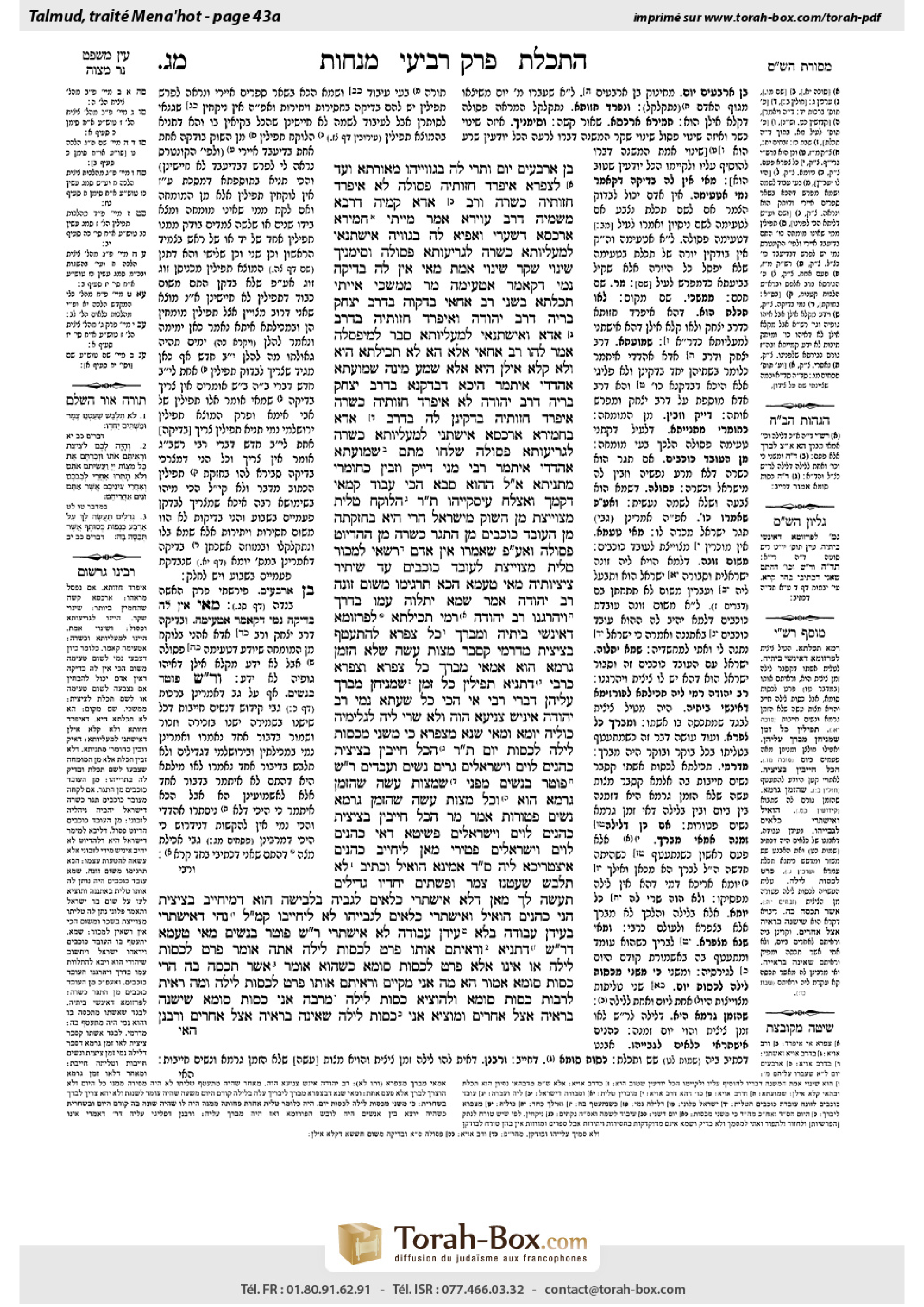
Menachot 43a: Talmud study for Daf Yomi
Daf Yomi is the daily study of one Talmud folio. Explore 37 tractates with scans, Hebrew text, Sefaria English and AI-generated French translations where annotated.
Passage selection and English or AI-generated French translation are available where the scan has annotations. Daf Study is independent of Torah-Box and Sefaria.
Browse Menachot · מנחות · All tractatesMenachot 43a text and translations
This page of Menachot includes the Aramaic text, an English translation and an AI-generated French translation, alongside the scan above.
מנחות מ״ג א · Aramaic and Hebrew text
בֶּן אַרְבָּעִים יוֹם, וְתָרֵי לַהּ בְּגַוַּויְיהוּ מֵאוּרְתָּא וְעַד לְצַפְרָא. אִיפְּרֵד חֲזוּתַיהּ – פְּסוּלָה, לָא אִיפְּרֵד חֲזוּתַיהּ – כְּשֵׁרָה.
וְרַב אַדָּא קַמֵּיהּ דְּרָבָא מִשְּׁמֵיהּ דְּרַב עַוִּירָא אָמַר: מַיְיתֵי חֲמִירָא אַרְכְּסָא דִּשְׂעָרֵי וְאָפְיָא לַהּ בְּגַוֵּויהּ, אִישְׁתַּנַּאי לִמְעַלְּיוּתָא – כְּשֵׁרָה, לִגְרִיעוּתָא – פְּסוּלָה, וְסִימָנָיךְ: שִׁינּוּי שֶׁקֶר, שִׁינּוּי אֱמֶת.
מַאי ״אֵין לָהּ בְּדִיקָה״ נָמֵי דְּקָאָמַר? אַטְּעִימָה.
מָר מִמִּשְׁכִּי אַיְיתִי תְּכֵלְתָּא בִּשְׁנֵי רַב אַחַאי, בַּדְקוּהָ בִּדְרַב יִצְחָק בְּרֵיהּ דְּרַב יְהוּדָה, וְאִיפְּרֵד חֲזוּתַיהּ, בִּדְרַב אַדָּא, וְאִישְׁתַּנַּאי לִמְעַלְּיוּתָא.
סְבַר לְמִיפְסְלַהּ, אֲמַר לְהוּ רַב אַחַאי: אֶלָּא הָא לָא תְּכֵילְתָּא הִיא, וְלָא קָלָא אִילָן הִיא, אֶלָּא שְׁמַע מִינַּהּ שְׁמוּעָתָא אַהֲדָדֵי אִיתְּמַר.
הֵיכָא דִּבְדַקְנָא בִּדְרַב יִצְחָק בְּרֵיהּ דְּרַב יְהוּדָה, לָא אִיפְּרֵד חֲזוּתַיהּ – כְּשֵׁרָה; אִיפְּרֵד חֲזוּתַיהּ – בָּדְקִינַן לַהּ בִּדְרַב אַדָּא בַּחֲמִירָא אַרְכְּסָא: אִישְׁתַּנַּי לִמְעַלְּיוּתָא – כְּשֵׁרָה, לִגְרִיעוּתָא – פְּסוּלָה. שְׁלַחוּ מִתָּם: שְׁמוּעָתָא אַהֲדָדֵי אִיתְּמַר.
רַבִּי מָנִי דָּיֵיק וְזָבֵין כְּחוּמְרֵי מַתְנְיָתָא, אֲמַר לֵיהּ הָהוּא סָבָא: הָכִי עֲבוּד קַמָּאֵי דְקַמָּךְ, וְאַצְלַח עִיסְקַיְיהוּ.
תָּנוּ רַבָּנַן: הַלּוֹקֵחַ טַלִּית מְצוּיֶּיצֶת מִן הַשּׁוּק, מִיִּשְׂרָאֵל – הֲרֵי הִיא בְּחֶזְקָתָהּ, מִן הַגּוֹי, מִן הַתַּגָּר – כְּשֵׁרָה, מִן הַהֶדְיוֹט – פְּסוּלָה.
וְאַף עַל פִּי שֶׁאָמְרוּ: אֵין אָדָם רַשַּׁאי לִמְכּוֹר טַלִּית מְצוּיֶּיצֶת לְגוֹי עַד שֶׁיַּתִּיר צִיצִיּוֹתֶיהָ.
מַאי טַעְמָא? הָכָא תַּרְגִּימוּ מִשּׁוּם זוֹנָה, רַב יְהוּדָה אָמַר: שֶׁמָּא יִתְלַוֶּה עִמּוֹ בַּדֶּרֶךְ וְיַהַרְגֶנּוּ.
רַב יְהוּדָה רָמֵי תְּכֵילְתָּא לְפַרְזוּמָא דְּאִינָשֵׁי בֵּיתֵיהּ, וּמְבָרֵךְ כֹּל צַפְרָא ״לְהִתְעַטֵּף בַּצִּיצִית״.
מִדְּרָמֵי, קָסָבַר: מִצְוַת עֲשֵׂה שֶׁלֹּא הַזְּמַן גְּרָמָא הוּא, אַמַּאי מְבָרֵךְ כֹּל צַפְרָא וְצַפְרָא?
כְּרַבִּי, דְּתַנְיָא: תְּפִילִּין כׇּל זְמַן שֶׁמַּנִּיחָן מְבָרֵךְ עֲלֵיהֶן, דִּבְרֵי רַבִּי.
אִי הָכִי, כֹּל שַׁעְתָּא נָמֵי! רַב יְהוּדָה אִינִישׁ צְנִיעָא הֲוָה, וְלָא שָׁרֵי לֵיהּ לִגְלִימֵיהּ כּוּלֵּיהּ יוֹמָא. וּמַאי שְׁנָא מִצַּפְרָא? כִּי מְשַׁנֵּי מִכְּסוּת לַיְלָה לִכְסוּת יוֹם.
תָּנוּ רַבָּנַן: הַכֹּל חַיָּיבִין בְּצִיצִית, כֹּהֲנִים, לְוִיִּם וְיִשְׂרְאֵלִים, גֵּרִים, נָשִׁים וַעֲבָדִים. רַבִּי שִׁמְעוֹן פּוֹטֵר בְּנָשִׁים, מִפְּנֵי שֶׁמִּצְוַת עֲשֵׂה שֶׁהַזְּמַן גְּרָמָאּ הוּא, וְכׇל מִצְוַת עֲשֵׂה שֶׁהַזְּמַן גְּרָמָאּ נָשִׁים פְּטוּרוֹת.
אָמַר מָר: הַכֹּל חַיָּיבִין בְּצִיצִית, כֹּהֲנִים לְוִיִּם וְיִשְׂרְאֵלִים. פְּשִׁיטָא, דְּאִי כֹּהֲנִים לְוִיִּם וְיִשְׂרְאֵלִים פְּטִירִי, מַאן לִיחַיַּיב?
כֹּהֲנִים אִיצְטְרִיכָא לֵיהּ, סָלְקָא דַּעְתָּךְ אָמֵינָא: הוֹאִיל וּכְתִיב ״לֹא תִלְבַּשׁ שַׁעַטְנֵז צֶמֶר וּפִשְׁתִּים יַחְדָּו. גְּדִילִים תַּעֲשֶׂה לָךְ״, מַאן דְּלָא אִישְׁתְּרִי כִּלְאַיִם לְגַבֵּיהּ בִּלְבִישָׁה הוּא דְּמִיחַיַּיב בְּצִיצִית, הָנֵי כֹּהֲנִים הוֹאִיל וְאִישְׁתְּרִי כִּלְאַיִם לְגַבַּיְיהוּ – לָא לִיחַיְּיבוּ.
קָא מַשְׁמַע לַן: נְהִי דְּאִישְׁתְּרִי בְּעִידָּן עֲבוֹדָה, בְּלָא עִידָּן עֲבוֹדָה לָא אִישְׁתְּרִי.
רַבִּי שִׁמְעוֹן פּוֹטֵר בְּנָשִׁים. מַאי טַעְמָא דְּרַבִּי שִׁמְעוֹן? דְּתַנְיָא: ״וּרְאִיתֶם אוֹתוֹ״ – פְּרָט לִכְסוּת לַיְלָה.
אַתָּה אוֹמֵר: פְּרָט לִכְסוּת לַיְלָה, אוֹ אֵינוֹ אֶלָּא פְּרָט לִכְסוּת סוֹמֵא? כְּשֶׁהוּא אוֹמֵר: ״אֲשֶׁר תְּכַסֶּה בָּהּ״, הֲרֵי כְּסוּת סוֹמֵא אָמוּר, הָא מָה אֲנִי מְקַיֵּים ״וּרְאִיתֶם אוֹתוֹ״? פְּרָט לִכְסוּת לַיְלָה.
וּמָה רָאִיתָ לְרַבּוֹת כְּסוּת סוֹמֵא וּלְהוֹצִיא כְּסוּת לַיְלָה? מְרַבֶּה אֲנִי כְּסוּת סוֹמֵא שֶׁיֶּשְׁנָהּ בִּרְאִיָּה אֵצֶל אֲחֵרִים, וּמוֹצִיא אֲנִי כְּסוּת לַיְלָה שֶׁאֵינָהּ בִּרְאִיָּה אֵצֶל אֲחֵרִים.
וְרַבָּנַן
Menachot 43a · English translation
that was forty days old. He would soak the sky-blue wool in this solution from night until morning. If its color would fade [ipparad ḥazutei], the sky-blue wool was determined to be unfit, as it was not dyed with tekhelet derived from a ḥilazon. If its color would not fade, the sky-blue wool was determined to be fit.
And Rav Adda said before Rava in the name of Rav Avira: One brings hard [arkesa] leavened barley dough and bakes the sky-blue wool in it. If the color of the sky-blue wool changes for the better, meaning that the process intensifies the color of the sky-blue wool, then it is fit. If the color of the sky-blue wool changes for the worse, i.e., it fades, then it is unfit. And your mnemonic is: Change reveals falsehood and change reveals truth. All of this indicates that it is possible to test whether sky-blue wool has been dyed with real tekhelet, contrary to the baraita.
The Gemara explains the baraita: What does it mean when it says: There is no reliable method of testing sky-blue wool? It means that there is no way to test whether it was dyed for the sake of the mitzva or for the purpose of testing the dye.
The Gemara relates that Mar, a Sage from Mashkhei, brought sky-blue wool in the years when Rav Aḥai was a preeminent Sage. They tested it in the manner described by Rav Yitzḥak, son of Rav Yehuda, and its color faded. They then tested it in the manner described by Rav Adda and the color changed for the better.
The Sages thought that the sky-blue wool should be deemed unfit because it did not pass the first test. Rav Aḥai said to them: But how could it be that this wool is not tekhelet, as it failed one of the tests, and is also not indigo, as it passed the other? This is impossible, because it must be one or the other. Rather, conclude from it that these halakhot were stated together.
He explains: In a case where we tested the wool in the manner described by Rav Yitzḥak, son of Rav Yehuda, and its color did not fade, it is fit and requires no further testing. If its color faded, then we test it in the manner described by Rav Adda, with hard leavened barley dough. If the color changed for the better it is fit; if the color changed for the worse it is unfit. The Gemara adds: They sent a message from there, i.e., Eretz Yisrael: These halakhot were in fact stated together, as explained by Rav Aḥai.
The Gemara relates that Rabbi Mani was exacting and purchased sky-blue wool in accordance with the stringencies of the baraita cited earlier, i.e., that wool dyed as a test is unfit for ritual fringes, and that therefore one should purchase sky-blue wool for ritual fringes only from an expert. A certain elder said to him: This is what your early predecessors did, and their businesses were successful.
The Sages taught in a baraita: In the case of one who purchases a cloak with ritual fringes from the marketplace, if he purchased it from a Jew it retains its presumptive status that it is fit for the mitzva. If he purchased it from a gentile, then if he purchased it from a merchant it is presumed to be fit, as the merchant would want to maintain his credibility and would therefore purchase the sky-blue strings only from a reliable source. But if he purchased it from a gentile who is an ordinary person rather than a professional merchant, the sky-blue strings are unfit, as the seller presumably dyed them himself.
And even though the Sages said: A person is not permitted to sell a cloak with ritual fringes to a gentile until he unties and removes its ritual fringes, it is permitted to purchase such a cloak from a gentile merchant, as it is assumed that the merchant acquired the cloak from a Jew who ignored this halakha.
The Gemara asks: What is the reason for the prohibition against selling a cloak with ritual fringes to a gentile? The Gemara answers: Here they interpreted that it is prohibited because of the concern that the gentile will visit a prostitute and observers will think that he is a Jew. Alternatively, Rav Yehuda said: It is prohibited lest a Jew mistake the gentile for a Jew and accompany him on a journey thinking that he is also Jewish, due to his ritual fringes, and the gentile might then kill him.
§ Rav Yehuda would affix white and sky-blue strings to the garment [pirzuma] of his wife. And every morning he would recite the blessing: To wrap ourselves in garments with ritual fringes.
The Gemara asks: From the fact that he would affix ritual fringes to his wife’s garments, it is apparent that he holds that the obligation of ritual fringes is a positive mitzva that is not time-bound, and therefore women are also obligated in it. But if that is his opinion, why did he recite the blessing on ritual fringes each and every morning? In order for the mitzva to not be time-bound, it must apply at night, in which case a new blessing should not be recited in the morning.
The Gemara answers: Rav Yehuda was acting in accordance with the opinion of Rabbi Yehuda HaNasi, as it is taught in a baraita: With regard to phylacteries, every time one dons them he recites the blessing over them, even several times in one day; this is the statement of Rabbi Yehuda HaNasi.
The Gemara asks: If so, he should have also recited a blessing every time that he took the cloak off and put it back on, and not merely once a day in the morning. The Gemara answers: Rav Yehuda was a modest man and he did not remove his cloak the entire day. The Gemara asks: In what way is it different from the morning, i.e., why did he recite a blessing in the morning? The Gemara answers: He recited the blessing in the morning when he changed from a nighttime garment to a daytime garment.
§ The Sages taught in a baraita: Everyone is obligated in the mitzva of ritual fringes, including priests, Levites, Israelites, converts, women, and Canaanite slaves. Rabbi Shimon deems women exempt, because the mitzva of ritual fringes is a positive, time-bound mitzva, and women are exempt from every positive, time-bound mitzva.
The Gemara analyzes the baraita. The Master said in the baraita: Everyone is obligated in the mitzva of ritual fringes, including priests, Levites, and Israelites. The Gemara asks: Isn’t that obvious? As, if priests, Levites, and Israelites were exempt from the mitzva, who then is to be obligated?
The Gemara answers: It was necessary for the baraita to mention that priests are obligated to fulfill the mitzva, as it may enter your mind to say as follows: Since it is written: “You shall not wear diverse kinds, wool and linen together. You shall prepare yourself twisted cords upon the four corners of your covering” (Deuteronomy 22:11–12), only one who is not permitted to wear diverse kinds is obligated in the mitzva of ritual fringes. With regard to these priests, since diverse kinds are permitted for them when they perform the Temple service, as the belt of the priestly vestments contains diverse kinds, they should not be obligated in the mitzva of ritual fringes.
Therefore, the baraita teaches us that although the prohibition of diverse kinds is permitted for them at the time when they perform the Temple service, when it is not the time of the Temple service it is not permitted, and therefore priests are obligated in the mitzva of ritual fringes.
The baraita states that Rabbi Shimon deems women exempt. The Gemara asks: What is the reasoning of Rabbi Shimon? The Gemara answers: As it is taught in a baraita that with regard to ritual fringes it is stated: “And it shall be unto you for a fringe, that you may look upon it and remember all the commandments of the Lord” (Numbers 15:39). The term “that you may look” excludes a nighttime garment, as it is dark at night and it is therefore difficult to see.
The baraita continues: One may ask: Do you say that the verse serves to exclude a nighttime garment? Or is it to exclude only the garment of a blind person, who is also unable to see his ritual fringes? The tanna explains: When the verse states: “Of your covering, with which you cover yourself” (Deuteronomy 22:12), the garment of a blind person is mentioned as being included, as the verse already stated: “Of your covering,” and did not need to state: “With which you cover yourself.” If so, how do I realize the meaning of the exclusion: “That you may look upon it”? It must exclude a nighttime garment.
The Gemara asks: What did you see that led you to include the garment of a blind person from the phrase: “With which you cover yourself,” and to exclude a nighttime garment from the phrase: “That you may look upon it,” rather than including a nighttime garment in the obligation and excluding the garment of a blind person? The Gemara answers: I include the garment of a blind person, which is visible to others, even though the blind person himself cannot see it, and I exclude a nighttime garment, which is not visible even to others.
The Gemara asks: And the Rabbis who disagree with Rabbi Shimon,
Menachot 43a · Traduction française (IA)
qui avait quarante jours. Il faisait tremper la laine bleu azur dans cette solution du soir au matin. Si sa couleur pâlissait [ipparad ḥazutei], la laine bleu azur était déclarée impropre, car elle n’avait pas été teinte avec du tekhelet provenant d’un ḥilazon. Si sa couleur ne pâlissait pas, la laine bleu azur était déclarée apte.
Et Rav Adda dit devant Rava, au nom de Rav Avira : On prend une pâte d’orge fermentée et dure [arkesa], et on y fait cuire la laine bleu azur. Si la couleur de la laine bleu azur s’améliore, c’est-à-dire si le procédé intensifie sa couleur, elle est apte. Si sa couleur se dégrade, c’est-à-dire si elle pâlit, elle est impropre. Le moyen mnémotechnique est le suivant : le changement révèle le mensonge et le changement révèle la vérité. Tout cela indique qu’il est possible de vérifier si la laine bleu azur a été teinte avec du véritable tekhelet, contrairement à la baraïta.
La Guemara explique la baraïta : que signifie l’affirmation selon laquelle il n’existe aucune méthode fiable pour vérifier la laine bleu azur ? Cela signifie qu’il n’existe aucun moyen de vérifier si elle a été teinte en vue de la mitsva ou dans le but de tester la teinture.
La Guemara rapporte que Mar, un Sage de Mashkhei, apporta de la laine bleu azur à l’époque où Rav Aḥai était un Sage éminent. On la vérifia selon la méthode décrite par Rav Yitzḥak, fils de Rav Yehuda, et sa couleur pâlit. On la vérifia ensuite selon la méthode décrite par Rav Adda, et sa couleur s’améliora.
Les Sages pensèrent que la laine bleu azur devait être déclarée impropre, puisqu’elle n’avait pas réussi le premier test. Rav Aḥai leur dit : Mais comment cette laine pourrait-elle ne pas être du tekhelet, puisqu’elle a échoué à l’un des tests, et ne pas être de l’indigo, puisqu’elle a réussi l’autre ? C’est impossible, car elle doit être l’un ou l’autre. Il faut donc en conclure que ces halakhot ont été énoncées ensemble.
Il explique : Si l’on a vérifié la laine selon la méthode décrite par Rav Yitzḥak, fils de Rav Yehuda, et que sa couleur n’a pas pâli, elle est apte et n’a pas besoin d’être soumise à d’autres tests. Si sa couleur a pâli, on la vérifie alors selon la méthode décrite par Rav Adda, avec de la pâte d’orge fermentée et dure. Si sa couleur s’améliore, elle est apte ; si elle se dégrade, elle est impropre. La Guemara ajoute : On fit parvenir de là-bas, c’est-à-dire d’Eretz Israël, le message suivant : ces halakhot ont effectivement été énoncées ensemble, comme Rav Aḥai l’a expliqué.
La Guemara rapporte que Rabbi Mani était scrupuleux et achetait de la laine bleu azur en respectant les exigences de la baraïta citée précédemment, à savoir que la laine teinte à titre d’essai est impropre aux franges rituelles et qu’il faut donc acheter de la laine bleu azur destinée aux franges rituelles uniquement auprès d’un expert. Un certain ancien lui dit : C’est ainsi que procédaient tes ancêtres, et leurs affaires prospéraient.
Les Sages ont enseigné dans une baraïta : Celui qui achète sur le marché un manteau muni de franges rituelles, s’il l’a acheté à un Juif, celui-ci conserve son statut présumé d’article apte à la mitsva. S’il l’a acheté à un non-Juif, alors, s’il l’a acheté à un marchand, il est présumé apte, car le marchand souhaite préserver sa crédibilité et n’achèterait donc les fils bleu azur qu’auprès d’une source fiable. Mais s’il l’a acheté à un non-Juif qui est un simple particulier et non un marchand professionnel, les fils bleu azur sont impropres, car on peut présumer que le vendeur les a teints lui-même.
Et bien que les Sages aient dit qu’il est interdit de vendre à un non-Juif un manteau muni de franges rituelles avant d’avoir dénoué et retiré celles-ci, il est permis d’acheter un tel manteau à un marchand non juif, car on présume que le marchand l’a acquis auprès d’un Juif qui n’a pas respecté cette halakha.
La Guemara demande : Quelle est la raison de l’interdiction de vendre à un non-Juif un manteau muni de franges rituelles ? La Guemara répond : Ici, les Sages expliquent que cette interdiction vise à éviter que le non-Juif ne se rende chez une prostituée et que des observateurs le prennent pour un Juif. Autrement, Rav Yehuda dit : C’est interdit de crainte qu’un Juif ne prenne le non-Juif pour un Juif et ne l’accompagne en voyage, pensant qu’il est lui aussi juif à cause de ses franges rituelles ; le non-Juif pourrait alors le tuer.
§ Rav Yehuda attachait des fils blancs et bleu azur au vêtement [pirzuma] de sa femme. Chaque matin, il récitait la bénédiction : « Qui nous a ordonné de nous envelopper de vêtements munis de franges rituelles. »
La Guemara demande : Le fait qu’il attachait des franges rituelles aux vêtements de sa femme montre qu’il estimait que l’obligation des franges rituelles est une mitsva positive qui n’est pas liée au temps et que, par conséquent, les femmes y sont également astreintes. Mais si telle était son opinion, pourquoi récitait-il la bénédiction sur les franges rituelles chaque matin ? Pour que la mitsva ne soit pas liée au temps, elle doit s’appliquer la nuit ; dans ce cas, on ne devrait pas réciter une nouvelle bénédiction le matin.
La Guemara répond : Rav Yehuda agissait conformément à l’opinion de Rabbi Yehuda HaNassi, comme l’enseigne une baraïta : Concernant les phylactères, chaque fois qu’on les met, on récite la bénédiction à leur sujet, même plusieurs fois dans la journée ; telle est l’opinion de Rabbi Yehuda HaNassi.
La Guemara demande : Dans ce cas, il aurait également dû réciter une bénédiction chaque fois qu’il ôtait le manteau et le remettait, et pas seulement une fois par jour, le matin. La Guemara répond : Rav Yehuda était un homme pudique et ne retirait pas son manteau de toute la journée. La Guemara demande : En quoi le matin était-il différent, c’est-à-dire pourquoi récitait-il une bénédiction le matin ? La Guemara répond : Il récitait la bénédiction le matin, lorsqu’il troquait son vêtement de nuit contre son vêtement de jour.
§ Les Sages ont enseigné dans une baraïta : Tous sont astreints à la mitsva des franges rituelles, notamment les prêtres, les lévites, les Israélites, les convertis, les femmes et les esclaves cananéens. Rabbi Shimon dispense les femmes, car la mitsva des franges rituelles est une mitsva positive liée au temps, et les femmes sont dispensées de toute mitsva positive liée au temps.
La Guemara analyse la baraïta. Le maître a dit dans la baraïta : Tous sont astreints à la mitsva des franges rituelles, notamment les prêtres, les lévites et les Israélites. La Guemara demande : N’est-ce pas évident ? Car si les prêtres, les lévites et les Israélites étaient dispensés de cette mitsva, qui y serait donc astreint ?
La Guemara répond : Il était nécessaire que la baraïta précise que les prêtres sont astreints à accomplir la mitsva, car on aurait pu penser ceci : puisqu’il est écrit : « Tu ne porteras pas de vêtement mêlant des fils de laine et de lin. Tu te feras des cordons torsadés aux quatre coins de ton vêtement » (Deutéronome 22:11–12), seule une personne qui n’a pas le droit de porter un mélange de laine et de lin est astreinte à la mitsva des franges rituelles. Or, pour ces prêtres, puisque le mélange de laine et de lin leur est permis lorsqu’ils accomplissent le service du Temple — la ceinture des vêtements sacerdotaux étant faite d’un tel mélange —, ils ne devraient pas être astreints à la mitsva des franges rituelles.
La baraïta nous enseigne donc que, bien que l’interdiction du mélange de laine et de lin soit levée pour eux lorsqu’ils accomplissent le service du Temple, elle ne l’est pas en dehors du temps du service du Temple ; les prêtres sont donc astreints à la mitsva des franges rituelles.
La baraïta dit que Rabbi Shimon dispense les femmes. La Guemara demande : Quel est le raisonnement de Rabbi Shimon ? La Guemara répond : Car il est enseigné dans une baraïta qu’au sujet des franges rituelles, il est dit : « Cela vous servira de frange, afin qu’en la regardant vous vous souveniez de tous les commandements de l’Éternel » (Nombres 15:39). L’expression « afin qu’en la regardant » exclut un vêtement de nuit, car il fait sombre la nuit et il est donc difficile de voir.
La baraïta poursuit : On pourrait demander : Le verset sert-il, selon toi, à exclure un vêtement de nuit ? Ou bien exclut-il seulement le vêtement d’un aveugle, qui ne peut pas non plus voir ses franges rituelles ? Le tanna explique : Lorsque le verset dit : « De ton vêtement, dont tu te couvres » (Deutéronome 22:12), le vêtement d’un aveugle est inclus, puisque le verset avait déjà dit « de ton vêtement » et n’avait pas besoin d’ajouter « dont tu te couvres ». Dès lors, comment comprendre l’exclusion « afin qu’en la regardant » ? Elle doit exclure un vêtement de nuit.
La Guemara demande : Qu’as-tu vu qui t’a conduit à inclure le vêtement d’un aveugle à partir de l’expression « dont tu te couvres » et à exclure un vêtement de nuit à partir de l’expression « afin qu’en la regardant », plutôt que d’inclure un vêtement de nuit dans l’obligation et d’exclure le vêtement d’un aveugle ? La Guemara répond : J’inclus le vêtement d’un aveugle, qui est visible aux autres, même si l’aveugle lui-même ne peut pas le voir, et j’exclus un vêtement de nuit, qui n’est visible par personne d’autre.
La Guemara demande : Et les Rabbins qui ne sont pas d’accord avec Rabbi Shimon,
Traduction française générée par IA à partir de l’édition anglaise de Sefaria. Vérifie toujours un passage avec le texte source.
Text from Sefaria: William Davidson Edition - Vocalized Aramaic (unknown); William Davidson Edition - English (CC BY NC).