Menachot 42b: Talmud study for Daf Yomi
Daf Yomi is the daily study of one Talmud folio. Explore 37 tractates with scans, Hebrew text, Sefaria English and AI-generated French translations where annotated.
Passage selection and English or AI-generated French translation are available where the scan has annotations. Daf Study is independent of Torah-Box and Sefaria.
Browse Menachot · מנחות · All tractatesMenachot 42b text and translations
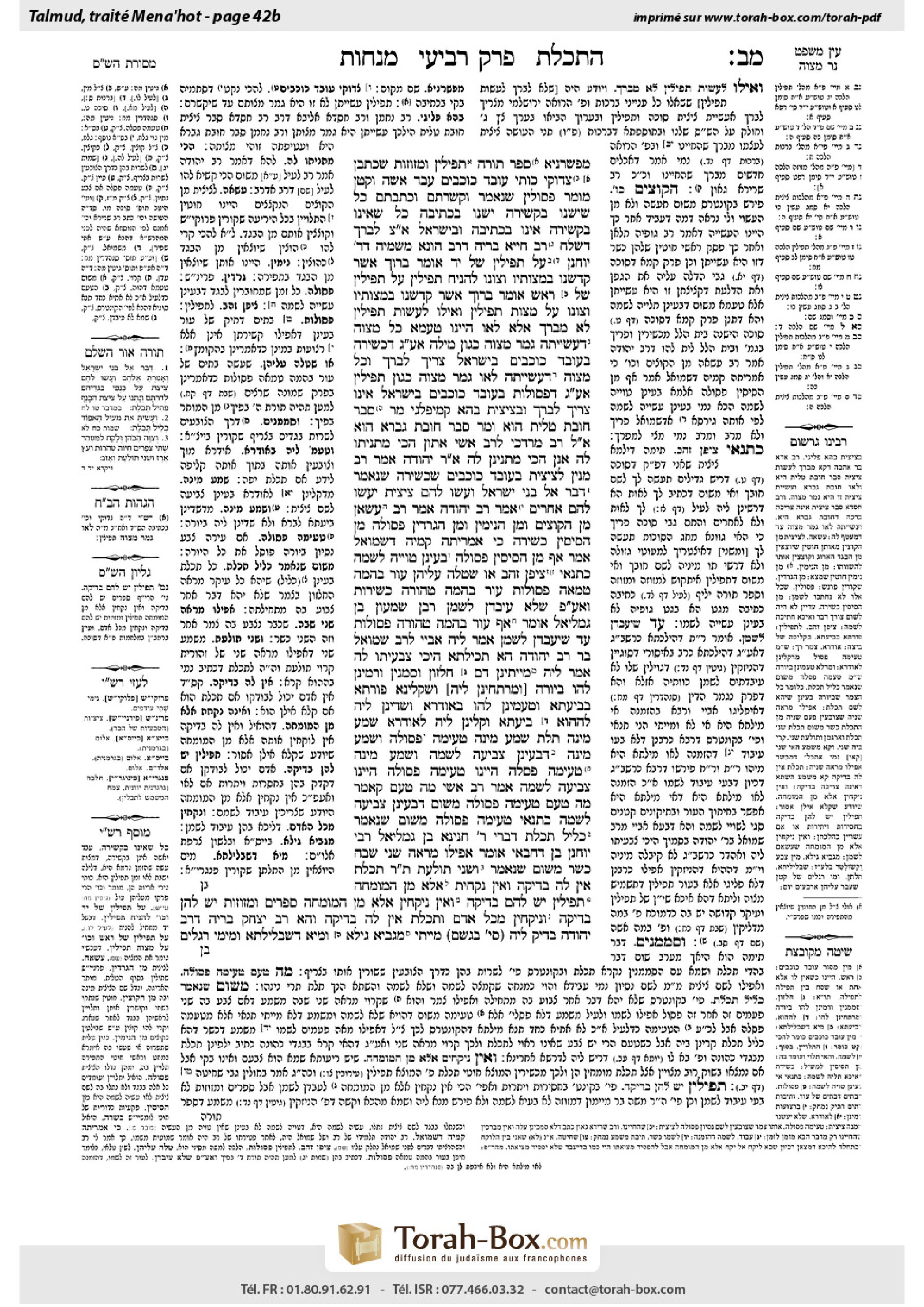
This page of Menachot includes the Aramaic text, an English translation and an AI-generated French translation, alongside the scan above.
מנחות מ״ב ב · Aramaic and Hebrew text
מִפַּשְׁרוּנְיָא: סֵפֶר תּוֹרָה, תְּפִילִּין וּמְזוּזוֹת שֶׁכְּתָבָן מִין, כּוּתִי, גּוֹי, עֶבֶד, אִשָּׁה, וְקָטָן, וְיִשְׂרָאֵל מְשׁוּמָּד – פְּסוּלִין, שֶׁנֶּאֱמַר: ״וּקְשַׁרְתָּם״ ״וּכְתַבְתָּם״, כֹּל שֶׁיֶּשְׁנוֹ בִּקְשִׁירָה יֶשְׁנוֹ בִּכְתִיבָה, כֹּל שֶׁאֵינוֹ בִּקְשִׁירָה אֵינוֹ בִּכְתִיבָה.
וּבְיִשְׂרָאֵל אֵין צָרִיךְ לְבָרֵךְ, דִּשְׁלַח רַב חִיָּיא בְּרֵיהּ דְּרַב הוּנָא מִשְּׁמֵיהּ דְּרַבִּי יוֹחָנָן: עַל תְּפִילִּין שֶׁל יָד אוֹמֵר: ״בָּרוּךְ אֲשֶׁר קִדְּשָׁנוּ בְּמִצְוֹתָיו וְצִוָּנוּ לְהַנִּיחַ תְּפִילִּין״, עַל תְּפִילִּין שֶׁל רֹאשׁ אוֹמֵר: ״בָּרוּךְ אֲשֶׁר קִדְּשָׁנוּ בְּמִצְוֹתָיו וְצִוָּנוּ עַל מִצְוַת תְּפִילִּין״, וְאִילּוּ ״לַעֲשׂוֹת תְּפִילִּין״ לָא מְבָרֵךְ!
אֶלָּא לָאו הַיְינוּ טַעְמָא: כׇּל מִצְוָה דַּעֲשִׂיָּיתָהּ גְּמַר מִצְוָה, כְּגוֹן מִילָה, אַף עַל גַּב דִּכְשֵׁירָה בְּגוֹי – בְּיִשְׂרָאֵל צָרִיךְ לְבָרֵךְ, וְכׇל מִצְוָה דַּעֲשִׂיָּיתָהּ לָאו גְּמַר מִצְוָה, כְּגוֹן תְּפִילִּין, אַף עַל גַּב דִּפְסוּלוֹת בְּגוֹי – בְּיִשְׂרָאֵל אֵינוֹ צָרִיךְ לְבָרֵךְ.
וּבְצִיצִית, בְּהָא קָמִיפַּלְגִי: מָר סָבַר חוֹבַת טַלִּית הוּא, וּמָר סָבַר חוֹבַת גַּבְרָא הוּא.
אֲמַר לֵיהּ רַב מָרְדֳּכַי לְרַב אָשֵׁי: אַתּוּן הָכִי מַתְנִיתוּ לַהּ.
אֲנַן הָכִי מַתְנֵינַן לַהּ, אָמַר רַב יְהוּדָה אָמַר רַב: מִנַּיִן לְצִיצִית בְּגוֹי שֶׁכְּשֵׁירָה? שֶׁנֶּאֱמַר: ״דַּבֵּר אֶל בְּנֵי יִשְׂרָאֵל וְעָשׂוּ לָהֶם צִיצִית״, יַעֲשׂוּ לָהֶם אֲחֵרִים.
אָמַר רַב יְהוּדָה אָמַר רַב: עֲשָׂאָן מִן הַקּוֹצִים, וּמִן הַנִּימִין, וּמִן הַגְּרָדִין – פְּסוּלָה, מִן הַסִּיסִין – כְּשֵׁירָה.
כִּי אַמְרִיתַהּ קַמֵּיהּ דִּשְׁמוּאֵל, אָמַר: אַף מִן הַסִּיסִין פְּסוּלָה, בָּעֵינַן טְוִיָּיה לִשְׁמָהּ.
כְּתַנָּאֵי: צִיפָּן זָהָב, אוֹ שֶׁטָּלָה עֲלֵיהֶן עוֹר בְּהֵמָה טְמֵאָה – פְּסוּלוֹת. עוֹר בְּהֵמָה טְהוֹרָה – כְּשֵׁירוֹת, וְאַף עַל פִּי שֶׁלֹּא עִיבְּדָן לִשְׁמָן. רַבָּן שִׁמְעוֹן בֶּן גַּמְלִיאֵל אוֹמֵר: אַף עוֹר בְּהֵמָה טְהוֹרָה פְּסוּלוֹת, עַד שֶׁיְּעַבְּדֵן לִשְׁמָן.
אֲמַר לֵיהּ אַבָּיֵי לְרַב שְׁמוּאֵל בַּר רַב יְהוּדָה: הָא תְּכֵילְתָּא הֵיכִי צָבְעִיתוּ לַהּ? אֲמַר לֵיהּ: מַיְיתִינַן דַּם חִלָּזוֹן וְסַמָּנִין, וְרָמֵינַן לְהוּ בְּיוֹרָה, וְשָׁקְלִינַן פּוּרְתָּא בְּבֵיעֲתָא, וְטָעֲמִינַן לְהוּ בְּאוּדְרָא, וְשָׁדֵינַן לַיהּ לְהָהוּא בֵּיעֲתָא, וְקָלֵינַן לֵיהּ לְאוּדְרָא.
שְׁמַע מִינַּהּ תְּלָת: שְׁמַע מִינַּהּ טְעִימָה פְּסוּלָה, וּשְׁמַע מִינַּהּ דְּבָעֵינַן צְבִיעָה לִשְׁמָהּ, וּשְׁמַע מִינַּהּ טְעִימָה פָּסְלָה.
הַיְינוּ טְעִימָה פְּסוּלָה, הַיְינוּ צְבִיעָה לִשְׁמָהּ? אָמַר רַב אָשֵׁי: מָה טַעַם קָאָמַר – מָה טַעַם טְעִימָה פְּסוּלָה? מִשּׁוּם דְּבָעֵינַן צְבִיעָה לִשְׁמָהּ.
כְּתַנָּאֵי: טְעִימָה פְּסוּלָה, מִשּׁוּם שֶׁנֶּאֱמַר: ״כְּלִיל תְּכֵלֶת״, דִּבְרֵי רַבִּי חֲנִינָא בֶּן גַּמְלִיאֵל.
רַבִּי יוֹחָנָן בֶּן דַּהֲבַאי אוֹמֵר: אֲפִילּוּ מַרְאֶה שֵׁנִי שֶׁבָּהּ כָּשֵׁר, מִשּׁוּם שֶׁנֶּאֱמַר: ״וּשְׁנִי תוֹלָעַת״.
תָּנוּ רַבָּנַן: תְּכֵלֶת אֵין לָהּ בְּדִיקָה, וְאֵין נִיקַּחַת אֶלָּא מִן הַמּוּמְחֶה. תְּפִילִּין יֵשׁ לָהֶם בְּדִיקָה, וְאֵין נִיקָּחִין אֶלָּא מִן הַמּוּמְחֶה. סְפָרִים וּמְזוּזוֹת יֵשׁ לָהֶן בְּדִיקָה, וְנִיקָּחִין מִכׇּל אָדָם.
וּתְכֵלֶת אֵין לָהּ בְּדִיקָה? וְהָא רַב יִצְחָק בְּרֵיהּ דְּרַב יְהוּדָה בָּדֵיק לֵיהּ! (סִימָן בְּגֶשֶׁם) מַיְיתֵי מַגְבְּיָא גִּילָא, וּמַיָּא דְּשַׁבְלִילְתָּא, וּמֵימֵי רַגְלַיִם
Menachot 42b · English translation
of Pashronya: A Torah scroll, phylacteries, or mezuzot that were written by a heretic, a Samaritan, a gentile, a Canaanite slave, a woman, a minor, or a Jewish apostate [meshummad] are unfit, as it is stated: “And you shall bind them for a sign on your arm…and you shall write them on the doorposts of your house” (Deuteronomy 6:8–9). From this juxtaposition, one can derive the following: Anyone who is included in the mitzva of binding the phylacteries, i.e., one who is both obligated and performs the mitzva, is included in the class of people who may write Torah scrolls, phylacteries, and mezuzot; and anyone who is not included in the mitzva of binding is not included in the class of people who may write sacred texts.
And despite the fact that phylacteries written by a gentile are unfit, a Jew who writes them does not have to recite a blessing. As Rav Ḥiyya, son of Rav Huna, sent a ruling in the name of Rabbi Yoḥanan: On phylacteries of the arm one says the blessing: Blessed are You, Lord our God, King of the universe, Who has sanctified us through His mitzvot and commanded us to don phylacteries. On phylacteries of the head one says the blessing: Blessed are You, Lord our God, King of the universe, Who has sanctified us through His mitzvot and commanded us concerning the mitzva of phylacteries. The implication of this is that one recites blessings only when he dons the phylacteries, whereas when he writes the phylacteries he does not recite a blessing: To prepare phylacteries.
Rather, isn’t this the reason for the distinction between different mitzvot: For any mitzva whose performance is the completion of the mitzva, such as circumcision, even though it is valid when performed by a gentile, when it is performed by a Jew he must recite a blessing. But for any mitzva where the performance of a particular act is not the completion of the mitzva, such as writing phylacteries, where one does not complete the mitzva until he dons them, even though it is not valid when performed by a gentile, when it is performed by a Jew he does not need to recite a blessing.
And with regard to reciting a blessing when one attaches ritual fringes to a garment, the Sages disagree about this: One Sage, Rav Adda bar Ahava, holds that it is an obligation pertaining to the cloak. Therefore, when one attaches the ritual fringes he is completing the mitzva, and he should recite a blessing: To prepare ritual fringes. And one Sage, Rav Naḥman, citing Rav, holds that it is an obligation incumbent upon the man. Consequently, the mitzva is not complete until he wears the garment, and he should not recite a blessing when he attaches the ritual fringes to the garment.
Rav Mordekhai said to Rav Ashi: You teach this halakha about gentiles attaching ritual fringes to a garment in this manner, citing Rav Yehuda in the name of Rav that the ritual fringes are invalid. Consequently, Rav Ḥisda raises a contradiction between this ruling and another ruling of Rav.
We teach it in this way, according to which there is no contradiction: Rav Yehuda says that Rav says: From where is it derived that if ritual fringes are attached to a garment by a gentile they are valid? It is derived from that which is stated: “Speak unto the children of Israel and command them that they prepare for themselves [lahem] strings” (Numbers 15:38). From the fact that the verse does not merely state: That they prepare [ve’asu], but rather states “ve’asu lahem,” which can be translated as: That they prepare for them, the indication is that even others, i.e., gentiles, shall prepare ritual fringes for them.
§ Rav Yehuda says that Rav says: If one prepared ritual fringes from threads that protrude from the fabric like thorns [kotzim], or if he prepared them from threads [nimin] that were used to sew the garment and remain attached to it, or from the strings [geradin] that hang from the bottom of a garment, the ritual fringes are unfit, as one must attach ritual fringes to a garment for the sake of the mitzva. But if he prepared ritual fringes from swatches of wool that were not spun for the sake of the mitzva, they are fit.
Rav Yehuda continues: When I stated this halakha in the name of Rav before Shmuel, he said to me: Even ritual fringes tied from swatches of wool that were not spun for the sake of the mitzva are unfit, as we require the spinning of the string to be for the sake of the mitzva.
The Gemara notes that this dispute is like a dispute between tanna’im, as it is taught in a baraita: If one took phylacteries and coated them with gold or patched them with the skin of a non-kosher animal, then they are unfit. But if one patched them with the skin of a kosher animal, then they are fit, and this is so even though he did not prepare the skin for their sake, i.e., for the sake of its use in a mitzva. Rabban Shimon ben Gamliel says: Even if he patched them with the skin of a kosher animal they are unfit, until he prepares them for their sake.
§ Abaye said to Rav Shmuel bar Rav Yehuda: How do you dye this sky-blue wool to be used for ritual fringes? Rav Shmuel bar Rav Yehuda said to Abaye: We bring blood of a ḥilazon and various herbs and put them in a pot and boil them. And then we take a bit of the resulting dye in an egg shell and test it by using it to dye a wad of wool to see if it has attained the desired hue. And then we throw away that egg shell and its contents and burn the wad of wool.
The Gemara comments: Learn from this statement three halakhot: Learn from it that wool that was dyed for the purpose of testing the dye and not for use as ritual fringes is unfit for ritual fringes. Consequently, one burns the wad of wool so that no one will use it for ritual fringes. And learn from it that we require dyeing for the sake of the mitzva. And learn from it that using dye for testing renders all the dye in that vessel unfit. Therefore, some of the dye is removed from the pot before it is tested.
The Gemara challenges: The halakha that wool dyed for the purpose of testing the dye is unfit is the same as the requirement of dyeing for the sake of the mitzva. It is only because the sky-blue strings must be dyed for the sake of the mitzva that wool dyed as a test is unfit for use as ritual fringes, so why are these stated as two halakhot? Rav Ashi said: The statement about learning three halakhot employs the style known as: What is the reason, and it means: What is the reason that wool that was dyed for the purpose of testing is unfit? It is because we require dyeing for the sake of the mitzva.
The Gemara notes that the halakha that using the dye for testing renders all the dye in the pot unfit is subject to a dispute between tanna’im, as it is taught in a baraita: Tekhelet dye that was used for testing is unfit, as it is stated concerning the priestly vestments: “And you shall make the robe of the ephod entirely of blue [kelil tekhelet]” (Exodus 28:31), which indicates that the dye must be used exclusively for this purpose, i.e., this must be the first item it is being used to dye. This is the statement of Rabbi Ḥanina ben Gamliel.
Rabbi Yoḥanan ben Dahavai says: Even a second appearance caused by the dye is fit, meaning even if it is the second time that the dye is being used, it is still fit. As it is stated in the verse: “And scarlet wool [ushni tola’at]” (Leviticus 14:4), which is interpreted to mean that this may be the second [sheni] usage of the dye.
The Sages taught in a baraita: There is no reliable method of testing sky-blue wool, and therefore it may be purchased only from an expert. There is a method of testing phylacteries to ensure they were written properly, but nevertheless they may be purchased only from an expert. There is a method of testing Torah scrolls and mezuzot, and they may be purchased from anyone.
The Gemara asks: And is there no method for testing sky-blue wool? But didn’t Rav Yitzḥak, son of Rav Yehuda, test it to ensure it was dyed with tekhelet? The Gemara provides a mnemonic for the test, which was carried out with items whose names contain the letters gimmel, shin, or mem. He would bring alum clay [megavya gila], and water of fenugreek [shavlilta], and urine [meimei raglayim]
Menachot 42b · Traduction française (IA)
de Pashronya : Un rouleau de la Torah, des tefillin ou des mezouzot écrits par un hérétique, un Samaritain, un non-Juif, un esclave cananéen, une femme, un mineur ou un apostat juif [meshummad] sont impropres, comme il est dit : « Tu les attacheras en signe sur ton bras… et tu les écriras sur les montants de ta maison » (Deutéronome 6, 8-9). De ce rapprochement, on peut déduire ce qui suit : quiconque est inclus dans la mitsva d’attacher les tefillin, c’est-à-dire qui en a l’obligation et l’accomplit, fait partie de ceux qui peuvent écrire des rouleaux de la Torah, des tefillin et des mezouzot ; et quiconque n’est pas inclus dans la mitsva d’attacher les tefillin ne fait pas partie de ceux qui peuvent écrire des textes sacrés.
Et bien que des tefillin écrits par un non-Juif soient impropres, un Juif qui les écrit n’a pas à réciter de bénédiction. En effet, Rav Ḥiyya, fils de Rav Huna, transmit une décision au nom de Rabbi Yoḥanan : Pour les tefillin du bras, on récite la bénédiction suivante : « Béni sois-Tu, Seigneur notre Dieu, Roi de l’univers, qui nous as sanctifiés par Ses mitsvot et nous as ordonné de mettre les tefillin. » Pour les tefillin de la tête, on récite : « Béni sois-Tu, Seigneur notre Dieu, Roi de l’univers, qui nous as sanctifiés par Ses mitsvot et nous as ordonné au sujet de la mitsva des tefillin. » Cela implique qu’on ne récite une bénédiction que lorsqu’on met les tefillin, tandis que lorsqu’on les écrit, on ne récite pas de bénédiction : « Pour préparer les tefillin. »
Au contraire, n’est-ce pas là la raison de la distinction entre les différentes mitsvot ? Pour toute mitsva dont l’accomplissement constitue l’achèvement de la mitsva, comme la circoncision, même si elle est valide lorsqu’elle est accomplie par un non-Juif, le Juif qui l’accomplit doit réciter une bénédiction. Mais pour toute mitsva dans laquelle l’accomplissement d’un acte particulier ne constitue pas l’achèvement de la mitsva, comme l’écriture des tefillin, puisque la mitsva n’est achevée que lorsqu’on les met, même si cet acte n’est pas valide lorsqu’il est accompli par un non-Juif, le Juif qui l’accomplit n’a pas besoin de réciter une bénédiction.
Quant à la récitation d’une bénédiction lorsqu’on attache des franges rituelles à un vêtement, les Sages sont en désaccord à ce sujet. Un Sage, Rav Adda bar Ahava, considère qu’il s’agit d’une obligation qui incombe au vêtement. Par conséquent, lorsqu’on y attache les franges rituelles, on achève la mitsva et on doit réciter une bénédiction : « Pour préparer les franges rituelles. » Un autre Sage, Rav Naḥman, citant Rav, considère qu’il s’agit d’une obligation qui incombe à l’homme. Par conséquent, la mitsva n’est achevée que lorsqu’il porte le vêtement, et il ne doit pas réciter de bénédiction lorsqu’il y attache les franges rituelles.
Rav Mordekhaï dit à Rav Ashi : Tu enseignes cette halakha concernant les non-Juifs qui attachent des franges rituelles à un vêtement de cette manière, en citant Rav Yehuda au nom de Rav, selon qui les franges rituelles sont impropres. Rav Ḥisda soulève donc une contradiction entre cette décision et une autre décision de Rav.
Nous l’enseignons de cette manière, ce qui écarte toute contradiction : Rav Yehuda dit au nom de Rav : D’où déduit-on que si des franges rituelles sont attachées à un vêtement par un non-Juif, elles sont valides ? On le déduit de ce qui est dit : « Parle aux enfants d’Israël et ordonne-leur qu’ils se fassent [lahem] des cordons » (Nombres 15, 38). Le verset ne dit pas simplement : « qu’ils fassent [ve’asu] », mais « ve’asu lahem », ce qui peut se traduire par « qu’ils leur fassent ». Cela indique que d’autres aussi, c’est-à-dire des non-Juifs, peuvent leur confectionner des franges rituelles.
§ Rav Yehuda dit au nom de Rav : Si quelqu’un confectionne des franges rituelles à partir de fils qui dépassent du tissu comme des épines [kotzim], ou à partir de fils [nimin] qui ont servi à coudre le vêtement et y sont restés attachés, ou de cordons [geradin] qui pendent au bas d’un vêtement, ces franges rituelles sont impropres, car il faut les attacher au vêtement en vue de la mitsva. Mais s’il confectionne des franges rituelles à partir d’écheveaux de laine qui n’ont pas été filés en vue de la mitsva, elles sont valides.
Rav Yehuda poursuit : Lorsque j’ai énoncé cette halakha au nom de Rav devant Shmuel, il m’a dit : Même des franges rituelles confectionnées à partir d’écheveaux de laine qui n’ont pas été filés en vue de la mitsva sont impropres, car nous exigeons que le filage du fil soit effectué en vue de la mitsva.
La Guemara relève que ce désaccord correspond à un désaccord entre des tannaïm, comme il est enseigné dans une baraïta : Si quelqu’un prend des tefillin et les recouvre d’or ou les rapièce avec la peau d’un animal non casher, ils sont impropres. Mais s’il les rapièce avec la peau d’un animal casher, ils sont valides, même s’il n’a pas préparé la peau pour leur usage, c’est-à-dire en vue de son utilisation pour une mitsva. Rabban Shimon ben Gamliel dit : Même s’il les a rapiécés avec la peau d’un animal casher, ils sont impropres tant qu’il ne l’a pas préparée pour leur usage.
§ Abaye dit à Rav Shmuel bar Rav Yehuda : Comment teins-tu cette laine bleu ciel destinée aux franges rituelles ? Rav Shmuel bar Rav Yehuda lui répondit : Nous apportons du sang d’un ḥilazon et diverses herbes, nous les mettons dans une marmite et les faisons bouillir. Puis nous prélevons un peu de la teinture obtenue dans une coquille d’œuf et nous la testons en l’utilisant pour teindre une touffe de laine, afin de vérifier si elle a atteint la nuance voulue. Ensuite, nous jetons cette coquille d’œuf et son contenu, et nous brûlons la touffe de laine.
La Guemara commente : Déduis de cette déclaration trois halakhot. Déduis-en que la laine teinte pour tester la teinture, et non pour servir à la confection de franges rituelles, est impropre à cet usage. Par conséquent, on brûle la touffe de laine afin que personne ne l’utilise pour des franges rituelles. Déduis-en également que la teinture doit être effectuée en vue de la mitsva. Enfin, déduis-en que l’utilisation d’une teinture pour un test rend impropre toute la teinture contenue dans le récipient. C’est pourquoi on prélève une partie de la teinture de la marmite avant de la tester.
La Guemara objecte : La halakha selon laquelle la laine teinte pour tester la teinture est impropre revient à exiger que la teinture soit effectuée en vue de la mitsva. C’est uniquement parce que les cordons bleu ciel doivent être teints en vue de la mitsva que la laine teinte pour un test ne peut pas servir à confectionner des franges rituelles. Pourquoi ces deux points sont-ils donc énoncés comme deux halakhot ? Rav Ashi dit : La déclaration selon laquelle on déduit trois halakhot suit la tournure « quel est le motif ? » et signifie : Quel est le motif pour lequel la laine teinte pour un test est impropre ? C’est parce que nous exigeons que la teinture soit effectuée en vue de la mitsva.
La Guemara relève que la halakha selon laquelle l’utilisation de la teinture pour un test rend impropre toute la teinture de la marmite fait l’objet d’un désaccord entre des tannaïm, comme il est enseigné dans une baraïta : La teinture tekhelet utilisée pour un test est impropre, comme il est dit à propos des vêtements sacerdotaux : « Tu feras entièrement de bleu [kelil tekhelet] le manteau de l’éphod » (Exode 28, 31), ce qui indique que la teinture doit être réservée à cet usage, c’est-à-dire que ce doit être le premier objet qu’elle sert à teindre. Telle est la déclaration de Rabbi Ḥanina ben Gamliel.
Rabbi Yoḥanan ben Dahavai dit : Même une seconde utilisation de la teinture est valide, c’est-à-dire qu’elle reste valide même si c’est la deuxième fois qu’on l’utilise. Comme il est dit dans le verset : « Et de la laine écarlate [ushni tola’at] » (Lévitique 14, 4), expression interprétée comme signifiant qu’il peut s’agir de la deuxième [sheni] utilisation de la teinture.
Les Sages enseignent dans une baraïta : Il n’existe aucune méthode fiable pour vérifier la laine bleu ciel ; on ne peut donc l’acheter qu’auprès d’un expert. Il existe une méthode pour vérifier que les tefillin ont été écrits correctement, mais on ne peut néanmoins les acheter qu’auprès d’un expert. Il existe une méthode pour vérifier les rouleaux de la Torah et les mezouzot, et on peut les acheter auprès de n’importe qui.
La Guemara demande : N’existe-t-il aucune méthode pour vérifier la laine bleu ciel ? Rav Yitzḥak, fils de Rav Yehuda, ne l’a-t-il pas vérifiée afin de s’assurer qu’elle avait été teinte avec du tekhelet ? La Guemara fournit un moyen mnémotechnique pour ce test, effectué au moyen d’éléments dont les noms contiennent les lettres guimel, shin ou mem. Il apportait de l’argile alunée [megavya gila], de l’eau de fenugrec [shavlilta] et de l’urine [meimei raglayim]
Traduction française générée par IA à partir de l’édition anglaise de Sefaria. Vérifie toujours un passage avec le texte source.
Text from Sefaria: William Davidson Edition - Vocalized Aramaic (unknown); William Davidson Edition - English (CC BY NC).