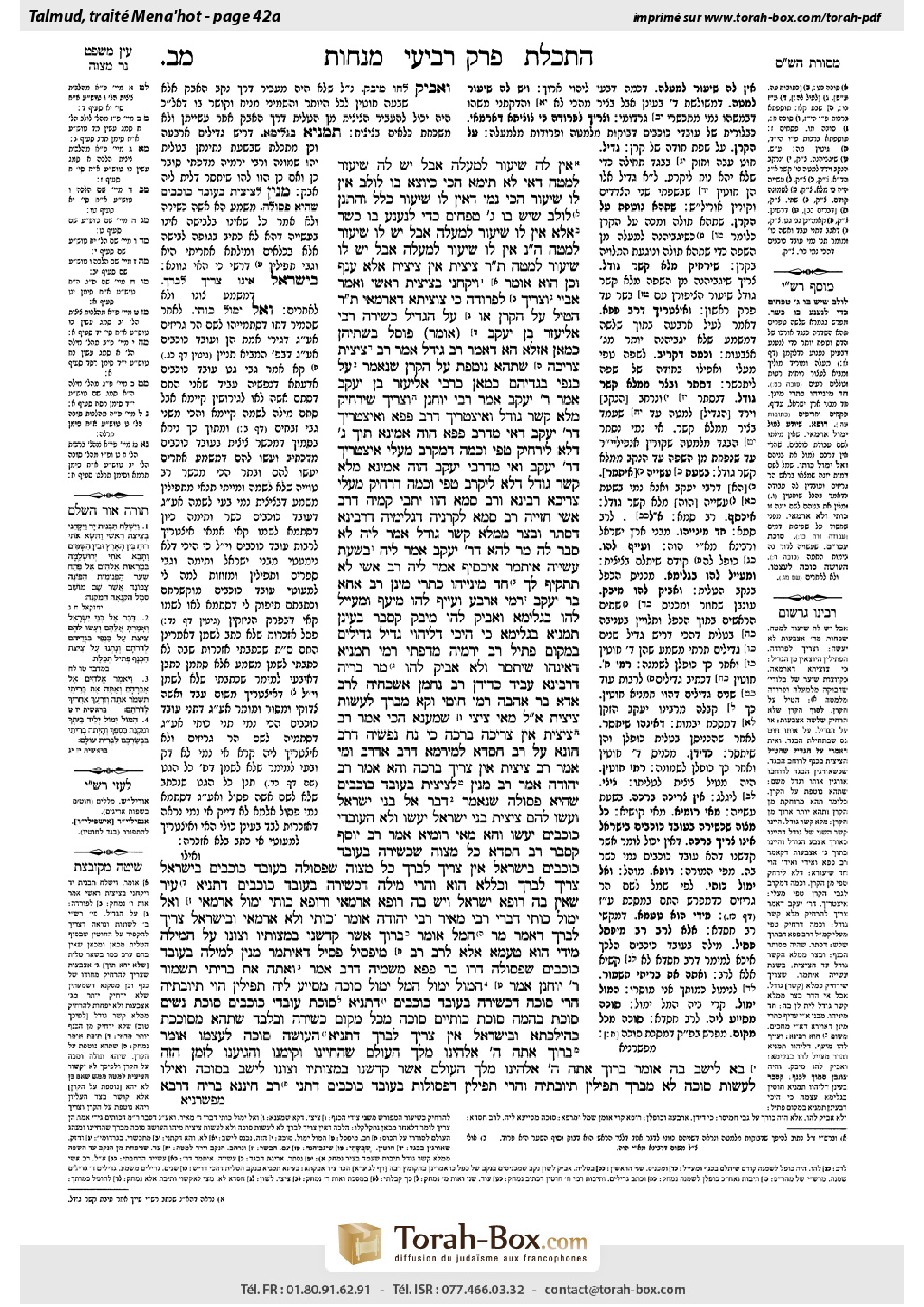
Menachot 42a: Talmud study for Daf Yomi
Daf Yomi is the daily study of one Talmud folio. Explore 37 tractates with scans, Hebrew text, Sefaria English and AI-generated French translations where annotated.
Passage selection and English or AI-generated French translation are available where the scan has annotations. Daf Study is independent of Torah-Box and Sefaria.
Browse Menachot · מנחות · All tractatesMenachot 42a text and translations
This page of Menachot includes the Aramaic text, an English translation and an AI-generated French translation, alongside the scan above.
מנחות מ״ב א · Aramaic and Hebrew text
אֵין לָהּ שִׁיעוּר לְמַעְלָה, אֲבָל יֵשׁ לָהּ שִׁיעוּר לְמַטָּה. דְּאִי לָא תֵּימָא הָכִי, כַּיּוֹצֵא בּוֹ לוּלָב אֵין לוֹ שִׁיעוּר, הָכִי נָמֵי דְּאֵין לוֹ שִׁיעוּר כְּלָל?
וְהָתְנַן: לוּלָב שֶׁיֵּשׁ בּוֹ שְׁלֹשָׁה טְפָחִים כְּדֵי לְנַעְנֵעַ בּוֹ – כָּשֵׁר, אֶלָּא: אֵין לוֹ שִׁיעוּר לְמַעְלָה, אֲבָל יֵשׁ לוֹ שִׁיעוּר לְמַטָּה; הָכִי נָמֵי אֵין לוֹ שִׁיעוּר לְמַעְלָה, אֲבָל יֵשׁ לוֹ שִׁיעוּר לְמַטָּה.
תָּנוּ רַבָּנַן: ״צִיצִת״ – אֵין צִיצִית אֶלָּא עָנָף, וְכֵן הוּא אוֹמֵר: ״וַיִּקָּחֵנִי בְּצִיצִת רֹאשִׁי״, וְאָמַר אַבָּיֵי: וְצָרִיךְ לְפָרוֹדַהּ כִּי צוּצִיתָא דְּאַרְמָאֵי.
תָּנוּ רַבָּנַן: הֵטִיל עַל הַקֶּרֶן, אוֹ עַל הַגְּדִיל – כְּשֵׁירָה. רַבִּי אֱלִיעֶזֶר בֶּן יַעֲקֹב (אוֹמֵר) פּוֹסֵל בִּשְׁתֵּיהֶן.
כְּמַאן אָזְלָא הָא דְּאָמַר רַב גִּידֵּל אָמַר רַב: צִיצִית צְרִיכָה שֶׁתְּהֵא נוֹטֶפֶת עַל הַקֶּרֶן, שֶׁנֶּאֱמַר: ״עַל כַּנְפֵי בִגְדֵיהֶם״, כְּמַאן? כְּרַבִּי אֱלִיעֶזֶר בֶּן יַעֲקֹב.
אָמַר רַבִּי יַעֲקֹב אָמַר רַבִּי יוֹחָנָן: וְצָרִיךְ שֶׁיַּרְחִיק מְלֹא קֶשֶׁר גּוּדָל.
וְאִיצְטְרִיךְ דְּרַב פָּפָּא, וְאִיצְטְרִיךְ דְּרַבִּי יַעֲקֹב, דְּאִי מִדְּרַב פָּפָּא הֲוָה אָמֵינָא: תּוֹךְ שָׁלֹשׁ דְּלָא לַירְחֵיק טְפֵי, וְכַמָּה דִּמְקָרַב מְעַלֵּי, אִיצְטְרִיךְ דְּרַבִּי יַעֲקֹב.
וְאִי מִדְּרַבִּי יַעֲקֹב, הֲוָה אָמֵינָא: מְלֹא קֶשֶׁר גּוּדָל, דְּלָא לִיקְרַב טְפֵי, וְכַמָּה דְּרַחִיק מְעַלֵּי, צְרִיכָא.
רָבִינָא וְרַב סַמָּא הֲווֹ יָתְבִי קַמֵּיהּ דְּרַב אָשֵׁי, חַזְיֵיהּ רַב סַמָּא לְקַרְנֵיהּ דִּגְלִימֵיהּ דְּרָבִינָא דִּסְתַר וּבְצַר מִמְּלֹא קֶשֶׁר גּוּדָל, אֲמַר לֵיהּ: לָא סָבַר לַהּ מָר לְהָא דְּרַבִּי יַעֲקֹב? אֲמַר לֵיהּ: בִּשְׁעַת עֲשִׂיָּיה אִיתְּמַר.
אִיכְּסִיף, אֲמַר לֵיהּ רַב אָשֵׁי: לָא תִּתְּקִיף לָךְ, חַד מִינַּיְיהוּ כִּתְרֵי מִינַּן.
רַב אַחָא בַּר יַעֲקֹב רָמֵי אַרְבַּע, וְעָיֵיף לְהוּ מֵיעָף, וּמְעַיֵּיל לְהוּ בִּגְלִימָא, וְאָבֵיק לְהוּ מֵיבָק. קָסָבַר: בָּעֵינַן תְּמָנְיָא בִּגְלִימָא, כִּי הֵיכִי דְּלֶיהְוֵי ״גְּדִיל״ ״גְּדִילִים״ בִּמְקוֹם פְּתִיל.
רַב יִרְמְיָה מִדִּפְתִּי רָמֵי תְּמָנְיָא, דְּאִינְהוּ שִׁיתְּסַר, וְלָא אָבֵיק לְהוּ. מָר בְּרֵיהּ דְּרָבִינָא עָבֵיד כְּדִידַן.
רַב נַחְמָן אַשְׁכְּחֵיהּ לְרַב אַדָּא בַּר אַהֲבָה רָמֵי חוּטֵי, וְקָא מְבָרֵךְ ״לַעֲשׂוֹת צִיצִית״. אֲמַר לֵיהּ: מַאי ״צִיצִי״ [דְּקָא] שָׁמַעְנָא? הָכִי אָמַר רַב: צִיצִית אֵין צְרִיכָה בְּרָכָה.
כִּי נָח נַפְשֵׁיהּ דְּרַב הוּנָא, עָל רַב חִסְדָּא לְמִירְמֵא דְּרַב אַדְּרַב, וּמִי אָמַר רַב: צִיצִית אֵין צָרִיךְ בְּרָכָה? וְהָא אָמַר רַב יְהוּדָה אָמַר רַב: מִנַּיִן לְצִיצִית בְּגוֹי שֶׁהִיא פְּסוּלָה, שֶׁנֶּאֱמַר: ״דַּבֵּר אֶל בְּנֵי יִשְׂרָאֵל וְעָשׂוּ לָהֶם צִיצִת״ – בְּנֵי יִשְׂרָאֵל יַעֲשׂוּ וְלֹא הַגּוֹיִם יַעֲשׂוּ!
וְהָא מַאי רוּמְיָא? אָמַר רַב יוֹסֵף: קָסָבַר רַב חִסְדָּא: כׇּל מִצְוָה שֶׁכְּשֵׁירָה בְּגוֹי – בְּיִשְׂרָאֵל אֵין צָרִיךְ לְבָרֵךְ, כׇּל מִצְוָה שֶׁפְּסוּלָה בְּגוֹי – בְּיִשְׂרָאֵל צָרִיךְ לְבָרֵךְ.
וּכְלָלָא הוּא? וַהֲרֵי מִילָה דִּכְשֵׁירָה בְּגוֹי, דְּתַנְיָא: עִיר שֶׁאֵין בָּהּ רוֹפֵא יִשְׂרָאֵל, וְיֵשׁ בָּהּ רוֹפֵא אַרְמַאי וְרוֹפֵא כּוּתִי – יָמוּל אַרְמַאי וְאַל יָמוּל כּוּתִי, דִּבְרֵי רַבִּי מֵאִיר. רַבִּי יְהוּדָה אוֹמֵר: כּוּתִי וְלֹא אַרְמַאי.
וּבְיִשְׂרָאֵל צָרִיךְ לְבָרֵךְ, דְּאָמַר מָר: הַמָּל אוֹמֵר: ״בָּרוּךְ אֲשֶׁר קִדְּשָׁנוּ בְּמִצְוֹתָיו וְצִוָּנוּ עַל הַמִּילָה״.
מִידֵּי הוּא טַעְמָא, אֶלָּא לְרַב? רַב מִיפְסָיל פָּסֵיל, דְּאִיתְּמַר: מִנַּיִן לְמִילָה בְּגוֹי שֶׁפְּסוּלָה? דָּרוּ בַּר פָּפָּא מִשְּׁמֵיהּ דְּרַב אָמַר: ״וְאַתָּה אֶת בְּרִיתִי תִשְׁמֹר״.
רַבִּי יוֹחָנָן אָמַר: ״הִמּוֹל יִמּוֹל״, הַמָּל יִמּוֹל.
סוּכָּה מְסַיַּיע לֵיהּ, תְּפִילִּין הָוֵי תְּיוּבְתֵּיהּ.
הֲרֵי סוּכָּה דִּכְשֵׁירָה בְּגוֹי, דְּתַנְיָא: סוּכַּת גּוֹיִם, סוּכַּת נָשִׁים, סוּכַּת בְּהֵמָה, סוּכַּת כּוּתִיִּים, סוּכָּה מִכׇּל מָקוֹם – כְּשֵׁירָה, וּבִלְבַד שֶׁתְּהֵא מְסוּכֶּכֶת כְּהִילְכָתָהּ.
וּבְיִשְׂרָאֵל אֵין צָרִיךְ לְבָרֵךְ, דְּתַנְיָא: הָעוֹשֶׂה סוּכָּה לְעַצְמוֹ אוֹמֵר: ״בָּרוּךְ אַתָּה ה׳ אֱלֹהֵינוּ מֶלֶךְ הָעוֹלָם שֶׁהֶחֱיָינוּ וְקִיְּמָנוּ וְהִגִּיעָנוּ לַזְּמַן הַזֶּה״, בָּא לֵישֵׁב בָּהּ אוֹמֵר: ״בָּרוּךְ אַתָּה ה׳ אֱלֹהֵינוּ מֶלֶךְ הָעוֹלָם אֲשֶׁר קִדְּשָׁנוּ בְּמִצְוֹתָיו וְצִוָּנוּ לֵישֵׁב בַּסּוּכָּה״, וְאִילּוּ ״לַעֲשׂוֹת סוּכָּה״ לָא מְבָרֵךְ.
תְּפִילִּין תְּיוּבְתֵּיהּ, וַהֲרֵי תְּפִילִּין דִּפְסוּלוֹת בְּגוֹי, דְּתָנֵי רַב חִינָּנָא בְּרֵיהּ דְּרָבָא
Menachot 42a · English translation
the baraita means that ritual fringes do not have a maximum measure, i.e., the strings can be as long as one wants; however, they do have a minimum measure, and if the strings are shorter than this measure they are not fit. As, if you do not say so, in a case similar to it, where it is taught that a lulav has no measure, is it possible that it also has no measure whatsoever?
But didn’t we learn in a mishna (Sukka 29b): A lulav that has three handbreadths in length, sufficient to enable one to wave with it, is fit for use in fulfilling the mitzva? This indicates that if the lulav is less than the measure, it is not fit. Rather, it must be that a lulav has no maximum measure, but it does have a minimum measure. So too, ritual fringes have no maximum measure, but they have a minimum measure.
§ The Sages taught in a baraita: The verse states: “That they prepare for themselves strings” (Numbers 15:38). The term strings [tzitzit] means nothing other than strings that hang down [anaf], and so it states in the verse: “I was taken by a lock [betzitzit] of my head” (Ezekiel 8:3). And Abaye says: And one is required to separate the ritual fringes like a gentile’s lock of hair, part of which is braided and the rest of which is allowed to hang loose.
The Sages taught in a baraita: If one affixed the ritual fringes to the tip of the corner or to the border [gadil], they are fit. Rabbi Eliezer ben Ya’akov disqualifies them in both cases.
The Gemara asks: In accordance with whose opinion is that which Rav Giddel says that Rav says: Ritual fringes must be inserted into a hole above the corner and hang down onto the corner of the garment, as it is stated: “On the corners of their garments” (Numbers 15:38)? In accordance with whose opinion is this? The Gemara answers: It is in accordance with the opinion of Rabbi Eliezer ben Ya’akov.
Rabbi Ya’akov says that Rabbi Yoḥanan says: And one must distance the hole through which the ritual fringes are inserted into the garment the length of a full thumb joint from the edge of the garment.
The Gemara notes: And it was necessary to state the ruling of Rav Pappa (41b) that the ritual fringes must be inserted into a hole within three fingerbreadths of the edge of the garment, and it was also necessary to state the ruling of Rabbi Ya’akov. This is because if the location of the hole was taught only from the statement of Rav Pappa, I would say that his ruling that the hole must be within three fingerbreadths of the edge of the garment was to teach that one may not distance the hole from the edge of the garment by more than this amount, but the closer the hole is to the edge of the garment, the better. Consequently, it was necessary to include the statement of Rabbi Ya’akov.
And if the location of the hole was taught only from the statement of Rabbi Ya’akov, I would say that his ruling that it must be a full thumb joint away from the edge of the garment was to teach that one may not situate the hole closer than that to the edge of the garment, but the further he places it, the better. Therefore, both statements were necessary.
The Gemara relates that Ravina and Rav Samma were sitting before Rav Ashi. Rav Samma saw that the corner of Ravina’s cloak was torn and therefore the hole through which the ritual fringes were inserted was less than the full length of a thumb joint from the edge of the garment. Rav Samma said to Ravina: Doesn’t the Master hold in accordance with that statement of Rabbi Ya’akov that the hole must be at least the length of a thumb joint from the edge of the garment? Ravina said to Rav Samma: It was stated that this distance is required at the time when the ritual fringes are made. If the corner tears later, causing the hole to be closer to the edge of the garment, the ritual fringes remain fit.
Rav Samma became embarrassed because he had asked his question based on a mistaken assumption. Rav Ashi said to Rav Samma: Do not be upset that Ravina is a greater scholar than you are; one of them, i.e., the Sages of Eretz Yisrael, is like two of us, i.e., the Sages of Babylonia.
§ With regard to attaching ritual fringes to a garment, the Gemara relates that Rav Aḥa bar Ya’akov would affix four strings to the garment, and he would first fold them in half and then insert them at the point of the folds into the hole of the garment, so that on one side there were eight strings and on the other side there were four loops. He would then take the eight strings and loop them through the four loops and pull them tight, thereby attaching them to the garment. The Gemara explains that he held that we require eight strings when they are initially placed in the garment, in order that there be twisted cord and “twisted cords” (Deuteronomy 22:12), i.e., four doubled strings, at the place, i.e., the time, when he creates the loose hanging string.
Rav Yirmeya of Difti would affix eight strings that are sixteen strings after they are placed in the hole of the garment and half of each string hangs down on each side, and he would not loop them as Rav Aha bar Ya’akov did. Mar, son of Ravina, would prepare ritual fringes like ours, placing four strings through the hole and allowing both ends of each string to hang down, thereby forming eight.
§ The Gemara relates that Rav Naḥman found Rav Adda bar Ahava affixing strings to a garment and reciting the blessing that concludes: To prepare ritual fringes [tzitzit]. Rav Naḥman said to Rav Adda bar Ahava: What is this tzitzi sound that I hear? This is what Rav says: Ritual fringes do not require a blessing when one attaches them to the garment.
With regard to this statement of Rav, the Gemara relates that when Rav Huna died, Rav Ḥisda went into the study hall to raise a contradiction from one statement of Rav to another statement of Rav, as follows: Did Rav actually say that ritual fringes do not require a blessing when one attaches them to the garment? But doesn’t Rav Yehuda say that Rav says: From where is it derived that ritual fringes attached by a gentile are unfit? It is derived from a verse, as it is stated: “Speak unto the children of Israel and command them that they prepare for themselves strings” (Numbers 15:38). The Sages derive from here that the children of Israel shall prepare ritual fringes, but the gentiles shall not prepare ritual fringes.
The Gemara asks: But what is the contradiction between these two statements of Rav? Rav Yosef said: Rav Ḥisda held that in the case of any mitzva for which the necessary item is fit when produced by a gentile, if it is produced by a Jew, he does not need to recite a blessing. Conversely, any mitzva for which the necessary item is unfit when produced by a gentile, if it is produced by a Jew, he needs to recite a blessing when he produces the item.
The Gemara asks: And is this an established principle? But what about circumcision, which is valid if performed by a gentile, as it is taught in a baraita: In a city in which there is no Jewish physician, and in which there is an Aramean, i.e., a gentile, physician and a Samaritan physician, it is preferable that the Aramean circumcise the Jewish boys of the city and the Samaritan not circumcise them; this is the statement of Rabbi Meir. Rabbi Yehuda says: It is preferable that the Samaritan circumcise the boys and the Aramean not circumcise them. Nevertheless, all agree that a circumcision performed by a gentile is valid.
And despite the fact that circumcision performed by a gentile is valid, when it is performed by a Jew, he must recite a blessing, as the Master said: The one who circumcises a child says: Blessed are You, Lord our God, King of the universe, Who has sanctified us through His mitzvot and has commanded us concerning circumcision.
The Gemara answers: Is there reason to resolve the contradiction according to anyone but Rav? Rav himself invalidates circumcision performed by a gentile, as it was stated: From where is it derived that circumcision performed by a gentile is not valid? Daru bar Pappa says in the name of Rav: This is derived from the verse: “And God said unto Abraham: And as for you, you shall keep My covenant, you, and your seed after you throughout their generations” (Genesis 17:9). The verse indicates that only the descendants of Abraham may perform circumcision.
Rabbi Yoḥanan says that this halakha is derived from the doubled verb in the verse: “Must be circumcised [himmol yimmol]” (Genesis 17:13), which he interprets to mean: Only one who is circumcised [hammal] may circumcise [yamul] others.
The Gemara notes that the halakha with regard to a sukka supports the opinion of Rav Ḥisda, who holds that when an item used for a mitzva can be created by a gentile, a Jew who creates it does not recite a blessing. And the halakha with regard to phylacteries is a conclusive refutation of his opinion.
The Gemara explains: A sukka is fit even if it was built by a gentile, as it is taught in a baraita: With regard to a booth built by gentiles, a booth built by women, a booth for domesticated animals, a booth built by Samaritans, a booth of any sort, each is fit for use as a sukka, provided that it is roofed in accordance with the halakha.
And if a sukka was built by a Jew, he is not required to recite a blessing upon its construction, as it is taught in a baraita: One who constructs a sukka for himself recites: Blessed are You, Lord our God, King of the universe, Who has given us life, sustained us, and brought us to this time. When he comes to sit in the sukka, he recites: Blessed are You, Lord our God, King of the universe, Who has sanctified us through His mitzvot and commanded us to reside in the sukka. The Gemara notes that the baraita indicates that he recites a blessing at the time of construction, whereas he does not recite a blessing including the words: To construct a sukka, which confirms the opinion of Rav Ḥisda.
By contrast, the halakha with regard to phylacteries is a conclusive refutation of Rav Ḥisda’s opinion. Phylacteries are unfit when written by a gentile, as it is taught by Rav Ḥinnana, son of Rava,
Menachot 42a · Traduction française (IA)
La baraïta signifie que les franges rituelles n’ont pas de longueur maximale : les fils peuvent être aussi longs qu’on le souhaite. Elles ont toutefois une longueur minimale ; si les fils sont plus courts que cette mesure, ils ne sont pas aptes. En effet, si l’on ne l’interprétait pas ainsi, dans un cas similaire où il est enseigné qu’un loulav n’a pas de mesure, pourrait-on comprendre qu’il n’a absolument aucune mesure ?
Mais n’avons-nous pas appris dans une Michna (Soukka 29b) : « Un loulav qui mesure trois téfa’him, longueur suffisante pour pouvoir l’agiter, est apte à accomplir la mitsva » ? Cela indique que si le loulav est plus court que cette mesure, il n’est pas apte. Il faut donc plutôt dire qu’un loulav n’a pas de longueur maximale, mais qu’il a une longueur minimale. De même, les franges rituelles n’ont pas de longueur maximale, mais elles ont une longueur minimale.
§ Les Sages ont enseigné dans une baraïta : Le verset dit : « Qu’ils se fassent des fils » (Nombres 15:38). Le terme « fils » [tzitzit] désigne uniquement des fils qui pendent [anaf], comme il est dit : « Je fus saisi par une mèche [betzitzit] de ma tête » (Ézéchiel 8:3). Et Abayé dit : Il faut séparer les franges rituelles à la manière de la mèche d’un non-Juif, dont une partie est tressée et le reste laissé libre de pendre.
Les Sages ont enseigné dans une baraïta : Si quelqu’un fixe les franges rituelles à la pointe du coin ou à la bordure [gadil], elles sont aptes. Rabbi Eliezer ben Ya’akov les invalide dans les deux cas.
La Guemara demande : Selon l’opinion de qui Rav Giddel rapporte-t-il au nom de Rav que les franges rituelles doivent être insérées dans un trou situé au-dessus du coin et pendre sur le coin du vêtement, comme il est dit : « Aux coins de leurs vêtements » (Nombres 15:38) ? La Guemara répond : Selon l’opinion de Rabbi Eliezer ben Ya’akov.
Rabbi Ya’akov rapporte au nom de Rabbi Yo’hanan : Il faut aussi que le trou par lequel les franges rituelles sont insérées dans le vêtement soit éloigné du bord du vêtement de la largeur d’une articulation entière du pouce.
La Guemara remarque qu’il était nécessaire d’énoncer la règle de Rav Pappa (41b), selon laquelle les franges rituelles doivent être insérées dans un trou situé à moins de trois largeurs de doigt du bord du vêtement, et également celle de Rabbi Ya’akov. En effet, si l’emplacement du trou n’avait été enseigné que dans la déclaration de Rav Pappa, j’aurais pensé que la règle selon laquelle le trou doit se trouver à moins de trois largeurs de doigt du bord du vêtement vise à enseigner qu’on ne peut pas l’en éloigner davantage, mais que plus il est proche du bord, mieux cela vaut. Il était donc nécessaire d’inclure la déclaration de Rabbi Ya’akov.
Et si l’emplacement du trou n’avait été enseigné que dans la déclaration de Rabbi Ya’akov, j’aurais pensé que sa règle, selon laquelle le trou doit se trouver à une articulation entière du pouce du bord du vêtement, vise à enseigner qu’on ne peut pas le placer plus près du bord, mais que plus on l’en éloigne, mieux cela vaut. Les deux déclarations étaient donc nécessaires.
La Guemara rapporte que Ravina et Rav Samma étaient assis devant Rav Ashi. Rav Samma vit que le coin du manteau de Ravina était déchiré et que, par conséquent, le trou par lequel les franges rituelles étaient insérées se trouvait à moins d’une articulation entière du pouce du bord du vêtement. Rav Samma dit à Ravina : « Le Maître ne suit-il pas l’opinion de Rabbi Ya’akov, selon laquelle le trou doit se trouver à au moins une articulation du pouce du bord du vêtement ? » Ravina lui répondit : « Cette distance est requise au moment où l’on confectionne les franges rituelles. Si le coin se déchire par la suite et que le trou se rapproche du bord du vêtement, les franges rituelles restent aptes. »
Rav Samma fut embarrassé d’avoir posé sa question sur la base d’une supposition erronée. Rav Ashi lui dit : « Ne sois pas contrarié parce que Ravina est un plus grand érudit que toi ; l’un d’eux, c’est-à-dire les Sages de la Terre d’Israël, équivaut à deux d’entre nous, c’est-à-dire les Sages de Babylonie. »
§ À propos de la fixation des franges rituelles à un vêtement, la Guemara rapporte que Rav A’ha bar Ya’akov fixait quatre fils au vêtement. Il les pliait d’abord en deux, puis les insérait dans le trou du vêtement par leur pli, de sorte qu’il y avait huit fils d’un côté et quatre boucles de l’autre. Il prenait ensuite les huit fils, les passait dans les quatre boucles et les serrait, les fixant ainsi au vêtement. La Guemara explique qu’il estimait qu’il fallait huit fils au moment de les insérer initialement dans le vêtement, afin qu’il y ait un cordon torsadé et des « cordons torsadés » (Deutéronome 22:12), c’est-à-dire quatre fils doublés, à l’endroit — autrement dit au moment — où l’on crée le fil qui pend librement.
Rav Yirmeya de Difti fixait huit fils, qui en formaient seize une fois insérés dans le trou du vêtement, la moitié de chaque fil pendant de chaque côté ; il ne les passait pas en boucle comme le faisait Rav A’ha bar Ya’akov. Mar, fils de Ravina, confectionnait les franges rituelles comme les nôtres : il faisait passer quatre fils dans le trou et laissait pendre les deux extrémités de chaque fil, formant ainsi huit fils.
§ La Guemara rapporte que Rav Na’hman trouva Rav Adda bar Ahava en train de fixer des fils à un vêtement et de réciter la bénédiction qui se termine par : « Pour confectionner les franges rituelles » [tzitzit]. Rav Na’hman lui dit : « Quel est ce bruit de tzitzi que j’entends ? Rav dit que les franges rituelles n’exigent pas de bénédiction lorsqu’on les fixe au vêtement. »
À propos de cette déclaration de Rav, la Guemara rapporte qu’à la mort de Rav Houna, Rav Hisda entra dans la maison d’étude pour soulever une contradiction entre deux déclarations de Rav. Il demanda : « Rav a-t-il réellement dit qu’il n’est pas nécessaire de réciter une bénédiction lorsqu’on fixe les franges rituelles au vêtement ? Pourtant, Rav Yehouda rapporte au nom de Rav : D’où apprend-on que les franges rituelles fixées par un non-Juif sont inaptes ? On l’apprend d’un verset, comme il est dit : “Parle aux enfants d’Israël et ordonne-leur qu’ils se fassent des fils” (Nombres 15:38). Les Sages en déduisent que les enfants d’Israël doivent confectionner les franges rituelles, mais pas les non-Juifs. »
La Guemara demande : « Mais quelle est la contradiction entre ces deux déclarations de Rav ? » Rav Yossef dit : « Rav Hisda estimait que, pour toute mitsva dont l’objet nécessaire est apte lorsqu’il est confectionné par un non-Juif, le Juif qui le confectionne n’a pas besoin de réciter de bénédiction. À l’inverse, pour toute mitsva dont l’objet nécessaire est inapte lorsqu’il est confectionné par un non-Juif, le Juif qui le confectionne doit réciter une bénédiction au moment de sa confection. »
La Guemara demande : « Est-ce là un principe établi ? Mais qu’en est-il de la circoncision, qui est valable même si elle est pratiquée par un non-Juif, comme il est enseigné dans une baraïta : Dans une ville où il n’y a pas de médecin juif, mais où se trouvent un médecin araméen, c’est-à-dire non juif, et un médecin samaritain, il est préférable que l’Araméen circoncise les garçons juifs de la ville et que le Samaritain ne les circoncise pas ; telle est l’opinion de Rabbi Meïr. Rabbi Yehouda dit : Il est préférable que le Samaritain circoncise les garçons et que l’Araméen ne les circoncise pas. Néanmoins, tous conviennent qu’une circoncision pratiquée par un non-Juif est valable. »
Et bien que la circoncision pratiquée par un non-Juif soit valable, lorsqu’elle est pratiquée par un Juif, celui-ci doit réciter une bénédiction, comme le Maître l’a enseigné : « Celui qui circoncit un enfant dit : Béni sois-Tu, Seigneur notre Dieu, Roi de l’univers, qui nous as sanctifiés par Tes mitsvot et nous as ordonné la circoncision. »
La Guemara répond : « Y a-t-il une raison de résoudre la contradiction selon l’opinion de quelqu’un d’autre que Rav ? Rav lui-même invalide la circoncision pratiquée par un non-Juif, comme il a été enseigné : D’où apprend-on qu’une circoncision pratiquée par un non-Juif n’est pas valable ? Darou bar Pappa dit au nom de Rav : On l’apprend du verset : “Dieu dit à Abraham : Quant à toi, tu garderas Mon alliance, toi et ta descendance après toi, de génération en génération” (Genèse 17:9). Le verset indique que seuls les descendants d’Abraham peuvent pratiquer la circoncision. »
Rabbi Yo’hanan dit que cette halakha se déduit du verbe redoublé du verset : « Il devra être circoncis [himmol yimmol] » (Genèse 17:13), qu’il interprète ainsi : Seul celui qui est circoncis [hammal] peut circoncire [yamul] les autres.
La Guemara remarque que la halakha concernant la soukka confirme l’opinion de Rav Hisda, selon laquelle, lorsqu’un objet servant à accomplir une mitsva peut être confectionné par un non-Juif, le Juif qui le confectionne ne récite pas de bénédiction. En revanche, la halakha concernant les tefillin réfute définitivement son opinion.
La Guemara explique : Une soukka est apte même si elle a été construite par un non-Juif, comme il est enseigné dans une baraïta : Un abri construit par des non-Juifs, un abri construit par des femmes, un abri destiné à des animaux domestiques, un abri construit par des Samaritains, un abri de quelque sorte que ce soit : chacun est apte à servir de soukka, à condition d’être couvert conformément à la halakha.
Et si une soukka a été construite par un Juif, celui-ci n’est pas tenu de réciter une bénédiction au moment de sa construction, comme il est enseigné dans une baraïta : « Celui qui construit une soukka pour lui-même récite : Béni sois-Tu, Seigneur notre Dieu, Roi de l’univers, qui nous as fait vivre, nous as soutenus et nous as conduits jusqu’à ce moment. Lorsqu’il vient s’asseoir dans la soukka, il récite : Béni sois-Tu, Seigneur notre Dieu, Roi de l’univers, qui nous as sanctifiés par Tes mitsvot et nous as ordonné de résider dans la soukka. » La Guemara remarque que la baraïta indique qu’il récite une bénédiction au moment de la construction, mais pas une bénédiction contenant les mots « pour construire une soukka », ce qui confirme l’opinion de Rav Hisda.
À l’inverse, la halakha concernant les tefillin réfute définitivement l’opinion de Rav Hisda. Les tefillin sont inaptes lorsqu’ils sont écrits par un non-Juif, comme l’enseigne Rav Hinnana, fils de Rava,
Traduction française générée par IA à partir de l’édition anglaise de Sefaria. Vérifie toujours un passage avec le texte source.
Text from Sefaria: William Davidson Edition - Vocalized Aramaic (unknown); William Davidson Edition - English (CC BY NC).