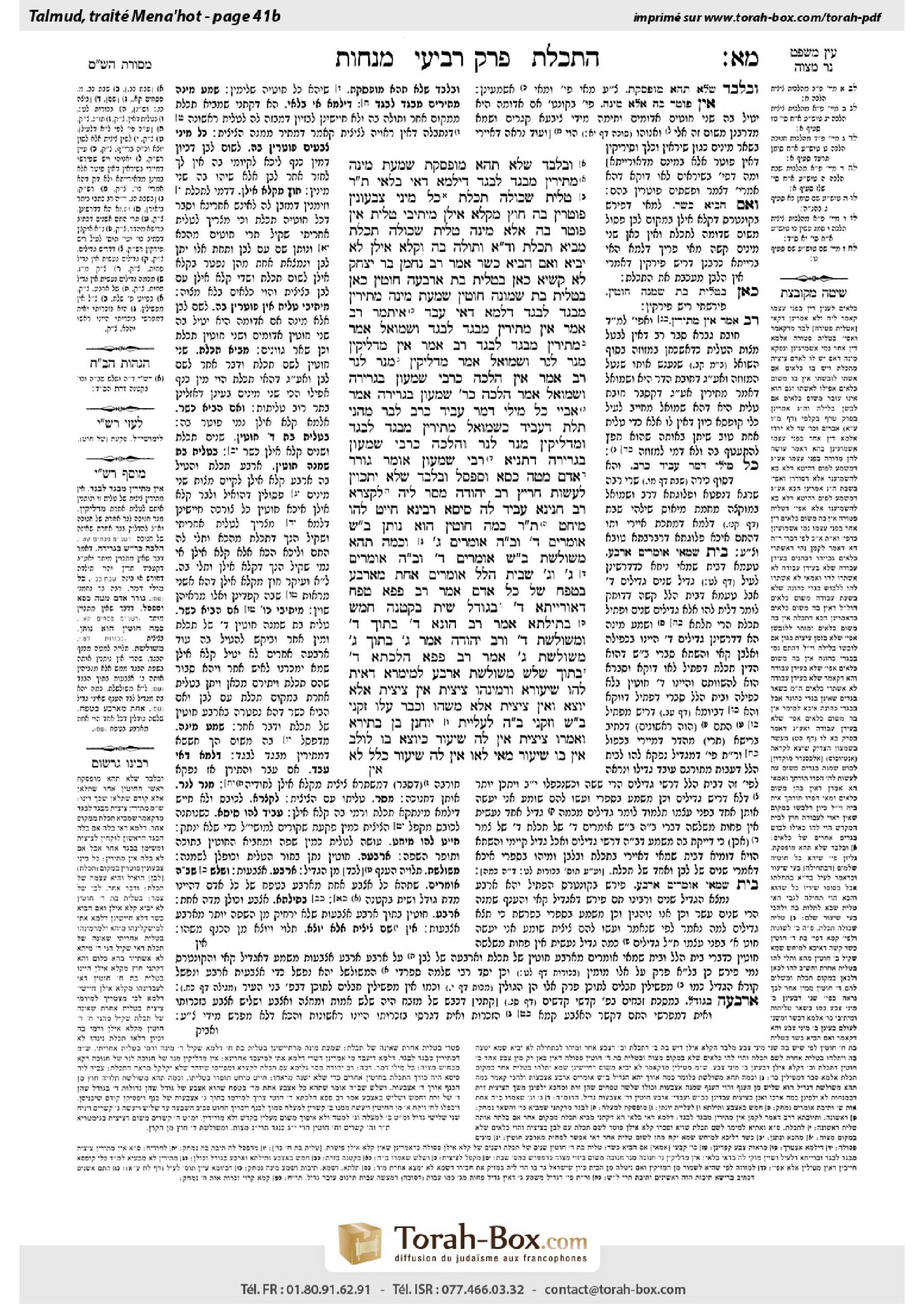
Menachot 41b: Talmud study for Daf Yomi
Daf Yomi is the daily study of one Talmud folio. Explore 37 tractates with scans, Hebrew text, Sefaria English and AI-generated French translations where annotated.
Passage selection and English or AI-generated French translation are available where the scan has annotations. Daf Study is independent of Torah-Box and Sefaria.
Browse Menachot · מנחות · All tractatesMenachot 41b text and translations
This page of Menachot includes the Aramaic text, an English translation and an AI-generated French translation, alongside the scan above.
מנחות מ״א ב · Aramaic and Hebrew text
וּבִלְבַד שֶׁלֹּא תְּהֵא מוּפְסֶקֶת. שָׁמְעַתְּ מִינַּהּ מַתִּירִין מִבֶּגֶד לְבֶגֶד? דִּילְמָא דְּאִי בְּלַאי.
תָּנוּ רַבָּנַן: טַלִּית שֶׁכּוּלָּהּ תְּכֵלֶת – כׇּל מִינֵי צִבְעוֹנִין פּוֹטְרִין בָּהּ, חוּץ מִקָּלָא אִילָן.
מֵיתִיבִי: טַלִּית אֵין פּוֹטֵר בָּהּ אֶלָּא מִינָהּ. טַלִּית שֶׁכּוּלָּהּ תְּכֵלֶת – מֵבִיא תְּכֵלֶת וְדָבָר אַחֵר וְתוֹלֶה בָּהּ, וְקָלָא אִילָן לֹא יָבִיא, וְאִם הֵבִיא – כָּשֵׁר.
אָמַר רַב נַחְמָן בַּר יִצְחָק: לָא קַשְׁיָא, כָּאן בְּטַלִּית בַּת אַרְבָּעָה חוּטִין, כָּאן בְּטַלִּית בַּת שְׁמוֹנָה חוּטִין.
שָׁמְעַתְּ מִינַּהּ מַתִּירִין מִבֶּגֶד לְבֶגֶד? דִּלְמָא דְּאִי עֲבַד.
אִיתְּמַר, רַב אָמַר: אֵין מַתִּירִין מִבֶּגֶד לְבֶגֶד, וּשְׁמוּאֵל אָמַר: מַתִּירִין מִבֶּגֶד לְבֶגֶד.
רַב אָמַר: אֵין מַדְלִיקִין מִנֵּר לְנֵר, וּשְׁמוּאֵל אָמַר: מַדְלִיקִין מִנֵּר לְנֵר.
רַב אָמַר: אֵין הֲלָכָה כְּרַבִּי שִׁמְעוֹן בִּגְרִירָה, וּשְׁמוּאֵל אָמַר: הֲלָכָה כְּרַבִּי שִׁמְעוֹן בִּגְרִירָה.
אָמַר אַבָּיֵי: כֹּל מִילֵּי דְּמָר עָבֵיד כְּרַב, לְבַר מֵהָנֵי תְּלָת דְּעָבֵיד כִּשְׁמוּאֵל: מַתִּירִין מִבֶּגֶד לְבֶגֶד, וּמַדְלִיקִין מִנֵּר לְנֵר, וַהֲלָכָה כְּרַבִּי שִׁמְעוֹן בִּגְרִירָה.
דְּתַנְיָא, רַבִּי שִׁמְעוֹן אוֹמֵר: גּוֹרֵר אָדָם מִטָּה, כִּסֵּא וְסַפְסָל, וּבִלְבַד שֶׁלֹּא יִתְכַּוֵּין לַעֲשׂוֹת חָרִיץ.
רַב יְהוּדָה מָסַר לֵיהּ לְקַצָּרָא, רַב חֲנִינָא עָבֵיד לֵהּ סִיסָא, רָבִינָא חָיֵיט לְהוּ מֵיחָט.
תָּנוּ רַבָּנַן: כַּמָּה חוּטִין הוּא נוֹתֵן? בֵּית שַׁמַּאי אוֹמְרִים: אַרְבָּעָה, וּבֵית הִלֵּל אוֹמְרִים: שְׁלֹשָׁה.
וְכַמָּה תְּהֵא מְשׁוּלֶּשֶׁת? בֵּית שַׁמַּאי אוֹמְרִים: אַרְבַּע, וּבֵית הִלֵּל אוֹמְרִים: שָׁלֹשׁ. וְשָׁלֹשׁ שֶׁבֵּית הִלֵּל אוֹמְרִים, אַחַת מֵאַרְבַּע בְּטֶפַח שֶׁל כׇּל אָדָם. אָמַר רַב פָּפָּא: טֶפַח דְּאוֹרָיְיתָא אַרְבַּע בְּגוּדָל, שֵׁית בִּקְטַנָּה, חֲמֵשׁ בְּתִילְתָּא.
אָמַר רַב הוּנָא: אַרְבָּעָה בְּתוֹךְ אַרְבַּע, וּמְשׁוּלֶּשֶׁת אַרְבַּע, וְרַב יְהוּדָה אָמַר: שְׁלֹשָׁה בְּתוֹךְ שָׁלֹשׁ, מְשׁוּלֶּשֶׁת שָׁלֹשׁ.
אָמַר רַב פָּפָּא, הִלְכְתָא: אַרְבָּעָה בְּתוֹךְ שָׁלֹשׁ, מְשׁוּלֶּשֶׁת אַרְבַּע.
לְמֵימְרָא דְּאִית לְהוּ שִׁיעוּרָא, וּרְמִינְהוּ: ״צִיצִית״ – אֵין צִיצִית אֶלָּא יוֹצֵא, וְאֵין צִיצִית אֶלָּא מַשֶּׁהוּ, וּכְבָר עָלוּ זִקְנֵי בֵּית שַׁמַּאי וְזִקְנֵי בֵּית הִלֵּל לַעֲלִיַּית יוֹחָנָן בֶּן בְּתִירָא, וְאָמְרוּ: צִיצִית אֵין לָהּ שִׁיעוּר; כַּיּוֹצֵא בּוֹ, לוּלָב אֵין בּוֹ שִׁיעוּר.
מַאי לָאו אֵין לָהּ שִׁיעוּר כְּלָל? לָא,
Menachot 41b · English translation
This is permitted provided that the strings are not broken. The Gemara asks: Should one conclude from this baraita that it is always permitted to untie ritual fringes from one garment in order to affix them to another garment? The Gemara rejects this inference: Perhaps the ruling of this baraita applies only if the first garment was worn out and no longer wearable.
The Sages taught in a baraita: In the case of a cloak that is made entirely of sky-blue wool, strings of every type of color exempt it, i.e., the ritual fringes that are not tekhelet may be any color except for indigo, a color that is indistinguishable from tekhelet. This indicates that if one attached strings dyed with indigo alongside the strings dyed with tekhelet, the ritual fringes are unfit.
The Gemara raises an objection from a baraita: A cloak is exempted only by strings of its own type. In the case of a cloak that is made entirely of sky-blue wool, one brings sky-blue [tekhelet] strings and something else, i.e., strings of a different color, and attaches them to the cloak. And he may not bring strings dyed with indigo along with the strings dyed with tekhelet. But if he brought strings dyed with indigo together with the strings dyed with tekhelet, the ritual fringes are fit.
Rav Naḥman bar Yitzḥak said: This is not difficult, because here, in the baraita that holds that the ritual fringes are fit after the fact, it is referring to a cloak that has only four strings, two of tekhelet and two of indigo. There, in the baraita that holds that the ritual fringes are unfit after the fact, it is referring to a cloak that has eight strings, four of tekhelet and four of indigo. In this case, the Sages were concerned that one would take the four indigo strings from this garment and use them in another garment, thinking that they were tekhelet.
The Gemara asks: Should you conclude from the fact that the Sages were concerned lest one take the indigo strings from this garment for use in another garment that in general one may untie ritual fringes from one garment in order to affix them to another garment? The Gemara responds: Perhaps their concern was that if one did transfer the strings, he might mistake indigo for tekhelet, but it is not permitted to transfer the strings ab initio.
It was stated that there is a dispute between amora’im with regard to this halakha. Rav says: One may not untie ritual fringes from one garment in order to affix them to another garment. And Shmuel says: One may untie them from one garment and affix them to another garment.
The Gemara cites additional disputes between Rav and Shmuel: Rav says: One may not light from one Hanukkah lamp to another Hanukkah lamp. And Shmuel says: One may light from one Hanukkah lamp to another Hanukkah lamp.
Rabbi Shimon rules that it is permitted to drag items on Shabbat despite the possibility that one might thereby create a furrow in the ground. Creating a furrow is a labor prohibited on Shabbat, but since he does not intend to create the furrow, and it is not certain that a furrow will be created, dragging the item is permitted. Rav says: The halakha is not in accordance with the opinion of Rabbi Shimon with regard to dragging items on Shabbat. And Shmuel says that the halakha is in accordance with the opinion of Rabbi Shimon with regard to dragging items on Shabbat.
Abaye said: In all halakhic matters of the Master, Rabba, he conducted himself in accordance with the opinion of Rav, except these three where he conducted himself in accordance with the opinion of Shmuel. He ruled that one may untie ritual fringes from one garment in order to affix them to another garment, and one may light from one Hanukkah lamp to another Hanukkah lamp, and the halakha is in accordance with the opinion of Rabbi Shimon with regard to dragging items on Shabbat.
As it is taught in a baraita that Rabbi Shimon says: A person may drag a bed, chair, or bench on the ground on Shabbat, provided that he does not intend to make a furrow in the ground. Even if a furrow is formed inadvertently, one does not need to be concerned.
The Gemara relates that Rav Yehuda would give his garments containing ritual fringes to a laundryman and was not concerned that the strings dyed with tekhelet might become detached and that the laundryman would replace them with strings dyed with indigo. Rav Ḥanina would form a bundle with his ritual fringes so that they would not become detached while they were being laundered. Ravina would tuck them into a pocket he formed on the garment and sew the cover of the pocket in order to protect the ritual fringes.
§ The Sages taught in a baraita: How many strings does one place on a garment? Beit Shammai say: Four strings are inserted into the hole in the garment, so that there are eight strings hanging down altogether, and Beit Hillel say: Three strings are inserted into the garment.
And how much should be hanging [meshulleshet] beyond the knots and windings? Beit Shammai say: Four fingerbreadths, and Beit Hillel say: Three fingerbreadths. And the three fingerbreadths that Beit Hillel say should be hanging are each one-fourth of a handbreadth [tefaḥ] of any average person. The Gemara notes that Rav Pappa said: The handbreadth of the Torah is four fingerbreadths if measured by the thumb; six fingerbreadths if measured by the smallest finger; and five if measured by the third, i.e., the middle, finger.
Rav Huna says that the halakha is: One must attach four strings within four fingerbreadths of the edge of the garment, and they should hang down four fingerbreadths beyond the knots and windings. And Rav Yehuda says: One must attach three strings within three fingerbreadths of the edge of the garment, and they should hang down three fingerbreadths beyond the knots and windings.
Rav Pappa says that the halakha is that one must attach four strings within three fingerbreadths of the edge of the garment, and they should hang down four fingerbreadths beyond the knots and windings.
The Gemara asks: Is this to say that ritual fringes have a required measure? And the Gemara raises a contradiction to this from a baraita: The verse states: “That they prepare for themselves strings” (Numbers 15:38). Strings are nothing other than what emerges from the corner of the garment, and the term strings indicates only that there must be strings of any length. And it already occurred that the elders of Beit Shammai and the elders of Beit Hillel ascended to the attic of Yoḥanan ben Beteira, and they discussed the matter and said: Ritual fringes have no measure. Similarly, a lulav has no measure.
What, does this not mean that ritual fringes have no required measure at all? The Gemara answers: No,
Menachot 41b · Traduction française (IA)
Cela est permis, à condition que les fils ne soient pas rompus. La Guemara demande : Faut-il en conclure, d’après cette baraïta, qu’il est toujours permis de dénouer les franges rituelles d’un vêtement pour les fixer à un autre vêtement ? La Guemara rejette cette déduction : Peut-être la décision de cette baraïta ne s’applique-t-elle que si le premier vêtement était usé et n’était plus portable.
Les Sages enseignent dans une baraïta : Dans le cas d’un manteau entièrement fait de laine bleu ciel, des fils de toutes les couleurs le rendent quitte, c’est-à-dire que les franges rituelles qui ne sont pas en tekhelet peuvent être de n’importe quelle couleur, à l’exception de l’indigo, une couleur impossible à distinguer du tekhelet. Cela indique que si l’on a fixé des fils teints à l’indigo à côté des fils teints en tekhelet, les franges rituelles sont invalides.
La Guemara soulève une objection à partir d’une baraïta : Un manteau n’est rendu quitte que par des fils de son propre type. Dans le cas d’un manteau entièrement fait de laine bleu ciel, on apporte des fils bleu ciel [tekhelet] et autre chose, c’est-à-dire des fils d’une autre couleur, et on les fixe au manteau. On ne doit pas apporter des fils teints à l’indigo avec les fils teints en tekhelet. Mais si l’on a apporté des fils teints à l’indigo avec les fils teints en tekhelet, les franges rituelles sont valides.
Rav Naḥman bar Yitzḥak dit : Il n’y a pas de difficulté, car ici, dans la baraïta qui estime que les franges rituelles restent valides après coup, il s’agit d’un manteau qui ne comporte que quatre fils, deux en tekhelet et deux teints à l’indigo. Là, dans la baraïta qui estime que les franges rituelles sont invalides après coup, il s’agit d’un manteau qui comporte huit fils, quatre en tekhelet et quatre teints à l’indigo. Dans ce cas, les Sages craignaient que l’on prenne les quatre fils teints à l’indigo de ce vêtement pour les utiliser sur un autre vêtement, en pensant qu’il s’agissait de tekhelet.
La Guemara demande : Faut-il conclure du fait que les Sages craignaient que l’on prenne les fils teints à l’indigo de ce vêtement pour les utiliser sur un autre vêtement qu’en général, on peut dénouer les franges rituelles d’un vêtement afin de les fixer à un autre vêtement ? La Guemara répond : Peut-être craignaient-ils que, si l’on transférait effectivement les fils, on confonde l’indigo avec le tekhelet ; toutefois, il n’est pas permis de transférer les fils a priori.
Il a été rapporté qu’il existe une controverse entre les amoraïm au sujet de cette halakha. Rav dit : On ne peut pas dénouer les franges rituelles d’un vêtement pour les fixer à un autre vêtement. Et Shmuel dit : On peut les dénouer d’un vêtement et les fixer à un autre vêtement.
La Guemara cite d’autres controverses entre Rav et Shmuel : Rav dit : On ne peut pas allumer une lampe de Hanoucca à partir d’une autre lampe de Hanoucca. Et Shmuel dit : On peut allumer une lampe de Hanoucca à partir d’une autre lampe de Hanoucca.
Rabbi Shimon estime qu’il est permis de traîner des objets pendant Chabbat, malgré la possibilité que cela creuse un sillon dans le sol. Creuser un sillon est un travail interdit pendant Chabbat, mais comme la personne n’a pas l’intention d’en creuser un et qu’il n’est pas certain qu’un sillon se forme, il est permis de traîner l’objet. Rav dit : La halakha ne suit pas l’opinion de Rabbi Shimon concernant le fait de traîner des objets pendant Chabbat. Et Shmuel dit que la halakha suit l’opinion de Rabbi Shimon concernant le fait de traîner des objets pendant Chabbat.
Abaye dit : Dans toutes les questions de halakha, son maître Rabba se conduisait conformément à l’opinion de Rav, à l’exception de ces trois cas où il se conduisait conformément à l’opinion de Shmuel. Il statuait qu’on peut dénouer les franges rituelles d’un vêtement afin de les fixer à un autre vêtement, qu’on peut allumer une lampe de Hanoucca à partir d’une autre lampe de Hanoucca et que la halakha suit l’opinion de Rabbi Shimon concernant le fait de traîner des objets pendant Chabbat.
Comme il est enseigné dans une baraïta que Rabbi Shimon dit : Une personne peut traîner un lit, une chaise ou un banc sur le sol pendant Chabbat, à condition de ne pas avoir l’intention de creuser un sillon dans le sol. Même si un sillon se forme par inadvertance, il n’y a pas lieu de s’en inquiéter.
La Guemara rapporte que Rav Yehuda confiait ses vêtements munis de franges rituelles à un blanchisseur et ne craignait pas que les fils teints en tekhelet se détachent et que le blanchisseur les remplace par des fils teints à l’indigo. Rav Ḥanina faisait un paquet avec ses franges rituelles afin qu’elles ne se détachent pas pendant le lavage. Ravina les rentrait dans une poche qu’il aménageait sur le vêtement, puis en cousait le rabat afin de protéger les franges rituelles.
§ Les Sages enseignent dans une baraïta : Combien de fils place-t-on sur un vêtement ? Beit Shammaï dit : On insère quatre fils dans le trou du vêtement, de sorte que huit fils pendent en tout ; et Beit Hillel dit : On insère trois fils dans le vêtement.
Et quelle longueur doit pendre [meshulleshet] au-delà des nœuds et des enroulements ? Beit Shammaï dit : Quatre largeurs de doigt ; et Beit Hillel dit : Trois largeurs de doigt. Les trois largeurs de doigt que, selon Beit Hillel, les fils doivent pendre correspondent chacune à un quart de palme [tefaḥ] d’une personne de taille moyenne. La Guemara note que Rav Pappa a dit : La palme de la Torah vaut quatre largeurs de doigt si l’on mesure avec le pouce, six largeurs de doigt si l’on mesure avec l’auriculaire, et cinq si l’on mesure avec le troisième doigt, c’est-à-dire le majeur.
Rav Huna dit que la halakha est la suivante : Il faut fixer quatre fils à moins de quatre largeurs de doigt du bord du vêtement, et ils doivent pendre sur quatre largeurs de doigt au-delà des nœuds et des enroulements. Rav Yehuda dit : Il faut fixer trois fils à moins de trois largeurs de doigt du bord du vêtement, et ils doivent pendre sur trois largeurs de doigt au-delà des nœuds et des enroulements.
Rav Pappa dit que la halakha est la suivante : Il faut fixer quatre fils à moins de trois largeurs de doigt du bord du vêtement, et ils doivent pendre sur quatre largeurs de doigt au-delà des nœuds et des enroulements.
La Guemara demande : Cela signifie-t-il que les franges rituelles doivent respecter une mesure prescrite ? La Guemara soulève une contradiction à partir d’une baraïta : Le verset dit : « Qu’ils se fassent des fils » (Nombres 15:38). Les fils ne sont rien d’autre que ce qui sort du coin du vêtement, et le terme « fils » indique seulement qu’il doit y avoir des fils, quelle que soit leur longueur. Or, il est déjà arrivé que les anciens de Beit Shammaï et les anciens de Beit Hillel montent au grenier de Yoḥanan ben Beteira, discutent de la question et disent : Les franges rituelles n’ont pas de mesure. De même, le loulav n’a pas de mesure.
Ne faut-il pas comprendre que cela signifie que les franges rituelles n’ont absolument aucune mesure prescrite ? La Guemara répond : Non,
Traduction française générée par IA à partir de l’édition anglaise de Sefaria. Vérifie toujours un passage avec le texte source.
Text from Sefaria: William Davidson Edition - Vocalized Aramaic (unknown); William Davidson Edition - English (CC BY NC).