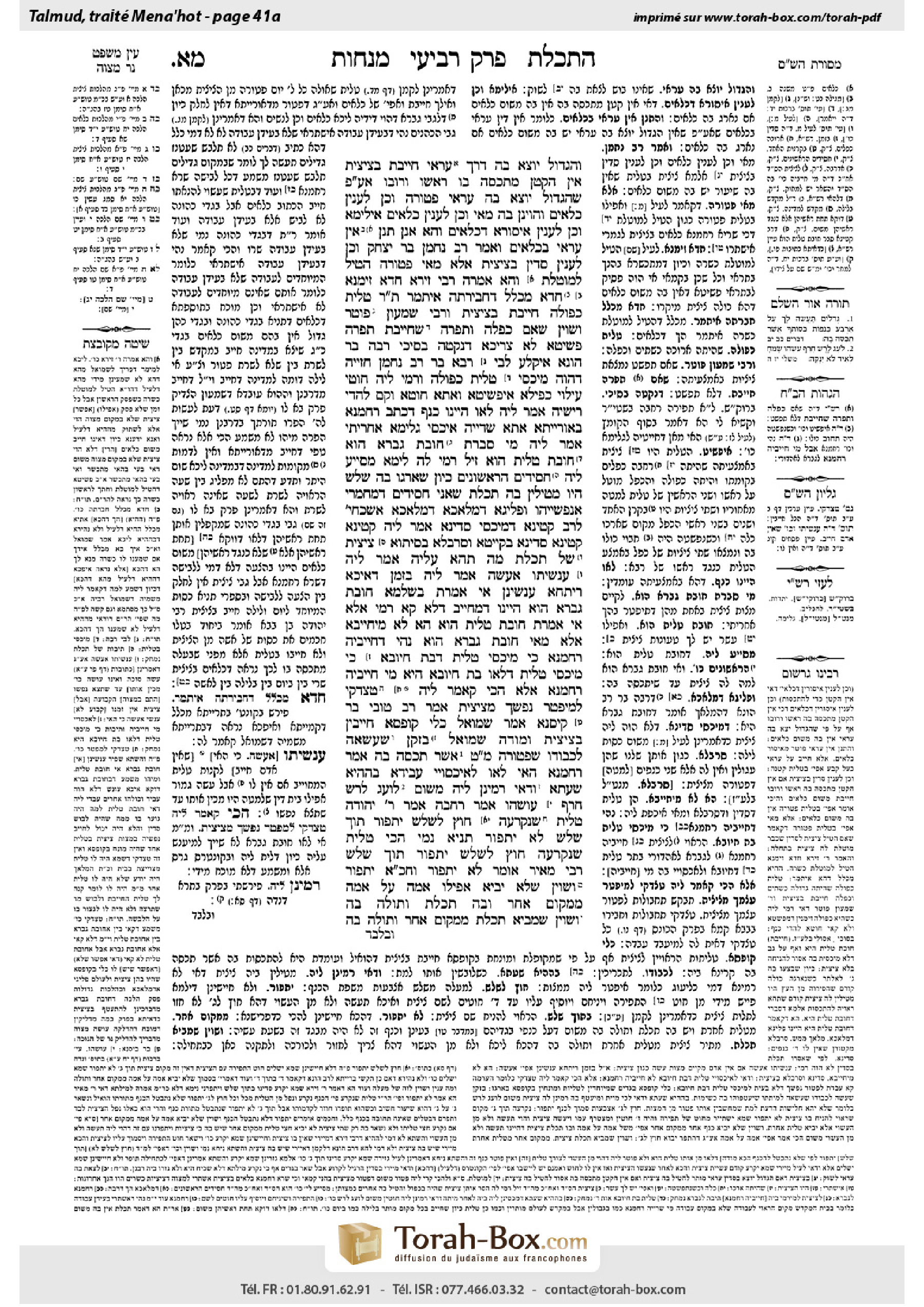
Menachot 41a: Talmud study for Daf Yomi
Daf Yomi is the daily study of one Talmud folio. Explore 37 tractates with scans, Hebrew text, Sefaria English and AI-generated French translations where annotated.
Passage selection and English or AI-generated French translation are available where the scan has annotations. Daf Study is independent of Torah-Box and Sefaria.
Browse Menachot · מנחות · All tractatesMenachot 41a text and translations
This page of Menachot includes the Aramaic text, an English translation and an AI-generated French translation, alongside the scan above.
מנחות מ״א א · Aramaic and Hebrew text
וְהַגָּדוֹל יוֹצֵא בָּהּ דֶּרֶךְ עֲרַאי – חַיֶּיבֶת בְּצִיצִית, אֵין הַקָּטָן מִתְכַּסֶּה בּוֹ רֹאשׁוֹ וְרוּבּוֹ, אַף עַל פִּי שֶׁהַגָּדוֹל יוֹצֵא בָּהּ עֲרַאי – פְּטוּרָה, וְכֵן לְעִנְיַן כִּלְאַיִם.
וְהָוֵינַן בַּהּ: מַאי ״וְכֵן לְעִנְיַן כִּלְאַיִם״? אִילֵּימָא וְכֵן לְעִנְיַן אִיסּוּרָא דְכִלְאַיִם, וְהָא אֲנַן תְּנַן: אֵין עֲרַאי בְּכִלְאַיִם!
וְאָמַר רַב נַחְמָן בַּר יִצְחָק: וְכֵן לְעִנְיַן סָדִין בְּצִיצִית.
אֶלָּא מַאי פְּטוּרָה – הֵטִיל לַמּוּטֶלֶת.
וְהָא אַמְרַהּ רַבִּי זֵירָא חֲדָא זִימְנָא? חֲדָא מִכְּלָל דַּחֲבֶירְתָּהּ אִיתְּמַר.
תָּנוּ רַבָּנַן: טַלִּית כְּפוּלָה חַיֶּיבֶת בְּצִיצִית, וְרַבִּי שִׁמְעוֹן פּוֹטֵר, וְשָׁוִין שֶׁאִם כְּפָלָהּ וּתְפָרָהּ – שֶׁחַיֶּיבֶת.
תְּפָרָהּ, פְּשִׁיטָא! לָא צְרִיכָא דְּנַקְטַהּ בְּסִיכֵּי.
רַבָּה בַּר הוּנָא אִיקְּלַע לְבֵי רָבָא בַּר רַב נַחְמָן, חַזְיֵיהּ דַּהֲוָה מִיכַּסֵּי טַלִּית כְּפוּלָה, וּרְמֵי לֵיהּ חוּטֵי עִילָּוֵי כְּפֵילָא. אִיפְּשִׁיטָא, וַאֲתָא חוּטָא וְקָם לַהֲדֵי רֵישֵׁיהּ.
אֲמַר לֵיהּ: לָאו הַיְינוּ כָּנָף דִּכְתַב רַחֲמָנָא בְּאוֹרָיְיתָא! אֲתָא שַׁדְיַיהּ, אִיכַּסִּי גְּלִימָא אַחֲרִיתִי.
אֲמַר לֵיהּ: מִי סָבְרַתְּ חוֹבַת גַּבְרָא הוּא? חוֹבַת טַלִּית הוּא, זִיל רְמִי לַהּ.
לֵימָא מְסַיַּיע לֵיהּ: חֲסִידִים הָרִאשׁוֹנִים, כֵּיוָן שֶׁאָרְגוּ בָּהּ שָׁלֹשׁ – הָיוּ מְטִילִין בָּהּ תְּכֵלֶת. שָׁאנֵי חֲסִידִים, דְּמַחְמְרִי אַנַּפְשַׁיְיהוּ.
וּפְלִיגָא דְּמַלְאֲכָא, דְּמַלְאֲכָא אַשְׁכְּחֵיהּ לְרַב קַטִּינָא דְּמִיכַּסֵּי סְדִינָא, אֲמַר לֵיהּ: קַטִּינָא, קַטִּינָא! סְדִינָא בְּקַיְיטָא וְסַרְבָּלָא בְּסִיתְוָא, צִיצִית שֶׁל תְּכֵלֶת מָה תְּהֵא עָלֶיהָ?
אֲמַר לֵיהּ: עָנְשִׁיתוּ אַעֲשֵׂה? אֲמַר לֵיהּ: בִּזְמַן דְּאִיכָּא רִיתְחָא עָנְשִׁינַן.
אִי אָמְרַתְּ בִּשְׁלָמָא חוֹבַת גַּבְרָא הוּא – הַיְינוּ דְּמִחַיַּיב דְּלָא קָא רָמֵי, אֶלָּא אִי אָמְרַתְּ חוֹבַת טַלִּית הוּא – הָא לָא מִיחַיְּיבָא!
אֶלָּא מַאי חוֹבַת גַּבְרָא הוּא? נְהִי דְּחַיְּיבֵיהּ רַחֲמָנָא כִּי מִיכַּסֵּי טַלִּית דְּבַת חִיּוּבָא, כִּי מִיכַּסֵּי טַלִּית דְּלָאו בַּת חִיּוּבָא הִיא, מִי חַיְּיבֵיהּ רַחֲמָנָא?
אֶלָּא הָכִי קָאָמַר לֵיהּ: טַצְדְּקֵי לְמִיפְטַר נַפְשָׁךְ מִצִּיצִית?
אָמַר רַב טוֹבִי בַּר קִיסְנָא אָמַר שְׁמוּאֵל: כְּלֵי קוּפְסָא חַיָּיבִין בְּצִיצִית, וּמוֹדֶה שְׁמוּאֵל בְּזָקֵן שֶׁעֲשָׂאָהּ לִכְבוֹדוֹ שֶׁפְּטוּרָה. מַאי טַעְמָא? ״אֲשֶׁר תְּכַסֶּה בָּהּ״ אָמַר רַחֲמָנָא, הַאי לָאו לְאִיכַּסּוֹיֵי עֲבִידָא.
בְּהָהִיא שַׁעְתָּא, וַדַּאי רָמֵינַן לֵיהּ, מִשּׁוּם ״לֹעֵג לָרָשׁ חֵרֵף עֹשֵׂהוּ״.
אָמַר רַחֲבָה אָמַר רַבִּי יְהוּדָה: טַלִּית שֶׁנִּקְרְעָה חוּץ לְשָׁלֹשׁ – יִתְפּוֹר, תּוֹךְ שָׁלֹשׁ – לֹא יִתְפּוֹר.
תַּנְיָא נָמֵי הָכִי: טַלִּית שֶׁנִּקְרְעָה, חוּץ לְשָׁלֹשׁ – יִתְפּוֹר, תּוֹךְ שָׁלֹשׁ – רַבִּי מֵאִיר אוֹמֵר: לֹא יִתְפּוֹר, וַחֲכָמִים אוֹמְרִים: יִתְפּוֹר.
וְשָׁוִין שֶׁלֹּא יָבִיא אֲפִילּוּ אַמָּה עַל אַמָּה מִמָּקוֹם אַחֵר וּבָהּ תְּכֵלֶת, וְתוֹלֶה בָּהּ. וְשָׁוִין שֶׁמֵּבִיא תְּכֵלֶת מִמָּקוֹם אַחֵר וְתוֹלֶה בָּהּ,
Menachot 41a · English translation
and an adult goes out in public on occasion while wearing it, it is required to have ritual fringes. But if it is not large enough for a minor to cover his head and most of his body with it, then even if an adult goes out in public on occasion while wearing it, it is exempt from ritual fringes. And so too with regard to diverse kinds, i.e., the prohibition against wearing wool and linen together.
And we discussed it: What is meant by: And so too with regard to diverse kinds? If we say that it means: And so too with regard to the prohibition of diverse kinds, that if a minor could not cover the majority of his head and body with it, the prohibition of diverse kinds does not apply, that is difficult: But didn’t we learn in a mishna (Kilayim 9:2): There is no exemption with regard to the prohibition of diverse kinds for clothing that an adult would not wear even occasionally in public?
And Rav Naḥman bar Yitzḥak says in explanation: Rather, the baraita means: And so too with regard to whether a linen cloak is required to have ritual fringes. If the cloak is large enough for a minor to cover his head and most of his body with it, then it requires ritual fringes, and wearing the garment with the ritual fringes is not a violation of the prohibition of diverse kinds. But if the garment is smaller than that, it is prohibited to place ritual fringes on it, due to the prohibition of diverse kinds. Therefore, one cannot explain Shmuel’s statement to mean that a cloak that is exempt from ritual fringes because it is too small is not subject to the prohibition of diverse kinds.
Rather, what is meant by the statement that a cloak that is exempt from ritual fringes is not subject to the prohibition of diverse kinds? It is referring to where one affixed ritual fringes to a garment that already had ritual fringes affixed to it. Even though the second set of ritual fringes is superfluous, nevertheless there is no violation of the prohibition of diverse kinds.
The Gemara asks: But didn’t Rabbi Zeira already say this one time when he stated that if one attached ritual fringes to a garment that already had ritual fringes attached to it and he then removed the first set of strings, the garment is fit? The Gemara answers: One was stated from the other by inference, and Rabbi Zeira did not state both statements.
§ The Sages taught in a baraita: A very long cloak that is folded in half is required to have ritual fringes at the fold. And Rabbi Shimon deems it exempt from ritual fringes at the fold because that is not where the corners of the garment are located. And Rabbi Shimon and the Rabbis agree that if he folded it and sewed it, it is required to have ritual fringes at the fold.
The Gemara challenges: If one sewed it, it is obvious that it is required to have ritual fringes at the fold. The Gemara explains: No, it is necessary to state this halakha because it is referring to a case where he fastened it with pins rather than sewing it in the conventional manner.
The Gemara relates that Rabba bar Huna arrived at the house of Rava bar Rav Naḥman, and he saw that Rava bar Rav Naḥman was wearing a cloak that was folded and that he had affixed strings to it on the corners of the fold. The cloak unfolded, and the string that had been on the corner of the fold now came and settled near his head, i.e., in the middle of the cloak, as the two sides of the cloak were in the front and back of Rava bar Rav Naḥman.
Rabba bar Huna said to Rava bar Rav Naḥman: This is not the corner of the garment that the Merciful One writes about in the Torah. Rava bar Rav Naḥman went and threw it off, and he covered himself with a different cloak.
Rabba bar Huna said to Rava bar Rav Naḥman: Do you hold that ritual fringes are an obligation incumbent upon the man? That is not so. Rather, it is an obligation that pertains to every cloak that one owns. Therefore, go and affix ritual fringes to it properly.
The Gemara suggests: Let us say that a baraita supports the opinion of Rabba bar Huna: It is told of the early generations of pious men that once they weaved three fingerbreadths of the length of the garment, they would affix the white and sky-blue strings to the first two corners, even though the garment was not yet ready to be worn. This seems to prove that there is an obligation to affix ritual fringes to all the cloaks in one’s possession, even if he is not currently wearing them. The Gemara rejects this proof: The pious men were different, as they would act stringently with themselves. Therefore, one cannot adduce the actual requirement from their behavior.
The Gemara notes that this disagrees with what an angel said. As an angel found Rav Ketina when he was wearing a linen cloak, which is exempt from ritual fringes. The angel said to him: Ketina, Ketina, if you wear a linen cloak in the summer and a coat [sarbela], which has only two corners and is therefore also exempt from ritual fringes, in the winter, what will become of the ritual fringes of sky-blue wool? As a result, you will never fulfill the mitzva.
Rav Ketina said to him: Do you punish us even for failing to fulfill a positive mitzva? The angel said to him: At a time when there is divine anger and judgment, we punish even for the failure to fulfill a positive mitzva.
The Gemara attempts to draw conclusions from the statement of the angel: Granted, if you say that the mitzva of ritual fringes is an obligation incumbent upon the man, that is why Rav Ketina would be deemed liable at a time of divine anger, as he did not affix ritual fringes to his cloak and thereby neglected the obligation incumbent upon him. But if you say that it is an obligation to attach them to every cloak that one owns, since Rav Ketina’s cloaks were not required to have ritual fringes, he was not obligated to attach ritual fringes to them. Why should he be punished in a time of divine anger?
The Gemara responds: Rather, what should one assume, that it is an obligation incumbent upon the man? Even so, granted that the Merciful One rendered him obligated when he is wearing a cloak that has four corners and is therefore subject to the obligation of ritual fringes, but when he is wearing a cloak that is not subject to the obligation of ritual fringes, did the Merciful One deem him obligated?
Rather, this is what the angel is saying to Rav Ketina: Are you seeking ploys [tatzdeki] to exempt yourself from performing the mitzva of ritual fringes?
Rav Tovi bar Kisna says that Shmuel says: Garments that are not being worn but are stored in a box are required to have ritual fringes, because the mitzva pertains to the garment, not the man. But Shmuel concedes in the case of an old man, where the garment was made as a shroud in his honor, that the shroud is exempt. What is the reason for this? The Merciful One states in the Torah that one must place ritual fringes on the corners of garments “with which you cover yourself” (Deuteronomy 22:12). This shroud is not made for the purpose of covering oneself.
The Gemara comments: At that time, i.e., a person’s burial, we certainly affix ritual fringes to the shroud, because otherwise it would be a violation of: “Whoever mocks the poor blasphemes his Maker” (Proverbs 17:5). If we did not place them, it would be mocking the deceased, as if to taunt him that now he is no longer obligated in mitzvot.
§ Raḥava says that Rabbi Yehuda says: In the case of a cloak that became torn at one of its corners, if it was torn beyond three fingerbreadths from the edge of the garment, one may sew it. But if it was torn within three fingerbreadths of the edge of the garment, then one may not sew it. There is a concern that he might use the thread with which he sewed the garment for the ritual fringes, in which case the strings would be unfit due to the principle: Prepare it, and not from what has already been prepared.
The Gemara comments: This halakha is also taught in a baraita: In the case of a cloak that became torn at one of its corners, if it was torn beyond three fingerbreadths from the edge of the garment, one may sew it. But if it was torn within three fingerbreadths of the edge of the garment, Rabbi Meir says: One may not sew it. And the Rabbis say: One may sew it.
And Rabbi Meir and the Rabbis agree that one may not bring a piece of cloth, even if it is a square cubit in size, from elsewhere, containing white and sky-blue strings, and attach it to a cloak. This is because one must attach the ritual fringes directly to the corner of the garment, rather than attaching them to a piece of cloth and then attaching that cloth to the garment. And Rabbi Meir and the Rabbis also agree that one may bring white or sky-blue strings from elsewhere and attach them to the garment, i.e., one may remove strings from one garment in order to attach them to another garment.
Menachot 41a · Traduction française (IA)
et qu’un adulte le porte parfois en public, il doit être muni de franges rituelles. Mais s’il n’est pas assez grand pour qu’un mineur puisse s’en couvrir la tête et la majeure partie du corps, alors, même si un adulte le porte parfois en public, il est exempté des franges rituelles. Il en va de même pour les espèces mélangées, c’est-à-dire pour l’interdiction de porter ensemble de la laine et du lin.
Et nous avons examiné cette question : que signifie « il en va de même pour les espèces mélangées » ? Si l’on dit que cela signifie : « Il en va de même pour l’interdiction des espèces mélangées », à savoir que si un mineur ne peut pas s’en couvrir la majeure partie de la tête et du corps, l’interdiction des espèces mélangées ne s’applique pas, cela pose difficulté. N’avons-nous pas appris dans une Michna (Kilayim 9:2) qu’il n’y a pas d’exemption de l’interdiction des espèces mélangées pour un vêtement qu’un adulte ne porterait même pas occasionnellement en public ?
Rav Naḥman bar Yitzḥak explique plutôt que la baraïta veut dire : « Il en va de même pour la question de savoir si une cape de lin doit être munie de franges rituelles. » Si la cape est assez grande pour qu’un mineur puisse s’en couvrir la tête et la majeure partie du corps, elle doit être munie de franges rituelles, et porter ce vêtement ainsi muni ne constitue pas une transgression de l’interdiction des espèces mélangées. Mais si le vêtement est plus petit que cela, il est interdit d’y fixer des franges rituelles, en raison de l’interdiction des espèces mélangées. Par conséquent, on ne peut pas interpréter la déclaration de Shmuel comme signifiant qu’une cape exemptée des franges rituelles parce qu’elle est trop petite n’est pas soumise à l’interdiction des espèces mélangées.
Que signifie donc l’affirmation selon laquelle une cape exemptée des franges rituelles n’est pas soumise à l’interdiction des espèces mélangées ? Elle concerne le cas où l’on a fixé des franges rituelles à un vêtement qui en était déjà muni. Bien que le second jeu de franges rituelles soit superflu, il n’y a néanmoins pas de transgression de l’interdiction des espèces mélangées.
La Guemara demande : Rabbi Zeira n’a-t-il pas déjà dit cela lorsqu’il a déclaré que si quelqu’un fixait des franges rituelles à un vêtement qui en était déjà muni, puis retirait le premier jeu de fils, le vêtement était valide ? La Guemara répond : L’une des deux déclarations a été déduite de l’autre ; Rabbi Zeira n’a pas formulé les deux.
§ Les Sages ont enseigné dans une baraïta : une cape très longue, pliée en deux, doit être munie de franges rituelles au niveau du pli. Rabbi Shimon l’en exempte, car les coins du vêtement ne se trouvent pas à cet endroit. Rabbi Shimon et les Rabbins conviennent que si on l’a pliée et cousue, elle doit être munie de franges rituelles au niveau du pli.
La Guemara objecte : si on l’a cousue, il est évident qu’elle doit être munie de franges rituelles au niveau du pli. La Guemara explique : non, cette halakha est nécessaire parce qu’elle concerne un cas où on l’a attachée avec des épingles, plutôt que de la coudre de la manière habituelle.
La Guemara rapporte que Rabba bar Huna arriva chez Rava bar Rav Naḥman et vit que celui-ci portait une cape pliée, à laquelle il avait fixé des fils aux coins du pli. La cape se déplia, et le fil qui se trouvait au coin du pli vint alors se placer près de sa tête, c’est-à-dire au milieu de la cape, les deux pans de celle-ci se trouvant devant et derrière Rava bar Rav Naḥman.
Rabba bar Huna dit à Rava bar Rav Naḥman : « Ce n’est pas le coin du vêtement dont parle le Miséricordieux dans la Torah. » Rava bar Rav Naḥman alla l’enlever et se couvrit d’une autre cape.
Rabba bar Huna dit à Rava bar Rav Naḥman : « Penses-tu que les franges rituelles sont une obligation qui incombe à l’homme ? Ce n’est pas le cas. C’est plutôt une obligation qui concerne chaque cape que l’on possède. Va donc y fixer correctement des franges rituelles. »
La Guemara propose : disons qu’une baraïta appuie l’opinion de Rabba bar Huna : il est rapporté qu’aux premières générations, les hommes pieux, dès qu’ils avaient tissé trois téfaḥim de la longueur du vêtement, fixaient les fils blancs et bleu ciel aux deux premiers coins, bien que le vêtement ne fût pas encore prêt à être porté. Cela semble prouver qu’il est obligatoire de fixer des franges rituelles à toutes les capes que l’on possède, même si on ne les porte pas à ce moment-là. La Guemara rejette cette preuve : les hommes pieux faisaient exception, car ils s’imposaient une conduite rigoureuse. On ne peut donc pas déduire de leur comportement ce qui est effectivement obligatoire.
La Guemara note que cela est en désaccord avec les paroles d’un ange. En effet, un ange trouva Rav Ketina alors qu’il portait une cape de lin, exemptée des franges rituelles. L’ange lui dit : « Ketina, Ketina, si tu portes une cape de lin en été et un manteau [sarbela], qui n’a que deux coins et est donc lui aussi exempté des franges rituelles, en hiver, qu’adviendra-t-il des franges de laine bleu ciel ? Ainsi, tu n’accompliras jamais la mitsva. »
Rav Ketina lui dit : « Nous punissez-vous donc même pour avoir omis d’accomplir une mitsva positive ? » L’ange lui répondit : « Au moment de la colère et du jugement divins, nous punissons même pour l’omission d’une mitsva positive. »
La Guemara tente de tirer des conclusions de la déclaration de l’ange : il est logique que, si l’on dit que la mitsva des franges rituelles est une obligation qui incombe à l’homme, Rav Ketina soit tenu pour responsable au moment de la colère divine, puisqu’il n’a pas fixé de franges rituelles à sa cape et a ainsi négligé l’obligation qui lui incombe. Mais si l’on dit qu’il s’agit d’une obligation de fixer des franges rituelles à chaque cape que l’on possède, puisque les capes de Rav Ketina n’étaient pas tenues d’en être munies, il n’était pas obligé d’y fixer des franges rituelles. Pourquoi serait-il puni au moment de la colère divine ?
La Guemara répond : que faudrait-il donc supposer, sinon que c’est une obligation qui incombe à l’homme ? Même ainsi, il est logique que le Miséricordieux l’ait rendu obligé lorsqu’il porte une cape à quatre coins, donc soumise à l’obligation des franges rituelles ; mais lorsqu’il porte une cape qui n’est pas soumise à cette obligation, le Miséricordieux l’a-t-il rendu obligé ?
Voici plutôt ce que l’ange dit à Rav Ketina : « Cherches-tu des subterfuges [tatzdeki] pour te soustraire à l’accomplissement de la mitsva des franges rituelles ? »
Rav Tovi bar Kisna dit au nom de Shmuel : les vêtements qui ne sont pas portés et sont rangés dans un coffre doivent être munis de franges rituelles, car la mitsva concerne le vêtement et non l’homme. Mais Shmuel reconnaît que, dans le cas d’un vieillard, si le vêtement a été confectionné comme linceul en son honneur, celui-ci est exempté. Pour quelle raison ? Le Miséricordieux dit dans la Torah qu’il faut placer des franges rituelles aux coins des vêtements « dont tu te couvres » (Deutéronome 22:12). Ce linceul n’a pas été confectionné pour servir à se couvrir.
La Guemara fait remarquer qu’au moment de l’enterrement d’une personne, on fixe certainement des franges rituelles au linceul, car sinon ce serait transgresser le verset : « Celui qui se moque du pauvre outrage son Créateur » (Proverbes 17:5). Si nous ne les y fixions pas, ce serait se moquer du défunt, comme pour le railler en disant qu’à présent il n’est plus tenu d’accomplir les mitsvot.
§ Raḥava dit au nom de Rabbi Yehuda : dans le cas d’une cape déchirée à l’un de ses coins, si la déchirure se trouve à plus de trois téfaḥim du bord du vêtement, on peut la coudre. Mais si elle se trouve à moins de trois téfaḥim du bord du vêtement, on ne peut pas la coudre. On craint qu’il n’utilise pour les franges rituelles le fil avec lequel il a cousu le vêtement ; les fils seraient alors invalides en vertu du principe : « Prépare-le, et non à partir de ce qui a déjà été préparé. »
La Guemara fait remarquer que cette halakha est également enseignée dans une baraïta : dans le cas d’une cape déchirée à l’un de ses coins, si la déchirure se trouve à plus de trois téfaḥim du bord du vêtement, on peut la coudre. Mais si elle se trouve à moins de trois téfaḥim du bord du vêtement, Rabbi Meir dit : on ne peut pas la coudre. Et les Rabbins disent : on peut la coudre.
Rabbi Meir et les Rabbins conviennent qu’on ne peut pas prendre ailleurs une pièce de tissu, même d’une coudée carrée, munie de fils blancs et bleu ciel, et la fixer à une cape. En effet, il faut fixer directement les franges rituelles au coin du vêtement, au lieu de les fixer à une pièce de tissu puis de fixer celle-ci au vêtement. Rabbi Meir et les Rabbins conviennent également qu’on peut prendre ailleurs des fils blancs ou bleu ciel et les fixer au vêtement ; autrement dit, on peut retirer des fils d’un vêtement pour les fixer à un autre vêtement.
Traduction française générée par IA à partir de l’édition anglaise de Sefaria. Vérifie toujours un passage avec le texte source.
Text from Sefaria: William Davidson Edition - Vocalized Aramaic (unknown); William Davidson Edition - English (CC BY NC).