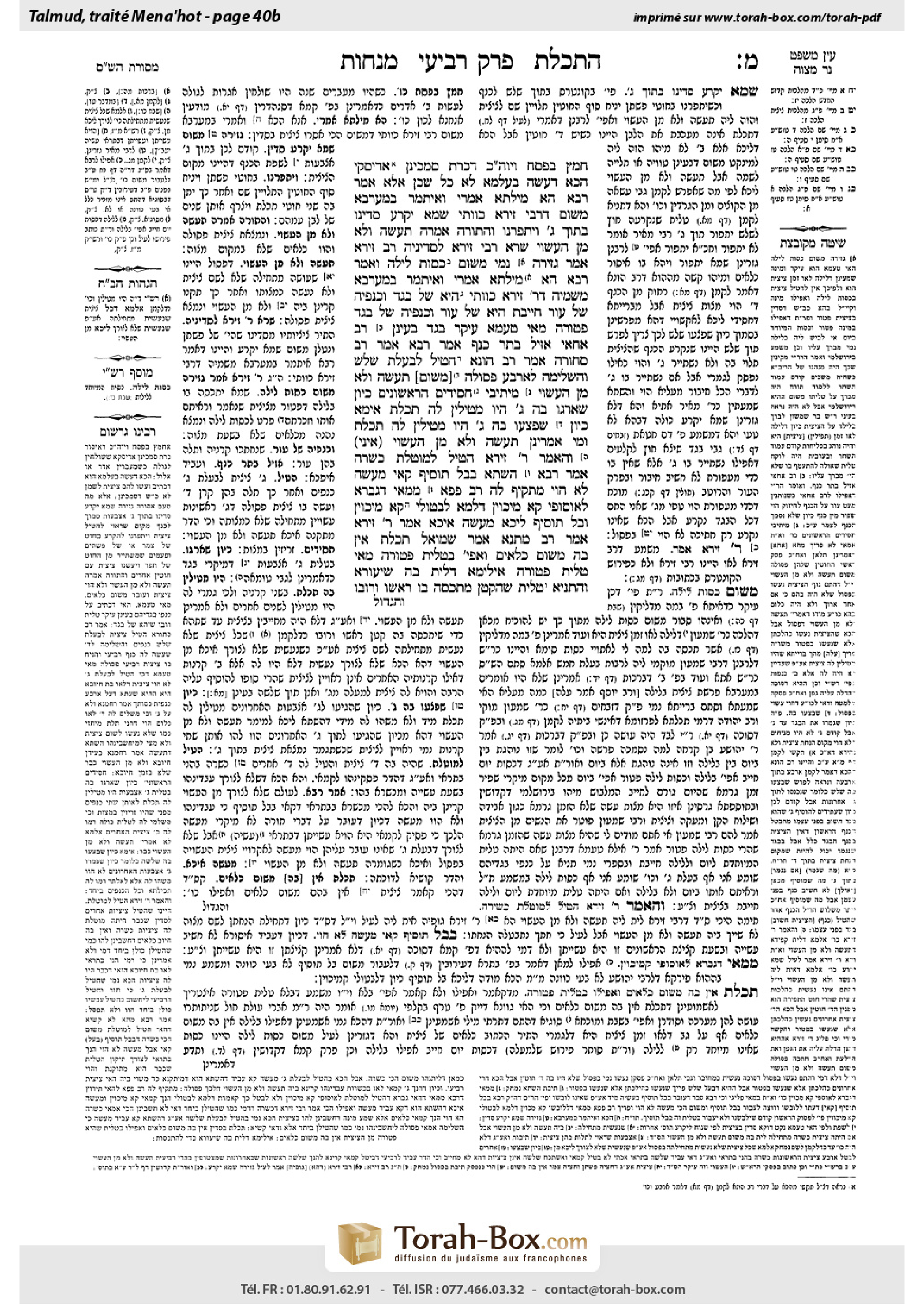
Menachot 40b: Talmud study for Daf Yomi
Daf Yomi is the daily study of one Talmud folio. Explore 37 tractates with scans, Hebrew text, Sefaria English and AI-generated French translations where annotated.
Passage selection and English or AI-generated French translation are available where the scan has annotations. Daf Study is independent of Torah-Box and Sefaria.
Browse Menachot · מנחות · All tractatesMenachot 40b text and translations
This page of Menachot includes the Aramaic text, an English translation and an AI-generated French translation, alongside the scan above.
מנחות מ׳ ב · Aramaic and Hebrew text
חָמֵץ בְּפֶסַח וְיוֹם הַכִּפּוּרִים דְּכָרֵת – סָמְכִינַן אַדִּיסְקֵי, הָכָא דַּעֲשֵׂה בְּעָלְמָא לֹא כׇּל שֶׁכֵּן!
אֶלָּא אָמַר רָבָא: הָא מִילְּתָא אָמְרִי, וְאִיתְּמַר בְּמַעְרְבָא מִשּׁוּם דְּרַבִּי זֵירָא כְּוָותִי: שֶׁמָּא יִקָּרַע סְדִינוֹ בְּתוֹךְ שָׁלֹשׁ וְיִתְפְּרֶנּוּ.
וְהַתּוֹרָה אָמְרָה: ״תַּעֲשֶׂה״ – וְלֹא מִן הֶעָשׂוּי.
שְׁרָא רַבִּי זֵירָא לִסְדִינֵיהּ. רַב זֵירָא אָמַר: גְּזֵירָה נָמֵי מִשּׁוּם כְּסוּת לַיְלָה.
וְאָמַר רָבָא: הָא מִילְּתָא אֲמַרִי, וְאִיתְּמַר בְּמַעְרְבָא מִשְּׁמֵיהּ דְּרַבִּי זֵירָא כְּוָותִי: הִיא שֶׁל בֶּגֶד וּכְנָפֶיהָ שֶׁל עוֹר – חַיֶּיבֶת, הִיא שֶׁל עוֹר וּכְנָפֶיהָ שֶׁל בֶּגֶד – פְּטוּרָה. מַאי טַעְמָא? עִיקַּר בֶּגֶד בָּעֵינַן.
רַב אַחַאי אָזֵיל בָּתַר כָּנָף.
אָמַר רָבָא אָמַר רַב סְחוֹרָה אָמַר רַב הוּנָא: הֵטִיל לְבַעֲלַת שָׁלֹשׁ, וְהִשְׁלִימָהּ לְאַרְבַּע – פְּסוּלָה, ״תַּעֲשֶׂה״ – וְלֹא מִן הֶעָשׂוּי.
מֵיתִיבִי: חֲסִידִים הָרִאשׁוֹנִים, כֵּיוָן שֶׁאָרְגוּ בָּהּ שָׁלֹשׁ, הָיוּ מְטִילִין לָהּ תְּכֵלֶת. אֵימָא: כֵּיוָן שֶׁפָּצְעוּ בָּהּ שָׁלֹשׁ, הָיוּ מְטִילִין לָהּ תְּכֵלֶת.
וּמִי אָמְרִינַן ״תַּעֲשֶׂה״ – וְלֹא מִן הֶעָשׂוּי? (אִינִי), וְהָאָמַר רַבִּי זֵירָא: הֵטִיל לְמוּטֶּלֶת – כְּשֵׁרָה.
אָמַר רָבָא: הַשְׁתָּא בְּ״בַל תּוֹסִיף״ קָאֵי, מַעֲשֶׂה לָא הָוֵי?
מַתְקֵיף לַהּ רַב פָּפָּא: מִמַּאי דְּגַבְרָא לְאוֹסוֹפֵי קָא מִיכַּוֵּין? דִּלְמָא לְבַטּוֹלֵי קָא מִיכַּוֵּין, וּ״בַל תּוֹסִיף״ לֵיכָּא, מַעֲשֶׂה אִיכָּא!
אָמַר רַבִּי זֵירָא אָמַר רַב מַתְנָא אָמַר שְׁמוּאֵל: תְּכֵלֶת אֵין בָּהּ מִשּׁוּם כִּלְאַיִם, וַאֲפִילּוּ בְּטַלִּית פְּטוּרָה.
מַאי טַלִּית פְּטוּרָה? אִילֵּימָא דְּלֵית בַּהּ שִׁיעוּרָא, וְהָתַנְיָא: טַלִּית שֶׁהַקָּטָן מִתְכַּסֶּה בּוֹ רֹאשׁוֹ וְרוּבּוֹ
Menachot 40b · English translation
with regard to the prohibitions against eating leavened bread on Passover and eating on Yom Kippur, which are punishable by karet, we rely on letters sent from the rabbinical court in Eretz Yisrael publicizing whether the year was declared a leap year and when they have declared the New Moon; here, with regard to the mitzva of ritual fringes, which is merely a positive mitzva, is it not all the more so correct that letters can be relied on?
Rather, Rava said: This is a statement that I said, and it was stated in the West, Eretz Yisrael, in the name of Rabbi Zeira in accordance with my opinion: The reason for the rabbinic decree is lest one’s cloak rip within three fingerbreadths of the edge of the corner of the garment, which is where the ritual fringes are placed, and he sew it with linen string and then use the excess string for ritual fringes.
And in such a case the ritual fringes would be unfit because the Torah states: “You shall prepare yourself twisted cords” (Deuteronomy 22:12), which teaches: Prepare it, and not from what has already been prepared. Consequently, the strings must be attached to the garment for the sake of the mitzva of ritual fringes. When the individual places the linen string there in order to stitch the garment and then decides to use it for the mitzva of ritual fringes and adds sky-blue wool strings, he does not fulfill the mitzva of ritual fringes and violates the prohibition against wearing a garment of wool and linen.
Because of this rabbinic decree, Rabbi Zeira untied the ritual fringes and removed them from his linen cloak. Rav Zeira said: The rabbinic decree prohibiting ritual fringes on a linen garment is also due to the concern that one might affix ritual fringes to a nighttime garment. Since the mitzva of ritual fringes does not apply in that case, if one wears the garment he would not fulfill the mitzva and would violate the prohibition against wearing a garment with wool and linen.
And Rava said: This is a statement that I said, and it was stated in the West, Eretz Yisrael, in the name of Rabbi Zeira in accordance with my opinion: If a garment is made from cloth and its corners are made from leather, it is required to have ritual fringes. Conversely, if a cloak is made from leather and its corners are made from cloth, it is exempt from the mitzva of ritual fringes. What is the reason for this? We require that the main part of the garment be obligated, and a leather garment is not required to have ritual fringes.
The Gemara notes: Rav Aḥai would follow the corner in determining whether the garment is required to have ritual fringes or not, because the Torah states: “On the corners of their garments” (Numbers 15:38).
§ Rava says that Rav Seḥora says that Rav Huna says: In a case where one affixed ritual fringes to a garment possessing only three corners, which is not required to have ritual fringes, and then completed its fourth corner by sewing on additional material or cutting away some of the material, the ritual fringes he attached to the original three corners are unfit. This is due to the principle: Prepare it, and not from what has already been prepared. Once the garment is required to have ritual fringes one may attach the ritual fringes; the strings that were attached before the garment was required to have them are not fit.
The Gemara raises an objection from a baraita: It is told of the early generations of pious men that once they weaved three fingerbreadths of the length of the garment, they would affix the white and sky-blue strings to the first two corners, even though the garment was not yet long enough to be obligated to have ritual fringes. The Gemara answers: Say that the baraita should read as follows: Once they completed [shepatzu] the garment until there were only three fingerbreadths left to weave, they would affix the white and sky-blue strings to the first two corners.
The Gemara asks: And do we say: Prepare it, and not from what has already been prepared? Is that so that this principle disqualifies ritual fringes that one affixed to a garment before he was required to do so? But doesn’t Rabbi Zeira say: If one affixed ritual fringes to a garment that already had ritual fringes affixed to it and then removed the original strings, it is fit, despite the fact that when he attached the second set they were superfluous? This indicates that even if one attaches ritual fringes to a garment when there is no obligation to attach them, the ritual fringes are fit.
Rava said: This does not present a difficulty, because now that he adds a second, unnecessary set of ritual fringes and is liable for violating the prohibition of adding to a mitzva (see Deuteronomy 13:1), is it not considered an action?
Rav Pappa objects to this: From where is it known that Rabbi Zeira is discussing a case where the person intended to add to the original set of ritual fringes? Perhaps Rabbi Zeira is discussing a case where he intended to nullify the original strings, and therefore there is no prohibition of adding to a mitzva, and there is an action.
With regard to the issue of affixing ritual fringes to a garment that already has ritual fringes, the Gemara relates: Rabbi Zeira says that Rav Mattana says that Shmuel says: White and sky-blue strings are not subject to the prohibition of diverse kinds, and this is the halakha even if they are affixed to a cloak that is exempt from ritual fringes.
The Gemara asks: What is meant by: A cloak that is exempt from ritual fringes? If we say that it is referring to a cloak that is not of the size necessary to require the affixing of ritual fringes, that is difficult: But isn’t it taught in a baraita: With regard to a cloak that is large enough for a minor to cover his head and most of his body with it,
Menachot 40b · Traduction française (IA)
S’agissant des interdictions de manger du pain levé à Pessa’h et de manger à Yom Kippour, passibles de karet, nous nous fions aux lettres envoyées par le tribunal rabbinique d’Eretz Israël pour annoncer si l’année a été déclarée embolismique et quand la nouvelle lune a été proclamée. Ici, s’agissant de la mitsva des franges rituelles, qui n’est qu’une mitsva positive, n’est-il pas d’autant plus juste de pouvoir se fier à des lettres ?
Rava dit plutôt : « C’est une explication que j’ai donnée, et elle a été énoncée en Occident, en Eretz Israël, au nom de Rabbi Zeira, conformément à mon avis : la raison du décret rabbinique est la crainte que le vêtement se déchire à moins de trois largeurs de doigt du bord de son angle, là où sont placées les franges rituelles, et qu’on le recouse avec un fil de lin, puis qu’on utilise le surplus de fil pour les franges rituelles.
Dans ce cas, les franges rituelles seraient impropres, car la Torah dit : « Tu te feras des cordons torsadés » (Deutéronome 22,12), ce qui enseigne : « Fais-les, et non à partir de ce qui a déjà été fait. » Par conséquent, les fils doivent être attachés au vêtement en vue de la mitsva des franges rituelles. Lorsque quelqu’un place le fil de lin à cet endroit pour coudre le vêtement, puis décide de l’utiliser pour la mitsva des franges rituelles et y ajoute des fils de laine bleu azur, il ne s’acquitte pas de la mitsva des franges rituelles et transgresse l’interdiction de porter un vêtement de laine et de lin.
En raison de ce décret rabbinique, Rabbi Zeira dénoua les franges rituelles et les retira de son manteau de lin. Rav Zeira dit : le décret rabbinique interdisant les franges rituelles sur un vêtement de lin tient également à la crainte que l’on fixe des franges rituelles à un vêtement de nuit. Comme la mitsva des franges rituelles ne s’applique pas dans ce cas, celui qui porte ce vêtement ne s’acquitterait pas de la mitsva et transgresserait l’interdiction de porter un vêtement de laine et de lin.
Rava dit également : « C’est une explication que j’ai donnée, et elle a été énoncée en Occident, en Eretz Israël, au nom de Rabbi Zeira, conformément à mon avis : si un vêtement est fait d’étoffe et que ses angles sont en cuir, il doit avoir des franges rituelles. À l’inverse, si un manteau est en cuir et que ses angles sont en étoffe, il est exempt de la mitsva des franges rituelles. Pour quelle raison ? Nous exigeons que la partie principale du vêtement soit assujettie à cette obligation, et un vêtement de cuir n’est pas tenu d’avoir des franges rituelles.
La Guemara note : Rav Aḥai se fondait sur l’angle pour déterminer si le vêtement devait avoir des franges rituelles ou non, car la Torah dit : « Aux angles de leurs vêtements » (Nombres 15,38).
§ Rava dit au nom de Rav Seḥora, qui dit au nom de Rav Huna : si l’on a fixé des franges rituelles à un vêtement qui ne possède que trois angles et n’est donc pas tenu d’en avoir, puis qu’on lui a donné un quatrième angle en y cousant une pièce supplémentaire ou en en coupant une partie, les franges rituelles fixées aux trois angles initiaux sont impropres. Cela découle du principe : « Fais-les, et non à partir de ce qui a déjà été fait. » On ne peut fixer les franges rituelles qu’une fois le vêtement assujetti à cette obligation ; les fils attachés auparavant sont impropres.
La Guemara soulève une objection à partir d’une baraïta : il est rapporté que les premières générations d’hommes pieux, dès qu’elles avaient tissé trois largeurs de doigt sur la longueur du vêtement, fixaient les fils blancs et bleu azur aux deux premiers angles, alors que le vêtement n’était pas encore assez long pour être assujetti à l’obligation des franges rituelles. La Guemara répond : il faut lire la baraïta ainsi : lorsqu’ils avaient achevé [shepatzu] le vêtement, de sorte qu’il ne restait que trois largeurs de doigt à tisser, ils fixaient les fils blancs et bleu azur aux deux premiers angles.
La Guemara demande : Dit-on donc : « Fais-les, et non à partir de ce qui a déjà été fait » ? Ce principe invaliderait-il les franges rituelles fixées à un vêtement avant que l’on soit tenu de le faire ? Pourtant, Rabbi Zeira ne dit-il pas : si quelqu’un fixe des franges rituelles à un vêtement auquel des franges rituelles ont déjà été fixées, puis retire les premiers fils, le vêtement est apte, bien qu’au moment où il a fixé la seconde série, celle-ci ait été superflue ? Cela indique que même si l’on fixe des franges rituelles à un vêtement alors qu’on n’est pas tenu de le faire, elles sont aptes.
Rava dit : cela ne pose pas de difficulté, car, dès lors qu’il ajoute une seconde série de franges rituelles, inutile, et devient passible d’avoir transgressé l’interdiction d’ajouter à une mitsva (voir Deutéronome 13,1), cet ajout n’est-il pas considéré comme un acte ?
Rav Pappa objecte : d’où sait-on que Rabbi Zeira parle d’un cas où la personne avait l’intention d’ajouter à la première série de franges rituelles ? Peut-être Rabbi Zeira parle-t-il d’un cas où elle avait l’intention d’annuler les premiers fils ; il n’y a donc pas d’interdiction d’ajouter à une mitsva, et il y a bien un acte.
À propos de la question de fixer des franges rituelles à un vêtement qui en porte déjà, la Guemara rapporte : Rabbi Zeira dit au nom de Rav Mattana, qui dit au nom de Shmuel : les fils blancs et bleu azur ne sont pas soumis à l’interdiction des mélanges d’espèces, et telle est la halakha même s’ils sont fixés à un manteau exempt de l’obligation des franges rituelles.
La Guemara demande : que signifie « un manteau exempt de l’obligation des franges rituelles » ? Si l’on dit qu’il s’agit d’un manteau qui n’a pas la taille requise pour être assujetti à l’obligation d’y fixer des franges rituelles, cela pose problème. N’est-il pas enseigné dans une baraïta : s’agissant d’un manteau assez grand pour qu’un mineur puisse s’en couvrir la tête et la majeure partie du corps,
Traduction française générée par IA à partir de l’édition anglaise de Sefaria. Vérifie toujours un passage avec le texte source.
Text from Sefaria: William Davidson Edition - Vocalized Aramaic (unknown); William Davidson Edition - English (CC BY NC).