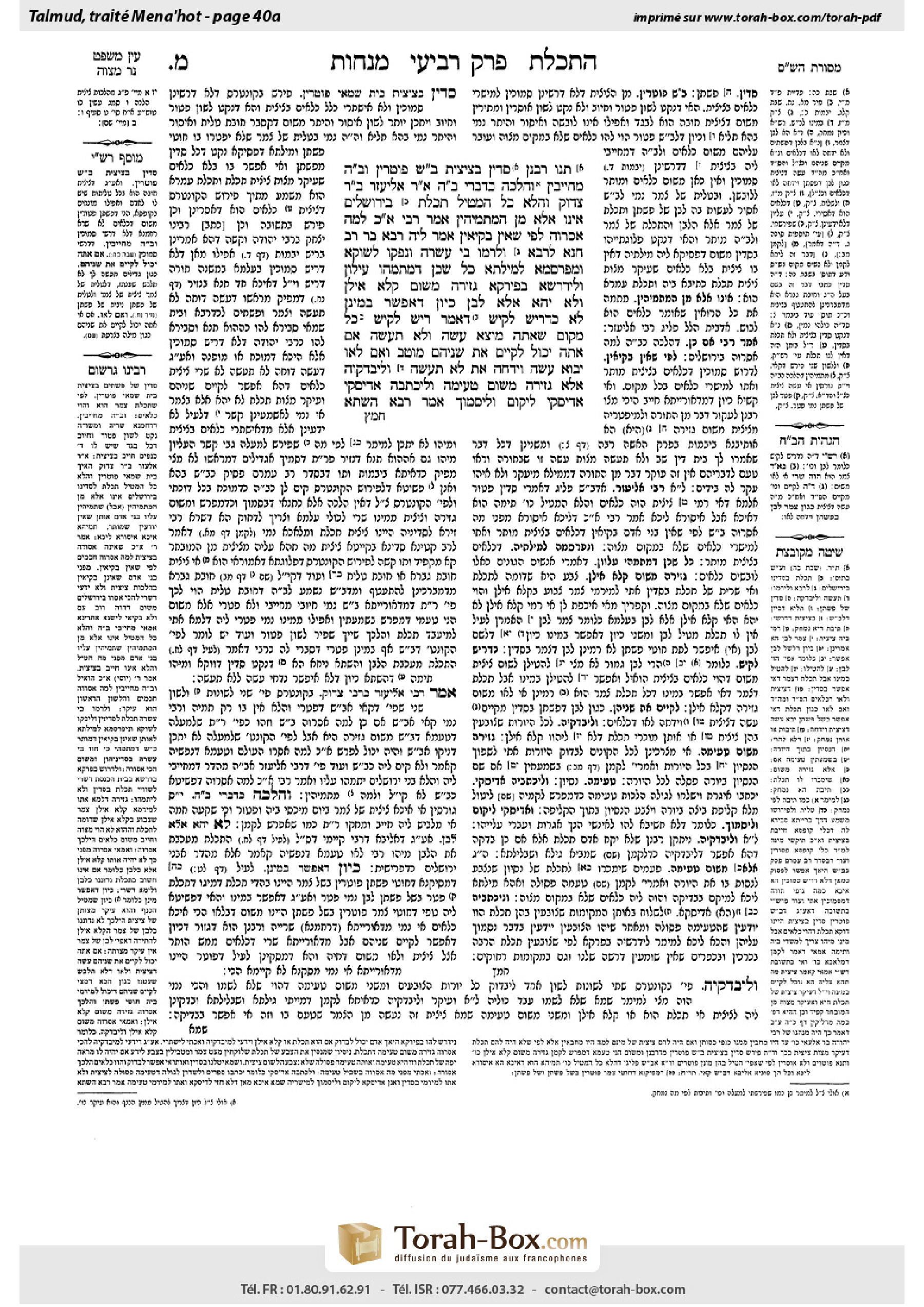
Menachot 40a: Talmud study for Daf Yomi
Daf Yomi is the daily study of one Talmud folio. Explore 37 tractates with scans, Hebrew text, Sefaria English and AI-generated French translations where annotated.
Passage selection and English or AI-generated French translation are available where the scan has annotations. Daf Study is independent of Torah-Box and Sefaria.
Browse Menachot · מנחות · All tractatesMenachot 40a text and translations
This page of Menachot includes the Aramaic text, an English translation and an AI-generated French translation, alongside the scan above.
מנחות מ׳ א · Aramaic and Hebrew text
תָּנוּ רַבָּנַן: סָדִין בְּצִיצִית – בֵּית שַׁמַּאי פּוֹטְרִין וּבֵית הִלֵּל מְחַיְּיבִין, וַהֲלָכָה כְּדִבְרֵי בֵּית הִלֵּל.
אָמַר רַבִּי אֱלִיעֶזֶר בֶּן רַבִּי צָדוֹק: וַהֲלֹא כׇּל הַמֵּטִיל תְּכֵלֶת בִּירוּשָׁלַיִם אֵינוֹ אֶלָּא מִן הַמַּתְמִיהִין!
אָמַר רַבִּי: אִם כֵּן, לָמָּה אֲסָרוּהָ? לְפִי שֶׁאֵין בְּקִיאִין.
אֲמַר לֵיהּ רָבָא בַּר רַב חָנָא לְרָבָא: וְלִרְמוֹ בֵּי עַשְׂרָה וְנִפְּקוּ לְשׁוּקָא וּמִפַּרְסְמָא (למילתא) [מִילְּתָא]! כׇּל שֶׁכֵּן דְּמַתְמְהוּ עִילָּוַן.
וְלִידְרְשַׁהּ בְּפִירְקָא! גְּזֵירָה מִשּׁוּם קָלָא אִילָן.
וְלֹא יְהֵא אֶלָּא לָבָן! כֵּיוָן דְּאֶפְשָׁר בְּמִינָן – לָא.
כִּדְרֵישׁ לָקִישׁ, דְּאָמַר רֵישׁ לָקִישׁ: כׇּל מָקוֹם שֶׁאַתָּה מוֹצֵא עֲשֵׂה וְלֹא תַעֲשֶׂה, אִם אַתָּה יָכוֹל לְקַיֵּים אֶת שְׁנֵיהֶם – מוּטָב, וְאִם לָאו – יָבוֹא עֲשֵׂה וְיִדְחֶה אֶת לֹא תַעֲשֶׂה.
וְלִיבְדְּקוּהָ, אֶלָּא גְּזֵירָה מִשּׁוּם טְעִימָה.
וְלִיכְתְּבָה אַדִּיסְקֵי! אַדִּיסְקֵי לֵיקוּם וְלִיסְמוֹךְ? אָמַר רָבָא: הַשְׁתָּא
Menachot 40a · English translation
The Sages taught in a baraita: With regard to ritual fringes on a linen cloak, Beit Shammai deem the cloak exempt from ritual fringes due to the fact that the sky-blue strings must be made from wool, and there is a Torah prohibition against wearing a mixture of wool and linen. And Beit Hillel deem a linen cloak obligated in the mitzva of ritual fringes. And the halakha is in accordance with the statement of Beit Hillel.
Rabbi Eliezer ben Rabbi Tzadok says: But is it not the case that anyone who affixes sky-blue strings to a linen cloak in Jerusalem is considered nothing other than one of those who causes others to be astonished at their behavior, as it appears that he is violating the prohibition against wearing a garment containing wool and linen?
The baraita concludes: Rabbi Yehuda HaNasi says: If so, that the halakha is in accordance with Beit Hillel and a linen cloak is required to have ritual fringes, why did the Sages prohibit attaching ritual fringes to linen garments in Jerusalem? It is because people are not well versed in the halakha and might ultimately wear garments of wool and linen even when it is not necessary for the mitzva of ritual fringes.
Rava bar Rav Ḥana said to Rava: If that is the concern, then let ten people take linen cloaks with ritual fringes and go out to the marketplace and thereby publicize the matter, i.e., that it is permitted to affix wool strings to a linen garment due to the mitzva. Rava answered: All the more so people would be astonished at us for acting in such an unconventional manner.
The Gemara suggests: Let the Rabbis teach during their public lecture that affixing wool strings to a linen garment is permitted for the mitzva of ritual fringes. The Gemara answers: Wearing strings on a linen garment is prohibited because of a rabbinic decree due to the concern that people might use strings that were dyed blue with indigo [kala ilan], instead of with tekhelet, the sky-blue dye produced from the ḥilazon (see 44b), in which case they would not fulfill the mitzva of ritual fringes and would violate the prohibition against wearing garments containing wool and linen.
The Gemara suggests: Even if one’s blue strings are not dyed with tekhelet as required for the mitzva, let them be considered merely as white strings. In the absence of tekhelet one fulfills the mitzva with white strings, and therefore it should be permitted to affix white woolen strings to a linen garment. The Gemara explains: Since it is possible to affix white strings that are the same type of material as the garment, i.e., linen, and thereby fulfill the mitzva without overriding the prohibition against wearing a garment made from wool and linen, one may not affix white wool strings to a linen garment.
The Gemara notes: This is in accordance with the opinion of Reish Lakish. As Reish Lakish says: Any place where you find a positive mitzva and a prohibition that clash with one another, if you are able to fulfill both of them, that is preferable; and if that is not possible, the positive mitzva shall come and override the prohibition. In this case, the clash is between the mitzva of ritual fringes and the prohibition against wearing a garment that contains wool and linen. One can fulfill both of them by using white strings that are linen instead of wool if the garment is made from linen.
The Gemara suggests: And let them test the strings to ascertain whether they are dyed with indigo or with tekhelet, as explained by the Gemara (42b). The Gemara responds: Rather, the prohibition against affixing ritual fringes to a linen garment is a rabbinic decree due to the concern that perhaps the sky-blue strings were colored with tekhelet dye that had been used for testing the color of the dye in the vat and therefore became unfit (see 42b). In such a case, there would be no fulfillment of the mitzva of sky-blue ritual fringes to override the prohibition against wearing a garment of wool and linen.
The Gemara suggests: Let the Sages write letters informing dye producers that tekhelet that was used for testing the color of the dye in the vat is unfit for ritual fringes. The Gemara explains: Shall we go and rely on letters, assuming that dye producers will follow the instructions they contain? Rava responded to this and said: Now,
Menachot 40a · Traduction française (IA)
Les Sages ont enseigné dans une baraïta : Au sujet des franges rituelles d’un manteau de lin, Beit Shammaï dispensent ce manteau de franges rituelles, car les fils bleu azur doivent être en laine, et le port d’un mélange de laine et de lin est interdit par la Torah. Beit Hillel estiment, quant à eux, qu’un manteau de lin est soumis à la mitsva des franges rituelles. La halakha suit l’avis de Beit Hillel.
Rabbi Eliezer ben Rabbi Tzadok dit : N’est-il pas vrai que quiconque fixe des fils bleu azur à un manteau de lin à Jérusalem est considéré comme quelqu’un qui ne peut que susciter l’étonnement par son comportement, puisqu’il semble transgresser l’interdiction de porter un vêtement contenant de la laine et du lin ?
La baraïta conclut : Rabbi Yehuda HaNasi dit : Si tel est le cas, si la halakha suit Beit Hillel et qu’un manteau de lin doit porter des franges rituelles, pourquoi les Sages ont-ils interdit de fixer des franges rituelles aux vêtements de lin à Jérusalem ? C’est parce que les gens ne connaissent pas bien la halakha et pourraient finir par porter des vêtements de laine et de lin même lorsque la mitsva des franges rituelles ne l’exige pas.
Rava bar Rav Ḥana dit à Rava : Si telle est la crainte, que dix personnes prennent des manteaux de lin munis de franges rituelles, sortent sur la place du marché et fassent ainsi connaître la chose, c’est-à-dire qu’il est permis, pour accomplir la mitsva, de fixer des fils de laine à un vêtement de lin. Rava répondit : À plus forte raison, les gens s’étonneraient de nous voir agir d’une manière aussi peu conventionnelle.
La Guemara propose : Que les rabbins enseignent, lors de leur cours public, qu’il est permis de fixer des fils de laine à un vêtement de lin pour accomplir la mitsva des franges rituelles. La Guemara répond : Le port de fils sur un vêtement de lin est interdit par décret rabbinique, par crainte que les gens n’utilisent des fils teints en bleu avec de l’indigo [kala ilan], au lieu du tekhelet, la teinture bleu azur produite à partir du ḥilazon (voir 44b). Dans ce cas, ils n’accompliraient pas la mitsva des franges rituelles et transgresseraient l’interdiction de porter un vêtement contenant de la laine et du lin.
La Guemara propose : Même si les fils bleus de quelqu’un ne sont pas teints avec le tekhelet requis pour accomplir la mitsva, qu’on les considère simplement comme des fils blancs. En l’absence de tekhelet, on accomplit la mitsva avec des fils blancs ; il devrait donc être permis de fixer des fils blancs de laine à un vêtement de lin. La Guemara explique : Puisqu’il est possible de fixer des fils blancs faits de la même matière que le vêtement, c’est-à-dire de lin, et d’accomplir ainsi la mitsva sans enfreindre l’interdiction de porter un vêtement fait de laine et de lin, on ne peut pas fixer des fils blancs de laine à un vêtement de lin.
La Guemara note : Cela correspond à l’opinion de Reish Lakish. En effet, Reish Lakish dit : Chaque fois qu’une mitsva positive et une interdiction entrent en conflit, s’il est possible d’accomplir les deux, c’est préférable ; et si cela n’est pas possible, la mitsva positive vient et l’emporte sur l’interdiction. Ici, le conflit oppose la mitsva des franges rituelles à l’interdiction de porter un vêtement contenant de la laine et du lin. Si le vêtement est en lin, on peut accomplir les deux en utilisant des fils blancs de lin plutôt que de laine.
La Guemara propose : Qu’on teste les fils pour déterminer s’ils sont teints à l’indigo ou au tekhelet, comme l’explique la Guemara (42b). La Guemara répond : En réalité, l’interdiction de fixer des franges rituelles à un vêtement de lin est un décret rabbinique, par crainte que les fils bleu azur aient été teints avec du tekhelet ayant servi à tester la couleur de la teinture dans la cuve et soient donc devenus impropres (voir 42b). Dans ce cas, la mitsva des franges rituelles bleu azur ne serait pas accomplie et ne pourrait donc pas l’emporter sur l’interdiction de porter un vêtement de laine et de lin.
La Guemara propose : Que les Sages écrivent aux teinturiers pour les informer que le tekhelet ayant servi à tester la couleur de la teinture dans la cuve est impropre aux franges rituelles. La Guemara explique : Allons-nous nous en remettre à des lettres, en supposant que les teinturiers suivront les instructions qu’elles contiennent ? Rava répondit à cela et dit : À présent,
Traduction française générée par IA à partir de l’édition anglaise de Sefaria. Vérifie toujours un passage avec le texte source.
Text from Sefaria: William Davidson Edition - Vocalized Aramaic (unknown); William Davidson Edition - English (CC BY NC).