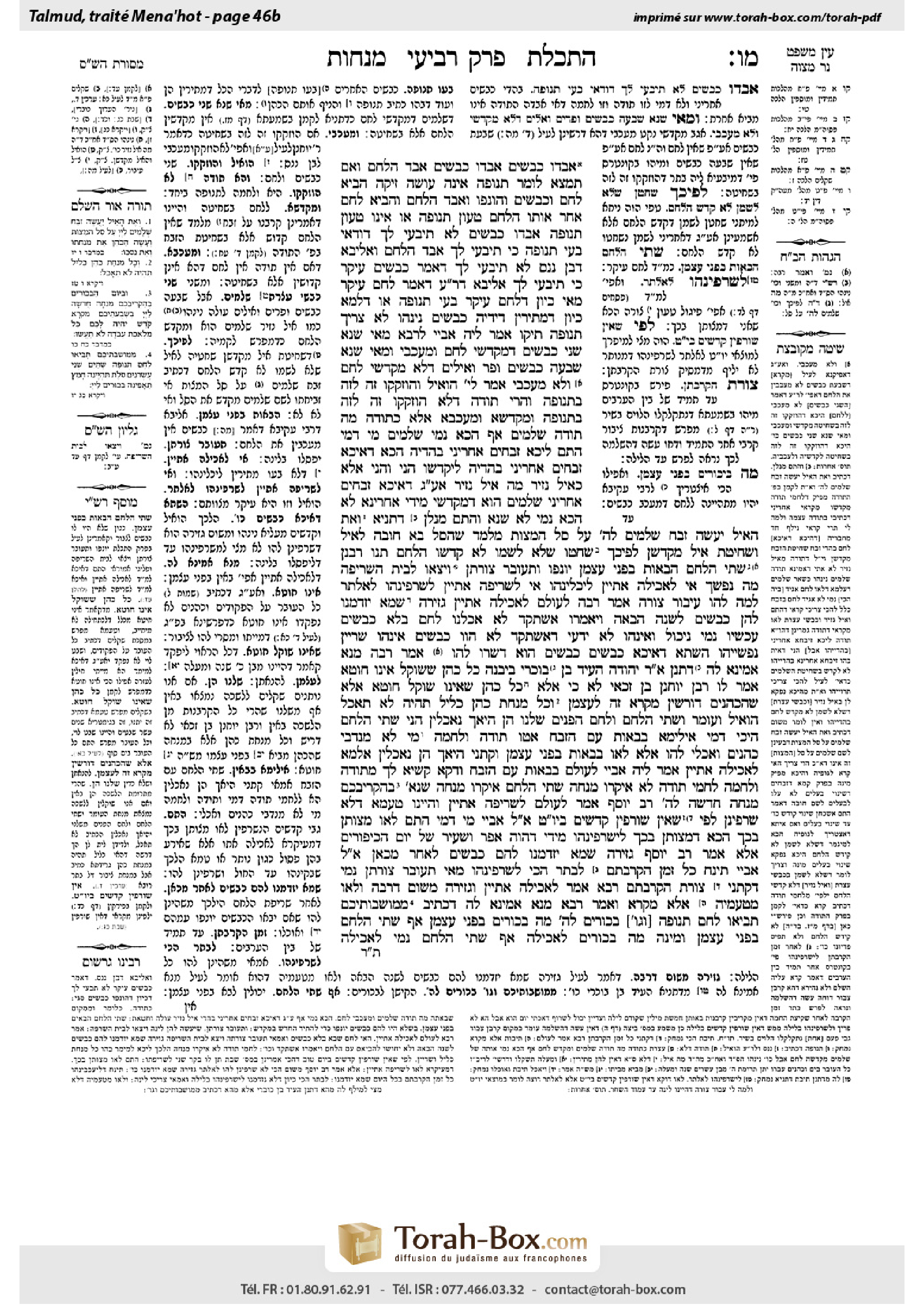
Menachot 46b: Talmud study for Daf Yomi
Daf Yomi is the daily study of one Talmud folio. Explore 37 tractates with scans, Hebrew text, Sefaria English and AI-generated French translations where annotated.
Passage selection and English or AI-generated French translation are available where the scan has annotations. Daf Study is independent of Torah-Box and Sefaria.
Browse Menachot · מנחות · All tractatesMenachot 46b text and translations
This page of Menachot includes the Aramaic text, an English translation and an AI-generated French translation, alongside the scan above.
מנחות מ״ו ב · Aramaic and Hebrew text
אָבְדוּ כְּבָשִׂים, אָבְדוּ כְּבָשִׂים – אָבַד הַלֶּחֶם.
וְאִם תִּמְצָא לוֹמַר, תְּנוּפָה אֵינָהּ עוֹשָׂה זִיקָּה – הֵבִיא לֶחֶם וּכְבָשִׂים וְהוּנְפוּ, וְאָבַד הַלֶּחֶם, וְהֵבִיא לֶחֶם אַחֵר – אוֹתוֹ הַלֶּחֶם טָעוּן תְּנוּפָה, אוֹ אֵינוֹ טָעוּן תְּנוּפָה?
אָבְדוּ כְּבָשִׂים – לָא תִּיבְּעֵי לָךְ, דְּוַדַּאי בָּעֵי תְּנוּפָה; כִּי תִּיבְּעֵי לָךְ – אָבַד הַלֶּחֶם.
וְאַלִּיבָּא דְּבֶן נַנָּס, לָא תִּיבְּעֵי לָךְ, דְּאָמַר כְּבָשִׂים עִיקָּר. כִּי תִּיבְּעֵי לָךְ אַלִּיבָּא דְּרַבִּי עֲקִיבָא, דְּאָמַר לֶחֶם עִיקָּר – מַאי?
כֵּיוָן דְּלֶחֶם עִיקָּר – בָּעֵי תְּנוּפָה, אוֹ דִלְמָא כֵּיוָן דְּמַתִּירִין דִּידֵיהּ כְּבָשִׂים נִינְהוּ – לָא צְרִיךְ תְּנוּפָה. תֵּיקוּ.
אֲמַר לֵיהּ אַבָּיֵי לְרָבָא: מַאי שְׁנָא שְׁנֵי כְּבָשִׂים דִּמְקַדְּשִׁי לֶחֶם וּמְעַכְּבִי, וּמַאי שְׁנָא שִׁבְעָה כְּבָשִׂים וּפַר וְאֵילִים דְּלָא מְקַדְּשִׁי לֶחֶם וְלָא מְעַכְּבִי?
אֲמַר לֵיהּ: הוֹאִיל וְהוּזְקְקוּ זֶה לָזֶה בִּתְנוּפָה. וַהֲרֵי תּוֹדָה דְּלֹא הוּזְקְקוּ זֶה לָזֶה בִּתְנוּפָה, וּמְקַדְּשָׁא וּמְעַכְּבָא!
אֶלָּא, כְּתוֹדָה – מָה תּוֹדָה שְׁלָמִים, אַף הָכָא נָמֵי שְׁלָמִים.
מִי דָּמֵי? הָתָם לֵיכָּא זְבָחִים אַחֲרִינֵי בַּהֲדֵיהּ, הָכָא דְּאִיכָּא זְבָחִים אַחֲרִינֵי בַּהֲדֵיהּ – לִיקְדְּשׁוּ הָנֵי וְהָנֵי!
אֶלָּא, כְּאֵיל נָזִיר – מָה אֵיל נָזִיר, אַף עַל גַּב דְּאִיכָּא זְבָחִים אַחֲרִינִי, שְׁלָמִים הוּא דִּמְקַדְּשִׁי, מִידֵּי אַחֲרִינָא לָא, הָכָא נָמֵי לָא שְׁנָא.
וְהָתָם מְנָלַן? דְּתַנְיָא: ״וְאֶת הָאַיִל יַעֲשֶׂה זֶבַח שְׁלָמִים לַה׳ עַל סַל הַמַּצּוֹת״ – מְלַמֵּד שֶׁהַסַּל בָּא חוֹבָה לָאַיִל, וּשְׁחִיטַת אַיִל מְקַדְּשָׁן. לְפִיכָךְ, שְׁחָטוֹ שֶׁלֹּא לִשְׁמוֹ – לֹא קָדַשׁוֹ הַלֶּחֶם.
תָּנוּ רַבָּנַן: שְׁתֵּי הַלֶּחֶם הַבָּאוֹת בִּפְנֵי עַצְמָן – יוּנְפוּ, וּתְעוּבַּר צוּרָתָן, וְיֵצְאוּ לְבֵית הַשְּׂרֵיפָה.
מָה נַפְשָׁךְ? אִי לַאֲכִילָה אָתְיָין – לֵיכְלִינְהוּ, אִי לִשְׂרֵיפָה אָתְיָין – לִשְׂרְפִינְהוּ לְאַלְתַּר, לְמָה לְהוּ עִיבּוּר צוּרָה?
אָמַר רַבָּה: לְעוֹלָם לַאֲכִילָה אָתְיָין, גְּזֵירָה שֶׁמָּא יִזְדַּמְּנוּ לָהֶן כְּבָשִׂים לְשָׁנָה הַבָּאָה, וְיֹאמְרוּ: אֶשְׁתָּקַד לֹא אָכַלְנוּ לֶחֶם בְּלֹא כְּבָשִׂים, עַכְשָׁיו נָמֵי נֵיכוֹל.
וְאִינְהוּ לָא יָדְעִי, דְּאֶשְׁתָּקַד לָא הֲווֹ כְּבָשִׂים, אִינְהוּ שָׁרְיָין נַפְשַׁיְיהוּ, הַשְׁתָּא דְּאִיכָּא כְּבָשִׂים – כְּבָשִׂים הוּא דְּשָׁרוּ לְהוּ.
אָמַר רַבָּה: מְנָא אָמֵינָא לַהּ? דִּתְנַן: אָמַר רַבִּי יְהוּדָה: הֵעִיד בֶּן בּוּכְרִי בְּיַבְנֶה: כׇּל כֹּהֵן שֶׁשּׁוֹקֵל – אֵינוֹ חוֹטֵא.
אָמַר לוֹ רַבָּן יוֹחָנָן בֶּן זַכַּאי: לֹא כִי, אֶלָּא כׇּל כֹּהֵן שֶׁאֵינוֹ שׁוֹקֵל – חוֹטֵא, אֶלָּא שֶׁהַכֹּהֲנִים דּוֹרְשִׁין מִקְרָא זֶה לְעַצְמָן:
״וְכׇל מִנְחַת כֹּהֵן כָּלִיל תִּהְיֶה לֹא תֵאָכֵל״. הוֹאִיל וְעוֹמֶר וּשְׁתֵּי הַלֶּחֶם וְלֶחֶם הַפָּנִים שֶׁלָּנוּ הֵן, הֵיאַךְ נֶאֱכָלִין?
הָנֵי שְׁתֵּי הַלֶּחֶם הֵיכִי דָמֵי? אִילֵּימָא בְּבָאוֹת עִם הַזֶּבַח – אַטּוּ תּוֹדָה וְלַחְמָהּ מִי לָא מְנַדְּבִי כֹּהֲנִים וְאָכְלִי לְהוּ?
אֶלָּא לָאו בְּבָאוֹת בִּפְנֵי עַצְמָן, וְקָתָנֵי: ״הֵיאַךְ הֵן נֶאֱכָלִין״, אַלְמָא לַאֲכִילָה אָתְיָין.
אֲמַר לֵיהּ אַבָּיֵי: לְעוֹלָם בְּבָאוֹת עִם הַזֶּבַח, וּדְקָא קַשְׁיָא לָךְ מִתּוֹדָה וְלַחְמָהּ – לַחְמֵי תוֹדָה לָא אִיקְּרוּ ״מִנְחָה״, שְׁתֵּי הַלֶּחֶם אִיקְּרוּ ״מִנְחָה״, שֶׁנֶּאֱמַר: ״בְּהַקְרִיבְכֶם מִנְחָה חֲדָשָׁה לַה׳״.
רַב יוֹסֵף אָמַר: לְעוֹלָם לִשְׂרֵיפָה אָתְיָין, וְהַיְינוּ טַעְמָא דְּלָא שָׂרְפִינַן – לְפִי שֶׁאֵין שׂוֹרְפִין קָדָשִׁים בְּיוֹם טוֹב.
אֲמַר לֵיהּ אַבָּיֵי: מִי דָּמֵי? הָתָם – לָאו מִצְוָתָן בְּכָךְ, הָכָא – דְּמִצְוָתָן בְּכָךְ, לִישְׂרְפִינְהוּ, מִידֵּי דְּהָוֵה אַפַּר וְשָׂעִיר שֶׁל יוֹם הַכִּיפּוּרִים.
אֶלָּא אָמַר רַב יוֹסֵף: גְּזֵירָה שֶׁמָּא יִזְדַּמְּנוּ לָהֶם כְּבָשִׂים לְאַחַר מִכָּאן. אֲמַר לֵיהּ אַבָּיֵי: תִּינַח כׇּל זְמַן הַקְרָבָתָם, לְבָתַר הָכִי לִשְׂרְפִינְהוּ! מַאי ״תְּעוּבַּר צוּרָתָן״ נָמֵי דְּקָתָנֵי? – צוּרַת הַקְרָבָתָם.
רָבָא אָמַר: לַאֲכִילָה אָתְיָין, וּגְזֵירָה מִשּׁוּם דְּרַבָּה, וְלָאו מִטַּעְמֵיהּ, אֶלָּא מִקְּרָא.
וְאָמַר רָבָא: מְנָא אָמֵינָא לַהּ? דִּכְתִיב: ״מִמּוֹשְׁבֹתֵיכֶם תָּבִיאּוּ לֶחֶם תְּנוּפָה וְגוֹ׳ בִּכּוּרִים לַה׳״, מָה בִּכּוּרִים בִּפְנֵי עַצְמָן, אַף שְׁתֵּי הַלֶּחֶם בִּפְנֵי עַצְמָן, וּמִינַּהּ: מָה בִּכּוּרִים לַאֲכִילָה, אַף שְׁתֵּי הַלֶּחֶם נָמֵי לַאֲכִילָה.
Menachot 46b · English translation
the sheep are lost as well, i.e., they cannot be sacrificed, and one must bring different loaves and sheep. Similarly, if the sheep are lost after the waving, the loaves are thereby lost as well, since a bond was established between them by means of the waving.
And if you say that waving does not establish a bond between the loaves and the sheep, then one can raise the following dilemma: If one brought loaves and sheep and they were waved, and then the loaves were lost and he brought other loaves to replace the original loaves, does that second set of loaves require waving with the sheep, as it has not yet been waved? Or does it not require waving, as the accompanying sheep have already been waved with the original loaves, and the sheep are the subject in the verse that serves as the source of the requirement of waving (see Leviticus 23:20)?
Rabbi Yirmeya clarifies the dilemma: In a case where the sheep were lost after the waving, do not raise the dilemma, as in this case they certainly require waving, because the primary obligation of waving is mentioned with respect to the sheep, and these sheep have not yet been waved. When should you raise the dilemma? You should raise it in a case where the loaves were lost after the waving.
And according to the opinion of Rabbi Shimon ben Nannas, who holds that failure to sacrifice the sheep prevents one from sacrificing the loaves, do not raise the dilemma, as he says that the sheep are primary. Consequently, since the sheep have been waved, there is no need to repeat the waving. When should you raise the dilemma? Raise it according to the opinion of Rabbi Akiva, who holds that failure to bring the loaves prevents one from sacrificing the sheep, as he says that the loaves are primary. According to his opinion, what is the halakha concerning the loaves that are brought as replacements?
On the one hand, one might say that since the loaves are primary and this set of loaves has not yet been waved, it requires waving. Or on the other hand, perhaps one should say that since its permitting factors are the sheep, and they were already waved, the new set of loaves does not require waving. The Gemara concludes that the question shall stand unresolved.
§ Abaye said to Rava: What is different about the two sheep brought as peace offerings together with the two loaves of Shavuot, such that their slaughter sanctifies the loaves (see 47a), and according to Rabbi Yoḥanan failure to sacrifice them once they have been slaughtered prevents the bringing of the loaves; and what is different about the seven sheep, the bull, and the two rams brought on Shavuot as an additional offering, such that their slaughter does not sanctify the loaves, and failure to sacrifice them does not prevent the bringing of the loaves?
Rava said to Abaye: The reason for the distinction is because the two sheep and the loaves brought as peace offerings are bound to each other through the waving. This is not so with regard to the additional offerings, which are not waved with the loaves. The Gemara challenges: But in the case of a thanks offering and its loaves, which are not waved together, they are not bound to each other through waving, and nevertheless the slaughter of the animal offering sanctifies the loaves and failure to sacrifice the animal offering prevents the bringing of the loaves. This indicates that the waving is not the critical factor.
Rather, the reason for the distinction is that the two sheep brought as peace offerings are comparable to a thanks offering. Just as a thanks offering is a peace offering, so too the two sheep are also a peace offering. Consequently, just as the slaughter of the thanks offering sanctifies the accompanying loaves, and failure to sacrifice the animal prevents one from bringing the loaves, the same applies with regard to the sheep peace offerings and loaves of Shavuot.
The Gemara responds: Are the two sheep of Shavuot and the thanks offering really comparable? There, in the case of the thanks offering, there are no other animal offerings brought with it. But here, in the case of the offerings brought on Shavuot, where there are other animal offerings brought with it, let these peace offerings and those additional offerings sanctify the loaves. Why is it only the sheep brought as peace offerings that sanctify the loaves?
Rather, the reason for the distinction is that the two sheep brought as peace offerings are comparable to a nazirite’s ram, which is sacrificed as a peace offering when he completes his term of naziriteship, in addition to a lamb that he sacrifices as a burnt offering, a female lamb that he brings then as a sin offering, and the nazirite loaves (see Numbers 6:14–15). Just as in the case of a nazirite’s ram, even though there are other offerings brought with it, nevertheless it is the slaughter of the peace offering that sanctifies the nazirite loaves and not the slaughter of anything else, here too, the halakha is no different, and it is specifically the slaughter of the peace offerings that sanctifies the loaves.
The Gemara asks: And there, in the case of the offerings of the nazirite, from where do we derive that it is specifically the slaughter of the peace offering that sanctifies the loaves? The Gemara answers: This is as it is taught in a baraita concerning a verse stated with regard to the offerings of the nazirite: “And he shall offer the ram for a sacrifice of peace offerings to the Lord, with the basket of unleavened bread” (Numbers 6:17). This verse, which connects the ram and the loaves, teaches that the basket of the nazirite loaves comes as an obligation for the ram, which is a peace offering, and the slaughter of the ram sanctifies the loaves. Therefore, if the slaughter was unfit, e.g., in a case where he slaughtered the ram not for the sake of a peace offering, the loaves were not sanctified.
§ The mishna teaches that according to Rabbi Akiva failure to sacrifice the two sheep brought as peace offerings does not prevent sacrifice of the loaves. Consequently, if there are no sheep, the loaves are sacrificed by themselves. Concerning this the Sages taught in a baraita: In a case where the two loaves are brought by themselves, they should be waved. They should then be left overnight so that their form decays, i.e., they become disqualified, and they are then brought out to the place of burning, like any disqualified offering.
The Gemara challenges: Whichever way you look at it, this is difficult: If the loaves are brought and waved in order to be eaten, let the priests eat them rather than burn them. If they are brought only to be burned, let the priests burn them immediately. Why are they left overnight so that they undergo a decay of form, i.e., become disqualified?
Rabba said: Actually, the loaves are brought and waved in order to be eaten. Nevertheless, the Sages instituted a rabbinic decree that they not be eaten out of concern lest sheep become available to the nation the following year, and they might say: Didn’t we eat the loaves without any accompanying sheep last year [eshtakad]? Now too, we will eat the loaves without sacrificing sheep.
And they will not know that the reason they were permitted to eat the loaves without sacrificing sheep last year is that there were no sheep, and therefore the two loaves permitted themselves to be eaten, i.e., they could be eaten without the sacrifice of the sheep. But now that there are sheep, it is the sacrifice of the sheep that permits the loaves to be eaten. Since loaves brought without sheep are fit by Torah law and may not be eaten due to rabbinic decree, they may not be burned until they become disqualified by remaining overnight.
Rabba said: From where do I say this, i.e., what is the source for my statement? It is as we learned in a mishna (Shekalim 1:4): Rabbi Yehuda said that ben Bukhri testified before the Sages in Yavne: Any priest who contributes his half-shekel is not considered a sinner, despite the fact that he is not obligated to do so.
Rabbi Yehuda added that Rabban Yoḥanan ben Zakkai said to ben Bukhri: That is not the case, rather, any priest who does not contribute his half-shekel is considered a sinner, as they are obligated in this mitzva like all other Jews. But the priests who do not contribute the half-shekel interpret this following verse to their own advantage in order to excuse themselves from the mitzva.
The verse states: “And every meal offering of the priest shall be wholly made to smoke; it shall not be eaten” (Leviticus 6:16). Those priests claim as follows: Since the omer offering and the two loaves, i.e., the public offering of two loaves from the new wheat, brought on the festival of Shavuot, and the shewbread placed on the Table in the Sanctuary each Shabbat, which are all meal offerings, are ours, then if we contribute half-shekels we will have partial ownership of these communal offerings, as they are purchased with the half-shekels. How, then, can they be eaten? They would then be regarded as priests’ meal offerings, which must be wholly burned.
Rabba discusses this mishna: What are the circumstances of these two loaves? If we say that the mishna is referring to a case where they are brought with the animal offering, i.e., the two sheep brought as peace offerings, why shouldn’t the loaves be eaten? Is that to say that priests cannot volunteer to bring a thanks offering and its loaves and eat them? Just as the loaves that accompany a thanks offering may be eaten, even if brought by a priest, the same halakha should apply to the two loaves when they accompany sheep brought as peace offerings.
Rather, is it not referring to a case where the two loaves are brought by themselves, and the mishna teaches that the priests claimed: How can they be eaten? Apparently, in principle the loaves come to be eaten, but due to rabbinic decree they are not eaten and are left overnight until their form decays.
Abaye said to Rabba in response: Actually, the mishna can be interpreted as referring to loaves brought with the animal offering, and therefore it does not prove that when the two loaves are brought by themselves they may be eaten. And as for that which is difficult for you based on the case of a thanks offering and its loaves, the resolution is that the loaves of a thanks offering are not called a meal offering, and therefore even when a priest brings a thanks offering, the loaves may be eaten. By contrast, the two loaves of Shavuot are called a meal offering, as it is stated with regard to the two loaves: “Also in the day of the first fruits, when you bring a new meal offering to the Lord” (Numbers 28:26). Therefore, the priests held that if they would donate half-shekels, the two loaves would not be permitted to be eaten.
Rav Yosef said a different response to Rabba’s proof: Actually, when the two loaves of Shavuot are brought by themselves they come to be burned, i.e., they may not be eaten. And this is the reason that we do not burn them until the following day: It is because one may not burn consecrated items on a Festival.
Abaye said to Rav Yosef: Is the burning of the two loaves comparable to the burning of other consecrated items, such that the loaves may not be burned right away for this reason? There, in the case of other consecrated items, this is not their mitzva, i.e., they are supposed to be eaten, but if they become disqualified they must be burned. Conversely, here, in the case of the two loaves of Shavuot that are brought by themselves, where this is their mitzva, i.e., they are supposed to be burned, let the priests burn them on the Festival, just as is the halakha in the case of the bull and the goat of Yom Kippur, which are burned on Yom Kippur despite the fact that it is a Festival.
Rather, Rav Yosef said: The reason the loaves are left overnight is due to a rabbinic decree not to burn them immediately, lest sheep become available to the nation afterward, i.e., later in the day, in which case the loaves could be waved with them and then eaten. Abaye said to Rav Yosef: That works out well for the entire time period when they may be sacrificed, i.e., until the afternoon daily offering is sacrificed. But after that, let them burn the loaves immediately and not wait until the next day. Rav Yosef replied: What is the meaning of the phrase in the baraita that teaches that the loaves must be left until their form decays? It means that they must be left until the form of their sacrifice has passed, i.e., until after the time when the sheep could be sacrificed.
Rava said that there is a different response to Rabba’s proof: When the two loaves of Shavuot are brought by themselves, by Torah law they come to be eaten, but due to rabbinic decree they are not eaten and are left overnight until they are disqualified. The reason for the decree is due to that which Rabba said, i.e., due to the concern that the following year sheep will be available and nevertheless the nation will bring the two loaves without sheep. But the proof that by Torah law the loaves may be eaten is not from Rabba’s line of reasoning, i.e., from the mishna in Shekalim; rather, it is from a verse.
And Rava said by way of explanation: From where do I state this halakha? From the fact that it is written with regard to the two loaves: “You shall bring out of your dwellings two loaves of waving of two tenth parts of an ephah; they shall be of fine flour, they shall be baked with leaven, for first fruits to the Lord” (Leviticus 23:17). Just as first fruits are brought by themselves, without an accompanying animal offering, so too the two loaves are brought by themselves when there are no sheep available. And learn from this comparison to first fruits that just as first fruits are brought to be eaten, so too the two loaves are also brought to be eaten, even in the absence of the sheep brought as peace offerings.
Menachot 46b · Traduction française (IA)
Les moutons sont eux aussi perdus, c’est-à-dire qu’ils ne peuvent pas être sacrifiés, et il faut apporter d’autres pains et d’autres moutons. De même, si les moutons sont perdus après la vague, les pains sont eux aussi perdus, car la vague a établi un lien entre eux.
Et si tu dis que la vague n’établit pas de lien entre les pains et les moutons, on peut alors soulever le dilemme suivant : si l’on a apporté les pains et les moutons et qu’ils ont été agités, puis que les pains ont été perdus et qu’on en a apporté d’autres pour les remplacer, cette nouvelle série de pains doit-elle être agitée avec les moutons, puisqu’elle ne l’a pas encore été ? Ou n’a-t-elle pas besoin de l’être, puisque les moutons qui l’accompagnent ont déjà été agités avec les pains initiaux, et que les moutons sont le sujet du verset qui fonde l’obligation de les agiter (voir Lévitique 23,20) ?
Rabbi Yirmeya précise le dilemme : dans le cas où les moutons ont été perdus après la vague, ne soulève pas le dilemme, car ils doivent certainement être agités, puisque l’obligation principale d’agiter est mentionnée à propos des moutons, et que ces moutons n’ont pas encore été agités. Dans quel cas faut-il soulever le dilemme ? Dans celui où les pains ont été perdus après la vague.
Et selon l’opinion de Rabbi Shimon ben Nannas, qui estime que l’absence de sacrifice des moutons empêche le sacrifice des pains, ne soulève pas le dilemme, car il considère que les moutons sont l’élément principal. Par conséquent, puisque les moutons ont été agités, il n’est pas nécessaire de répéter le geste. Dans quel cas faut-il soulever le dilemme ? Selon l’opinion de Rabbi Akiva, qui estime que l’absence d’apport des pains empêche le sacrifice des moutons, car il considère que les pains sont l’élément principal. Selon son opinion, quelle est la halakha concernant les pains apportés en remplacement ?
D’un côté, on pourrait dire que, puisque les pains sont l’élément principal et que cette série de pains n’a pas encore été agitée, elle doit l’être. D’un autre côté, peut-être faut-il dire que, puisque ce sont les moutons qui rendent les pains propres à être consommés et qu’ils ont déjà été agités, la nouvelle série de pains n’a pas besoin de l’être. La Guemara conclut que la question reste sans réponse.
§ Abaye dit à Rava : En quoi les deux moutons apportés comme sacrifices de paix avec les deux pains de Chavouot diffèrent-ils, de sorte que leur abattage sanctifie les pains (voir 47a) et que, selon Rabbi Yoḥanan, le fait de ne pas les sacrifier après les avoir abattus empêche l’apport des pains ? Et en quoi les sept moutons, le taureau et les deux béliers apportés à Chavouot comme offrandes supplémentaires diffèrent-ils, de sorte que leur abattage ne sanctifie pas les pains et que le fait de ne pas les sacrifier n’empêche pas l’apport des pains ?
Rava dit à Abaye : La distinction s’explique par le fait que les deux moutons et les pains apportés comme sacrifices de paix sont liés entre eux par la vague. Il n’en va pas ainsi des offrandes supplémentaires, qui ne sont pas agitées avec les pains. La Guemara objecte : mais dans le cas d’un sacrifice de remerciement et de ses pains, qui ne sont pas agités ensemble, ils ne sont pas liés entre eux par la vague ; pourtant, l’abattage de l’animal du sacrifice sanctifie les pains et le fait de ne pas sacrifier l’animal empêche l’apport des pains. Cela indique que la vague n’est pas le facteur déterminant.
La raison de la distinction est plutôt que les deux moutons apportés comme sacrifices de paix sont comparables à un sacrifice de remerciement. De même qu’un sacrifice de remerciement est un sacrifice de paix, les deux moutons sont eux aussi des sacrifices de paix. Par conséquent, de même que l’abattage de l’animal du sacrifice de remerciement sanctifie les pains qui l’accompagnent et que le fait de ne pas sacrifier l’animal empêche l’apport des pains, il en va de même des moutons offerts en sacrifice de paix et des pains de Chavouot.
La Guemara répond : Les deux moutons de Chavouot sont-ils vraiment comparables au sacrifice de remerciement ? Dans le cas du sacrifice de remerciement, aucun autre sacrifice animal n’est apporté avec lui. Mais ici, dans le cas des sacrifices apportés à Chavouot, puisque d’autres sacrifices animaux sont aussi apportés, que ces sacrifices de paix et ces offrandes supplémentaires sanctifient les pains ! Pourquoi seuls les moutons apportés comme sacrifices de paix sanctifient-ils les pains ?
La raison de la distinction est plutôt que les deux moutons apportés comme sacrifices de paix sont comparables au bélier du nazir, sacrifié en sacrifice de paix à la fin de sa période de naziréat, en plus d’un agneau qu’il sacrifie en holocauste, d’une agnelle qu’il apporte alors en sacrifice expiatoire et des pains du nazir (voir Nombres 6,14-15). De même que, dans le cas du bélier du nazir, bien que d’autres sacrifices soient apportés avec lui, c’est l’abattage du sacrifice de paix qui sanctifie les pains du nazir, et non l’abattage d’un autre sacrifice, de même ici, la halakha ne diffère pas : c’est précisément l’abattage des sacrifices de paix qui sanctifie les pains.
La Guemara demande : et là, dans le cas des sacrifices du nazir, d’où savons-nous que c’est précisément l’abattage du sacrifice de paix qui sanctifie les pains ? La Guemara répond : c’est ce qui est enseigné dans une baraïta à propos d’un verset relatif aux sacrifices du nazir : « Il offrira le bélier en sacrifice de paix à l’Éternel, avec le panier de pains sans levain » (Nombres 6,17). Ce verset, qui relie le bélier aux pains, enseigne que le panier de pains du nazir est apporté comme une obligation liée au bélier, qui est un sacrifice de paix, et que l’abattage du bélier sanctifie les pains. Par conséquent, si l’abattage n’était pas valide, par exemple s’il avait abattu le bélier sans l’intention d’en faire un sacrifice de paix, les pains n’étaient pas sanctifiés.
§ La Michna enseigne que, selon Rabbi Akiva, le fait de ne pas sacrifier les deux moutons apportés comme sacrifices de paix n’empêche pas le sacrifice des pains. Par conséquent, s’il n’y a pas de moutons, les pains sont sacrifiés seuls. À ce sujet, les Sages ont enseigné dans une baraïta : lorsque les deux pains sont apportés seuls, ils doivent être agités. Il faut ensuite les laisser toute la nuit afin qu’ils se décomposent, c’est-à-dire qu’ils deviennent impropres, puis les sortir vers le lieu où l’on brûle les offrandes, comme toute offrande devenue impropre.
La Guemara objecte : quelle que soit la manière dont on considère la chose, cela pose difficulté. Si les pains sont apportés et agités afin d’être mangés, que les prêtres les mangent plutôt que de les brûler. S’ils sont apportés uniquement pour être brûlés, que les prêtres les brûlent immédiatement. Pourquoi les laisse-t-on toute la nuit afin qu’ils se décomposent, c’est-à-dire qu’ils deviennent impropres ?
Rabba dit : en réalité, les pains sont apportés et agités afin d’être mangés. Néanmoins, les Sages ont institué un décret rabbinique interdisant de les manger, par crainte que des moutons ne deviennent disponibles pour le peuple l’année suivante et qu’on dise : « N’avons-nous pas mangé les pains sans moutons qui les accompagnaient l’année dernière [eshtakad] ? Cette année aussi, nous mangerons les pains sans sacrifier de moutons. »
Ils ne sauront pas que, l’année dernière, ils ont été autorisés à manger les pains sans sacrifier de moutons parce qu’il n’y avait pas de moutons et que, par conséquent, les deux pains rendaient eux-mêmes leur consommation permise, c’est-à-dire qu’on pouvait les manger sans sacrifier les moutons. Mais à présent qu’il y a des moutons, c’est leur sacrifice qui rend les pains propres à être consommés. Puisque, selon la Torah, les pains apportés sans moutons sont valides et que seule une interdiction rabbinique empêche de les manger, on ne peut pas les brûler avant qu’ils ne deviennent impropres en restant toute la nuit.
Rabba dit : d’où tiens-je cela, c’est-à-dire quelle est la source de ce que j’affirme ? C’est ce que nous avons appris dans une Michna (Chekalim 1,4) : Rabbi Yehouda dit que ben Bukhri a témoigné devant les Sages à Yavné : tout prêtre qui contribue son demi-sicle n’est pas considéré comme un pécheur, bien qu’il n’y soit pas tenu.
Rabbi Yehouda ajouta que Rabban Yoḥanan ben Zakkaï dit à ben Bukhri : ce n’est pas le cas ; au contraire, tout prêtre qui ne contribue pas son demi-sicle est considéré comme un pécheur, car il est tenu à cette mitsva comme tous les autres Juifs. Mais les prêtres qui ne contribuent pas le demi-sicle interprètent le verset suivant à leur avantage, afin de s’exempter de la mitsva.
Le verset dit : « Toute offrande de céréales du prêtre sera entièrement consumée par le feu ; elle ne sera pas mangée » (Lévitique 6,16). Ces prêtres prétendent ceci : puisque l’offrande de l’omer, les deux pains — c’est-à-dire l’offrande publique de deux pains de blé nouveau apportée à la fête de Chavouot — et les pains de proposition placés chaque Chabbat sur la Table dans le Sanctuaire sont tous des offrandes de céréales qui nous appartiennent, si nous contribuons des demi-sicles, nous aurons une part de propriété dans ces offrandes communautaires, puisqu’elles sont achetées avec les demi-sicles. Comment pourraient-elles alors être mangées ? Elles seraient considérées comme des offrandes de céréales des prêtres, qui doivent être entièrement brûlées.
Rabba examine cette Michna : dans quelles circonstances s’agit-il de ces deux pains ? Si nous disons que la Michna parle d’un cas où ils sont apportés avec le sacrifice animal, c’est-à-dire les deux moutons apportés comme sacrifices de paix, pourquoi les pains ne seraient-ils pas mangés ? Est-ce à dire que les prêtres ne peuvent pas apporter volontairement un sacrifice de remerciement avec ses pains et les manger ? De même que les pains qui accompagnent un sacrifice de remerciement peuvent être mangés, même si celui-ci est apporté par un prêtre, la même halakha devrait s’appliquer aux deux pains lorsqu’ils accompagnent les moutons apportés comme sacrifices de paix.
Au contraire, ne s’agit-il pas d’un cas où les deux pains sont apportés seuls, et où la Michna enseigne que les prêtres prétendaient : comment pourraient-ils être mangés ? Apparemment, en principe, les pains sont destinés à être mangés, mais, en vertu d’un décret rabbinique, on ne les mange pas et on les laisse toute la nuit jusqu’à ce qu’ils se décomposent.
Abaye répondit à Rabba : en réalité, la Michna peut être interprétée comme parlant de pains apportés avec le sacrifice animal ; elle ne prouve donc pas que, lorsque les deux pains sont apportés seuls, ils peuvent être mangés. Quant à la difficulté que tu soulèves à partir du cas du sacrifice de remerciement et de ses pains, la solution est que les pains du sacrifice de remerciement ne sont pas appelés une offrande de céréales ; par conséquent, même lorsqu’un prêtre apporte un sacrifice de remerciement, les pains peuvent être mangés. En revanche, les deux pains de Chavouot sont appelés une offrande de céréales, comme il est dit à leur sujet : « Le jour des prémices aussi, lorsque vous apporterez une nouvelle offrande de céréales à l’Éternel » (Nombres 28,26). Les prêtres estimaient donc que, s’ils donnaient des demi-sicles, les deux pains ne pourraient pas être mangés.
Rav Yossef donna une autre réponse à la preuve de Rabba : en réalité, lorsque les deux pains de Chavouot sont apportés seuls, ils sont destinés à être brûlés, c’est-à-dire qu’ils ne peuvent pas être mangés. Et si on ne les brûle que le lendemain, c’est parce qu’il est interdit de brûler des objets consacrés pendant une fête.
Abaye dit à Rav Yossef : la combustion des deux pains est-elle comparable à celle des autres objets consacrés, de sorte que les pains ne peuvent être brûlés immédiatement pour cette raison ? Dans le cas des autres objets consacrés, ce n’est pas leur mitsva, c’est-à-dire qu’ils sont censés être mangés, mais s’ils deviennent impropres, ils doivent être brûlés. À l’inverse, ici, dans le cas des deux pains de Chavouot apportés seuls, puisque telle est leur mitsva, c’est-à-dire qu’ils sont censés être brûlés, que les prêtres les brûlent pendant la fête, comme le veut la halakha pour le taureau et le bouc de Yom Kippour, qui sont brûlés le jour de Yom Kippour bien que ce soit une fête.
Rav Yossef dit plutôt : si l’on laisse les pains toute la nuit, c’est à cause d’un décret rabbinique interdisant de les brûler immédiatement, de crainte que des moutons ne deviennent disponibles pour le peuple par la suite, c’est-à-dire plus tard dans la journée ; les pains pourraient alors être agités avec eux, puis mangés. Abaye dit à Rav Yossef : cela convient pendant toute la période où ils peuvent être sacrifiés, c’est-à-dire jusqu’au sacrifice de l’offrande quotidienne de l’après-midi. Mais après cela, qu’on brûle les pains immédiatement au lieu d’attendre le lendemain. Rav Yossef répondit : que signifie l’expression de la baraïta qui enseigne que les pains doivent être laissés jusqu’à ce qu’ils se décomposent ? Elle signifie qu’ils doivent être laissés jusqu’à ce que le délai prévu pour leur sacrifice soit passé, c’est-à-dire jusqu’après le moment où les moutons auraient pu être sacrifiés.
Rava donna une autre réponse à la preuve de Rabba : lorsque les deux pains de Chavouot sont apportés seuls, selon la Torah, ils sont destinés à être mangés, mais, en vertu d’un décret rabbinique, on ne les mange pas et on les laisse toute la nuit jusqu’à ce qu’ils deviennent impropres. Le décret tient à ce qu’a dit Rabba, c’est-à-dire à la crainte que l’année suivante des moutons soient disponibles et que le peuple apporte néanmoins les deux pains sans moutons. Mais la preuve que, selon la Torah, les pains peuvent être mangés ne vient pas du raisonnement de Rabba, c’est-à-dire de la Michna de Chekalim ; elle vient plutôt d’un verset.
Et Rava expliqua : d’où tiens-je cette halakha ? Du fait qu’il est écrit à propos des deux pains : « Vous apporterez de vos demeures deux pains de vague, faits de deux dixièmes d’épha ; ils seront de fleur de farine, cuits avec du levain, comme prémices pour l’Éternel » (Lévitique 23,17). De même que les prémices sont apportées seules, sans sacrifice animal qui les accompagne, de même les deux pains sont apportés seuls lorsqu’il n’y a pas de moutons disponibles. Déduis de cette comparaison avec les prémices que, de même que les prémices sont apportées pour être mangées, les deux pains sont eux aussi apportés pour être mangés, même en l’absence des moutons apportés comme sacrifices de paix.
Traduction française générée par IA à partir de l’édition anglaise de Sefaria. Vérifie toujours un passage avec le texte source.
Text from Sefaria: William Davidson Edition - Vocalized Aramaic (unknown); William Davidson Edition - English (CC BY NC).