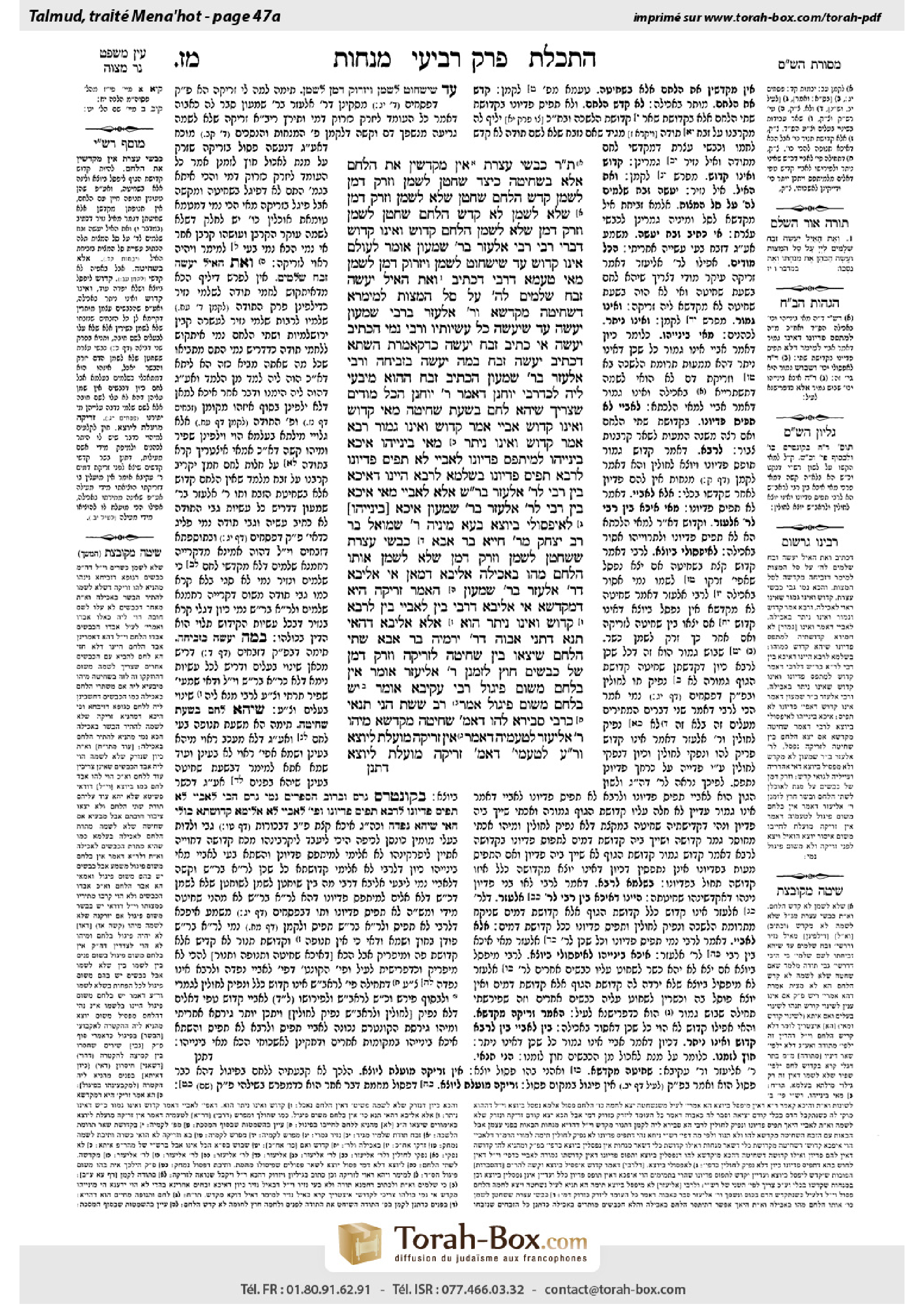
Menachot 47a: Talmud study for Daf Yomi
Daf Yomi is the daily study of one Talmud folio. Explore 37 tractates with scans, Hebrew text, Sefaria English and AI-generated French translations where annotated.
Passage selection and English or AI-generated French translation are available where the scan has annotations. Daf Study is independent of Torah-Box and Sefaria.
Browse Menachot · מנחות · All tractatesMenachot 47a text and translations
This page of Menachot includes the Aramaic text, an English translation and an AI-generated French translation, alongside the scan above.
מנחות מ״ז א · Aramaic and Hebrew text
תָּנוּ רַבָּנַן: כִּבְשֵׂי עֲצֶרֶת אֵין מְקַדְּשִׁין אֶת הַלֶּחֶם אֶלָּא בִּשְׁחִיטָה.
כֵּיצַד? שְׁחָטָן לִשְׁמָן, וְזָרַק דָּמָן לִשְׁמָן – קָדַשׁ הַלֶּחֶם. שְׁחָטָן שֶׁלֹּא לִשְׁמָן, וְזָרַק דָּמָן שֶׁלֹּא לִשְׁמָן – לֹא קָדַשׁ הַלֶּחֶם. שְׁחָטָן לִשְׁמָן, וְזָרַק דָּמָן שֶׁלֹּא לִשְׁמָן – הַלֶּחֶם קָדוֹשׁ וְאֵינוֹ קָדוֹשׁ, דִּבְרֵי רַבִּי. רַבִּי אֶלְעָזָר בְּרַבִּי שִׁמְעוֹן אוֹמֵר: לְעוֹלָם אֵינוֹ קָדוֹשׁ עַד שֶׁיִּשְׁחוֹט לִשְׁמָן וְיִזְרוֹק דָּמָן לִשְׁמָן.
מַאי טַעְמָא דְּרַבִּי?
דִּכְתִיב ״וְאֶת הָאַיִל יַעֲשֶׂה זֶבַח שְׁלָמִים לַה׳ עַל סַל הַמַּצּוֹת״, לְמֵימְרָא דִּשְׁחִיטָה מְקַדְּשָׁא.
וְרַבִּי אֶלְעָזָר בְּרַבִּי שִׁמְעוֹן: ״יַעֲשֶׂה״ – עַד שֶׁיַּעֲשֶׂה כָּל עֲשִׂיּוֹתָיו.
וְרַבִּי נָמֵי הָכְתִיב ״יַעֲשֶׂה״? אִי כְּתִיב ״זֶבַח יַעֲשֶׂה״ – כִּדְקָאָמְרַתְּ, הַשְׁתָּא דִּכְתִיב ״יַעֲשֶׂה זֶבַח״ – בְּמָה יַעֲשֶׂה? בִּזְבִיחָה.
וְרַבִּי אֶלְעָזָר בְּרַבִּי שִׁמְעוֹן, הָכְתִיב ״זֶבַח״? הָהוּא מִיבְּעֵי לֵיהּ לְכִדְרַבִּי יוֹחָנָן, דְּאָמַר רַבִּי יוֹחָנָן: הַכֹּל מוֹדִים שֶׁצָּרִיךְ שֶׁיְּהֵא לֶחֶם בִּשְׁעַת שְׁחִיטָה.
מַאי ״קָדוֹשׁ וְאֵינוֹ קָדוֹשׁ״? אַבָּיֵי אָמַר: קָדוֹשׁ וְאֵינוֹ גָּמוּר. רָבָא אָמַר: קָדוֹשׁ וְאֵינוֹ נִיתָּר.
מַאי בֵּינַיְיהוּ? אִיכָּא בֵּינַיְיהוּ לְמִיתְפַּס פִּדְיוֹנוֹ: לְאַבָּיֵי – לָא תָּפֵיס פִּדְיוֹנוֹ, לְרָבָא – תָּפֵיס פִּדְיוֹנוֹ.
בִּשְׁלָמָא לְרָבָא, הַיְינוּ דְּאִיכָּא בֵּין רַבִּי לְרַבִּי אֶלְעָזָר בְּרַבִּי שִׁמְעוֹן. אֶלָּא לְאַבָּיֵי, מַאי אִיכָּא בֵּין רַבִּי לְרַבִּי אֶלְעָזָר בְּרַבִּי שִׁמְעוֹן?
אִיכָּא [בֵּינַיְיהוּ] לְאִיפְּסוֹלֵי בְּיוֹצֵא.
בְּעָא מִינֵּיהּ רַבִּי שְׁמוּאֵל בַּר רַב יִצְחָק מֵרַבִּי חִיָּיא בַּר אַבָּא: כִּבְשֵׂי עֲצֶרֶת שֶׁשְּׁחָטָן לִשְׁמָן, וְזָרַק דָּמָן שֶׁלֹּא לִשְׁמָן – אוֹתוֹ הַלֶּחֶם מַהוּ בַּאֲכִילָה?
אַלִּיבָּא דְּמַאן? אִי אַלִּיבָּא דְּרַבִּי אֶלְעָזָר בְּרַבִּי שִׁמְעוֹן – הָאָמַר זְרִיקָה הִיא דִּמְקַדְּשָׁא! אִי אַלִּיבָּא דְּרַבִּי – בֵּין לְאַבָּיֵי בֵּין לְרָבָא, קָדוֹשׁ וְאֵינוֹ נִיתָּר הוּא!
אֶלָּא, אַלִּיבָּא דְּהַאי תַּנָּא, דְּתָנֵי אֲבוּהּ דְּרַבִּי יִרְמְיָה בַּר אַבָּא: שְׁתֵּי הַלֶּחֶם שֶׁיָּצְאוּ בֵּין שְׁחִיטָה לִזְרִיקָה, וְזָרַק דָּמָן שֶׁל כְּבָשִׂים חוּץ לִזְמַנָּן – רַבִּי אֱלִיעֶזֶר אוֹמֵר: אֵין בַּלֶּחֶם מִשּׁוּם פִּיגּוּל, רַבִּי עֲקִיבָא אוֹמֵר: יֵשׁ בַּלֶּחֶם מִשּׁוּם פִּיגּוּל.
אָמַר רַב שֵׁשֶׁת: הָנֵי תַּנָּאֵי כְּרַבִּי סְבִירָא לְהוּ, דְּאָמַר: שְׁחִיטָה מְקַדְּשָׁא.
מִיהוּ רַבִּי אֱלִיעֶזֶר לְטַעְמֵיהּ, דְּאָמַר אֵין זְרִיקָה מוֹעֶלֶת לַיּוֹצֵא, וְרַבִּי עֲקִיבָא לְטַעְמֵיהּ, דְּאָמַר זְרִיקָה מוֹעֶלֶת לַיּוֹצֵא.
Menachot 47a · English translation
§ The Gemara cites further discussion of the two sheep and the two loaves of Shavuot: The Sages taught in a baraita: The two sheep of Shavuot consecrate the two loaves that accompany them only by means of their slaughter.
How so? If one slaughtered the sheep for their own sake, as the peace offerings that are supposed to be sacrificed on Shavuot, and then the priest sprinkled their blood on the altar for their own sake, then the loaves are consecrated. But if one slaughtered them not for their own sake, and the priest sprinkled their blood not for their own sake, the loaves are not consecrated. If one slaughtered them for their own sake and he sprinkled their blood not for their own sake, the loaves are partially consecrated, but they are not fully consecrated. This is the statement of Rabbi Yehuda HaNasi. Rabbi Elazar, son of Rabbi Shimon, says: The loaves are never consecrated at all until one slaughters the offerings for their own sake and sprinkles their blood for their own sake.
The Gemara asks: What is the reasoning of Rabbi Yehuda HaNasi, who holds that the slaughtering of the sheep partially consecrates the loaves even without the sprinkling of the blood?
The Gemara answers: It is based on the fact that it is written concerning the ram brought by the nazirite when he completes his naziriteship: “And he shall offer the ram for a sacrifice [zevaḥ] of peace offerings to the Lord, with the basket of unleavened bread” (Numbers 6:17). Since the verse uses the word zevaḥ, which also means slaughter, and the verse then makes reference to the loaves, that is to say that it is specifically the slaughter that consecrates the loaves that accompany the offering. Similarly, the slaughter of the sheep brought as peace offerings on Shavuot consecrates the accompanying two loaves, as the halakha of the loaves of Shavuot is derived from that of the loaves of the nazirite.
The Gemara asks: And what is the reasoning of Rabbi Elazar, son of Rabbi Shimon, who holds that the slaughtering and sprinkling of the blood together consecrate the loaves? The Gemara answers: He derives it from the term: “He shall offer,” which he understands to mean that the loaves are not consecrated until the priest performs all of the actions included in the sacrificial rites of that offering, including the sprinkling of the blood.
The Gemara asks: And according to Rabbi Yehuda HaNasi also, isn’t it written: “He shall offer,” which indicates that the loaves are consecrated only once the blood has been sprinkled on the altar? The Gemara answers: If it were written: A sacrifice [zevaḥ] he shall offer, it would be as you are saying that he should slaughter it and then perform a further action, i.e., sprinkling the blood, in order to consecrate the loaves. Now that it is written: “He shall offer the ram for a sacrifice [zevaḥ],” it should be understood as: By what means should he offer the ram in order to consecrate the loaves? By means of slaughtering [zeviḥa].
The Gemara asks: And according to Rabbi Elazar, son of Rabbi Shimon, isn’t it written: “A sacrifice [zevaḥ],” indicating that slaughtering alone consecrates the loaves? The Gemara answers: He requires that expression for that which Rabbi Yoḥanan says, as Rabbi Yoḥanan says that everyone, including Rabbi Elazar, son of Rabbi Shimon, concedes that the loaves must be in existence at the time of the slaughter.
§ The Gemara asks: What is meant by Rabbi Yehuda HaNasi’s statement in the baraita that if one slaughtered the sheep for their own sake and sprinkled their blood not for their own sake, then the loaves are partially consecrated, but they are not fully consecrated? Abaye says: The loaves are consecrated by means of the slaughtering, but their consecration is not complete. Rava says: The loaves are fully consecrated by means of the slaughtering, but they are not thereby permitted to be eaten.
The Gemara asks: What is the practical difference between them? Everyone concedes that the loaves may not be eaten as a result of this slaughtering. The Gemara answers: The practical difference between them is the ability to transfer sanctity to their redemption money. According to Abaye, who holds that the loaves are not completely consecrated, they do not transfer sanctity to their redemption money if one tries to redeem them for money. According to Rava, who holds that the loaves are completely consecrated, they transfer sanctity to their redemption money.
The Gemara asks: Granted, according to Rava, who holds that according to Rabbi Yehuda HaNasi the loaves are completely sanctified, that is the difference between the opinions of Rabbi Yehuda HaNasi and Rabbi Elazar, son of Rabbi Shimon. But according to Abaye, what difference is there between the opinions of Rabbi Yehuda HaNasi and Rabbi Elazar, son of Rabbi Shimon?
The Gemara answers: The practical difference between them is with regard to whether the loaves are rendered unfit by means of leaving the Temple courtyard after the slaughtering of the offering. According to Rabbi Yehuda HaNasi, the loaves are rendered unfit if they leave the courtyard. According to Rabbi Elazar, son of Rabbi Shimon, who holds that the loaves are not consecrated, they are not rendered unfit if they leave the courtyard.
§ The Gemara continues the discussion of the dispute between Rabbi Yehuda HaNasi and Rabbi Elazar, son of Rabbi Shimon, concerning the consecration of the two loaves by means of the slaughter and sprinkling of the blood of the sheep of Shavuot. Rabbi Shmuel bar Rav Yitzḥak raised a dilemma before Rabbi Ḥiyya bar Abba: In the case of a communal peace offering of two sheep that accompany the two loaves on Shavuot that one slaughtered for their sake but the priest sprinkled their blood not for their sake, concerning those accompanying loaves, what is the halakha with regard to eating them?
The Gemara asks: In accordance with whose opinion was this dilemma raised? If it was raised in accordance with the opinion of Rabbi Elazar, son of Rabbi Shimon, doesn’t he say that it is the sprinkling of the blood that consecrates the loaves? Consequently, if the blood was not properly sprinkled, it is clear that the loaves are unfit and may not be eaten. And if it was raised in accordance with the opinion of Rabbi Yehuda HaNasi, both according to the opinion of Abaye and according to that of Rava, Rabbi Yehuda HaNasi holds that the loaves are consecrated but are not permitted to be eaten.
The Gemara responds: Rather, one must say that the question was asked in accordance with the opinion of this following tanna. As the father of Rabbi Yirmeya bar Abba teaches in a baraita: In a case where the two loaves left the Temple courtyard between the slaughtering of the offering and the sprinkling of its blood, and then the priest sprinkled the blood of the sheep with the intent that their meat would be eaten beyond their designated time, the sheep are rendered piggul. With regard to the loaves, Rabbi Eliezer says: The loaves do not become prohibited due to the prohibition of piggul. Rabbi Akiva says: The loaves do become prohibited due to the prohibition of piggul.
Rav Sheshet said: These tanna’im, Rabbi Eliezer and Rabbi Akiva, both hold in accordance with the opinion of Rabbi Yehuda HaNasi, who said: The slaughtering consecrates the loaves by itself. Consequently, if the loaves are taken out of the Temple courtyard after the sheep are slaughtered, the loaves become disqualified.
But they disagree as to the following: Rabbi Eliezer conforms to his line of reasoning, as Rabbi Eliezer says that sprinkling the blood is not effective with regard to offerings that left the Temple courtyard. Since the loaves left the courtyard before the sprinkling of the blood, the intent of the priest while sprinkling the blood that the offering be eaten outside of its designated time does not render the loaves piggul. And Rabbi Akiva conforms to his line of reasoning, as Rabbi Akiva says that sprinkling the blood is effective with regard to offerings that left the Temple courtyard. Therefore, the intent of the priest while sprinkling the blood that the offering be eaten outside of its designated time renders the loaves piggul, even though they left the courtyard.
Menachot 47a · Traduction française (IA)
§ La Guemara cite une discussion supplémentaire au sujet des deux agneaux et des deux pains de Chavouot. Les Sages ont enseigné dans une baraïta : Les deux agneaux de Chavouot ne consacrent les deux pains qui les accompagnent que par leur abattage.
Comment cela ? Si l’on a abattu les agneaux pour leur propre compte, en tant que sacrifices de paix destinés à être offerts à Chavouot, puis que le prêtre a aspergé leur sang sur l’autel avec cette même intention, les pains sont consacrés. Mais si on les a abattus sans cette intention et que le prêtre a aspergé leur sang sans cette intention, les pains ne sont pas consacrés. Si on les a abattus avec cette intention, mais que le prêtre a aspergé leur sang sans cette intention, les pains sont partiellement consacrés, mais pas pleinement. Telle est la déclaration de Rabbi Yehuda HaNasi. Rabbi Elazar, fils de Rabbi Shimon, dit : Les pains ne sont jamais consacrés tant qu’on n’a pas abattu les sacrifices avec l’intention requise et aspergé leur sang avec cette même intention.
La Guemara demande : Quel est le raisonnement de Rabbi Yehuda HaNasi, qui estime que l’abattage des agneaux consacre partiellement les pains même sans l’aspersion du sang ?
La Guemara répond : Cela repose sur ce qui est écrit au sujet du bélier offert par le nazir à la fin de son naziréat : « Il offrira le bélier en sacrifice [zevaḥ] de paix au Seigneur, avec la corbeille de pains sans levain » (Nombres 6:17). Puisque le verset emploie le mot zevaḥ, qui signifie également « abattage », et mentionne ensuite les pains, cela signifie que c’est précisément l’abattage qui consacre les pains accompagnant le sacrifice. De même, l’abattage des agneaux offerts comme sacrifices de paix à Chavouot consacre les deux pains qui les accompagnent, car la halakha relative aux pains de Chavouot est déduite de celle des pains du nazir.
La Guemara demande : Et quel est le raisonnement de Rabbi Elazar, fils de Rabbi Shimon, qui estime que l’abattage et l’aspersion du sang consacrent ensemble les pains ? La Guemara répond : Il le déduit de l’expression « il offrira », qu’il comprend ainsi : les pains ne sont pas consacrés tant que le prêtre n’a pas accompli toutes les actions comprises dans le rite sacrificiel de cette offrande, y compris l’aspersion du sang.
La Guemara demande : Mais selon Rabbi Yehuda HaNasi également, n’est-il pas écrit « il offrira », ce qui indique que les pains ne sont consacrés qu’une fois le sang aspergé sur l’autel ? La Guemara répond : S’il était écrit « il offrira un sacrifice [zevaḥ] », on pourrait dire, comme tu le soutiens, qu’il doit l’abattre puis accomplir une autre action, à savoir asperger le sang, afin de consacrer les pains. Mais puisque le texte dit « il offrira le bélier en sacrifice [zevaḥ] », il faut comprendre : Par quel moyen doit-il offrir le bélier afin de consacrer les pains ? Par l’abattage [zeviḥa].
La Guemara demande : Et selon Rabbi Elazar, fils de Rabbi Shimon, n’est-il pas écrit « un sacrifice [zevaḥ] », ce qui indique que le seul abattage consacre les pains ? La Guemara répond : Il a besoin de cette expression pour établir ce que dit Rabbi Yoḥanan. En effet, Rabbi Yoḥanan dit que tous, y compris Rabbi Elazar, fils de Rabbi Shimon, reconnaissent que les pains doivent exister au moment de l’abattage.
§ La Guemara demande : Que signifie la déclaration de Rabbi Yehuda HaNasi dans la baraïta, selon laquelle si l’on a abattu les agneaux avec l’intention requise, mais que le prêtre a aspergé leur sang sans cette intention, les pains sont partiellement consacrés, mais pas pleinement ? Abaye dit : Les pains sont consacrés par l’abattage, mais leur consécration n’est pas complète. Rava dit : Les pains sont pleinement consacrés par l’abattage, mais ils ne sont pas pour autant permis à la consommation.
La Guemara demande : Quelle est la différence pratique entre eux ? Tous reconnaissent que cet abattage ne permet pas de consommer les pains. La Guemara répond : La différence pratique concerne la possibilité de transférer la sainteté des pains sur l’argent de leur rachat. Selon Abaye, qui estime que les pains ne sont pas pleinement consacrés, ils ne transfèrent pas leur sainteté sur l’argent si l’on tente de les racheter contre de l’argent. Selon Rava, qui estime que les pains sont pleinement consacrés, ils transfèrent leur sainteté sur l’argent de leur rachat.
La Guemara demande : Il est compréhensible que, selon Rava, qui estime que Rabbi Yehuda HaNasi considère les pains comme pleinement consacrés, cela constitue la différence entre les opinions de Rabbi Yehuda HaNasi et de Rabbi Elazar, fils de Rabbi Shimon. Mais selon Abaye, quelle différence y a-t-il entre leurs opinions ?
La Guemara répond : La différence pratique concerne le fait de savoir si les pains deviennent impropres lorsque l’offrande quitte la cour du Temple après son abattage. Selon Rabbi Yehuda HaNasi, les pains deviennent impropres s’ils sortent de la cour. Selon Rabbi Elazar, fils de Rabbi Shimon, qui estime que les pains ne sont pas consacrés, ils ne deviennent pas impropres s’ils sortent de la cour.
§ La Guemara poursuit la discussion du désaccord entre Rabbi Yehuda HaNasi et Rabbi Elazar, fils de Rabbi Shimon, concernant la consécration des deux pains par l’abattage et l’aspersion du sang des agneaux de Chavouot. Rabbi Shmuel bar Rav Yitzḥak posa une question à Rabbi Ḥiyya bar Abba : Dans le cas d’un sacrifice de paix communautaire constitué de deux agneaux accompagnant les deux pains de Chavouot, que l’on a abattus avec l’intention requise, mais dont le prêtre a aspergé le sang sans cette intention, quelle est la halakha concernant la consommation des pains qui les accompagnent ?
La Guemara demande : Selon l’opinion de qui cette question a-t-elle été posée ? Si elle a été posée selon Rabbi Elazar, fils de Rabbi Shimon, ne dit-il pas que c’est l’aspersion du sang qui consacre les pains ? Par conséquent, si le sang n’a pas été aspergé correctement, il est clair que les pains sont impropres et ne peuvent être consommés. Et si elle a été posée selon Rabbi Yehuda HaNasi, tant selon Abaye que selon Rava, Rabbi Yehuda HaNasi estime que les pains sont consacrés, mais qu’ils ne sont pas permis à la consommation.
La Guemara répond : Il faut plutôt dire que la question a été posée selon l’opinion du tanna suivant. En effet, le père de Rabbi Yirmeya bar Abba enseigne dans une baraïta : Si les deux pains sont sortis de la cour du Temple entre l’abattage de l’offrande et l’aspersion de son sang, puis que le prêtre a aspergé le sang des agneaux avec l’intention que leur viande soit consommée au-delà du délai prévu, les agneaux deviennent piggoul. Quant aux pains, Rabbi Eliezer dit : Ils ne deviennent pas interdits en raison de l’interdiction du piggoul. Rabbi Akiva dit : Ils deviennent interdits en raison de l’interdiction du piggoul.
Rav Sheshet dit : Ces tannaïm, Rabbi Eliezer et Rabbi Akiva, sont tous deux d’accord avec l’opinion de Rabbi Yehuda HaNasi, qui a dit : L’abattage consacre à lui seul les pains. Par conséquent, si l’on fait sortir les pains de la cour du Temple après l’abattage des agneaux, ils deviennent impropres.
Mais ils sont en désaccord sur le point suivant : Rabbi Eliezer reste cohérent avec son raisonnement, car il dit que l’aspersion du sang n’a pas d’effet sur les sacrifices qui sont sortis de la cour du Temple. Puisque les pains sont sortis de la cour avant l’aspersion du sang, l’intention du prêtre, lors de l’aspersion, que l’offrande soit consommée au-delà du délai prévu ne rend pas les pains piggoul. Rabbi Akiva, lui, reste cohérent avec son raisonnement, car il dit que l’aspersion du sang a un effet sur les sacrifices qui sont sortis de la cour du Temple. Par conséquent, l’intention du prêtre, lors de l’aspersion du sang, que l’offrande soit consommée au-delà du délai prévu rend les pains piggoul, bien qu’ils soient sortis de la cour.
Traduction française générée par IA à partir de l’édition anglaise de Sefaria. Vérifie toujours un passage avec le texte source.
Text from Sefaria: William Davidson Edition - Vocalized Aramaic (unknown); William Davidson Edition - English (CC BY NC).