Menachot 47b: Talmud study for Daf Yomi
Daf Yomi is the daily study of one Talmud folio. Explore 37 tractates with scans, Hebrew text, Sefaria English and AI-generated French translations where annotated.
Passage selection and English or AI-generated French translation are available where the scan has annotations. Daf Study is independent of Torah-Box and Sefaria.
Browse Menachot · מנחות · All tractatesMenachot 47b text and translations
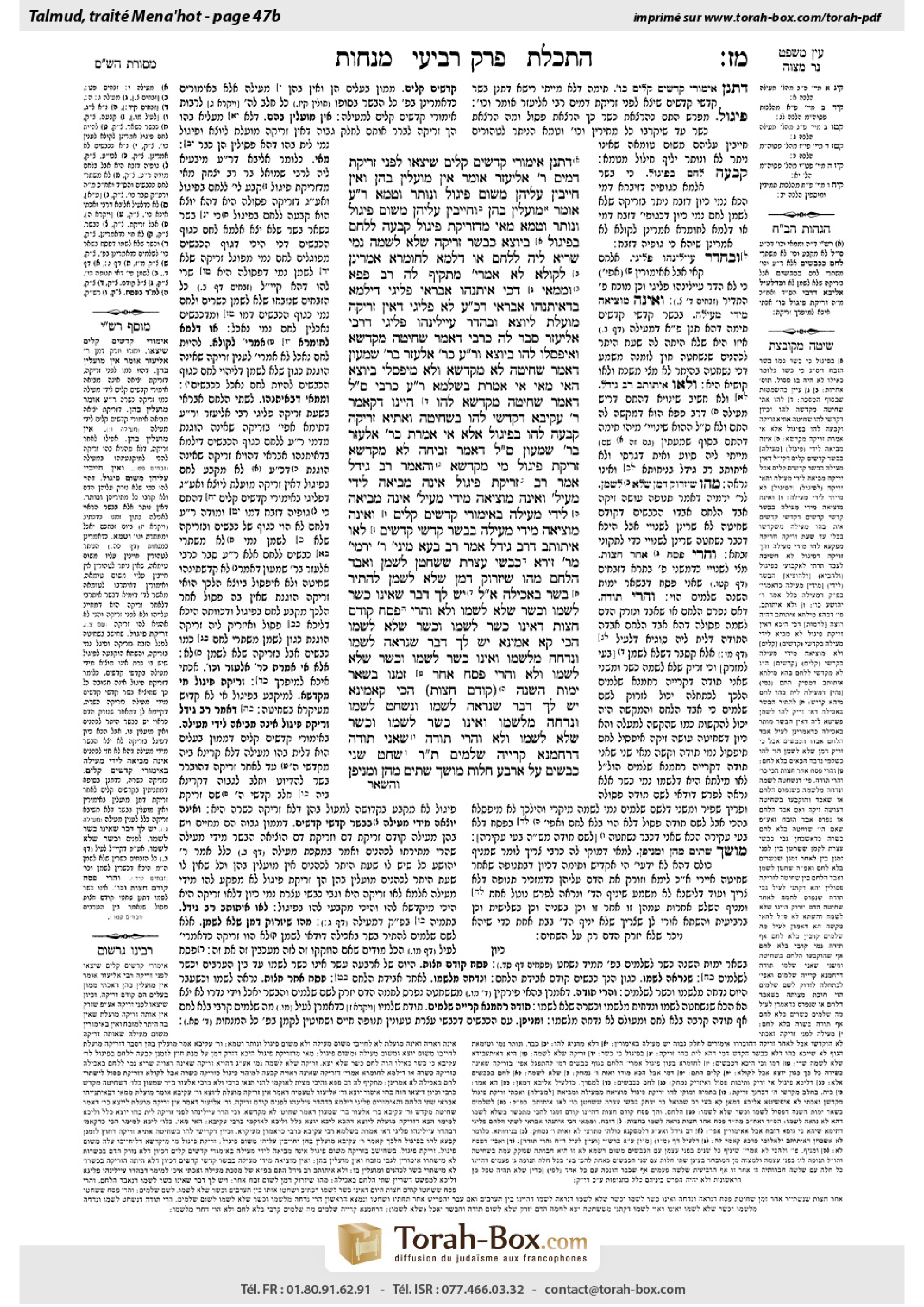
This page of Menachot includes the Aramaic text, an English translation and an AI-generated French translation, alongside the scan above.
מנחות מ״ז ב · Aramaic and Hebrew text
דִּתְנַן: אֵימוּרֵי קָדָשִׁים קַלִּים שֶׁיָּצְאוּ לִפְנֵי זְרִיקַת דָּמִים, רַבִּי אֱלִיעֶזֶר אוֹמֵר: אֵין מוֹעֲלִין בָּהֶן, וְאֵין חַיָּיבִין עֲלֵיהֶן מִשּׁוּם פִּיגּוּל וְנוֹתָר וְטָמֵא.
רַבִּי עֲקִיבָא אוֹמֵר: מוֹעֲלִין בָּהֶן, וְחַיָּיבִין עֲלֵיהֶן מִשּׁוּם פִּיגּוּל וְנוֹתָר וְטָמֵא.
מַאי?
מִדִּזְרִיקַת פִּיגּוּל קָבְעָה לְלֶחֶם בְּפִיגּוּל בְּיוֹצֵא כְּבָשָׂר, זְרִיקָה שֶׁלֹּא לִשְׁמָהּ נָמֵי שָׁרְיָא לֵיהּ לְלֶחֶם, אוֹ דִלְמָא לְחוּמְרָא אָמְרִינַן, לְקוּלָּא לָא אָמְרִינַן.
מַתְקֵיף לַהּ רַב פָּפָּא: וּמִמַּאי דְּכִי אִיתַנְהוּ אַבָּרַאי פְּלִיגִי?
דִּילְמָא בִּדְאִיתַנְהוּ אַבָּרַאי, דְּכוּלֵּי עָלְמָא לָא פְּלִיגִי דְּאֵין זְרִיקָה מוֹעֶלֶת לַיּוֹצֵא, וּבַהֲדַר עַיְּילִינְהוּ פְּלִיגִי, דְּרַבִּי אֱלִיעֶזֶר סָבַר לַהּ כְּרַבִּי, דְּאָמַר: שְׁחִיטָה מְקַדְּשָׁא, וְאִיפְּסִלוּ לְהוּ בְּיוֹצֵא.
וְרַבִּי עֲקִיבָא כְּרַבִּי אֶלְעָזָר בְּרַבִּי שִׁמְעוֹן, דְּאָמַר: שְׁחִיטָה לָא מְקַדְּשָׁא, וְלָא מִיפַּסְלִי בְּיוֹצֵא.
הַאי מַאי? אִי אָמְרַתְּ בִּשְׁלָמָא רַבִּי עֲקִיבָא כְּרַבִּי סְבִירָא לֵיהּ, דְּאָמַר: שְׁחִיטָה מְקַדְּשָׁא לְהוּ, הַיְינוּ דְּקָאָמַר רַבִּי עֲקִיבָא דְּקָדְשִׁי לְהוּ בִּשְׁחִיטָה, וְאָתְיָא זְרִיקָה קָבְעָה לְהוּ בְּפִיגּוּל.
אֶלָּא אִי אָמְרַתְּ, כְּרַבִּי אֶלְעָזָר בְּרַבִּי שִׁמְעוֹן סְבִירָא לֵיהּ, דְּאָמַר: זְבִיחָה לָא מְקַדְּשָׁא, זְרִיקַת פִּיגּוּל מִי מְקַדְּשָׁא?
וְהָאָמַר רַב גִּידֵּל, אָמַר רַב: זְרִיקַת פִּיגּוּל אֵינָהּ מְבִיאָה לִידֵי מְעִילָה, וְאֵינָהּ מוֹצִיאָה מִידֵי מְעִילָה.
אֵינָהּ מְבִיאָה לִידֵי מְעִילָה – בְּאֵימוּרֵי קָדָשִׁים קַלִּים.
וְאֵינָהּ מוֹצִיאָה מִידֵי מְעִילָה – בִּבְשַׂר קׇדְשֵׁי קָדָשִׁים.
לָאו אִיתּוֹתַב דְּרַב גִּידֵּל אָמַר רַב?
בְּעָא מִינֵּיהּ רַבִּי יִרְמְיָה מֵרַבִּי זֵירָא: כִּבְשֵׂי עֲצֶרֶת שֶׁשְּׁחָטָן לִשְׁמָן, וְאָבַד הַלֶּחֶם – מַהוּ שֶׁיִּזְרוֹק דָּמָן שֶׁלֹּא לִשְׁמָן לְהַתִּיר בָּשָׂר בַּאֲכִילָה?
אֲמַר לֵיהּ: יֵשׁ לְךָ דָּבָר שֶׁאֵינוֹ כָּשֵׁר לִשְׁמוֹ, וְכָשֵׁר שֶׁלֹּא לִשְׁמוֹ?! וְלָא?! וַהֲרֵי פֶּסַח קוֹדֶם חֲצוֹת, דְּאֵינוֹ כָּשֵׁר לִשְׁמוֹ, וְכָשֵׁר שֶׁלֹּא לִשְׁמוֹ!
הָכִי קָא אָמֵינָא: יֵשׁ לָךְ דָּבָר שֶׁנִּרְאֶה לִשְׁמוֹ, וְנִדְחֶה מִלִּשְׁמוֹ, וְאֵינוֹ כָּשֵׁר לִשְׁמוֹ, וְכָשֵׁר שֶׁלֹּא לִשְׁמוֹ?!
וְלָא? וַהֲרֵי פֶּסַח אַחַר זְמַנּוֹ, בִּשְׁאָר יְמוֹת הַשָּׁנָה קוֹדֶם חֲצוֹת!
הָכִי קָאָמֵינָא: יֵשׁ לָךְ דָּבָר שֶׁנִּרְאֶה לִשְׁמוֹ, וְנִשְׁחָט לִשְׁמוֹ, וְנִדְחֶה מִלִּשְׁמוֹ, וְאֵינוֹ כָּשֵׁר לִשְׁמוֹ, וְכָשֵׁר שֶׁלֹּא לִשְׁמוֹ?
וְלָא?! וַהֲרֵי תּוֹדָה!
שָׁאנֵי תּוֹדָה, דְּרַחֲמָנָא קַרְיַיהּ ״שְׁלָמִים״.
תָּנוּ רַבָּנַן: שָׁחַט שְׁנֵי כְּבָשִׂים עַל אַרְבַּע חַלּוֹת – מוֹשֵׁךְ שְׁתַּיִם מֵהֶן וּמְנִיפָן,
Menachot 47b · English translation
As we learned in a mishna (Me’ila 6b): In the case of sacrificial portions of offerings of lesser sanctity that left the Temple courtyard before the sprinkling of the blood, Rabbi Eliezer says: The sprinkling of the blood is completely ineffective with regard to these portions, and therefore one is not liable for misusing them. And if one eats them, he is not liable due to the prohibitions of piggul, notar, or of partaking of sacrificial meat while one is ritually impure.
Rabbi Akiva says: The sprinkling is effective and therefore, one is liable for misusing them. And if one eats them he is liable due to the prohibitions of piggul, notar, or of partaking of sacrificial meat while one is ritually impure.
The Gemara now concludes the dilemma that Rabbi Shmuel bar Rav Yitzḥak raised before Rabbi Ḥiyya bar Abba: According to the opinion of Rabbi Akiva, what is the halakha with regard to eating the loaves when the sheep were slaughtered for their own sake, but their blood was sprinkled not for their sake?
The Gemara clarifies the two sides of the dilemma: Should one say that from the fact that sprinkling the blood of the sheep in a manner that renders it piggul renders the loaves piggul, like the meat of the offering, despite the fact that the loaves were disqualified by leaving the courtyard of the Temple, it can be derived that sprinkling the blood not for its own sake also permits the loaves to be eaten, just as it permits the meat of the sheep to be eaten? Or perhaps it is only to be stringent that we say that sprinkling the blood is effective with regard to loaves that have left the Temple courtyard, but we do not say this in order to be lenient, e.g., to render the loaves permitted to be eaten.
Rav Pappa objects to this understanding of the dispute between Rabbi Akiva and Rabbi Eliezer. From where do we know that they disagree in a case where the loaves are outside the courtyard at the time of the sprinkling?
Perhaps in a case where the loaves are still outside the courtyard everyone agrees that sprinkling the blood is not effective with regard to offerings that left the Temple courtyard, and they disagree in a case where the loaves left the courtyard and one then brought them back into the courtyard before the sprinkling. As Rabbi Eliezer holds in accordance with the opinion of Rabbi Yehuda HaNasi, who said: The slaughter of the sheep consecrates the loaves, and therefore the loaves became disqualified by leaving the courtyard after the sheep were slaughtered. Consequently, even if they were brought back into the courtyard before the sprinkling of the blood they cannot become piggul because they have already been disqualified for a different reason.
And Rabbi Akiva holds in accordance with the opinion of Rabbi Elazar, son of Rabbi Shimon, who said: The slaughter of the sheep does not consecrate the loaves at all before the sprinkling of the blood. Since the loaves were not yet consecrated, they do not become disqualified by leaving the Temple courtyard.
The Gemara asks: What is this interpretation of the dispute between Rabbi Akiva and Rabbi Eliezer? It does not fit what they say. Granted, if you say that Rabbi Akiva holds in accordance with the opinion of Rabbi Yehuda HaNasi, who said: The slaughter of the sheep consecrates the loaves, that is what Rabbi Akiva means when he says that the loaves are consecrated by the slaughter of the sheep and then the sprinkling that was done with the intent to consume the offering after its appointed time comes and renders the loaves piggul.
But if you say that Rabbi Akiva holds in accordance with the opinion of Rabbi Elazar, son of Rabbi Shimon, who said: The slaughter of the sheep does not consecrate the loaves without the sprinkling of the blood, does sprinkling with an intent that renders the sheep piggul actually consecrate the loaves?
But doesn’t Rav Giddel say that Rav says: Sprinkling with an intent that renders an offering piggul does not cause items to become subject to the prohibition against misuse of consecrated property, and it does not remove items from being subject to the prohibition against misuse of consecrated property?
Rav explains: The halakha that it does not cause items to become subject to the prohibition against misuse of consecrated property applies with regard to sacrificial portions of offerings of lesser sanctity. The prohibition against misusing consecrated property applies to: “The sacred items of the Lord” (Leviticus 5:15). Consequently, it does not apply to offerings of lesser sanctity, as the meat is the property of those who brought the offering, and the sacrificial portions are disqualified by the sprinkling performed with improper intent.
And the halakha that it does not remove items from being subject to the prohibition against misuse of consecrated property applies with regard to meat of offerings of the most sacred order, such as a sin offering, a guilt offering, or a communal peace offering. Since the sprinkling of the blood was not valid, the meat, which would have become permitted for the priests to eat, retains the status of “the sacred items of the Lord,” and the prohibition against misuse of consecrated property still applies.
The Gemara rejects this explanation: Wasn’t that which Rav Giddel says that Rav says conclusively refuted? Consequently, one cannot ask a question based on this statement.
§ The Gemara cites another dilemma concerning the sheep and loaves of Shavuot. Rabbi Yirmeya raised a dilemma before Rabbi Zeira: In a case of the two sheep of Shavuot that one slaughtered for their own sake, thereby establishing a bond between the sheep and the loaves, and the loaves were then lost, if the blood of the sheep would be sprinkled for their sake, the meat would not be permitted to be eaten because the loaves were lost. That said, what is the halakha with regard to whether the priest may sprinkle their blood not for their own sake but rather for the sake of a peace offering in order to permit the meat of the sheep to be eaten?
Rabbi Zeira said to Rabbi Yirmeya: Do you have anything that is not fit if the sacrificial rites are performed for its own sake, and yet it is fit if the sacrificial rites are performed not for its own sake? This is certainly not a logical option. Rabbi Yirmeya responded: And is there no precedent for this? But there is the Paschal offering before midday on the fourteenth of Nisan, which is not fit if it is slaughtered for its own sake, as it is before the proper time for the Paschal offering, and yet it is fit if it is slaughtered not for its own sake but rather for the sake of a peace offering.
Rabbi Zeira replied: This is what I was saying: Do you have anything that was fit to be sacrificed for its own sake, like these sheep of Shavuot that were slaughtered before the loaves were lost, and was then rejected from being sacrificed for its own sake, like these sheep when the loaves were lost, and is not fit if it is sacrificed for its own sake, and yet it is fit if it is sacrificed not for its own sake?
Rabbi Yirmeya responded: And is there no precedent for this? But there is the Paschal offering, which was fit to be sacrificed for its own sake during its designated time, and after its designated time, during the rest of the days of the year before midday, it is not fit to be sacrificed as a Paschal offering but it is fit to be sacrificed as a peace offering.
Rabbi Zeira replied: This is what I was saying: Do you have anything that was fit to be sacrificed for its own sake, like the two sheep of Shavuot that were slaughtered before the loaves were lost, and it was slaughtered for its own sake, and was then rejected from being sacrificed for its own sake, like the two sheep when the loaves were lost, and it is not fit if it is sacrificed for its own sake, and yet it is fit if it is sacrificed not for its own sake?
Rabbi Yirmeya responded: And is there no precedent for this? But there is the thanks offering, as the Gemara (46a) states that if the thanks offering was slaughtered and then its accompanying loaves broke into pieces and thereby became disqualified, the blood should be sprinkled for the sake of a peace offering rather than a thanks offering, and then the meat may be eaten. Yet, if the blood was sprinkled for the sake of a thanks offering, the meat would not be permitted to be eaten.
Rabbi Zeira answered: The thanks offering is different, as the Merciful One called it a peace offering (see Leviticus 7:13). Just as a peace offering is sacrificed without loaves, so too a thanks offering may sometimes be sacrificed without loaves. Therefore, the loss of the loaves does not render the thanks offering disqualified, and this case is not comparable to the case of the two sheep and two loaves of Shavuot.
§ The Gemara cites another discussion concerning the sheep and loaves of Shavuot. The Sages taught in a baraita: If one slaughtered the two sheep as required but they were accompanied by four loaves rather than the requisite two loaves, he draws two of the loaves from the four and waves them together with the sheep,
Menachot 47b · Traduction française (IA)
Comme nous l’avons appris dans une Michna (Meïla 6b) : lorsque des portions sacrificielles d’offrandes de moindre sainteté ont quitté le parvis du Temple avant l’aspersion du sang, Rabbi Eliezer dit : l’aspersion du sang est entièrement sans effet à leur égard, et l’on n’est donc pas passible pour leur détournement. Si on les mange, on n’est pas passible au titre des interdictions de piggul, de notar ou de consommation de viande sacrificielle en état d’impureté rituelle.
Rabbi Akiva dit : l’aspersion est efficace et l’on est donc passible pour leur détournement. Si on les mange, on est passible au titre des interdictions de piggul, de notar ou de consommation de viande sacrificielle en état d’impureté rituelle.
La Guemara conclut à présent la question que Rabbi Shmuel bar Rav Yitzḥak avait posée à Rabbi Ḥiyya bar Abba : selon l’opinion de Rabbi Akiva, quelle est la halakha concernant la consommation des pains lorsque les moutons ont été égorgés pour eux-mêmes, mais que leur sang a été aspergé sans que ce soit pour eux-mêmes ?
La Guemara précise les deux aspects de la question : faut-il dire que, puisque l’aspersion du sang des moutons effectuée avec une intention qui rend l’offrande piggul rend les pains piggul, comme la viande de l’offrande, bien que les pains aient été disqualifiés en quittant le parvis du Temple, on peut en déduire que l’aspersion du sang effectuée sans que ce soit pour eux-mêmes permet également de consommer les pains, tout comme elle permet de consommer la viande des moutons ? Ou peut-être dit-on seulement, par rigueur, que l’aspersion du sang est efficace à l’égard des pains qui ont quitté le parvis du Temple, mais pas pour être indulgent, par exemple en rendant les pains permis à la consommation ?
Rav Pappa objecte à cette interprétation du désaccord entre Rabbi Akiva et Rabbi Eliezer. D’où sait-on qu’ils sont en désaccord dans un cas où les pains se trouvent à l’extérieur du parvis au moment de l’aspersion ?
Peut-être que, lorsque les pains se trouvent encore à l’extérieur du parvis, tous conviennent que l’aspersion du sang est sans effet à l’égard des offrandes qui ont quitté le parvis du Temple, et qu’ils sont en désaccord dans le cas où les pains ont quitté le parvis, puis ont été ramenés à l’intérieur avant l’aspersion. Rabbi Eliezer suit en effet l’opinion de Rabbi Yehuda HaNasi, qui a dit : l’égorgement des moutons consacre les pains ; ceux-ci ont donc été disqualifiés en quittant le parvis après l’égorgement des moutons. Par conséquent, même s’ils ont été ramenés à l’intérieur avant l’aspersion du sang, ils ne peuvent pas devenir piggul, puisqu’ils ont déjà été disqualifiés pour une autre raison.
Et Rabbi Akiva suit l’opinion de Rabbi Elazar, fils de Rabbi Shimon, qui a dit : l’égorgement des moutons ne consacre pas du tout les pains avant l’aspersion du sang. Puisque les pains n’étaient pas encore consacrés, ils ne sont pas disqualifiés en quittant le parvis du Temple.
La Guemara demande : cette interprétation du désaccord entre Rabbi Akiva et Rabbi Eliezer correspond-elle à leurs propos ? En effet, si tu dis que Rabbi Akiva suit l’opinion de Rabbi Yehuda HaNasi, qui a dit que l’égorgement des moutons consacre les pains, alors on comprend ce que dit Rabbi Akiva : les pains sont consacrés par l’égorgement des moutons, puis l’aspersion effectuée avec l’intention de consommer l’offrande après le délai fixé vient les rendre piggul.
Mais si tu dis que Rabbi Akiva suit l’opinion de Rabbi Elazar, fils de Rabbi Shimon, qui a dit que l’égorgement des moutons ne consacre pas les pains sans l’aspersion du sang, l’aspersion effectuée avec une intention qui rend les moutons piggul consacre-t-elle réellement les pains ?
Mais Rav Giddel ne dit-il pas au nom de Rav : une aspersion effectuée avec une intention qui rend une offrande piggul ne soumet pas des objets à l’interdiction de détournement de biens consacrés et ne les soustrait pas non plus à cette interdiction ?
Rav explique : la halakha selon laquelle cela ne soumet pas des objets à l’interdiction de détournement de biens consacrés s’applique aux portions sacrificielles d’offrandes de moindre sainteté. L’interdiction de détourner des biens consacrés s’applique aux « choses saintes du Seigneur » (Lévitique 5,15). Par conséquent, elle ne s’applique pas aux offrandes de moindre sainteté, puisque la viande appartient à ceux qui ont apporté l’offrande et que les portions sacrificielles sont disqualifiées par l’aspersion effectuée avec une intention inadéquate.
Et la halakha selon laquelle cela ne soustrait pas des objets à l’interdiction de détournement de biens consacrés s’applique à la viande d’offrandes de très haute sainteté, comme un sacrifice expiatoire, un sacrifice de culpabilité ou un sacrifice de paix communautaire. Puisque l’aspersion du sang n’était pas valide, la viande, qui aurait été permise à la consommation des prêtres, conserve le statut de « choses saintes du Seigneur », et l’interdiction de détournement de biens consacrés reste applicable.
La Guemara rejette cette explication : ce que Rav Giddel dit au nom de Rav n’a-t-il pas été réfuté de façon concluante ? On ne peut donc pas soulever une objection fondée sur cette déclaration.
§ La Guemara cite une autre question concernant les moutons et les pains de Chavouot. Rabbi Yirmeya posa une question à Rabbi Zeira : dans le cas des deux moutons de Chavouot, égorgés pour eux-mêmes, établissant ainsi un lien entre les moutons et les pains, puis des pains qui ont été perdus, si leur sang était aspergé pour eux-mêmes, la viande ne serait pas permise à la consommation, car les pains ont été perdus. Cela étant, quelle est la halakha : le prêtre peut-il asperger leur sang non pas pour eux-mêmes, mais pour un sacrifice de paix, afin de permettre la consommation de la viande des moutons ?
Rabbi Zeira dit à Rabbi Yirmeya : connais-tu quelque chose qui ne convient pas lorsque les rites sacrificiels sont accomplis pour soi, mais qui convient lorsqu’ils sont accomplis sans que ce soit pour soi ? Ce n’est certainement pas une possibilité logique. Rabbi Yirmeya répondit : N’y a-t-il aucun précédent ? Il y a pourtant l’offrande pascale avant midi, le quatorze Nissan : elle ne convient pas si elle est égorgée pour elle-même, puisque le moment approprié pour l’offrande pascale n’est pas encore arrivé ; elle convient pourtant si elle est égorgée non pas pour elle-même, mais pour un sacrifice de paix.
Rabbi Zeira répondit : Voici ce que je voulais dire : connais-tu quelque chose qui convenait à être offert pour soi, comme ces moutons de Chavouot qui ont été égorgés avant que les pains ne soient perdus, puis qui a été écarté de l’offrande pour soi, comme ces moutons après la perte des pains, et qui ne convient pas s’il est offert pour soi, mais convient s’il est offert sans que ce soit pour soi ?
Rabbi Yirmeya répondit : N’y a-t-il aucun précédent ? Il y a pourtant l’offrande pascale, qui convenait à être offerte pour elle-même pendant sa période prévue et qui, après cette période, durant le reste de l’année et avant midi, ne convient pas comme offrande pascale, mais convient comme sacrifice de paix.
Rabbi Zeira répondit : Voici ce que je voulais dire : connais-tu quelque chose qui convenait à être offert pour soi, comme les deux moutons de Chavouot égorgés avant que les pains ne soient perdus et qui ont été égorgés pour eux-mêmes, puis qui a été écarté de l’offrande pour soi, comme les deux moutons après la perte des pains, et qui ne convient pas s’il est offert pour soi, mais convient s’il est offert sans que ce soit pour soi ?
Rabbi Yirmeya répondit : N’y a-t-il aucun précédent ? Il y a pourtant l’offrande de remerciement. En effet, la Guemara (46a) enseigne que, si l’offrande de remerciement a été égorgée, puis que les pains qui l’accompagnaient se sont brisés et ont ainsi été disqualifiés, le sang doit être aspergé pour un sacrifice de paix plutôt que pour une offrande de remerciement, et la viande peut alors être consommée. En revanche, si le sang était aspergé pour une offrande de remerciement, la viande ne serait pas permise à la consommation.
Rabbi Zeira répondit : l’offrande de remerciement est différente, car le Miséricordieux l’a appelée sacrifice de paix (voir Lévitique 7,13). De même qu’un sacrifice de paix est offert sans pains, une offrande de remerciement peut parfois être offerte sans pains. Par conséquent, la perte des pains ne disqualifie pas l’offrande de remerciement, et ce cas n’est pas comparable à celui des deux moutons et des deux pains de Chavouot.
§ La Guemara cite une autre discussion concernant les moutons et les pains de Chavouot. Les Sages ont enseigné dans une baraïta : si l’on a égorgé les deux moutons comme il se doit, mais qu’ils étaient accompagnés de quatre pains au lieu des deux requis, on prélève deux des quatre pains et on les balance avec les moutons,
Traduction française générée par IA à partir de l’édition anglaise de Sefaria. Vérifie toujours un passage avec le texte source.
Text from Sefaria: William Davidson Edition - Vocalized Aramaic (unknown); William Davidson Edition - English (CC BY NC).