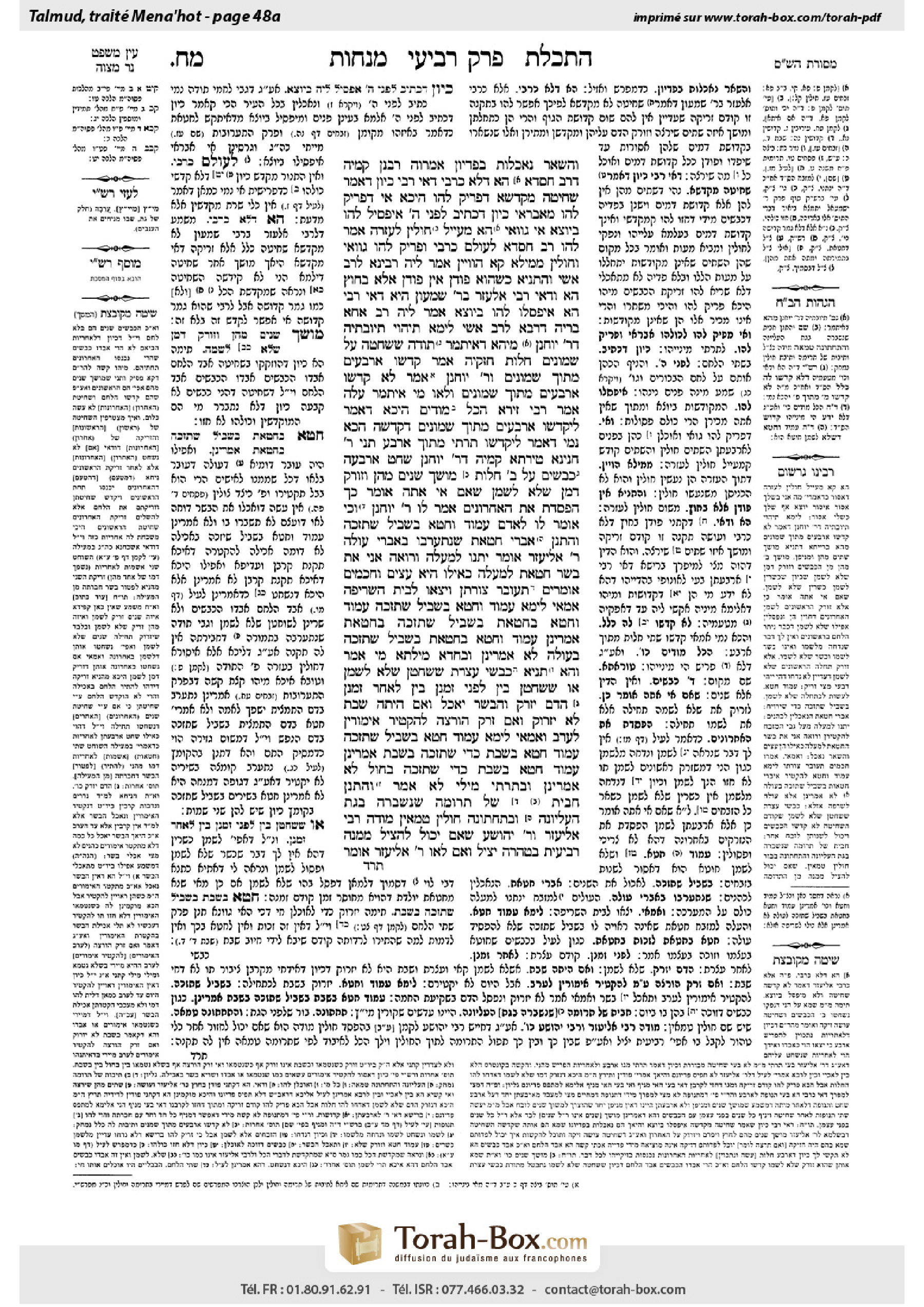
Menachot 48a: Talmud study for Daf Yomi
Daf Yomi is the daily study of one Talmud folio. Explore 37 tractates with scans, Hebrew text, Sefaria English and AI-generated French translations where annotated.
Passage selection and English or AI-generated French translation are available where the scan has annotations. Daf Study is independent of Torah-Box and Sefaria.
Browse Menachot · מנחות · All tractatesMenachot 48a text and translations
This page of Menachot includes the Aramaic text, an English translation and an AI-generated French translation, alongside the scan above.
מנחות מ״ח א · Aramaic and Hebrew text
וְהַשְּׁאָר נֶאֱכָלוֹת בְּפִדְיוֹן. אַמְרוּהָ רַבָּנַן קַמֵּיהּ דְּרַב חִסְדָּא: הָא דְּלָא כְּרַבִּי.
דְּאִי רַבִּי, כֵּיוָן דְּאָמַר שְׁחִיטָה מְקַדְּשָׁא, דְּפָרֵיק לְהוּ – הֵיכָא?
אִי דְּפָרֵיק לְהוּ מֵאַבָּרַאי, כֵּיוָן דִּכְתִיב ״לִפְנֵי ה׳״, אִיפְּסִיל לְהוּ בְּיוֹצֵא. אִי גַּוַּואי, הָא מְעַיֵּיל חוּלִּין לָעֲזָרָה.
אֲמַר לְהוּ רַב חִסְדָּא: לְעוֹלָם כְּרַבִּי, וּפָרֵיק לְהוּ גַּוַואי, וְחוּלִּין מִמֵּילָא קָא הָוְויָין.
אֲמַר לֵיהּ רָבִינָא לְרַב אָשֵׁי: וְהָתַנְיָא, כְּשֶׁהוּא פּוֹדָן – אֵין פּוֹדָן אֶלָּא בַּחוּץ.
הָא וַדַּאי רַבִּי אֶלְעָזָר בְּרַבִּי שִׁמְעוֹן הִיא, דְּאִי רַבִּי – הָא אִיפְּסִלוּ לְהוּ בְּיוֹצֵא!
אֲמַר לֵיהּ רַב אַחָא בְּרֵיהּ דְּרָבָא לְרַב אָשֵׁי: לֵימָא תֶּיהְוֵי תְּיוּבְתֵּיהּ דְּרַבִּי יוֹחָנָן, מִיהָא דְּאִיתְּמַר: תּוֹדָה שֶׁשְּׁחָטָהּ עַל שְׁמוֹנִים חַלּוֹת – חִזְקִיָּה אָמַר: קָדְשׁוּ אַרְבָּעִים מִתּוֹךְ שְׁמוֹנִים, וְרַבִּי יוֹחָנָן אָמַר: לֹא קָדְשׁוּ אַרְבָּעִים מִתּוֹךְ שְׁמוֹנִים.
וְלָאו מִי אִיתְּמַר עֲלַהּ, אָמַר רַבִּי זֵירָא: הַכֹּל מוֹדִים הֵיכָא דְּאָמַר ״לִיקְדְּשׁוּ אַרְבָּעִים מִתּוֹךְ שְׁמוֹנִים״ דְּקָדְשָׁה, הָכָא נָמֵי דְּאָמַר ״לִיקְדְּשׁוּ תַּרְתֵּי מִתּוֹךְ אַרְבַּע״.
תָּנֵי רַבִּי חֲנִינָא טִירָתָא קַמֵּיהּ דְּרַבִּי יוֹחָנָן: שָׁחַט אַרְבָּעָה כְּבָשִׂים עַל שְׁתֵּי חַלּוֹת – מוֹשֵׁךְ שְׁנַיִם מֵהֶן, וְזוֹרֵק דָּמָן שֶׁלֹּא לִשְׁמָן.
שֶׁאִם אִי אַתָּה אוֹמֵר כָּךְ, הִפְסַדְתָּ אֶת הָאַחֲרוֹנִים.
אָמַר לוֹ רַבִּי יוֹחָנָן: וְכִי אוֹמֵר לוֹ לְאָדָם ״עֲמוֹד וַחֲטָא בִּשְׁבִיל שֶׁתִּזְכֶּה״?!
וְהָתְנַן: אֵבְרֵי חַטָּאת שֶׁנִּתְעָרְבוּ בְּאֵבְרֵי עוֹלָה, רַבִּי אֱלִיעֶזֶר אוֹמֵר: יֻתְּנוּ לְמַעְלָה, וְרוֹאֶה אֲנִי אֶת בְּשַׂר חַטָּאת לְמַעְלָה כְּאִילּוּ הִיא עֵצִים, וַחֲכָמִים אוֹמְרִים: תְּעוּבַּר צוּרָתָן וְיֵצְאוּ לְבֵית הַשְּׂרֵיפָה.
אַמַּאי? לֵימָא: ״עֲמוֹד וַחֲטָא בִּשְׁבִיל שֶׁתִּזְכֶּה״!
עֲמוֹד וַחֲטָא בְּחַטָּאת בִּשְׁבִיל שֶׁתִּזְכֶּה בְּחַטָּאת – אָמְרִינַן, עֲמוֹד וַחֲטָא בְּחַטָּאת בִּשְׁבִיל שֶׁתִּזְכֶּה בְּעוֹלָה – לָא אָמְרִינַן.
וּבַחֲדָא מִילְּתָא מִי אָמַר? וְהָא תַּנְיָא: כִּבְשֵׂי עֲצֶרֶת שֶׁשְּׁחָטָן שֶׁלֹּא לִשְׁמָן, אוֹ שֶׁשְּׁחָטָן בֵּין לִפְנֵי זְמַנָּן בֵּין לְאַחַר זְמַנָּן – הַדָּם יִזָּרֵק וְהַבָּשָׂר יֵאָכֵל.
וְאִם הָיְתָה שַׁבָּת, לֹא יִזְרוֹק. וְאִם זָרַק – הוּרְצָה לְהַקְטִיר אֵימוּרִין לָעֶרֶב.
וְאַמַּאי? לֵימָא: ״עֲמוֹד חֲטָא בִּשְׁבִיל שֶׁתִּזְכֶּה״!
עֲמוֹד חֲטָא בְּשַׁבָּת כְּדֵי שֶׁתִּזְכֶּה בְּשַׁבָּת – אָמְרִינַן, עֲמוֹד חֲטָא בְּשַׁבָּת כְּדֵי שֶׁתִּזְכֶּה בַּחוֹל – לָא אָמְרִינַן.
וּבְתַרְתֵּי מִילֵּי לָא אָמַר? וְהָתְנַן: חָבִית שֶׁל תְּרוּמָה שֶׁנִּשְׁבְּרָה בְּגַת הָעֶלְיוֹנָה, וּבַתַּחְתּוֹנָה חוּלִּין טְמֵאִין – מוֹדֶה רַבִּי אֱלִיעֶזֶר וְרַבִּי יְהוֹשֻׁעַ שֶׁאִם יָכוֹל לְהַצִּיל מִמֶּנָּה רְבִיעִית בְּטׇהֳרָה יַצִּיל.
וְאִם לָאו, רַבִּי אֱלִיעֶזֶר אוֹמֵר:
Menachot 48a · English translation
and the rest of the loaves are permitted to be eaten through redemption. The Sages said the following before Rav Ḥisda: This baraita is not in accordance with the opinion of Rabbi Yehuda HaNasi, who holds that the slaughter of the sheep grants the loaves inherent sanctity, and in this case two of the loaves have inherent sanctity but it is not known which ones.
As, if the baraita is in accordance with the opinion of Rabbi Yehuda HaNasi, since he says that the slaughter of the sheep consecrates the loaves with inherent sanctity, when the baraita states that he redeems the loaves, where does he redeem them?
The process of redemption would be to place all four loaves in front of him and state that whichever two of the loaves do not have inherent sanctity are redeemed for money. If he redeems them outside of the Temple courtyard, since it is written: “And the priest shall wave them with the bread of the first fruits for a wave offering before the Lord, with the two lambs” (Leviticus 23:20), he disqualifies the two loaves that possess inherent sanctity by causing them to leave the courtyard, at which point they are no longer “before the Lord.” Conversely, if he redeems them inside the courtyard, once the two loaves that do not possess inherent sanctity are redeemed, he violates the prohibition against bringing non-sacred items into the Temple courtyard.
Rav Ḥisda said to them: Actually, the baraita is in accordance with the opinion of Rabbi Yehuda HaNasi, and one redeems the loaves inside the courtyard. Nevertheless, it is not considered to be a violation of the prohibition against bringing non-sacred items into the courtyard because the non-sacred loaves came into the courtyard by themselves, i.e., they were already there when they became non-sacred and were not actively brought into the courtyard in their non-sacred state.
Ravina said to Rav Ashi: But isn’t it taught in a baraita with regard to this very case: When he redeems the loaves, he may redeem them only outside of the courtyard? This contradicts Rav Ḥisda’s claim that according to Rabbi Yehuda HaNasi one redeems the loaves inside the courtyard.
Rav Ashi answered: This baraita is certainly in accordance with the opinion of Rabbi Elazar, son of Rabbi Shimon, because if it were in accordance with the opinion of Rabbi Yehuda HaNasi, when he brings the loaves outside the courtyard he thereby disqualifies them by causing them to leave the courtyard.
§ Rav Aḥa, son of Rava, said to Rav Ashi: Let us say that the baraita, which states that if the sheep of Shavuot are slaughtered with four loaves instead of two, two of the four are invested with inherent sanctity, is a conclusive refutation of the opinion of Rabbi Yoḥanan that was stated with regard to a thanks offering that one slaughtered accompanied by eighty loaves rather than the required forty. In that case, Ḥizkiyya says: Forty of the eighty loaves are consecrated, and Rabbi Yoḥanan says: Not even forty of the eighty loaves are consecrated.
The Gemara answers: Wasn’t it stated with regard to this dispute that Rabbi Zeira says: Everyone, even Rabbi Yoḥanan, concedes that in a case where the individual bringing the offering said: Let forty of the eighty loaves be consecrated, that forty are consecrated? Here too, one can say that the baraita is referring to a case where one said: Let two of the four loaves be consecrated.
§ The Gemara cites another discussion concerning the sheep and loaves of Shavuot. Rabbi Ḥanina Tirata taught a baraita before Rabbi Yoḥanan: If one slaughtered four sheep for Shavuot, rather than the required two, accompanied by two loaves, he draws two of the sheep out of the four and sprinkles their blood not for the sake of the sheep of Shavuot. He then sprinkles the blood of the other sheep for the sake of the sheep of Shavuot.
As, if you do not say to do this, but rather require him to first sprinkle the blood of two of the sheep for their own sake, then you have caused the loss of the latter two sheep. Since they were previously fit to have their blood sprinkled on the altar for the sake of the sheep of Shavuot, and were disqualified from this status when the blood of the other two sheep was sprinkled for that purpose, they are no longer fit to have their blood sprinkled even for the sake of a different offering.
Rabbi Yoḥanan said to Rabbi Ḥanina Tirata: And does the court say to a person: Arise and sin in order that you may gain? Is it proper for the priest to sprinkle the blood of the first pair not for their own sake so that the second pair will remain fit?
But didn’t we learn in a mishna (Zevaḥim 77a) that tanna’im disagree concerning this matter? The mishna teaches: In the case of the limbs of a sin offering, whose flesh is eaten by priests and may not be burned on the altar, that were intermingled with the limbs of a burnt offering, which are burned on the altar, Rabbi Eliezer says: The priest shall place all the limbs above, on the altar, and I view the flesh of the limbs of the sin offering above on the altar as though they are pieces of wood burned on the altar, not an offering. And the Rabbis say: One should wait until the form of all the intermingled limbs decays and they will all go out to the place of burning in the Temple courtyard, where all disqualified offerings of the most sacred order are burned.
Rabbi Yoḥanan continued: According to your opinion, why do the Rabbis say that the mixture is burned? Let the court say to the priest instead: Arise and sin by burning all the limbs on the altar, including the limbs of the sin offering, in order that you may gain by performing the mitzva of sacrificing the limbs of the burnt offering.
Rabbi Ḥanina Tirata answered Rabbi Yoḥanan: We do say: Arise and sin with a sin offering in order that you may gain with regard to a sin offering, since it is the same type of offering. Similarly, one may sin with regard to the sheep of Shavuot in order to gain with regard to the other sheep brought for the same offering. We do not say: Arise and sin with a sin offering in order that you may gain with regard to a burnt offering. Therefore, the Rabbis prohibit burning the limbs of the sin offering on the altar in order to allow for the burning of the limbs of the burnt offering.
Rabbi Yoḥanan asked Rabbi Ḥanina Tirata: And does the court actually say: Arise and sin in order that you may gain in a case where the sin and the gain are with regard to one matter? But isn’t it taught in a baraita concerning a case of the two sheep of Shavuot where one slaughtered them not for their own sake, or where he slaughtered them either before their time, i.e., before Shavuot, or after their time, that the blood shall be sprinkled, although it shall be sprinkled for the sake of a peace offering, and the meat shall be eaten.
Rabbi Yoḥanan continued: And if the Festival was on Shabbat, one may not sprinkle the blood, the sacrificial portions may not be burned on the altar, and the meat may not be eaten. This is because the improper slaughter of the sheep disqualified them as communal offerings, whereas individual offerings may not be sacrificed on Shabbat. But if the priest nevertheless sprinkled the blood of these sheep on Shabbat, the offering is accepted in that it is permitted to burn its sacrificial portions on the altar in the evening, after the conclusion of Shabbat, and then the meat may be eaten.
Rabbi Yoḥanan concluded his proof: But according to your opinion, why is it not permitted to sprinkle the blood on Shabbat? Let the court say: Arise and sin by sprinkling the blood of these offerings in order that you may gain by being able to burn their sacrificial portions in the evening and then eat their meat.
Rabbi Ḥanina Tirata answered: We do say: Arise and sin on Shabbat in order that you may gain on Shabbat. We do not say: Arise and sin on Shabbat in order that you may gain on a weekday.
The Gemara asks: And is it so that with regard to two separate matters the court does not say that one should sin with regard to one in order to gain with regard to other? But didn’t we learn in a mishna (Terumot 8:9): In the case of a barrel of wine that is teruma that broke in the upper section of a winepress, and in the lower section of the winepress there is non-sacred, impure wine, and the wine that is teruma will flow into the lower press and become impure, Rabbi Eliezer and Rabbi Yehoshua both concede that if one is able to rescue even a quarter-log of the wine that is teruma in a pure vessel so that it retains its ritual purity, he should rescue it, even if, in the process, the rest of the wine that is teruma will mix with the non-sacred wine. This will cause the owner a financial loss, because the wine that is teruma will become impure, causing the entire mixture to become prohibited for consumption.
But if not, i.e., one cannot save any of the wine that is teruma, e.g., if one does not have any pure vessels in which to collect it, Rabbi Eliezer says:
Menachot 48a · Traduction française (IA)
et le reste des pains peut être consommé après rachat. Les Sages dirent à Rav Ḥisda : Cette baraïta n’est pas conforme à l’opinion de Rabbi Yehuda HaNasi, qui considère que l’abattage des agneaux confère aux pains une sainteté intrinsèque. Dans ce cas, deux des pains possèdent une sainteté intrinsèque, mais on ne sait pas lesquels.
En effet, si la baraïta était conforme à l’opinion de Rabbi Yehuda HaNasi, puisqu’il affirme que l’abattage des agneaux confère aux pains une sainteté intrinsèque, où les rachèterait-on, lorsque la baraïta dit qu’on rachète les pains ?
La procédure de rachat consisterait à placer les quatre pains devant lui et à déclarer que les deux pains qui ne possèdent pas de sainteté intrinsèque sont rachetés contre de l’argent. S’il les rachète à l’extérieur du parvis du Temple, comme il est écrit : « Le prêtre les balancera avec le pain des prémices, en offrande balancée devant l’Éternel, avec les deux agneaux » (Lévitique 23,20), il invalide les deux pains qui possèdent une sainteté intrinsèque en les faisant sortir du parvis, où ils ne sont alors plus « devant l’Éternel ». À l’inverse, s’il les rachète à l’intérieur du parvis, une fois que les deux pains qui ne possèdent pas de sainteté intrinsèque sont rachetés, il enfreint l’interdiction d’introduire des objets profanes dans le parvis du Temple.
Rav Ḥisda leur dit : En réalité, la baraïta est conforme à l’opinion de Rabbi Yehuda HaNasi, et l’on rachète les pains à l’intérieur du parvis. Néanmoins, cela n’est pas considéré comme une infraction à l’interdiction d’introduire des objets profanes dans le parvis, car les pains profanes y sont entrés d’eux-mêmes, c’est-à-dire qu’ils s’y trouvaient déjà lorsqu’ils sont devenus profanes et qu’on ne les y a pas activement introduits alors qu’ils étaient profanes.
Ravina dit à Rav Ashi : Mais n’est-il pas enseigné dans une baraïta, à propos de ce cas même, que lorsqu’on rachète les pains, on ne peut les racheter qu’à l’extérieur du parvis ? Cela contredit l’affirmation de Rav Ḥisda selon laquelle, d’après Rabbi Yehuda HaNasi, on rachète les pains à l’intérieur du parvis.
Rav Ashi répondit : Cette baraïta est certainement conforme à l’opinion de Rabbi Elazar, fils de Rabbi Shimon, car si elle était conforme à l’opinion de Rabbi Yehuda HaNasi, faire sortir les pains du parvis les invaliderait en les faisant quitter le parvis.
§ Rav Aḥa, fils de Rava, dit à Rav Ashi : Disons que la baraïta, qui affirme que si l’on abat les agneaux de Chavouot avec quatre pains au lieu de deux, deux des quatre acquièrent une sainteté intrinsèque, réfute de manière décisive l’opinion de Rabbi Yoḥanan, énoncée à propos d’un sacrifice de reconnaissance abattu avec quatre-vingts pains au lieu des quarante requis. Dans ce cas, Ḥizkiyya dit : quarante des quatre-vingts pains sont consacrés ; et Rabbi Yoḥanan dit : pas même quarante des quatre-vingts pains ne sont consacrés.
La Guemara répond : N’a-t-il pas été dit à propos de cette controverse que Rabbi Zeira affirme que tous, même Rabbi Yoḥanan, reconnaissent que si celui qui apporte le sacrifice a dit : « Que quarante des quatre-vingts pains soient consacrés », quarante sont consacrés ? Ici aussi, on peut dire que la baraïta parle d’un cas où l’on a dit : « Que deux des quatre pains soient consacrés. »
§ La Guemara cite une autre discussion concernant les agneaux et les pains de Chavouot. Rabbi Ḥanina Tirata enseigna une baraïta devant Rabbi Yoḥanan : si quelqu’un abat quatre agneaux pour Chavouot, au lieu des deux requis, accompagnés de deux pains, il met à part deux des quatre agneaux et asperge leur sang sans l’intention de les offrir comme agneaux de Chavouot. Puis il asperge le sang des autres agneaux avec l’intention de les offrir comme agneaux de Chavouot.
En effet, si l’on ne procède pas ainsi, mais qu’on lui demande plutôt d’asperger d’abord le sang de deux des agneaux avec l’intention de les offrir comme tels, on provoque alors la perte des deux autres agneaux. Puisqu’ils étaient auparavant aptes à ce que leur sang soit aspergé sur l’autel avec l’intention de les offrir comme agneaux de Chavouot, et qu’ils ont perdu cette aptitude lorsque le sang des deux autres agneaux a été aspergé à cette fin, leur sang n’est désormais plus apte à être aspergé, même pour un autre sacrifice.
Rabbi Yoḥanan dit à Rabbi Ḥanina Tirata : Le tribunal dit-il à quelqu’un : « Lève-toi et commets une faute afin d’en tirer profit » ? Convient-il que le prêtre asperge le sang de la première paire sans l’intention de l’offrir comme telle, afin que la seconde paire reste apte ?
Mais n’avons-nous pas appris dans une Michna (Zevaḥim 77a) que les tannaïm sont en désaccord à ce sujet ? La Michna enseigne : dans le cas de membres d’un sacrifice expiatoire, dont la chair est consommée par les prêtres et ne peut être brûlée sur l’autel, mêlés à des membres d’un holocauste, qui sont brûlés sur l’autel, Rabbi Eliezer dit : « Le prêtre placera tous les membres sur l’autel, et je considère la chair des membres du sacrifice expiatoire déposés sur l’autel comme des morceaux de bois brûlés sur l’autel, et non comme une offrande. » Les Sages disent : « Il faut attendre que la forme de tous les membres mêlés se décompose ; ils seront alors tous emportés vers le lieu de combustion dans le parvis du Temple, où l’on brûle toutes les offrandes de très haut degré de sainteté invalidées. »
Rabbi Yoḥanan poursuivit : Selon ton avis, pourquoi les Sages disent-ils que le mélange doit être brûlé ? Que le tribunal dise plutôt au prêtre : « Lève-toi et commets une faute en brûlant tous les membres sur l’autel, y compris ceux du sacrifice expiatoire, afin d’en tirer profit en accomplissant la mitsva de sacrifier les membres de l’holocauste. »
Rabbi Ḥanina Tirata répondit à Rabbi Yoḥanan : Nous disons bien : « Lève-toi et commets une faute avec un sacrifice expiatoire afin d’en tirer profit à propos d’un sacrifice expiatoire », puisqu’il s’agit du même type de sacrifice. De même, on peut commettre une faute à propos des agneaux de Chavouot afin d’en tirer profit à propos des autres agneaux apportés pour le même sacrifice. Nous ne disons pas : « Lève-toi et commets une faute avec un sacrifice expiatoire afin d’en tirer profit à propos d’un holocauste. » C’est pourquoi les Sages interdisent de brûler sur l’autel les membres du sacrifice expiatoire afin de permettre la combustion des membres de l’holocauste.
Rabbi Yoḥanan demanda à Rabbi Ḥanina Tirata : Le tribunal dit-il réellement : « Lève-toi et commets une faute afin d’en tirer profit », lorsque la faute et le profit concernent une seule et même chose ? Pourtant, une baraïta enseigne au sujet des deux agneaux de Chavouot que, si on les a abattus sans l’intention de les offrir comme tels, ou si on les a abattus soit avant leur échéance, c’est-à-dire avant Chavouot, soit après celle-ci, leur sang doit être aspergé, mais avec l’intention de les offrir comme sacrifice de paix, et leur viande doit être consommée.
Rabbi Yoḥanan poursuivit : Et si la fête tombait un Chabbat, on ne peut asperger le sang, les parties sacrificielles ne peuvent être brûlées sur l’autel et la viande ne peut être consommée. En effet, l’abattage irrégulier des agneaux les a invalidés comme offrandes communautaires, tandis que les offrandes individuelles ne peuvent pas être sacrifiées le Chabbat. Toutefois, si le prêtre a malgré tout aspergé le sang de ces agneaux le Chabbat, l’offrande est acceptée, en ce sens qu’il est permis d’en brûler les parties sacrificielles sur l’autel le soir, après la fin du Chabbat, puis d’en consommer la viande.
Rabbi Yoḥanan conclut sa démonstration : Selon ton avis, pourquoi n’est-il pas permis d’asperger le sang le Chabbat ? Que le tribunal dise : « Lève-toi et commets une faute en aspergeant le sang de ces offrandes afin d’en tirer profit, puisque tu pourras en brûler les parties sacrificielles le soir et ensuite en consommer la viande. »
Rabbi Ḥanina Tirata répondit : Nous disons bien : « Lève-toi et commets une faute le Chabbat afin d’en tirer profit le Chabbat. » Nous ne disons pas : « Lève-toi et commets une faute le Chabbat afin d’en tirer profit un jour de semaine. »
La Guemara demande : Est-il donc vrai que, lorsqu’il s’agit de deux choses distinctes, le tribunal ne dit pas de commettre une faute à propos de l’une afin d’en tirer profit à propos de l’autre ? N’avons-nous pas appris dans une Michna (Teroumot 8:9) : dans le cas d’un tonneau de vin de terouma qui s’est brisé dans la partie supérieure d’un pressoir, alors que, dans la partie inférieure, se trouve du vin profane impur, et que le vin de terouma va s’écouler dans la cuve inférieure et devenir impur, Rabbi Eliezer et Rabbi Yehoshua reconnaissent tous deux que, si l’on peut sauver même un quart de log du vin de terouma dans un récipient pur, de sorte qu’il conserve sa pureté rituelle, il faut le sauver, même si, ce faisant, le reste du vin de terouma se mêle au vin profane. Cela entraînera une perte financière pour le propriétaire, car le vin de terouma deviendra impur, rendant ainsi l’ensemble du mélange impropre à la consommation.
Mais sinon, c’est-à-dire si l’on ne peut sauver aucune partie du vin de terouma, par exemple si l’on ne dispose d’aucun récipient pur pour le recueillir, Rabbi Eliezer dit :
Traduction française générée par IA à partir de l’édition anglaise de Sefaria. Vérifie toujours un passage avec le texte source.
Text from Sefaria: William Davidson Edition - Vocalized Aramaic (unknown); William Davidson Edition - English (CC BY NC).