Menachot 48b: Talmud study for Daf Yomi
Daf Yomi is the daily study of one Talmud folio. Explore 37 tractates with scans, Hebrew text, Sefaria English and AI-generated French translations where annotated.
Passage selection and English or AI-generated French translation are available where the scan has annotations. Daf Study is independent of Torah-Box and Sefaria.
Browse Menachot · מנחות · All tractatesMenachot 48b text and translations
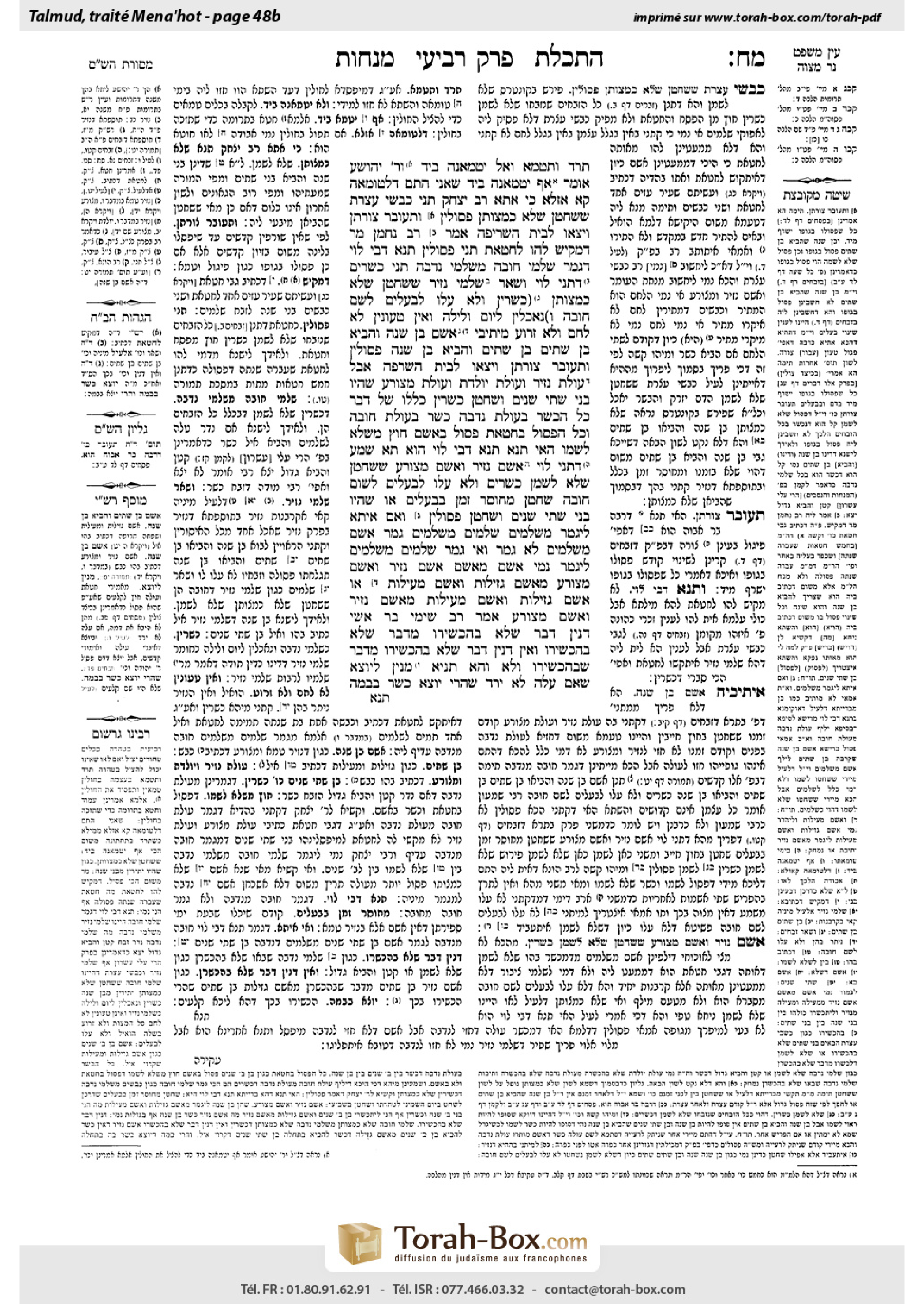
This page of Menachot includes the Aramaic text, an English translation and an AI-generated French translation, alongside the scan above.
מנחות מ״ח ב · Aramaic and Hebrew text
תֵּרֵד וְתִטַּמֵּא, וְאַל יְטַמְּאֶנָּה בַּיָּד, וְרַבִּי יְהוֹשֻׁעַ אוֹמֵר: אַף יְטַמְּאֶנָּה בַּיָּד.
שָׁאנֵי הָתָם, דִּלְטוּמְאָה קָא אָזְלָא.
כִּי אֲתָא רַב יִצְחָק, תָּנֵי: כִּבְשֵׂי עֲצֶרֶת שֶׁשְּׁחָטָן שֶׁלֹּא כְּמִצְוָתָן – פְּסוּלִין, וּתְעוּבַּר צוּרָתָן, וְיֵצְאוּ לְבֵית הַשְּׂרֵיפָה.
אָמַר רַב נַחְמָן: מָר, דְּמַקֵּישׁ לְהוּ לְחַטָּאת – תָּנֵי פְּסוּלִין, תָּנָא דְּבֵי לֵוִי, דְּגָמַר שַׁלְמֵי חוֹבָה מִשַּׁלְמֵי נְדָבָה – תָּנֵי כְּשֵׁרִים.
דְּתָנֵי לֵוִי: וּשְׁאָר שַׁלְמֵי נָזִיר שֶׁשְּׁחָטָן שֶׁלֹּא כְּמִצְוָתָן – כְּשֵׁרִין, וְלֹא עָלוּ לַבְּעָלִים לְשֵׁם חוֹבָה, וְנֶאֱכָלִין לְיוֹם וָלַיְלָה, וְאֵין טְעוּנִין לֹא לֶחֶם וְלֹא זְרוֹעַ.
מֵיתִיבִי: אָשָׁם בֶּן שָׁנָה וְהֵבִיא בֶּן שְׁתַּיִם, בֶּן שְׁתַּיִם וְהֵבִיא בֶּן שָׁנָה – פְּסוּלִין, וּתְעוּבַּר צוּרָתָן וְיֵצְאוּ לְבֵית הַשְּׂרֵפָה.
אֲבָל עוֹלַת נָזִיר, וְעוֹלַת יוֹלֶדֶת, וְעוֹלַת מְצוֹרָע, שֶׁהָיוּ בְּנֵי שְׁתֵּי שָׁנִים, וּשְׁחָטָן – כְּשֵׁרִין.
כְּלָלוֹ שֶׁל דָּבָר: כׇּל הַכָּשֵׁר בְּעוֹלַת נְדָבָה – כָּשֵׁר בְּעוֹלַת חוֹבָה, וְכׇל הַפָּסוּל בְּחַטָּאת – פָּסוּל בְּאָשָׁם, חוּץ מִשֶּׁלֹּא לִשְׁמוֹ.
הַאי תַּנָּא, תַּנָּא דְּבֵי לֵוִי הוּא.
תָּא שְׁמַע, דְּתָנֵי לֵוִי: אֲשַׁם נָזִיר וַאֲשַׁם מְצוֹרָע, שֶׁשְּׁחָטָן שֶׁלֹּא לִשְׁמָן – כְּשֵׁרִים, וְלֹא עָלוּ לַבְּעָלִים לְשׁוּם חוֹבָה.
שְׁחָטָן מְחוּסַּר זְמַן בִּבְעָלִים, אוֹ שֶׁהָיוּ בְּנֵי שְׁתֵּי שָׁנִים וּשְׁחָטָן – פְּסוּלִין.
וְאִם אִיתָא, לִיגְמַר מִשְּׁלָמִים? שְׁלָמִים מִשְּׁלָמִים – גָּמַר, אָשָׁם מִשְּׁלָמִים – לָא גָּמַר.
וְאִי גָּמַר שְׁלָמִים מִשְּׁלָמִים, לִיגְמַר נָמֵי אָשָׁם מֵאָשָׁם: אֲשַׁם נָזִיר וַאֲשַׁם מְצוֹרָע מֵאֲשַׁם גְּזֵילוֹת וַאֲשַׁם מְעִילוֹת, אוֹ אֲשַׁם גְּזֵילוֹת וַאֲשַׁם מְעִילוֹת מֵאֲשַׁם נָזִיר וַאֲשַׁם מְצוֹרָע.
אָמַר רַב שִׁימִי בַּר אָשֵׁי: דָּנִין דָּבָר שֶׁלֹּא בְּהֶכְשֵׁירוֹ מִדָּבָר שֶׁלֹּא בְּהֶכְשֵׁירוֹ, וְאֵין דָּנִין דָּבָר שֶׁלֹּא בְּהֶכְשֵׁירוֹ מִדָּבָר שֶׁבְּהֶכְשֵׁירוֹ.
וְלָא? וְהָא תַּנְיָא: מִנַּיִן לְיוֹצֵא, שֶׁאִם עָלָה לֹא יֵרֵד? שֶׁהֲרֵי יוֹצֵא כָּשֵׁר בְּבָמָה.
Menachot 48b · English translation
The teruma wine should be allowed to descend and become impure on its own, ruining the non-sacred wine in the lower press, but one should not render it impure through his direct action by catching it in an impure vessel, even though catching it would prevent the wine that is teruma from mixing with his impure, non-sacred wine. And Rabbi Yehoshua says: Since the wine that is teruma will become impure in any event, one may even render it impure through his direct action in order to save his non-sacred wine. This indicates that according to Rabbi Yehoshua it is permitted to sin with regard to one matter, i.e., the wine that is teruma, in order to gain with regard to another matter, i.e., the non-sacred wine.
The Gemara responds: It is different there, in the case of the wine, because the wine that is teruma is going to become impure in any event. Consequently, his action is not considered a sin, and this is not a case of sinning with regard to one matter in order to gain in another.
§ The Gemara continues its discussion of the sheep of Shavuot. When Rav Yitzḥak came from Eretz Yisrael to Babylonia he reported traditions that he learned in Eretz Yisrael, and he taught a baraita: With regard to a case of the two sheep of Shavuot where one slaughtered them not in accordance with their mitzva, e.g., he slaughtered them for the sake of a different offering, they are disqualified; and they should be left overnight until their form decays and they attain the status of leftover sacrificial meat, and then they are brought out to the place designated for burning.
Rav Naḥman said to Rav Yitzḥak: The Master, i.e., Rav Yitzḥak, who compares the sheep of Shavuot to a sin offering because they are juxtaposed in a verse (see Leviticus 23:19), teaches: The sheep are disqualified, like a sin offering that was slaughtered not for its own sake. By contrast, the tanna of the school of Levi, who derives the halakha with regard to an obligatory peace offering, e.g., the two sheep of Shavuot, from the halakha concerning a voluntary peace offering, teaches that the two sheep remain valid offerings, just as a voluntary peace offering remains valid even if it is slaughtered for the sake of a different offering.
As Levi teaches: And with regard to the other peace offerings of a nazirite that one slaughtered not in accordance with their mitzva, they are valid offerings like voluntary peace offerings, but they do not satisfy the obligation of the owner to bring the required nazirite peace offerings. And these offerings are eaten for only one day and one night, in accordance with the halakha concerning the peace offerings of nazirite, and not for two days and one night like voluntary peace offerings. They require neither bread nor the foreleg, unlike the required peace offering of a nazirite.
The Gemara raises an objection to the opinion of Rav Yitzḥak from that which was taught in a baraita: In a case where one is obligated to sacrifice as a guilt offering an animal in its first year, which the Torah calls a lamb, and instead he brought an animal in its second year, which is considered a ram; or if he is obligated to sacrifice as a guilt offering an animal in its second year and he brought an animal in its first year; the offerings are disqualified. They are to be left overnight until their form decays, and are brought out to the place designated for burning.
But in the case of the burnt offering of a nazirite, i.e., the lamb that is sacrificed when he completes his naziriteship; or the burnt offering of a woman after childbirth, i.e., the lamb she sacrifices on the forty-first day after giving birth to a son or on the eighty-first day after giving birth to a daughter; or the burnt offering of a leper, i.e., the lamb that is sacrificed after he is purified; in all of these cases if the animals were in their second year instead, and one slaughtered them, the offerings are valid.
The baraita concludes: The principle of the matter is: Any animal that is valid as a voluntary burnt offering is also valid as an obligatory burnt offering, and any animal that is disqualified as a sin offering is also disqualified as a guilt offering, except for an offering that was sacrificed not for its own sake, which is disqualified in the case of a sin offering but not a guilt offering. This demonstrates that the halakhot of obligatory burnt offerings are derived from those of voluntary burnt offerings, despite the fact that the burnt offering of a nazirite is juxtaposed to the sin offering of a nazirite (see Numbers 6:14) and the burnt offering of a leper is juxtaposed to the sin offering of a leper (see Leviticus 14:19). Similarly, the halakha pertaining to the sheep of Shavuot, which are obligatory peace offerings, should be derived from the halakha pertaining to voluntary peace offerings, and not from the halakha pertaining to a sin offering as Rav Yitzḥak holds.
The Gemara answers: This tanna, who taught this baraita, is the tanna of the school of Levi cited earlier, who holds that if one slaughters a sheep of Shavuot not for its own sake, it is nevertheless valid.
The Gemara discusses the opinion of Rav Naḥman, who maintains that the tanna of the school of Levi holds that a sheep of Shavuot slaughtered not for its own sake is valid because he derives its halakha from that of a voluntary peace offering. Come and hear what Levi teaches to the contrary, as Levi teaches: The guilt offering of a nazirite, i.e., the lamb he brings on the eighth day after becoming impure through contact with a corpse, and the guilt offering of a leper, i.e., the lamb he brings at the completion of his purification, that one slaughtered not for their sake are valid, but they did not satisfy the obligation of the owner.
If one slaughtered them when the time had not yet arrived for their owners to sacrifice these offerings, or they were in their second year instead of their first year and one slaughtered them, they are disqualified.
The Gemara comments: But if it is so that Levi derives the halakhot of an obligatory offering from those of a voluntary one, let him derive the halakha of the guilt offering from that of the peace offering, in which case the guilt offerings should be valid even if they were in their second year. The Gemara answers: Levi derives the halakha concerning an obligatory peace offering from the halakha concerning a voluntary peace offering, but he does not derive the halakha concerning a guilt offering from the halakha concerning a peace offering.
The Gemara further challenges the statement of Rav Naḥman: But if Levi derives the halakha of an obligatory peace offering from that of a voluntary peace offering, let him similarly derive the halakha of one guilt offering from that of another guilt offering. He should derive that the guilt offering of a nazirite and the guilt offering of a leper are valid even if the animal is in its second year from the halakha concerning a guilt offering for robbery and a guilt offering for misuse of consecrated property, which are supposed to be a ram in its second year. Or, if one brought a lamb in its first year as a guilt offering for robbery or a guilt offering for misuse of consecrated property, Levi should derive that it is valid from the halakha concerning the guilt offering of a nazirite and the guilt offering of a leper, which are lambs in their first year.
Rav Shimi bar Ashi said: One can derive the halakha with regard to an item that is prepared not in its valid manner, e.g., the sheep of Shavuot that were slaughtered not for their own sake, from the halakha with regard to another item that is prepared not in its valid manner, e.g., a voluntary peace offering slaughtered not for its own sake. But one cannot derive the halakha with regard to an item that is prepared not in its valid manner, e.g., the guilt offering of a nazirite or a leper that is sacrificed when it is in its second year, from the halakha with regard to an item that is prepared in its valid manner, e.g., a guilt offering for robbery or for misuse of consecrated property that is sacrificed when it is in its second year.
The Gemara asks: And can one not derive the halakha with regard to disqualified offerings from the halakha with regard to fit offerings? But isn’t it taught in a baraita: From where is it derived with regard to an item that left the Temple courtyard and was thereby disqualified that if it nevertheless ascended upon the altar it shall not descend? It is derived from the fact that an item that left is valid for sacrifice on a private altar. Here, the baraita derives the halakha with regard to a disqualified offering from the halakha with regard to a fit offering.
Menachot 48b · Traduction française (IA)
Le vin de terouma devrait être laissé s’écouler et devenir impur de lui-même, quitte à gâcher le vin profane dans le pressoir inférieur. Mais on ne devrait pas le rendre impur par une action directe, en le recueillant dans un récipient impur, même si cela empêcherait le vin de terouma de se mélanger à son vin profane impur. Rabbi Yehoshua dit : « Puisque le vin de terouma deviendra impur de toute façon, on peut même le rendre impur par une action directe afin de sauver son vin profane. » Cela indique que, selon Rabbi Yehoshua, il est permis de fauter dans un domaine — celui du vin de terouma — afin d’obtenir un avantage dans un autre — celui du vin profane.
La Guemara répond : le cas du vin est différent, car le vin de terouma va devenir impur de toute façon. Par conséquent, son action n’est pas considérée comme une faute, et il ne s’agit pas d’un cas où l’on faute dans un domaine pour obtenir un avantage dans un autre.
§ La Guemara poursuit son examen des deux agneaux de Chavouot. Lorsque Rav Yitzḥak vint d’Eretz Israël en Babylonie, il rapporta les traditions qu’il avait apprises en Eretz Israël et enseigna une baraïta : si, dans le cas des deux agneaux de Chavouot, quelqu’un les a égorgés sans respecter leur mitsva, par exemple en vue d’un autre sacrifice, ils sont invalides. Il faut les laisser toute la nuit, jusqu’à ce que leur forme se décompose et qu’ils acquièrent le statut de restes de sacrifices ; on les porte alors à l’endroit prévu pour les brûler.
Rav Naḥman dit à Rav Yitzḥak : « Maître, vous qui comparez les agneaux de Chavouot à un sacrifice expiatoire, parce qu’ils sont rapprochés de celui-ci dans un verset (voir Lévitique 23:19), enseignez que les agneaux sont invalides, comme un sacrifice expiatoire égorgé sans être destiné à lui-même. En revanche, le tanna de l’école de Levi, qui déduit la halakha relative à un sacrifice de paix obligatoire, tel que les deux agneaux de Chavouot, de la halakha concernant un sacrifice de paix volontaire, enseigne que les deux agneaux restent valides, tout comme un sacrifice de paix volontaire reste valide même s’il est égorgé en vue d’un autre sacrifice. »
Car Levi enseigne : les autres sacrifices de paix du nazir, s’ils sont égorgés sans respecter leur mitsva, sont valides comme des sacrifices de paix volontaires, mais ils ne satisfont pas à l’obligation du propriétaire d’apporter les sacrifices de paix requis pour le nazir. Ces sacrifices ne sont consommés que pendant un jour et une nuit, conformément à la halakha concernant les sacrifices de paix du nazir, et non pendant deux jours et une nuit comme les sacrifices de paix volontaires. Ils ne requièrent ni pain ni patte antérieure, contrairement au sacrifice de paix obligatoire du nazir.
La Guemara objecte à l’opinion de Rav Yitzḥak en s’appuyant sur ce qui a été enseigné dans une baraïta : si quelqu’un est tenu d’offrir en sacrifice de culpabilité un animal dans sa première année — que la Torah appelle un agneau — mais apporte à la place un animal dans sa deuxième année, considéré comme un bélier ; ou s’il est tenu d’offrir en sacrifice de culpabilité un animal dans sa deuxième année et apporte un animal dans sa première année, les sacrifices sont invalides. Il faut les laisser toute la nuit jusqu’à ce que leur forme se décompose, puis les porter à l’endroit prévu pour les brûler.
Mais, dans le cas de l’holocauste du nazir, c’est-à-dire l’agneau offert lorsqu’il achève son naziréat ; de l’holocauste d’une femme après un accouchement, c’est-à-dire l’agneau qu’elle offre le quarante et unième jour après avoir donné naissance à un garçon ou le quatre-vingt-unième jour après avoir donné naissance à une fille ; ou de l’holocauste d’un lépreux, c’est-à-dire l’agneau offert après sa purification, si les animaux étaient plutôt dans leur deuxième année et qu’on les égorgeait, les sacrifices étaient valides.
La baraïta conclut : le principe est le suivant : tout animal qui est valide comme holocauste volontaire est également valide comme holocauste obligatoire, et tout animal qui est invalide comme sacrifice expiatoire est également invalide comme sacrifice de culpabilité, à l’exception d’un sacrifice offert sans être destiné à lui-même, qui est invalide dans le cas d’un sacrifice expiatoire, mais non dans celui d’un sacrifice de culpabilité. Cela démontre que les halakhot des holocaustes obligatoires sont déduites de celles des holocaustes volontaires, bien que l’holocauste du nazir soit rapproché du sacrifice expiatoire du nazir (voir Nombres 6:14) et que l’holocauste du lépreux soit rapproché du sacrifice expiatoire du lépreux (voir Lévitique 14:19). De même, la halakha concernant les agneaux de Chavouot, qui sont des sacrifices de paix obligatoires, devrait être déduite de la halakha concernant les sacrifices de paix volontaires, et non de celle concernant un sacrifice expiatoire, comme le soutient Rav Yitzḥak.
La Guemara répond : ce tanna, qui a enseigné cette baraïta, est le tanna de l’école de Levi cité précédemment, qui soutient que si quelqu’un égorge un agneau de Chavouot sans le destiner à lui-même, celui-ci reste néanmoins valide.
La Guemara examine l’opinion de Rav Naḥman, qui soutient que le tanna de l’école de Levi considère qu’un agneau de Chavouot égorgé sans être destiné à lui-même est valide parce qu’il déduit sa halakha de celle d’un sacrifice de paix volontaire. Mais voyons ce qu’enseigne Levi en sens contraire : le sacrifice de culpabilité du nazir, c’est-à-dire l’agneau qu’il apporte le huitième jour après être devenu impur au contact d’un cadavre, et le sacrifice de culpabilité du lépreux, c’est-à-dire l’agneau qu’il apporte à la fin de sa purification, s’ils sont égorgés sans être destinés à eux-mêmes, sont valides, mais ne satisfont pas à l’obligation du propriétaire.
Si quelqu’un les égorge avant que le moment où leurs propriétaires doivent offrir ces sacrifices soit arrivé, ou s’ils sont dans leur deuxième année au lieu de leur première année et qu’on les égorge, ils sont invalides.
La Guemara fait remarquer : mais, s’il en est ainsi, si Levi déduit les halakhot d’un sacrifice obligatoire de celles d’un sacrifice volontaire, qu’il déduise la halakha du sacrifice de culpabilité de celle du sacrifice de paix ; les sacrifices de culpabilité devraient alors être valides même s’ils sont dans leur deuxième année. La Guemara répond : Levi déduit la halakha concernant un sacrifice de paix obligatoire de celle concernant un sacrifice de paix volontaire, mais il ne déduit pas la halakha concernant un sacrifice de culpabilité de celle concernant un sacrifice de paix.
La Guemara conteste encore la déclaration de Rav Naḥman : mais si Levi déduit la halakha d’un sacrifice de paix obligatoire de celle d’un sacrifice de paix volontaire, qu’il déduise de même la halakha d’un sacrifice de culpabilité de celle d’un autre sacrifice de culpabilité. Il devrait déduire de la halakha concernant le sacrifice de culpabilité pour vol et celui pour usage illicite de biens consacrés — qui doivent être des béliers dans leur deuxième année — que le sacrifice de culpabilité du nazir et celui du lépreux sont valides même si l’animal est dans sa deuxième année. Ou bien, si quelqu’un apporte un agneau dans sa première année comme sacrifice de culpabilité pour vol ou pour usage illicite de biens consacrés, Levi devrait déduire qu’il est valide de la halakha concernant le sacrifice de culpabilité du nazir et celui du lépreux, qui sont des agneaux dans leur première année.
Rav Shimi bar Ashi dit : on peut déduire la halakha concernant un élément préparé de manière non conforme, par exemple les agneaux de Chavouot égorgés sans être destinés à eux-mêmes, de la halakha concernant un autre élément préparé de manière non conforme, par exemple un sacrifice de paix volontaire égorgé sans être destiné à lui-même. Mais on ne peut pas déduire la halakha concernant un élément préparé de manière non conforme, par exemple le sacrifice de culpabilité d’un nazir ou d’un lépreux offert alors qu’il est dans sa deuxième année, de la halakha concernant un élément préparé de manière conforme, par exemple un sacrifice de culpabilité pour vol ou pour usage illicite de biens consacrés offert alors qu’il est dans sa deuxième année.
La Guemara demande : ne peut-on donc pas déduire la halakha concernant des sacrifices invalides de celle concernant des sacrifices valides ? N’est-il pas enseigné dans une baraïta : d’où déduit-on qu’un élément qui a quitté le parvis du Temple et a ainsi été invalidé, s’il est néanmoins monté sur l’autel, ne doit pas en redescendre ? On le déduit du fait qu’un élément qui a quitté le parvis est valide pour être offert sur un autel privé. Ici, la baraïta déduit la halakha concernant un sacrifice invalide de celle concernant un sacrifice valide.
Traduction française générée par IA à partir de l’édition anglaise de Sefaria. Vérifie toujours un passage avec le texte source.
Text from Sefaria: William Davidson Edition - Vocalized Aramaic (unknown); William Davidson Edition - English (CC BY NC).