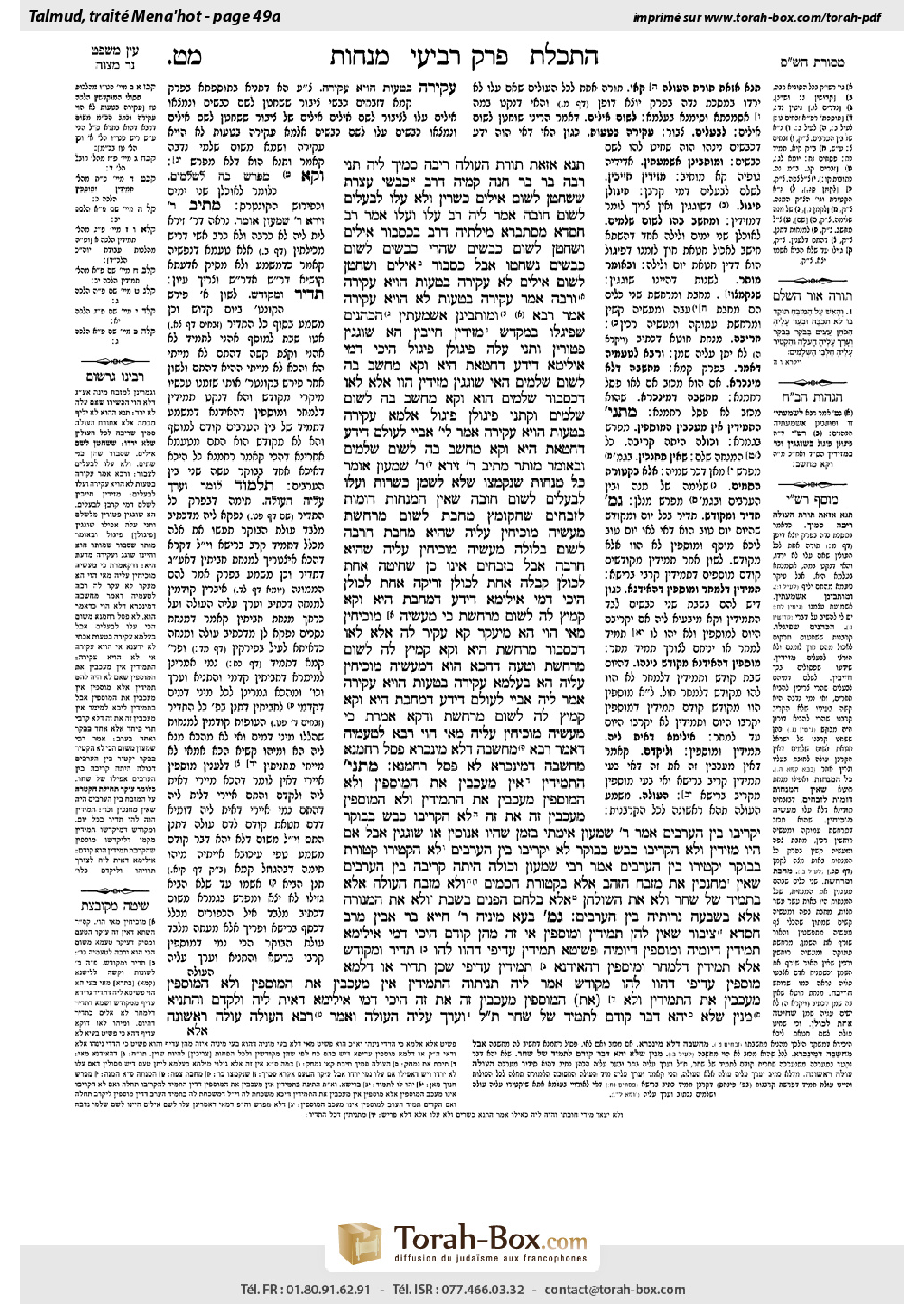
Menachot 49a: Talmud study for Daf Yomi
Daf Yomi is the daily study of one Talmud folio. Explore 37 tractates with scans, Hebrew text, Sefaria English and AI-generated French translations where annotated.
Passage selection and English or AI-generated French translation are available where the scan has annotations. Daf Study is independent of Torah-Box and Sefaria.
Browse Menachot · מנחות · All tractatesMenachot 49a text and translations
This page of Menachot includes the Aramaic text, an English translation and an AI-generated French translation, alongside the scan above.
מנחות מ״ט א · Aramaic and Hebrew text
תְּנָא אַ״זֹּאת תּוֹרַת הָעֹלָה״ רִיבָּה סְמִיךְ לֵיהּ.
תָּנֵי רַבָּה בַּר בַּר חַנָּה קַמֵּיהּ דְּרַב: כִּבְשֵׂי עֲצֶרֶת שֶׁשְּׁחָטָן לְשׁוּם אֵילִים – כְּשֵׁרִין, וְלֹא עָלוּ לַבְּעָלִים לְשׁוּם חוֹבָה. אֲמַר לֵיהּ רַב: עָלוּ וְעָלוּ.
אָמַר רַב חִסְדָּא: מִסְתַּבְּרָא מִילְּתֵיהּ דְּרַב בִּכְסָבוּר אֵילִים, וּשְׁחָטָן לְשׁוּם כְּבָשִׂים, שֶׁהֲרֵי כְּבָשִׂים לְשׁוּם כְּבָשִׂים נִשְׁחֲטוּ.
אֲבָל כְּסָבוּר אֵילִים, וּשְׁחָטָן לְשׁוּם אֵילִים – לָא. עֲקִירָה בְּטָעוּת הָוְיָא עֲקִירָה; וְרַבָּה אָמַר: עֲקִירָה בְּטָעוּת לָא הָוְיָא עֲקִירָה.
אָמַר רָבָא: וּמוֹתְבִינַן אַשְּׁמַעְתִּין, הַכֹּהֲנִים שֶׁפִּיגְּלוּ בַּמִּקְדָּשׁ מְזִידִין – חַיָּיבִין, הָא שׁוֹגְגִין – פְּטוּרִין, וְתָנֵי עֲלַהּ: פִּיגּוּלָן פִּיגּוּל.
הֵיכִי דָּמֵי? אִילֵּימָא דְּיָדַע דְּחַטָּאת הִיא, וְקָא מְחַשֵּׁב בַּהּ לְשׁוּם שְׁלָמִים – הַאי שׁוֹגְגִין?! מְזִידִין הָווּ!
אֶלָּא לָאו דִּכְסָבוּר שְׁלָמִים הוּא, וְקָא מְחַשֵּׁב בַּהּ לְשׁוּם שְׁלָמִים, וְקָתָנֵי: פִּיגּוּלָן פִּיגּוּל, אַלְמָא עֲקִירָה בְּטָעוּת הָוְיָא עֲקִירָה.
אֲמַר לֵיהּ אַבָּיֵי: לְעוֹלָם דְּיָדַע דְּחַטָּאת הִיא, וְקָא מְחַשֵּׁב בַּהּ לְשׁוּם שְׁלָמִים, וּבְאוֹמֵר ״מוּתָּר״.
מֵתִיב רַבִּי זֵירָא: רַבִּי שִׁמְעוֹן אוֹמֵר, כׇּל מְנָחוֹת שֶׁנִּקְמְצוּ שֶׁלֹּא לִשְׁמָן – כְּשֵׁרוֹת, וְעָלוּ לַבְּעָלִים לְשׁוּם חוֹבָה.
שֶׁאֵין הַמְּנָחוֹת דּוֹמוֹת לַזְּבָחִים, שֶׁהַקּוֹמֵץ מַחֲבַת לְשׁוּם מַרְחֶשֶׁת – מַעֲשֶׂיהָ מוֹכִיחִין עָלֶיהָ שֶׁהִיא מַחֲבַת, חֲרֵבָה לְשׁוּם בְּלוּלָה – מַעֲשֶׂיהָ מוֹכִיחִין עָלֶיהָ שֶׁהִיא חֲרֵבָה.
אֲבָל בִּזְבָחִים אֵינוֹ כֵּן, שְׁחִיטָה אַחַת לְכוּלָּן, קַבָּלָה אַחַת לְכוּלָּן, זְרִיקָה אַחַת לְכוּלָּן.
הֵיכִי דָּמֵי? אִילֵּימָא דְּיָדַע דְּמַחֲבַת הִיא, וְקָא קָמֵיץ לָהּ לְשׁוּם מַרְחֶשֶׁת – כִּי מַעֲשֶׂיהָ מוֹכִיחִין, מַאי הָוֵי? הָא מִיעְקָר קָא עָקַיר לַהּ!
אֶלָּא לָאו דִּכְסָבוּר מַרְחֶשֶׁת הִיא, וְקָא קָמֵיץ לָהּ לְשׁוּם מַרְחֶשֶׁת, וּטְעָה, דְּהָכָא הוּא דְּמַעֲשֶׂיהָ מוֹכִיחִין עָלֶיהָ, הָא בְּעָלְמָא עֲקִירָה בְּטָעוּת הָוְיָא עֲקִירָה.
אֲמַר לֵיהּ אַבָּיֵי: לְעוֹלָם דְּיָדַע דְּמַחֲבַת הִיא, וְקָא קָמֵיץ לַהּ לְשׁוּם מַרְחֶשֶׁת.
וּדְקָא אָמְרַתְּ: כִּי מַעֲשֶׂיהָ מוֹכִיחִין עָלֶיהָ מַאי הָוֵי? רָבָא לְטַעְמֵיהּ, דְּאָמַר רָבָא: מַחְשָׁבָה דְּלָא מִינַּכְרָא – פְּסַל רַחֲמָנָא, מַחְשָׁבָה דְּמִינַּכְרָא – לָא פְּסַל רַחֲמָנָא.
מַתְנִי׳ הַתְּמִידִין אֵין מְעַכְּבִין אֶת הַמּוּסָפִין, וְלֹא הַמּוּסָפִין מְעַכְּבִין אֶת הַתְּמִידִין, וְלֹא הַמּוּסָפִין מְעַכְּבִין זֶה אֶת זֶה. לֹא הִקְרִיבוּ כֶּבֶשׂ בַּבּוֹקֶר – יַקְרִיבוּ בֵּין הָעַרְבַּיִם.
אָמַר רַבִּי שִׁמְעוֹן: אֵימָתַי? בִּזְמַן שֶׁהָיוּ אֲנוּסִין אוֹ שׁוֹגְגִין, אֲבָל אִם הָיוּ מְזִידִין וְלֹא הִקְרִיבוּ כֶּבֶשׂ בַּבּוֹקֶר – לֹא יַקְרִיבוּ בֵּין הָעַרְבַּיִם.
לֹא הִקְטִירוּ קְטוֹרֶת בַּבּוֹקֶר – יַקְטִירוּ בֵּין הָעַרְבַּיִם.
אָמַר רַבִּי שִׁמְעוֹן: וְכוּלָּהּ הָיְתָה קְרֵיבָה בֵּין הָעַרְבַּיִם, שֶׁאֵין מְחַנְּכִין אֶת מִזְבַּח הַזָּהָב אֶלָּא בִּקְטוֹרֶת הַסַּמִּים, וְלֹא מִזְבַּח הָעוֹלָה אֶלָּא בְּתָמִיד שֶׁל שַׁחַר, וְלֹא אֶת הַשּׁוּלְחָן אֶלָּא בְּלֶחֶם הַפָּנִים בְּשַׁבָּת, וְלֹא אֶת הַמְּנוֹרָה אֶלָּא בְּשִׁבְעָה נֵרוֹתֶיהָ בֵּין הָעַרְבַּיִם.
גְּמָ׳ בְּעָא מִינֵּיהּ רַבִּי חִיָּיא בַּר אָבִין מֵרַב חִסְדָּא: צִיבּוּר שֶׁאֵין לָהֶן תְּמִידִין וּמוּסָפִין, אֵי זֶה מֵהֶן קוֹדֵם?
הֵיכִי דָמֵי? אִילֵּימָא תְּמִידִין דְּיוֹמֵיהּ וּמוּסָפִין דְּיוֹמֵיהּ – פְּשִׁיטָא תְּמִידִין עֲדִיפִי, דְּהָווּ לְהוּ תָּדִיר וּמְקוּדָּשׁ!
אֶלָּא, תְּמִידִין דְּלִמְחַר וּמוּסָפִין דְּהָאִידָּנָא – תְּמִידִין עֲדִיפִי, שֶׁכֵּן תָּדִיר, אוֹ דִלְמָא מוּסָפִין עֲדִיפִי, דְּהָווּ לְהוּ מְקוּדָּשׁ?
אֲמַר לֵיהּ, תְּנֵיתוּהָ: הַתְּמִידִין אֵין מְעַכְּבִין אֶת הַמּוּסָפִין, וְלֹא הַמּוּסָפִין מְעַכְּבִין אֶת הַתְּמִידִין, וְלֹא הַמּוּסָפִין מְעַכְּבִין זֶה אֶת זֶה.
הֵיכִי דָמֵי? אִילֵּימָא דְּאִית לֵיהּ, וּלְקַדֵּם, וְהָתַנְיָא: מִנַּיִן שֶׁלֹּא יְהֵא דָּבָר קוֹדֵם לְתָמִיד שֶׁל שַׁחַר? תַּלְמוּד לוֹמַר: ״וְעָרַךְ עָלֶיהָ הָעֹלָה״.
וְאָמַר רָבָא: ״הָעֹלָה״ – עוֹלָה רִאשׁוֹנָה!
Menachot 49a · English translation
The Gemara answers: The tanna of that baraita relies on the phrase: “This is the law of the burnt offering [ha’ola]: It is that which goes up on its firewood upon the altar all night unto the morning” (Leviticus 6:2), a seemingly superfluous general phrase which is interpreted homiletically to include the halakha that any item that ascends [ola] upon the altar shall not descend from it, even if it was disqualified. The verse is the actual source for the halakha of the baraita, whereas the case of a private altar is cited merely in support of this ruling. Accordingly, the baraita does not contradict the opinion of Rav Shimi bar Ashi.
§ The Gemara cites another discussion concerning the sheep of Shavuot. Rabba bar bar Ḥana taught a baraita before Rav: In a case of the two sheep of Shavuot where one slaughtered them for the sake of rams and not for their own sake, they are valid offerings, but they do not satisfy the obligation of the owner, i.e., the community, to sacrifice these offerings. Rav said to Rabba bar bar Ḥana: That is not so; rather, the sheep certainly satisfy the obligation of the community.
Rav Ḥisda said: The statement of Rav is reasonable in a case where one thought that they were rams when he slaughtered them, and nevertheless slaughtered them for the sake of lambs. In such a case, it makes sense that they satisfy the community’s obligation since the lambs were slaughtered for the sake of lambs.
But in a case where he thought that they were rams when he slaughtered them, and therefore slaughtered them for the sake of rams, they do not satisfy the community’s obligation, even though they were actually lambs. This is due to the fact that the erroneous uprooting of the status of an offering constitutes uprooting, despite the fact that it was done in error. But Rabba said: The erroneous uprooting of the status of an offering does not constitute uprooting.
Rava said: We raise an objection to our own ruling concerning this halakha from that which was taught in a mishna (Gittin 54a): In a case of priests who disqualified an offering through improper intention in the Temple, by expressing, while sacrificing the offering, the intention to eat it after the appropriate time, if they did so intentionally, they are liable to pay the value of the offering to its owner, who must now bring another offering. It follows, therefore, that if the priests did so unintentionally they are exempt. And it is taught concerning this case in a baraita: Even though they slaughtered it with improper intent unintentionally, their act of improper intention renders the offering piggul, despite the fact that they are exempt from paying damages.
What are the circumstances in which this is the halakha? If we say that it is referring to a case where the priest knew that the offering was a sin offering, which is eaten for only one day and one night, and nevertheless he intended the offering to be for the sake of a peace offering, which is eaten for two days and one night, and thereby his intention was that it be eaten after its appropriate time, is this considered an unintentional act by the priests? Certainly they were acting intentionally.
Rather, is it not referring to a case where the offering was a sin offering, which is eaten for only one day and one night, and the priest thought that it was a peace offering and therefore he intended the offering to be for the sake of a peace offering, which is eaten for two days and one night, and thereby his intention was that it be eaten after its appropriate time? And with regard to this case the tanna taught: Their act of improper intention renders the offering piggul. Apparently, this proves that the erroneous uprooting of the status of an offering constitutes uprooting, contrary to the ruling of Rabba.
Abaye said to Rava: There is no objection from this baraita, because actually it is referring to a case where the priest knew that it was a sin offering and nevertheless he intended the offering to be for the sake of a peace offering, and his uprooting was done intentionally. Nevertheless, the baraita refers to the priests as acting unintentionally because it is referring to circumstances where the priest says, i.e., he mistakenly thinks, that it is permitted to sacrifice the offering with this intent.
Rabbi Zeira raises an objection to Rabba’s opinion that erroneous uprooting of the status of an offering does not constitute uprooting. A baraita teaches that Rabbi Shimon says: All meal offerings from which the handful was removed not for their sake are entirely valid, and have even satisfied the obligation of the owner, unlike animal offerings slaughtered not for their sake, which do not satisfy the obligation of the owner.
This is because meal offerings are not similar to animal offerings. As, in the case of one who removes a handful from a meal offering prepared in a shallow pan for the sake of a meal offering prepared in a deep pan, its mode of preparation proves that it is a shallow-pan meal offering and not a deep-pan meal offering. Since a meal offering prepared in a shallow pan is hard and one prepared in a deep pan is soft, his intention is plainly false. Similarly, if one removes a handful from a dry meal offering, the meal offering of a sinner, which has no oil, for the sake of a meal offering mixed with oil, his intention is plainly false, as its mode of preparation proves that it is a dry meal offering.
But with regard to animal offerings this is not so. There is one mode of slaughter for all of the offerings, one mode of collection of the blood for all of them, and one mode of sprinkling for all of them. Since the only factor that distinguishes between one type of offering and another is the intention of the individuals involved in its sacrifice, their intention is significant. Consequently, if one of the sacrificial rites is performed for the sake of the wrong type of offering, the offering does not satisfy its owner’s obligation.
The Gemara clarifies: What are the circumstances to which Rabbi Shimon is referring? If we say that he is referring to a case where the priest knew that the meal offering was prepared in a shallow pan, and nevertheless he removed a handful from it for the sake of a meal offering prepared in a deep pan, then although its mode of preparation proves that it was prepared in a shallow pan, what of it? In any case he is consciously uprooting its status as a shallow-pan meal offering, changing it to a deep-pan meal offering by means of his intention when he removes the handful.
Rather, is it not referring to a case where the priest thought it was a meal offering prepared in a deep pan and therefore removed a handful for the sake of a meal offering prepared in a deep pan, but he was mistaken, as it was actually a meal offering prepared in a shallow pan? It is specifically here, in this case, that Rabbi Shimon rules that the offering remains valid, since its mode of preparation proves that it is a shallow-pan meal offering, which indicates that in general, erroneous uprooting of the status of an offering constitutes uprooting, contrary the ruling of Rabba.
Abaye said to Rabbi Zeira, in response to his objection: This objection to Rabba’s opinion is inconclusive, because one can explain that the baraita is actually referring to a case where the priest knew that the meal offering was prepared in a shallow pan, and nevertheless he removed a handful for the sake of a meal offering prepared in a deep pan.
And with regard to that which you said in your question: Although its mode of preparation proves that it is prepared in a shallow pan, what of it, i.e., since he is consciously uprooting its identity, how can it satisfy its owner’s obligation? Abaye answers that Rava conforms to his line of reasoning, as Rava says: The Merciful One disqualifies an offering due to improper intent that is not recognizably false, i.e., when the physical properties of the offering itself do not prove that the intent is mistaken. The Merciful One does not disqualify an offering due to improper intent that is recognizably false. Consequently, if one removes a handful from a shallow-pan meal offering for the sake of a deep-pan meal offering, even if he did so consciously, the offering remains valid and satisfies the owner’s obligation.
MISHNA: Failure to sacrifice the daily offerings does not prevent sacrifice of the additional offerings, and likewise, failure to sacrifice the additional offerings does not prevent sacrifice of the daily offerings. And failure to sacrifice some of the additional offerings on a day when more than one is sacrificed, e.g., if it was both Shabbat and the New Moon, does not prevent sacrifice of the other additional offerings. If the priests did not sacrifice a lamb in the morning as the daily offering, nevertheless, they should sacrifice a lamb in the afternoon as the daily offering, as failure to sacrifice one daily offering does not prevent sacrifice of the other. In all of these cases, if they failed to sacrifice one offering, they should still sacrifice the other.
Rabbi Shimon said: When does this halakha apply? It applies at a time when the failure to sacrifice the daily morning offering was because they were prevented from sacrificing it due to circumstances beyond their control or they failed to sacrifice it unwittingly. But if the priests acted intentionally and did not sacrifice a lamb in the morning as the daily offering, they should not sacrifice a lamb in the afternoon as the daily offering.
Incense was burned twice a day, half a measure in the morning and half a measure in the afternoon. If they did not burn the half-measure of incense in the morning, they should burn the half-measure in the afternoon.
Rabbi Shimon said: And in such a case, the entire measure was sacrificed in the afternoon. The reason for the difference between the daily offerings and the incense is that the daily service on a new golden altar is initiated only with the burning of the incense of the spices in the afternoon, at which time they would burn a full measure. And the daily service on a new altar of the burnt offering, on which the daily offerings were sacrificed, is initiated only with the daily morning offering. And use of a new Table was initiated only with the arrangement of the shewbread on Shabbat, and use of a new Candelabrum was initiated only with the kindling of its seven lamps in the afternoon.
GEMARA: The mishna teaches that the daily offerings and the additional offerings each do not prevent fulfillment of the mitzva with the other. Concerning this, Rabbi Ḥiyya bar Avin raised a dilemma before Rav Ḥisda: In the case of a community that did not have the resources to sacrifice both the daily offerings and the additional offerings, which of them takes precedence over the other?
The Gemara clarifies: What are the circumstances to which Rabbi Ḥiyya bar Avin is referring? If we say that he is referring to a case where the choice is between the daily offerings of that day and the additional offerings of that same day, it is obvious that the daily offerings are given preference, as the sacrifice of the daily offerings is more frequent than the sacrifice of the additional offerings, which are sacrificed only on special occasions, and the daily offerings are also sanctified.
Rather, Rabbi Ḥiyya bar Avin must be referring to a case where they have enough animals for the daily offerings of today and also for either the daily offerings for tomorrow or the additional offerings for today. In such a case, are the daily offerings given preference since their sacrifice is more frequent? Or perhaps the additional offerings are given preference because they are considered more sanctified because they are sacrificed on a holy day.
Rav Ḥisda said to Rabbi Ḥiyya bar Avin: The resolution to this dilemma can be derived from that which you learned in the mishna: Failure to sacrifice the daily offerings does not prevent sacrifice of the additional offerings, and likewise, failure to sacrifice the additional offerings does not prevent sacrifice of the daily offerings. And failure to sacrifice some of the additional offerings does not prevent sacrifice of the other additional offerings.
What are the circumstances to which the mishna is referring? If we say that it is referring to a case where the Temple treasury has all of the animals necessary for both offerings, and the only question is in terms of sacrificing one before the other, isn’t it taught in a baraita: From where is it derived that no sacrifice should precede the sacrifice of the daily offering of morning? The baraita continues: It is derived from that which the verse states: “And the fire upon the altar shall be kept burning thereby, it shall not go out; and the priest shall kindle wood on it every morning; and he shall lay the burnt offering in order on it, and shall cause the fats of the peace offering to go up in smoke upon it” (Leviticus 6:5).
And Rava says in explanation of this derivation in the baraita that the term “the burnt offering,” with the definite article, is referring to the first burnt offering of the day, which is the daily offering. Consequently, one may not sacrifice the additional offerings before the daily offering.
Menachot 49a · Traduction française (IA)
La Guemara répond : Le tanna de cette baraïta s’appuie sur le verset : « Telle est la loi de l’holocauste [ha’ola] : c’est celui qui monte sur son bois, sur l’autel, toute la nuit jusqu’au matin » (Lévitique 6,2), une formulation générale apparemment superflue, interprétée de manière homilétique comme incluant la halakha selon laquelle tout ce qui monte [ola] sur l’autel ne doit pas en être retiré, même si cela a été disqualifié. Le verset est la véritable source de la halakha de la baraïta, tandis que le cas d’un autel privé n’est cité qu’à l’appui de cette règle. Par conséquent, la baraïta ne contredit pas l’avis de Rav Shimi bar Ashi.
§ La Guemara cite une autre discussion concernant les deux agneaux de Chavouot. Rabba bar bar Ḥana enseigna une baraïta devant Rav : dans le cas des deux agneaux de Chavouot, si on les a abattus en les destinant à être des béliers, et non à être ce qu’ils étaient, ce sont des offrandes valides, mais elles ne permettent pas à leur propriétaire, c’est-à-dire à la communauté, de s’acquitter de l’obligation de les offrir. Rav dit à Rabba bar bar Ḥana : Ce n’est pas ainsi ; les agneaux permettent certainement à la communauté de s’acquitter de son obligation.
Rav Ḥisda dit : La déclaration de Rav est raisonnable dans le cas où, au moment de les abattre, on croyait qu’il s’agissait de béliers, mais où on les a néanmoins abattus en les destinant à être des agneaux. Dans ce cas, il est logique qu’ils permettent à la communauté de s’acquitter de son obligation, puisque les agneaux ont été abattus en les destinant à être des agneaux.
Mais si, au moment de les abattre, on croyait qu’il s’agissait de béliers et qu’on les a donc abattus en les destinant à être des béliers, ils ne permettent pas à la communauté de s’acquitter de son obligation, bien qu’il s’agisse en réalité d’agneaux. En effet, le changement erroné du statut d’une offrande constitue un changement, même s’il a été effectué par erreur. Mais Rabba a dit : Le changement erroné du statut d’une offrande ne constitue pas un changement.
Rava dit : Nous soulevons une objection à notre propre décision concernant cette halakha, à partir de ce qui est enseigné dans une Michna (Guittin 54a) : dans le cas de prêtres qui ont disqualifié une offrande dans le Temple par une intention incorrecte, en exprimant, pendant le sacrifice, l’intention de la consommer après le délai prescrit, s’ils l’ont fait intentionnellement, ils sont tenus de payer à son propriétaire la valeur de l’offrande, car celui-ci doit désormais en apporter une autre. Il s’ensuit donc que si les prêtres l’ont fait involontairement, ils sont exemptés. Or, une baraïta enseigne à propos de ce cas : même s’ils l’ont abattue avec une intention incorrecte involontairement, cette intention rend l’offrande piggoul, bien qu’ils soient exemptés de payer des dommages-intérêts.
Dans quelles circonstances cette halakha s’applique-t-elle ? Si nous disons qu’il s’agit d’un cas où le prêtre savait que l’offrande était un sacrifice expiatoire, qui ne se consomme que pendant un jour et une nuit, mais qu’il a néanmoins eu l’intention de l’offrir comme sacrifice de paix, qui se consomme pendant deux jours et une nuit, et qu’il avait ainsi l’intention qu’elle soit consommée après le délai prescrit, peut-on considérer que les prêtres ont agi involontairement ? Ils agissaient certainement intentionnellement.
Ne faut-il pas plutôt dire qu’il s’agit d’un cas où l’offrande était un sacrifice expiatoire, qui ne se consomme que pendant un jour et une nuit, mais où le prêtre croyait qu’il s’agissait d’un sacrifice de paix et a donc eu l’intention de l’offrir comme sacrifice de paix, qui se consomme pendant deux jours et une nuit, avec l’intention qu’elle soit consommée après le délai prescrit ? À propos de ce cas, le tanna a enseigné que leur intention incorrecte rend l’offrande piggoul. Cela prouve apparemment que le changement erroné du statut d’une offrande constitue un changement, contrairement à la décision de Rabba.
Abaye dit à Rava : Cette baraïta ne soulève aucune objection, car, en réalité, elle parle d’un cas où le prêtre savait qu’il s’agissait d’un sacrifice expiatoire et a néanmoins eu l’intention de l’offrir comme sacrifice de paix : le changement de statut était donc intentionnel. Pourtant, la baraïta dit que les prêtres ont agi involontairement, car elle parle de circonstances où le prêtre dit, c’est-à-dire croit à tort, qu’il est permis de sacrifier l’offrande avec cette intention.
Rabbi Zeira soulève une objection à l’avis de Rabba, selon lequel le changement erroné du statut d’une offrande ne constitue pas un changement. Une baraïta enseigne que Rabbi Shimon dit : Toutes les offrandes végétales dont on a prélevé la poignée sans les destiner à ce qu’elles étaient sont entièrement valides et permettent même à leur propriétaire de s’acquitter de son obligation, contrairement aux offrandes animales abattues sans être destinées à ce qu’elles étaient, qui ne permettent pas à leur propriétaire de s’acquitter de son obligation.
Cela tient au fait que les offrandes végétales ne sont pas comparables aux offrandes animales. En effet, si quelqu’un prélève une poignée d’une offrande végétale préparée dans une poêle plate en la destinant à être une offrande préparée dans une poêle profonde, son mode de préparation prouve qu’il s’agit d’une offrande préparée dans une poêle plate, et non dans une poêle profonde. Puisqu’une offrande préparée dans une poêle plate est ferme, tandis qu’une offrande préparée dans une poêle profonde est molle, son intention est manifestement erronée. De même, si quelqu’un prélève une poignée d’une offrande sèche — l’offrande du pécheur, qui ne contient pas d’huile — en la destinant à être une offrande mélangée à de l’huile, son intention est manifestement erronée, car son mode de préparation prouve qu’il s’agit d’une offrande sèche.
Mais il n’en va pas ainsi pour les offrandes animales. Le mode d’abattage est le même pour toutes les offrandes, le mode de recueil du sang est le même pour toutes et le mode d’aspersion est le même pour toutes. Puisque seul l’intention des personnes qui accomplissent le sacrifice distingue un type d’offrande d’un autre, leur intention est déterminante. Par conséquent, si l’un des rites sacrificiels est accompli en destinant l’offrande à un autre type de sacrifice, celle-ci ne permet pas à son propriétaire de s’acquitter de son obligation.
La Guemara précise : À quelles circonstances Rabbi Shimon fait-il référence ? Si nous disons qu’il s’agit d’un cas où le prêtre savait que l’offrande était préparée dans une poêle plate, mais qu’il en a néanmoins prélevé une poignée en la destinant à être une offrande préparée dans une poêle profonde, alors, même si son mode de préparation prouve qu’elle a été préparée dans une poêle plate, qu’importe ? En tout état de cause, il change consciemment son statut d’offrande préparée dans une poêle plate et la transforme en offrande préparée dans une poêle profonde par son intention au moment où il en prélève la poignée.
Ne faut-il pas plutôt dire qu’il s’agit d’un cas où le prêtre croyait qu’il s’agissait d’une offrande préparée dans une poêle profonde et en a donc prélevé une poignée en la destinant à être une offrande préparée dans une poêle profonde, mais qu’il se trompait, car il s’agissait en réalité d’une offrande préparée dans une poêle plate ? C’est précisément dans ce cas que Rabbi Shimon décide que l’offrande reste valide, puisque son mode de préparation prouve qu’il s’agit d’une offrande préparée dans une poêle plate. Cela indique qu’en général, le changement erroné du statut d’une offrande constitue un changement, contrairement à la décision de Rabba.
Abaye dit à Rabbi Zeira, en réponse à son objection : Cette objection à l’avis de Rabba n’est pas concluante, car on peut expliquer que la baraïta parle en réalité d’un cas où le prêtre savait que l’offrande était préparée dans une poêle plate, mais qu’il en a néanmoins prélevé une poignée en la destinant à être une offrande préparée dans une poêle profonde.
Et quant à ce que tu as dit dans ta question : même si son mode de préparation prouve qu’elle est préparée dans une poêle plate, qu’importe ? Autrement dit, puisqu’il en change consciemment l’identité, comment peut-elle permettre à son propriétaire de s’acquitter de son obligation ? Abaye répond que Rava reste fidèle à son raisonnement, car Rava dit : Le Miséricordieux disqualifie une offrande en raison d’une intention incorrecte qui n’est pas manifestement erronée, c’est-à-dire lorsque les propriétés physiques de l’offrande elle-même ne prouvent pas que l’intention est erronée. Le Miséricordieux ne disqualifie pas une offrande en raison d’une intention incorrecte manifestement erronée. Par conséquent, si quelqu’un prélève une poignée d’une offrande préparée dans une poêle plate en la destinant à être une offrande préparée dans une poêle profonde, l’offrande reste valide et permet à son propriétaire de s’acquitter de son obligation, même s’il l’a fait consciemment.
MICHNA : Le fait de ne pas sacrifier les offrandes quotidiennes n’empêche pas de sacrifier les offrandes supplémentaires ; de même, le fait de ne pas sacrifier les offrandes supplémentaires n’empêche pas de sacrifier les offrandes quotidiennes. Le fait de ne pas sacrifier certaines des offrandes supplémentaires un jour où l’on en sacrifie plusieurs, par exemple lorsque Chabbat et la néoménie tombent le même jour, n’empêche pas de sacrifier les autres offrandes supplémentaires. Si les prêtres n’ont pas sacrifié un agneau le matin comme offrande quotidienne, ils doivent néanmoins sacrifier un agneau l’après-midi comme offrande quotidienne, car le fait de ne pas sacrifier une offrande quotidienne n’empêche pas de sacrifier l’autre. Dans tous ces cas, si l’on n’a pas sacrifié une offrande, il faut tout de même sacrifier l’autre.
Rabbi Shimon dit : Quand cette halakha s’applique-t-elle ? Elle s’applique lorsque l’offrande quotidienne du matin n’a pas été sacrifiée parce que des circonstances indépendantes de leur volonté les en ont empêchés, ou parce qu’ils ne l’ont pas sacrifiée par inadvertance. Mais si les prêtres ont agi intentionnellement et n’ont pas sacrifié un agneau le matin comme offrande quotidienne, ils ne doivent pas sacrifier un agneau l’après-midi comme offrande quotidienne.
L’encens était brûlé deux fois par jour, une demi-mesure le matin et une demi-mesure l’après-midi. S’ils n’ont pas brûlé la demi-mesure d’encens le matin, ils doivent brûler la demi-mesure l’après-midi.
Rabbi Shimon dit : Dans un tel cas, toute la mesure était offerte l’après-midi. La différence entre les offrandes quotidiennes et l’encens s’explique ainsi : le service quotidien sur un nouvel autel d’or ne commence qu’avec la combustion de l’encens des aromates l’après-midi, moment où l’on en brûlait une mesure entière. Le service quotidien sur un nouvel autel des holocaustes, sur lequel étaient sacrifiées les offrandes quotidiennes, ne commence qu’avec l’offrande quotidienne du matin. De même, l’utilisation d’une nouvelle Table ne commence qu’avec la disposition des pains de proposition le Chabbat, et l’utilisation d’un nouveau Candélabre ne commence qu’avec l’allumage de ses sept lampes l’après-midi.
GUEMARA : La Michna enseigne que les offrandes quotidiennes et les offrandes supplémentaires ne s’empêchent pas mutuellement d’accomplir la mitsva. À ce propos, Rabbi Ḥiyya bar Avin souleva une question devant Rav Ḥisda : dans le cas d’une communauté qui n’a pas les ressources nécessaires pour sacrifier à la fois les offrandes quotidiennes et les offrandes supplémentaires, lesquelles ont la priorité ?
La Guemara précise : À quelles circonstances Rabbi Ḥiyya bar Avin fait-il référence ? Si nous disons qu’il s’agit d’un choix entre les offrandes quotidiennes de ce jour et les offrandes supplémentaires du même jour, il est évident que les offrandes quotidiennes ont la priorité, car leur sacrifice est plus fréquent que celui des offrandes supplémentaires, qui ne sont sacrifiées qu’en des occasions particulières, et les offrandes quotidiennes sont également consacrées.
Rabbi Ḥiyya bar Avin doit plutôt faire référence à un cas où ils ont assez d’animaux pour les offrandes quotidiennes d’aujourd’hui, ainsi que pour soit les offrandes quotidiennes de demain, soit les offrandes supplémentaires d’aujourd’hui. Dans ce cas, les offrandes quotidiennes ont-elles la priorité parce que leur sacrifice est plus fréquent ? Ou bien les offrandes supplémentaires ont-elles la priorité parce qu’elles sont considérées comme plus saintes, puisqu’elles sont sacrifiées un jour saint ?
Rav Ḥisda dit à Rabbi Ḥiyya bar Avin : La réponse à cette question peut être déduite de ce que tu as appris dans la Michna : le fait de ne pas sacrifier les offrandes quotidiennes n’empêche pas de sacrifier les offrandes supplémentaires et, de même, le fait de ne pas sacrifier les offrandes supplémentaires n’empêche pas de sacrifier les offrandes quotidiennes. Le fait de ne pas sacrifier certaines des offrandes supplémentaires n’empêche pas non plus de sacrifier les autres offrandes supplémentaires.
À quelles circonstances la Michna fait-elle référence ? Si nous disons qu’il s’agit d’un cas où le trésor du Temple dispose de tous les animaux nécessaires aux deux types d’offrandes et où la seule question est de savoir laquelle sacrifier avant l’autre, n’est-il pas enseigné dans une baraïta : D’où déduit-on qu’aucun sacrifice ne doit précéder l’offrande quotidienne du matin ? La baraïta poursuit : Cela se déduit du verset : « Le feu sur l’autel y sera maintenu allumé, il ne s’éteindra pas ; le prêtre y mettra du bois chaque matin ; il y disposera l’holocauste et fera monter en fumée les graisses du sacrifice de paix » (Lévitique 6,5).
Rava explique cette déduction de la baraïta en disant que l’expression « l’holocauste », avec l’article défini, désigne le premier holocauste de la journée, à savoir l’offrande quotidienne. Par conséquent, on ne peut pas sacrifier les offrandes supplémentaires avant l’offrande quotidienne.
Traduction française générée par IA à partir de l’édition anglaise de Sefaria. Vérifie toujours un passage avec le texte source.
Text from Sefaria: William Davidson Edition - Vocalized Aramaic (unknown); William Davidson Edition - English (CC BY NC).