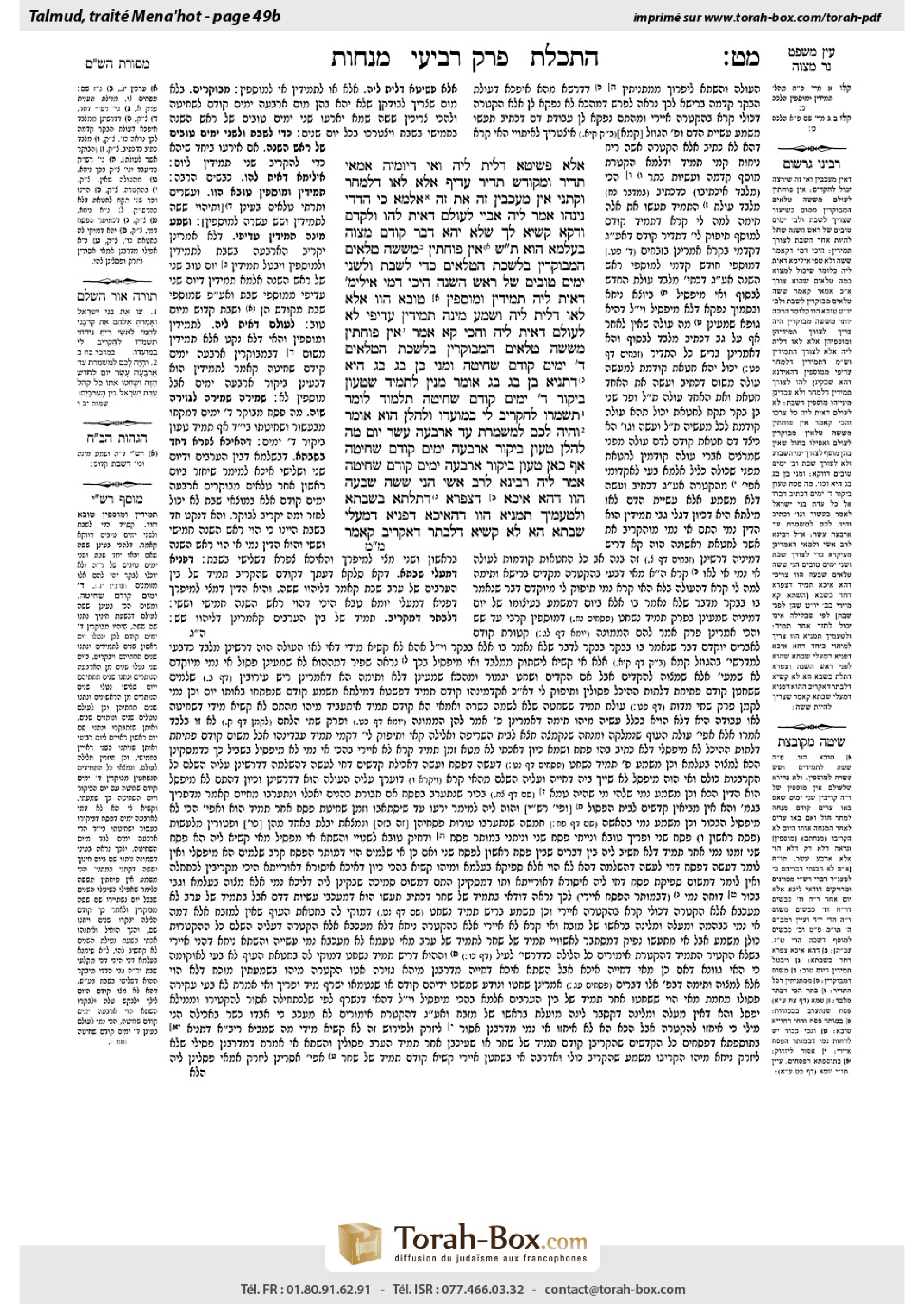
Menachot 49b: Talmud study for Daf Yomi
Daf Yomi is the daily study of one Talmud folio. Explore 37 tractates with scans, Hebrew text, Sefaria English and AI-generated French translations where annotated.
Passage selection and English or AI-generated French translation are available where the scan has annotations. Daf Study is independent of Torah-Box and Sefaria.
Browse Menachot · מנחות · All tractatesMenachot 49b text and translations
This page of Menachot includes the Aramaic text, an English translation and an AI-generated French translation, alongside the scan above.
מנחות מ״ט ב · Aramaic and Hebrew text
אֶלָּא פְּשִׁיטָא דְּלֵית לֵיהּ! וְאִי דְּיוֹמֵיהּ, אַמַּאי? תָּדִיר וּמְקוּדָּשׁ – תָּדִיר עָדִיף!
אֶלָּא לָאו דְּלִמְחַר, וְקָתָנֵי אֵין מְעַכְּבִין זֶה אֶת זֶה, אַלְמָא כִּי הֲדָדֵי נִינְהוּ.
אֲמַר לֵיהּ אַבָּיֵי: לְעוֹלָם דְּאִית לְהוּ, וּלְקַדֵּם. וּדְקָא קַשְׁיָא לָךְ שֶׁלֹּא יְהֵא דָּבָר קוֹדֵם – מִצְוָה בְּעָלְמָא הוּא.
תָּא שְׁמַע: אֵין פּוֹחֲתִין מִשִּׁשָּׁה טְלָאִים הַמְבוּקָּרִין בְּלִשְׁכַּת הַטְּלָאִים, כְּדֵי לַשַּׁבָּת וְלִשְׁנֵי יָמִים טוֹבִים שֶׁל רֹאשׁ הַשָּׁנָה.
הֵיכִי דָמֵי? אִילֵּימָא דְּאִית לֵיהּ תְּמִידִין וּמוּסָפִין – טוּבָא הֲווֹ!
אֶלָּא לָאו דְּלֵית לֵיהּ, וּשְׁמַע מִינַּהּ תְּמִידִין עֲדִיפִי!
לָא, לְעוֹלָם דְּאִית לֵיהּ, וְהָכִי קָא אָמַר: אֵין פּוֹחֲתִין מִשִּׁשָּׁה טְלָאִים הַמְבוּקָּרִין בְּלִשְׁכַּת הַטְּלָאִים אַרְבָּעָה יָמִים קוֹדֶם שְׁחִיטָה, וּמַנִּי? בֶּן בַּג בַּג הִיא.
דְּתַנְיָא, בֶּן בַּג בַּג אוֹמֵר: מִנַּיִן לְתָמִיד שֶׁטָּעוּן בִּיקּוּר אַרְבָּעָה יָמִים קוֹדֶם שְׁחִיטָה? תַּלְמוּד לוֹמַר ״תִּשְׁמְרוּ לְהַקְרִיב לִי בְּמוֹעֲדוֹ״, וּלְהַלָּן הוּא אוֹמֵר: ״וְהָיָה לָכֶם לְמִשְׁמֶרֶת עַד אַרְבָּעָה עָשָׂר יוֹם״.
מָה לְהַלָּן טָעוּן בִּיקּוּר אַרְבָּעָה יָמִים קוֹדֶם שְׁחִיטָה, אַף כָּאן טָעוּן בִּיקּוּר אַרְבָּעָה יָמִים קוֹדֶם שְׁחִיטָה.
אֲמַר לֵיהּ רָבִינָא לְרַב אָשֵׁי: הָנֵי שִׁשָּׁה? שִׁבְעָה הָווּ, דְּהָא אִיכָּא דְּצַפְרָא דִּתְלָתָא בְּשַׁבְּתָא!
וּלְטַעְמָיךְ, תְּמָנְיָא הָווּ, דְּהָאִיכָּא דְּפַנְיָא דְּמַעֲלֵי שַׁבְּתָא!
הָא לָא קַשְׁיָא, דִּלְבָתַר דְּאַקְרֵיב קָאָמַר.
Menachot 49b · English translation
Rather, it is obvious that the mishna is referring to a case where he does not have a sufficient number of animals for both offerings. And if it is referring to the offerings of that day, why does the mishna say that failure to sacrifice one does not prevent sacrifice of the other? Since the daily offering is more frequent and it is sanctified, and the additional offerings are sanctified but are less frequent than the daily offering, the frequent offering is given preference. Consequently, failure to sacrifice the daily offering should prevent the sacrifice of the additional offerings.
Rather, is it not referring to a case where the Temple treasury does not have enough animals for both the additional offerings of today and the daily offering of tomorrow, and yet the mishna teaches that failure to sacrifice one does not prevent one from sacrificing the other? Evidently, they are equal and he may sacrifice whichever offering he chooses. This would resolve Rabbi Ḥiyya bar Avin’s dilemma.
Abaye said to Rav Ḥisda: That is not a valid resolution of the dilemma, as one can claim that actually, the mishna is referring to a case where they have enough animals for all the offerings, and the mishna is referring to the issue of sacrificing one before the other. And with regard to that which poses a difficulty for you based upon the baraita that states that no sacrifice should precede the sacrifice of the daily offering of the morning, that baraita is merely stating the mitzva ab initio.
The Gemara suggests: Come and hear a resolution to Rabbi Ḥiyya bar Avin’s dilemma based upon a mishna (Arakhin 13a): One maintains no fewer than six lambs that have been inspected and found to be unblemished in the Chamber of the Lambs, sufficient for Shabbat and for the two festival days of Rosh HaShana that in some years occur adjacent to it.
The Gemara clarifies: What are the circumstances of this case? If we say that it is referring to a case where the Temple treasury has enough animals for all of the offerings that should be brought, six lambs are not enough, as there are many lambs sacrificed for daily offerings and additional offerings on those three days. In total, twenty-two lambs are required: Two each day for the daily offerings, two for the additional offering of Shabbat, seven for the additional offering of Rosh HaShana, and seven for the additional offering of the New Moon.
Rather, is it not that the mishna is referring to a case where the Temple treasury does not have enough animals for all of the offerings, and it is teaching that the animals that he does have are utilized for the daily offerings of all three days rather than for the additional offering of Shabbat on the first of the three days? Consequently, one may conclude from it that the daily offerings of tomorrow are given preference over the additional offerings of today.
The Gemara replies: No, this is not a valid proof, as one can claim that actually, the mishna is referring to a case where the Temple treasury has enough animals for all of the offerings of the three days, and this is what the mishna is saying when it mentions six lambs: One maintains for use as daily offerings no fewer than six lambs that have been inspected and found to be unblemished in the Chamber of the Lambs four days prior to their slaughter. Lambs sacrificed as other offerings do not have to be inspected four days prior to being slaughtered. And in accordance with whose opinion is this mishna? It is in accordance with the opinion of ben Bag Bag.
As it is taught in a baraita that ben Bag Bag says: From where is it derived that the daily offering requires inspection four days prior to its slaughter? The verse states with regard to the daily offering: “You shall observe [tishmeru] to sacrifice to Me in its due season” (Numbers 28:2), and elsewhere, with regard to the Paschal offering, the verse states: “On the tenth day of this month they shall take for them every man a lamb…and you shall keep it [mishmeret] until the fourteenth day of this month” (Exodus 12:3–6).
Consequently, it is derived by means of a verbal analogy that just as in the verse there, the Paschal offering requires inspection four days prior to its slaughter, from the tenth of the month to the fourteenth, so too here, the daily offering requires inspection four days prior to its slaughter. This is not a requirement that pertains to all offerings; it is stated specifically with regard to the Paschal offering and extended by means of a verbal analogy to the daily offering.
§ The Gemara cites a discussion pertaining to the mishna cited earlier. Ravina said to Rav Ashi: With regard to these six inspected lambs that must always be kept in the Chamber of Lambs, there ought to be seven, as there is a need for another lamb for the daily offering of the morning of the third day of the week, since it cannot be inspected on Shabbat or the subsequent festival days of Rosh HaShana, and therefore should be inspected and kept beforehand.
Rav Ashi responded to Ravina: According to your reasoning the correct number is not seven, but rather it is eight; as there is also the daily offering of the afternoon of Shabbat eve that should also be counted.
Ravina replied: That is not difficult, because the mishna is saying that after he sacrificed the daily offering of the afternoon there must be six inspected lambs.
Menachot 49b · Traduction française (IA)
En réalité, il est évident que la Michna parle d’un cas où il ne dispose pas d’un nombre suffisant d’animaux pour les deux sacrifices. Et si elle parle des sacrifices de ce jour-là, pourquoi la Michna dit-elle que l’omission de l’un n’empêche pas d’offrir l’autre ? Puisque le sacrifice quotidien est plus fréquent et qu’il est sanctifié, tandis que les sacrifices supplémentaires sont eux aussi sanctifiés, mais moins fréquents que le sacrifice quotidien, le sacrifice le plus fréquent a priorité. Par conséquent, l’omission du sacrifice quotidien devrait empêcher d’offrir les sacrifices supplémentaires.
Ne parle-t-elle pas plutôt d’un cas où le trésor du Temple ne dispose pas d’assez d’animaux pour les sacrifices supplémentaires de ce jour-là et pour le sacrifice quotidien du lendemain, et où la Michna enseigne néanmoins que l’omission de l’un n’empêche pas d’offrir l’autre ? Il en ressort qu’ils sont de même rang et qu’il peut offrir celui de son choix. Cela résoudrait le dilemme de Rabbi Ḥiyya bar Avin.
Abayé dit à Rav Ḥisda : Ce n’est pas une résolution valable du dilemme, car on peut soutenir qu’en réalité, la Michna parle d’un cas où ils disposent d’assez d’animaux pour tous les sacrifices, et qu’elle traite de la question de l’ordre dans lequel ils doivent être offerts. Quant à la difficulté que tu soulèves à partir de la baraïta, selon laquelle aucun sacrifice ne doit précéder le sacrifice quotidien du matin, cette baraïta énonce simplement la mitsva à accomplir a priori.
La Guemara propose : Viens et écoute une résolution au dilemme de Rabbi Ḥiyya bar Avin, fondée sur une Michna (Arakhin 13a) : On conserve dans la Chambre des Agneaux au moins six agneaux examinés et reconnus sans défaut, en nombre suffisant pour le Chabbat et les deux jours de fête de Roch Hachana qui, certaines années, lui sont contigus.
La Guemara précise : Dans quelles circonstances cela se produit-il ? Si nous disons qu’il s’agit d’un cas où le trésor du Temple dispose d’assez d’animaux pour tous les sacrifices à offrir, six agneaux ne suffisent pas, car de nombreux agneaux sont sacrifiés au titre des sacrifices quotidiens et supplémentaires pendant ces trois jours. Au total, vingt-deux agneaux sont nécessaires : deux chaque jour pour les sacrifices quotidiens, deux pour le sacrifice supplémentaire du Chabbat, sept pour le sacrifice supplémentaire de Roch Hachana et sept pour le sacrifice supplémentaire de la néoménie.
La Michna ne parle-t-elle pas plutôt d’un cas où le trésor du Temple ne dispose pas d’assez d’animaux pour tous les sacrifices, et n’enseigne-t-elle pas que les animaux dont il dispose sont utilisés pour les sacrifices quotidiens des trois jours plutôt que pour le sacrifice supplémentaire du Chabbat, le premier de ces trois jours ? On peut donc en conclure que les sacrifices quotidiens du lendemain ont priorité sur les sacrifices supplémentaires du jour présent.
La Guemara répond : Non, ce n’est pas une preuve valable, car on peut soutenir qu’en réalité, la Michna parle d’un cas où le trésor du Temple dispose d’assez d’animaux pour tous les sacrifices des trois jours, et que voici ce que signifie la Michna lorsqu’elle mentionne six agneaux : On conserve dans la Chambre des Agneaux, pour servir aux sacrifices quotidiens, au moins six agneaux examinés et reconnus sans défaut, quatre jours avant leur abattage. Les agneaux destinés à d’autres sacrifices n’ont pas à être examinés quatre jours avant leur abattage. Et selon l’opinion de qui cette Michna est-elle établie ? Selon celle de ben Bag Bag.
Comme il est enseigné dans une baraïta que ben Bag Bag dit : D’où déduit-on que le sacrifice quotidien doit être examiné quatre jours avant son abattage ? Le verset dit au sujet du sacrifice quotidien : « Vous veillerez [tishmeru] à Me l’offrir en son temps fixé » (Nombres 28, 2), et ailleurs, au sujet du sacrifice pascal, le verset dit : « Le dixième jour de ce mois, chacun prendra pour soi un agneau… et vous le garderez [mishmeret] jusqu’au quatorzième jour de ce mois » (Exode 12, 3–6).
On déduit donc, au moyen d’une analogie verbale, que de même que, dans le verset cité là-bas, le sacrifice pascal doit être examiné quatre jours avant son abattage, du dixième au quatorzième du mois, de même, ici, le sacrifice quotidien doit être examiné quatre jours avant son abattage. Cette obligation ne concerne pas tous les sacrifices : elle est énoncée spécifiquement au sujet du sacrifice pascal, puis étendue au sacrifice quotidien au moyen d’une analogie verbale.
§ La Guemara rapporte une discussion concernant la Michna citée précédemment. Ravina dit à Rav Achi : Au sujet de ces six agneaux examinés qui doivent toujours être conservés dans la Chambre des Agneaux, il devrait y en avoir sept, puisqu’il faut un autre agneau pour le sacrifice quotidien du matin du troisième jour de la semaine : il ne peut être examiné ni le Chabbat ni les jours de fête de Roch Hachana qui suivent ; il devrait donc être examiné et conservé à l’avance.
Rav Achi répondit à Ravina : Selon ton raisonnement, le nombre correct n’est pas sept, mais huit, car il faut également compter le sacrifice quotidien de l’après-midi de la veille du Chabbat.
Ravina répondit : Cela ne pose pas de difficulté, car la Michna dit qu’après avoir offert le sacrifice quotidien de l’après-midi, il doit rester six agneaux examinés.
Traduction française générée par IA à partir de l’édition anglaise de Sefaria. Vérifie toujours un passage avec le texte source.
Text from Sefaria: William Davidson Edition - Vocalized Aramaic (unknown); William Davidson Edition - English (CC BY NC).