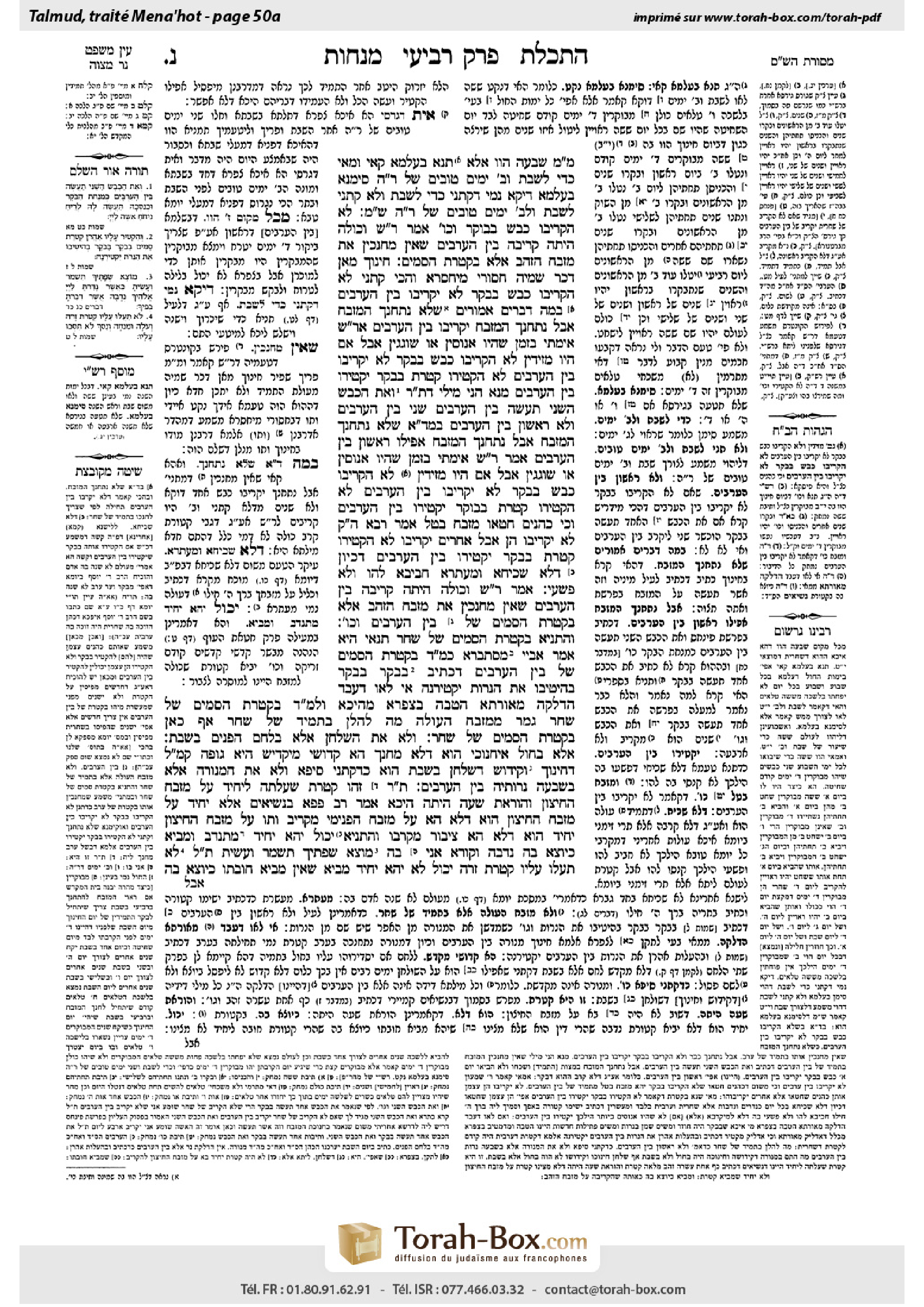
Menachot 50a: Talmud study for Daf Yomi
Daf Yomi is the daily study of one Talmud folio. Explore 37 tractates with scans, Hebrew text, Sefaria English and AI-generated French translations where annotated.
Passage selection and English or AI-generated French translation are available where the scan has annotations. Daf Study is independent of Torah-Box and Sefaria.
Browse Menachot · מנחות · All tractatesMenachot 50a text and translations
This page of Menachot includes the Aramaic text, an English translation and an AI-generated French translation, alongside the scan above.
מנחות נ׳ א · Aramaic and Hebrew text
מִכׇּל מָקוֹם שִׁבְעָה הָווּ! אֶלָּא, תַּנָּא בְּעָלְמָא קָאֵי, וּמַאי כְּדֵי לַשַּׁבָּת וּשְׁנֵי יָמִים טוֹבִים שֶׁל רֹאשׁ הַשָּׁנָה? סִימָנָא בְּעָלְמָא.
דַּיְקָא נָמֵי, דְּקָתָנֵי ״כְּדֵי לַשַּׁבָּת״, וְלָא קָתָנֵי ״לְשַׁבָּת וְלִשְׁנֵי יָמִים טוֹבִים שֶׁל רֹאשׁ הַשָּׁנָה״, שְׁמַע מִינַּהּ.
לֹא הִקְרִיבוּ כֶּבֶשׂ בַּבּוֹקֶר וְכוּ׳. אָמַר רַבִּי שִׁמְעוֹן: וְכוּלָּהּ הָיְתָה קְרֵיבָה בֵּין הָעַרְבַּיִם, שֶׁאֵין מְחַנְּכִין אֶת מִזְבַּח הַזָּהָב אֶלָּא בִּקְטֹרֶת הַסַּמִּים. חִינּוּךְ מַאן דְּכַר שְׁמֵיהּ?!
חַסּוֹרֵי מִיחַסְּרָא וְהָכִי קָתָנֵי: לֹא הִקְרִיבוּ כֶּבֶשׂ בַּבֹּקֶר – לֹא יַקְרִיבוּ בֵּין הָעַרְבָּיִם. בַּמֶּה דְּבָרִים אֲמוּרִים? שֶׁלֹּא נִתְחַנֵּךְ הַמִּזְבֵּחַ, אֲבָל נִתְחַנֵּךְ הַמִּזְבֵּחַ – יַקְרִיבוּ בֵּין הָעַרְבָּיִם.
אָמַר רַבִּי שִׁמְעוֹן: אֵימָתַי? בִּזְמַן שֶׁהָיוּ אֲנוּסִין אוֹ שׁוֹגְגִין, אֲבָל אִם הָיוּ מְזִידִין – לֹא הִקְרִיבוּ כֶּבֶשׂ בַּבֹּקֶר, לֹא יַקְרִיבוּ בֵּין הָעַרְבַּיִם. לֹא הִקְטִירוּ קְטֹרֶת בַּבֹּקֶר, יַקְטִירוּ בֵּין הָעַרְבַּיִם.
מְנָא הָנֵי מִילֵּי? דְּתָנוּ רַבָּנַן: ״וְאֵת הַכֶּבֶשׂ הַשֵּׁנִי תַּעֲשֶׂה בֵּין הָעַרְבָּיִם״ – שֵׁנִי בֵּין הָעַרְבָּיִם, וְלֹא רִאשׁוֹן בֵּין הָעַרְבָּיִם.
בַּמֶּה דְּבָרִים אֲמוּרִים? שֶׁלֹּא נִתְחַנֵּךְ הַמִּזְבֵּחַ, אֲבָל נִתְחַנֵּךְ הַמִּזְבֵּחַ – אֲפִילּוּ רִאשׁוֹן בֵּין הָעַרְבָּיִם.
אָמַר רַבִּי שִׁמְעוֹן: אֵימָתַי? בִּזְמַן שֶׁהָיוּ אֲנוּסִין אוֹ שׁוֹגְגִין, אֲבָל אִם הָיוּ מְזִידִין – לֹא הִקְרִיבוּ כֶּבֶשׂ בַּבֹּקֶר, לֹא יַקְרִיבוּ בֵּין הָעַרְבָּיִם. לֹא הִקְטִירוּ קְטֹרֶת בַּבּוֹקֶר – יַקְטִירוּ בֵּין הָעַרְבָּיִם.
וְכִי כֹהֲנִים חָטְאוּ, מִזְבֵּחַ בָּטֵל?! אָמַר רָבָא: הָכִי קָאָמַר – לֹא יַקְרִיבוּ הֵן, אֲבָל אֲחֵרִים יַקְרִיבוּ.
לֹא הִקְטִירוּ קְטֹרֶת בַּבֹּקֶר, יַקְטִירוּ בֵּין הָעַרְבָּיִם, דְּכֵיוָן דְּלָא שְׁכִיחָא, וּמְעַתְּרָא, חֲבִיבָא לְהוּ וְלָא פָּשְׁעִי.
אָמַר רַבִּי שִׁמְעוֹן: וְכוּלָּהּ הָיְתָה קְרֵיבָה בֵּין הָעַרְבָּיִם, שֶׁאֵין מְחַנְּכִין אֶת מִזְבַּח הַזָּהָב אֶלָּא בִּקְטֹרֶת הַסַּמִּים שֶׁל בֵּין הָעַרְבָּיִם וְכוּ׳. וְהָתַנְיָא: בִּקְטֹרֶת הַסַּמִּים שֶׁל שַׁחַר! תַּנָּאֵי הִיא.
אָמַר אַבָּיֵי: מִסְתַּבְּרָא כְּמַאן דְּאָמַר בִּקְטֹרֶת הַסַּמִּים שֶׁל בֵּין הָעַרְבָּיִם, דִּכְתִיב: ״בַּבֹּקֶר בַּבֹּקֶר בְּהֵיטִיבוֹ אֶת הַנֵּרוֹת יַקְטִירֶנָּה״.
אִי לָאו דַּעֲבַד הַדְלָקָה מֵאוּרְתָּא, הֲטָבָה בְּצַפְרָא מֵהֵיכָא?
וּלְמַאן דְּאָמַר בִּקְטֹרֶת הַסַּמִּים שֶׁל שַׁחַר, גָּמַר מִמִּזְבַּח הָעוֹלָה: מָה לְהַלָּן בְּתָמִיד שֶׁל שַׁחַר – אַף כָּאן בִּקְטֹרֶת הַסַּמִּים שֶׁל שַׁחַר.
וְלֹא אֶת הַשֻּׁלְחָן אֶלָּא בְּלֶחֶם הַפָּנִים בְּשַׁבָּת, אֶלָּא בְּחוֹל – אִיחַנּוֹכֵי הוּא דְּלָא מִחַנַּךְ, הָא קַדּוֹשֵׁי מְיקַדֵּישׁ?!
הִיא גּוּפַהּ קָא מַשְׁמַע לַן, דְּחִינּוּךְ וְקִידּוּשׁ דְּשֻׁלְחָן בְּשַׁבָּת הוּא, כִּדְקָתָנֵי סֵיפָא: וְלֹא אֶת הַמְּנוֹרָה אֶלָּא בְּשִׁבְעָה נֵרוֹתֶיהָ בֵּין הָעַרְבָּיִם.
תָּנוּ רַבָּנַן: (זֶהוּ) [זוֹהִי] קְטֹרֶת שֶׁעָלְתָה לְיָחִיד עַל מִזְבֵּחַ הַחִיצוֹן, וְהוֹרָאַת שָׁעָה הָיְתָה. הֵיכָא? אָמַר רַב פָּפָּא: בַּנְּשִׂיאִים.
אֶלָּא יָחִיד עַל מִזְבֵּחַ הַחִיצוֹן הוּא דְּלָא, הָא עַל מִזְבֵּחַ הַפְּנִימִי מַקְרֵיב? וְתוּ: עַל מִזְבֵּחַ הַחִיצוֹן יָחִיד הוּא דְּלָא, הָא צִיבּוּר מַקְרְבִי?
וְהָתַנְיָא: יָכוֹל יְהֵא יָחִיד מִתְנַדֵּב וּמֵבִיא כְּיוֹצֵא בָּהּ נְדָבָה, וְקוֹרֵא אֲנִי בָּהּ ״מוֹצָא שְׂפָתֶיךָ תִּשְׁמֹר וְעָשִׂיתָ״? תַּלְמוּד לוֹמַר: ״לֹא תַעֲלוּ עָלָיו קְטֹרֶת זָרָה״.
יָכוֹל לֹא יְהֵא יָחִיד מֵבִיא, שֶׁאֵין מֵבִיא חוֹבָתוֹ כְּיוֹצֵא בָּהּ,
Menachot 50a · English translation
The Gemara asks: In any case, the question stands: Why does the mishna say six lambs when, in fact the number required is seven? The Gemara answers: Rather, the tanna is speaking generally, referring to how many inspected lambs are required throughout the year. And what did he mean by his statement: Sufficient for Shabbat and for the two festival days of Rosh HaShana? It is merely intended as a mnemonic, to help one remember that there must be enough lambs for the daily offering of three days.
According to this the language of the mishna is also precise, as it teaches: Sufficient for Shabbat and for the two festival days of Rosh HaShana, and it does not teach that there must be six lambs for Shabbat and for the two festival days of Rosh HaShana, which would have indicated that these lambs are meant to actually be sacrificed on those days. The Gemara concludes that in fact one can learn from the language of the mishna that this is the correct interpretation.
§ The mishna teaches: If the priests did not sacrifice a lamb in the morning as the daily offering, nevertheless, they should sacrifice a lamb in the afternoon as the daily offering. If they did not burn the half-measure of incense in the morning, they should burn the half-measure in the afternoon. Rabbi Shimon said: And in such a case, the entire measure was sacrificed in the afternoon, as the daily service on a new golden altar is initiated only with the burning of the incense of the spices in the afternoon, at which time they would burn a full measure. The Gemara asks: Who mentioned anything about the initiation of the Temple vessels, i.e., what is its relevance to the mishna?
The Gemara answers that the mishna is incomplete, and this is what it is teaching: If they did not sacrifice a lamb for the daily offering in the morning, they should not sacrifice a lamb in the afternoon. In what case is this statement said? It is said in a case where the service of a new altar had not yet been initiated, since it must first be initiated with the daily offering of the morning. But if the service of the altar had already been initiated, then they should sacrifice the lamb of the daily offering in the afternoon even though they did not sacrifice the lamb of the morning offering.
Rabbi Shimon said: When does this halakha apply? It applies at a time when the failure to sacrifice the daily morning offering was because they were prevented from sacrificing it due to circumstances beyond their control or they failed to sacrifice it unwittingly. But if the priests acted intentionally and did not sacrifice a lamb in the morning as the daily offering, they should not sacrifice a lamb in the afternoon as the daily offering. By contrast, if they did not burn the half-measure of incense in the morning, they should burn the half-measure in the afternoon regardless of the circumstances.
The Gemara asks: From where are these matters derived, that if the lamb of the daily offering of the morning was not sacrificed and the service of a new altar had not yet been initiated, then the lamb of the afternoon is also not sacrificed? The Gemara explains that it is derived as the Sages taught in a baraita: “The one lamb you shall offer in the morning; and the second lamb you shall offer in the afternoon” (Exodus 29:39). This verse teaches that the second lamb of the daily offering is sacrificed in the afternoon, but if it is the first one to be sacrificed, it may not be sacrificed in the afternoon.
In what case is this statement said? It is said in a case where the service of a new altar had not yet been initiated, since it must first be initiated with the offering of the morning. When the verse refers to the first or second offering, it means the first or second offering ever sacrificed on the altar. But if the service of the altar had already been initiated, then even if it is the first to be sacrificed that day, it should be sacrificed in the afternoon.
Rabbi Shimon said: When does this halakha apply? It applies at a time when the failure to sacrifice the daily morning offering was because they were prevented from sacrificing it due to circumstances beyond their control or they failed to sacrifice it unwittingly. But if the priests acted intentionally and did not sacrifice a lamb in the morning as the daily offering, they should not sacrifice a lamb in the afternoon as the daily offering. By contrast, if they did not burn the half-measure of incense in the morning, they should burn the half-measure in the afternoon regardless of the circumstances.
The Gemara asks: Does it make sense that because the priests sinned by intentionally failing to sacrifice the morning daily offering, the altar should be entirely idle? Rava said that this is what Rabbi Shimon is saying: They, the priests who deliberately failed to sacrifice the morning daily offering, should not sacrifice the afternoon daily offering; but other priests should sacrifice it.
By contrast, if the priests acted intentionally and did not burn the incense in the morning, even those same priests may burn it in the afternoon. The reason for this is that since burning the incense is uncommon and causes those who do so to become wealthy, it is dear to the priests, and they will not be negligent in the performance of this rite.
§ The mishna teaches that if they did not burn the half-measure of incense in the morning, they should burn the half-measure in the afternoon. Rabbi Shimon said: And in such a case, the entire measure was sacrificed in the afternoon. The reason for the difference between the daily offerings and the incense is that the daily service on a new golden altar is initiated only with the burning of the incense of the spices of the afternoon, at which time they would burn a full measure. The Gemara asks: But isn’t it taught in a baraita: The service of a new golden altar is initiated with the burning of the incense of the spices of the morning? The Gemara answers: The question of whether the incense of the morning or the afternoon initiates the service of a new golden altar is a dispute between tanna’im.
Abaye said: It stands to reason that the halakha should be in accordance with the one who says that it was initiated with the incense of the spices of the afternoon, as it is written with regard to the golden altar: “And Aaron shall burn thereon incense of sweet spices; every morning, when he dresses the lamps, he shall burn it. And when Aaron lights the lamps at dusk, he shall burn it, a perpetual incense before the Lord throughout your generations” (Exodus 30:7–8).
The fact that ashes are removed from the lamps of the Candelabrum in the morning indicates that the lamps had been lit previously, since if the priest had not performed the lighting of the lamps the previous evening, from where would the ashes be removed in the morning? This proves that the Candelabrum must have been lit for the first time in the evening. Since the verse states: “When Aaron lights the lamps at dusk, he shall burn it, a perpetual incense before the Lord,” it must be that the incense was burned for the first time in the evening.
The Gemara asks: And according to the one who says that the service of a new golden altar is initiated with the burning of the incense of the spices of the morning, from where is this halakha derived? The Gemara answers: He derives it from the initiation of the altar of the burnt offering. Just as there, the service of a new altar of the burnt offering is initiated by means of the daily offering of the morning rather than the afternoon, so too here, the service of a new golden altar is initiated by means of the burning of the incense of the spices of the morning.
§ The mishna teaches: And use of a new Table was initiated only with the arrangement of the shewbread on Shabbat. The Gemara asks: But does the mishna mean to indicate that if the shewbread was placed on the Table on a weekday it is merely that the use of a new Table is not initiated, but the shewbread is sanctified? The halakha is that the shewbread is sanctified only when it is placed on the Table on Shabbat.
The Gemara answers: The mishna teaches us this halakha itself, that the initiation of the use of a new Table and the sanctification of the shewbread when it is placed on the Table occur only on Shabbat. This is as the mishna teaches in the latter clause with regard to the initiation of the use of a new Candelabrum: And use of a new Candelabrum was initiated only with the kindling of its seven lamps in the afternoon.
§ The Gemara cites another halakha relating to the burning of incense. The Sages taught in a baraita: This is incense that was offered for an individual rather than the community on the external altar, and not on the golden altar as usual; and this was a provisional edict, permitted temporarily for that time only. The Gemara clarifies: To what case is the baraita referring? Rav Pappa said: It is referring to the incense brought by the tribal princes at the inauguration of the Tabernacle (see Numbers, chapter 7).
The Gemara asks: But with regard to the incense of an individual, is it only on the external altar that it is not generally permitted to be burned, but an individual may sacrifice incense on the inner altar, as indicated by the baraita? And furthermore, on the external altar, is it only an individual who may not sacrifice incense, but the community may sacrifice incense on the external altar?
But isn’t it taught in a baraita contrary to those two inferences: One might have thought that an individual may voluntarily donate and bring incense similar to the incense brought by the tribal princes to the Temple as a gift offering, and I will read with regard to this incense, as in the case of other gift offerings: “That which has gone out of your lips you shall observe and do” (Deuteronomy 23:24). Therefore, the verse states concerning the inner altar: “You shall bring no strange incense thereon” (Exodus 30:9). This indicates that an individual may not sacrifice incense even on the inner altar.
One might have thought that only an individual may not bring a gift of incense on the inner altar, as an individual does not bring his obligatory offering similar to this gift of incense, i.e., since an individual is never obligated to sacrifice incense, he may not voluntarily sacrifice incense either;
Menachot 50a · Traduction française (IA)
La Guemara demande : Quoi qu’il en soit, la question demeure : pourquoi la Michna dit-elle six agneaux, alors qu’il en faut en réalité sept ? La Guemara répond : Le tanna parle plutôt de manière générale du nombre d’agneaux inspectés nécessaires au cours de l’année. Que voulait-il donc dire par ces mots : « Suffisants pour Chabbat et pour les deux jours de fête de Roch Hachana » ? Il s’agit simplement d’un moyen mnémotechnique, destiné à rappeler qu’il faut assez d’agneaux pour les offrandes quotidiennes de trois jours.
Selon cette interprétation, la formulation de la Michna est également précise : elle enseigne « Suffisants pour Chabbat et pour les deux jours de fête de Roch Hachana », et non qu’il faut six agneaux pour Chabbat et les deux jours de fête de Roch Hachana, ce qui aurait indiqué que ces agneaux devaient effectivement être sacrifiés ces jours-là. La Guemara conclut qu’on peut effectivement déduire de la formulation de la Michna que telle est l’interprétation correcte.
§ La Michna enseigne : Si les prêtres n’ont pas sacrifié d’agneau le matin comme offrande quotidienne, ils doivent néanmoins en sacrifier un l’après-midi comme offrande quotidienne. S’ils n’ont pas brûlé la demi-dose d’encens le matin, ils doivent brûler la demi-dose l’après-midi. Rabbi Chimon a dit : Dans un tel cas, la dose entière était sacrifiée l’après-midi, car le service quotidien sur un nouvel autel d’or ne commence qu’avec la combustion de l’encens aromatique l’après-midi, moment où l’on brûlait une dose entière. La Guemara demande : Qui a parlé de l’inauguration des ustensiles du Temple, c’est-à-dire quel rapport cela a-t-il avec la Michna ?
La Guemara répond que la Michna est incomplète et qu’elle enseigne ceci : Si les prêtres n’ont pas sacrifié d’agneau pour l’offrande quotidienne le matin, ils ne doivent pas en sacrifier un l’après-midi. Dans quel cas cette déclaration s’applique-t-elle ? Lorsque le service d’un nouvel autel n’avait pas encore été inauguré, car il doit d’abord l’être par l’offrande quotidienne du matin. Mais si le service de l’autel avait déjà été inauguré, ils doivent sacrifier l’agneau de l’offrande quotidienne l’après-midi, même s’ils n’ont pas sacrifié l’agneau de l’offrande du matin.
Rabbi Chimon a dit : Quand cette halakha s’applique-t-elle ? Lorsque l’omission de l’offrande quotidienne du matin était due au fait qu’ils avaient été empêchés de la sacrifier par des circonstances indépendantes de leur volonté, ou qu’ils avaient omis de la sacrifier par inadvertance. Mais si les prêtres ont agi délibérément et n’ont pas sacrifié d’agneau le matin comme offrande quotidienne, ils ne doivent pas en sacrifier un l’après-midi comme offrande quotidienne. En revanche, s’ils n’ont pas brûlé la demi-dose d’encens le matin, ils doivent brûler la demi-dose l’après-midi, quelles que soient les circonstances.
La Guemara demande : De quelle source déduit-on ces règles, selon lesquelles, si l’agneau de l’offrande quotidienne du matin n’a pas été sacrifié et que le service d’un nouvel autel n’avait pas encore été inauguré, l’agneau de l’après-midi n’est pas non plus sacrifié ? La Guemara explique qu’on le déduit de ce que les Sages ont enseigné dans une baraïta : « Tu offriras un agneau le matin, et le second agneau, tu l’offriras l’après-midi » (Exode 29,39). Ce verset enseigne que le second agneau de l’offrande quotidienne est sacrifié l’après-midi, mais que s’il s’agit du premier à être sacrifié, il ne peut pas l’être l’après-midi.
Dans quel cas cette déclaration s’applique-t-elle ? Lorsque le service d’un nouvel autel n’avait pas encore été inauguré, car il doit d’abord l’être par l’offrande du matin. Lorsque le verset parle de la première ou de la seconde offrande, il s’agit de la première ou de la seconde offrande jamais sacrifiée sur l’autel. Mais si le service de l’autel avait déjà été inauguré, alors, même s’il s’agit de la première offrande sacrifiée ce jour-là, elle doit être sacrifiée l’après-midi.
Rabbi Chimon a dit : Quand cette halakha s’applique-t-elle ? Lorsque l’omission de l’offrande quotidienne du matin était due au fait qu’ils avaient été empêchés de la sacrifier par des circonstances indépendantes de leur volonté, ou qu’ils avaient omis de la sacrifier par inadvertance. Mais si les prêtres ont agi délibérément et n’ont pas sacrifié d’agneau le matin comme offrande quotidienne, ils ne doivent pas en sacrifier un l’après-midi comme offrande quotidienne. En revanche, s’ils n’ont pas brûlé la demi-dose d’encens le matin, ils doivent brûler la demi-dose l’après-midi, quelles que soient les circonstances.
La Guemara demande : Est-il logique que, parce que les prêtres ont péché en omettant délibérément de sacrifier l’offrande quotidienne du matin, l’autel reste entièrement inactif ? Rava dit que voici ce que Rabbi Chimon veut dire : Eux, les prêtres qui ont délibérément omis de sacrifier l’offrande quotidienne du matin, ne doivent pas sacrifier celle de l’après-midi ; mais d’autres prêtres doivent le faire.
En revanche, si les prêtres ont agi délibérément et n’ont pas brûlé l’encens le matin, ces mêmes prêtres peuvent le brûler l’après-midi. En effet, comme la combustion de l’encens est peu fréquente et rend riches ceux qui l’accomplissent, elle est précieuse aux yeux des prêtres, qui ne négligeront donc pas ce rite.
§ La Michna enseigne que, s’ils n’ont pas brûlé la demi-dose d’encens le matin, ils doivent brûler la demi-dose l’après-midi. Rabbi Chimon a dit : Dans un tel cas, la dose entière était sacrifiée l’après-midi. La différence entre les offrandes quotidiennes et l’encens tient au fait que le service sur un nouvel autel d’or ne commence qu’avec la combustion de l’encens aromatique l’après-midi, moment où l’on brûlait une dose entière. La Guemara demande : Mais n’est-il pas enseigné dans une baraïta que le service d’un nouvel autel d’or commence avec la combustion de l’encens aromatique du matin ? La Guemara répond : La question de savoir si le service d’un nouvel autel d’or commence avec l’encens du matin ou avec celui de l’après-midi fait l’objet d’une discussion entre tannaïm.
Abayé dit : Il est logique que la halakha suive l’opinion selon laquelle le service était inauguré par l’encens aromatique de l’après-midi, car il est écrit au sujet de l’autel d’or : « Aaron y fera brûler un encens aromatique ; chaque matin, lorsqu’il arrangera les lampes, il le fera brûler. Et lorsque Aaron allumera les lampes au crépuscule, il le fera brûler : un encens perpétuel devant le Seigneur, pour vos générations » (Exode 30,7-8).
Le fait que les cendres soient retirées le matin des lampes de la Ménorah indique que celles-ci avaient été allumées auparavant, car si le prêtre n’avait pas allumé les lampes la veille au soir, d’où aurait-on retiré les cendres le matin ? Cela prouve que la Ménorah devait être allumée pour la première fois le soir. Puisque le verset dit : « Lorsque Aaron allumera les lampes au crépuscule, il le fera brûler : un encens perpétuel devant le Seigneur », il faut conclure que l’encens était brûlé pour la première fois le soir.
La Guemara demande : Et selon celui qui dit que le service d’un nouvel autel d’or commence par la combustion de l’encens aromatique du matin, de quelle source déduit-il cette halakha ? La Guemara répond : Il la déduit de l’inauguration de l’autel des holocaustes. De même que là-bas, le service d’un nouvel autel des holocaustes commence par l’offrande quotidienne du matin plutôt que par celle de l’après-midi, de même ici, le service d’un nouvel autel d’or commence par la combustion de l’encens aromatique du matin.
§ La Michna enseigne : L’utilisation d’une nouvelle Table n’était inaugurée que par la disposition du pain de proposition le Chabbat. La Guemara demande : La Michna veut-elle dire que, si le pain de proposition était placé sur la Table un jour de semaine, seule l’utilisation d’une nouvelle Table n’était pas inaugurée, mais que le pain de proposition était néanmoins sanctifié ? La halakha est que le pain de proposition n’est sanctifié que lorsqu’il est placé sur la Table le Chabbat.
La Guemara répond : La Michna nous enseigne précisément cette halakha : l’inauguration de l’utilisation d’une nouvelle Table et la sanctification du pain de proposition lorsqu’il y est placé n’ont lieu que le Chabbat. C’est ce qu’enseigne la Michna dans la clause suivante au sujet de l’inauguration de l’utilisation d’une nouvelle Ménorah : L’utilisation d’une nouvelle Ménorah n’était inaugurée que par l’allumage de ses sept lampes l’après-midi.
§ La Guemara cite une autre halakha concernant la combustion de l’encens. Les Sages ont enseigné dans une baraïta : Il s’agit d’encens offert par un particulier, et non par la communauté, sur l’autel extérieur, et non sur l’autel d’or comme à l’accoutumée ; il s’agissait d’un décret provisoire, autorisé uniquement pour cette période. La Guemara précise : À quel cas la baraïta fait-elle référence ? Rav Pappa dit : Elle fait référence à l’encens apporté par les princes des tribus lors de l’inauguration du Tabernacle (voir Nombres, chapitre 7).
La Guemara demande : Mais, concernant l’encens offert par un particulier, est-il seulement interdit de le brûler sur l’autel extérieur, tandis qu’un particulier peut en sacrifier sur l’autel intérieur, comme l’indique la baraïta ? Et en outre, sur l’autel extérieur, est-il seulement interdit à un particulier d’offrir de l’encens, tandis que la communauté peut en offrir sur cet autel ?
Mais n’est-il pas enseigné dans une baraïta le contraire de ces deux déductions : On aurait pu penser qu’un particulier peut faire don volontairement d’encens et l’apporter au Temple, à l’image de l’encens offert par les princes des tribus, comme offrande volontaire, et appliquer à cet encens, comme aux autres offrandes volontaires, le verset : « Tu observeras et tu accompliras ce qui est sorti de tes lèvres » (Deutéronome 23,24). C’est pourquoi le verset dit, au sujet de l’autel intérieur : « Vous n’y brûlerez pas d’encens étranger » (Exode 30,9). Cela indique qu’un particulier ne peut offrir de l’encens même sur l’autel intérieur.
On aurait pu penser que seul un particulier ne peut pas apporter une offrande volontaire d’encens sur l’autel intérieur, puisqu’un particulier n’apporte pas d’offrande obligatoire semblable à cette offrande volontaire d’encens ; autrement dit, comme un particulier n’est jamais tenu d’offrir de l’encens, il ne peut pas non plus en offrir volontairement ;
Traduction française générée par IA à partir de l’édition anglaise de Sefaria. Vérifie toujours un passage avec le texte source.
Text from Sefaria: William Davidson Edition - Vocalized Aramaic (unknown); William Davidson Edition - English (CC BY NC).