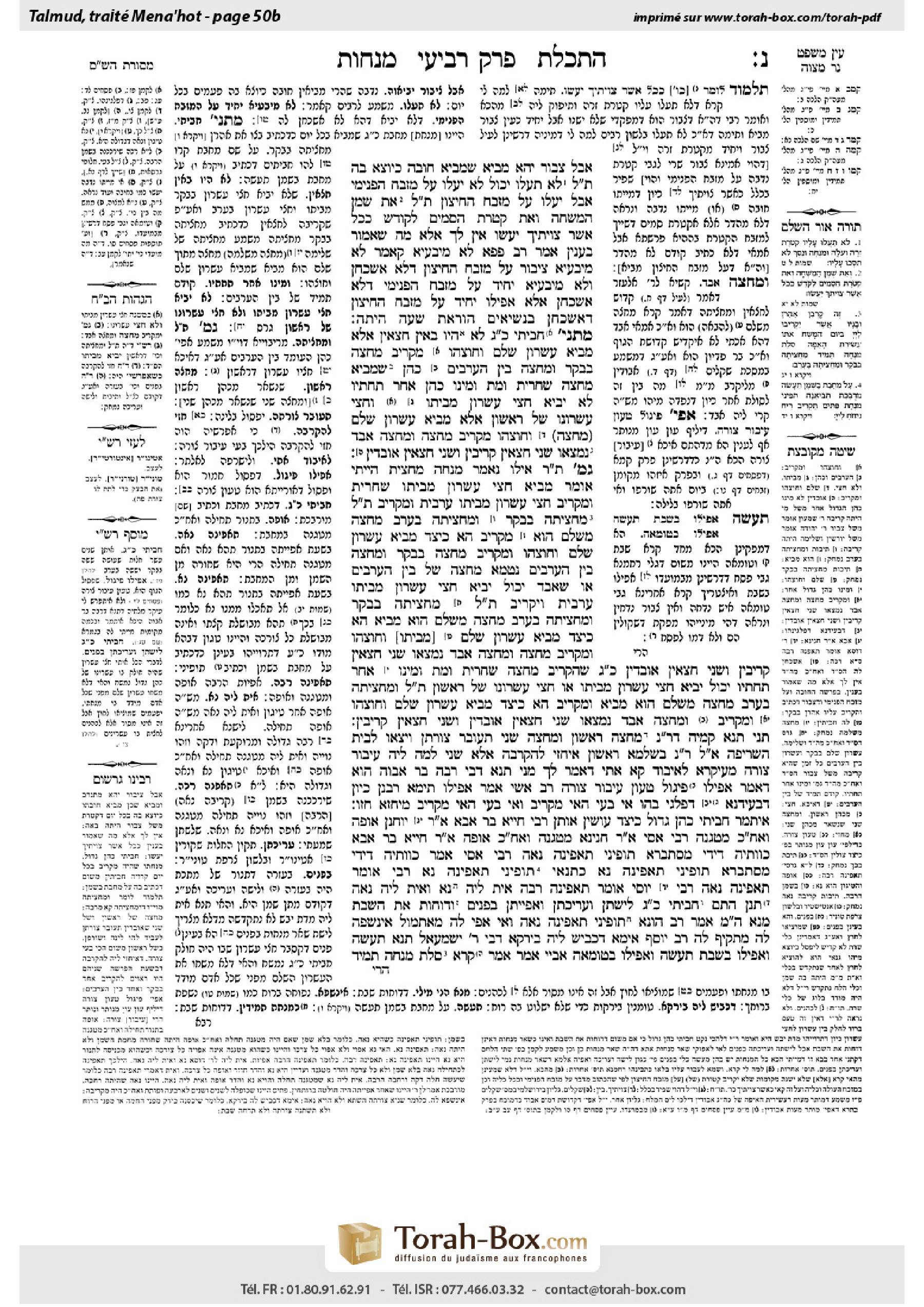
Menachot 50b: Talmud study for Daf Yomi
Daf Yomi is the daily study of one Talmud folio. Explore 37 tractates with scans, Hebrew text, Sefaria English and AI-generated French translations where annotated.
Passage selection and English or AI-generated French translation are available where the scan has annotations. Daf Study is independent of Torah-Box and Sefaria.
Browse Menachot · מנחות · All tractatesMenachot 50b text and translations
This page of Menachot includes the Aramaic text, an English translation and an AI-generated French translation, alongside the scan above.
מנחות נ׳ ב · Aramaic and Hebrew text
אֲבָל צִבּוּר יְהֵא מֵבִיא, שֶׁמֵּבִיא חוֹבָה כְּיוֹצֵא בָּהּ, תַּלְמוּד לוֹמַר ״לֹא תַעֲלוּ״.
יָכוֹל לֹא יַעֲלוּ עַל מִזְבֵּחַ הַפְּנִימִי, אֲבָל יַעֲלוּ עַל מִזְבֵּחַ הַחִיצוֹן? תַּלְמוּד לוֹמַר: ״אֶת שֶׁמֶן הַמִּשְׁחָה וְאֶת קְטֹרֶת הַסַּמִּים לַקֹּדֶשׁ כְּכֹל אֲשֶׁר צִוִּיתִךָ יַעֲשׂוּ״ – אֵין לְךָ אֶלָּא מַה שֶּׁאָמוּר בָּעִנְיָן.
אָמַר רַב פָּפָּא: לָא מִיבַּעְיָא קָאָמַר, לָא מִיבַּעְיָא צִיבּוּר עַל מִזְבֵּחַ הַחִיצוֹן, דְּלָא אַשְׁכְּחַן, וְלָא מִיבַּעְיָא יָחִיד עַל מִזְבֵּחַ הַפְּנִימִי, דְּלָא אַשְׁכְּחַן, אֶלָּא אֲפִילּוּ יָחִיד עַל מִזְבֵּחַ הַחִיצוֹן, דְּאַשְׁכְּחַן בִּנְשִׂיאִים – הוֹרָאַת שָׁעָה הָיְתָה.
מַתְנִי׳ חֲבִיתֵּי כֹּהֵן גָּדוֹל לֹא הָיוּ בָּאִין חֲצָאִין, אֶלָּא מֵבִיא עִשָּׂרוֹן שָׁלֵם וְחוֹצֵהוּ, מַקְרִיב מֶחֱצָה בַּבֹּקֶר וּמֶחֱצָה בֵּין הָעַרְבָּיִם.
כֹּהֵן שֶׁמֵּבִיא מֶחֱצָה שַׁחֲרִית, וָמֵת, וּמִינּוּ כֹּהֵן אַחֵר תַּחְתָּיו – לֹא יָבִיא חֲצִי עִשָּׂרוֹן מִבֵּיתוֹ וַחֲצִי עֶשְׂרוֹנוֹ שֶׁל רִאשׁוֹן, אֶלָּא מֵבִיא עִשָּׂרוֹן שָׁלֵם (מֶחֱצָה) וְחוֹצֵהוּ, מַקְרִיב מֶחֱצָה וּמֶחֱצָה אָבֵד. נִמְצְאוּ שְׁנֵי חֲצָאִין קְרֵיבִין, וּשְׁנֵי חֲצָאִין אוֹבְדִין.
גְּמָ׳ תָּנוּ רַבָּנַן: אִילּוּ נֶאֱמַר ״מִנְחָה מַחֲצִית״, הָיִיתִי אוֹמֵר מֵבִיא חֲצִי עִשָּׂרוֹן מִבֵּיתוֹ שַׁחֲרִית וּמַקְרִיב, חֲצִי עִשָּׂרוֹן מִבֵּיתוֹ עַרְבִית וּמַקְרִיב.
תַּלְמוּד לוֹמַר ״מַחֲצִיתָהּ בַּבֹּקֶר וּמַחֲצִיתָהּ בָּעָרֶב״ – מֶחֱצָה מִשָּׁלֵם הוּא מַקְרִיב, הָא כֵּיצַד? מֵבִיא עִשָּׂרוֹן שָׁלֵם וְחוֹצֵהוּ, וּמַקְרִיב מֶחֱצָה בַּבֹּקֶר וּמֶחֱצָה בֵּין הָעַרְבָּיִם.
נִטְמָא מֶחֱצָה שֶׁל בֵּין הָעַרְבָּיִם, אוֹ שֶׁאָבַד, יָכוֹל יָבִיא חֲצִי עִשָּׂרוֹן מִבֵּיתוֹ עַרְבִית וְיַקְרִיב? תַּלְמוּד לוֹמַר ״מַחֲצִיתָהּ בַּבֹּקֶר וּמַחֲצִיתָהּ בָּעָרֶב״ – מֶחֱצָה מִשָּׁלֵם הוּא מֵבִיא.
הָא כֵּיצַד? מֵבִיא עִשָּׂרוֹן שָׁלֵם [מִבֵּיתוֹ], וְחוֹצֵהוּ, וּמַקְרִיב מֶחֱצָה, וּמֶחֱצָה אָבֵד. נִמְצְאוּ שְׁנֵי חֲצָאִין קְרֵיבִין, וּשְׁנֵי חֲצָאִין אוֹבְדִין.
כֹּהֵן גָּדוֹל שֶׁהִקְרִיב מֶחֱצָה שַׁחֲרִית וָמֵת, וּמִינּוּ אַחֵר תַּחְתָּיו, יָכוֹל יָבִיא חֲצִי עִשָּׂרוֹן מִבֵּיתוֹ, אוֹ חֲצִי עֶשְׂרוֹנוֹ שֶׁל רִאשׁוֹן? תַּלְמוּד לוֹמַר ״וּמַחֲצִיתָהּ בָּעָרֶב״ – מֶחֱצָה מִשָּׁלֵם הוּא מֵבִיא וּמַקְרִיב.
הָא כֵּיצַד? מֵבִיא עִשָּׂרוֹן שָׁלֵם, וְחוֹצֵהוּ, וּמַקְרִיב, וּמֶחֱצָה אָבֵד. נִמְצְאוּ שְׁנֵי חֲצָאִין אוֹבְדִין, וּשְׁנֵי חֲצָאִין קְרֵיבִין.
תָּנֵי תַּנָּא קַמֵּיהּ דְּרַב נַחְמָן: מֶחֱצָה רִאשׁוֹן וּמֶחֱצָה שֵׁנִי – תְּעוּבַּר צוּרָתָן, וְיֵצְאוּ לְבֵית הַשְּׂרֵיפָה.
אֲמַר לֵיהּ רַב נַחְמָן: בִּשְׁלָמָא רִאשׁוֹן אִיחֲזִי לְהַקְרָבָה, אֶלָּא שֵׁנִי לְמָה לֵיהּ עִיבּוּר צוּרָה? מֵעִיקָּרָא לְאִיבּוּד קָא אָתֵי.
דַּאֲמַר לָךְ, מַנִּי? תַּנָּא דְּבֵי רַבָּה בַּר אֲבוּהּ הוּא, דְּאָמַר: אֲפִילּוּ פִּיגּוּל טָעוּן עִיבּוּר צוּרָה.
רַב אָשֵׁי אָמַר: אֲפִילּוּ תֵּימָא רַבָּנַן, כֵּיוָן דִּבְעִידָּנָא (דְּפָלְגִי בְּהוּ) [דְּפַלְגִינְהוּ], אִי בָּעֵי הַאי מַקְרֵיב, וְאִי בָּעֵי הַאי מַקְרֵיב – מִיחְזָא חֲזוּ.
אִיתְּמַר: חֲבִיתֵּי כֹּהֵן גָּדוֹל, כֵּיצַד עוֹשִׂין אוֹתָן? רַבִּי חִיָּיא בַּר אַבָּא אָמַר רַבִּי יוֹחָנָן: אוֹפָהּ, וְאַחַר כָּךְ מְטַגְּנָהּ. רַבִּי אַסִּי אָמַר רַבִּי חֲנִינָא: מְטַגְּנָהּ, וְאַחַר כָּךְ אוֹפָהּ.
אָמַר רַבִּי חִיָּיא בַּר אַבָּא: כְּוָותֵיהּ דִּידִי מִסְתַּבְּרָא, ״תֻּפִינֵי״ – תֹּאפֶינָּה נָאָה. רַבִּי אַסִּי אָמַר: כְּוָותֵיהּ דִּידִי מִסְתַּבְּרָא, ״תֻּפִינֵי״ – תֹּאפֶינָּה נָא.
כְּתַנָּאֵי: ״תֻּפִינֵי״ – תֹּאפֶינָּה נָא. רַבִּי אוֹמֵר: תֹּאפֶינָּה נָאָה. רַבִּי יוֹסֵי אוֹמֵר: תֹּאפֶינָּה רַבָּה. אִית לֵיהּ נָא, וְאִית לֵיהּ נָאָה.
תְּנַן הָתָם: חֲבִיתֵּי כֹּהֵן גָּדוֹל – לִישָׁתָן וַעֲרִיכָתָן וַאֲפִיָּיתָן בִּפְנִים, וְדוֹחוֹת אֶת הַשַּׁבָּת.
מְנָא הָנֵי מִילֵּי? אָמַר רַב הוּנָא: ״תֻּפִינֵי״ – תֹּאפֶינָּה נָאָה, וְאִי אָפֵי לַהּ מֵאֶתְמוֹל – אִינַּשְׁפָה לַהּ. מַתְקֵיף לַהּ רַב יוֹסֵף: אֵימָא דְּכָבֵישׁ לֵיהּ בְּיַרְקָא!
דְּבֵי רַבִּי יִשְׁמָעֵאל תָּנָא: ״תֵּעָשֶׂה״ – וַאֲפִילּוּ בְּשַׁבָּת, ״תֵּעָשֶׂה״ – וַאֲפִילּוּ בְּטוּמְאָה.
אַבָּיֵי אָמַר: אָמַר קְרָא ״סֹלֶת מִנְחָה תָּמִיד״,
Menachot 50b · English translation
but a community may bring incense as a gift offering, as the community does bring its obligatory offering similar to this, i.e., since the community is obligated to sacrifice incense it can also voluntarily sacrifice incense. Therefore, the verse states: You shall not bring [lo ta’alu] strange incense thereon” (Exodus 30:9). The fact that the verse formulates the prohibition with the plural word ta’alu indicates that even the community may not sacrifice incense as a voluntary gift offering.
The baraita continues: One might have thought that the community may not bring a gift offering of incense on the inner altar, but it may bring incense on the external altar. Therefore, the verse states: “And the anointing oil, and the incense of sweet spices for the sacred place; according to all that I have commanded you shall they do” (Exodus 31:11). This teaches that one has the right to do only that which is stated with regard to the matter, without deviation. Consequently, incense may be sacrificed only by the community, only when there is an obligation to sacrifice it, and it must be burned only on the inner altar. This contradicts the implication of the previously cited baraita that it is permitted to burn the incense of an individual on the golden altar or the incense of a community on the outer altar.
Rav Pappa said: This is not problematic. The baraita is speaking utilizing the style of: It is not necessary, as follows. It is not necessary to state that the community may not sacrifice incense on the external altar, as we have not found a precedent for it. And similarly, it is not necessary to state that an individual may not sacrifice incense on the inner altar, as we have not found a precedent for it. But it is necessary to state that it is even prohibited for an individual to sacrifice incense on the external altar, despite the fact that we have ostensibly found a precedent for it in the case of the tribal princes; as that was a provisional edict and therefore cannot serve as a precedent.
MISHNA: The twelve loaves of matza prepared from a tenth of an ephah of flour of the griddle-cake offering of the High Priest did not come from the house of the High Priest in halves. Rather, the High Priest brings from his house a complete tenth of an ephah of flour (see Leviticus 6:13) and divides it in half, and he sacrifices half in the morning and half in the afternoon.
In the case of a High Priest who brings and sacrifices half in the morning and dies, and they appointed another High Priest in his stead, the replacement High Priest should neither bring half of a tenth of an ephah of flour from his house nor sacrifice the remaining half of the tenth of an ephah of his predecessor. Rather, he brings from his house an entire tenth of an ephah and divides it in half, sacrifices half, and the other half is not sacrificed and is lost. Consequently, two halves of a tenth of an ephah are sacrificed, one-half of what was brought by each priest, and the other two halves are lost.
GEMARA: The Gemara cites that which the Sages taught in a baraita, commenting on the verse: “This is the offering of Aaron and of his sons, which they shall offer to the Lord on the day when he is anointed: The tenth part of an ephah of fine flour for a meal offering perpetually, half of it in the morning, and half of it in the evening” (Leviticus 6:13). If the verse had stated: A meal offering perpetually, half in the morning and half in the evening; I would have said that the High Priest brings half of a tenth of an ephah in the morning and sacrifices it, and then he brings half of a tenth of an ephah in the afternoon and sacrifices it.
Since the verse states: “Half of it in the morning, and half of it in the evening” (Leviticus 6:13), it teaches that he sacrifices half of a complete tenth of an ephah. How so? The High Priest brings from his house a complete tenth of an ephah of fine flour, and divides it in half, and sacrifices half in the morning and half in the afternoon.
In a case where the half of a tenth of an ephah that was supposed to be offered in the afternoon became impure or was lost after the High Priest sacrificed the first half in the morning, one might have thought that he should bring half of a tenth of an ephah from his house and sacrifice it. Therefore, the verse states: “Half of it in the morning, and half of it in the evening,” which teaches that he brings half of a complete tenth of an ephah.
How so? The High Priest brings a complete tenth of an ephah of fine flour from his house and divides it in half, and he sacrifices half, and the other half is not sacrificed and is lost. Consequently, two halves of a tenth of an ephah are sacrificed, the half that was sacrificed in the morning from the original tenth of an ephah, and half of the replacement tenth of an ephah, and the other two halves are lost.
In the case of a High Priest who sacrificed half in the morning and died, and they appointed another High Priest in his stead, one might have thought that the second High Priest should bring half of a tenth of an ephah from his house and sacrifice it, or that he should sacrifice the remaining half of a tenth of an ephah of the first High Priest. Therefore, the verse states: “And half of it in the evening,” which teaches that he brings and sacrifices half of a complete tenth of an ephah.
How so? The replacement High Priest brings a complete tenth of an ephah of fine flour from his house and divides it in half, and he sacrifices half, and half is not sacrificed and is lost. Consequently, two halves of a tenth of an ephah are lost, half of the tenth of an ephah brought by each priest, and the other two halves are sacrificed.
§ With regard to the two halves of a tenth of an ephah that are lost, a tanna, i.e., a Sage who recited baraitot, taught a baraita before Rav Naḥman: With regard to the half that was not sacrificed by the first High Priest, who died, and the half brought but not sacrificed by the second High Priest who replaced him, their form should decay, i.e., they should be left overnight so they become disqualified, and then they should be brought out to the place designated for burning.
Rav Naḥman said to the tanna: Granted, the half that was not sacrificed by the first High Priest should be left overnight before it is burned, because it was initially fit for sacrifice before the first High Priest died. But with regard to the half that was not sacrificed by the second High Priest, why must it be left overnight so that its form decays? It was brought to be lost from the outset, i.e., when the full tenth of an ephah was brought it was known that only half would be sacrificed and half would be lost. Consequently, it is unnecessary to leave it overnight before burning it.
Rav Naḥman continued: Who is the one who said this baraita to you? It was the tanna of the school of Rabba bar Avuh, who says: All disqualified offerings, even piggul, which is disqualified by Torah law, require decay of form before they are burned.
Rav Ashi said: The baraita can be understood even if you say it is in accordance with the opinion of the Rabbis who disagree with Rabba bar Avuh and hold that piggul does not require decay of form. Nevertheless, since at the time when the second High Priest divides the two halves, if he wants he can sacrifice this half, and if he wants he can sacrifice that other half, both halves are considered fit to be sacrificed and may not be burned until they are left overnight.
§ The Gemara cites that which was stated further about the griddle-cake offering: How are the griddle-cake offerings of the High Priest prepared? The verse seems to prescribe a variety of methods of preparation: “On a griddle it shall be made with oil; when it is soaked, you shall bring it in; and baked pieces [tufinei] of the meal offering shall you sacrifice for a pleasing aroma to the Lord” (Leviticus 6:14). Rabbi Ḥiyya bar Abba says that Rabbi Yoḥanan says that it is prepared in the following manner: The individual preparing it bakes it in an oven and afterward he fries it in a pan. Rabbi Asi says that Rabbi Ḥanina says that it is prepared in the following manner: The individual preparing it fries it in a pan and afterward he bakes it in an oven.
Rabbi Ḥiyya bar Abba said: It stands to reason in accordance with my opinion because the verse states: “And baked pieces [tufinei] of the meal offering.” The word for baked pieces [tufinei] should be understood as meaning that they shall be baked when they are still beautiful [te’afena na’a], i.e., before being fried. Rabbi Asi said: It stands to reason in accordance with my opinion because the word tufinei should be understood as meaning that they shall be baked when they are already partially cooked [te’afena na], i.e., after being fried.
This dispute between the amora’im is parallel to a dispute between tanna’im in a baraita: The word for baked pieces [tufinei] should be understood as meaning that they shall be baked when they are already partially cooked [te’afena na]. Rabbi Yehuda HaNasi says: It should be understood as meaning that they shall be baked when they are still beautiful [te’afena na’a]. Rabbi Yosei says: The word tufinei is plural, indicating that the pieces should be baked extensively, i.e., more than once. Consequently, Rabbi Yosei accepts the opinion that the pieces should be baked when they are already partially cooked, and he also accepts the opinion that they should be baked when they are beautiful. Therefore the offering should first be baked, then fried, then baked again.
§ We learned in a mishna elsewhere (96a): Concerning the twelve loaves of the High Priest’s griddle-cake offering, of which six are sacrificed in the morning and six in the evening, their kneading, and forming of their loaves, and their baking are performed inside the Temple courtyard, and all labors involved in those actions override Shabbat.
The Gemara asks: From where is this matter, i.e., that these actions override Shabbat, derived? Rav Huna said: The verse says tufinei, meaning that when it is already baked it must still be beautiful [te’afena na’a]. And if one would bake it yesterday, on the eve of Shabbat, it would become swollen [inshefa] and no longer beautiful. Rav Yosef objects to this: If the purpose of baking them on Shabbat is to ensure they remain fresh, say that the loaves should be baked before Shabbat and covered with greens to preserve them.
The Gemara cites another explanation of why the preparation of these loaves overrides Shabbat. A Sage from the school of Rabbi Yishmael taught: The verse states: “On a griddle it shall be made with oil” (Leviticus 6:14), which teaches that it shall be made under all circumstances, even on Shabbat. Similarly, this phrase “shall be made” teaches that it should be made even in a state of ritual impurity.
Abaye said that there is a different explanation: The verse states: “Fine flour for a meal offering perpetually” (Leviticus 6:13);
Menachot 50b · Traduction française (IA)
Mais la communauté pourrait offrir de l’encens en offrande volontaire, puisque, de même, elle apporte une offrande obligatoire de ce type ; autrement dit, puisqu’elle est tenue d’offrir de l’encens, elle pourrait aussi en offrir volontairement. Le verset dit donc : « Vous n’y ferez pas monter [lo ta’alu] d’encens étranger » (Exode 30,9). Le fait que le verset formule l’interdiction au pluriel, ta’alu, indique que même la communauté ne peut offrir de l’encens en offrande volontaire.
La baraïta poursuit : On aurait pu penser que la communauté ne peut pas offrir volontairement de l’encens sur l’autel intérieur, mais qu’elle peut en offrir sur l’autel extérieur. Le verset dit donc : « L’huile d’onction et l’encens parfumé pour le sanctuaire ; ils agiront conformément à tout ce que je t’ai ordonné » (Exode 31,11). Cela enseigne qu’on ne peut agir que conformément à ce qui est prescrit à ce sujet, sans s’en écarter. Par conséquent, l’encens ne peut être offert que par la communauté, uniquement lorsqu’il y a obligation de l’offrir, et il doit être brûlé exclusivement sur l’autel intérieur. Cela contredit ce que la baraïta précédemment citée semblait impliquer, à savoir qu’il est permis de brûler l’encens d’un particulier sur l’autel d’or, ou celui de la communauté sur l’autel extérieur.
Rav Pappa dit : Il n’y a pas de difficulté. La baraïta adopte la tournure « il n’est pas nécessaire de dire », comme suit : Il n’est pas nécessaire de dire que la communauté ne peut pas offrir d’encens sur l’autel extérieur, car nous n’avons trouvé aucun précédent en ce sens. De même, il n’est pas nécessaire de dire qu’un particulier ne peut pas offrir d’encens sur l’autel intérieur, car nous n’avons trouvé aucun précédent en ce sens. Mais il est nécessaire de préciser qu’il est même interdit à un particulier d’offrir de l’encens sur l’autel extérieur, bien que nous semblions en avoir trouvé un précédent dans le cas des princes des tribus ; car il s’agissait d’un décret provisoire, qui ne peut donc servir de précédent.
MICHNA : Les douze pains azymes préparés avec un dixième d’épha de farine pour l’offrande de gâteaux à la poêle du grand prêtre ne provenaient pas de la maison du grand prêtre en deux moitiés. Au contraire, le grand prêtre apporte de chez lui un dixième d’épha entier de farine (voir Lévitique 6,13), le divise en deux et en offre une moitié le matin et l’autre l’après-midi.
Dans le cas d’un grand prêtre qui apporte et offre une moitié le matin, puis meurt, et qu’un autre grand prêtre est nommé à sa place, le grand prêtre qui le remplace ne doit ni apporter de chez lui une moitié de dixième d’épha de farine, ni offrir la moitié restante du dixième d’épha de son prédécesseur. Il apporte plutôt de chez lui un dixième d’épha entier, le divise en deux et en offre une moitié ; l’autre moitié n’est pas offerte et est perdue. Ainsi, deux moitiés d’un dixième d’épha sont offertes, une moitié de ce qu’a apporté chacun des prêtres, et les deux autres moitiés sont perdues.
GUEMARA : La Guemara rapporte l’enseignement des Sages dans une baraïta au sujet du verset : « Voici l’offrande d’Aaron et de ses fils, qu’ils présenteront à l’Éternel le jour où il sera oint : un dixième d’épha de fleur de farine comme offrande de farine perpétuelle, la moitié le matin et la moitié le soir » (Lévitique 6,13). Si le verset avait dit : « Une offrande de farine perpétuelle, la moitié le matin et la moitié le soir », j’aurais dit que le grand prêtre apporte une moitié de dixième d’épha le matin et l’offre, puis qu’il apporte une moitié de dixième d’épha l’après-midi et l’offre.
Puisque le verset dit : « La moitié le matin et la moitié le soir » (Lévitique 6,13), cela enseigne qu’il offre la moitié d’un dixième d’épha entier. Comment cela ? Le grand prêtre apporte de chez lui un dixième d’épha entier de fleur de farine, le divise en deux et en offre une moitié le matin et l’autre l’après-midi.
Dans le cas où la moitié d’un dixième d’épha destinée à être offerte l’après-midi devient impure ou est perdue après que le grand prêtre a offert la première moitié le matin, on aurait pu penser qu’il doit apporter de chez lui une moitié de dixième d’épha et l’offrir. Le verset dit donc : « La moitié le matin et la moitié le soir », ce qui enseigne qu’il apporte la moitié d’un dixième d’épha entier.
Comment cela ? Le grand prêtre apporte de chez lui un dixième d’épha entier de fleur de farine, le divise en deux et en offre une moitié ; l’autre moitié n’est pas offerte et est perdue. Ainsi, deux moitiés d’un dixième d’épha sont offertes : la moitié offerte le matin, prélevée sur le dixième d’épha initial, et la moitié du dixième d’épha de remplacement ; les deux autres moitiés sont perdues.
Dans le cas d’un grand prêtre qui offre une moitié le matin, puis meurt et qu’un autre grand prêtre est nommé à sa place, on aurait pu penser que le second grand prêtre doit apporter de chez lui une moitié de dixième d’épha et l’offrir, ou qu’il doit offrir la moitié restante du dixième d’épha du premier grand prêtre. Le verset dit donc : « Et la moitié le soir », ce qui enseigne qu’il apporte et offre la moitié d’un dixième d’épha entier.
Comment cela ? Le grand prêtre qui remplace son prédécesseur apporte de chez lui un dixième d’épha entier de fleur de farine, le divise en deux et en offre une moitié ; l’autre moitié n’est pas offerte et est perdue. Ainsi, deux moitiés d’un dixième d’épha sont perdues, une moitié du dixième d’épha apporté par chacun des prêtres, et les deux autres moitiés sont offertes.
§ Au sujet des deux moitiés d’un dixième d’épha qui sont perdues, un tanna, c’est-à-dire un Sage qui récitait des baraïtot, enseigna une baraïta devant Rav Naḥman : La moitié qui n’a pas été offerte par le premier grand prêtre, qui est mort, et la moitié apportée mais non offerte par le second grand prêtre qui l’a remplacé doivent se détériorer, c’est-à-dire être laissées toute la nuit afin d’être disqualifiées, puis être emportées au lieu désigné pour être brûlées.
Rav Naḥman dit au tanna : Il est logique que la moitié qui n’a pas été offerte par le premier grand prêtre soit laissée toute la nuit avant d’être brûlée, car elle était initialement apte à être offerte avant la mort du premier grand prêtre. Mais pourquoi la moitié qui n’a pas été offerte par le second grand prêtre doit-elle être laissée toute la nuit pour se détériorer ? Elle avait été apportée dès le départ pour être perdue ; autrement dit, lorsqu’on a apporté le dixième d’épha entier, on savait qu’une moitié seulement serait offerte et que l’autre serait perdue. Il n’est donc pas nécessaire de la laisser toute la nuit avant de la brûler.
Rav Naḥman poursuivit : Qui t’a enseigné cette baraïta ? Le tanna de l’école de Rabba bar Avuh, qui dit que toutes les offrandes disqualifiées, même celles qui sont piggul, c’est-à-dire disqualifiées selon la Torah, doivent se détériorer avant d’être brûlées.
Rav Ashi dit : On peut comprendre la baraïta même si l’on considère qu’elle suit l’opinion des Rabbins, qui sont en désaccord avec Rabba bar Avuh et estiment que le piggul n’a pas besoin de se détériorer. Néanmoins, au moment où le second grand prêtre divise les deux moitiés, il peut, s’il le souhaite, offrir cette moitié ou l’autre. Les deux moitiés sont donc considérées comme aptes à être offertes et ne peuvent être brûlées avant d’avoir été laissées toute la nuit.
§ La Guemara rapporte ce qui a également été dit au sujet de l’offrande de gâteaux à la poêle : Comment prépare-t-on les gâteaux à la poêle du grand prêtre ? Le verset semble prescrire différentes méthodes de préparation : « Elle sera faite à la poêle avec de l’huile ; lorsqu’elle sera imbibée, tu l’apporteras ; et tu offriras les morceaux cuits [tufinei] de l’offrande de farine, en agréable parfum pour l’Éternel » (Lévitique 6,14). Rabbi Ḥiyya bar Abba dit au nom de Rabbi Yoḥanan qu’elle est préparée de la manière suivante : celui qui la prépare la cuit au four, puis la fait frire dans une poêle. Rabbi Asi dit au nom de Rabbi Ḥanina qu’elle est préparée de la manière suivante : celui qui la prépare la fait frire dans une poêle, puis la cuit au four.
Rabbi Ḥiyya bar Abba dit : Il est logique de retenir mon opinion, car le verset dit : « Et les morceaux cuits [tufinei] de l’offrande de farine. » Le terme désignant les morceaux cuits [tufinei] doit être compris comme signifiant qu’ils doivent être cuits lorsqu’ils sont encore beaux [te’afena na’a], c’est-à-dire avant d’être frits. Rabbi Asi dit : Il est logique de retenir mon opinion, car le terme tufinei doit être compris comme signifiant qu’ils doivent être cuits lorsqu’ils sont déjà partiellement cuits [te’afena na], c’est-à-dire après avoir été frits.
Cette controverse entre les amoraïm correspond à une controverse entre tannaïm dans une baraïta : Le terme désignant les morceaux cuits [tufinei] doit être compris comme signifiant qu’ils doivent être cuits lorsqu’ils sont déjà partiellement cuits [te’afena na]. Rabbi Yehuda HaNasi dit qu’il faut le comprendre comme signifiant qu’ils doivent être cuits lorsqu’ils sont encore beaux [te’afena na’a]. Rabbi Yosei dit : Le terme tufinei est au pluriel, ce qui indique que les morceaux doivent être cuits à plusieurs reprises, c’est-à-dire plus d’une fois. Par conséquent, Rabbi Yosei retient à la fois l’opinion selon laquelle les morceaux doivent être cuits lorsqu’ils sont déjà partiellement cuits et celle selon laquelle ils doivent l’être lorsqu’ils sont beaux. L’offrande doit donc d’abord être cuite, puis frite, puis cuite à nouveau.
§ Nous avons appris dans une Michna ailleurs (96a) : Pour les douze pains de l’offrande de gâteaux à la poêle du grand prêtre, dont six sont offerts le matin et six le soir, le pétrissage, le façonnage des pains et leur cuisson se font dans la cour du Temple, et tous les travaux liés à ces opérations repoussent le Chabbat.
La Guemara demande : De quoi déduit-on cette règle, à savoir que ces opérations repoussent le Chabbat ? Rav Huna dit : Le verset emploie le terme tufinei, qui signifie que, même lorsqu’ils sont déjà cuits, les pains doivent encore être beaux [te’afena na’a]. Or, si on les faisait cuire la veille de Chabbat, ils gonfleraient [inshefa] et ne seraient plus beaux. Rav Yosef objecte : Si l’on fait cuire les pains le Chabbat afin qu’ils restent frais, on pourrait dire qu’il faut les cuire avant Chabbat et les couvrir de feuilles vertes pour les conserver.
La Guemara cite une autre explication du fait que la préparation de ces pains repousse le Chabbat. Un Sage de l’école de Rabbi Yishmael enseigna : Le verset dit : « Elle sera faite à la poêle avec de l’huile » (Lévitique 6,14), ce qui enseigne qu’elle doit être faite en toutes circonstances, même le Chabbat. De même, l’expression « sera faite » enseigne qu’elle doit être faite même en état d’impureté rituelle.
Abaye dit qu’il y a une autre explication : Le verset dit : « De la fleur de farine comme offrande de farine perpétuelle » (Lévitique 6,13) ;
Traduction française générée par IA à partir de l’édition anglaise de Sefaria. Vérifie toujours un passage avec le texte source.
Text from Sefaria: William Davidson Edition - Vocalized Aramaic (unknown); William Davidson Edition - English (CC BY NC).