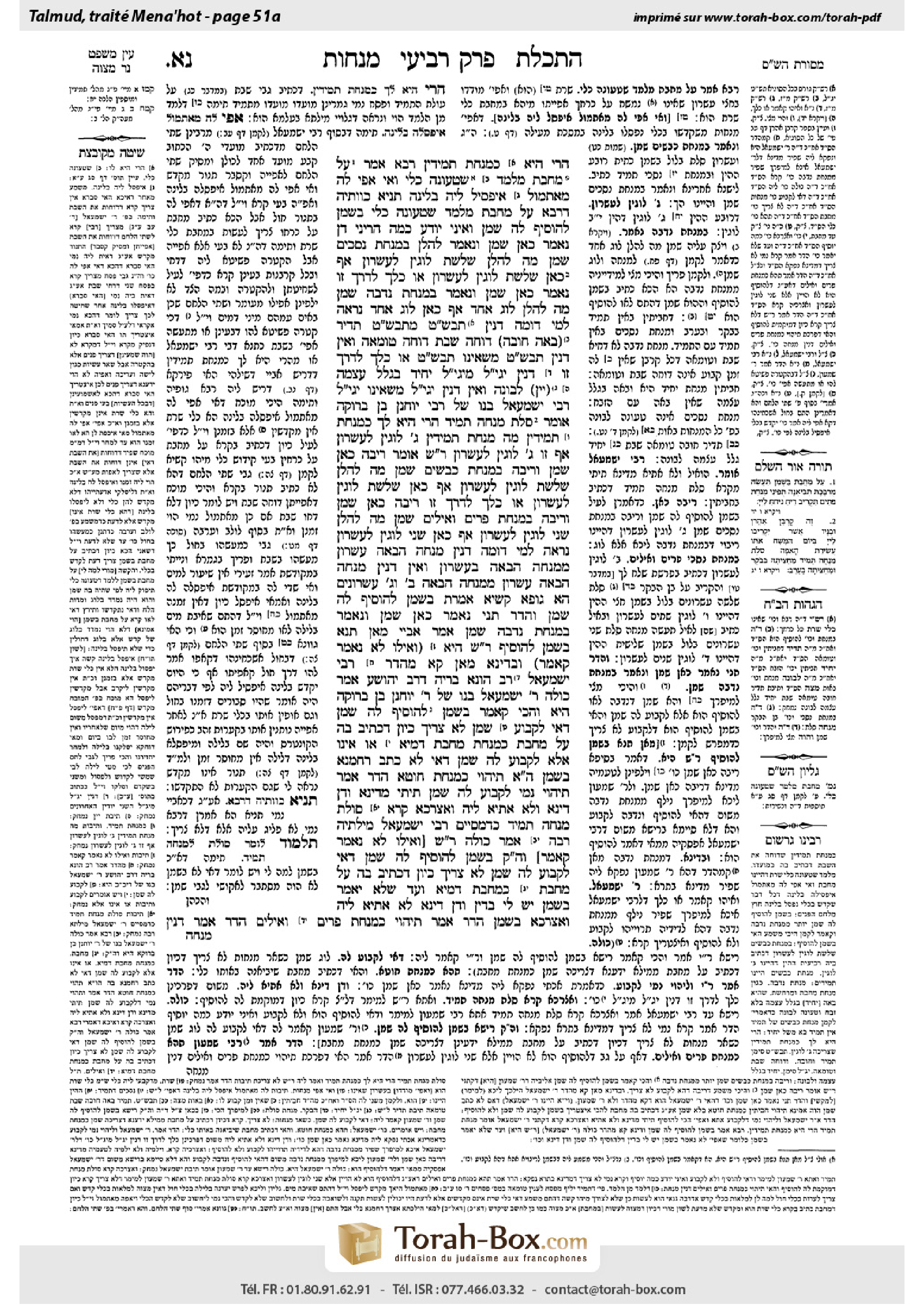
Menachot 51a: Talmud study for Daf Yomi
Daf Yomi is the daily study of one Talmud folio. Explore 37 tractates with scans, Hebrew text, Sefaria English and AI-generated French translations where annotated.
Passage selection and English or AI-generated French translation are available where the scan has annotations. Daf Study is independent of Torah-Box and Sefaria.
Browse Menachot · מנחות · All tractatesMenachot 51a text and translations
This page of Menachot includes the Aramaic text, an English translation and an AI-generated French translation, alongside the scan above.
מנחות נ״א א · Aramaic and Hebrew text
הֲרֵי הִיא כְּמִנְחַת תְּמִידִין.
רָבָא אָמַר: ״עַל מַחֲבַת״ – מְלַמֵּד שֶׁטְּעוּנָה כְּלִי, וְאִי אָפֵי לַהּ מֵאֶתְמוֹל – אִיפְּסִילָא לַיהּ בְּלִינָה. תַּנְיָא כְּוָותֵיהּ דְּרָבָא: ״עַל מַחֲבַת״ – מְלַמֵּד שֶׁטְּעוּנָה כְּלִי.
״בַּשֶּׁמֶן״ – לְהוֹסִיף לָהּ שֶׁמֶן, וְאֵינִי יוֹדֵעַ כַּמָּה.
הֲרֵינִי דָּן: נֶאֱמַר כָּאן ״שֶׁמֶן״, וְנֶאֱמַר לְהַלָּן בְּמִנְחַת נְסָכִים ״שֶׁמֶן״ – מָה לְהַלָּן שְׁלֹשֶׁת לוּגִּין לְעִשָּׂרוֹן, אַף כָּאן שְׁלֹשֶׁת לוּגִּין לְעִשָּׂרוֹן.
אוֹ כְּלָךְ לְדֶרֶךְ זוֹ: נֶאֱמַר כָּאן ״שֶׁמֶן״, וְנֶאֱמַר בְּמִנְחַת נְדָבָה ״שֶׁמֶן״, מָה לְהַלָּן לוֹג אֶחָד, אַף כָּאן לוֹג אֶחָד.
נִרְאֶה לְמִי דּוֹמֶה? דָּנִין תבש״ט מתבש״ט: תָּדִיר, בָּאָה חוֹבָה, דּוֹחָה שַׁבָּת, דּוֹחָה טוּמְאָה.
וְאֵין דָּנִין תבש״ט מִשֶּׁאֵינוֹ תבש״ט.
אוֹ כְּלָךְ לְדֶרֶךְ זוֹ: דָּנִין יגי״ל מיגי״ל – יָחִיד, בִּגְלַל עַצְמָהּ, יַיִן, לְבוֹנָה.
וְאֵין דָּנִין יגי״ל, מִשֶּׁאֵינוֹ יגי״ל.
רַבִּי יִשְׁמָעֵאל בְּנוֹ שֶׁל רַבִּי יוֹחָנָן בֶּן בְּרוֹקָה אוֹמֵר: ״סֹלֶת מִנְחָה תָּמִיד״ – הֲרֵי הִיא לְךָ כְּמִנְחַת תְּמִידִין, מָה מִנְחַת תְּמִידִין שְׁלֹשָׁה לוּגִּין לְעִשָּׂרוֹן, אַף זוֹ שְׁלֹשָׁה לוּגִּין לְעִשָּׂרוֹן.
רַבִּי שִׁמְעוֹן אוֹמֵר: רִיבָּה כָּאן שֶׁמֶן, וְרִיבָּה בְּמִנְחַת כְּבָשִׂים שֶׁמֶן, מָה לְהַלָּן שְׁלֹשֶׁת לוּגִּין לְעִשָּׂרוֹן, אַף כָּאן שְׁלֹשֶׁת לוּגִּין לְעִשָּׂרוֹן.
אוֹ כְּלָךְ לְדֶרֶךְ זוֹ: רִיבָּה כָּאן שֶׁמֶן, וְרִיבָּה בְּמִנְחַת פָּרִים וְאֵילִים שֶׁמֶן, מָה לְהַלָּן שְׁנֵי לוּגִּין לְעִשָּׂרוֹן, אַף כָּאן שְׁנֵי לוּגִּין לְעִשָּׂרוֹן?
נִרְאֶה לְמִי דּוֹמֶה: דָּנִין מִנְחָה הַבָּאָה עִשָּׂרוֹן, מִמִּנְחָה הַבָּאָה בְּעִשָּׂרוֹן, וְאֵין דָּנִין מִנְחָה הַבָּאָה עִשָּׂרוֹן, מִמִּנְחָה הַבָּאָה שְׁנַיִם וּשְׁלֹשָׁה עֶשְׂרוֹנִים.
הָא גוּפַאּ קַשְׁיָא, אָמְרַתְּ ״בַּשֶּׁמֶן״ לְהוֹסִיף לָהּ שֶׁמֶן, וַהֲדַר תָּנֵי: נֶאֱמַר כָּאן ״שֶׁמֶן״, וְנֶאֱמַר בְּמִנְחַת נְדָבָה ״שֶׁמֶן״.
אָמַר אַבָּיֵי: מַאן תְּנָא ״בַּשֶּׁמֶן״ לְהוֹסִיף? רַבִּי שִׁמְעוֹן הִיא, וְאִילּוּ לֹא נֶאֱמַר קָאָמַר. וּבְדִינָא מַאן קָא מַהְדַּר? רַבִּי יִשְׁמָעֵאל.
רַב הוּנָא בְּרֵיהּ דְּרַב יְהוֹשֻׁעַ אָמַר: כּוּלָּהּ רַבִּי יִשְׁמָעֵאל בְּנוֹ שֶׁל רַבִּי יוֹחָנָן בֶּן בְּרוֹקָה הִיא.
וְהָכִי קָאָמַר: ״בַּשֶּׁמֶן״ – לְהוֹסִיף לָהּ שֶׁמֶן, דְּאִי לִקְבּוֹעַ שֶׁמֶן – לָא צְרִיךְ, כֵּיוָן דִּכְתִיב בָּהּ ״עַל מַחֲבַת״ – כְּמִנְחַת מַחֲבַת דָּמְיָא.
אוֹ אֵינוֹ אֶלָּא לִקְבּוֹעַ לָהּ שֶׁמֶן, דְּאִי לָא כְּתַב רַחֲמָנָא ״בַּשֶּׁמֶן״, הֲוָה אָמֵינָא תֶּיהְוֵי כְּמִנְחַת חוֹטֵא.
הֲדַר אָמַר: תִּיהְוֵי נָמֵי לִקְבּוֹעַ לָהּ שֶׁמֶן, תֵּיתֵי מִדִּינָא, וְדָן דִּינָא וְלָא אָתְיָא לֵיהּ, וְאַצְרְכַהּ קְרָא ״סֹלֶת מִנְחָה תָּמִיד״, כְּדִמְסַיֵּים רַבִּי יִשְׁמָעֵאל מִילְּתֵיהּ.
רַבָּה אָמַר: כּוּלַּהּ רַבִּי שִׁמְעוֹן [וְאִילּוּ לֹא נֶאֱמַר קָאָמַר].
וְהָכִי קָאָמַר: ״בַּשֶּׁמֶן״ לְהוֹסִיף לָהּ שֶׁמֶן, דְּאִי לִקְבּוֹעַ לָהּ שֶׁמֶן לָא צְרִיךְ, כֵּיוָן דִּכְתִיב בַּהּ ״עַל מַחֲבַת״ כְּמַחֲבַת דָּמְיָא, וְעַד שֶׁלֹּא יֵאָמֵר ״בַּשֶּׁמֶן״ יֵשׁ לִי בַּדִּין.
וְדָן דִּינָא, לָא אָתְיָא לֵיהּ, וְאַצְרְכַהּ ״בַּשֶּׁמֶן״, הֲדַר אָמַר: תֶּיהְוֵי כְּמִנְחַת פָּרִים וְאֵילִים.
הֲדַר אָמַר: דָּנִין
Menachot 51a · English translation
this teaches that the halakha of the griddle-cake offering of the High Priest is like that of the meal offering that is a component of the daily offerings. The daily offerings override Shabbat, as the verse says: “This is the burnt offering of every Shabbat, beside the continual burnt offering, and the drink offering thereof” (Numbers 28:10). Therefore, preparing the griddle-cake offering of the High Priest likewise overrides Shabbat.
Rava said that the basis for it overriding Shabbat is the fact that the verse states: “On a griddle” (Leviticus 6:14), which teaches that the griddle-cake offering of the High Priest requires a vessel. Therefore, if he had baked it the previous day rather than on Shabbat, it would be disqualified by being left overnight, since the loaves had already been consecrated in a service vessel. It is taught in a baraita in accordance with the opinion of Rava: “On a griddle” teaches that the griddle-cake offering of the High Priest requires a vessel.
The baraita continues: The continuation of the verse states: “It shall be made with the oil.” The fact that the verse makes reference to “the oil” rather than just oil indicates that one is supposed to add extra oil to it, but I do not know how much oil to add.
Therefore I must deduce as follows: It is stated here, concerning the griddle-cake offering of the High Priest: “Oil,” and it is stated there, with regard to the meal offering brought with the libations that accompany animal offerings: “A tenth part of an ephah of fine flour mingled with the fourth part of a hin of beaten oil” (Exodus 29:40). Just as there, with regard to the meal offering brought with the libations, the amount of oil required is three log per tenth of an ephah of flour; so too here, in the case of the griddle-cake offering of the High Priest, one brings three log of oil per tenth of an ephah of flour.
Or perhaps, go this way: It is stated here, concerning the griddle-cake offering of the High Priest: “Oil,” and it is stated with regard to the voluntary meal offering: “And when anyone brings a meal offering to the Lord, his offering shall be of fine flour; and he shall pour oil upon it” (Leviticus 2:1). Just as there, with regard to the voluntary meal offering, one brings one log of oil for each tenth of an ephah of flour (see 88a); so too here, one brings one log of oil for each tenth of an ephah of flour.
The baraita analyzes these two possibilities: Let us see to which case it is more similar, i.e., which is a better comparison to the griddle-cake offering of the High Priest. Perhaps we should derive the halakha with regard to the griddle-cake offering of the High Priest, which has characteristics represented by the letters tav, beit, shin, tet, from the halakha with regard to a meal offering brought with libations, which also has the characteristics represented by the letters tav, beit, shin, tet. These characteristics are that they are frequent [tadir], as these offerings are sacrificed twice daily; they are brought [ba’ah] as an obligation; they override Shabbat; and they override impurity [tuma].
And we should not derive the halakha with regard to the griddle-cake offering of the High Priest, which has the characteristics represented by the letters tav, beit, shin, tet, from the voluntary meal offering, which does not have the characteristics represented by the letters tav, beit, shin, tet.
Or perhaps, go this way: We should derive the halakha with regard to the griddle-cake offering of the High Priest, which has the characteristics represented by the letters yod, gimmel, yod, lamed, from the voluntary meal offering, which also has the characteristics represented by the letters yod, gimmel, yod, lamed, which stand for the following halakhot: Each of these offerings may be brought by an individual [yaḥid]; each is brought for [biglal] its own sake, rather than accompanying another offering; they are not accompanied by wine [yayin] for a libation; and they require frankincense [levona].
And we should not derive the halakha with regard to the griddle-cake offering of the High Priest, which has the characteristics represented by the letters yod, gimmel, yod, lamed, from the halakha with regard to the meal offering brought with libations, which does not have the characteristics represented by the letters yod, gimmel, yod, lamed. Consequently, the comparisons in both directions are equally compelling.
The baraita continues its determination of how much oil is brought with the griddle-cake offering of the High Priest. Rabbi Yishmael, son of Rabbi Yoḥanan ben Beroka, says: “This is the offering of Aaron…the tenth part of an ephah of fine flour for a meal offering perpetually [tamid], half of it in the morning, and half of it in the evening” (Leviticus 6:13). The fact that the verse makes reference to the griddle-cake offering of the High Priest as tamid teaches that it is in the same category as the meal offering component of the daily offerings [temidin]. Just as the meal offering component of the daily offerings requires three log of oil for each tenth of an ephah of flour, so too this griddle-cake offering of the High Priest requires three log of oil for each tenth of an ephah of flour.
Rabbi Shimon says: The verse adds to the amount of oil that is required here, with regard to the griddle-cake offering of the High Priest, and it similarly adds to the amount of oil that is required there, in the case of the meal offering that accompanies the sacrifice of sheep. Just as there, in the case of the meal offering that accompanies the sacrifice of sheep, three log of oil are required for each tenth of an ephah of flour, so too here, in the case of the griddle-cake offering of the High Priest, three log of oil are required for each tenth of an ephah of flour.
Or perhaps, go this way: The verse adds to the amount of oil that is required here, and it similarly adds to the amount of oil that is required in the case of the meal offering that accompanies the sacrifice of bulls and rams. Just as there, in the case of the meal offering that accompanies the sacrifice of bulls and rams, two log of oil are required for each tenth of an ephah of flour, so too here, in the case of the griddle-cake offering of the High Priest, two log of oil are required for each tenth of an ephah of flour.
With regard to these two possibilities, let us see to which case it is more similar, i.e., which is a better comparison to the griddle-cake offering of the High Priest. Perhaps we should derive the halakha with regard to the griddle-cake offering of the High Priest, which is a meal offering that comes in the amount of a tenth of an ephah of flour, from the meal offering that accompanies the sacrifice of sheep, which is also a meal offering that comes in the amount of a tenth of an ephah of flour. And we should not derive the halakha with regard to a meal offering that comes in the amount of a tenth of an ephah of flour from the halakha in the case of a meal offering that comes in the amount of two or three tenths of an ephah of flour, such as the meal offerings that accompany the sacrifice of bulls and rams.
The Gemara asks a question with regard to the beginning of the baraita: This baraita itself is difficult, as it contains an internal contradiction. First you said that the expression “with the oil” stated in the verse concerning the griddle-cake offering of the High Priest serves to add extra oil, which indicates that more than the basic amount of one log of oil is required. And then it teaches: It is stated here, concerning the griddle-cake offering of the High Priest: “Oil,” and it is stated with regard to the voluntary meal offering that it must be brought with “oil.” The baraita suggests that just as one log of oil is brought with the voluntary meal offering, so too one log is brought with the griddle-cake offering of the High Priest.
In answer to this question, Abaye said: Who is the tanna who taught that the term “with the oil” with regard to the griddle-cake offering of the High Priest serves to add extra oil? It is Rabbi Shimon, who holds that three log of oil are required, as derived from the meal offering that accompanies the sacrifice of sheep. And Rabbi Shimon is speaking utilizing the style of: If it were not stated. If the verse had not indicated by the term “with the oil” that extra oil is required, it would have been possible to derive from the voluntary meal offering that only one log is required. And who is the tanna who responds to Rabbi Shimon’s derivation and suggests that in fact the amount of oil can be derived from the case of the voluntary meal offering? It is Rabbi Yishmael.
Rav Huna, son of Rav Yehoshua, said that the baraita should be understood differently: The entire baraita is in accordance with the opinion of Rabbi Yishmael, son of Rabbi Yoḥanan ben Beroka, who derives that three log of oil are required in the griddle-cake offering based upon the amount required in the meal offering component of the daily offerings.
And with regard to the possibility of deriving that only one log is required, as in the voluntary meal offering, this is what he is saying: The term “with the oil” stated with regard to the griddle-cake offering of the High Priest comes to add more oil to it than the single log required for the voluntary meal offering. As, if the purpose of that term were merely to establish the basic fact that the offering must include oil, a verse is not needed to teach that. Since it is written with respect to the griddle-cake offering of the High Priest: “On a griddle [maḥavat]” (Leviticus 6:14), it is comparable to a pan [maḥavat] meal offering, which requires oil.
Or perhaps the purpose of the verse is to establish only that the offering must include oil, and it is necessary to teach that because if the Merciful One had not stated: “With the oil,” I would say: Let it be like the meal offering of a sinner, which does not include oil.
Rabbi Yishmael, son of Rabbi Yoḥanan ben Beroka, then said: Let it even be that the purpose of the verse is to establish only that it requires oil, and even so one can arrive at the conclusion that three log are required due to the derivation based upon the verbal analogy from the meal offering brought with the libations that accompany animal offerings. But although Rabbi Yishmael, son of Rabbi Yoḥanan ben Beroka, attempts to employ this derivation he is unsuccessful, as there is a counter-indication from another verbal analogy to the voluntary meal offering. Therefore, Rabbi Yishmael, son of Rabbi Yoḥanan ben Beroka, needed to derive the halakha from the verse: “Fine flour for a meal offering perpetually [tamid]” (Leviticus 6:13), as Rabbi Yishmael, son of Rabbi Yoḥanan ben Beroka, concluded his statement in the baraita.
Rabba said that the baraita should be understood differently: The entire baraita is in accordance with the opinion of Rabbi Shimon, and Rabbi Shimon is speaking utilizing the style of: If it were not stated.
And this is what Rabbi Shimon is saying: The term “with the oil” serves to add extra oil to it. As, if the purpose of that term were merely to establish that the offering must include oil, a verse is not needed to teach that. Since it is written with respect to the griddle-cake offering of the High Priest: “On a griddle [maḥavat]” (Leviticus 6:14), it is comparable to a pan [maḥavat] meal offering, which requires oil. And even if the verse had not stated: “With the oil,” I have a manner of derivation for the fact that more than one log of oil is required, based upon a verbal analogy.
But although Rabbi Shimon attempts to employ this derivation he is unsuccessful, as there is a counter-indication from another verbal analogy, and therefore the term “with the oil” is needed to teach that more than one log of oil is required. Nevertheless, this teaches only that more oil than usual is required, but the specific amount still must be clarified. Rabbi Shimon then said: Let the griddle-cake offering of the High Priest be like the meal offering that accompanies the sacrifice of bulls and rams, which require two log of oil per ephah of flour.
Rabbi Shimon then said: We should derive the halakha
Menachot 51a · Traduction française (IA)
Cela enseigne que la halakha relative à l’offrande de galettes à la poêle du grand prêtre est identique à celle de l’offrande végétale qui fait partie des offrandes quotidiennes. Les offrandes quotidiennes l’emportent sur le Chabbat, comme le dit le verset : « Telle est l’offrande holocauste de chaque Chabbat, en plus de l’holocauste perpétuel et de sa libation » (Nombres 28:10). Par conséquent, la préparation de l’offrande de galettes à la poêle du grand prêtre l’emporte elle aussi sur le Chabbat.
Rava dit que le fondement de la règle selon laquelle elle l’emporte sur le Chabbat est que le verset dit : « Sur une poêle » (Lévitique 6:14), ce qui enseigne que l’offrande de galettes à la poêle du grand prêtre requiert un ustensile. Par conséquent, s’il l’avait cuite la veille plutôt que le Chabbat, elle aurait été invalidée parce qu’elle serait restée toute la nuit, puisque les galettes avaient déjà été consacrées dans un ustensile de service. Une baraïta enseigne conformément à l’opinion de Rava : « Sur une poêle » enseigne que l’offrande de galettes à la poêle du grand prêtre requiert un ustensile.
La baraïta poursuit : La suite du verset dit : « Elle sera préparée avec l’huile. » Le fait que le verset mentionne « l’huile » plutôt que simplement « de l’huile » indique qu’il faut en ajouter une quantité supplémentaire, mais je ne sais pas combien d’huile ajouter.
Il faut donc raisonner ainsi : Ici, au sujet de l’offrande de galettes à la poêle du grand prêtre, il est question d’« huile », et là, à propos de l’offrande végétale apportée avec les libations qui accompagnent les sacrifices d’animaux, il est dit : « Un dixième d’épha de fleur de farine mélangée à un quart de hin d’huile battue » (Exode 29:40). De même que là, pour l’offrande végétale apportée avec les libations, il faut trois log d’huile pour chaque dixième d’épha de farine, de même ici, pour l’offrande de galettes à la poêle du grand prêtre, il faut trois log d’huile pour chaque dixième d’épha de farine.
Ou peut-être faut-il raisonner ainsi : Ici, au sujet de l’offrande de galettes à la poêle du grand prêtre, il est question d’« huile », et là, à propos de l’offrande végétale volontaire, il est dit : « Si quelqu’un apporte au Seigneur une offrande végétale, son offrande sera de fleur de farine ; il y versera de l’huile » (Lévitique 2:1). De même que là, pour l’offrande végétale volontaire, il faut un log d’huile pour chaque dixième d’épha de farine (voir 88a), de même ici, il faut un log d’huile pour chaque dixième d’épha de farine.
La baraïta examine ces deux possibilités : voyons à quel cas elle ressemble le plus, c’est-à-dire quelle comparaison convient le mieux à l’offrande de galettes à la poêle du grand prêtre. Peut-être faut-il déduire la halakha relative à l’offrande de galettes à la poêle du grand prêtre, qui présente les caractéristiques représentées par les lettres tav, beit, shin, tet, de la halakha relative à une offrande végétale apportée avec des libations, qui présente également les caractéristiques représentées par les lettres tav, beit, shin, tet. Ces caractéristiques sont les suivantes : elles sont fréquentes [tadir], car ces offrandes sont sacrifiées deux fois par jour ; elles sont apportées [ba’ah] à titre obligatoire ; elles l’emportent sur le Chabbat ; et elles l’emportent sur l’impureté [tuma].
Et nous ne devrions pas déduire la halakha relative à l’offrande de galettes à la poêle du grand prêtre, qui présente les caractéristiques représentées par les lettres tav, beit, shin, tet, de celle relative à l’offrande végétale volontaire, qui ne présente pas les caractéristiques représentées par ces lettres.
Ou peut-être faut-il raisonner ainsi : nous devrions déduire la halakha relative à l’offrande de galettes à la poêle du grand prêtre, qui présente les caractéristiques représentées par les lettres yod, gimmel, yod, lamed, de celle relative à l’offrande végétale volontaire, qui présente elle aussi les caractéristiques représentées par les lettres yod, gimmel, yod, lamed, lesquelles renvoient aux halakhot suivantes : chacune de ces offrandes peut être apportée par un particulier [yaḥid] ; chacune est apportée pour [biglal] elle-même, et non en accompagnement d’une autre offrande ; elles ne sont pas accompagnées de vin [yayin] pour une libation ; et elles requièrent de l’encens [levona].
Et nous ne devrions pas déduire la halakha relative à l’offrande de galettes à la poêle du grand prêtre, qui présente les caractéristiques représentées par les lettres yod, gimmel, yod, lamed, de celle relative à l’offrande végétale apportée avec des libations, qui ne présente pas les caractéristiques représentées par ces lettres. Par conséquent, les comparaisons dans les deux sens sont tout aussi convaincantes.
La baraïta poursuit en déterminant la quantité d’huile à apporter avec l’offrande de galettes à la poêle du grand prêtre. Rabbi Yishmael, fils de Rabbi Yoḥanan ben Beroka, dit : « Telle est l’offrande d’Aaron… un dixième d’épha de fleur de farine pour une offrande végétale perpétuelle [tamid], la moitié le matin et la moitié le soir » (Lévitique 6:13). Le fait que le verset qualifie de tamid l’offrande de galettes à la poêle du grand prêtre enseigne qu’elle relève de la même catégorie que l’offrande végétale faisant partie des offrandes quotidiennes [temidin]. De même que l’offrande végétale faisant partie des offrandes quotidiennes requiert trois log d’huile pour chaque dixième d’épha de farine, de même cette offrande de galettes à la poêle du grand prêtre requiert trois log d’huile pour chaque dixième d’épha de farine.
Rabbi Shimon dit : Le verset ajoute à la quantité d’huile requise ici, pour l’offrande de galettes à la poêle du grand prêtre, tout comme il ajoute à la quantité d’huile requise là, pour l’offrande végétale qui accompagne le sacrifice de moutons. De même que là, pour l’offrande végétale qui accompagne le sacrifice de moutons, il faut trois log d’huile pour chaque dixième d’épha de farine, de même ici, pour l’offrande de galettes à la poêle du grand prêtre, il faut trois log d’huile pour chaque dixième d’épha de farine.
Ou peut-être faut-il raisonner ainsi : le verset ajoute à la quantité d’huile requise ici, tout comme il ajoute à celle requise pour l’offrande végétale qui accompagne le sacrifice de taureaux et de béliers. De même que là, pour l’offrande végétale qui accompagne le sacrifice de taureaux et de béliers, il faut deux log d’huile pour chaque dixième d’épha de farine, de même ici, pour l’offrande de galettes à la poêle du grand prêtre, il faut deux log d’huile pour chaque dixième d’épha de farine.
À propos de ces deux possibilités, voyons à quel cas l’offrande de galettes à la poêle du grand prêtre ressemble le plus, c’est-à-dire quelle comparaison lui convient le mieux. Peut-être faut-il déduire la halakha relative à l’offrande de galettes à la poêle du grand prêtre, qui est une offrande végétale composée d’un dixième d’épha de farine, de l’offrande végétale qui accompagne le sacrifice de moutons, laquelle est également composée d’un dixième d’épha de farine. Et nous ne devrions pas déduire la halakha relative à une offrande végétale composée d’un dixième d’épha de farine de celle applicable à une offrande végétale composée de deux ou trois dixièmes d’épha de farine, comme celles qui accompagnent le sacrifice de taureaux et de béliers.
La Guemara pose une question sur le début de la baraïta : cette baraïta elle-même présente une difficulté, car elle contient une contradiction interne. D’abord, tu as dit que l’expression « avec l’huile », dans le verset concernant l’offrande de galettes à la poêle du grand prêtre, sert à ajouter de l’huile, ce qui indique qu’une quantité supérieure à la mesure de base d’un log d’huile est requise. Puis la baraïta enseigne : Ici, au sujet de l’offrande de galettes à la poêle du grand prêtre, il est question d’« huile », et là, à propos de l’offrande végétale volontaire, il est dit qu’elle doit être apportée avec de l’« huile ». La baraïta laisse entendre que, de même qu’un log d’huile accompagne l’offrande végétale volontaire, de même un log accompagne l’offrande de galettes à la poêle du grand prêtre.
Pour répondre à cette question, Abayé dit : Qui est le tanna qui a enseigné que l’expression « avec l’huile », à propos de l’offrande de galettes à la poêle du grand prêtre, sert à ajouter de l’huile ? C’est Rabbi Shimon, qui soutient qu’il faut trois log d’huile, comme on le déduit de l’offrande végétale qui accompagne le sacrifice de moutons. Et Rabbi Shimon s’exprime selon la formule : « Si cela n’avait pas été dit ». Si le verset n’avait pas indiqué, par l’expression « avec l’huile », qu’une quantité supplémentaire d’huile est requise, on aurait pu déduire de l’offrande végétale volontaire qu’un seul log est requis. Et qui est le tanna qui répond à la déduction de Rabbi Shimon et suggère qu’en réalité, la quantité d’huile peut être déduite du cas de l’offrande végétale volontaire ? C’est Rabbi Yishmael.
Rav Houna, fils de Rav Yehoshoua, dit qu’il faut comprendre la baraïta autrement : toute la baraïta est conforme à l’opinion de Rabbi Yishmael, fils de Rabbi Yoḥanan ben Beroka, qui déduit que l’offrande de galettes à la poêle requiert trois log d’huile, en se fondant sur la quantité requise pour l’offrande végétale faisant partie des offrandes quotidiennes.
Quant à la possibilité de déduire qu’un seul log est requis, comme pour l’offrande végétale volontaire, voici ce qu’il dit : l’expression « avec l’huile », à propos de l’offrande de galettes à la poêle du grand prêtre, vient indiquer qu’il faut y ajouter de l’huile au-delà du log unique requis pour l’offrande végétale volontaire. En effet, si cette expression avait seulement pour but d’établir que l’offrande doit contenir de l’huile, un verset n’aurait pas été nécessaire pour l’enseigner. Puisqu’il est écrit au sujet de l’offrande de galettes à la poêle du grand prêtre : « Sur une poêle [maḥavat] » (Lévitique 6:14), elle est comparable à une offrande végétale préparée sur une poêle [maḥavat], qui requiert de l’huile.
Ou peut-être le verset a-t-il seulement pour but d’établir que l’offrande doit contenir de l’huile, et faut-il l’enseigner parce que, si le Miséricordieux n’avait pas dit « avec l’huile », j’aurais dit : qu’elle soit comme le sacrifice expiatoire du pécheur, qui ne contient pas d’huile.
Rabbi Yishmael, fils de Rabbi Yoḥanan ben Beroka, dit alors : admettons même que le verset ait seulement pour but d’établir que l’offrande requiert de l’huile ; malgré cela, on peut conclure qu’il faut trois log grâce à l’analogie verbale avec l’offrande végétale apportée avec les libations qui accompagnent les sacrifices d’animaux. Mais Rabbi Yishmael, fils de Rabbi Yoḥanan ben Beroka, ne parvient pas à appliquer cette déduction, car une indication contraire découle d’une autre analogie verbale avec l’offrande végétale volontaire. Rabbi Yishmael, fils de Rabbi Yoḥanan ben Beroka, a donc dû déduire la halakha du verset : « Fleur de farine pour une offrande végétale perpétuelle [tamid] » (Lévitique 6:13), comme il conclut sa déclaration dans la baraïta.
Rabba dit qu’il faut comprendre la baraïta autrement : toute la baraïta est conforme à l’opinion de Rabbi Shimon, et Rabbi Shimon s’exprime selon la formule : « Si cela n’avait pas été dit ».
Et voici ce que dit Rabbi Shimon : l’expression « avec l’huile » sert à ajouter de l’huile. En effet, si cette expression avait seulement pour but d’établir que l’offrande doit contenir de l’huile, un verset n’aurait pas été nécessaire pour l’enseigner. Puisqu’il est écrit au sujet de l’offrande de galettes à la poêle du grand prêtre : « Sur une poêle [maḥavat] » (Lévitique 6:14), elle est comparable à une offrande végétale préparée sur une poêle [maḥavat], qui requiert de l’huile. Et même si le verset n’avait pas dit « avec l’huile », je pourrais déduire par analogie verbale qu’il faut plus d’un log d’huile.
Mais Rabbi Shimon ne parvient pas à appliquer cette déduction, car une indication contraire découle d’une autre analogie verbale ; l’expression « avec l’huile » est donc nécessaire pour enseigner qu’il faut plus d’un log d’huile. Toutefois, cela enseigne seulement qu’il faut davantage d’huile que d’ordinaire ; la quantité précise reste à déterminer. Rabbi Shimon dit alors : que l’offrande de galettes à la poêle du grand prêtre soit comme l’offrande végétale qui accompagne le sacrifice de taureaux et de béliers, pour laquelle il faut deux log d’huile par épha de farine.
Rabbi Shimon dit alors : nous devrions déduire la halakha
Traduction française générée par IA à partir de l’édition anglaise de Sefaria. Vérifie toujours un passage avec le texte source.
Text from Sefaria: William Davidson Edition - Vocalized Aramaic (unknown); William Davidson Edition - English (CC BY NC).