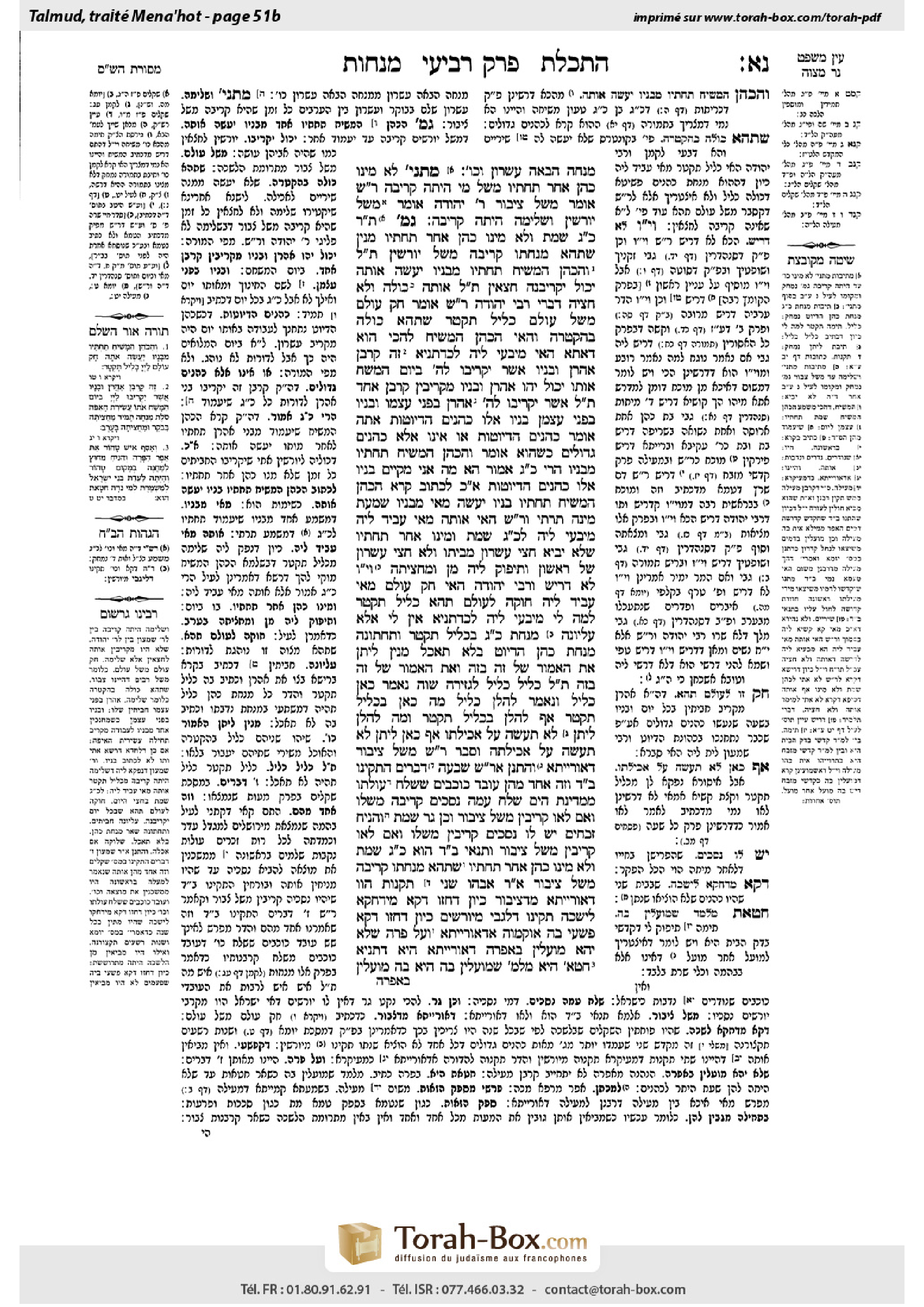
Menachot 51b: Talmud study for Daf Yomi
Daf Yomi is the daily study of one Talmud folio. Explore 37 tractates with scans, Hebrew text, Sefaria English and AI-generated French translations where annotated.
Passage selection and English or AI-generated French translation are available where the scan has annotations. Daf Study is independent of Torah-Box and Sefaria.
Browse Menachot · מנחות · All tractatesMenachot 51b text and translations
This page of Menachot includes the Aramaic text, an English translation and an AI-generated French translation, alongside the scan above.
מנחות נ״א ב · Aramaic and Hebrew text
מִנְחָה הַבָּאָה עִשָּׂרוֹן וְכוּ׳.
מַתְנִי׳ לֹא מִינּוּ כֹּהֵן אַחֵר תַּחְתָּיו, מִשֶּׁל מִי הָיְתָה קְרֵיבָה? רַבִּי שִׁמְעוֹן אוֹמֵר: מִשֶּׁל צִיבּוּר. רַבִּי יְהוּדָה אוֹמֵר: מִשֶּׁל יוֹרְשִׁין. וּשְׁלֵימָה הָיְתָה קְרֵיבָה.
גְּמָ׳ תָּנוּ רַבָּנַן: כֹּהֵן גָּדוֹל שֶׁמֵּת וְלֹא מִינּוּ כֹּהֵן אַחֵר תַּחְתָּיו, מִנַּיִן שֶׁתְּהֵא מִנְחָתוֹ קְרֵיבָה מִשֶּׁל יוֹרְשִׁין? תַּלְמוּד לוֹמַר: ״וְהַכֹּהֵן הַמָּשִׁיחַ תַּחְתָּיו מִבָּנָיו יַעֲשֶׂה אֹתָהּ״.
יָכוֹל יַקְרִיבֶנָּה חֲצָאִין? תַּלְמוּד לוֹמַר ״אֹתָהּ״ – כּוּלָּהּ וְלֹא חֶצְיָהּ, דִּבְרֵי רַבִּי יְהוּדָה.
רַבִּי שִׁמְעוֹן אוֹמֵר: ״חׇק עוֹלָם״ – מִשֶּׁל עוֹלָם, ״כָּלִיל תׇּקְטָר״ – שֶׁתְּהֵא כּוּלָּהּ בְּהַקְטָרָה.
וְהַאי ״הַכֹּהֵן הַמָּשִׁיחַ״ לְהָכִי הוּא דַּאֲתָא?
הַאי מִיבְּעֵי לֵיהּ לְכִדְתַנְיָא: ״זֶה קׇרְבַּן אַהֲרֹן וּבָנָיו אֲשֶׁר יַקְרִיבוּ לַה׳ בְּיוֹם הִמָּשַׁח אֹתוֹ״, יָכוֹל יְהוּ אַהֲרֹן וּבָנָיו מַקְרִיבִין קׇרְבָּן אֶחָד? תַּלְמוּד לוֹמַר ״אֲשֶׁר יַקְרִיבוּ לַה׳״, אַהֲרֹן בִּפְנֵי עַצְמוֹ וּבָנָיו בִּפְנֵי עַצְמָן. ״בָּנָיו״ – אֵלּוּ כֹּהֲנִים הֶדְיוֹטוֹת.
אַתָּה אוֹמֵר כֹּהֲנִים הֶדְיוֹטוֹת, אוֹ אֵינוֹ אֶלָּא כֹּהֲנִים גְּדוֹלִים? כְּשֶׁהוּא אוֹמֵר ״וְהַכֹּהֵן הַמָּשִׁיחַ תַּחְתָּיו מִבָּנָיו״ – הֲרֵי כֹּהֵן גָּדוֹל אָמוּר, הָא מָה אֲנִי מְקַיֵּים ״בָּנָיו״? אֵלּוּ כֹּהֲנִים הֶדְיוֹטוֹת.
אִם כֵּן לִכְתּוֹב קְרָא ״הַכֹּהֵן הַמָּשִׁיחַ תַּחְתָּיו בָּנָיו יַעֲשֶׂה״, מַאי ״מִבָּנָיו״? שָׁמְעַתְּ מִינַּהּ תַּרְתֵּי.
וְרַבִּי שִׁמְעוֹן, הַאי ״אֹתָהּ״ מַאי עָבֵיד לֵיהּ? מִיבְּעֵי לֵיהּ לְכֹהֵן גָּדוֹל שֶׁמֵּת וּמִינּוּ אַחֵר תַּחְתָּיו, שֶׁלֹּא יָבִיא חֲצִי עִשָּׂרוֹן מִבֵּיתוֹ וְלֹא חֲצִי עִשָּׂרוֹן שֶׁל רִאשׁוֹן.
וְתִיפּוֹק לֵיהּ מִן ״וּמַחֲצִיתָהּ״? וָי״ו לָא דָּרֵישׁ.
וְרַבִּי יְהוּדָה, הַאי ״חׇק עוֹלָם״ מַאי עָבֵיד לֵיהּ? חוּקָּה לְעוֹלָם תְּהֵא.
״כָּלִיל תׇּקְטָר״ לְמָה לִי? מִיבְּעֵי לֵיהּ לְכִדְתַנְיָא: אֵין לִי אֶלָּא עֶלְיוֹנָה (מִנְחַת כֹּהֵן גָּדוֹל) בְּ״כָלִיל תׇּקְטָר״, וְתַחְתּוֹנָה (מִנְחַת כֹּהֵן הֶדְיוֹט) בְּ״לֹא תֵאָכֵל״.
מִנַּיִן לִיתֵּן אֶת הָאָמוּר שֶׁל זֶה בָּזֶה וְאֶת הָאָמוּר שֶׁל זֶה בָּזֶה? תַּלְמוּד לוֹמַר ״כָּלִיל״ ״כָּלִיל״ לִגְזֵירָה שָׁוָה, נֶאֱמַר כָּאן ״כָּלִיל״ וְנֶאֱמַר לְהַלָּן ״כָּלִיל״,
מָה כָּאן בְּ״כָלִיל תׇּקְטָר״, אַף לְהַלָּן בְּ״כָלִיל תׇּקְטָר״. וּמָה לְהַלָּן לִיתֵּן לֹא תַעֲשֶׂה עַל אֲכִילָתוֹ, אַף כָּאן לִיתֵּן לֹא תַעֲשֶׂה עַל אֲכִילָתָהּ.
וְסָבַר רַבִּי שִׁמְעוֹן מִשֶּׁל צִיבּוּר דְּאוֹרָיְיתָא?
וְהָתְנַן, אָמַר רַבִּי שִׁמְעוֹן: שִׁבְעָה דְּבָרִים הִתְקִינוּ בֵּית דִּין, וְזֶה אֶחָד מֵהֶן. גּוֹי שֶׁשָּׁלַח עוֹלָתוֹ מִמְּדִינַת הַיָּם, שָׁלַח עִמָּהּ נְסָכִים – (קְרֵיבָה) [קְרֵיבִין] מִשֶּׁלּוֹ, וְאִם לָאו – קְרֵיבִין מִשֶּׁל צִיבּוּר.
וְכֵן גֵּר שֶׁמֵּת, וְהִנִּיחַ זְבָחִים – יֵשׁ לוֹ נְסָכִים קְרֵיבִין מִשֶּׁלּוֹ, וְאִם לָאו – קְרֵיבִין מִשֶּׁל צִיבּוּר.
וּתְנַאי בֵּית דִּין הוּא, כֹּהֵן גָּדוֹל שֶׁמֵּת וְלֹא מִינּוּ כֹּהֵן אַחֵר תַּחְתָּיו, שֶׁתְּהֵא מִנְחָתוֹ קְרֵיבָה מִשֶּׁל צִיבּוּר.
אָמַר רַבִּי אֲבָהוּ: (שְׁנֵי) [שְׁתֵּי] תַּקָּנוֹת הֲווֹ.
דְּאוֹרָיְיתָא מִדְּצִיבּוּר, כֵּיוָן דַּחֲזוֹ דְּקָא מִידַּחְקָא לִישְׁכָּה – תַּקִּינוּ דְּלִגְבֵּי מִיּוֹרְשִׁים, כֵּיוָן דַּחֲזוֹ דְּקָא פָשְׁעִי בַּהּ – אוֹקְמוּהָ אַדְּאוֹרָיְיתָא.
וְעַל פָּרָה שֶׁלֹּא יְהוּ מוֹעֲלִין בְּאֶפְרָהּ דְּאוֹרָיְיתָא הִיא! דְּתַנְיָא: ״חַטָּאת הִיא״, מְלַמֵּד שֶׁמּוֹעֲלִין בַּהּ – ״הִיא״, בָּהּ מוֹעֲלִין,
Menachot 51b · English translation
with regard to the griddle-cake offering of the High Priest, which is a meal offering that comes in the amount of a tenth of an ephah of flour, from the meal offering that accompanies the sacrifice of sheep, which is also a meal offering that comes in the amount of a tenth of an ephah of flour, and not from a meal offering that is brought in the amount of two or three tenths of an ephah of flour.
MISHNA: If they did not appoint another High Priest in his stead, from whose property was the griddle-cake offering brought and sacrificed? Rabbi Shimon says: It is brought and sacrificed from the property of the community. Rabbi Yehuda says: It is brought and sacrificed from the property of the heirs of the High Priest. And for the duration of the period until a new High Priest was appointed, the griddle-cake offering was sacrificed as a complete tenth of an ephah of fine flour.
GEMARA: The Sages taught in a baraita: In a case where the High Priest died and they did not appoint another High Priest in his stead, from where is it derived that his griddle-cake meal offering should be sacrificed from the property of the heirs of the High Priest? The verse states in reference to the griddle-cake offering: “And the anointed priest that shall be in his stead from among his sons shall offer it” (Leviticus 6:15).
One might have thought that the heirs should sacrifice it in halves as the High Priest does. Therefore the verse states “it,” teaching that they should sacrifice all of the tenth of an ephah and not half of it; this is the statement of Rabbi Yehuda.
Rabbi Shimon says: The continuation of the verse: “It is a statute forever [olam] to the Lord,” teaches that in this case of a High Priest who has died and has not yet been replaced, the offering is brought from the property of the world [olam], i.e., the community. The end of the verse: “It shall be wholly made to smoke to the Lord,” teaches that although it is brought by the community and not by a priest, the entire tenth of an ephah should be sacrificed and not eaten.
The Gemara asks: And did that verse: “And the anointed priest that shall be in his stead from among his sons shall offer it,” come to teach this halakha that Rabbi Yehuda derived from it?
That verse is needed for that which is taught in a baraita: “This is the offering of Aaron and of his sons, which they shall offer to the Lord in the day when he is anointed” (Leviticus 6:13). One might have thought that since the verse speaks of the offering in the singular, it means that Aaron and his sons should sacrifice one offering. Therefore the verse states: “Which they shall offer to the Lord,” in plural, teaching that Aaron sacrifices an offering by himself as the High Priest, and his sons sacrifice offerings by themselves as ordinary priests. When the verse refers to “his sons,” these are the ordinary priests. Each priest must bring a griddle-cake offering as an offering of initiation when he begins his service.
Do you say that this is referring to the offering of initiation of ordinary priests, or is it referring only to the griddle-cake offering of the High Priests? When the verse states in the continuation of that passage: “And the anointed priest that shall be in his stead from among his sons shall offer it; it is a statute forever to the Lord; it shall be wholly made to smoke to the Lord” (Leviticus 6:15), the griddle-cake offering of the High Priest is thereby mentioned. How do I realize the meaning of the term “his sons” in Leviticus 6:13? These are the ordinary priests, and the verse is referring to their offering of initiation. Consequently, verse 15 is referring to the basic obligation of the High Priest to bring the griddle-cake offering, rather than referring to a case of a High Priest who died.
The Gemara answers: The verse teaches both the basic obligation of the High Priest to bring the griddle-cake offering daily and the fact that when he dies his heirs must bring the offering until a new High Priest is appointed. If it were so that the verse is teaching only that the heirs of a High Priest who died must bring the griddle-cake offering until a new High Priest is appointed, let the verse merely write: The anointed priest that shall be in his stead, his sons shall offer. What is the need to say: “From among his sons”? Learn from the fact that verse uses this term that two halakhot are derived from the verse.
The Gemara asks: And what does Rabbi Shimon, who derives the halakha that it should be entirely sacrificed from the phrase: “It shall be wholly made to smoke,” do with that word “it,” from which Rabbi Yehuda derives this halakha? The Gemara answers: He requires it to teach that in the case of a High Priest who died after bringing the first half of his griddle-cake offering, and then they appointed another High Priest in his stead, the replacement High Priest should neither bring half of a tenth of an ephah of flour from his house nor sacrifice the remaining half of the tenth of an ephah of the first High Priest, i.e., his predecessor.
The Gemara asks: Let him derive this halakha from the expression: “And half of it” (Leviticus 6:13), as discussed on 50b; the word “and,” which is added by the letter vav at the beginning of the word, is expounded to mean that the replacement High Priest must bring a complete tenth of an ephah of fine flour. The Gemara answers: He did not derive the halakha from there because he does not expound the extra letter vav in that word, as he holds that its addition is not significant.
The Gemara asks: And what does Rabbi Yehuda, who holds that if the High Priest dies and a new one has not yet been appointed the griddle-cake offering is brought by the previous High Priest’s heirs, do with that phrase: “It is a statute forever to the Lord,” from which Rabbi Shimon derives that it is brought from communal resources? The Gemara answers: It teaches that the statute requiring the High Priest to sacrifice the griddle-cake offering is to apply forever.
The Gemara asks: According to Rabbi Yehuda, why do I need the phrase: “It shall be wholly made to smoke”? The Gemara answers: He requires it for that which is taught in a baraita: I have derived only that the griddle-cake meal offering of the High Priest mentioned above is included in the mandate: “It shall be wholly made to smoke” (Leviticus 6:15), and that the voluntary meal offering of the ordinary priest mentioned below is included in the prohibition: “It shall not be eaten” (Leviticus 6:16).
From where is it derived that one is mandated to apply what is said about that verse to this one, and what is said about this verse to that one? The verse states with regard to the griddle-cake offering: “Wholly,” and the verse uses the word “wholly” with regard to the voluntary meal offering of a priest, in order to teach a verbal analogy: It is stated here, with regard to the griddle-cake meal offering of the High Priest: “Wholly” (Leviticus 6:15), and it is stated there, with regard to the voluntary meal offering of the ordinary priest: “Wholly” (Leviticus 6:16).
Just as here, with regard to the griddle-cake meal offering, it is included in the mandate: “It shall be wholly made to smoke,” so too there, the voluntary meal offering of the ordinary priest is included in the mandate: It shall be wholly made to smoke. And just as there, with regard to the voluntary meal offering of the ordinary priest, the verse comes to place a prohibition on its consumption, so too here, with regard to the griddle-cake meal offering of the High Priest, the verse comes to place a prohibition on its consumption.
The Gemara asks: And does Rabbi Shimon hold that in a case where the High Priest died and a new one has not been appointed, the requirement that the griddle offering be brought from the property of the community is by Torah law, as indicated by the fact that he derives this halakha from a verse?
But didn’t we learn in a mishna (Shekalim 7:6) that Rabbi Shimon said: The court instituted seven ordinances with regard to the financial aspects of offerings and consecrations; and this ordinance, namely, that the cost of the libations accompanying the sacrifice of a found animal is borne by the public, is one of them. These are the other ordinances: In the case of a gentile who sent his burnt offering from a country overseas, and he sent with it money for the purchase of the libations that must accompany it, the libations are sacrificed at his expense. And if the gentile did not cover the cost of the libations, it is a condition of the court that the libations are sacrificed at the public’s expense, with funds taken from the Temple treasury.
And similarly, in the case of a convert who died without heirs and left animals that he had designated as offerings, if he has the libations, i.e., if he also had set aside libations or money for that purpose, the libations are sacrificed from his estate. And if he did not do so, the libations are sacrificed from public funds.
And another ordinance: It is a stipulation of the court with regard to a High Priest who died, and they did not yet appoint another High Priest in his stead, that his griddle-cake meal offering would be sacrificed from public funds. Rabbi Shimon then enumerates three additional ordinances. In any case, it is clear from this mishna that Rabbi Shimon holds that this halakha concerning the offering of a High Priest who died is a rabbinic ordinance, rather than Torah law.
Rabbi Abbahu said in response: In fact, Rabbi Shimon holds that this halakha is by Torah law. But in fact, there were two ordinances that were enacted concerning this matter.
Initially, they acted in accordance with that which is prescribed by Torah law, and if a High Priest died and a new High Priest had not yet been appointed in his stead, his griddle-cake meal offering would be sacrificed from public funds. Once they saw that the funds in the chamber of the Temple treasury were being depleted, the Sages instituted an ordinance that the payment for the offering should be collected from the previous High Priest’s heirs. Once they saw that the heirs were negligent in the matter and did not bring the offering, they revoked the previous ordinance and established it in accordance with the halakha as it is by Torah law, that it is brought from public funds.
§ The Gemara cites the continuation of the mishna in Shekalim (7:7): And the court enacted an ordinance with regard to the red heifer that one is not liable to bring an offering for misusing consecrated property if he derives benefit from its ashes. The Gemara asks: Why does the baraita state that this is an ordinance of the court, when in fact it is by Torah law? As it is taught in a baraita: The verse states with regard to a red heifer: “It is a sin offering” (Numbers 19:9), which teaches that a red heifer is treated like a sin offering in that one is liable for misusing it. The fact that it states: “It is a sin offering” indicates that if one derives benefit from it, the animal itself, he is liable for misusing consecrated property,
Menachot 51b · Traduction française (IA)
concernant l’offrande de galettes sur plaque du Grand Prêtre, qui est une offrande végétale d’un dixième d’épha de farine, et non l’offrande végétale qui accompagne le sacrifice d’un mouton, qui est également d’un dixième d’épha de farine, ni une offrande végétale apportée en quantité de deux ou trois dixièmes d’épha de farine.
MICHNA : S’ils n’avaient pas nommé un autre Grand Prêtre à sa place, sur les biens de qui l’offrande de galettes sur plaque était-elle apportée et sacrifiée ? Rabbi Shimon dit : Elle était apportée et sacrifiée sur les biens de la communauté. Rabbi Yehouda dit : Elle était apportée et sacrifiée sur les biens des héritiers du Grand Prêtre. Pendant toute la période précédant la nomination d’un nouveau Grand Prêtre, l’offrande de galettes sur plaque était sacrifiée sous la forme d’un dixième d’épha entier de farine fine.
GUEMARA : Les Sages ont enseigné dans une baraïta : Si le Grand Prêtre est mort et qu’on n’a pas nommé un autre Grand Prêtre à sa place, d’où apprend-on que son offrande végétale de galettes sur plaque doit être sacrifiée sur les biens de ses héritiers ? Le verset dit, au sujet de cette offrande : « Le prêtre oint qui sera à sa place parmi ses fils l’offrira » (Lévitique 6:15).
On aurait pu penser que les héritiers la sacrifieraient en deux moitiés, comme le fait le Grand Prêtre. C’est pourquoi le verset dit « elle », pour enseigner qu’ils doivent sacrifier le dixième d’épha entier, et non la moitié. Telle est la position de Rabbi Yehouda.
Rabbi Shimon dit : La suite du verset, « C’est un statut perpétuel [olam] pour l’Éternel », enseigne que, dans le cas où le Grand Prêtre est mort et n’a pas encore été remplacé, l’offrande est apportée sur les biens du monde [olam], c’est-à-dire ceux de la communauté. La fin du verset, « Elle sera entièrement consumée par le feu pour l’Éternel », enseigne que, bien qu’elle soit apportée par la communauté et non par un prêtre, le dixième d’épha entier doit être sacrifié et ne doit pas être mangé.
La Guemara demande : Ce verset, « Le prêtre oint qui sera à sa place parmi ses fils l’offrira », vient-il donc enseigner la halakha que Rabbi Yehouda en déduit ?
Ce verset est nécessaire pour ce qui est enseigné dans une baraïta : « Voici l’offrande d’Aaron et de ses fils, qu’ils offriront à l’Éternel le jour où il sera oint » (Lévitique 6:13). On aurait pu penser que, puisque le verset parle de l’offrande au singulier, Aaron et ses fils doivent sacrifier une seule offrande. C’est pourquoi le verset précise : « qu’ils offriront à l’Éternel », au pluriel, enseignant qu’Aaron sacrifie une offrande à lui seul en tant que Grand Prêtre, et que ses fils sacrifient chacun leurs propres offrandes en tant que prêtres ordinaires. Lorsque le verset parle de « ses fils », il s’agit des prêtres ordinaires. Chaque prêtre doit apporter une offrande de galettes sur plaque comme offrande d’initiation lorsqu’il commence son service.
Dis-tu que cela désigne l’offrande d’initiation des prêtres ordinaires, ou bien cela désigne-t-il uniquement l’offrande de galettes sur plaque des Grands Prêtres ? Lorsque le verset dit, dans la suite du passage : « Le prêtre oint qui sera à sa place parmi ses fils l’offrira ; c’est un statut perpétuel pour l’Éternel ; elle sera entièrement consumée par le feu pour l’Éternel » (Lévitique 6:15), il mentionne ainsi l’offrande de galettes sur plaque du Grand Prêtre. Comment comprendre alors l’expression « ses fils » en Lévitique 6:13 ? Elle désigne les prêtres ordinaires, et le verset parle de leur offrande d’initiation. Par conséquent, le verset 15 traite de l’obligation fondamentale du Grand Prêtre d’apporter l’offrande de galettes sur plaque, et non du cas d’un Grand Prêtre décédé.
La Guemara répond : Le verset enseigne à la fois l’obligation fondamentale du Grand Prêtre d’apporter chaque jour l’offrande de galettes sur plaque et le fait que, lorsqu’il meurt, ses héritiers doivent apporter l’offrande jusqu’à la nomination d’un nouveau Grand Prêtre. S’il n’enseignait que l’obligation des héritiers d’un Grand Prêtre décédé d’apporter l’offrande de galettes sur plaque jusqu’à la nomination d’un nouveau Grand Prêtre, le verset aurait pu simplement dire : « Le prêtre oint qui sera à sa place, ses fils l’offriront. » Pourquoi est-il nécessaire de dire « parmi ses fils » ? Déduis de l’emploi de cette expression que le verset enseigne deux halakhot.
La Guemara demande : Et que fait Rabbi Shimon, qui déduit de l’expression « elle sera entièrement consumée par le feu » la halakha selon laquelle l’offrande doit être sacrifiée dans son intégralité, du mot « elle », dont Rabbi Yehouda déduit cette halakha ? La Guemara répond : Il en a besoin pour enseigner que, si le Grand Prêtre meurt après avoir apporté la première moitié de son offrande de galettes sur plaque, puis qu’un autre Grand Prêtre est nommé à sa place, le nouveau Grand Prêtre ne doit ni apporter de chez lui une moitié de dixième d’épha de farine, ni sacrifier la moitié restante du dixième d’épha du premier Grand Prêtre, c’est-à-dire de son prédécesseur.
La Guemara demande : Qu’il déduise cette halakha de l’expression « et la moitié » (Lévitique 6:13), comme cela a été expliqué en 50b ; la lettre vav, qui signifie « et » et figure au début du mot, est interprétée comme signifiant que le Grand Prêtre qui remplace son prédécesseur doit apporter un dixième d’épha entier de farine fine. La Guemara répond : Il ne déduit pas la halakha de cette expression, car il n’interprète pas le vav supplémentaire de ce mot, estimant que son ajout n’a pas de portée particulière.
La Guemara demande : Et que fait Rabbi Yehouda, qui estime que, si le Grand Prêtre meurt et qu’aucun nouveau Grand Prêtre n’a encore été nommé, l’offrande de galettes sur plaque est apportée par les héritiers du Grand Prêtre précédent, de l’expression « C’est un statut perpétuel pour l’Éternel », dont Rabbi Shimon déduit que l’offrande est apportée sur les fonds de la communauté ? La Guemara répond : Cette expression enseigne que le statut imposant au Grand Prêtre de sacrifier l’offrande de galettes sur plaque s’applique à perpétuité.
La Guemara demande : Selon Rabbi Yehouda, pourquoi a-t-on besoin de l’expression « Elle sera entièrement consumée par le feu » ? La Guemara répond : Il en a besoin pour ce qui est enseigné dans une baraïta : J’ai seulement déduit que l’offrande végétale de galettes sur plaque du Grand Prêtre mentionnée plus haut est soumise à l’injonction « Elle sera entièrement consumée par le feu » (Lévitique 6:15), et que l’offrande végétale volontaire du prêtre ordinaire mentionnée plus bas est soumise à l’interdiction « Elle ne sera pas mangée » (Lévitique 6:16).
D’où apprend-on qu’il faut appliquer à l’un ce qui est dit au sujet de l’autre, et à l’autre ce qui est dit au sujet de l’un ? Le verset emploie, au sujet de l’offrande de galettes sur plaque, le terme « entièrement », et le verset emploie aussi ce terme au sujet de l’offrande végétale volontaire d’un prêtre, afin d’enseigner une analogie verbale : ici, au sujet de l’offrande végétale de galettes sur plaque du Grand Prêtre, il est dit « entièrement » (Lévitique 6:15), et là, au sujet de l’offrande végétale volontaire du prêtre ordinaire, il est dit « entièrement » (Lévitique 6:16).
De même qu’ici, au sujet de l’offrande végétale de galettes sur plaque, celle-ci est soumise à l’injonction « Elle sera entièrement consumée par le feu », de même là, l’offrande végétale volontaire du prêtre ordinaire est soumise à l’injonction de la consumer entièrement par le feu. Et de même que là, au sujet de l’offrande végétale volontaire du prêtre ordinaire, le verset vient interdire sa consommation, de même ici, au sujet de l’offrande végétale de galettes sur plaque du Grand Prêtre, le verset vient interdire sa consommation.
La Guemara demande : Rabbi Shimon estime-t-il que, dans le cas où le Grand Prêtre est mort et où aucun nouveau Grand Prêtre n’a été nommé, l’obligation d’apporter l’offrande de galettes sur plaque sur les biens de la communauté relève de la Torah, comme l’indique le fait qu’il déduit cette halakha d’un verset ?
Mais n’avons-nous pas appris dans une Michna (Shekalim 7:6) que Rabbi Shimon a dit : Le tribunal a institué sept règlements concernant les aspects financiers des offrandes et des consécrations ; et ce règlement, à savoir que les frais des libations accompagnant le sacrifice d’un animal trouvé sont à la charge du public, en fait partie. Voici les autres règlements : dans le cas d’un non-Juif qui a envoyé son holocauste depuis un pays d’outre-mer et qui a envoyé avec lui de l’argent destiné à l’achat des libations qui doivent l’accompagner, les libations sont offertes à ses frais. Mais si le non-Juif n’a pas pris en charge leur coût, le tribunal a stipulé que les libations seraient offertes aux frais du public, au moyen de fonds prélevés sur le trésor du Temple.
De même, dans le cas d’un converti mort sans héritiers et ayant laissé des animaux qu’il avait désignés comme offrandes, s’il a les libations, c’est-à-dire s’il avait également mis de côté des libations ou de l’argent à cette fin, les libations sont offertes sur sa succession. S’il ne l’a pas fait, elles sont offertes sur les fonds publics.
Et un autre règlement : le tribunal a stipulé que, si un Grand Prêtre meurt et qu’on n’a pas encore nommé un autre Grand Prêtre à sa place, son offrande végétale de galettes sur plaque serait sacrifiée sur les fonds publics. Rabbi Shimon énumère ensuite trois autres règlements. Quoi qu’il en soit, cette Michna montre clairement que Rabbi Shimon estime que cette halakha concernant l’offrande d’un Grand Prêtre décédé relève d’un règlement rabbinique, et non de la Torah.
Rabbi Abbahou répondit : En réalité, Rabbi Shimon estime que cette halakha relève de la Torah. Toutefois, deux règlements ont été institués à ce sujet.
Au début, on agissait conformément à la Torah : si un Grand Prêtre mourait et qu’un nouveau Grand Prêtre n’avait pas encore été nommé à sa place, son offrande végétale de galettes sur plaque était sacrifiée sur les fonds publics. Lorsqu’on a constaté que les fonds de la chambre du trésor du Temple s’épuisaient, les Sages ont institué un règlement selon lequel le paiement de l’offrande devait être prélevé sur les biens des héritiers du Grand Prêtre précédent. Lorsqu’on a constaté que les héritiers négligeaient cette obligation et n’apportaient pas l’offrande, on a abrogé le règlement précédent et rétabli la halakha conforme à la Torah, selon laquelle l’offrande est apportée sur les fonds publics.
§ La Guemara cite la suite de la Michna de Shekalim (7:7) : le tribunal a institué un règlement concernant la vache rousse, selon lequel celui qui tire profit de ses cendres n’est pas passible d’une offrande pour usage illicite de biens consacrés. La Guemara demande : Pourquoi la baraïta dit-elle qu’il s’agit d’un règlement du tribunal, alors qu’en réalité cela relève de la Torah ? En effet, il est enseigné dans une baraïta : Au sujet de la vache rousse, le verset dit : « C’est un sacrifice expiatoire » (Nombres 19:9), ce qui enseigne qu’elle est traitée comme un sacrifice expiatoire, en ce sens que celui qui en fait un usage illicite est passible. Le fait que le verset dise « C’est un sacrifice expiatoire » indique que celui qui tire profit de l’animal lui-même est passible pour usage illicite de biens consacrés,
Traduction française générée par IA à partir de l’édition anglaise de Sefaria. Vérifie toujours un passage avec le texte source.
Text from Sefaria: William Davidson Edition - Vocalized Aramaic (unknown); William Davidson Edition - English (CC BY NC).