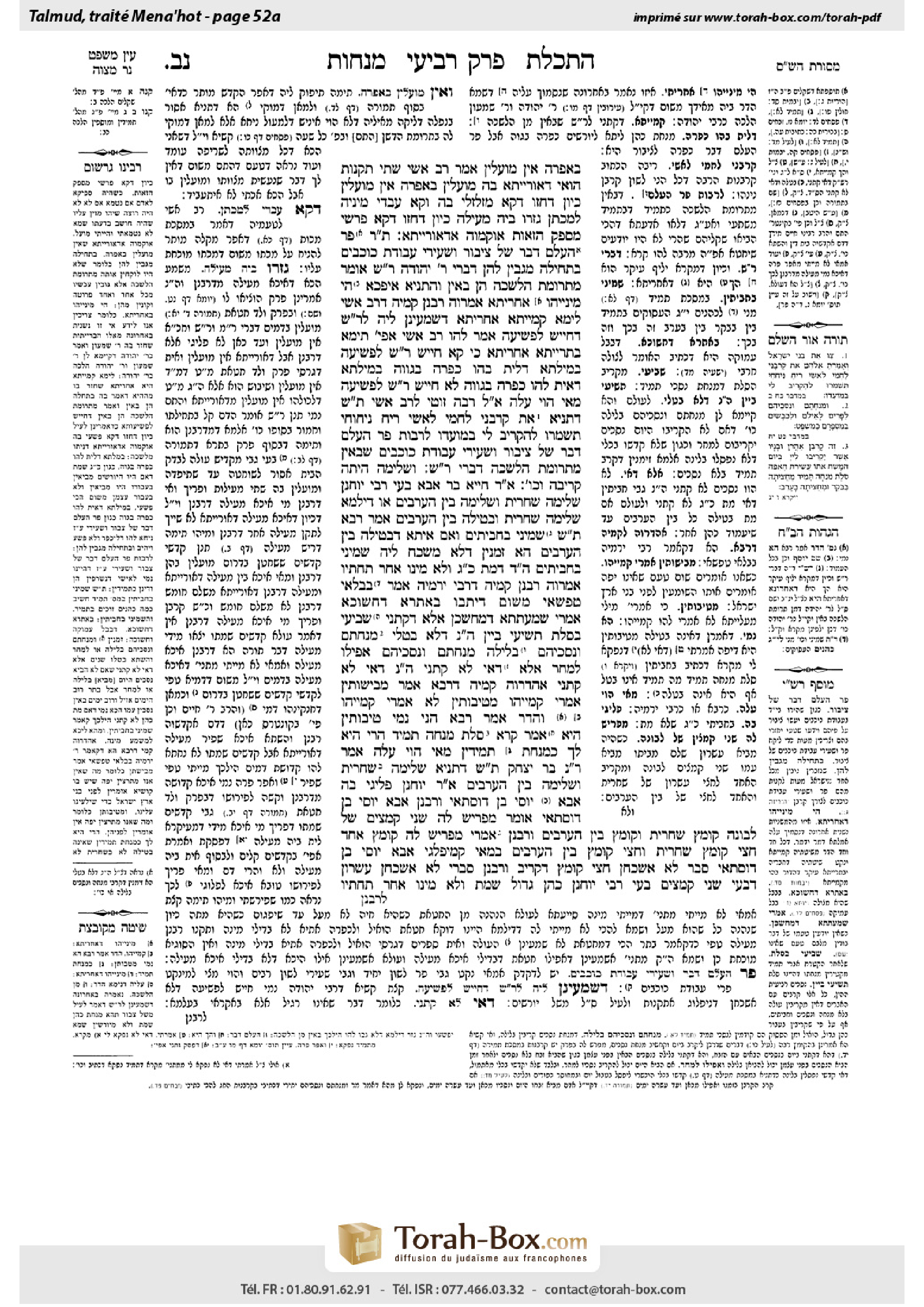
Menachot 52a: Talmud study for Daf Yomi
Daf Yomi is the daily study of one Talmud folio. Explore 37 tractates with scans, Hebrew text, Sefaria English and AI-generated French translations where annotated.
Passage selection and English or AI-generated French translation are available where the scan has annotations. Daf Study is independent of Torah-Box and Sefaria.
Browse Menachot · מנחות · All tractatesMenachot 52a text and translations
This page of Menachot includes the Aramaic text, an English translation and an AI-generated French translation, alongside the scan above.
מנחות נ״ב א · Aramaic and Hebrew text
בְּאֶפְרָהּ אֵין מוֹעֲלִין.
אָמַר רַב אָשֵׁי: שְׁתֵּי תַּקָּנוֹת הֲוַאי, דְּאוֹרָיְיתָא – בָּהּ מוֹעֲלִין, בְּאֶפְרָהּ אֵין מוֹעֲלִין. כֵּיוָן דַּחֲזוֹ דְּקָא מְזַלְזְלִי בַּהּ, וְקָא עָבְדִי מִינֵּיהּ לְמַכָּתָן – גְּזַרוּ בֵּיהּ מְעִילָה.
כֵּיוָן דַּחֲזוֹ דְּקָא פָּרְשִׁי מִסְּפֵק הַזָּאוֹת, אוֹקְמוּהָ אַדְּאוֹרָיְיתָא.
תָּנוּ רַבָּנַן: פַּר הֶעְלֵם דָּבָר שֶׁל צִיבּוּר וּשְׂעִירֵי עֲבוֹדָה זָרָה – בַּתְּחִילָּה מַגְבִּין לָהֶן, דִּבְרֵי רַבִּי יְהוּדָה. רַבִּי שִׁמְעוֹן אוֹמֵר: מִתְּרוּמַת הַלִּשְׁכָּה הֵן בָּאִין.
וְהָתַנְיָא אִיפְּכָא, הֵי מִינַּיְיהוּ אַחְרִיתָא?
אַמְרוּהָ רַבָּנַן קַמֵּיהּ דְּרַב אָשֵׁי: לֵימָא קַמַּיְיתָא אַחְרִיתָא, דְּשָׁמְעִינַן לֵיהּ לְרַבִּי שִׁמְעוֹן דְּחָיֵישׁ לִפְשִׁיעָה.
אֲמַר לְהוּ רַב אָשֵׁי: אֲפִילּוּ תֵּימָא בָּתְרָיְיתָא אַחְרִיתָא, כִּי קָא חָיֵישׁ רַבִּי שִׁמְעוֹן לִפְשִׁיעָה – מִילְּתָא דְּלֵית בְּהוּ כַּפָּרָה בְּגַוַּוהּ, בְּמִילְּתָא דְּאִית לְהוּ כַּפָּרָה בְּגַוַּוהּ – לָא חָיֵישׁ רַבִּי שִׁמְעוֹן לִפְשִׁיעָה.
מַאי הָוֵי עֲלַהּ?
אֲמַר לֵיהּ רַבָּה זוּטֵי לְרַב אָשֵׁי: תָּא שְׁמַע, דְּתַנְיָא: ״אֶת קׇרְבָּנִי לַחְמִי לְאִשַּׁי רֵיחַ נִיחֹחִי תִּשְׁמְרוּ לְהַקְרִיב לִי בְּמוֹעֲדוֹ״ – לְרַבּוֹת פַּר הֶעְלֵם דָּבָר שֶׁל צִיבּוּר וּשְׂעִירֵי עֲבוֹדָה זָרָה שֶׁבָּאִין מִתְּרוּמַת הַלִּשְׁכָּה, דִּבְרֵי רַבִּי שִׁמְעוֹן.
וּשְׁלֵימָה הָיְתָה קְרֵיבָה וְכוּ׳. אָמַר רַבִּי חִיָּיא בַּר אַבָּא: בָּעֵי רַבִּי יוֹחָנָן – שְׁלֵימָה שַׁחֲרִית וּשְׁלֵימָה בֵּין הָעַרְבַּיִם, אוֹ דִילְמָא שְׁלֵימָה שַׁחֲרִית וּבְטֵילָה בֵּין הָעַרְבַּיִם?
אָמַר רָבָא תָּא שְׁמַע: שְׁמִינִי בַּחֲבִיתִּים, וְאִם אִיתָא דִּבְטֵילָה בֵּין הָעַרְבַּיִם – הָא זִמְנִין דְּלָא מַשְׁכַּח לֵיהּ שְׁמִינִי בַּחֲבִיתִּים! הֵיכִי דָּמֵי? דְּמֵת כֹּהֵן גָּדוֹל וְלֹא מִינּוּ אַחֵר תַּחְתָּיו.
אַמְרוּהָ רַבָּנַן קַמֵּיהּ דְּרַבִּי יִרְמְיָה, אֲמַר: בַּבְלָאֵי טַפְשָׁאֵי, מִשּׁוּם (דְּיָתְבוּ) [דְּיָתְבִי] בְּאַתְרָא דַּחֲשׁוֹכָא אָמְרִי שְׁמַעְתָּתָא דִּמְחַשְּׁכָן.
אֶלָּא, דְּקָתָנֵי: שְׁבִיעִי בַּסֹּלֶת, תְּשִׁיעִי בַּיַּיִן, הָכִי נָמֵי דְּלָא בָּטְלִי?
״מִנְחָתָם וְנִסְכֵּיהֶם״ בַּלַּיְלָה, ״מִנְחָתָם וְנִסְכֵּיהֶם״ אֲפִילּוּ לְמָחָר.
אֶלָּא, דְּאִי לָא קָתָנֵי; הָכִי נָמֵי, דְּאִי לָא קָתָנֵי.
אַהְדְּרוּהָ קַמֵּיהּ דְּרָבָא, אֲמַר: מִבִּישׁוּתִין אָמְרִי קַמַּיְיהוּ, מִטֵּיבוּתִין לָא אָמְרִי קַמַּיְיהוּ.
והֲדַר אָמַר רָבָא: הָנֵי נָמֵי טֵיבוּתִין הִיא, אָמַר קְרָא: ״סֹלֶת מִנְחָה תָּמִיד״, הֲרֵי הִיא לְךָ כְּמִנְחַת תְּמִידִין.
מַאי הָוֵי עֲלַהּ? אָמַר רַב נַחְמָן בַּר יִצְחָק: תָּא שְׁמַע, דְּתַנְיָא: שְׁלֵימָה שַׁחֲרִית, וּשְׁלֵימָה בֵּין הָעַרְבָּיִם.
אָמַר רַבִּי יוֹחָנָן: פְּלִיגִי בַּהּ אַבָּא יוֹסֵי בֶּן דּוֹסְתַּאי וְרַבָּנַן.
אַבָּא יוֹסֵי בֶּן דּוֹסְתַּאי אוֹמֵר: מַפְרִישׁ לָהּ שְׁנֵי קְמָצִים שֶׁל לְבוֹנָה, קוֹמֶץ שַׁחֲרִית וְקוֹמֶץ בֵּין הָעַרְבָּיִם. וְרַבָּנַן אָמְרִי: מַפְרִישׁ לָהּ קוֹמֶץ אֶחָד, חֲצִי קוֹמֶץ שַׁחֲרִית וַחֲצִי קוֹמֶץ בֵּין הָעַרְבָּיִם.
בְּמַאי קָמִיפַּלְגִי? אַבָּא יוֹסֵי בֶּן דּוֹסְתַּאי סָבַר: לָא אַשְׁכְּחַן חֲצִי קוֹמֶץ דְּקָרֵיב, וְרַבָּנַן סָבְרִי: לָא אַשְׁכְּחַן עִשָּׂרוֹן דְּבָעֵי שְׁנֵי קְמָצִים.
בָּעֵי רַבִּי יוֹחָנָן: כֹּהֵן גָּדוֹל שֶׁמֵּת וְלֹא מִינּוּ אַחֵר תַּחְתָּיו,
Menachot 52a · English translation
but if one derives benefit from its ashes, one is not liable for misusing consecrated property. It is clear from the baraita that by Torah law one is not liable for misuse of consecrated property if he derives benefit from the ashes of a red heifer.
Rav Ashi said in response: In fact, this halakha is by Torah law, but there were two ordinances that were enacted concerning this matter. By Torah law, if one derives benefit from it, the animal itself, he is liable for misusing consecrated property, but if he derives benefit from its ashes he is not liable for misusing consecrated property. Once the Sages saw that people were treating the ashes of the heifer disrespectfully, and making salves for their wounds from it, they decreed that it is subject to the halakhot of misuse of consecrated property and one may not derive benefit from it.
Once they saw that as a result of this decree people were refraining from sprinkling it in cases where there was uncertainty as to whether or not an individual was impure and required sprinkling, they revoked the decree and established it in accordance with the halakha as it is by Torah law, that one is not liable for misusing the ashes of a red heifer.
§ The Gemara cites a dispute between Rabbi Shimon and Rabbi Yehuda that is similar to the one cited earlier. The Sages taught in a baraita: If there is a need to sacrifice the bull for an unwitting communal sin, brought if the Sanhedrin issues an erroneous halakhic ruling concerning a prohibition for which one is liable to receive karet and the majority of the community acts upon it, or the goats brought if the Sanhedrin issues an erroneous ruling permitting idol worship and the majority of the community acts on it, a new collection of funds is organized for them. The funds are not taken from the collection of the Temple treasury chamber, unlike other communal offerings. This is the statement of Rabbi Yehuda. Rabbi Shimon says: The funds for these sacrifices come from the collection of the chamber.
The Gemara challenges: But isn’t it taught in a baraita the opposite, i.e., that the first opinion cited above is that of Rabbi Shimon and the second is that of Rabbi Yehuda? Which of the two baraitot is the later one and therefore the more accurate and authoritative version of their opinions?
The Sages said the following before Rav Ashi: Let us say that the first baraita cited above is the later one, as we have heard that Rabbi Shimon is concerned about the possibility of negligence. Just as Rabbi Shimon was concerned above that the heirs of the High Priest would not provide the funds for the griddle-cake offering, it is reasonable to assume that he would be concerned that people would not contribute to a new collection, and therefore the funds are taken from the collection of the chamber.
Rav Ashi said to the Sages: You may even say that the latter baraita cited above is the later and more authoritative one. When Rabbi Shimon expressed that he is concerned about the possibility of people acting with negligence, that was only with regard to a matter that does not provide them with atonement, e.g., the griddle-cake offering of the deceased High Priest. But Rabbi Shimon is not concerned about the possibility of negligence with regard to a matter that does provide them with atonement, e.g., these sin offerings.
The Gemara asks, in light of the fact that the discussion above was inconclusive: What conclusion was reached about it; which baraita is later and more authoritative?
Rabba Zuti said to Rav Ashi: Come and hear a resolution, as it is taught in a baraita: The verse concerning the daily sacrifice: “Command the children of Israel, and say to them: My food that is presented to Me for offerings made by fire, of a pleasing aroma to Me, you shall observe to sacrifice to Me in its due season” (Numbers 28:2), serves to include the bull for an unwitting communal sin and the goats of idol worship. This teaches that the funds for these offerings come from the collection of the chamber; this is the statement of Rabbi Shimon. This proves that it is Rabbi Shimon who holds that these sacrifices are brought from the collection of the chamber.
§ The mishna teaches: And for the duration of the period until a new High Priest is appointed, the griddle-cake offering was sacrificed as a complete tenth of an ephah of fine flour. Rabbi Ḥiyya bar Abba says that Rabbi Yoḥanan raises a dilemma: Does the mishna mean that a complete tenth of an ephah is offered in the morning and another complete tenth of an ephah is offered in the afternoon, because this offering is sacrificed twice a day and is not divided in half when it is not brought by the High Priest himself? Or does it perhaps mean that a complete tenth of an ephah is sacrificed in the morning and the offering is canceled in the afternoon?
Rava said: Come and hear the resolution to this dilemma from that which is taught in a mishna (Tamid 31b) describing the order of the nine priests who brought the limbs of the daily offering up to the ramp of the altar, both in the morning and in the afternoon: The eighth priest carries the griddle-cake offering of the High Priest. And if it were so that the offering is canceled in the afternoon, then sometimes one would not find the eighth priest carrying the griddle-cake offering. What are the circumstances when there would be no eighth priest? In a case where the High Priest died after he brought his griddle-cake offering in the morning and they did not yet appoint another High Priest in his stead. Therefore, it must be that a complete tenth of an ephah was also brought for the afternoon offering.
The Sages stated this proof before Rabbi Yirmeya. Rabbi Yirmeya rejected it and said: Those foolish Babylonians, because they dwell in a low-lying and therefore dark land, they state halakhot that are dark, i.e., erroneous.
Rather, with regard to that which the same mishna teaches: The seventh priest carries the fine flour for the meal offering component of the daily offering and the ninth priest carries the wine for the libations that accompany the daily offering, is it also the case that they are never canceled?
That is not correct, as it is derived from the verse “Their meal offering and their libations” (Numbers 29:18) that these items may be sacrificed even at night, despite the fact that the daily offering they accompany must be sacrificed during the day. Similarly, the phrase “their meal offering and their libations” indicates that these items may be sacrificed even the next day (see 44b). Under those circumstances there would not have been fine flour and wine brought by the seventh and nine priests at the time of the daily offering.
Rather, one must explain that the tanna does not teach cases of what if, and is speaking only about the typical case. So too with regard to Rava’s proof from the mishna, it is not compelling because the tanna does not teach cases of what if the High Priest dies and a successor has not yet been appointed.
The Sages then brought Rabbi Yirmeya’s analysis before Rava. Rava initially said to them: You state our inferior statements, which can be refuted, before the Sages of Eretz Yisrael, but you do not state our superior statements before them?
And Rava then said to them: This statement, that the griddle-cake offering is sacrificed twice a day even if there is no High Priest, is also one of our superior statements, as the verse states concerning the griddle-cake offering of the High Priest: “Fine flour for a meal offering perpetually [tamid], half of it in the morning, and half of it in the evening” (Leviticus 6:13). This teaches that the griddle-cake offering of the High Priest is like the meal offering component of the daily offerings [temidin] and must be sacrificed in the morning and the afternoon, even if the High Priest died and was not yet replaced.
The Gemara asks: What halakhic conclusion was reached about this matter? Rav Naḥman bar Yitzḥak said: Come and hear a resolution to Rabbi Yoḥanan’s dilemma, as it is taught explicitly in a baraita: If the High Priest died and was not yet replaced, a complete tenth of an ephah is sacrificed in the morning and another complete tenth of an ephah is sacrificed in the afternoon.
§ Rabbi Yoḥanan says: Abba Yosei ben Dostai and the Rabbis disagree as to the amount of frankincense brought with the griddle-cake offering of the High Priest.
Abba Yosei ben Dostai says: The High Priest separates two handfuls of frankincense for his griddle-cake offering each day; one handful for his morning offering and one handful for his afternoon offering. And the Rabbis say: The High Priest separates one handful of frankincense each day for his griddle-cake offering. He divides it in half and brings half a handful for his morning offering and half a handful for his afternoon offering.
The Gemara clarifies: With regard to what principle do they disagree? Abba Yosei ben Dostai holds that since one does not find a case where the Torah explicitly states that half a handful is sacrificed, he brings a complete handful for each offering. And the Rabbis hold that since one does not find a case where a tenth of an ephah requires two handfuls of frankincense, he brings only one handful and divides it between the two offerings.
Having discussed the quantity of frankincense that is generally brought with the griddle-cake offering, the Gemara now addresses a case where the High Priest died. Rabbi Yoḥanan raises a dilemma: In the case of a High Priest who died and they did not yet appoint another in his stead,
Menachot 52a · Traduction française (IA)
mais si quelqu’un tire profit de ses cendres, il n’est pas passible pour avoir fait un usage profane d’un bien consacré. La baraïta montre clairement que, selon la Torah, on n’est pas passible pour avoir fait un usage profane des cendres d’une vache rousse.
Rav Ashi répondit : En réalité, cette halakha relève de la Torah, mais deux décrets ont été édictés à ce sujet. Selon la Torah, si quelqu’un tire profit de l’animal lui-même, il est passible pour avoir fait un usage profane d’un bien consacré ; mais s’il tire profit de ses cendres, il n’en est pas passible. Lorsque les Sages constatèrent que les gens traitaient les cendres de la vache rousse avec irrespect et en faisaient des onguents pour leurs plaies, ils décrétèrent que les cendres étaient soumises aux règles relatives à l’usage profane des biens consacrés et qu’il était interdit d’en tirer profit.
Lorsqu’ils constatèrent qu’à la suite de ce décret les gens s’abstenaient de faire l’aspersion dans les cas où l’on ne savait pas avec certitude si une personne était impure et devait recevoir l’aspersion, ils annulèrent le décret et rétablirent la halakha telle qu’elle s’applique selon la Torah : on n’est pas passible pour avoir fait un usage profane des cendres d’une vache rousse.
§ La Guemara rapporte un désaccord entre Rabbi Shimon et Rabbi Yehuda, semblable à celui cité précédemment. Les Sages ont enseigné dans une baraïta : S’il faut offrir le taureau pour une faute involontaire de la communauté, apporté lorsque le Sanhédrin rend une décision halakhique erronée concernant une interdiction passible de karet et que la majorité de la communauté agit en conséquence, ou les boucs apportés lorsque le Sanhédrin rend une décision erronée autorisant le culte idolâtre et que la majorité de la communauté agit en conséquence, une nouvelle collecte de fonds est organisée à cette fin. Les fonds ne sont pas prélevés sur la collecte de la chambre du Trésor du Temple, contrairement à ceux des autres offrandes communautaires. Telle est l’opinion de Rabbi Yehuda. Rabbi Shimon dit : Les fonds destinés à ces sacrifices proviennent de la collecte de la chambre.
La Guemara objecte : Mais une baraïta n’enseigne-t-elle pas le contraire, c’est-à-dire que la première opinion citée ci-dessus est celle de Rabbi Shimon et la seconde celle de Rabbi Yehuda ? Laquelle des deux baraïtot est la plus tardive et, par conséquent, donne la version la plus exacte et la plus autorisée de leurs opinions ?
Les Sages dirent devant Rav Ashi : Disons que la première baraïta citée ci-dessus est la plus tardive, puisque nous savons que Rabbi Shimon tient compte du risque de négligence. De même que Rabbi Shimon craignait plus haut que les héritiers du grand prêtre ne fournissent pas les fonds pour l’offrande de galettes à la poêle, il est raisonnable de supposer qu’il craindrait que les gens ne contribuent pas à une nouvelle collecte ; les fonds sont donc prélevés sur la collecte de la chambre.
Rav Ashi dit aux Sages : Vous pouvez même dire que la baraïta citée en dernier est la plus tardive et fait davantage autorité. Lorsque Rabbi Shimon a exprimé sa crainte que les gens fassent preuve de négligence, cela ne concernait qu’une chose qui ne leur procure pas d’expiation, par exemple l’offrande de galettes à la poêle du grand prêtre défunt. Mais Rabbi Shimon ne craint pas que les gens fassent preuve de négligence lorsqu’il s’agit d’une chose qui leur procure une expiation, par exemple ces sacrifices expiatoires.
La Guemara demande, puisque la discussion ci-dessus n’a pas abouti : Quelle conclusion a-t-on tirée à ce sujet ? Quelle baraïta est la plus tardive et fait le plus autorité ?
Rabba Zuti dit à Rav Ashi : Viens entendre une résolution, car une baraïta enseigne : Le verset concernant l’offrande quotidienne : « Ordonne aux enfants d’Israël et dis-leur : Mon pain, destiné à mes sacrifices consumés par le feu, d’agréable odeur pour Moi, vous veillerez à me l’offrir en son temps fixé » (Nombres 28:2), inclut le taureau pour une faute involontaire de la communauté et les boucs pour le culte idolâtre. Cela enseigne que les fonds destinés à ces offrandes proviennent de la collecte de la chambre ; telle est l’opinion de Rabbi Shimon. Il est donc établi que, selon Rabbi Shimon, ces sacrifices sont financés par la collecte de la chambre.
§ La Michna enseigne : Pendant la période allant jusqu’à la nomination d’un nouveau grand prêtre, l’offrande de galettes à la poêle était offerte avec un dixième complet d’épha de fleur de farine. Rabbi Ḥiyya bar Abba rapporte que Rabbi Yoḥanan soulève une question : La Michna veut-elle dire qu’un dixième complet d’épha est offert le matin et un autre dixième complet d’épha l’après-midi, puisque cette offrande est apportée deux fois par jour et n’est pas divisée en deux lorsque le grand prêtre ne l’apporte pas lui-même ? Ou bien veut-elle dire qu’un dixième complet d’épha est offert le matin et que l’offrande est supprimée l’après-midi ?
Rava dit : Viens entendre la réponse à cette question dans une Michna (Tamid 31b) qui décrit l’ordre des neuf prêtres portant les membres de l’offrande quotidienne jusqu’à la rampe de l’autel, le matin comme l’après-midi : le huitième prêtre porte l’offrande de galettes à la poêle du grand prêtre. Or, si l’offrande était supprimée l’après-midi, il arriverait parfois qu’aucun huitième prêtre ne porte cette offrande. Dans quelles circonstances n’y aurait-il pas de huitième prêtre ? Si le grand prêtre mourait après avoir apporté son offrande de galettes à la poêle le matin, et qu’aucun autre grand prêtre n’ait encore été nommé pour le remplacer. Il faut donc conclure qu’un dixième complet d’épha était également apporté pour l’offrande de l’après-midi.
Les Sages présentèrent cette preuve à Rabbi Yirmeya. Rabbi Yirmeya la rejeta et dit : Ces Babyloniens stupides, parce qu’ils habitent un pays bas et donc sombre, énoncent des halakhot obscures, c’est-à-dire erronées.
Mais alors, concernant ce que la même Michna enseigne — le septième prêtre porte la fleur de farine destinée à l’offrande de farine de l’offrande quotidienne, et le neuvième prêtre porte le vin des libations qui l’accompagnent —, ces éléments ne sont-ils jamais supprimés, eux non plus ?
Ce n’est pas exact, car il est déduit du verset « leurs offrandes de farine et leurs libations » (Nombres 29:18) que ces éléments peuvent être offerts même la nuit, bien que l’offrande quotidienne qu’ils accompagnent doive être offerte le jour. De même, l’expression « leurs offrandes de farine et leurs libations » indique que ces éléments peuvent être offerts même le lendemain (voir 44b). Dans ces circonstances, la fleur de farine et le vin n’auraient pas été apportés par les septième et neuvième prêtres au moment de l’offrande quotidienne.
Il faut plutôt expliquer que le tanna n’enseigne pas les cas hypothétiques, mais parle uniquement du cas habituel. De même, la preuve que Rava tire de la Michna n’est pas concluante, car le tanna n’enseigne pas les cas hypothétiques où le grand prêtre meurt et où son successeur n’a pas encore été nommé.
Les Sages rapportèrent alors à Rava l’analyse de Rabbi Yirmeya. Rava leur dit d’abord : Vous présentez aux Sages d’Eretz Israël nos arguments les plus faibles, ceux qu’on peut réfuter, mais vous ne leur présentez pas nos arguments les plus solides ?
Puis Rava leur dit : Cette affirmation, selon laquelle l’offrande de galettes à la poêle est apportée deux fois par jour même en l’absence de grand prêtre, est elle aussi l’un de nos arguments les plus solides, car le verset dit au sujet de l’offrande de galettes à la poêle du grand prêtre : « Fleur de farine pour une offrande de farine perpétuelle [tamid], la moitié le matin et la moitié le soir » (Lévitique 6:13). Cela enseigne que l’offrande de galettes à la poêle du grand prêtre est semblable à la partie de farine des offrandes quotidiennes [temidin] et doit être apportée le matin et l’après-midi, même si le grand prêtre est mort et n’a pas encore été remplacé.
La Guemara demande : Quelle conclusion halakhique a-t-on tirée à ce sujet ? Rav Naḥman bar Yitzḥak dit : Viens entendre la réponse à la question de Rabbi Yoḥanan, car une baraïta l’enseigne explicitement : Si le grand prêtre est mort et n’a pas encore été remplacé, un dixième complet d’épha est offert le matin et un autre dixième complet d’épha l’après-midi.
§ Rabbi Yoḥanan dit : Abba Yosei ben Dostai et les Rabbins sont en désaccord sur la quantité d’encens apportée avec l’offrande de galettes à la poêle du grand prêtre.
Abba Yosei ben Dostai dit : Chaque jour, le grand prêtre prélève deux poignées d’encens pour son offrande de galettes à la poêle : une poignée pour l’offrande du matin et une poignée pour celle de l’après-midi. Les Rabbins disent : Chaque jour, le grand prêtre prélève une poignée d’encens pour son offrande de galettes à la poêle. Il la divise en deux et apporte une demi-poignée pour l’offrande du matin et une demi-poignée pour celle de l’après-midi.
La Guemara précise : Sur quel principe sont-ils en désaccord ? Abba Yosei ben Dostai estime que, puisqu’on ne trouve aucun cas où la Torah indique explicitement qu’une demi-poignée doit être offerte, il apporte une poignée entière pour chaque offrande. Les Rabbins estiment que, puisqu’on ne trouve aucun cas où un dixième d’épha requiert deux poignées d’encens, il n’apporte qu’une seule poignée et la répartit entre les deux offrandes.
Après avoir discuté de la quantité d’encens généralement apportée avec l’offrande de galettes à la poêle, la Guemara aborde le cas où le grand prêtre est mort. Rabbi Yoḥanan soulève une question : dans le cas d’un grand prêtre qui est mort et dont on n’a pas encore nommé de remplaçant,
Traduction française générée par IA à partir de l’édition anglaise de Sefaria. Vérifie toujours un passage avec le texte source.
Text from Sefaria: William Davidson Edition - Vocalized Aramaic (unknown); William Davidson Edition - English (CC BY NC).