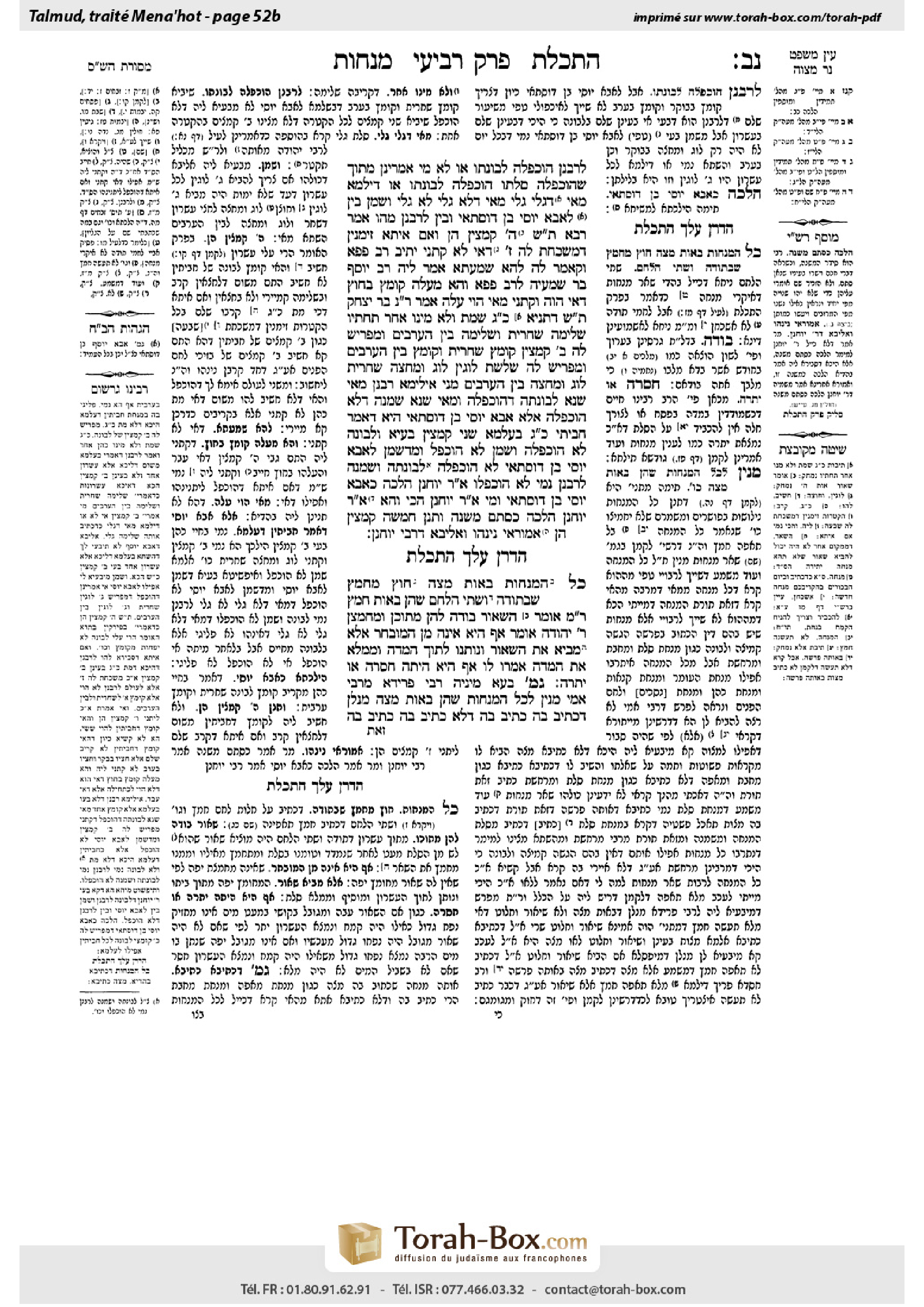
Menachot 52b: Talmud study for Daf Yomi
Daf Yomi is the daily study of one Talmud folio. Explore 37 tractates with scans, Hebrew text, Sefaria English and AI-generated French translations where annotated.
Passage selection and English or AI-generated French translation are available where the scan has annotations. Daf Study is independent of Torah-Box and Sefaria.
Browse Menachot · מנחות · All tractatesMenachot 52b text and translations
This page of Menachot includes the Aramaic text, an English translation and an AI-generated French translation, alongside the scan above.
מנחות נ״ב ב · Aramaic and Hebrew text
לְרַבָּנַן הוּכְפְּלָה לְבוֹנָתוֹ, אוֹ לָא? מִי אָמְרִינַן: מִתּוֹךְ שֶׁהוּכְפְּלָה סׇלְתּוֹ הוּכְפְּלָה לְבוֹנָתוֹ, אוֹ דִילְמָא מַאי דְּגַלִּי גַּלִּי, מַאי דְּלָא גַּלִּי לָא גַּלִּי.
וְשֶׁמֶן, בֵּין לְאַבָּא יוֹסֵי בֶּן דּוֹסְתַּאי וּבֵין לְרַבָּנַן – מַהוּ?
אָמַר רָבָא תָּא שְׁמַע: חֲמִשָּׁה קְמָצִין הֵן, וְאִם אִיתָא, זִימְנִין דְּמַשְׁכַּחַתְּ לַהּ שִׁבְעָה.
דְּאִי לָא קָתָנֵי, יָתֵיב רַב פָּפָּא וְקָאָמַר לַהּ לְהָא שְׁמַעְתָּא. אֲמַר לֵיהּ רַב יוֹסֵף בַּר שְׁמַעְיָה לְרַב פָּפָּא: וְהָא מַעֲלֶה קוֹמֶץ בַּחוּץ, דְּאִי הֲוָה, וְקָתָנֵי.
מַאי הָוֵי עֲלַהּ? אָמַר רַב נַחְמָן בַּר יִצְחָק: תָּא שְׁמַע, דְּתַנְיָא: כֹּהֵן גָּדוֹל שֶׁמֵּת וְלֹא מִינּוּ אַחֵר תַּחְתָּיו – שְׁלֵימָה שַׁחֲרִית, וּשְׁלֵימָה בֵּין הָעַרְבָּיִם, וּמַפְרִישׁ לָהּ שְׁנֵי קְמָצִין – קוֹמֶץ שַׁחֲרִית וְקוֹמֶץ בֵּין הָעַרְבָּיִם, וּמַפְרִישׁ לָהּ שְׁלֹשֶׁת לוּגִּין – לוֹג וּמֶחֱצָה שַׁחֲרִית, לוֹג וּמֶחֱצָה בֵּין הָעַרְבָּיִם.
מַנִּי? אִילֵּימָא רַבָּנַן – מַאי שְׁנָא לְבוֹנָתָהּ דְּהוּכְפְּלָה, וּמַאי שְׁנָא שַׁמְנָהּ דְּלֹא הוּכְפְּלָה?
אֶלָּא, אַבָּא יוֹסֵי בֶּן דּוֹסְתַּאי הִיא, דְּאָמַר: חֲבִיתֵּי כֹּהֵן גָּדוֹל בְּעָלְמָא שְׁנֵי קְמָצִין בָּעֲיָא, וּלְבוֹנָה לֹא הוּכְפְּלָה, וְשֶׁמֶן לֹא הוּכְפַּל.
וּמִדְּשֶׁמֶן לְאַבָּא יוֹסֵי בֶּן דּוֹסְתַּאי לֹא הוּכְפְּלָה לְבוֹנָתָהּ וְשַׁמְנָהּ, לְרַבָּנַן נָמֵי לָא הוּכְפְּלוּ.
אָמַר רַבִּי יוֹחָנָן: הֲלָכָה כְּאַבָּא יוֹסֵי בֶּן דּוֹסְתַּאי. וּמִי אָמַר רַבִּי יוֹחָנָן הָכִי? וְהָא אָמַר רַבִּי יוֹחָנָן: הֲלָכָה כִּסְתַם מִשְׁנָה, וּתְנַן: חֲמִשָּׁה קְמָצִין הֵן.
אָמוֹרָאֵי נִינְהוּ, וְאַלִּיבָּא דְּרַבִּי יוֹחָנָן.
הֲדַרַן עֲלָךְ הַתְּכֵלֶת.
מַתְנִי׳ כׇּל הַמְּנָחוֹת בָּאוֹת מַצָּה, חוּץ מֵחָמֵץ שֶׁבַּתּוֹדָה וּשְׁתֵּי הַלֶּחֶם שֶׁהֵן בָּאוֹת חָמֵץ.
רַבִּי מֵאִיר אוֹמֵר: הַשְּׂאוֹר בּוֹדֶה לָהֶן מִתּוֹכָן, וּמְחַמְּצָן.
רַבִּי יְהוּדָה אוֹמֵר: אַף הִיא אֵינָהּ מִן הַמּוּבְחָר, אֶלָּא מֵבִיא אֶת הַשְּׂאוֹר וְנוֹתְנוֹ לְתוֹךְ הַמִּדָּה, וּמְמַלֵּא אֶת הַמִּדָּה. אָמְרוּ לוֹ: אַף הִיא הָיְתָה חֲסֵרָה אוֹ יְתֵרָה.
גְּמָ׳ בְּעָא מִינֵּיהּ רַבִּי פְּרִידָא מֵרַבִּי אַמֵּי: מִנַּיִן לְכׇל הַמְּנָחוֹת שֶׁהֵן בָּאוֹת מַצָּה? מְנָלַן? דִּכְתִיב בַּהּ – כְּתִיב בַּהּ, דְּלָא כְּתִיב בַּהּ – כְּתִיב בַּהּ
Menachot 52b · English translation
according to the Rabbis, who hold that generally one handful of frankincense is divided between the morning and afternoon offerings, is the amount of frankincense doubled or not? Do we say that since in this case its fine flour is doubled, as a complete tenth of an ephah of fine flour is sacrificed in both the morning and evening, its frankincense is also doubled? Or perhaps that which the verse reveals, i.e., that a complete tenth of an ephah is sacrificed in the morning and afternoon, it reveals, and that which it does not reveal, it does not reveal; and therefore, since the verse does not indicate that the amount of frankincense is doubled, only one handful is brought.
And furthermore, what is the halakha concerning the oil of the griddle-cake offering in a case where the High Priest died and was not yet replaced, both according to Abba Yosei ben Dostai and according to the Rabbis? Is the required amount three log, as it is when the High Priest brings the griddle-cake offering, or is the amount of oil doubled just as the amount of fine flour is doubled?
Rava said: Come and hear a resolution to the dilemma concerning the quantity of frankincense that is brought in this case, based upon a mishna (106b): There are five halakhot pertaining to a handful. The halakha of the frankincense sacrificed with the griddle-cake offering of the High Priest is not included in this number, because only half a handful of frankincense is sacrificed at one time. And if it is so that when there is no High Priest a complete handful is brought in the morning and in the afternoon, then sometimes you find that there are seven halakhot pertaining to a handful.
The Gemara rejects this proof: The tanna does not teach cases of what if the High Priest died, and is speaking only about a typical case. The Gemara relates that Rav Pappa was sitting and teaching this halakha. Rav Yosef bar Shemaya said to Rav Pappa: But the mishna does list the case of one who intentionally offers up the handful from a meal offering outside the Temple courtyard, who is liable to receive karet. This is not a standard case but rather a case of what if, and nevertheless it is taught in the mishna. Accordingly, Rava’s proof is valid.
The Gemara asks: What conclusion was reached about this matter? Rav Naḥman bar Yitzḥak said: Come and hear a resolution, as it is taught in a baraita: In the case of a High Priest who died and they did not yet appoint another in his stead, a complete tenth of an ephah of fine flour is brought for the griddle-cake offering in the morning and another complete tenth of an ephah is brought in the afternoon. And one separates two handfuls of frankincense for it, and sacrifices one handful with the morning offering and one handful with the afternoon offering. And one separates three log of oil for it, and brings a log and a half with the morning offering and a log and a half with the afternoon offering.
The Gemara asks: In accordance with whose opinion is this baraita? If we say that it is in accordance with the opinion of the Rabbis, what is different about its frankincense such that it is doubled in the case where the High Priest died, and what is different about its oil such that it is not doubled?
Rather, the baraita is in accordance with the opinion of Abba Yosei ben Dostai, who said: The griddle-cake offering of the High Priest generally requires two handfuls. And therefore when the baraita requires two handfuls of frankincense in the case where the High Priest died and another has not yet been appointed, the frankincense is not being doubled and the oil is also not doubled. Therefore, three log of oil are required, as usual.
And from the fact that according to Abba Yosei ben Dostai the requisite oil is not doubled, one can conclude that also according to the Rabbis its frankincense and its oil are not doubled.
This discussion in the Gemara began with Rabbi Yoḥanan presenting the dispute between Abba Yosei ben Dostai and the Rabbis, and it concludes with his ruling concerning their dispute. Rabbi Yoḥanan says: The halakha is in accordance with the opinion of Abba Yosei ben Dostai. The Gemara asks: And did Rabbi Yoḥanan actually say this? But doesn’t Rabbi Yoḥanan state a principle that the halakha is in accordance with the ruling of an unattributed mishna, and we learned in the unattributed mishna cited earlier: There are only five halakhot pertaining to a handful. Since the mishna does not list the fact that a handful of frankincense is offered twice daily with the griddle-cake offering, how can Rabbi Yoḥanan accept that opinion?
The Gemara answers: They are different amora’im, and they disagree with regard to the opinion of Rabbi Yoḥanan. One said that Rabbi Yoḥanan rules in accordance with Abba Yosei ben Dostai, and one said that according to Rabbi Yoḥanan the halakha is always in accordance with an unattributed mishna.
MISHNA: All the meal offerings come to be offered as matza, with care taken to prevent leavening, except for ten loaves of leavened bread among the forty loaves that accompany the thanks offering, and the meal offering of the two loaves that are brought on the festival of Shavuot, as they come to be offered as leavened bread.
The Sages disagree as to the manner in which those meal offerings are leavened. Rabbi Meir says: With regard to the leaven added to the dough to facilitate leavening, one separates [bodeh] part of the flour for the meal offerings from within the flour of the meal offerings themselves, causes it to become leaven, and leavens the meal offerings with it.
Rabbi Yehuda says: That is also not the optimal manner in which to fulfill the mitzva, as aged leaven is a more effective leavening agent. Rather, one brings the leaven from another, aged, dough and places it into the measuring vessel, and then he adds flour until he fills the measuring vessel, to ensure the appropriate measure of a tenth of an ephah of flour. The Rabbis said to Rabbi Yehuda: That too is inappropriate, as in that manner the meal offering will either be lacking the requisite measure or be greater than the required measure, as the Gemara will explain.
GEMARA: Rabbi Perida raised a dilemma before Rabbi Ami: From where is it derived with regard to all the meal offerings that they come to be offered as matza? Rabbi Ami was puzzled by this question, and replied: What do you mean when you say: From where do we derive this? Concerning every meal offering with regard to which it is written explicitly in the Torah that it comes as matza, it is written with regard to it, and therefore the dilemma does not arise. And concerning any meal offering where it is not written explicitly with regard to it that it must be matza, nevertheless it is written with regard to it:
Menachot 52b · Traduction française (IA)
Selon les Rabbins, qui estiment qu’en règle générale une poignée d’encens est répartie entre les offrandes du matin et de l’après-midi, la quantité d’encens est-elle doublée ou non ? Faut-il dire que, puisque dans ce cas la quantité de fleur de farine est doublée — car un dixième complet d’épha de fleur de farine est offert le matin comme le soir —, la quantité d’encens est elle aussi doublée ? Ou peut-être faut-il dire que le verset révèle ce qu’il révèle, à savoir qu’un dixième complet d’épha est offert le matin et l’après-midi, et ne révèle pas ce qu’il ne révèle pas. Par conséquent, puisque le verset n’indique pas que la quantité d’encens est doublée, on n’apporte qu’une seule poignée.
Et, de plus, quelle est la halakha concernant l’huile de l’offrande à la poêle, dans le cas où le Grand Prêtre est mort et n’a pas encore été remplacé, selon Abba Yosei ben Dostai comme selon les Rabbins ? La quantité requise est-elle de trois log, comme lorsque le Grand Prêtre apporte l’offrande à la poêle, ou la quantité d’huile est-elle doublée, tout comme celle de fleur de farine ?
Rava dit : Viens et entends une réponse à la question concernant la quantité d’encens apportée dans ce cas, fondée sur une Michna (106b) : Il existe cinq halakhot relatives à une poignée. La halakha concernant l’encens offert avec l’offrande à la poêle du Grand Prêtre n’est pas comprise dans ce nombre, car seule une demi-poignée d’encens est offerte à la fois. Or, s’il en est ainsi, si, en l’absence de Grand Prêtre, on apporte une poignée complète le matin et une autre l’après-midi, on trouve parfois sept halakhot relatives à une poignée.
La Guemara rejette cette preuve : le tanna n’enseigne pas les cas où le Grand Prêtre serait mort ; il ne parle que des cas habituels. La Guemara rapporte que Rav Pappa était assis et enseignait cette halakha. Rav Yosef bar Shemaya dit à Rav Pappa : Pourtant, la Michna énumère bien le cas de celui qui offre intentionnellement la poignée d’une offrande de repas hors du parvis du Temple et qui est passible de karet. Ce n’est pas un cas habituel, mais un cas hypothétique ; pourtant, il est enseigné dans la Michna. Par conséquent, la preuve de Rava est valable.
La Guemara demande : Quelle conclusion a-t-on tirée à ce sujet ? Rav Naḥman bar Yitzḥak dit : Viens et entends une réponse, car il est enseigné dans une baraïta : Dans le cas où le Grand Prêtre est mort et où l’on n’en a pas encore nommé un autre à sa place, on apporte un dixième complet d’épha de fleur de farine pour l’offrande à la poêle le matin, et un autre dixième complet d’épha l’après-midi. On prélève pour celle-ci deux poignées d’encens : on en offre une avec l’offrande du matin et l’autre avec celle de l’après-midi. On prélève pour celle-ci trois log d’huile et on en apporte un log et demi avec l’offrande du matin, puis un log et demi avec celle de l’après-midi.
La Guemara demande : Selon l’opinion de qui cette baraïta est-elle formulée ? Si l’on dit qu’elle suit l’opinion des Rabbins, qu’est-ce qui distingue l’encens, dont la quantité est doublée dans le cas où le Grand Prêtre est mort, de l’huile, dont la quantité n’est pas doublée ?
La baraïta suit plutôt l’opinion d’Abba Yosei ben Dostai, qui disait que l’offrande à la poêle du Grand Prêtre requiert habituellement deux poignées. Par conséquent, lorsque la baraïta exige deux poignées d’encens dans le cas où le Grand Prêtre est mort et où aucun autre n’a encore été nommé, la quantité d’encens n’est pas doublée, pas plus que celle de l’huile. Il faut donc trois log d’huile, comme d’habitude.
Et du fait que, selon Abba Yosei ben Dostai, la quantité d’huile requise n’est pas doublée, on peut conclure que, selon les Rabbins également, ni la quantité d’encens ni celle d’huile ne sont doublées.
Cette discussion de la Guemara a commencé par la présentation, par Rabbi Yoḥanan, du désaccord entre Abba Yosei ben Dostai et les Rabbins, et s’achève par sa décision à propos de leur différend. Rabbi Yoḥanan dit : La halakha suit l’opinion d’Abba Yosei ben Dostai. La Guemara demande : Rabbi Yoḥanan a-t-il vraiment dit cela ? Rabbi Yoḥanan n’énonce-t-il pas le principe selon lequel la halakha suit la décision d’une Michna anonyme ? Or, nous avons appris dans la Michna anonyme citée plus haut : Il n’existe que cinq halakhot relatives à une poignée. Puisque la Michna ne mentionne pas qu’une poignée d’encens est offerte deux fois par jour avec l’offrande à la poêle, comment Rabbi Yoḥanan peut-il retenir cette opinion ?
La Guemara répond : Il s’agit de deux amoraïm différents, qui sont en désaccord sur l’opinion de Rabbi Yoḥanan. L’un dit que Rabbi Yoḥanan statue conformément à l’opinion d’Abba Yosei ben Dostai, et l’autre dit que, selon Rabbi Yoḥanan, la halakha suit toujours une Michna anonyme.
MICHNA : Toutes les offrandes de repas sont offertes sous forme de matsa, en veillant à empêcher toute fermentation, à l’exception de dix pains levés parmi les quarante pains qui accompagnent le sacrifice de gratitude, ainsi que de l’offrande de repas constituée des deux pains apportés lors de la fête de Chavouot, car ces pains sont offerts sous forme de pain levé.
Les Sages sont en désaccord sur la manière de faire lever ces offrandes de repas. Rabbi Meïr dit : Pour le levain ajouté à la pâte afin de la faire lever, on prélève [bodeh] une partie de la farine destinée aux offrandes de repas, parmi la farine même de ces offrandes ; on la fait fermenter, puis on s’en sert pour faire lever les offrandes de repas.
Rabbi Yehouda dit : Ce n’est pas non plus la manière optimale d’accomplir la mitsva, car un levain ancien est un agent levant plus efficace. On apporte plutôt du levain provenant d’une autre pâte, déjà fermentée, on le place dans le récipient de mesure, puis on ajoute de la farine jusqu’à remplir le récipient, afin d’obtenir la mesure appropriée d’un dixième d’épha de farine. Les Rabbins dirent à Rabbi Yehouda : Cela non plus ne convient pas, car de cette manière l’offrande de repas aura soit une quantité inférieure à la mesure requise, soit une quantité supérieure à cette mesure, comme la Guemara l’expliquera.
GUEMARA : Rabbi Perida souleva une question devant Rabbi Ami : D’où apprend-on que toutes les offrandes de repas sont offertes sous forme de matsa ? Rabbi Ami fut perplexe devant cette question et répondit : Que veux-tu dire par « D’où l’apprend-on ? » Pour toute offrande de repas au sujet de laquelle il est explicitement écrit dans la Torah qu’elle est apportée sous forme de matsa, cela est écrit à son sujet ; la question ne se pose donc pas. Et pour toute offrande de repas au sujet de laquelle il n’est pas explicitement écrit qu’elle doit être sous forme de matsa, cela est néanmoins écrit à son sujet :
Traduction française générée par IA à partir de l’édition anglaise de Sefaria. Vérifie toujours un passage avec le texte source.
Text from Sefaria: William Davidson Edition - Vocalized Aramaic (unknown); William Davidson Edition - English (CC BY NC).