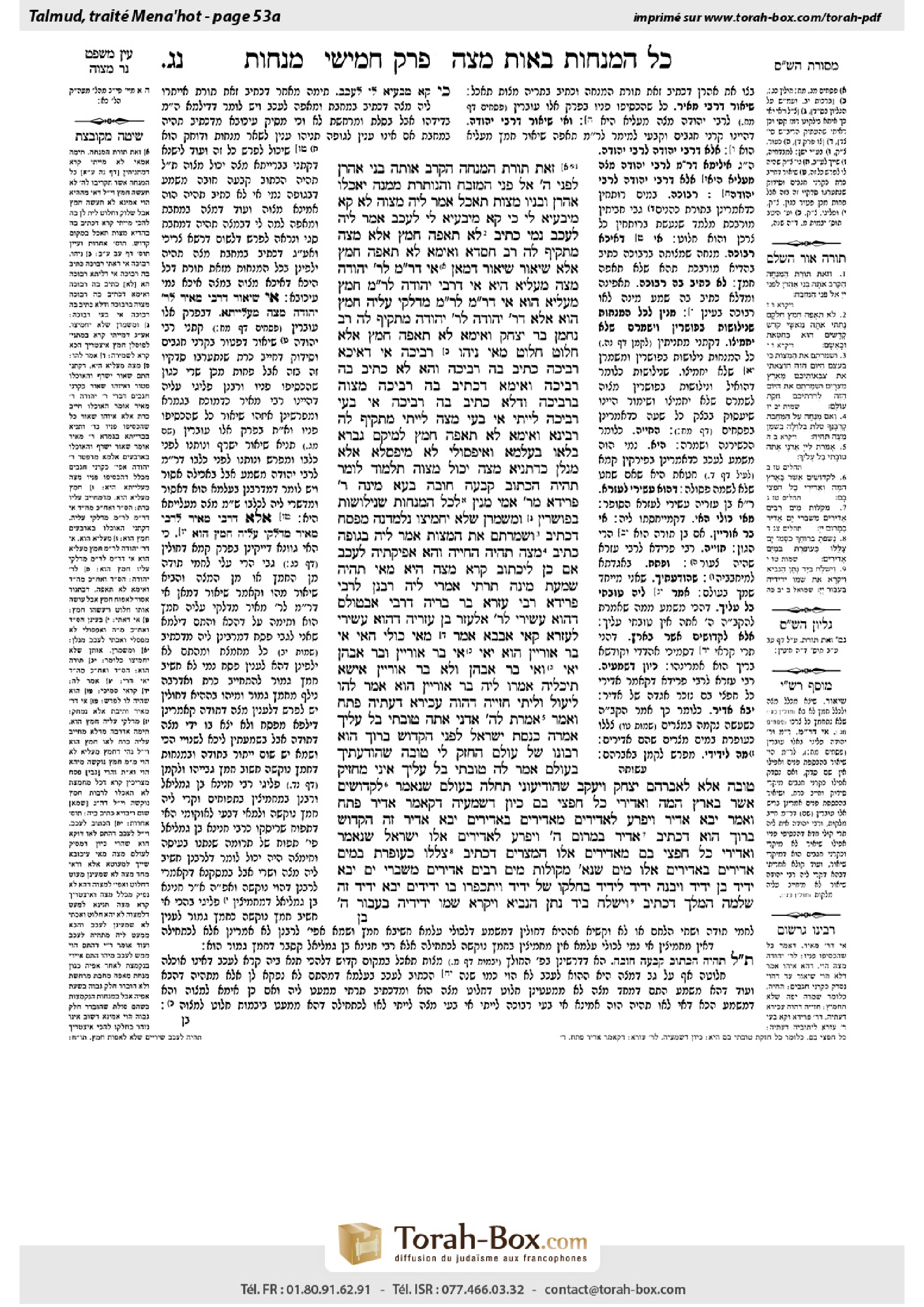
Menachot 53a: Talmud study for Daf Yomi
Daf Yomi is the daily study of one Talmud folio. Explore 37 tractates with scans, Hebrew text, Sefaria English and AI-generated French translations where annotated.
Passage selection and English or AI-generated French translation are available where the scan has annotations. Daf Study is independent of Torah-Box and Sefaria.
Browse Menachot · מנחות · All tractatesMenachot 53a text and translations
This page of Menachot includes the Aramaic text, an English translation and an AI-generated French translation, alongside the scan above.
מנחות נ״ג א · Aramaic and Hebrew text
״זֹאת תּוֹרַת הַמִּנְחָה הַקְרֵב אֹתָהּ בְּנֵי אַהֲרֹן לִפְנֵי ה׳ אֶל פְּנֵי הַמִּזְבֵּחַ. וְהַנּוֹתֶרֶת מִמֶּנָּה יֹאכְלוּ אַהֲרֹן וּבָנָיו מַצּוֹת תֵּאָכֵל״. אֲמַר לֵיהּ: מִצְוָה לָא קָא מִיבַּעְיָא לִי, כִּי קָא מִיבַּעְיָא לִי לְעַכֵּב.
אֲמַר לֵיהּ: לְעַכֵּב, נָמֵי כְּתִיב ״לֹא תֵאָפֶה חָמֵץ״, אֶלָּא מַצָּה.
מַתְקֵיף לַהּ רַב חִסְדָּא: וְאֵימָא ״לֹא תֵאָפֶה חָמֵץ״, אֶלָּא שִׂיאוּר.
שִׂיאוּר דְּמַאן? אִי דְּרַבִּי מֵאִיר – לְרַבִּי יְהוּדָה מַצָּה מְעַלְּיָא הִיא, אִי דְּרַבִּי יְהוּדָה – לְרַבִּי מֵאִיר חָמֵץ מְעַלְּיָא הוּא.
אִי דְּרַבִּי מֵאִיר, לְרַבִּי מֵאִיר – מִדְּלָקֵי עֲלֵיהּ, חָמֵץ הוּא! אֶלָּא דְּרַבִּי יְהוּדָה, לְרַבִּי יְהוּדָה.
מַתְקֵיף לַהּ רַב נַחְמָן בַּר יִצְחָק, וְאֵימָא: ״לֹא תֵאָפֶה חָמֵץ״ – אֶלָּא חָלוּט. חָלוּט מַאי נִיהוּ? רְבִיכָה. אִי דְּאִיכָּא רְבוּכָה – כְּתִיב בָּהּ רְבוּכָה, וְהָא לָא כְּתִיב בָּהּ רְבוּכָה.
וְאֵימָא: דִּכְתִיב בָּהּ רְבוּכָה – מִצְוָה בִּרְבוּכָה, וּדְלָא כְּתִיב בַּהּ רְבוּכָה – אִי בָּעֵי רְבוּכָה לַיְיתֵי, אִי בָּעֵי מַצָּה לַיְיתֵי.
מַתְקֵיף לַהּ רָבִינָא, וְאֵימָא: ״לֹא תֵאָפֶה חָמֵץ״ – לְמֵיקָם גַּבְרָא בְּלָאו בְּעָלְמָא, וְאִיפְּסוֹלֵי לָא מִיפַּסְלָא?
אֶלָּא מְנָלַן? כִּדְתַנְיָא: ״מַצָּה״ – יָכוֹל מִצְוָה? תַּלְמוּד לוֹמַר ״תִּהְיֶה״ – הַכָּתוּב קְבָעָהּ חוֹבָה.
בְּעָא מִינַּהּ רַבִּי פְּרִידָא מֵרַבִּי אַמֵּי: מִנַּיִן לְכׇל הַמְּנָחוֹת שֶׁנִּילּוֹשׁוֹת בְּפוֹשְׁרִין, וּמְשַׁמְּרָן שֶׁלֹּא יַחֲמִיצוּ? נִלְמְדֶנָּה מִפֶּסַח, דִּכְתִיב ״וּשְׁמַרְתֶּם אֶת הַמַּצּוֹת״.
אֲמַר לֵיהּ: בְּגוּפַהּ כְּתִיב ״מַצָּה תִּהְיֶה״, הַחְיֶיהָ.
וְהָא אַפֵּיקְתֵּיהּ לְעַכֵּב? אִם כֵּן, לִיכְתּוֹב קְרָא ״מַצָּה הִיא״, מַאי ״תִּהְיֶה״? שָׁמְעַתְּ מִינַּהּ תַּרְתֵּי.
אָמְרִי לֵיהּ רַבָּנַן לְרַבִּי פְּרִידָא: רַבִּי עֶזְרָא בַּר בְּרֵיהּ דְּרַבִּי אַבְטוֹלָס, דְּהוּא עֲשִׂירִי לְרַבִּי אֶלְעָזָר בֶּן עֲזַרְיָה, דְּהוּא עֲשִׂירִי לְעֶזְרָא, קָאֵי אַבָּבָא. אֲמַר: מַאי כּוּלֵּי הַאי?
אִי בַּר אוֹרְיָין הוּא – יָאֵי, אִי בַּר אוֹרְיָין וּבַר אֲבָהָן – יָאֵי, וְאִי בַּר אֲבָהָן וְלָא בַּר אוֹרְיָין – אִישָּׁא תֵּיכְלֵיהּ. אֲמַרוּ לֵיהּ: בַּר אוֹרְיָין הוּא. אֲמַר לְהוּ: לֵיעוּל וְלֵיתֵי.
חַזְיֵיהּ דַּהֲוָה עֲכִירָא דַּעְתֵּיהּ, פְּתַח וַאֲמַר: ״אָמַרְתְּ לַה׳ אֲדֹנָי אָתָּה טוֹבָתִי בַּל עָלֶיךָ״, אָמְרָה כְּנֶסֶת יִשְׂרָאֵל לִפְנֵי הַקָּדוֹשׁ בָּרוּךְ הוּא: רִבּוֹנוֹ שֶׁל עוֹלָם, הַחֲזֵק לִי טוֹבָה שֶׁהוֹדַעְתִּיךָ בָּעוֹלָם.
אָמַר לָהּ: ״טוֹבָתִי בַּל עָלֶיךָ״ – אֵינִי מַחְזִיק טוֹבָה אֶלָּא לְאַבְרָהָם יִצְחָק וְיַעֲקֹב, שֶׁהוֹדִיעוּנִי תְּחִלָּה בָּעוֹלָם, שֶׁנֶּאֱמַר: ״לִקְדוֹשִׁים אֲשֶׁר בָּאָרֶץ הֵמָּה וְאַדִּירֵי כׇּל חֶפְצִי בָם״.
כֵּיוָן דְּשַׁמְעֵיהּ דְּקָאָמַר ״אַדִּיר״, פָּתַח וְאָמַר: יָבֹא אַדִּיר וְיִפָּרַע לְאַדִּירִים מֵאַדִּירִים בְּאַדִּירִים.
יָבֹא אַדִּיר – זֶה הַקָּדוֹשׁ בָּרוּךְ הוּא, דִּכְתִיב: ״אַדִּיר בַּמָּרוֹם ה׳״. וְיִפָּרַע לְאַדִּירִים – אֵלּוּ יִשְׂרָאֵל, שֶׁנֶּאֱמַר: ״וְאַדִּירֵי כׇּל חֶפְצִי בָם״. מֵאַדִּירִים – אֵלּוּ הַמִּצְרִים, דִּכְתִיב: ״צָלֲלוּ כַּעוֹפֶרֶת בְּמַיִם אַדִּירִים״. בְּאַדִּירִים – אֵלּוּ מַיִם, שֶׁנֶּאֱמַר: ״מִקֹּלוֹת מַיִם רַבִּים אַדִּירִים מִשְׁבְּרֵי יָם״.
יָבֹא יָדִיד בֶּן יָדִיד, וְיִבְנֶה יָדִיד לְיָדִיד בְּחֶלְקוֹ שֶׁל יָדִיד, וְיִתְכַּפְּרוּ בּוֹ יְדִידִים.
יָבֹא יָדִיד – זֶה שְׁלֹמֹה הַמֶּלֶךְ, דִּכְתִיב: ״וַיִּשְׁלַח בְּיַד נָתָן הַנָּבִיא וַיִּקְרָא שְׁמוֹ יְדִידְיָהּ בַּעֲבוּר ה׳״.
Menachot 53a · English translation
“And this is the law of the meal offering: The sons of Aaron shall sacrifice it before the Lord in front of the altar…And that which is left of it Aaron and his sons shall eat; it shall be eaten as matzot” (Leviticus 6:7–9). These verses demonstrate that there is a general requirement that meal offerings must be brought as matza. Rabbi Perida said to Rabbi Ami: I do not raise the dilemma with regard to the source of the mitzva ab initio, as that is clearly derived from these verses. Where I raise the dilemma, it is with regard to the source that indicates this requirement is indispensable, i.e., that if one violated the mitzva and brought a meal offering not as matza the offering is not valid.
Rabbi Ami said to Rabbi Perida: With regard to the halakha that the requirement that meal offerings must come as matza is indispensable, it is also written: “It shall not be baked as leavened bread” (Leviticus 6:10), but rather must come as matza. This additional verse indicates that even after the fact, if a meal offering was not made as matza it is not valid.
Rav Ḥisda objects to this: But one can say that the verse should be interpreted as follows: “It shall not be baked as leavened bread,” i.e., fully leavened, but it can be brought even if it has been leavened slightly with leavening [siur] dough. Although it does not have the status of leavened bread and is therefore not prohibited by the verse, it also does not have the status of matza.
The Gemara analyzes Rav Ḥisda’s objection, as there is a dispute among the Sages with regard to the definition of siur (see Pesaḥim 48b). According to Rabbi Meir, siur is dough at the beginning of the leavening process, when its surface has become pale. Conversely, Rabbi Yehuda maintains that siur is dough that has been leavened to the point that it has cracks that look like the antennae of locusts. In this light, the Gemara inquires: This siur, mentioned by Rav Ḥisda in his suggested interpretation of the verse, is in accordance with whose opinion? If he is referring to siur as defined by Rabbi Meir, then according to the opinion of Rabbi Yehuda Rav Ḥisda’s objection does not arise, as Rabbi Yehuda maintains this is full-fledged matza. And if Rav Ḥisda is referring to siur as defined by Rabbi Yehuda, then according to the opinion of Rabbi Meir Rav Ḥisda’s objection does not arise either, as Rabbi Meir holds that it is full-fledged leavened bread.
Furthermore, if Rav Ḥisda is referring to siur as defined by Rabbi Meir, then even according to the opinion of Rabbi Meir himself the objection does not arise. The reason is that from the fact that Rabbi Meir rules that one who eats this siur on Passover is flogged for it, this indicates that it is deemed full-fledged leavened bread. Rather, Rav Ḥisda’s objection arises with regard to leavening dough as defined by Rabbi Yehuda, according to the opinion of Rabbi Yehuda, who maintains that this dough is not considered full-fledged leavened bread.
Rav Naḥman bar Yitzḥak also objects to Rabbi Ami’s explanation: But one can say that the verse can be interpreted as follows: “It shall not be baked as leavened bread,” but one may bring a meal offering that has been boiled, as this is not leavened bread; although it is also not matza. The Gemara asks: This boiled dough, what is it? It is poached [revikha], as described in the verse: “In a pan it shall be made of oil, when it is soaked [murbekhet]” (Leviticus 6:14). If so, there is no need to derive the halakha of boiled dough from the verse: “It shall not be baked as leavened bread.” If it is a meal offering that must be poached, it is explicitly written with regard to it that it must be poached. And if it is a meal offering that is not to be poached, it is not written with regard to it that it is poached.
The Gemara challenges: But one can say that the verse: “It shall not be baked as leavened bread,” indicates that with regard to a meal offering about which it is written explicitly that it must be poached, it is a mitzva that it be poached, and with regard to a meal offering about which it is not written that it must be poached, the one who brings the offering can decide: If he wants, let him bring it poached, and if he wants, let him bring it as matza. Accordingly, Rabbi Ami’s proof from the verse is inconclusive.
Ravina also objects to Rabbi Ami’s explanation: But one can say that the verse: “It shall not be baked as leavened bread,” serves to determine that this man who brings a meal offering as leavened bread is liable for violating a mere prohibition, but the meal offering itself is not invalid.
All these objections indicate that the verse: “It shall not be baked as leavened bread,” can be interpreted in ways other than that suggested by Rabbi Ami. Accordingly, the Gemara asks: Rather, from where do we derive that all meal offerings not brought as matza are not valid? The Gemara answers: We derive it as it is taught in a baraita discussing a verse concerning meal offerings: “It shall be of matza” (Leviticus 2:5): One might have thought that it is only a mitzva ab initio for a meal offering to be of matza. Therefore, the verse states: “It shall be,” which indicates that the verse established it as an obligation, i.e., if the meal offering was not brought as matza it is not valid.
§ Rabbi Perida raised another dilemma before Rabbi Ami: From where is it derived with regard to all the meal offerings that must be brought as matza that they are kneaded with lukewarm water so that the dough will be baked well, as only a small amount of oil is added, and that one must watch over them to ensure that they do not become leavened while kneading and shaping them? Shall we derive this halakha from the prohibition concerning leavened bread on the festival of Passover, as it is written: “And you shall watch over the matzot” (Exodus 12:17), which indicates that one must watch over any dough that is supposed to be made into matza, to ensure that it does not become leavened?
Rabbi Ami said to Rabbi Perida: The halakha of meal offerings is not derived from Passover, as it is written in the context of a meal offering itself: “It shall be [tehiye] of matza” (Leviticus 2:5), which can be read as meaning: Preserve [haḥaye] matza, i.e., preserve the matza as it is, and do not let it become leavened.
The Gemara asks: But didn’t you already derive from the term “it shall be” that the requirement that a meal offering must be made as matza is indispensable? The Gemara answers: If so, that this term serves to teach only one halakha, let the verse write: It is matza. What is the reason that it writes: “It shall be of matza”? Learn from it two conclusions, both that the requirement that it be made as matza is indispensable and that one must watch over the matza to ensure that it does not become leavened.
§ The Gemara relates an incident that involves the aforementioned Rabbi Perida. The Sages said to Rabbi Perida: The Sage Rabbi Ezra, who is of especially fine lineage, a grandson of Rabbi Avtolus, who in turn is a tenth-generation descendant of Rabbi Elazar ben Azarya, who is a tenth-generation descendant of Ezra the Scribe, is standing and waiting at the gate of the house and seeks entry. Rabbi Perida said to the Sages: What is the need for all this detail about Rabbi Ezra’s lineage?
Rabbi Perida elaborated: If he is a man of Torah study, he is worthy of entry on his own account, regardless of his ancestors. And if he is both a man of Torah study and a man of lineage, he is also worthy of entry. But if he is a man of lineage and not a man of Torah, better for fire to devour him than for him to enter my house. In this case, his lineage is to his detriment, as it highlights his failure to become a Sage like his ancestors. The Sages said to Rabbi Perida: Rabbi Ezra is a man of Torah study. Rabbi Perida said to them: If so, let him enter and come.
When Rabbi Ezra entered his house, Rabbi Perida saw that Rabbi Ezra’s mind was troubled with embarrassment at having to wait outside. Therefore, Rabbi Perida taught a homily to comfort Rabbi Ezra. He began and said an interpretation of the verse: “I have said to the Lord: You are my Lord; I have no good but in You [tovati bal alekha]” (Psalms 16:2). Rabbi Perida interpreted: The congregation of Israel said before the Holy One, Blessed be He: Master of the Universe, give me credit, as I made Your Name known in the world, as indicated by the phrase: “You are my Lord.”
God said to the congregation of Israel: I give no credit to you [tovati bal alekha]. God explained: I give credit only to the three Patriarchs, Abraham, Isaac, and Jacob, who were the first who made My Name known in the world, as it is stated: “As for the holy that are in the earth, they are the excellent [ve’addirei] in whom is all My delight” (Psalms 16:3). The holy in the earth are the Patriarchs, in whom God delights. In this manner Rabbi Perida alluded to the importance of the ancestors of the Jewish people, including Ezra the Scribe, from whom Rabbi Ezra was descended.
When Rabbi Ezra heard Rabbi Perida say the word: Excellent [addir], he too began a homily, one that plays with different forms of this term, and said: Let the Addir come and exact punishment for the addirim from the addirim in the addirim.
Rabbi Ezra explained this statement: With regard to Addir in the phrase: Let the Addir come, this is the Holy One, Blessed be He, as it is written: “The Lord on high is mighty [addir]” (Psalms 93:4). In the phrase: And exact punishment for the addirim, these addirim are the Jews, as it is stated: “The excellent [ve’addirei] in whom is all My delight” (Psalms 16:3). In the phrase: From the addirim, these addirim are the Egyptians, as it is written with regard to the splitting of the Red Sea: “The mighty [addirim] sank as lead in the waters” (Exodus 15:10). In the phrase: In the addirim, these addirim are the waters, as it is stated: “Above the voices of many waters, the mighty [addirim] breakers of the sea” (Psalms 93:4).
Rabbi Ezra stated another, similar, homiletic interpretation: Let yadid, son of yadid, come and build yadid for yadid in the portion of yadid, and let yedidim achieve atonement through it.
Rabbi Ezra explained this statement: With regard to yadid in the phrase: Let yadid, this is King Solomon, as it is written after Solomon’s birth: “And He sent by the hand of Nathan the prophet, and he called his name Yedidya, for the Lord’s sake” (II Samuel 12:25).
Menachot 53a · Traduction française (IA)
« Voici la loi de l’offrande végétale : les fils d’Aaron la présenteront devant le Seigneur, devant l’autel… Ce qui en restera, Aaron et ses fils le mangeront ; elle sera mangée sous forme de matsot » (Lévitique 6:7–9). Ces versets montrent qu’il existe une exigence générale selon laquelle les offrandes végétales doivent être apportées sous forme de matsa. Rabbi Perida dit à Rabbi Ami : Je ne pose pas la question de la source de la mitsva a priori, car elle se déduit clairement de ces versets. Ma question porte sur la source indiquant que cette exigence est indispensable, c’est-à-dire que si l’on transgresse la mitsva et apporte une offrande végétale qui n’est pas sous forme de matsa, l’offrande n’est pas valide.
Rabbi Ami dit à Rabbi Perida : La halakha selon laquelle l’exigence que les offrandes végétales soient apportées sous forme de matsa est indispensable est également écrite : « Elle ne sera pas cuite sous forme de pain levé » (Lévitique 6:10), mais doit être apportée sous forme de matsa. Ce verset supplémentaire indique que même après coup, si une offrande végétale n’a pas été préparée sous forme de matsa, elle n’est pas valide.
Rav Ḥisda objecte : Mais on peut dire que le verset doit être interprété ainsi : « Elle ne sera pas cuite sous forme de pain levé », c’est-à-dire qu’elle ne doit pas être complètement levée ; toutefois, elle peut être apportée même si elle a légèrement levé avec de la pâte levée [siur]. Bien qu’elle n’ait pas le statut de pain levé et ne soit donc pas interdite par le verset, elle n’a pas non plus le statut de matsa.
La Guemara examine l’objection de Rav Ḥisda, car les Sages sont en désaccord sur la définition du siur (voir Pesaḥim 48b). Selon Rabbi Meir, le siur est une pâte au début du processus de levée, lorsque sa surface est devenue pâle. Rabbi Yehuda, au contraire, considère que le siur est une pâte qui a levé au point de présenter des fissures ressemblant aux antennes des sauterelles. Dans cette perspective, la Guemara demande : De l’avis de qui relève ce siur mentionné par Rav Ḥisda dans l’interprétation qu’il propose du verset ? S’il parle du siur selon la définition de Rabbi Meir, alors, selon Rabbi Yehuda, l’objection de Rav Ḥisda ne se pose pas, puisque Rabbi Yehuda considère qu’il s’agit de matsa à part entière. Et si Rav Ḥisda parle du siur selon la définition de Rabbi Yehuda, alors, selon Rabbi Meir, l’objection de Rav Ḥisda ne se pose pas non plus, puisque Rabbi Meir considère qu’il s’agit de pain levé à part entière.
De plus, si Rav Ḥisda parle du siur selon la définition de Rabbi Meir, alors même selon l’avis de Rabbi Meir lui-même, l’objection ne se pose pas. En effet, le fait que Rabbi Meir statue que celui qui mange ce siur pendant Pessaḥ est passible de la flagellation indique qu’il est considéré comme du pain levé à part entière. L’objection de Rav Ḥisda porte donc plutôt sur la pâte levée selon la définition de Rabbi Yehuda, conformément à l’avis de Rabbi Yehuda, qui considère que cette pâte n’est pas du pain levé à part entière.
Rav Naḥman bar Yitzḥak objecte lui aussi à l’explication de Rabbi Ami : Mais on peut dire que le verset s’interprète ainsi : « Elle ne sera pas cuite sous forme de pain levé », mais on peut apporter une offrande végétale bouillie, car ce n’est pas du pain levé, bien que ce ne soit pas non plus de la matsa. La Guemara demande : Qu’est-ce que cette pâte bouillie ? C’est une pâte pochée [revikha], comme l’indique le verset : « Dans une poêle, elle sera préparée avec de l’huile, lorsqu’elle sera imbibée [murbekhet] » (Lévitique 6:14). Dans ce cas, il n’est pas nécessaire de déduire la halakha de la pâte bouillie du verset : « Elle ne sera pas cuite sous forme de pain levé. » S’il s’agit d’une offrande végétale qui doit être pochée, il est explicitement écrit à son sujet qu’elle doit être pochée. Et s’il s’agit d’une offrande végétale qui ne doit pas être pochée, il n’est pas écrit à son sujet qu’elle doit l’être.
La Guemara objecte : Mais on peut dire que le verset « Elle ne sera pas cuite sous forme de pain levé » indique que, pour une offrande végétale au sujet de laquelle il est explicitement écrit qu’elle doit être pochée, c’est une mitsva de la pocher ; et que, pour une offrande végétale au sujet de laquelle il n’est pas écrit qu’elle doit être pochée, celui qui l’apporte peut décider : s’il le souhaite, qu’il l’apporte pochée, et s’il le souhaite, qu’il l’apporte sous forme de matsa. Par conséquent, la preuve de Rabbi Ami tirée du verset n’est pas concluante.
Ravina objecte lui aussi à l’explication de Rabbi Ami : Mais on peut dire que le verset « Elle ne sera pas cuite sous forme de pain levé » établit que l’homme qui apporte une offrande végétale sous forme de pain levé est passible pour avoir enfreint une simple interdiction, mais que l’offrande elle-même n’est pas invalide.
Toutes ces objections indiquent que le verset « Elle ne sera pas cuite sous forme de pain levé » peut recevoir d’autres interprétations que celle proposée par Rabbi Ami. La Guemara demande donc : D’où déduisons-nous alors que toutes les offrandes végétales qui ne sont pas apportées sous forme de matsa ne sont pas valides ? La Guemara répond : Nous le déduisons de ce qui est enseigné dans une baraïta à propos d’un verset concernant les offrandes végétales : « Elle sera de matsa » (Lévitique 2:5). On aurait pu penser que, pour une offrande végétale, être de matsa n’est qu’une mitsva a priori. Le verset dit donc : « Elle sera », ce qui indique qu’il en fait une obligation, c’est-à-dire que si l’offrande végétale n’a pas été apportée sous forme de matsa, elle n’est pas valide.
§ Rabbi Perida posa une autre question à Rabbi Ami : D’où déduit-on, concernant toutes les offrandes végétales qui doivent être apportées sous forme de matsa, qu’elles doivent être pétries avec de l’eau tiède afin que la pâte cuise bien, puisqu’on n’y ajoute qu’une petite quantité d’huile, et qu’il faut veiller à ce qu’elles ne fermentent pas pendant qu’on les pétrit et qu’on leur donne forme ? Déduirons-nous cette halakha de l’interdiction du pain levé pendant la fête de Pessaḥ, puisqu’il est écrit : « Vous veillerez sur les matsot » (Exode 12:17), ce qui indique qu’il faut surveiller toute pâte destinée à être préparée sous forme de matsa afin qu’elle ne fermente pas ?
Rabbi Ami dit à Rabbi Perida : La halakha des offrandes végétales ne se déduit pas de Pessaḥ, car il est écrit dans le contexte même d’une offrande végétale : « Elle sera [tehiye] de matsa » (Lévitique 2:5), ce qu’on peut lire comme signifiant : « Préserve [haḥaye] la matsa », c’est-à-dire conserve la matsa telle quelle et ne la laisse pas fermenter.
La Guemara demande : Mais n’as-tu pas déjà déduit du terme « elle sera » que l’exigence selon laquelle une offrande végétale doit être préparée sous forme de matsa est indispensable ? La Guemara répond : Si ce terme ne sert qu’à enseigner une seule halakha, que le verset écrive : « Elle est matsa ». Pourquoi écrit-il : « Elle sera de matsa » ? Déduis-en deux conclusions : d’une part, l’exigence qu’elle soit préparée sous forme de matsa est indispensable et, d’autre part, il faut surveiller la matsa afin qu’elle ne fermente pas.
§ La Guemara rapporte un épisode concernant Rabbi Perida, mentionné plus haut. Les Sages dirent à Rabbi Perida : Le sage Rabbi Ezra, d’une lignée particulièrement noble, petit-fils de Rabbi Avtolus, lui-même descendant à la dixième génération de Rabbi Elazar ben Azarya, qui est un descendant à la dixième génération d’Ezra le Scribe, se tient à la porte de la maison et attend d’entrer. Rabbi Perida dit aux Sages : Pourquoi tous ces détails sur la lignée de Rabbi Ezra ?
Rabbi Perida précisa : S’il est versé dans l’étude de la Torah, il mérite d’entrer pour lui-même, indépendamment de ses ancêtres. Et s’il est à la fois versé dans l’étude de la Torah et de noble lignée, il mérite également d’entrer. Mais s’il est de noble lignée sans être versé dans l’étude de la Torah, mieux vaudrait que le feu le dévore plutôt qu’il n’entre dans ma maison. Dans ce cas, sa lignée lui porte préjudice, car elle souligne qu’il n’est pas devenu un Sage à l’image de ses ancêtres. Les Sages dirent à Rabbi Perida : Rabbi Ezra est versé dans l’étude de la Torah. Rabbi Perida leur dit : Si tel est le cas, qu’il entre donc.
Lorsque Rabbi Ezra entra dans sa maison, Rabbi Perida vit qu’il était gêné d’avoir dû attendre dehors. Rabbi Perida lui enseigna donc une homélie pour le réconforter. Il commença par interpréter le verset : « J’ai dit au Seigneur : Tu es mon Seigneur ; mon bien [tovati bal alekha] ne vient pas de toi » (Psaumes 16:2). Rabbi Perida interpréta : La communauté d’Israël dit devant le Saint, béni soit-Il : Maître de l’Univers, reconnais mon mérite, car j’ai fait connaître Ton Nom dans le monde, comme l’indique l’expression : « Tu es mon Seigneur. »
Dieu dit à la communauté d’Israël : Je ne te reconnais aucun mérite [tovati bal alekha]. Dieu expliqua : Je ne reconnais de mérite qu’aux trois Patriarches, Abraham, Isaac et Jacob, qui furent les premiers à faire connaître Mon Nom dans le monde, comme il est dit : « Quant aux saints qui sont dans le pays, ils sont les nobles [ve’addirei], en qui est tout mon plaisir » (Psaumes 16:3). Les saints qui sont dans le pays sont les Patriarches, en qui Dieu prend plaisir. Ainsi, Rabbi Perida faisait allusion à l’importance des ancêtres du peuple juif, notamment Ezra le Scribe, dont Rabbi Ezra descendait.
Lorsque Rabbi Ezra entendit Rabbi Perida prononcer le mot « noble » [addir], il se mit à son tour à développer une homélie jouant sur différentes formes de ce terme, et dit : Que l’Addir vienne réclamer des comptes aux addirim, aux dépens des addirim, dans les addirim.
Rabbi Ezra expliqua cette déclaration : Dans l’expression « Que l’Addir vienne », Addir désigne le Saint, béni soit-Il, comme il est écrit : « Le Seigneur dans les hauteurs est puissant [addir] » (Psaumes 93:4). Dans l’expression « réclamer des comptes aux addirim », les addirim désignent les Juifs, comme il est dit : « Les nobles [ve’addirei], en qui est tout mon plaisir » (Psaumes 16:3). Dans l’expression « aux dépens des addirim », les addirim désignent les Égyptiens, comme il est écrit à propos de l’ouverture de la mer Rouge : « Les puissants [addirim] ont sombré comme du plomb dans les eaux » (Exode 15:10). Dans l’expression « dans les addirim », les addirim désignent les eaux, comme il est dit : « Plus que les voix des eaux nombreuses, les puissants [addirim] flots de la mer » (Psaumes 93:4).
Rabbi Ezra donna une autre interprétation homilétique similaire : Que Yadid, fils de Yadid, vienne bâtir Yadid pour Yadid, dans le territoire de Yadid, et que les yedidim obtiennent par son intermédiaire l’expiation.
Rabbi Ezra expliqua cette déclaration : Dans l’expression « Que Yadid vienne », Yadid désigne le roi Salomon, comme il est écrit après sa naissance : « Il le confia au prophète Nathan, qui l’appela Yedidya, pour l’amour du Seigneur » (II Samuel 12:25).
Traduction française générée par IA à partir de l’édition anglaise de Sefaria. Vérifie toujours un passage avec le texte source.
Text from Sefaria: William Davidson Edition - Vocalized Aramaic (unknown); William Davidson Edition - English (CC BY NC).