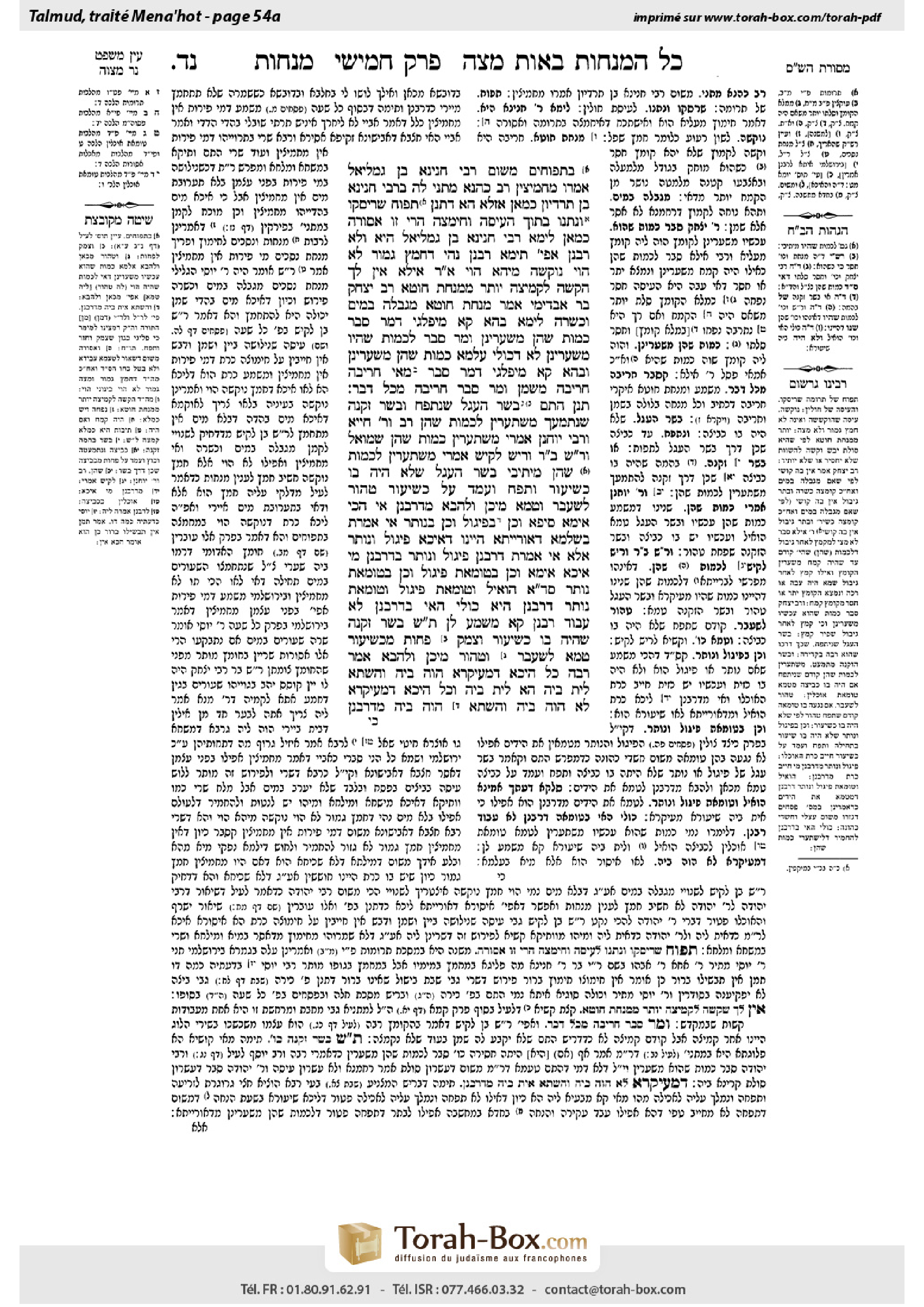
Menachot 54a: Talmud study for Daf Yomi
Daf Yomi is the daily study of one Talmud folio. Explore 37 tractates with scans, Hebrew text, Sefaria English and AI-generated French translations where annotated.
Passage selection and English or AI-generated French translation are available where the scan has annotations. Daf Study is independent of Torah-Box and Sefaria.
Browse Menachot · מנחות · All tractatesMenachot 54a text and translations
This page of Menachot includes the Aramaic text, an English translation and an AI-generated French translation, alongside the scan above.
מנחות נ״ד א · Aramaic and Hebrew text
בְּתַפּוּחִים. מִשּׁוּם רַבִּי חֲנִינָא בֶּן גַּמְלִיאֵל אָמְרוּ: מַחְמִיצִין. רַב כָּהֲנָא מַתְנֵי לַהּ בְּרַבִּי חֲנִינָא בֶּן תְּרַדְיוֹן.
כְּמַאן אָזְלָא הָא דִּתְנַן: תַּפּוּחַ שֶׁרִיסְּקוֹ, וּנְתָנוֹ בְּתוֹךְ הָעִיסָּה, וְחִימְּצָה – הֲרֵי זוֹ אֲסוּרָה.
כְּמַאן? לֵימָא רַבִּי חֲנִינָא בֶּן גַּמְלִיאֵל הִיא, וְלָא רַבָּנַן? אֲפִילּוּ תֵּימָא רַבָּנַן, נְהִי דְּחָמֵץ גָּמוּר לָא הָוֵי, נוּקְשֶׁה מִיהָא הָוֵי.
אָמַר רַבִּי אִילָא: אֵין לְךָ הַקָּשָׁה לִקְמִיצָה יוֹתֵר מִמִּנְחַת חוֹטֵא. רַב יִצְחָק בַּר אַבְדִּימִי אָמַר: מִנְחַת חוֹטֵא מְגַבְּלָהּ בַּמַּיִם, וּכְשֵׁרָה.
לֵימָא בְּהָא קָא מִיפַּלְגִי, דְּמָר סָבַר: כְּמוֹת שֶׁהֵן מְשַׁעֲרִינַן, וּמָר סָבַר: לִכְמוֹת שֶׁהָיוּ מְשַׁעֲרִינַן.
לָא, דְּכוּלֵּי עָלְמָא כְּמוֹת שֶׁהֵן מְשַׁעֲרִינַן, וּבְהָא קָא מִיפַּלְגִי: דְּמָר סָבַר מַאי ״חֲרֵיבָה״? חֲרֵיבָה מִשֶּׁמֶן, וּמָר סָבַר חֲרֵיבָה מִכׇּל דָּבָר.
תְּנַן הָתָם: בְּשַׂר הָעֵגֶל שֶׁנִּתְפַּח, וּבְשַׂר זְקֵנָה שֶׁנִּתְמַעֵךְ, מִשְׁתַּעֲרִין לִכְמוֹת שֶׁהֵן.
רַב וְרַבִּי חִיָּיא וְרַבִּי יוֹחָנָן אָמְרִי: מִשְׁתַּעֲרִין כְּמוֹת שֶׁהֵן, שְׁמוּאֵל וְרַבִּי שִׁמְעוֹן בַּר רַבִּי וְרֵישׁ לָקִישׁ אָמְרִי: מִשְׁתַּעֲרִין לִכְמוֹת שֶׁהֵן.
מֵיתִיבִי: בְּשַׂר הָעֵגֶל שֶׁלֹּא הָיָה בּוֹ כְּשִׁיעוּר, וְתָפַח וְעָמַד עַל כְּשִׁיעוּר – טָהוֹר לְשֶׁעָבַר, וְטָמֵא מִיכָּן וּלְהַבָּא!
מִדְּרַבָּנַן.
אִי הָכִי, אֵימָא סֵיפָא: וְכֵן בְּפִיגּוּל, וְכֵן בְּנוֹתָר. אִי אָמְרַתְּ בִּשְׁלָמָא דְּאוֹרָיְיתָא, הַיְינוּ דְּאִיכָּא פִּיגּוּל וְנוֹתָר, אֶלָּא אִי אָמְרַתְּ דְּרַבָּנַן, פִּיגּוּל וְנוֹתָר בִּדְרַבָּנַן מִי אִיכָּא?
אֵימָא: וְכֵן בְּטוּמְאַת פִּיגּוּל, וְכֵן בְּטוּמְאַת נוֹתָר.
סָלְקָא דַּעְתָּךְ אָמֵינָא: הוֹאִיל וְטוּמְאַת פִּיגּוּל וְטוּמְאַת נוֹתָר דְּרַבָּנַן הִיא, כּוּלֵּי הַאי בִּדְרַבָּנַן לָא עֲבוּד רַבָּנַן, קָא מַשְׁמַע לַן.
תָּא שְׁמַע: בְּשַׂר זְקֵנָה שֶׁהָיָה בּוֹ כְּשִׁיעוּר, וְצָמַק פָּחוֹת מִכְּשִׁיעוּר – טָמֵא לְשֶׁעָבַר, וְטָהוֹר מִיכָּן וּלְהַבָּא.
אָמַר רַבָּה: כֹּל הֵיכָא דְּמֵעִיקָּרָא הֲוָה בֵּיהּ, וְהַשְׁתָּא לֵית בֵּיהּ – הָא לֵית בֵּיהּ, וְכֹל הֵיכָא דְּמֵעִיקָּרָא לָא הֲוָה בֵּיהּ וְהַשְׁתָּא הֲוָה בֵּיהּ – מִדְּרַבָּנַן.
Menachot 54a · English translation
with the juice of apples, as the dough will not leaven properly. It was said in the name of Rabbi Ḥanina ben Gamliel that one may leaven these meal offerings with juice from apples, as this is considered proper leavening. The Gemara notes that Rav Kahana would teach this halakha in the name of Rabbi Ḥanina ben Teradyon, not in the name of Rabbi Ḥanina ben Gamliel.
The Gemara analyzes this dispute. In accordance with whose opinion is that which we learned in a mishna (Terumot 10:2): In the case of an apple of teruma that one mashed and placed in non-sacred dough, and the juice of the apple leavened the dough, this dough is prohibited to be consumed by anyone who may not partake of teruma.
The Gemara reiterates the question: In accordance with whose opinion is this mishna? Shall we say that it is in accordance with the opinion of Rabbi Ḥanina ben Gamliel, who maintains that the juice of apples causes the dough to leaven properly, and not in accordance with the ruling of the Rabbis, the majority opinion that disputes this ruling? The Gemara refutes this suggestion: You may even say that the mishna is in accordance with the opinion of the Rabbis. Granted, the Rabbis hold that dough leavened by the juice of apples does not become full-fledged leavened bread, but in any event it becomes hardened [nukshe] leaven. Consequently, dough leavened by the juice of teruma apples is prohibited to non-priests.
§ On the previous amud the Gemara cited the opinion of Rabba and Rav Yosef that measuring the flour in the leavening dough must be performed before water is added. The Gemara discusses this matter further. Rabbi Ila says: Of all the meal offerings, you do not have a meal offering whose removal of the handful is more difficult than that of the meal offering of a sinner. This particular meal offering is dry, as no oil is added to it. Therefore, it is very difficult to remove precisely a handful, as when the priest takes a handful with his thumb and little finger, a large amount of flour is apt to fall out. Rav Yitzḥak bar Avdimi says: The removal of the handful in the case of the meal offering of a sinner is no more difficult than its removal in other meal offerings. The reason is that although the Torah prohibited the addition of oil to the meal offering of a sinner, nevertheless the priest may knead it in water, and it is fit to be offered.
The Gemara analyzes this dispute. Let us say that these amora’im disagree about this: As one Sage, Rav Yitzḥak bar Avdimi, holds that one measures meal offerings as they are, in their current state, after they have been mixed into a dough. Therefore it is permitted to perform the removal of the handful after water has been added, at which point it is not a particularly difficult rite to perform. And one Sage, Rabbi Ila, holds that one measures meal offerings as they were before they were mixed with water, when they were still flour. Therefore, if one were to add water before measuring he might add too much, which would cause the dough to be too soft and the measure of the offering too large, or conversely, if he were to add too little water the dough would be stiff and too small in volume. Either way, the handful will not contain the correct amount of flour, and therefore no water may be added.
The Gemara responds: No, as everyone agrees that one measures meal offerings as they currently are. And it is with regard to this that they disagree: As one Sage, Rav Yitzḥak bar Avdimi, holds: What is the meaning of “dry” written in the verse discussing a meal offering: “And every meal offering, mixed with oil, or dry” (Leviticus 7:10)? It means dry of oil, but one may add water. And one Sage, Rabbi Ila, holds that the meal offering of a sinner must be dry of all substances, i.e., it may not contain even water.
§ The question concerning whether a meal offering is to be measured in its current, mixed state or as it was before it was mixed relates to a fundamental issue that also arises in other areas of halakha. We learned in a mishna there (Okatzin 2:8): Meat of a calf that swelled due to cooking, as the volume of calf flesh increases when it is cooked in water, or meat of an old animal that shrank due to cooking, which is what happens to meat of this type, are to be measured as they are in order to determine if they are the volume of an egg-bulk, in which case they can contract ritual impurity and transfer impurity of food to other items.
The Sages disagree as to the meaning of: Measured as they are. Rav, Rabbi Ḥiyya, and Rabbi Yoḥanan all say that it means the items are to be measured as they are currently, after having been cooked. Shmuel, Rabbi Shimon bar Rabbi Yehuda HaNasi, and Reish Lakish all say it means they are to be measured according to their volume as they are, before having been cooked. In other words, even if the meat of a calf is the volume of an egg-bulk after it was cooked, if it was less than this before cooking it cannot contract ritual impurity. Conversely, even if the meat of an old animal was less than an egg-bulk after cooking, if it was an egg-bulk before it was cooked it can contract ritual impurity.
The Gemara raises an objection to the opinion of Shmuel, Rabbi Shimon bar Rabbi Yehuda HaNasi, and Reish Lakish from a baraita: With regard to meat of a calf that came into contact with a source of ritual impurity but that was not of a volume equivalent to the minimum measure for contracting impurity, i.e., an egg-bulk, if it was then cooked, and as a result it swelled until it stood at the requisite measure for ritual impurity, this meat is pure with regard to the past, but can become impure and render other items impure from here on. In other words, the previous contact with a source of impurity did not render the meat impure, as it was of insufficient volume at the time. This indicates that the status of an item with regard to ritual impurity depends on its volume at the current moment.
The Gemara answers: It is possible that by Torah law this meat is in fact not susceptible to ritual impurity even from here on, as the halakha defines it by its volume prior to cooking. Nevertheless, the baraita teaches that it is impure by rabbinic law.
The Gemara asks: If so, say the latter clause of that baraita: And similarly, the same principle applies to an offering that was sacrificed with the intent to consume it after its designated time [piggul], and similarly with regard to food left over from an offering after the time allotted for its consumption [notar]. The Gemara analyzes this statement: Granted, if you say that the baraita is discussing halakhot that apply by Torah law, this is why the cases of piggul and notar are included in the baraita, as they also apply by Torah law. But if you say that the halakhot in the baraita apply by rabbinic law, are there piggul and notar by rabbinic law?
The Gemara answers: Say that the baraita is not referring to the prohibitions of piggul and notar. Rather, it means the following: And similarly, the same principle applies with regard to ritual impurity imparted by piggul, and similarly with regard to ritual impurity imparted by notar. There is a rabbinic decree that meat which is piggul or notar imparts impurity to one’s hands even if the meat itself was not impure. The baraita teaches that if the meat is at least the volume of an egg-bulk after it was cooked, it renders the hands impure in this manner.
The Gemara explains that this statement is necessary, as it might enter your mind to say: Since the concepts of impurity imparted by piggul and impurity imparted by notar apply by rabbinic law, the Sages did not institute a stringency to such an extent, making items that were less than the requisite volume until they were cooked contract and impart forms of impurity that apply by rabbinic law. Therefore, the baraita teaches us that this halakha does apply to those forms of ritual impurity.
The Gemara continues to analyze this dispute. Come and hear a baraita: With regard to meat of an old animal that initially was of a volume equivalent to the requisite measure for contracting ritual impurity and became impure, after which it was cooked and as a result shrank until it was less than the requisite measure for contracting impurity, it is considered impure with regard to items that touched it in the past, when it was large enough, and it is pure with regard to items that it may touch from here on. This baraita indicates that the current state of the item is decisive.
Rabba said, in explanation of the dispute between the amora’im: Anywhere, i.e., with regard to any item, that was initially of a volume equivalent to the requisite measure, but now it is not of such a volume, the halakha is determined according to the item’s current volume, and it is not of the requisite volume. Conversely, anywhere, i.e., with regard to any item, that initially was not of the requisite measure but now it is of sufficient volume, the item contracts impurity by rabbinic law.
Menachot 54a · Traduction française (IA)
avec le jus de pommes, car la pâte ne lèverait pas correctement. On a rapporté au nom de Rabbi Ḥanina ben Gamliel qu’on peut faire lever ces offrandes de farine avec du jus de pommes, car celui-ci constitue un agent levant approprié. La Guemara relève que Rav Kahana enseignait cette halakha au nom de Rabbi Ḥanina ben Teradyon, et non au nom de Rabbi Ḥanina ben Gamliel.
La Guemara examine cette controverse. De l’avis de qui est la Michna que nous avons apprise (Teroumot 10:2) ? Dans le cas d’une pomme de terouma qu’on a écrasée et mise dans une pâte profane, si le jus de la pomme a fait lever la pâte, celle-ci est interdite à la consommation à quiconque n’a pas le droit de consommer de la terouma.
La Guemara reprend la question : de l’avis de qui est cette Michna ? Devrait-on dire qu’elle est conforme à l’opinion de Rabbi Ḥanina ben Gamliel, qui soutient que le jus de pommes fait correctement lever la pâte, et non à celle des Rabbins, l’opinion majoritaire qui conteste cette règle ? La Guemara réfute cette proposition : on peut même dire que la Michna est conforme à l’opinion des Rabbins. Certes, les Rabbins soutiennent qu’une pâte levée avec du jus de pommes ne devient pas du pain pleinement levé ; néanmoins, elle devient une pâte fermentée [nukshe]. Par conséquent, une pâte levée avec le jus de pommes de terouma est interdite aux non-prêtres.
§ Sur le daf précédent, la Guemara a cité l’opinion de Rabba et de Rav Yosef selon laquelle il faut mesurer la farine de la pâte à lever avant d’y ajouter de l’eau. La Guemara approfondit cette question. Rabbi Ila dit : parmi toutes les offrandes de farine, aucune n’est plus difficile à prélever à la poignée que l’offrande de farine d’un pécheur. Cette offrande est sèche, car on n’y ajoute pas d’huile. Il est donc très difficile d’en prélever exactement une poignée : lorsque le prêtre en prend une poignée avec son pouce et son auriculaire, une grande quantité de farine risque de tomber. Rav Yitzḥak bar Avdimi dit : le prélèvement de la poignée dans le cas de l’offrande de farine d’un pécheur n’est pas plus difficile que dans celui des autres offrandes de farine. En effet, bien que la Torah interdise d’ajouter de l’huile à l’offrande de farine d’un pécheur, le prêtre peut néanmoins la pétrir avec de l’eau, et elle est apte à être offerte.
La Guemara examine cette controverse. Ne pourrait-on pas dire que ces amoraïm sont en désaccord sur ce point : un Sage, Rav Yitzḥak bar Avdimi, soutient que les offrandes de farine sont mesurées telles qu’elles se présentent, après avoir été pétries. Il est donc permis d’en prélever la poignée après l’ajout d’eau, moment où ce rite n’est pas particulièrement difficile à accomplir. L’autre Sage, Rabbi Ila, soutient que les offrandes de farine sont mesurées telles qu’elles étaient avant d’être mélangées à l’eau, alors qu’elles n’étaient encore que de la farine. Si l’on ajoutait de l’eau avant de mesurer, on pourrait en ajouter trop, ce qui rendrait la pâte trop molle et le volume de l’offrande trop important ; à l’inverse, si l’on en ajoutait trop peu, la pâte serait ferme et son volume trop faible. Dans les deux cas, la poignée ne contiendrait pas la quantité correcte de farine ; on ne peut donc pas ajouter d’eau.
La Guemara répond : non, car tous conviennent que les offrandes de farine sont mesurées telles qu’elles se présentent alors. Leur désaccord porte sur le sens du terme « sèche » dans le verset relatif à une offrande de farine : « Toute offrande de farine, pétrie à l’huile ou sèche » (Lévitique 7:10). Un Sage, Rav Yitzḥak bar Avdimi, soutient que « sèche » signifie sèche d’huile, mais que l’on peut y ajouter de l’eau. L’autre Sage, Rabbi Ila, soutient que l’offrande de farine d’un pécheur doit être sèche de toute substance, c’est-à-dire qu’elle ne peut même pas contenir d’eau.
§ La question de savoir si une offrande de farine doit être mesurée dans son état actuel, après avoir été pétrie, ou dans l’état où elle se trouvait avant le pétrissage, touche à une question fondamentale qui se pose également dans d’autres domaines de la halakha. Nous avons appris dans une Michna, là-bas (Okatzin 2:8) : la viande d’un veau qui a gonflé à la cuisson, car le volume de la chair de veau augmente lorsqu’elle est cuite dans l’eau, ou la viande d’un animal âgé qui a rétréci à la cuisson, comme c’est le cas pour ce type de viande, se mesurent telles qu’elles sont afin de déterminer si elles ont le volume d’un œuf ; dans ce cas, elles peuvent contracter l’impureté rituelle et transmettre l’impureté alimentaire à d’autres objets.
Les Sages sont en désaccord sur le sens de « mesurées telles qu’elles sont ». Rav, Rabbi Ḥiyya et Rabbi Yoḥanan disent que cela signifie que les éléments doivent être mesurés dans leur état actuel, après la cuisson. Shmuel, Rabbi Shimon bar Rabbi Yehuda HaNasi et Reish Lakish disent qu’ils doivent être mesurés selon leur volume avant la cuisson. Autrement dit, même si la viande d’un veau a le volume d’un œuf après la cuisson, si son volume était inférieur avant la cuisson, elle ne peut pas contracter l’impureté rituelle. À l’inverse, même si la viande d’un animal âgé avait un volume inférieur à celui d’un œuf après la cuisson, si elle avait le volume d’un œuf avant la cuisson, elle peut contracter l’impureté rituelle.
La Guemara soulève une objection contre l’opinion de Shmuel, de Rabbi Shimon bar Rabbi Yehuda HaNasi et de Reish Lakish à partir d’une baraïta : de la viande de veau est entrée en contact avec une source d’impureté rituelle, mais son volume n’atteignait pas la mesure minimale pour contracter l’impureté, c’est-à-dire le volume d’un œuf. Si elle a ensuite été cuite et a gonflé jusqu’à atteindre la mesure requise pour l’impureté rituelle, cette viande est considérée comme pure pour la période passée, mais peut devenir impure et rendre d’autres éléments impurs à partir de maintenant. Autrement dit, le contact antérieur avec une source d’impureté n’a pas rendu la viande impure, car son volume était alors insuffisant. Cela indique que le statut d’un élément en matière d’impureté rituelle dépend de son volume au moment présent.
La Guemara répond : il est possible qu’en vertu de la Torah, cette viande ne soit en fait pas susceptible de contracter l’impureté rituelle, même à partir de maintenant, car la halakha détermine son statut d’après son volume avant la cuisson. Néanmoins, la baraïta enseigne qu’elle est impure en vertu d’un décret rabbinique.
La Guemara demande : dans ce cas, considère la dernière partie de cette baraïta : « Et de même, le même principe s’applique à une offrande qui a été sacrifiée avec l’intention d’être consommée après le délai qui lui est assigné [piggul], et de même à la nourriture restante d’une offrande après le délai fixé pour sa consommation [notar]. » La Guemara examine cette déclaration : il est compréhensible que les cas de piggul et de notar soient inclus dans la baraïta si l’on dit qu’elle traite de halakhot qui s’appliquent en vertu de la Torah, car ils s’appliquent eux aussi en vertu de la Torah. Mais si l’on dit que les halakhot de la baraïta s’appliquent en vertu d’un décret rabbinique, existe-t-il des cas de piggul et de notar relevant d’un décret rabbinique ?
La Guemara répond : il faut comprendre que la baraïta ne fait pas référence aux interdictions de piggul et de notar. Elle veut plutôt dire ceci : « Et de même, le même principe s’applique à l’impureté rituelle transmise par le piggul, et de même à l’impureté rituelle transmise par le notar. » Il existe un décret rabbinique selon lequel la viande qui est piggul ou notar transmet l’impureté aux mains, même si la viande elle-même n’est pas impure. La baraïta enseigne que si la viande a au moins le volume d’un œuf après avoir été cuite, elle rend les mains impures de cette manière.
La Guemara explique que cette précision est nécessaire, car on pourrait être tenté de dire : puisque les notions d’impureté transmise par le piggul et d’impureté transmise par le notar relèvent d’un décret rabbinique, les Sages n’ont pas institué une rigueur aussi importante, qui ferait que des éléments n’atteignant le volume requis qu’après la cuisson puissent contracter et transmettre des formes d’impureté relevant d’un décret rabbinique. La baraïta nous apprend donc que cette halakha s’applique également à ces formes d’impureté rituelle.
La Guemara poursuit l’examen de cette controverse. Viens et entends une baraïta : de la viande d’un animal âgé avait initialement le volume requis pour contracter l’impureté rituelle et est devenue impure ; après avoir été cuite, elle a rétréci, de sorte que son volume est devenu inférieur à la mesure requise pour contracter l’impureté. Elle est considérée comme impure à l’égard des éléments qui l’ont touchée dans le passé, lorsqu’elle avait un volume suffisant, et comme pure à l’égard des éléments qu’elle pourrait toucher à partir de maintenant. Cette baraïta indique que c’est l’état actuel de l’élément qui est déterminant.
Rabba expliqua ainsi la controverse entre les amoraïm : partout où un élément avait initialement le volume requis, mais ne l’a plus à présent, la halakha est déterminée d’après son volume actuel : il n’a donc pas le volume requis. À l’inverse, partout où un élément n’avait pas initialement le volume requis, mais l’a à présent, il contracte l’impureté en vertu d’un décret rabbinique.
Traduction française générée par IA à partir de l’édition anglaise de Sefaria. Vérifie toujours un passage avec le texte source.
Text from Sefaria: William Davidson Edition - Vocalized Aramaic (unknown); William Davidson Edition - English (CC BY NC).