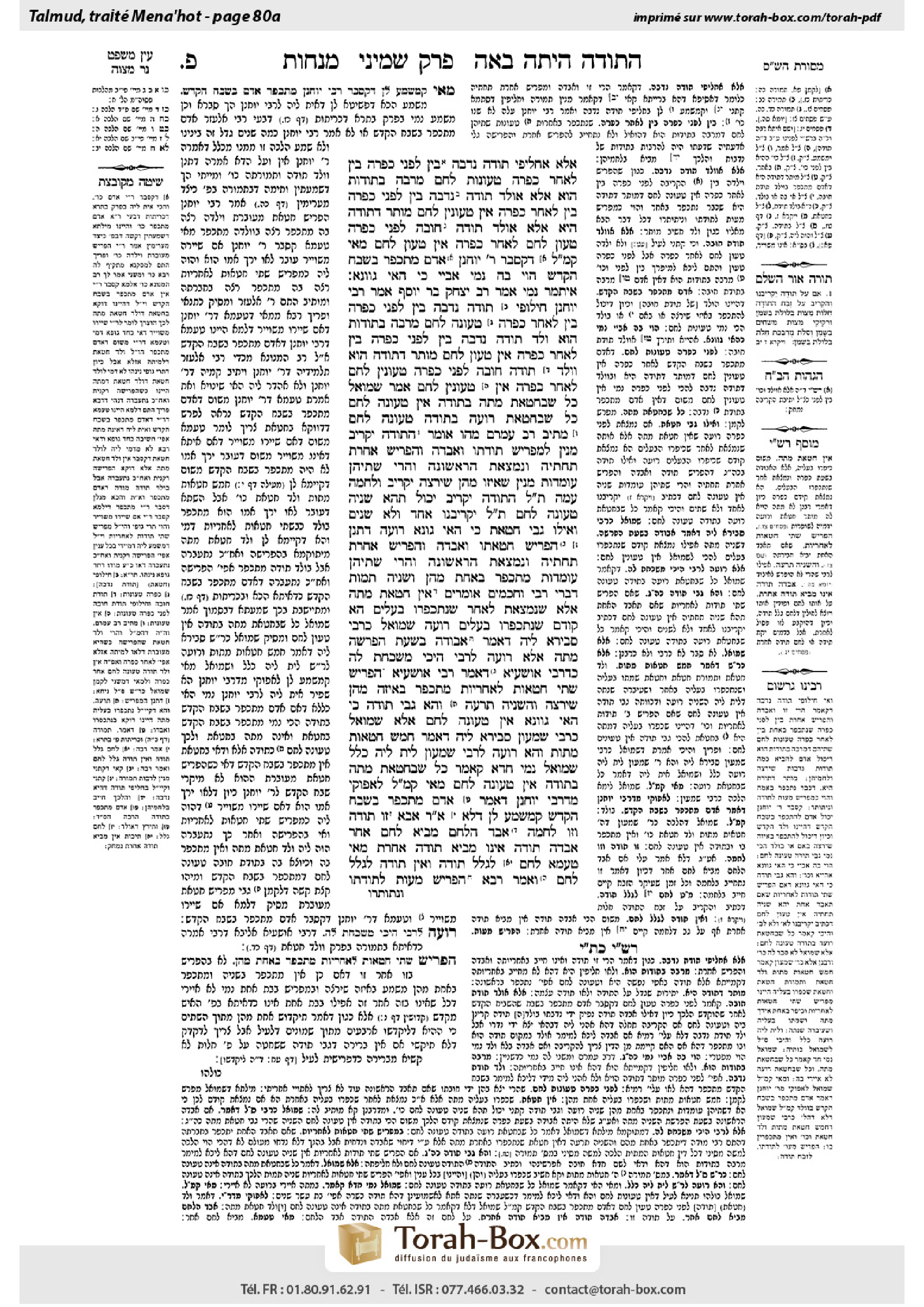
Menachot 80a: Talmud study for Daf Yomi
Daf Yomi is the daily study of one Talmud folio. Explore 37 tractates with scans, Hebrew text, Sefaria English and AI-generated French translations where annotated.
Passage selection and English or AI-generated French translation are available where the scan has annotations. Daf Study is independent of Torah-Box and Sefaria.
Browse Menachot · מנחות · All tractatesMenachot 80a text and translations
This page of Menachot includes the Aramaic text, an English translation and an AI-generated French translation, alongside the scan above.
מנחות פ׳ א · Aramaic and Hebrew text
אֶלָּא אַחֲלִיפֵי תּוֹדָה נְדָבָה, בֵּין לִפְנֵי כַפָּרָה בֵּין לְאַחַר כַּפָּרָה טְעוּנוֹת לֶחֶם – מַרְבֶּה בְּתוֹדוֹת הוּא!
אֶלָּא, אַוְּלַד תּוֹדָה נְדָבָה – בֵּין לִפְנֵי כַפָּרָה בֵּין לְאַחַר כַּפָּרָה אֵין טְעוּנִין לֶחֶם, מוֹתַר דְּתוֹדָה הִיא! אֶלָּא, אַוְּלַד תּוֹדָה חוֹבָה – לִפְנֵי כַפָּרָה טָעוּן לֶחֶם, לְאַחַר כַּפָּרָה אֵין טָעוּן לֶחֶם.
מַאי קָא מַשְׁמַע לַן, דְּקָסָבַר רַבִּי יוֹחָנָן: אָדָם מִתְכַּפֵּר בִּשְׁבַח הֶקְדֵּשׁ. הָוֵי בַּהּ נָמֵי אַבָּיֵי כִּי הַאי גַוְונָא.
אִיתְּמַר נָמֵי, אָמַר רַב יִצְחָק בַּר יוֹסֵף, אָמַר רַבִּי יוֹחָנָן: חִילּוּפֵי תוֹדָה נְדָבָה, בֵּין לִפְנֵי כַפָּרָה בֵּין לְאַחַר כַּפָּרָה – טְעוּנָה לֶחֶם, מַרְבֶּה בְּתוֹדוֹת הוּא. וְלַד תּוֹדָה נְדָבָה, בֵּין לִפְנֵי כַפָּרָה בֵּין לְאַחַר כַּפָּרָה – אֵין טָעוּן לֶחֶם, מוֹתַר דְּתוֹדָה הוּא. וְולַד תּוֹדָה חוֹבָה, לִפְנֵי כַפָּרָה – טְעוּנִין לֶחֶם, לְאַחַר כַּפָּרָה – אֵין טְעוּנִין לֶחֶם.
אָמַר שְׁמוּאֵל: כֹּל שֶׁבְּחַטָּאת מֵתָה – בְּתוֹדָה אֵין טְעוּנָה לֶחֶם, כֹּל שֶׁבְּחַטָּאת רוֹעָה – בַּתּוֹדָה טְעוּנָה לֶחֶם.
מֵתִיב רַב עַמְרָם: מַהוּ אוֹמֵר ״הַתּוֹדָה יַקְרִיב״? מִנַּיִן לְמַפְרִישׁ תּוֹדָתוֹ וְאָבְדָה, וְהִפְרִישׁ אַחֶרֶת תַּחְתֶּיהָ, וְנִמְצֵאת הָרִאשׁוֹנָה, וַהֲרֵי שְׁתֵּיהֶן עוֹמְדוֹת – מִנַּיִן שֶׁאֵיזוֹ מֵהֶן שֶׁיִּרְצֶה יַקְרִיב וְלַחְמָהּ עִמָּהּ? תַּלְמוּד לוֹמַר ״הַתּוֹדָה יַקְרִיב״. יָכוֹל תְּהֵא שְׁנִיָּה טְעוּנָה לֶחֶם? תַּלְמוּד לוֹמַר ״יַקְרִיבֶנּוּ״ – אֶחָד וְלֹא שְׁנַיִם.
וְאִילּוּ גַּבֵּי חַטָּאת כִּי הַאי גַּוְנָא רוֹעָה, דִּתְנַן: הִפְרִישׁ חַטָּאתוֹ וְאָבְדָה, וְהִפְרִישׁ אַחֶרֶת תַּחְתֶּיהָ, וְנִמְצֵאת הָרִאשׁוֹנָה, וַהֲרֵי שְׁתֵּיהֶן עוֹמְדוֹת – מִתְכַּפֵּר בְּאַחַת מֵהֶן וּשְׁנִיָּה תָּמוּת, דִּבְרֵי רַבִּי. וַחֲכָמִים אוֹמְרִים: אֵין חַטָּאת מֵתָה אֶלָּא שֶׁנִּמְצֵאת לְאַחַר שֶׁנִּתְכַּפְּרוּ בְּעָלִים, הָא קוֹדֶם שֶׁנִּתְכַּפְּרוּ בְּעָלִים – רוֹעָה.
שְׁמוּאֵל כְּרַבִּי סְבִירָא לֵיהּ, דְּאָמַר: אֲבוּדָה בִּשְׁעַת הַפְרָשָׁה – מֵתָה.
אֶלָּא רוֹעָה, לְרַבִּי הֵיכִי מַשְׁכַּחַתְּ לַהּ? כִּדְרַבִּי אוֹשַׁעְיָא, דְּאָמַר רַבִּי אוֹשַׁעְיָא: הִפְרִישׁ שְׁתֵּי חַטָּאוֹת לְאַחְרָיוּת, מִתְכַּפֵּר בְּאֵיזֶה מֵהֶן שֶׁיִּרְצֶה, וְהַשְּׁנִיָּה תִּרְעֶה.
וְהָא גַּבֵּי תוֹדָה כִּי הַאי גַוְונָא אֵין טְעוּנָה לֶחֶם, אֶלָּא שְׁמוּאֵל כְּרַבִּי שִׁמְעוֹן סְבִירָא לֵיהּ, דְּאָמַר: חָמֵשׁ חַטָּאוֹת מֵתוֹת.
וְהָא רוֹעָה, לְרַבִּי שִׁמְעוֹן לֵית לֵיהּ כְּלָל.
שְׁמוּאֵל נָמֵי חֲדָא קָאָמַר: כֹּל שֶׁבְּחַטָּאת מֵתָה – בְּתוֹדָה אֵין טְעוּנָה לֶחֶם. מַאי קָא מַשְׁמַע לַן? לְאַפּוֹקֵי מִדְּרַבִּי יוֹחָנָן, דְּאָמַר: אָדָם מִתְכַּפֵּר בִּשְׁבַח הֶקְדֵּשׁ, קָמַשְׁמַע לַן דְּלָא.
אָמַר רַבִּי אַבָּא: זוֹ תּוֹדָה וְזוֹ לַחְמָהּ, אָבַד הַלֶּחֶם – מֵבִיא לֶחֶם אַחֵר, אָבְדָה תּוֹדָה – אֵינוֹ מֵבִיא תּוֹדָה אַחֶרֶת. מַאי טַעְמָא? לֶחֶם לִגְלַל תּוֹדָה, וְאֵין תּוֹדָה לִגְלַל לֶחֶם.
וְאָמַר רָבָא: הִפְרִישׁ מָעוֹת לְתוֹדָתוֹ
Menachot 80a · English translation
Rather, perhaps Rabbi Yoḥanan was referring not to the replacement for an obligatory thanks offering, but to the replacement for a voluntary thanks offering. This too is difficult, because whether the initial thanks offering was found before the owner achieved atonement with the replacement or after he achieved atonement, both offerings require loaves, as the owner is considered one who increases thanks offerings. That is, since he was not required to bring a replacement for the offering, if he brings another offering it is considered an additional voluntary offering, and a voluntary thanks offering requires loaves.
Rather, perhaps Rabbi Yoḥanan was referring to the offspring of a voluntary thanks offering. This too is difficult, because whether the offspring was sacrificed before the owner achieved atonement with its mother or after he achieved atonement, offspring do not require loaves, as this is considered a leftover of the thanks offering, which does not require loaves. Rather, perhaps Rabbi Yoḥanan was referring to the offspring of an obligatory thanks offering. Rabbi Yoḥanan teaches that if the offspring was sacrificed before the owner achieved atonement, it requires loaves, but if it was sacrificed after he achieved atonement, it does not require loaves.
The Gemara asks: According to this explanation, what is Rav Ḥanina teaching us by sending this letter? He teaches us that Rabbi Yoḥanan holds: A person achieves atonement with the enhancement of consecrated property, even though it is not the initial consecrated property. If one sacrifices the offspring of an obligatory thanks-offering before the thanks-offering itself, he achieves atonement with the offspring, even though it is an enhancement of the consecrated thanks-offering. Accordingly, if he offers it before its mother, it requires loaves. The Gemara notes: Abaye also discusses the letter sent by Rav Ḥanina in this way and reaches conclusions similar to those of Rav Amram.
With regard to the conclusions of Rav Amram and Abaye, it was also stated: Rav Yitzḥak bar Yosef says that Rabbi Yoḥanan says: If one achieves atonement with the replacement for a voluntary thanks offering, whether the thanks offering was found before he achieved atonement or after he achieved atonement, the replacement requires loaves, as the owner is considered one who increases thanks offerings. The offspring of a voluntary thanks offering, whether it was sacrificed before he achieved atonement or after he achieved atonement, does not require loaves, as offspring is considered a leftover of the thanks offering. And with regard to the offspring of an obligatory thanks offering, if it was sacrificed before he achieved atonement, it requires loaves, but if it was sacrificed after he achieved atonement, it does not require loaves.
§ The Gemara cites additional halakhot with regard to the loaves of a thanks offering that was lost and another animal was taken as its replacement: Shmuel says: In any situation in which a sin offering would be placed in isolation for it to die, if that same situation occurs with a thanks offering, it does not require loaves. And in any situation in which a sin offering would be placed in the field to graze until it develops a blemish, if that same situation occurs with a thanks offering, it requires loaves.
Rav Amram raises an objection from the baraita cited on 79b: What is it that the verse teaches when it states: He sacrifices for a thanks offering? From where is it derived that one who separated an animal as his thanks offering and it was lost and he separated another in its stead, and the first animal was then found, and now they both stand fit to be sacrificed, from where is it derived that he may sacrifice whichever one of them he wishes, and its loaves are brought along with it? The verse states: He sacrifices for a thanks offering. One might have thought that the second animal also requires loaves to be brought with it. The verse states: “He sacrifices it,” indicating that only one thanks offering requires loaves, but not two.
Rav Amram continues: Whereas with regard to a sin offering in a case like this, the Rabbis hold that the animal is placed in the field to graze, as we learned in a mishna (Temura 22b): If one separated his sin offering and it was lost, and he separated another animal in its stead, and the first sin offering was found, and both animals stand fit for sacrifice, then he achieves atonement with one of them and the second animal shall be left to die; this is the statement of Rabbi Yehuda HaNasi. And the Rabbis say: A sin offering is left to die only if it was found after its owner achieved atonement. It may be inferred from the opinion of the Rabbis that if it is found before the owner achieved atonement, it is placed in the field to graze.
The Gemara responds: Shmuel holds in accordance with the opinion of Rabbi Yehuda HaNasi, who said: An animal separated as a sin offering that was lost at the time of the separation of its replacement, even if it was found before the replacement was sacrificed, is left to die. The principle stated by Shmuel is therefore correct, since in every situation in which a sin offering is left to die, a thanks offering does not require loaves.
The Gemara asks: But if Rabbi Yehuda HaNasi holds that even in such a case the second sin offering is left to die, how can you find a case where the sin offering is placed in the field to graze according to the opinion of Rabbi Yehuda HaNasi? The Gemara responds: It can be found in a case like that of Rabbi Oshaya, as Rabbi Oshaya says: If one separated two sin offerings, one to achieve atonement for his sin and the other as a guarantee in case the first one is lost, he may achieve atonement with whichever of them he wishes, and the second shall be placed in the field to graze.
The Gemara challenges: But in a case like this involving a thanks offering, the animal does not require loaves. Therefore, if Rabbi Yehuda HaNasi holds that in such a case the sin offering is placed in the field to graze, then Shmuel cannot hold in accordance with his opinion, since according to Shmuel, in circumstances where a sin offering would be left to graze, a thanks offering in the same circumstances would require loaves. Rather, Shmuel holds in accordance with the opinion of Rabbi Shimon, who said: There are five sin offerings that are left to die; one is a sin offering that was lost and found before its replacement was sacrificed, and another is the case where a sin offering was separated as a guarantee.
The Gemara challenges: But it cannot be that Shmuel holds in accordance with the opinion of Rabbi Shimon, since Rabbi Shimon does not hold that there are any circumstances in which a sin offering is placed in the field to graze. Accordingly, if Shmuel holds in accordance with the opinion of Rabbi Shimon, how can he say: And in any situation in which a sin offering would be placed in the field to graze until it develops a blemish, if that same situation occurs with a thanks offering, it requires loaves?
The Gemara responds: In fact, Shmuel also stated only one principle: In any situation in which a sin offering is placed in isolation for it to die, if that same situation occurs with a thanks offering, it does not require loaves. He did not state the second principle. The Gemara asks: What is Shmuel teaching us? The Gemara responds: Shmuel teaches us his statement to exclude the statement of Rabbi Yoḥanan, who said: A person achieves atonement with the enhancement of consecrated property. According to Rabbi Yoḥanan, the offspring of an obligatory thanks offering requires loaves if it is sacrificed before its mother. Shmuel teaches us that one does not achieve atonement with the enhancement of consecrated property, and the offspring of a thanks offering does not require loaves, which corresponds to the fact that the offspring of a sin offering is left to die.
§ With regard to the loaves of a thanks offering, Rabbi Abba says: If one volunteered to bring a thanks offering, and said: This animal is a thanks offering and this flour is designated for its loaves, then if the loaves were lost, he brings other loaves. If the thanks offering was lost, he does not bring another thanks offering, and the loaves are not sacrificed. What is the reason for this? The loaves are brought on account of the thanks offering; therefore, if there is no thanks offering, there are no loaves. But the thanks offering is not brought on account of the loaves; consequently, if the loaves were lost, the thanks offering is still sacrificed, and one brings different loaves.
§ And with regard to the distinctions between a thanks offering and its accompanying loaves, Rava says: In the case of one who separated money for his thanks offering
Menachot 80a · Traduction française (IA)
Mais peut-être Rabbi Yoḥanan faisait-il référence non pas au remplaçant d’un sacrifice de remerciement obligatoire, mais à celui d’un sacrifice de remerciement volontaire. Cela aussi pose difficulté : que le sacrifice de remerciement initial ait été retrouvé avant ou après que son propriétaire a obtenu l’expiation grâce au remplaçant, les deux sacrifices exigent des pains, car le propriétaire est considéré comme quelqu’un qui multiplie les sacrifices de remerciement. En effet, puisqu’il n’était pas tenu d’apporter un remplaçant pour le sacrifice, s’il en apporte un autre, celui-ci est considéré comme un sacrifice volontaire supplémentaire, et un sacrifice de remerciement volontaire exige des pains.
Mais peut-être Rabbi Yoḥanan faisait-il référence au petit d’un sacrifice de remerciement volontaire. Cela aussi pose difficulté : que le petit ait été sacrifié avant ou après que son propriétaire a obtenu l’expiation grâce à sa mère, les petits n’exigent pas de pains, car le petit est considéré comme un reste du sacrifice de remerciement, lequel n’exige pas de pains. Mais peut-être Rabbi Yoḥanan faisait-il référence au petit d’un sacrifice de remerciement obligatoire. Rabbi Yoḥanan enseigne que, si le petit a été sacrifié avant que son propriétaire obtienne l’expiation, il exige des pains, mais que, s’il a été sacrifié après qu’il l’a obtenue, il n’en exige pas.
La Guemara demande : selon cette explication, que nous enseigne Rav Ḥanina en envoyant cette lettre ? Il nous enseigne que, selon Rabbi Yoḥanan, une personne obtient l’expiation grâce à l’amélioration d’un bien consacré, même s’il ne s’agit pas du bien consacré initial. Si l’on sacrifie le petit d’un sacrifice de remerciement obligatoire avant le sacrifice de remerciement lui-même, on obtient l’expiation grâce au petit, même s’il constitue une amélioration du sacrifice de remerciement consacré. Par conséquent, si on le sacrifie avant sa mère, il exige des pains. La Guemara note : Abaye examine lui aussi de cette façon la lettre envoyée par Rav Ḥanina et parvient à des conclusions semblables à celles de Rav Amram.
Au sujet des conclusions de Rav Amram et d’Abaye, il a également été rapporté : Rav Yitzḥak bar Yosef dit que Rabbi Yoḥanan dit : si l’on obtient l’expiation grâce au remplaçant d’un sacrifice de remerciement volontaire, que le sacrifice de remerciement ait été retrouvé avant ou après que l’on a obtenu l’expiation, le remplaçant exige des pains, car le propriétaire est considéré comme quelqu’un qui multiplie les sacrifices de remerciement. Le petit d’un sacrifice de remerciement volontaire, qu’il ait été sacrifié avant ou après que l’on a obtenu l’expiation, n’exige pas de pains, car le petit est considéré comme un reste du sacrifice de remerciement. Quant au petit d’un sacrifice de remerciement obligatoire, s’il a été sacrifié avant que l’on obtienne l’expiation, il exige des pains, mais s’il a été sacrifié après, il n’en exige pas.
§ La Guemara cite d’autres halakhot concernant les pains d’un sacrifice de remerciement qui a été perdu et pour lequel un autre animal a été pris comme remplaçant. Shmuel dit : dans toute situation où un sacrifice expiatoire serait mis à l’écart pour mourir, si cette même situation se présente pour un sacrifice de remerciement, celui-ci n’exige pas de pains. Et dans toute situation où un sacrifice expiatoire serait envoyé au pâturage jusqu’à ce qu’il développe un défaut, si cette même situation se présente pour un sacrifice de remerciement, celui-ci exige des pains.
Rav Amram soulève une objection à partir de la baraïta citée en 79b : qu’enseigne le verset lorsqu’il dit : « Il offre un sacrifice de remerciement » ? D’où déduit-on que celui qui a désigné un animal comme sacrifice de remerciement, qui l’a perdu puis en a désigné un autre à sa place, et qui retrouve ensuite le premier animal, alors que les deux sont désormais aptes à être sacrifiés, peut sacrifier celui des deux qu’il souhaite, et que les pains sont apportés avec celui-ci ? Le verset dit : « Il offre un sacrifice de remerciement. » On aurait pu penser que le second animal aussi exige que des pains soient apportés avec lui. Le verset dit : « Il l’offre », ce qui indique qu’un seul sacrifice de remerciement exige des pains, et non deux.
Rav Amram poursuit : en revanche, dans un cas semblable concernant un sacrifice expiatoire, les Sages estiment que l’animal est envoyé au pâturage, comme nous l’avons appris dans une Michna (Temoura 22b) : si quelqu’un a désigné son sacrifice expiatoire, l’a perdu, puis a désigné un autre animal à sa place, et que le premier sacrifice expiatoire est retrouvé alors que les deux animaux sont aptes à être sacrifiés, il obtient l’expiation grâce à l’un d’eux, et le second animal doit être laissé mourir ; telle est la déclaration de Rabbi Yehuda HaNasi. Les Sages disent : un sacrifice expiatoire n’est laissé mourir que s’il est retrouvé après que son propriétaire a obtenu l’expiation. On peut déduire de l’avis des Sages que, s’il est retrouvé avant que son propriétaire obtienne l’expiation, il est envoyé au pâturage.
La Guemara répond : Shmuel suit l’avis de Rabbi Yehuda HaNasi, qui a dit qu’un animal désigné comme sacrifice expiatoire et perdu au moment où son remplaçant a été désigné doit être laissé mourir, même s’il est retrouvé avant que le remplaçant soit sacrifié. Le principe énoncé par Shmuel est donc exact, car, dans toute situation où un sacrifice expiatoire est laissé mourir, un sacrifice de remerciement n’exige pas de pains.
La Guemara demande : mais si Rabbi Yehuda HaNasi estime que, même dans un tel cas, le second sacrifice expiatoire doit être laissé mourir, comment peut-on trouver, selon son avis, un cas où le sacrifice expiatoire est envoyé au pâturage ? La Guemara répond : on peut le trouver dans un cas semblable à celui de Rabbi Oshaya, car Rabbi Oshaya dit : si quelqu’un a désigné deux sacrifices expiatoires, l’un pour obtenir l’expiation de sa faute et l’autre comme garantie au cas où le premier serait perdu, il peut obtenir l’expiation grâce à celui qu’il souhaite, et le second sera envoyé au pâturage.
La Guemara objecte : mais, dans un cas semblable concernant un sacrifice de remerciement, l’animal n’exige pas de pains. Par conséquent, si Rabbi Yehuda HaNasi estime que, dans un tel cas, le sacrifice expiatoire est envoyé au pâturage, Shmuel ne peut pas suivre son avis, car, selon Shmuel, dans les circonstances où un sacrifice expiatoire serait envoyé au pâturage, un sacrifice de remerciement placé dans les mêmes circonstances exigerait des pains. Shmuel suit plutôt l’avis de Rabbi Shimon, qui a dit qu’il existe cinq sacrifices expiatoires qui sont laissés mourir ; l’un d’eux est un sacrifice expiatoire qui a été perdu puis retrouvé avant que son remplaçant soit sacrifié, et un autre cas est celui d’un sacrifice expiatoire désigné comme garantie.
La Guemara objecte : mais Shmuel ne peut pas suivre l’avis de Rabbi Shimon, car celui-ci n’admet aucune situation où un sacrifice expiatoire est envoyé au pâturage. Ainsi, si Shmuel suit l’avis de Rabbi Shimon, comment peut-il dire : « Et dans toute situation où un sacrifice expiatoire serait envoyé au pâturage jusqu’à ce qu’il développe un défaut, si cette même situation se présente pour un sacrifice de remerciement, celui-ci exige des pains » ?
La Guemara répond : en réalité, Shmuel n’a énoncé qu’un seul principe : dans toute situation où un sacrifice expiatoire est mis à l’écart pour mourir, si cette même situation se présente pour un sacrifice de remerciement, celui-ci n’exige pas de pains. Il n’a pas énoncé le second principe. La Guemara demande : que nous enseigne Shmuel ? La Guemara répond : Shmuel formule son enseignement pour exclure celui de Rabbi Yoḥanan, qui a dit qu’une personne obtient l’expiation grâce à l’amélioration d’un bien consacré. Selon Rabbi Yoḥanan, le petit d’un sacrifice de remerciement obligatoire exige des pains s’il est sacrifié avant sa mère. Shmuel nous enseigne qu’on n’obtient pas l’expiation grâce à l’amélioration d’un bien consacré et que le petit d’un sacrifice de remerciement n’exige pas de pains, ce qui correspond au fait que le petit d’un sacrifice expiatoire est laissé mourir.
§ Concernant les pains d’un sacrifice de remerciement, Rabbi Abba dit : si quelqu’un s’est engagé volontairement à apporter un sacrifice de remerciement et a dit : « Cet animal est un sacrifice de remerciement et cette farine est destinée à ses pains », alors, si les pains ont été perdus, il en apporte d’autres. Si le sacrifice de remerciement a été perdu, il n’en apporte pas un autre, et les pains ne sont pas sacrifiés. Pourquoi ? Les pains sont apportés en raison du sacrifice de remerciement ; par conséquent, s’il n’y a pas de sacrifice de remerciement, il n’y a pas de pains. Mais le sacrifice de remerciement n’est pas apporté en raison des pains ; par conséquent, si les pains ont été perdus, le sacrifice de remerciement est tout de même sacrifié, et l’on apporte d’autres pains.
§ Au sujet des distinctions entre un sacrifice de remerciement et les pains qui l’accompagnent, Rava dit : dans le cas de quelqu’un qui a mis à part de l’argent pour son sacrifice de remerciement
Traduction française générée par IA à partir de l’édition anglaise de Sefaria. Vérifie toujours un passage avec le texte source.
Text from Sefaria: William Davidson Edition - Vocalized Aramaic (unknown); William Davidson Edition - English (CC BY NC).