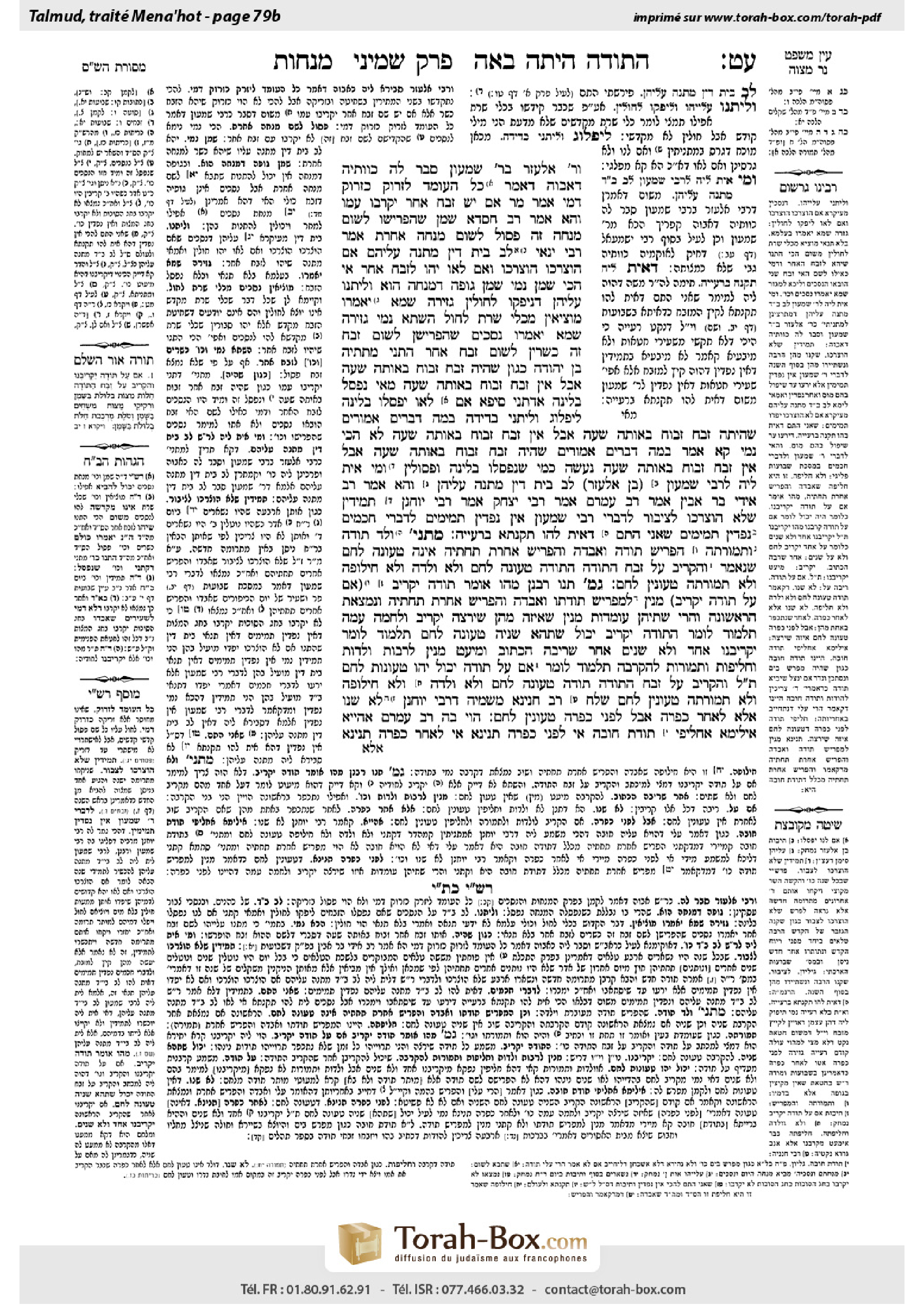
Menachot 79b: Talmud study for Daf Yomi
Daf Yomi is the daily study of one Talmud folio. Explore 37 tractates with scans, Hebrew text, Sefaria English and AI-generated French translations where annotated.
Passage selection and English or AI-generated French translation are available where the scan has annotations. Daf Study is independent of Torah-Box and Sefaria.
Browse Menachot · מנחות · All tractatesMenachot 79b text and translations
This page of Menachot includes the Aramaic text, an English translation and an AI-generated French translation, alongside the scan above.
מנחות ע״ט ב · Aramaic and Hebrew text
וְרַבִּי אֶלְעָזָר בְּרַבִּי שִׁמְעוֹן סָבַר לַהּ כְּוָותֵיהּ דַּאֲבוּהּ, דְּאָמַר: כׇּל הָעוֹמֵד לִזְרוֹק כְּזָרוּק דָּמֵי.
אָמַר מָר: אִם יֵשׁ זֶבַח אַחֵר יִקְרְבוּ עִמּוֹ, וְהָא אָמַר רַב חִסְדָּא: שֶׁמֶן שֶׁהִפְרִישׁוֹ לְשׁוּם מִנְחָה זוֹ – פָּסוּל לְשׁוּם מִנְחָה אַחֶרֶת! אָמַר רַבִּי יַנַּאי: לֵב בֵּית דִּין מַתְנֶה עֲלֵיהֶם, אִם הוּצְרְכוּ – הוּצְרְכוּ, וְאִם לָאו – יְהוּ לְזֶבַח אַחֵר.
אִי הָכִי, שֶׁמֶן נָמֵי? שֶׁמֶן גּוּפַהּ דְּמִנְחָה הוּא.
וְלַיתְנוֹ עֲלֵיהֶן דְּנִיפְּקוּ לְחוּלִּין? גְּזֵירָה שֶׁמָּא יֹאמְרוּ: מוֹצִיאִין מִכְּלֵי שָׁרֵת לַחוֹל.
הַשְׁתָּא נָמֵי, גְּזֵירָה שֶׁמָּא יֹאמְרוּ: נְסָכִים שֶׁהִפְרִישָׁן לְשׁוּם זֶבַח זֶה – כְּשֵׁרִין לְשׁוּם זֶבַח אַחֵר!
הָתָנֵי מַתִּתְיָה בֶּן יְהוּדָה, כְּגוֹן שֶׁהָיָה זֶבַח זָבוּחַ בְּאוֹתָהּ שָׁעָה.
אֲבָל אֵין זֶבַח זָבוּחַ בְּאוֹתָהּ שָׁעָה, מַאי? נִפְסָל בְּלִינָה? אַדְּתָנֵי סֵיפָא: אִם לָאו יִפָּסְלוּ בְּלִינָה, לִיפְלוֹג וְלִיתְנֵי בְּדִידַהּ: בַּמֶּה דְּבָרִים אֲמוּרִים? שֶׁהָיָה זֶבַח זָבוּחַ בְּאוֹתָהּ שָׁעָה, אֲבָל אֵין זֶבַח זָבוּחַ בְּאוֹתָהּ שָׁעָה – לֹא.
הָכִי נָמֵי קָא אָמַר: בַּמֶּה דְּבָרִים אֲמוּרִים? שֶׁהָיָה זֶבַח זָבוּחַ בְּאוֹתָהּ שָׁעָה, אֲבָל אֵין זֶבַח זָבוּחַ בְּאוֹתָהּ שָׁעָה – נַעֲשָׂה כְּמִי שֶׁנִּפְסְלוּ בְּלִינָה, וּפְסוּלִין.
וּמִי אִית לֵיהּ לְרַבִּי שִׁמְעוֹן בֶּן אֶלְעָזָר לֵב בֵּית דִּין מַתְנֶה עֲלֵיהֶן?
וְהָא אָמַר רַב אִידִי בַּר אָבִין, אָמַר רַב עַמְרָם, אָמַר רַבִּי יִצְחָק, אָמַר רַבִּי יוֹחָנָן: תְּמִידִין שֶׁלֹּא הוּצְרְכוּ לַצִּיבּוּר – לְדִבְרֵי רַבִּי שִׁמְעוֹן אֵין נִפְדִּין תְּמִימִים, לְדִבְרֵי חֲכָמִים נִפְדִּין תְּמִימִים.
שָׁאנֵי הָתָם, דְּאִית לְהוּ תַּקַּנְתָּא בִּרְעִיָּיה.
מַתְנִי׳ וְלַד תּוֹדָה וּתְמוּרָתָהּ, הִפְרִישׁ תּוֹדָה וְאָבְדָה וְהִפְרִישׁ אַחֶרֶת תַּחְתֶּיהָ – אֵינָהּ טְעוּנָה לֶחֶם, שֶׁנֶּאֱמַר: ״וְהִקְרִיב עַל זֶבַח הַתּוֹדָה״ – הַתּוֹדָה טְעוּנָה לֶחֶם, וְלֹא וְלָדָהּ וְלֹא חִילּוּפָהּ וְלֹא תְּמוּרָתָהּ טְעוּנִין לֶחֶם.
גְּמָ׳ תָּנוּ רַבָּנַן: מַהוּ אוֹמֵר ״תּוֹדָה יַקְרִיב״? ״אִם עַל תּוֹדָה יַקְרִיב״ – מִנַּיִן לְמַפְרִישׁ תּוֹדָתוֹ וְאָבְדָה, וְהִפְרִישׁ אַחֶרֶת תַּחְתֶּיהָ, וְנִמְצֵאת הָרִאשׁוֹנָה, וַהֲרֵי שְׁתֵּיהֶן עוֹמְדוֹת – מִנַּיִן שֶׁאֵיזֶה מֵהֶן שֶׁיִּרְצֶה יַקְרִיב וְלַחְמָהּ עִמָּהּ? תַּלְמוּד לוֹמַר ״הַתּוֹדָה יַקְרִיב״.
יָכוֹל שֶׁתְּהֵא שְׁנִיָּה טְעוּנָה לֶחֶם? תַּלְמוּד לוֹמַר ״יַקְרִיבֶנּוּ״ – אֶחָד וְלֹא שְׁנַיִם. אַחַר שֶׁרִיבָּה הַכָּתוּב וּמִיעֵט, מִנַּיִן לְרַבּוֹת וְלָדוֹת וַחֲלִיפוֹת וּתְמוּרוֹת לְהַקְרָבָה? תַּלְמוּד לוֹמַר ״אִם עַל תּוֹדָה״. יָכוֹל יְהוּ טְעוּנוֹת לֶחֶם? תַּלְמוּד לוֹמַר ״וְהִקְרִיב עַל זֶבַח הַתּוֹדָה״ – תּוֹדָה טְעוּנָה לֶחֶם, וְלֹא וְלָדָהּ וְלֹא חִילּוּפָהּ וְלֹא תְּמוּרָתָהּ טְעוּנִין לֶחֶם.
שְׁלַח רַב חֲנִינָא מִשְּׁמֵיהּ דְּרַבִּי יוֹחָנָן: לֹא שָׁנוּ אֶלָּא לְאַחַר כַּפָּרָה, אֲבָל לִפְנֵי כַפָּרָה – טְעוּנִין לֶחֶם.
הָוֵי בַּהּ רַב עַמְרָם: אַהֵיָיא? אִילֵּימָא אַחֲלִיפֵי תּוֹדַת חוֹבָה – אִי לִפְנֵי כַפָּרָה, תְּנֵינָא! אִי לְאַחַר כַּפָּרָה, תְּנֵינָא!
Menachot 79b · English translation
And Rabbi Elazar, son of Rabbi Shimon, holds in accordance with the opinion of his father in this matter, as Rabbi Shimon said: Any blood of an offering that stands fit to be sprinkled upon the altar is considered as if it were already sprinkled. Accordingly, although the blood was spilled after it was collected in the cup and was not actually sprinkled, it is nevertheless considered as if it were sprinkled.
§ The Master said in the mishna: If there is another offering that was slaughtered and requires libations, the libations should be sacrificed with that offering. The Gemara asks: But didn’t Rav Ḥisda say that oil that one separated for the sake of this one meal offering is unfit to be brought for the sake of another meal offering? Likewise, shouldn’t libations separated for one offering be unfit for sacrifice with another offering? Rabbi Yannai says: The court tacitly stipulates concerning the libations that if they were required for the offering for which they were separated, they were required and are brought with that offering. But if not, e.g., where the offering was disqualified, they should be brought with another offering.
The Gemara asks: If that is so, then shouldn’t it be that the court tacitly stipulates concerning the oil as well? The Gemara responds: The oil is part of the meal offering itself and cannot be brought for the sake of another meal offering, whereas the libations merely accompany the offering and are not an integral part of it.
The Gemara challenges: If it is so that the court tacitly stipulates concerning the libations, then let the court tacitly stipulate concerning them that if the offering they are meant to accompany is disqualified, they shall emerge to non-sacred status altogether. The Gemara responds: It is a rabbinic decree that the court does not tacitly make this stipulation, lest people who are unaware of such a stipulation see that an item that was previously sanctified has become non-sacred, and they will mistakenly say: One may remove sanctified items from service vessels to become non-sacred.
The Gemara objects: If the Sages did not tacitly make such a stipulation because they were concerned that people might mistakenly conclude that items that were already consecrated in service vessels can become non-sacred, then now as well, where the court tacitly stipulates that the libations should be sacrificed with another offering, let there be a rabbinic decree against such a stipulation, lest people say: Libations that one separated for the sake of one offering are fit for the sake of a different offering ab initio.
The Gemara responds: Mattitya ben Yehuda teaches that the mishna is referring specifically to a case where there was another offering that was slaughtered at the same time. In such a case, there is no concern that people will reach this mistaken conclusion, as one who sees that the libations are sacrificed immediately with the other offering will simply assume that they were separated for the sake of that offering from the outset.
The Gemara objects to this: According to the explanation of Mattitya ben Yehuda, it can be inferred from the mishna that if there is another offering that was slaughtered at the same time, then the libations are sacrificed with that offering; but if there is not another offering that was slaughtered at the same time, then what should be done with the libations? They should be disqualified by being left overnight. If so, rather than teaching in the latter clause of the mishna: And if there is not another offering that requires libations, they should be disqualified by being left overnight; let the tanna distinguish and teach the distinction within the case itself as follows: In what case is this statement said? It is said in a case where there was another offering that was slaughtered at the same time. But if there is not another offering that was slaughtered at the same time, the libations are not sacrificed with another offering.
The Gemara responds: That is also what the tanna of the mishna is saying: In what case is this statement said? It is said in a case where there was another offering that was slaughtered at the same time. But if there is not another offering that was slaughtered at the same time, the libations are immediately considered as if they were disqualified by being left overnight, and they are disqualified.
The Gemara explained above that the mishna is also in accordance with the opinion of Rabbi Elazar, son of Rabbi Shimon, and that he holds in accordance with the opinion of his father that any blood that stands fit to be sprinkled is considered as if it has been sprinkled. The Gemara also explained that the mishna allows for the sacrifice of the libations with another offering because the court tacitly stipulates that the libations should be brought with another offering if the first offering becomes disqualified. In light of this, the Gemara asks: But does Rabbi Shimon ben Elazar, i.e., the father of Rabbi Elazar, accept the principle that the court tacitly stipulates concerning the libations?
But didn’t Rav Idi bar Avin say that Rav Amram said that Rabbi Yitzḥak said that Rabbi Yoḥanan said: With regard to animals that were designated as daily offerings but that in the end were not needed for use by the public, and have inherent sanctity, how shall they be redeemed? According to the statement of Rabbi Shimon, they may not be redeemed as long as they are unblemished, since they retain the status of offerings. But according to the statement of the Rabbis, they may be redeemed even when they are unblemished, as the court initially stipulates that if they are not needed they will not assume the status of an offering. Since Rabbi Shimon disagrees with the Rabbis, it may be inferred that according to Rabbi Shimon, one does not say that the court tacitly stipulates concerning the offerings.
The Gemara responds: In general, Rabbi Shimon holds that the court stipulates concerning them. And it is different there, in the case of the daily offerings, because they have an alternative arrangement through which their total loss may be avoided, as they may be left in the field to graze until they develop a blemish, at which point they may be sold. Since there is no arrangement for the libations save for sacrificing them with another offering, even Rabbi Shimon holds that the court stipulates concerning them.
MISHNA: With regard to the offspring of an animal designated as a thanks offering, or an animal that is its substitute; or in a case where one separated an animal as a thanks offering and it was lost and he separated another in its stead, and the first animal was then found, in all three cases, the second animal, i.e., the offspring, the substitute, or the replacement, is sacrificed, but it does not require the bringing of accompanying loaves. This is as it is stated: “If he sacrifices it for a thanks offering, then he shall sacrifice with the thanks offering unleavened cakes mingled with oil, and unleavened wafers spread with oil, and cakes mingled with oil, of fine flour poached” (Leviticus 7:12). The verse indicates that the initial thanks offering requires loaves, but neither its offspring, nor its replacement, nor its substitute requires loaves.
GEMARA: The Sages taught in a baraita: What is it that the verse teaches when it states: He sacrifices for a thanks offering? The verse states: If he sacrifices for a thanks offering. From where is it derived that with regard to one who separated an animal as his thanks offering and it was lost and he separated another in its stead, and the first animal was then found, and now they both stand fit to be sacrificed, from where is it derived that he may sacrifice whichever one of them he wishes, and its loaves are brought along with it? The verse states that he shall sacrifice the thanks offering, i.e., as long as he sacrifices some thanks offering.
The baraita continues: One might have thought that the second animal also requires loaves to be brought with it. Therefore, the verse states: “He sacrifices it,” indicating that only one thanks offering requires loaves, but not two. Since the verse included the second animal as fit for sacrifice and excluded it from the requirement to bring loaves with it, from where is it derived that the verse also includes a thanks offering’s offspring, replacements, and substitutes as fit for sacrifice? From the fact that the verse states: “If for a thanks offering,” one might have thought that they would require loaves to be brought with them. Therefore, the verse states: “Then he shall sacrifice with the thanks offering,” indicating that the initial thanks offering itself requires loaves, but neither its offspring, nor its replacement, nor its substitute requires loaves.
§ With regard to the offspring, substitute, and replacement of a thanks offering, the Gemara relates: Rav Ḥanina sent a letter from Eretz Yisrael to the Sages in Babylonia containing the following statement in the name of Rabbi Yoḥanan: The mishna taught that the offspring, replacement, and substitute do not require loaves only in a case where they were sacrificed after the owner achieved atonement, i.e., where the initial thanks offering was already sacrificed with its loaves; but if they were sacrificed before he achieved atonement, they require loaves.
Rav Amram discussed this halakha sent in the name of Rabbi Yoḥanan and asked: To which halakha in the mishna is this referring? If we say that Rabbi Yoḥanan is referring to the replacement for an obligatory thanks offering, then there is no novelty in his statement. If his intention is to teach that where the thanks offering was found before the owner achieved atonement with its replacement, the replacement requires loaves, we already learned this in the baraita, as it states: He may sacrifice whichever one of them he wishes, and its loaves are brought along with it. And if his intention is to teach that where the thanks offering was found after the owner achieved atonement with the replacement, the thanks offering does not require loaves, this too we already learned in the baraita, as it teaches that only the first offering requires loaves.
Menachot 79b · Traduction française (IA)
Rabbi Elazar, fils de Rabbi Shimon, suit donc l’opinion de son père sur ce point, car Rabbi Shimon a dit : Tout sang d’un sacrifice qui peut être aspergé sur l’autel est considéré comme s’il avait déjà été aspergé. Ainsi, bien que le sang ait été renversé après avoir été recueilli dans la coupe et qu’il n’ait pas été aspergé, il est néanmoins considéré comme s’il l’avait été.
§ Le Maître a dit dans la Michna : Si une autre offrande a été égorgée et nécessite des libations, celles-ci doivent être offertes avec cette offrande. La Guemara demande : Mais Rav Ḥisda n’a-t-il pas dit que l’huile qu’on a réservée pour cette offrande de farine est impropre à être apportée pour une autre offrande de farine ? De même, les libations réservées pour une offrande ne devraient-elles pas être impropres à être offertes avec une autre offrande ? Rabbi Yannai dit : Le tribunal pose tacitement une condition concernant les libations : si elles étaient requises pour l’offrande à laquelle elles étaient destinées, elles le sont et sont offertes avec cette offrande. Sinon, par exemple si l’offrande a été invalidée, elles doivent être offertes avec une autre offrande.
La Guemara demande : Dans ce cas, le tribunal ne devrait-il pas également poser tacitement une condition concernant l’huile ? La Guemara répond : L’huile fait partie intégrante de l’offrande de farine elle-même et ne peut être apportée pour une autre offrande de farine, tandis que les libations accompagnent simplement l’offrande et n’en sont pas un élément intégrant.
La Guemara objecte : Si le tribunal pose tacitement une condition concernant les libations, qu’il pose donc la condition suivante : si l’offrande qu’elles doivent accompagner est invalidée, elles perdent entièrement leur statut sacré. La Guemara répond : Les Sages ont décrété que le tribunal ne pose pas tacitement une telle condition, de peur que des personnes ignorant l’existence de cette condition ne voient un objet qui avait été sanctifié devenir profane et ne disent par erreur : « On peut retirer des objets sacrés des ustensiles de service pour les rendre profanes. »
La Guemara objecte : Si les Sages n’ont pas posé tacitement une telle condition parce qu’ils craignaient que les gens en concluent par erreur que des objets déjà sanctifiés dans des ustensiles de service peuvent devenir profanes, alors, ici aussi, lorsque le tribunal pose tacitement la condition que les libations soient offertes avec une autre offrande, il devrait y avoir un décret rabbinique interdisant une telle condition, de peur que les gens disent : « Des libations réservées pour une offrande peuvent d’emblée être offertes avec une autre offrande. »
La Guemara répond : Mattitya ben Yehuda enseigne que la Michna parle précisément d’un cas où une autre offrande a été égorgée au même moment. Dans ce cas, il n’y a pas à craindre que les gens tirent cette conclusion erronée, car celui qui voit les libations être offertes immédiatement avec l’autre offrande supposera simplement qu’elles avaient été réservées pour cette offrande dès le départ.
La Guemara objecte : selon l’explication de Mattitya ben Yehuda, on peut déduire de la Michna que, si une autre offrande a été égorgée au même moment, les libations sont offertes avec cette offrande ; mais si aucune autre offrande n’a été égorgée au même moment, que faut-il faire des libations ? Elles devraient être invalidées en étant laissées toute la nuit. Dans ce cas, au lieu d’enseigner dans la dernière partie de la Michna : « Et s’il n’y a pas d’autre offrande qui nécessite des libations, elles sont invalidées en étant laissées toute la nuit », que le tanna distingue et enseigne cette distinction à propos du cas lui-même, comme suit : « Dans quel cas cette affirmation s’applique-t-elle ? Lorsqu’une autre offrande a été égorgée au même moment. Mais s’il n’y a pas d’autre offrande qui ait été égorgée au même moment, les libations ne sont pas offertes avec une autre offrande. »
La Guemara répond : C’est également ce que dit le tanna de la Michna : « Dans quel cas cette affirmation s’applique-t-elle ? Lorsqu’une autre offrande a été égorgée au même moment. Mais s’il n’y a pas d’autre offrande qui ait été égorgée au même moment, les libations sont immédiatement considérées comme invalidées parce qu’elles ont été laissées toute la nuit, et elles sont invalidées. »
La Guemara a expliqué plus haut que la Michna suit également l’opinion de Rabbi Elazar, fils de Rabbi Shimon, et que celui-ci suit l’opinion de son père, selon laquelle tout sang qui peut être aspergé est considéré comme s’il avait été aspergé. La Guemara a également expliqué que la Michna permet d’offrir les libations avec une autre offrande parce que le tribunal pose tacitement la condition qu’elles seront offertes avec une autre offrande si la première est invalidée. À la lumière de cela, la Guemara demande : Mais Rabbi Shimon ben Elazar, c’est-à-dire le père de Rabbi Elazar, accepte-t-il le principe selon lequel le tribunal pose tacitement une condition concernant les libations ?
Mais Rav Idi bar Avin n’a-t-il pas dit que Rav Amram a dit que Rabbi Yitzḥak a dit que Rabbi Yoḥanan a dit : Au sujet des animaux désignés comme offrandes quotidiennes, mais qui finalement n’ont pas été nécessaires pour la collectivité et qui possèdent une sainteté intrinsèque, comment faut-il les racheter ? Selon l’opinion de Rabbi Shimon, ils ne peuvent pas être rachetés tant qu’ils sont sans défaut, puisqu’ils conservent le statut d’offrandes. Mais selon l’opinion des Rabbins, ils peuvent être rachetés même sans défaut, car le tribunal pose d’emblée la condition que, s’ils ne sont pas nécessaires, ils ne prendront pas le statut d’offrande. Puisque Rabbi Shimon est en désaccord avec les Rabbins, on peut en déduire que, selon lui, on ne dit pas que le tribunal pose tacitement une condition concernant les offrandes.
La Guemara répond : En règle générale, Rabbi Shimon considère que le tribunal pose une condition à leur sujet. Le cas des offrandes quotidiennes est différent, car il existe une autre solution permettant d’éviter leur perte totale : on peut les laisser paître dans le champ jusqu’à ce qu’elles développent un défaut, après quoi on peut les vendre. Puisqu’il n’existe aucune solution pour les libations autre que de les offrir avec une autre offrande, Rabbi Shimon considère lui aussi que le tribunal pose une condition à leur sujet.
MICHNA : Le petit d’un animal désigné comme sacrifice de reconnaissance, ou un animal qui en est le substitut ; ou encore le cas où une personne a réservé un animal comme sacrifice de reconnaissance, qu’il s’est perdu, qu’elle en a réservé un autre à sa place, puis que le premier a été retrouvé : dans ces trois cas, le second animal — c’est-à-dire le petit, le substitut ou l’animal de remplacement — est offert, mais il ne nécessite pas l’apport des pains qui l’accompagnent. Comme il est dit : « S’il présente un sacrifice de reconnaissance, il présentera avec le sacrifice de reconnaissance des gâteaux sans levain pétris à l’huile, des galettes sans levain enduites d’huile et des gâteaux pétris à l’huile, de fleur de farine frite » (Lévitique 7, 12). Le verset indique que le sacrifice de reconnaissance initial nécessite des pains, mais que ni son petit, ni son animal de remplacement, ni son substitut n’en nécessite.
GUEMARA : Les Sages ont enseigné dans une baraïta : Que nous apprend le verset lorsqu’il dit : « Il présente un sacrifice de reconnaissance » ? Le verset dit : « S’il présente un sacrifice de reconnaissance. » D’où déduit-on que, lorsqu’une personne a réservé un animal comme sacrifice de reconnaissance, qu’il s’est perdu, qu’elle en a réservé un autre à sa place, puis que le premier a été retrouvé, et que les deux sont désormais aptes à être offerts, elle peut offrir celui des deux qu’elle souhaite, et que les pains sont apportés avec celui-ci ? Le verset dit qu’il présentera le sacrifice de reconnaissance, c’est-à-dire qu’il suffit qu’il présente un sacrifice de reconnaissance, quel qu’il soit.
La baraïta poursuit : On aurait pu penser que le second animal nécessite lui aussi l’apport de pains. Le verset dit donc : « Il le présente », ce qui indique qu’un seul sacrifice de reconnaissance nécessite des pains, et non deux. Puisque le verset inclut le second animal parmi ceux qui peuvent être offerts et l’exclut de l’obligation d’apporter des pains avec lui, d’où déduit-on que le verset inclut également le petit d’un sacrifice de reconnaissance, les animaux de remplacement et ses substituts parmi ceux qui peuvent être offerts ? Du fait que le verset dit : « Si c’est un sacrifice de reconnaissance », on aurait pu penser qu’ils nécessitent l’apport de pains. Le verset dit donc : « Alors il présentera avec le sacrifice de reconnaissance », ce qui indique que le sacrifice de reconnaissance initial lui-même nécessite des pains, mais que ni son petit, ni son animal de remplacement, ni son substitut n’en nécessite.
§ Au sujet du petit, du substitut et de l’animal de remplacement d’un sacrifice de reconnaissance, la Guemara rapporte : Rav Ḥanina a envoyé une lettre d’Eretz Israël aux Sages de Babylonie, contenant la déclaration suivante au nom de Rabbi Yoḥanan : La Michna enseigne que le petit, l’animal de remplacement et le substitut ne nécessitent pas de pains uniquement dans le cas où ils ont été offerts après que le propriétaire a obtenu l’expiation, c’est-à-dire lorsque le sacrifice de reconnaissance initial a déjà été offert avec ses pains ; mais s’ils ont été offerts avant qu’il ait obtenu l’expiation, ils nécessitent des pains.
Rav Amram a examiné cette halakha transmise au nom de Rabbi Yoḥanan et a demandé : À quelle halakha de la Michna cela se rapporte-t-il ? Si l’on dit que Rabbi Yoḥanan parle de l’animal de remplacement d’un sacrifice de reconnaissance obligatoire, sa déclaration n’apporte rien de nouveau. S’il entend enseigner que, lorsque le sacrifice de reconnaissance a été retrouvé avant que le propriétaire ait obtenu l’expiation avec l’animal de remplacement, celui-ci nécessite des pains, nous l’avons déjà appris dans la baraïta, qui dit : « Il peut offrir celui des deux qu’il souhaite, et les pains sont apportés avec lui. » Et s’il entend enseigner que, lorsque le sacrifice de reconnaissance a été retrouvé après que le propriétaire a obtenu l’expiation avec l’animal de remplacement, le sacrifice de reconnaissance ne nécessite pas de pains, cela aussi, nous l’avons déjà appris dans la baraïta, qui enseigne que seul le premier sacrifice nécessite des pains.
Traduction française générée par IA à partir de l’édition anglaise de Sefaria. Vérifie toujours un passage avec le texte source.
Text from Sefaria: William Davidson Edition - Vocalized Aramaic (unknown); William Davidson Edition - English (CC BY NC).