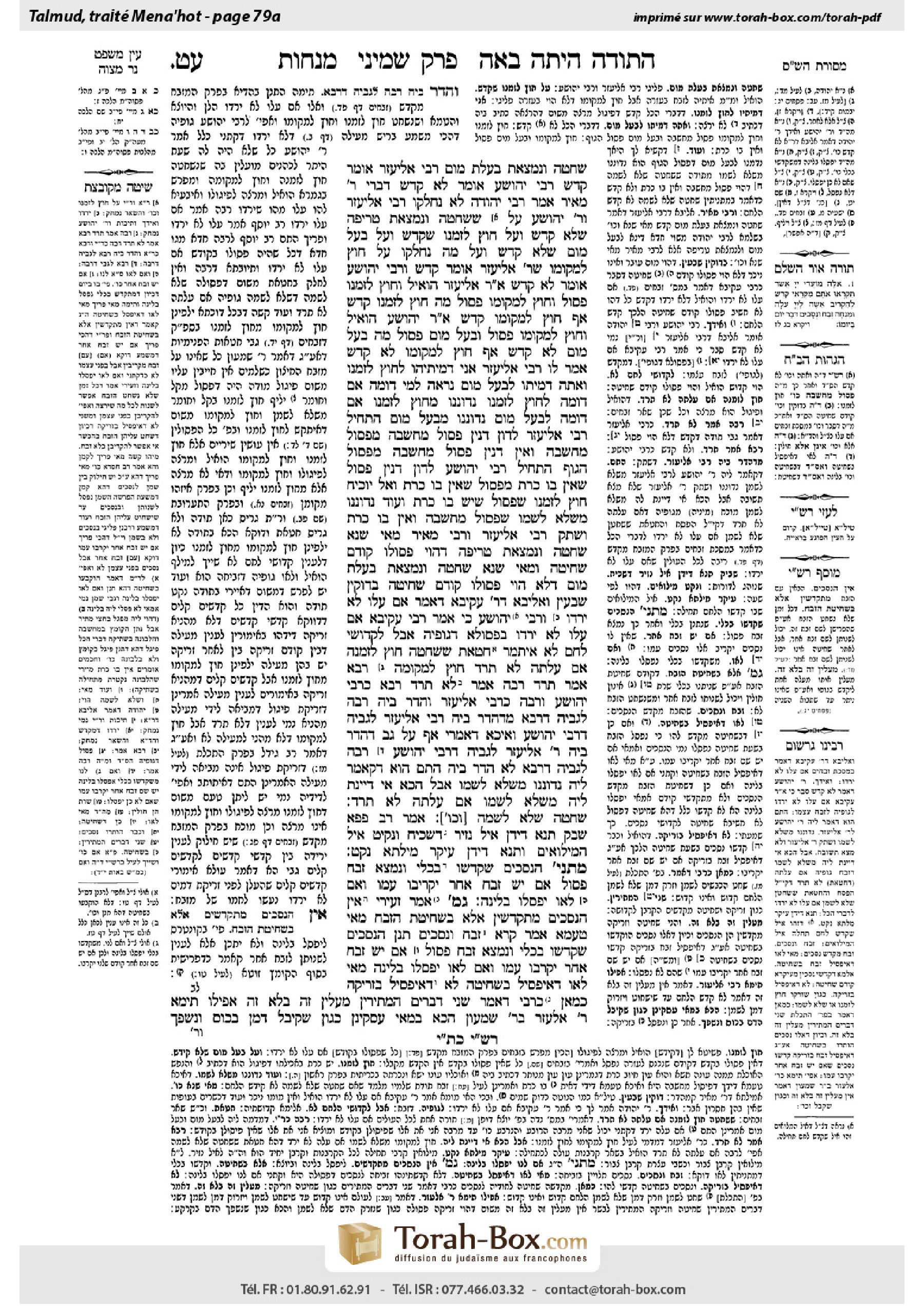
Menachot 79a: Talmud study for Daf Yomi
Daf Yomi is the daily study of one Talmud folio. Explore 37 tractates with scans, Hebrew text, Sefaria English and AI-generated French translations where annotated.
Passage selection and English or AI-generated French translation are available where the scan has annotations. Daf Study is independent of Torah-Box and Sefaria.
Browse Menachot · מנחות · All tractatesMenachot 79a text and translations
This page of Menachot includes the Aramaic text, an English translation and an AI-generated French translation, alongside the scan above.
מנחות ע״ט א · Aramaic and Hebrew text
שְׁחָטָהּ וְנִמְצֵאת בַּעֲלַת מוּם – רַבִּי אֱלִיעֶזֶר אוֹמֵר: קָדַשׁ, רַבִּי יְהוֹשֻׁעַ אוֹמֵר: לֹא קָדַשׁ, דִּבְרֵי רַבִּי מֵאִיר.
אָמַר רַבִּי יְהוּדָה: לֹא נֶחְלְקוּ רַבִּי אֱלִיעֶזֶר וְרַבִּי יְהוֹשֻׁעַ עַל שֶׁשְּׁחָטָהּ וְנִמְצֵאת טְרֵיפָה – שֶׁלֹּא קָדַשׁ, וְעַל חוּץ לִזְמַנּוֹ – שֶׁקָּדַשׁ, וְעַל בַּעַל מוּם – שֶׁלֹּא קָדַשׁ. וְעַל מָה נֶחְלְקוּ? עַל חוּץ לִמְקוֹמוֹ, שֶׁרַבִּי אֱלִיעֶזֶר אוֹמֵר: קָדַשׁ, וְרַבִּי יְהוֹשֻׁעַ אוֹמֵר: לֹא קָדַשׁ.
אָמַר רַבִּי אֱלִיעֶזֶר: הוֹאִיל וְחוּץ לִזְמַנּוֹ פָּסוּל, וְחוּץ לִמְקוֹמוֹ פָּסוּל, מָה חוּץ לִזְמַנּוֹ – קָדַשׁ, אַף חוּץ לִמְקוֹמוֹ – קָדַשׁ. אָמַר רַבִּי יְהוֹשֻׁעַ: הוֹאִיל וְחוּץ לִמְקוֹמוֹ פָּסוּל, וּבַעַל מוּם פָּסוּל, מָה בַּעַל מוּם – לֹא קָדַשׁ, אַף חוּץ לִמְקוֹמוֹ – לֹא קָדַשׁ.
אָמַר לוֹ רַבִּי אֱלִיעֶזֶר: אֲנִי דִּמִּיתִיהוּ לְחוּץ לִזְמַנּוֹ, וְאַתָּה דִּמִּיתוֹ לְבַעַל מוּם, נִרְאֶה לְמִי דּוֹמֶה – אִם דּוֹמֶה לְחוּץ לִזְמַנּוֹ, נְדוּנֶנּוּ מֵחוּץ לִזְמַנּוֹ, אִם דּוֹמֶה לְבַעַל מוּם, נְדוּנֶנּוּ מִבַּעַל מוּם.
הִתְחִיל רַבִּי אֱלִיעֶזֶר לָדוּן: דָּנִין פְּסוּל מַחְשָׁבָה מִפְּסוּל מַחְשָׁבָה, וְאֵין דָּנִין פְּסוּל מַחְשָׁבָה מִפְּסוּל הַגּוּף.
הִתְחִיל רַבִּי יְהוֹשֻׁעַ לָדוּן: דָּנִין פְּסוּל שֶׁאֵין בּוֹ כָּרֵת, מִפְּסוּל שֶׁאֵין בּוֹ כָּרֵת, וְאַל יוֹכִיחַ חוּץ לִזְמַנּוֹ, שֶׁפְּסוּל שֶׁיֵּשׁ בּוֹ כָּרֵת. וְעוֹד, נְדוּנֶנּוּ מִשֶּׁלֹּא לִשְׁמוֹ, שֶׁפְּסוּל מַחְשָׁבָה וְאֵין בּוֹ כָּרֵת.
וְשָׁתַק רַבִּי אֱלִיעֶזֶר.
וְרַבִּי מֵאִיר, מַאי שְׁנָא שְׁחָטָהּ וְנִמְצֵאת טְרֵיפָה, דְּהָוֵי פְּסוּלוֹ קוֹדֶם שְׁחִיטָה, וּמַאי שְׁנָא שְׁחָטָהּ וְנִמְצֵאת בַּעֲלַת מוּם, דְּלָא הָוֵי פְּסוּלוֹ קוֹדֶם שְׁחִיטָה?
בְּדוּקִּין שֶׁבָּעַיִן, וְאַלִּיבָּא דְּרַבִּי עֲקִיבָא, דְּאָמַר: אִם עָלוּ לֹא יֵרְדוּ. וְרַבִּי יְהוֹשֻׁעַ: כִּי אָמַר רַבִּי עֲקִיבָא אִם עָלוּ לֹא יֵרְדוּ – בִּפְסוּלָא דְּגוּפֵיהּ, אֲבָל לְקַדּוֹשֵׁי לֶחֶם – לָא.
אִיתְּמַר: חַטָּאת שֶׁשְּׁחָטָהּ חוּץ לִזְמַנָּהּ, אִם עָלְתָה – לֹא תֵּרֵד. חוּץ לִמְקוֹמָהּ, רָבָא אָמַר: תֵּרֵד, רַבָּה אָמַר: לֹא תֵּרֵד.
רָבָא כְּרַבִּי יְהוֹשֻׁעַ, וְרַבָּה כְּרַבִּי אֱלִיעֶזֶר.
וַהֲדַר בֵּיהּ רַבָּה לְגַבֵּיהּ דְּרָבָא, מִדַּהֲדַר בֵּיהּ רַבִּי אֱלִיעֶזֶר לְגַבֵּיהּ דְּרַבִּי יְהוֹשֻׁעַ.
וְאִיכָּא דְּאָמְרִי: אַף עַל גַּב דַּהֲדַר בֵּיהּ רַבִּי אֱלִיעֶזֶר לְגַבֵּיהּ דְּרַבִּי יְהוֹשֻׁעַ, רַבָּה לְגַבֵּיהּ דְּרָבָא לָא הֲדַר בֵּיהּ. הָתָם הוּא דְּקָאָמַר לֵיהּ: נְדוּנֶנּוּ מִשֶּׁלֹּא לִשְׁמוֹ, אֲבָל הָכָא, אִי דָּיְינַתְּ לֵיהּ מִשֶּׁלֹּא לִשְׁמוֹ – אִם עָלְתָה לֹא תֵּרֵד.
שְׁחָטָהּ שֶׁלֹּא לִשְׁמָהּ [וְכוּ׳]. אָמַר רַב פָּפָּא: שְׁבַק תַּנָּא דִידַן אֵיל נָזִיר דִּשְׁכִיחַ, וְנָקֵיט אֵיל הַמִּילּוּאִים? וְתַנָּא דִּידַן – עִיקַּר מִילְּתָא נָקֵט.
מַתְנִי׳ הַנְּסָכִים שֶׁקָּדְשׁוּ בִּכְלִי וְנִמְצָא זֶבַח פָּסוּל, אִם יֵשׁ זֶבַח אַחֵר – יַקְרִיבוּ עִמּוֹ, וְאִם לָאו – יִפָּסְלוּ בְּלִינָה.
גְּמָ׳ אָמַר זְעֵירִי: אֵין הַנְּסָכִים מִתְקַדְּשִׁין אֶלָּא בִּשְׁחִיטַת הַזֶּבַח. מַאי טַעְמָא? אָמַר קְרָא: ״זֶבַח וּנְסָכִים״.
תְּנַן: הַנְּסָכִים שֶׁקָּדְשׁוּ בִּכְלִי וְנִמְצָא זֶבַח פָּסוּל – אִם יֵשׁ זֶבַח אַחֵר, יִקְרְבוּ עִמּוֹ; וְאִם לָאו – יִפָּסְלוּ בְּלִינָה.
מַאי לָאו דְּאִיפְּסִיל בִּשְׁחִיטָה? לָא, דְּאִיפְּסִיל בִּזְרִיקָה.
כְּמַאן? כְּרַבִּי, דְּאָמַר: שְׁנֵי דְּבָרִים הַמַּתִּירִין מַעֲלִין זֶה בְּלֹא זֶה.
אֲפִילּוּ תֵּימָא רַבִּי אֶלְעָזָר בְּרַבִּי שִׁמְעוֹן, הָכָא בְּמַאי עָסְקִינַן – כְּגוֹן שֶׁקִּיבֵּל דָּמָן בְּכוֹס וְנִשְׁפַּךְ.
Menachot 79a · English translation
If one slaughtered the thanks offering and it was discovered that it is a blemished animal, Rabbi Eliezer says: The loaves were consecrated, and Rabbi Yehoshua says: The loaves were not consecrated. This is the statement of Rabbi Meir, consistent with the dispute appearing in the mishna.
The baraita continues: Rabbi Yehuda said: Rabbi Eliezer and Rabbi Yehoshua did not disagree with regard to a case where he slaughtered the thanks offering and it was discovered that it is a tereifa, as all agree that it was not consecrated; and they did not disagree with regard to a case where he slaughtered the thanks offering with the intent to partake of it or to burn the sacrificial portions beyond its designated time, as all agree that it was consecrated; and they did not disagree with regard to a case where he slaughtered the thanks offering and it was discovered that it is a blemished animal, as all agree that it was not consecrated. And with regard to what case did they disagree? They disagree with regard to a case where he slaughtered the thanks offering with the intent to partake of it or to burn the sacrificial portions outside its designated area, as Rabbi Eliezer says: It was consecrated, and Rabbi Yehoshua says: It was not consecrated.
The baraita continues: In explanation of his opinion, Rabbi Eliezer said: Since an offering slaughtered with intent to partake of it beyond its designated time is disqualified and an offering slaughtered with intent to partake of it outside its designated area is disqualified, it is reasonable that just as in the case of intent to partake of it beyond its time the loaves were consecrated, so too in the case of intent to partake of it outside its area the loaves were consecrated. Rabbi Yehoshua said: Since an offering slaughtered with intent to partake of it outside its designated area is disqualified and an offering discovered to be a blemished animal is disqualified, it is reasonable that just as in the case of a blemished animal the loaves were not consecrated, so too in the case of intent to partake of it outside its area the loaves were not consecrated.
Rabbi Eliezer said to him: I compared an offering slaughtered with intent to partake of it outside its designated area to an offering slaughtered with intent to partake of it beyond its designated time, and you compared it to an offering discovered to be a blemished animal. Let us consider to which it is similar. If it is similar to an offering slaughtered with intent to partake of it beyond its designated time, we will deduce its halakha from that of an offering slaughtered with intent to partake of it beyond its designated time. If it is similar to an offering discovered to be a blemished animal, we will deduce its halakha from that of an offering discovered to be a blemished animal.
Rabbi Eliezer began to reason: We deduce the halakha with regard to a disqualification due to improper intention from that of a disqualification due to an improper intention, i.e., the halakha with regard to one who slaughters the animal with intent to partake of it outside its designated area should be deduced from the halakha with regard to one who slaughters it with the intent to partake of it outside its designated time. And we do not deduce the halakha with regard to a disqualification due to improper intention from that of a disqualification due to a blemish in the physical body of the offering.
Rabbi Yehoshua began to reason to the contrary: We deduce the halakha with regard to a disqualification that does not include liability for excision from the World-to-Come [karet], i.e., an offering slaughtered with intent to partake of it outside its designated area, from that of a disqualification that does not include liability for karet, i.e., an offering discovered to be a blemished animal. And the halakha with regard to an offering slaughtered with intent to partake of it beyond its designated time should not be brought as proof, as it is a disqualification that includes liability for karet. And furthermore, even according to Rabbi Eliezer, who says that we deduce the halakha from a disqualification due to improper intention, let us deduce the halakha from that of an offering slaughtered not for its sake, as it is a disqualification due to improper intention and it also does not include liability for karet, and the loaves of such an offering were not consecrated.
The baraita concludes: And Rabbi Eliezer was silent, conceding to Rabbi Yehoshua. In any event, it is clear in the baraita that the mishna is in accordance with the opinion of Rabbi Meir.
The Gemara asks: And according to the opinion of Rabbi Meir, who says that if the thanks offering was slaughtered and discovered to be a tereifa the loaves were not consecrated, but if it was discovered to be a blemished animal Rabbi Eliezer holds that the loaves were consecrated, what is different if he slaughtered it and it was discovered to be a tereifa such that it is considered a case where its disqualification precedes its slaughter, and the loaves were not consecrated; and what is different if he slaughtered it and it was discovered to be a blemished animal such that it is not considered a case where its disqualification precedes its slaughter, and the loaves were consecrated according to Rabbi Eliezer?
The Gemara responds: Rabbi Meir is referring to a blemish on the cornea of the eye, and his ruling is in accordance with the opinion of Rabbi Akiva, who said with regard to this type of blemish: Although animals with such a blemish are disqualified as an offering ab initio, if they ascended the altar they shall not descend, and they are sacrificed on the altar. The Gemara adds: And Rabbi Yehoshua, who holds that if the animal is discovered to be blemished the loaves are not consecrated, says: When Rabbi Akiva said that if they ascended the altar, they shall not descend, he was referring to the disqualification of the offering itself, i.e., that once it ascended it shall not descend. But with regard to the consecration of the loaves through the slaughter of such an animal, he did not say this.
§ The Gemara continues to discuss the dispute between Rabbi Eliezer and Rabbi Yehoshua in the baraita: It was stated: With regard to a sin offering that one slaughtered with intent to partake of it beyond its designated time, if it ascended the altar it shall not descend. If one slaughtered it with intent to partake of it outside its designated area, Rava says: It shall descend and shall not be burned, and Rabba says: It shall not descend.
The Gemara suggests: Rava holds in accordance with the opinion of Rabbi Yehoshua, who deduces the halakha with regard to a thanks offering that was slaughtered with intent to partake of it outside its designated area from that of an offering discovered to have a blemish. Accordingly, just as a blemished sin offering descends from the altar even if it has already ascended, so too a sin offering that was slaughtered with intent to partake of it outside its designated area descends. And Rabba holds in accordance with the opinion of Rabbi Eliezer, who deduces the halakha with regard to a thanks offering that was slaughtered with intent to partake of it outside its designated area from that of an offering that was slaughtered with intent to partake of it beyond its designated time. Accordingly, just as a sin offering that was slaughtered with intent to partake of it beyond its designated time does not descend from the altar, so too a sin offering that was slaughtered with intent to partake of it outside its designated area does not descend.
And Rabba retracted his opinion in favor of the opinion of Rava and ruled that a sin offering slaughtered with intent to partake of it outside its designated area descends from the altar, since Rabbi Eliezer retracted his opinion in favor of the opinion of Rabbi Yehoshua, as the baraita teaches that he was silent and accepted the reasoning of Rabbi Yehoshua. Accordingly, the halakha with regard to an animal slaughtered with intent to partake of it outside its designated area should be deduced from that of an offering discovered to have a blemish.
And there are those who say: Even though Rabbi Eliezer retracted his opinion in favor of the opinion of Rabbi Yehoshua, Rabba did not retract his opinion in favor of the opinion of Rava, because there, with regard to the consecration of the loaves of the thanks offering, Rabbi Eliezer conceded to Rabbi Yehoshua because Rabbi Yehoshua said to him: Let us deduce its halakha from that of an offering slaughtered not for its sake. But here, if you deduce its halakha from that of an offering slaughtered not for its sake, then the halakha should be that if it ascended the altar it shall not descend.
§ The mishna teaches: If one slaughtered the thanks offering not for its sake, and likewise, if one slaughtered the ram of inauguration not for its sake, and likewise, if one slaughtered the communal peace offering of two sheep that accompany the two loaves on Shavuot not for their sake, the loaves were not consecrated. Rav Pappa said in bewilderment: Why does the tanna of our mishna omit the case of the loaves of the nazirite’s ram, which is common and is also not consecrated if the ram was slaughtered not for its sake, and teach instead the ram of the inauguration of the Tabernacle, which was brought only by the Jewish people in the wilderness? The Gemara responds: And what is the reasoning of the tanna of our mishna? He taught the ram of the inauguration because it was the primary matter, i.e., it was the first offering to be brought with loaves.
MISHNA: In a case where the libations that accompany the offerings were sanctified in a service vessel when the animal was slaughtered and the offering was discovered to be unfit, if there is another offering that was slaughtered and requires libations, the libations should be sacrificed with that offering; and if not, they should be disqualified by being left overnight, and then burned.
GEMARA: With regard to statement of the mishna concerning a case where the libations of an animal offering were consecrated and the animal was then discovered to be unfit, Ze’eiri says: Libations are sanctified only upon the slaughter of the offering. What is the reason for this? The verse states: “To bring an offering made by fire unto the Lord, a burnt offering, and a meal offering, a sacrifice, and libations, each on its own day” (Leviticus 23:37), indicating that the libations complement the offering and are consecrated only upon its slaughter.
The Gemara poses a difficulty to the statement of Ze’eiri from that which we learned in the mishna: In a case where the libations were sanctified in a service vessel when the animal was slaughtered and the offering was discovered to be unfit, if there is another offering that was slaughtered and requires libations, the libations should be sacrificed with that offering; and if not, they should be disqualified by being left overnight, and then burned.
What, is it not so that the mishna is referring to a case where the offering became unfit through its slaughter, and consequently the libations were not sanctified by the slaughter of the offering? Why, then, must the libations be left overnight in order to disqualify them? Evidently, the libations are sanctified upon being placed in a service vessel and not upon the slaughter of the offering, in contradiction to the statement of Ze’eiri. The Gemara rejects this: No, the mishna is referring to an offering that became unfit through the sprinkling of the blood; the libations were sanctified upon the slaughter of the offering, and therefore they must be disqualified by being left overnight.
The Gemara seeks to clarify: In accordance with whose opinion is this mishna? It is in accordance with the opinion of Rabbi Yehuda HaNasi, who said: If an offering has two factors that permit it for consumption or for sacrifice, they can each elevate it to sanctified status without the other. Accordingly, although the slaughter of the animal and the sprinkling of its blood are both permitting factors for the libations, the libations were sanctified through the slaughter of the animal, despite the fact that the animal became unfit through the sprinkling of its blood.
The Gemara rejects this: Even if you say that the mishna is in accordance with the opinion of Rabbi Elazar, son of Rabbi Shimon, who disagrees with Rabbi Yehuda HaNasi and holds that both permitting factors must be performed in order to confer sanctity upon the libations, the mishna can still be explained as follows: Here, we are dealing with a case where the priest collected its blood in the cup for the purpose of sprinkling it on the altar, but the blood spilled out of the cup and could not be sprinkled. Nevertheless, the libations were sanctified, as the blood was fit for sprinkling upon the altar.
Menachot 79a · Traduction française (IA)
Si l’on a égorgé le sacrifice de reconnaissance et qu’on a découvert qu’il s’agissait d’un animal atteint d’un défaut, Rabbi Eliezer dit : « Les pains ont été consacrés », et Rabbi Yehoshua dit : « Les pains n’ont pas été consacrés ». Telle est l’opinion de Rabbi Meïr, conformément à la controverse rapportée dans la Michna.
La baraïta poursuit : Rabbi Yehuda a dit : « Rabbi Eliezer et Rabbi Yehoshua n’étaient pas en désaccord dans le cas où l’on avait égorgé le sacrifice de reconnaissance et découvert qu’il s’agissait d’une tereifa, car tous s’accordent à dire qu’il n’a pas été consacré ; ils n’étaient pas non plus en désaccord dans le cas où l’on avait égorgé le sacrifice de reconnaissance avec l’intention d’en consommer la viande ou d’en brûler les portions sacrificielles après le temps fixé, car tous s’accordent à dire qu’il a été consacré ; et ils n’étaient pas non plus en désaccord dans le cas où l’on avait égorgé le sacrifice de reconnaissance et découvert qu’il s’agissait d’un animal atteint d’un défaut, car tous s’accordent à dire qu’il n’a pas été consacré. Sur quel cas étaient-ils donc en désaccord ? Ils l’étaient dans le cas où l’on avait égorgé le sacrifice de reconnaissance avec l’intention d’en consommer la viande ou d’en brûler les portions sacrificielles hors de l’endroit fixé : Rabbi Eliezer dit qu’il a été consacré, et Rabbi Yehoshua dit qu’il n’a pas été consacré. »
La baraïta poursuit : Pour expliquer son opinion, Rabbi Eliezer a dit : « Puisqu’un sacrifice égorgé avec l’intention d’en consommer la viande après le temps fixé est invalidé, et qu’un sacrifice égorgé avec l’intention d’en consommer la viande hors de l’endroit fixé est également invalidé, il est logique que, de même que, dans le cas où l’on avait l’intention d’en consommer la viande après le temps fixé, les pains ont été consacrés, de même, dans le cas où l’on avait l’intention d’en consommer la viande hors de l’endroit fixé, les pains ont été consacrés. » Rabbi Yehoshua a dit : « Puisqu’un sacrifice égorgé avec l’intention d’en consommer la viande hors de l’endroit fixé est invalidé, et qu’un sacrifice découvert comme étant un animal atteint d’un défaut est invalidé, il est logique que, de même que, dans le cas d’un animal atteint d’un défaut, les pains n’ont pas été consacrés, de même, dans le cas où l’on avait l’intention d’en consommer la viande hors de l’endroit fixé, les pains n’ont pas été consacrés. »
Rabbi Eliezer lui dit : « J’ai comparé un sacrifice égorgé avec l’intention d’en consommer la viande hors de l’endroit fixé à un sacrifice égorgé avec l’intention d’en consommer la viande après le temps fixé, tandis que toi, tu l’as comparé à un sacrifice découvert comme étant un animal atteint d’un défaut. Examinons auquel des deux il ressemble. S’il ressemble à un sacrifice égorgé avec l’intention d’en consommer la viande après le temps fixé, nous en déduirons la halakha de celle qui s’applique à un sacrifice égorgé avec cette intention après le temps fixé. S’il ressemble à un sacrifice découvert comme étant un animal atteint d’un défaut, nous en déduirons la halakha de celle qui s’applique à un sacrifice découvert comme étant un animal atteint d’un défaut. »
Rabbi Eliezer commença à raisonner ainsi : « Nous déduisons la halakha concernant une invalidation due à une intention incorrecte de celle qui s’applique à une invalidation due à une intention incorrecte ; autrement dit, la halakha concernant celui qui égorge l’animal avec l’intention d’en consommer la viande hors de l’endroit fixé doit être déduite de celle qui s’applique à celui qui l’égorge avec l’intention d’en consommer la viande après le temps fixé. Nous ne déduisons pas la halakha concernant une invalidation due à une intention incorrecte de celle qui s’applique à une invalidation due à un défaut physique de l’offrande. »
Rabbi Yehoshua commença à raisonner en sens contraire : « Nous déduisons la halakha concernant une invalidation qui n’entraîne pas la peine d’excision du Monde à venir [karet], c’est-à-dire celle d’un sacrifice égorgé avec l’intention d’en consommer la viande hors de l’endroit fixé, de celle qui s’applique à une invalidation qui n’entraîne pas la peine de karet, c’est-à-dire celle d’un sacrifice découvert comme étant un animal atteint d’un défaut. Il ne faut pas invoquer comme preuve la halakha concernant un sacrifice égorgé avec l’intention d’en consommer la viande après le temps fixé, car il s’agit d’une invalidation qui entraîne la peine de karet. En outre, même selon Rabbi Eliezer, qui dit que nous déduisons la halakha d’une invalidation due à une intention incorrecte, déduisons plutôt la halakha de celle qui s’applique à un sacrifice égorgé sans que ce soit pour lui : il s’agit d’une invalidation due à une intention incorrecte qui n’entraîne pas non plus la peine de karet, et les pains d’un tel sacrifice n’ont pas été consacrés. »
La baraïta conclut : Rabbi Eliezer garda le silence, reconnaissant que Rabbi Yehoshua avait raison. Quoi qu’il en soit, la baraïta montre clairement que la Michna suit l’opinion de Rabbi Meïr.
La Guemara demande : Selon l’opinion de Rabbi Meïr, qui dit que si l’on a égorgé le sacrifice de reconnaissance et découvert qu’il s’agissait d’une tereifa, les pains n’ont pas été consacrés, mais que, si l’on a découvert qu’il s’agissait d’un animal atteint d’un défaut, Rabbi Eliezer considère que les pains ont été consacrés, quelle différence y a-t-il entre le cas où l’on a égorgé le sacrifice et découvert qu’il s’agissait d’une tereifa, de sorte qu’on considère que son invalidité précédait son égorgement et que les pains n’ont pas été consacrés, et le cas où l’on a égorgé le sacrifice et découvert qu’il s’agissait d’un animal atteint d’un défaut, de sorte qu’on ne considère pas que son invalidité précédait son égorgement et que, selon Rabbi Eliezer, les pains ont été consacrés ?
La Guemara répond : Rabbi Meïr parle d’un défaut de la cornée de l’œil, et sa décision est conforme à l’opinion de Rabbi Akiva, qui a dit au sujet de ce type de défaut : « Bien que les animaux présentant un tel défaut soient invalides comme offrandes a priori, s’ils sont montés sur l’autel, ils n’en redescendront pas et seront sacrifiés sur l’autel. » La Guemara ajoute : Rabbi Yehoshua, qui considère que si l’on découvre que l’animal est atteint d’un défaut, les pains ne sont pas consacrés, dit : « Lorsque Rabbi Akiva a dit que, s’ils sont montés sur l’autel, ils n’en redescendront pas, il parlait de l’invalidité de l’offrande elle-même, c’est-à-dire qu’une fois qu’elle y est montée, elle n’en redescendra pas. Mais il n’a pas dit cela au sujet de la consécration des pains par l’égorgement d’un tel animal. »
§ La Guemara poursuit l’examen de la controverse entre Rabbi Eliezer et Rabbi Yehoshua dans la baraïta : Il a été enseigné qu’un sacrifice expiatoire égorgé avec l’intention d’en consommer la viande après le temps fixé, une fois monté sur l’autel, n’en redescend pas. Si on l’a égorgé avec l’intention d’en consommer la viande hors de l’endroit fixé, Rava dit : « Il en redescend et ne sera pas brûlé », et Rabba dit : « Il n’en redescend pas. »
La Guemara suggère : Rava suit l’opinion de Rabbi Yehoshua, qui déduit la halakha concernant un sacrifice de reconnaissance égorgé avec l’intention d’en consommer la viande hors de l’endroit fixé de celle qui s’applique à un sacrifice découvert comme étant atteint d’un défaut. En conséquence, de même qu’un sacrifice expiatoire atteint d’un défaut redescend de l’autel même s’il y est déjà monté, de même un sacrifice expiatoire égorgé avec l’intention d’en consommer la viande hors de l’endroit fixé en redescend. Rabba, lui, suit l’opinion de Rabbi Eliezer, qui déduit la halakha concernant un sacrifice de reconnaissance égorgé avec l’intention d’en consommer la viande hors de l’endroit fixé de celle qui s’applique à un sacrifice égorgé avec l’intention d’en consommer la viande après le temps fixé. En conséquence, de même qu’un sacrifice expiatoire égorgé avec l’intention d’en consommer la viande après le temps fixé ne redescend pas de l’autel, de même un sacrifice expiatoire égorgé avec l’intention d’en consommer la viande hors de l’endroit fixé n’en redescend pas.
Rabba revint sur son opinion et adopta celle de Rava : il décida qu’un sacrifice expiatoire égorgé avec l’intention d’en consommer la viande hors de l’endroit fixé redescend de l’autel, puisque Rabbi Eliezer était revenu sur son opinion et s’était rangé à celle de Rabbi Yehoshua, la baraïta enseignant qu’il garda le silence et accepta le raisonnement de Rabbi Yehoshua. Par conséquent, la halakha concernant un animal égorgé avec l’intention d’en consommer la viande hors de l’endroit fixé doit être déduite de celle qui s’applique à un sacrifice découvert comme étant atteint d’un défaut.
Certains disent : Même si Rabbi Eliezer est revenu sur son opinion et s’est rangé à celle de Rabbi Yehoshua, Rabba n’est pas revenu sur son opinion pour adopter celle de Rava. En effet, dans le cas de la consécration des pains du sacrifice de reconnaissance, Rabbi Eliezer a donné raison à Rabbi Yehoshua parce que celui-ci lui a dit : « Déduisons-en la halakha de celle qui s’applique à un sacrifice égorgé sans que ce soit pour lui. » Mais ici, si tu en déduis la halakha de celle qui s’applique à un sacrifice égorgé sans que ce soit pour lui, la halakha devrait être que, s’il est monté sur l’autel, il n’en redescend pas.
§ La Michna enseigne : Si l’on a égorgé le sacrifice de reconnaissance sans que ce soit pour lui, et de même si l’on a égorgé le bélier d’inauguration sans que ce soit pour lui, et de même si l’on a égorgé les deux moutons du sacrifice communautaire de paix qui accompagnent les deux pains de Chavouot sans que ce soit pour eux, les pains n’ont pas été consacrés. Rav Pappa dit, perplexe : Pourquoi le tanna de notre Michna omet-il le cas des pains du bélier du nazir, qui est courant et dont les pains ne sont pas non plus consacrés si le bélier a été égorgé sans que ce soit pour lui, et enseigne-t-il plutôt le cas du bélier d’inauguration du Tabernacle, qui n’a été offert que par le peuple juif dans le désert ? La Guemara répond : Quelle est donc la raison du tanna de notre Michna ? Il a enseigné le cas du bélier d’inauguration parce qu’il s’agissait du cas principal, c’est-à-dire du premier sacrifice offert avec des pains.
MICHNA : Lorsque les libations qui accompagnent les sacrifices ont été consacrées dans un ustensile de service au moment où l’animal a été égorgé, puis que le sacrifice s’est révélé impropre, s’il existe un autre sacrifice qui a été égorgé et qui nécessite des libations, on offrira les libations avec ce sacrifice ; sinon, on les invalidera en les laissant passer la nuit, puis on les brûlera.
GUEMARA : À propos de l’enseignement de la Michna concernant le cas où les libations d’un sacrifice animal ont été consacrées et où l’animal s’est ensuite révélé impropre, Ze’eiri dit : « Les libations ne sont consacrées qu’au moment de l’égorgement du sacrifice. » Quelle en est la raison ? Le verset dit : « Pour offrir une offrande consumée par le feu à l’Éternel : un holocauste, une offrande de céréales, un sacrifice et des libations, chacun en son jour » (Lévitique 23, 37), ce qui indique que les libations complètent le sacrifice et ne sont consacrées qu’au moment de son égorgement.
La Guemara soulève une difficulté à l’encontre de l’affirmation de Ze’eiri à partir de ce que nous avons appris dans la Michna : Lorsque les libations ont été consacrées dans un ustensile de service au moment où l’animal a été égorgé, puis que le sacrifice s’est révélé impropre, s’il existe un autre sacrifice qui a été égorgé et qui nécessite des libations, on offrira les libations avec ce sacrifice ; sinon, on les invalidera en les laissant passer la nuit, puis on les brûlera.
La Michna ne parle-t-elle pas du cas où le sacrifice est devenu impropre à la suite de son égorgement, de sorte que les libations n’ont pas été consacrées par l’égorgement du sacrifice ? Pourquoi faudrait-il alors laisser les libations passer la nuit pour les invalider ? Il apparaît donc que les libations sont consacrées lorsqu’elles sont placées dans un ustensile de service, et non au moment de l’égorgement du sacrifice, contrairement à l’affirmation de Ze’eiri. La Guemara rejette cette interprétation : Non, la Michna parle d’un sacrifice devenu impropre à la suite de l’aspersion du sang ; les libations ont été consacrées au moment de l’égorgement du sacrifice et doivent donc être invalidées en étant laissées passer la nuit.
La Guemara cherche à préciser : Selon l’opinion de qui cette Michna est-elle ? Elle suit l’opinion de Rabbi Yehuda HaNassi, qui a dit que, si un sacrifice comporte deux facteurs qui le rendent apte à être consommé ou offert, chacun peut à lui seul lui conférer le statut de chose consacrée, sans l’autre. Par conséquent, bien que l’égorgement de l’animal et l’aspersion de son sang soient tous deux des facteurs qui rendent les libations aptes à être offertes, celles-ci ont été consacrées par l’égorgement de l’animal, même si celui-ci est devenu impropre à la suite de l’aspersion de son sang.
La Guemara rejette cette interprétation : Même si tu dis que la Michna suit l’opinion de Rabbi Elazar, fils de Rabbi Shimon, qui est en désaccord avec Rabbi Yehuda HaNassi et considère que les deux facteurs permettant de conférer aux libations le statut de choses consacrées doivent être réunis, la Michna peut encore s’expliquer ainsi : Ici, il s’agit du cas où le prêtre a recueilli le sang dans le bassin afin de l’asperger sur l’autel, mais où le sang s’est répandu hors du bassin et n’a pas pu être aspergé. Néanmoins, les libations ont été consacrées, puisque le sang était apte à être aspergé sur l’autel.
Traduction française générée par IA à partir de l’édition anglaise de Sefaria. Vérifie toujours un passage avec le texte source.
Text from Sefaria: William Davidson Edition - Vocalized Aramaic (unknown); William Davidson Edition - English (CC BY NC).