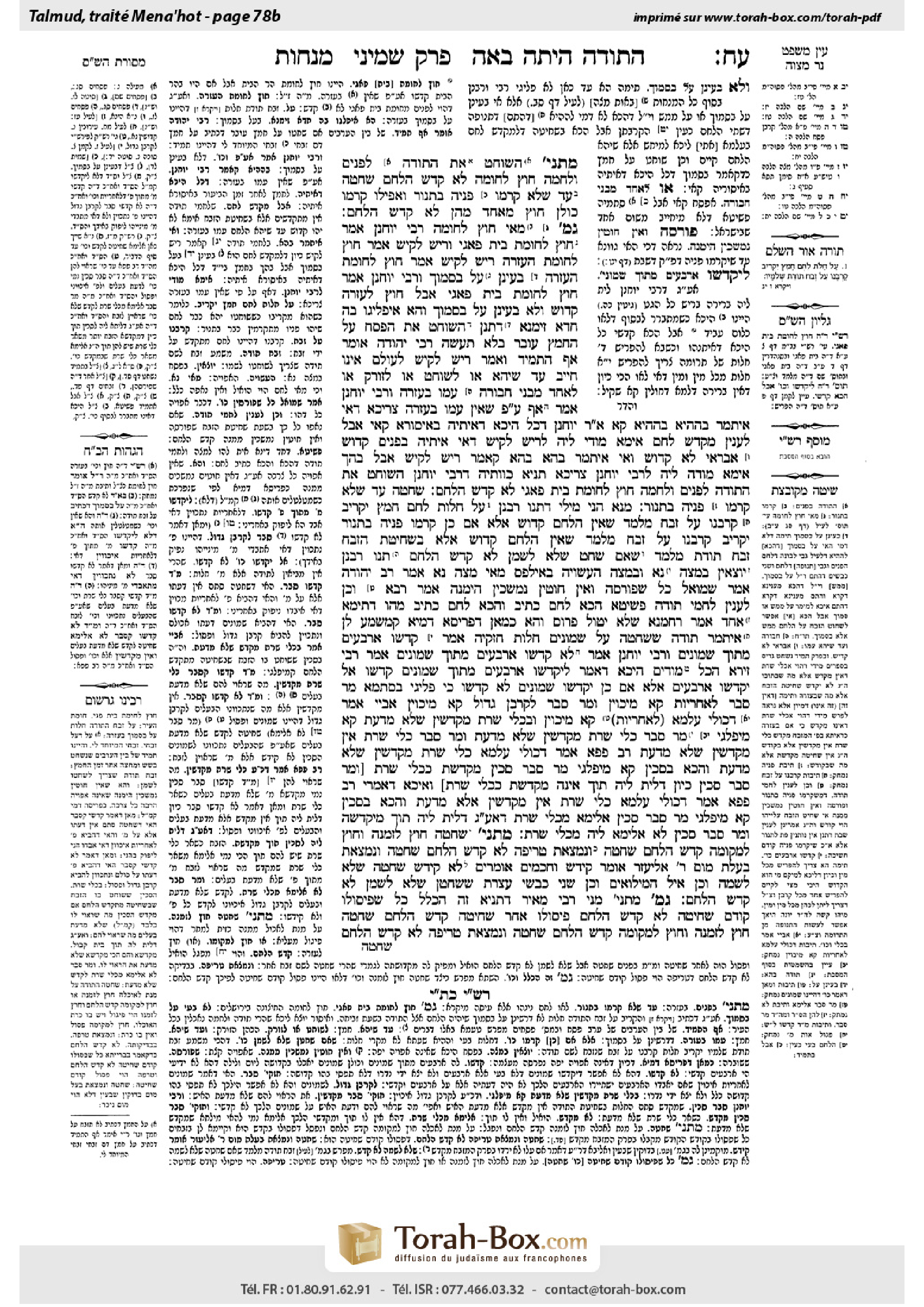
Menachot 78b: Talmud study for Daf Yomi
Daf Yomi is the daily study of one Talmud folio. Explore 37 tractates with scans, Hebrew text, Sefaria English and AI-generated French translations where annotated.
Passage selection and English or AI-generated French translation are available where the scan has annotations. Daf Study is independent of Torah-Box and Sefaria.
Browse Menachot · מנחות · All tractatesMenachot 78b text and translations
This page of Menachot includes the Aramaic text, an English translation and an AI-generated French translation, alongside the scan above.
מנחות ע״ח ב · Aramaic and Hebrew text
מַתְנִי׳ הַשּׁוֹחֵט אֶת הַתּוֹדָה לִפְנִים וְלַחְמָהּ חוּץ לַחוֹמָה – לֹא קָדַשׁ הַלֶּחֶם. שְׁחָטָהּ עַד שֶׁלֹּא קָרְמוּ פָּנֶיהָ בַּתַּנּוּר, וַאֲפִילּוּ קָרְמוּ כּוּלָּן חוּץ מֵאֶחָד מֵהֶן – לֹא קָדַשׁ הַלֶּחֶם.
גְּמָ׳ מַאי ״חוּץ לַחוֹמָה״? רַבִּי יוֹחָנָן אָמַר: חוּץ לְחוֹמַת בֵּית פָּאגֵי, וְרֵישׁ לָקִישׁ אָמַר: חוּץ לְחוֹמַת הָעֲזָרָה.
רֵישׁ לָקִישׁ אָמַר: חוּץ לְחוֹמַת הָעֲזָרָה, בָּעֵינַן ״עַל״ בְּסָמוּךְ.
וְרַבִּי יוֹחָנָן אָמַר: חוּץ לְחוֹמַת בֵּית פָּאגֵי, אֲבָל חוּץ לָעֲזָרָה – קָדוֹשׁ, וְלָא בָּעֵינַן ״עַל״ בְּסָמוּךְ.
וְהָא אִיפְּלִיגוּ בַּהּ חֲדָא זִימְנָא?
דִּתְנַן: הַשּׁוֹחֵט אֶת הַפֶּסַח עַל הֶחָמֵץ – עוֹבֵר בְּלֹא תַעֲשֶׂה. רַבִּי יְהוּדָה אוֹמֵר: אַף הַתָּמִיד. וְאָמַר רֵישׁ לָקִישׁ: לְעוֹלָם אֵינוֹ חַיָּיב עַד שֶׁיְּהֵא אוֹ לַשּׁוֹחֵט, אוֹ לַזּוֹרֵק, אוֹ לְאֶחָד מִבְּנֵי חֲבוּרָה – עִמּוֹ בָּעֲזָרָה. וְרַבִּי יוֹחָנָן אָמַר: אַף עַל פִּי שֶׁאֵין עִמּוֹ בַּעֲזָרָה.
צְרִיכָא, דְּאִי אִיתְּמַר בְּהַהִיא – בְּהַהִיא קָא אָמַר רַבִּי יוֹחָנָן, דְּכֹל הֵיכָא דְּאִיתֵיהּ בְּאִיסּוּרָא קָאֵי, אֲבָל לְעִנְיַן מִקְדַּשׁ לֶחֶם – אֵימָא מוֹדֵי לֵיהּ לְרֵישׁ לָקִישׁ דְּאִי אִיתֵיהּ בִּפְנִים – קָדוֹשׁ, אַבָּרַאי – לֹא קָדוֹשׁ.
וְאִי אִיתְּמַר בְּהָא, בְּהָא קָאָמַר רֵישׁ לָקִישׁ, אֲבָל בְּהָךְ אֵימָא מוֹדֶה לֵיהּ לְרַבִּי יוֹחָנָן, צְרִיכָא.
תַּנְיָא כְּוָותֵיהּ דְּרַבִּי יוֹחָנָן: הַשּׁוֹחֵט אֶת הַתּוֹדָה לִפְנִים, וְלַחְמָהּ חוּץ לְחוֹמַת בֵּית פָּאגֵי – לֹא קָדַשׁ הַלֶּחֶם.
שְׁחָטָהּ עַד שֶׁלֹּא קָרְמוּ פָּנֶיהָ בַּתַּנּוּר.
מְנָא הָנֵי מִילֵּי? דְּתָנוּ רַבָּנַן: ״עַל חַלּוֹת לֶחֶם חָמֵץ יַקְרִיב קׇרְבָּנוֹ עַל זֶבַח״ – מְלַמֵּד שֶׁאֵין הַלֶּחֶם קָדוֹשׁ אֶלָּא אִם כֵּן קָרְמוּ פָּנֶיהָ בַּתַּנּוּר. ״יַקְרִיב קׇרְבָּנוֹ עַל זֶבַח״ – מְלַמֵּד שֶׁאֵין הַלֶּחֶם קָדוֹשׁ אֶלָּא בִּשְׁחִיטַת הַזֶּבַח. ״זֶבַח תּוֹדַת״ – מְלַמֵּד שֶׁאִם שָׁחַט שֶׁלֹּא לִשְׁמָן לֹא קָדַשׁ הַלֶּחֶם.
תָּנוּ רַבָּנַן: יוֹצְאִין בְּמַצָּה נָא, וּבְמַצָּה הָעֲשׂוּיָה בְּאִילְפָּס. מַאי מַצָּה נָא? אָמַר רַב יְהוּדָה אָמַר שְׁמוּאֵל: כֹּל שֶׁפּוֹרְסָהּ וְאֵין חוּטִין נִמְשָׁכִין הֵימֶנָּה.
אָמַר רָבָא: וְכֵן לְעִנְיַן לַחְמֵי תוֹדָה, פְּשִׁיטָא! הָכָא ״לֶחֶם״ כְּתִיב, וְהָכָא ״לֶחֶם״ כְּתִיב.
מַהוּ דְּתֵימָא: ״אֶחָד״ אֲמַר רַחֲמָנָא – שֶׁלֹּא יִטּוֹל פָּרוּס, וְהָא כְּמַאן דִּפְרִיסָא דָּמְיָא, קָמַשְׁמַע לַן.
אִיתְּמַר, תּוֹדָה שֶׁשְּׁחָטָהּ עַל שְׁמוֹנִים חַלּוֹת: חִזְקִיָּה אָמַר: קָדְשׁוּ אַרְבָּעִים מִתּוֹךְ שְׁמוֹנִים, וְרַבִּי יוֹחָנָן אָמַר: לֹא קָדְשׁוּ אַרְבָּעִים מִתּוֹךְ שְׁמוֹנִים.
אָמַר רַבִּי זֵירָא: הַכֹּל מוֹדִים, הֵיכָא דְּאָמַר ״לִיקְדְּשׁוּ אַרְבָּעִים מִתּוֹךְ שְׁמוֹנִים״ – קָדְשׁוּ, ״אַל יִקְדְּשׁוּ אַרְבָּעִים אֶלָּא אִם כֵּן יִקְדְּשׁוּ שְׁמוֹנִים״ – לֹא קָדְשׁוּ. כִּי פְּלִיגִי בִּסְתָמָא, מָר סָבַר: לְאַחְרָיוּת קָא מִיכַּוֵּין, וּמָר סָבַר: לְקׇרְבָּן גָּדוֹל קָא מִיכַּוֵּין.
אַבָּיֵי אָמַר: דְּכוּלֵּי עָלְמָא לְאַחְרָיוּת קָא מִיכַּוֵּין, וּבִכְלֵי שָׁרֵת מְקַדְּשִׁין שֶׁלֹּא מִדַּעַת קָא מִיפַּלְגִי. מָר סָבַר: כְּלֵי שָׁרֵת מְקַדְּשִׁין שֶׁלֹּא מִדַּעַת, וּמָר סָבַר: כְּלֵי שָׁרֵת אֵין מְקַדְּשִׁין שֶׁלֹּא מִדַּעַת.
רַב פָּפָּא אָמַר: דְּכוּלֵּי עָלְמָא כְּלֵי שָׁרֵת מְקַדְּשִׁין שֶׁלֹּא מִדַּעַת, וְהָכָא בְּסַכִּין קָא מִיפַּלְגִי – מָר סָבַר: סַכִּין מְקַדֶּשֶׁת כִּכְלִי שָׁרֵת, וּמָר סָבַר: סַכִּין, כֵּיוָן דְּלֵית לֵיהּ תּוֹךְ, אֵינָהּ מְקַדֶּשֶׁת כִּכְלִי שָׁרֵת.
וְאִיכָּא דְּאָמְרִי, רַב פָּפָּא אָמַר: דְּכוּלֵּי עָלְמָא כְּלֵי שָׁרֵת אֵין מְקַדְּשִׁין אֶלָּא מִדַּעַת, וְהָכָא בְּסַכִּין קָא מִיפַּלְגִי. מָר סָבַר: סַכִּין אַלִּימָא מִכְּלִי שָׁרֵת, דְּאַף עַל גַּב דְּלֵית לַיהּ תּוֹךְ – מְיקַדְּשָׁה, וּמָר סָבַר: סַכִּין לָא אַלִּימָא (לַיהּ) מִכְּלִי שָׁרֵת.
מַתְנִי׳ שְׁחָטָהּ חוּץ לִזְמַנָּהּ וְחוּץ לִמְקוֹמָהּ – קָדַשׁ הַלֶּחֶם, שְׁחָטָהּ וְנִמְצֵאת טְרֵיפָה – לֹא קָדַשׁ הַלֶּחֶם.
שְׁחָטָהּ וְנִמְצֵאת בַּעֲלַת מוּם, רַבִּי אֱלִיעֶזֶר אוֹמֵר: קָדַשׁ, וַחֲכָמִים אוֹמְרִים: לֹא קָדַשׁ.
שְׁחָטָהּ שֶׁלֹּא לִשְׁמָהּ, וְכֵן אֵיל הַמִּילּוּאִים, וְכֵן שְׁנֵי כִּבְשֵׂי עֲצֶרֶת שֶׁשְּׁחָטָן שֶׁלֹּא לִשְׁמָן – לֹא קָדַשׁ הַלֶּחֶם.
גְּמָ׳ – מַתְנִיתִין מַנִּי? רַבִּי מֵאִיר.
דְּתַנְיָא, זֶה הַכְּלָל: כֹּל שֶׁפִּיסּוּלוֹ קוֹדֶם שְׁחִיטָה – לֹא קָדַשׁ הַלֶּחֶם; פִּיסּוּלוֹ אַחַר שְׁחִיטָה – קָדַשׁ הַלֶּחֶם. שְׁחָטָהּ חוּץ לִזְמַנָּהּ וְחוּץ לִמְקוֹמָהּ – קָדַשׁ הַלֶּחֶם; שְׁחָטָהּ וְנִמְצֵאת טְרֵיפָה – לֹא קָדַשׁ הַלֶּחֶם.
Menachot 78b · English translation
MISHNA: In the case of one who slaughters the thanks offering in its proper place inside the Temple courtyard, and at that time its forty loaves were outside the wall, the loaves were not consecrated. Likewise, if he slaughtered the thanks offering before the surface of the loaves formed a crust in the oven, and even if the surface of all the loaves formed a crust except for one of them, the loaves were not consecrated.
GEMARA: The Gemara clarifies: What is meant by outside the wall? Rabbi Yoḥanan says that it means outside the wall of Beit Pagei in Jerusalem. And Reish Lakish says that it means outside the wall of the Temple courtyard.
The Gemara elaborates: Reish Lakish says that it means outside the wall of the Temple courtyard, because the verse states with regard to the loaves of the thanks offering: “Then he shall sacrifice with [al] the thanks offering unleavened cakes mingled with oil” (Leviticus 7:12). And we require that the thanks offering be slaughtered strictly “with [al]” the accompanying loaves, i.e., with the loaves nearby. If the loaves are outside the wall of the Temple courtyard, they are not considered nearby.
And Rabbi Yoḥanan says: If the loaves were outside the wall of Beit Pagei, they are not consecrated, because it is prohibited to eat the loaves outside the wall of Beit Pagei. Since if they were taken outside the wall of Beit Pagei, they would be disqualified because they were removed from their permitted area, they cannot be consecrated if they are there. But if they were merely outside the Temple courtyard, where they may be eaten, they are consecrated. And we do not require that the thanks offering be slaughtered strictly “with” the accompanying loaves, i.e., nearby.
The Gemara objects: Why is it necessary for Rabbi Yoḥanan and Reish Lakish to disagree with regard to a case where the loaves were situated outside the wall when the thanks offering was slaughtered? But didn’t they already disagree with regard to this matter one other time?
This is as we learned in a mishna (Pesaḥim 63a) with regard to the slaughtering of the Paschal offering: One who slaughters the Paschal offering with leavened bread still in his possession transgresses a prohibition, as the verse states: “You shall not sacrifice the blood of My offering with [al] leavened bread; neither shall the offering of the festival of Passover be left until the morning” (Exodus 34:25). Rabbi Yehuda says: Even one who slaughters the daily afternoon offering on Passover eve with leavened bread in his possession transgresses the prohibition. And Reish Lakish says: Actually, one is not liable unless the leavened bread is in the possession of the one who slaughters the offering, or the one who sprinkles its blood, or one of the members of the group, and the leavened bread is with that person in the Temple courtyard. And Rabbi Yoḥanan says: One is liable even if the leavened bread is not with that person in the Temple courtyard. Evidently, they already disagree with regard to the meaning of the word “al.”
The Gemara replies: It is necessary to state the dispute concerning both matters. As, if their disagreement were stated only with regard to that matter of the Paschal offering, one might think that only with regard to that matter Rabbi Yoḥanan said that one is liable even if the leavened bread is not inside the Temple courtyard, since wherever there is leavened bread, its owner stands in violation of the prohibition against owning leavened bread at that time. But with regard to the matter of the consecration of the loaves of the thanks offering, one could say that he concedes to Reish Lakish that if the loaves are inside the Temple courtyard when the thanks offering is slaughtered, they are consecrated, but if they are outside, they are not consecrated.
And if their disagreement were stated only with regard to this matter of the loaves of the thanks offering, one might think that only with regard to this matter Reish Lakish says that the loaves are consecrated only if they were within the walls of the Temple courtyard. But with regard to that matter of the Paschal offering, one could say that he concedes to Rabbi Yoḥanan that one is liable for slaughtering the Paschal offering while in possession of leavened bread even if it was not with him inside the Temple courtyard, as wherever there is leavened bread, its owner stands in violation of the prohibition against owning leavened bread at that time. Therefore, it is necessary to state the dispute concerning both matters.
The Gemara notes: It is taught in a baraita in accordance with the opinion of Rabbi Yoḥanan: In the case of one who slaughters the thanks offering inside the Temple courtyard, and at that time its loaves were outside the walls of Beit Pagei, the loaves were not consecrated.
§ The mishna teaches: If he slaughtered the thanks offering before the surface of the loaves formed a crust in the oven, the loaves were not consecrated. The next mishna also teaches: If one slaughtered the thanks offering not for its sake, the loaves were not consecrated.
The Gemara seeks to clarify: From where are these matters derived? As the Sages taught: The verse states with regard to the loaves accompanying the thanks offering: “With cakes of leavened bread he shall present his offering with the sacrifice of his peace offerings for thanks” (Leviticus 7:13). This teaches that the loaves are not consecrated unless the surface of the loaves formed a crust in the oven, as only then can they be considered “cakes of leavened bread.” The phrase “he shall present his offering with the sacrifice” teaches that the loaves are consecrated only upon the slaughtering of the offering. The phrase “the sacrifice of his peace offerings for thanks” teaches that if one slaughtered the offering not for its sake, the loaves were not consecrated.
§ On a similar note, the Sages taught: One fulfills the obligation to eat matza on Passover with half-done, i.e., not fully baked, matza, and with matza made in a stewpot [ilpas] rather than baked in an oven. The Gemara asks: What constitutes half-done matza? Rav Yehuda says that Shmuel says: It is any matza that is sufficiently baked such that if one breaks it, threads of dough are not drawn from it.
Rava said: And so this is the halakha with regard to the matter of the loaves of the thanks offering, i.e., if the loaves were already half-done at the time of the slaughter of the thanks offering, they are consecrated. The Gemara asks: Why is it necessary for Rava to state this? Isn’t it obvious? Here, with regard to matza, the term “bread” is written (Deuteronomy 16:3), and here, with regard to the loaves of the thanks offering, the term “bread” is written.
The Gemara responds: Lest you say that since the Merciful One states with regard to the loaves of the thanks offering: “And of it he shall present one out of each offering for a gift unto the Lord” (Leviticus 7:14), this indicates that one may not take sliced bread for the thanks offering, and this half-done bread is considered like one that is sliced, as it will break apart upon being lifted, and it should consequently be disqualified for the bread of the thanks offering, therefore Rava teaches us that once it is baked to that point, it is considered as one loaf and it is valid for the thanks offering.
§ It was stated that there is a dispute among the amora’im with regard to a thanks offering that one slaughtered accompanied by eighty loaves rather than the required forty. Ḥizkiyya says: Forty of the eighty loaves are consecrated, and Rabbi Yoḥanan says: Not even forty of the eighty loaves are consecrated.
With regard to this dispute, Rabbi Zeira says: Everyone, even Rabbi Yoḥanan, concedes that in a case where the individual bringing the offering said: Let forty of the eighty loaves be consecrated, that forty are consecrated. Likewise, everyone concedes that where he said: Forty should not be consecrated unless eighty will be consecrated, that they were not consecrated. They disagree when one brings eighty loaves without specification. One Sage, Ḥizkiyya, holds: He intends to consecrate only forty of them, but he brought eighty in order to guarantee that there will be sufficient loaves. And one Sage, Rabbi Yoḥanan, holds: He intends to bring a large offering of eighty loaves; consequently, none of the loaves are consecrated.
Abaye offered another explanation of the dispute and said: Everyone agrees that he intends to guarantee that there will be sufficient loaves, and they disagree with regard to whether service vessels consecrate the appropriate measure without the intention of the one bringing the offering. One Sage, Ḥizkiyya, holds that service vessels consecrate items without intention. Accordingly, the knife that slaughters the thanks offering and consecrates its accompanying loaves consecrates forty of the eighty. And one Sage, Rabbi Yoḥanan, holds that service vessels do not consecrate items without intention.
Rav Pappa offered another explanation of the dispute and said: Everyone agrees that service vessels consecrate items without intention, and here they disagree with regard to whether this is also the halakha with regard to the slaughtering knife. One Sage, Ḥizkiyya, holds that the knife consecrates items as a service vessel does. And one Sage, Rabbi Yoḥanan, holds that since the knife has no inside, it does not consecrate items as a service vessel does.
And there are those who say that Rav Pappa said: Everyone agrees that service vessels consecrate items only with intention, and here they disagree with regard to the ability of the slaughtering knife to consecrate without intention. One Sage, Ḥizkiyya, holds that the power of the knife to consecrate items is stronger than that of other service vessels, as even though it has no inside it consecrates items, and therefore it also consecrates items without intention. And one Sage, Rabbi Yoḥanan, holds that the power of the knife to consecrate items is not stronger than that of other service vessels, and like all service vessels, it does not consecrate items without intention.
MISHNA: If one slaughtered the thanks offering with the intent to partake of it or to burn the sacrificial portions beyond its designated time or outside its designated area, and the offering was rendered piggul or was disqualified, respectively, the loaves were consecrated and either rendered piggul or disqualified. If one slaughtered the thanks offering and it was discovered that it was an animal with a wound that would have caused it to die within twelve months [tereifa], the loaves were not consecrated, as the cause of the animal’s disqualification preceded its slaughter.
If one slaughtered the thanks offering and it was discovered that it is a blemished animal that may not be sacrificed ab initio but if it ascended the altar it may be sacrificed, Rabbi Eliezer says: He has consecrated the loaves, since if the offering ascends the altar it is sacrificed. And the Rabbis say: He has not consecrated the loaves, since it may not be sacrificed ab initio.
If one slaughtered the thanks offering not for its sake but for the sake of another offering, and likewise, if one slaughtered the ram of inauguration not for its sake, and likewise, if one slaughtered the communal peace offering of two sheep that accompany the two loaves on Shavuot not for their sake, the loaves were not consecrated.
GEMARA: The mishna teaches that if one slaughtered the thanks offering with the intent to partake of it beyond its designated time or outside its designated area, the loaves become consecrated. The mishna also teaches that if the thanks offering was slaughtered and it was discovered that it was a tereifa, the loaves were not consecrated, but if it was discovered to have a blemish, Rabbi Eliezer says that the loaves were consecrated, and the Rabbis say that they were not. The Gemara asks: Whose opinion is expressed in the mishna? It is the opinion of Rabbi Meir.
As it is taught in a baraita: This is the principle: Any instance in which the disqualification of the thanks offering preceded its slaughter, the loaves were not consecrated, and any instance in which its disqualification came into existence after its slaughter, the loaves were consecrated. Therefore, if one slaughtered the thanks offering with the intent to partake of it or to burn the sacrificial portions beyond its designated time or outside its designated area, the loaves were consecrated, as the offering remained fit until after its slaughter. But if one slaughtered the thanks offering and it was discovered that it was a tereifa, the loaves were not consecrated, as the cause of the animal’s disqualification preceded its slaughter.
Menachot 78b · Traduction française (IA)
MICHNA : Dans le cas de celui qui égorge le sacrifice de reconnaissance à l’endroit qui lui convient, dans la cour du Temple, alors que ses quarante pains se trouvent à l’extérieur du mur, les pains ne sont pas consacrés. De même, s’il égorge le sacrifice de reconnaissance avant que la surface des pains ait formé une croûte dans le four — et même si tous les pains ont formé une croûte, à l’exception d’un seul —, les pains ne sont pas consacrés.
GUEMARA : La Guemara précise : Que signifie « à l’extérieur du mur » ? Rabbi Yoḥanan dit que cela désigne l’extérieur du mur de Beit Pagei, à Jérusalem. Reish Lakish dit que cela désigne l’extérieur du mur de la cour du Temple.
La Guemara développe : Reish Lakish dit que cela désigne l’extérieur du mur de la cour du Temple, car le verset dit au sujet des pains accompagnant le sacrifice de reconnaissance : « Il offrira avec [al] le sacrifice de reconnaissance des gâteaux sans levain pétris à l’huile » (Lévitique 7:12). Or, nous exigeons que le sacrifice de reconnaissance soit égorgé précisément « avec [al] » les pains qui l’accompagnent, c’est-à-dire que les pains soient à proximité. S’ils se trouvent à l’extérieur du mur de la cour du Temple, ils ne sont pas considérés comme étant à proximité.
Et Rabbi Yoḥanan dit : Si les pains se trouvaient à l’extérieur du mur de Beit Pagei, ils ne sont pas consacrés, car il est interdit de les manger à l’extérieur de ce mur. Puisqu’ils seraient disqualifiés s’ils étaient emportés au-delà de ce mur, car ils auraient été retirés de leur aire autorisée, ils ne peuvent pas être consacrés s’ils s’y trouvent. Mais s’ils se trouvaient simplement à l’extérieur de la cour du Temple, où il est permis de les manger, ils sont consacrés. Nous n’exigeons pas que le sacrifice de reconnaissance soit égorgé précisément « avec » les pains qui l’accompagnent, c’est-à-dire à proximité.
La Guemara objecte : Pourquoi Rabbi Yoḥanan et Reish Lakish doivent-ils être en désaccord au sujet d’un cas où les pains se trouvaient à l’extérieur du mur au moment de l’égorgement du sacrifice de reconnaissance ? Ne sont-ils pas déjà en désaccord sur cette question dans un autre cas ?
C’est ce que nous avons appris dans une Michna (Pessaḥim 63a) au sujet de l’égorgement du sacrifice pascal : celui qui égorge le sacrifice pascal alors qu’il a encore du pain levé en sa possession transgresse une interdiction, comme le dit le verset : « Tu n’offriras pas le sang de mon sacrifice avec [al] du pain levé ; et que le sacrifice de la fête de Pessa’h ne soit pas laissé jusqu’au matin » (Exode 34:25). Rabbi Yehouda dit : même celui qui égorge le sacrifice quotidien de l’après-midi, la veille de Pessa’h, alors qu’il a du pain levé en sa possession, transgresse l’interdiction. Reish Lakish dit : en réalité, on n’est passible que si le pain levé est en possession de celui qui égorge le sacrifice, de celui qui en asperge le sang ou de l’un des membres du groupe, et qu’il se trouve avec cette personne dans la cour du Temple. Rabbi Yoḥanan dit : on est passible même si le pain levé ne se trouve pas avec cette personne dans la cour du Temple. Il est donc évident qu’ils sont déjà en désaccord sur le sens du mot « al ».
La Guemara répond : Il faut exposer leur désaccord sur les deux questions. En effet, si leur désaccord n’était exposé qu’au sujet du sacrifice pascal, on pourrait penser que Rabbi Yoḥanan dit seulement à ce propos qu’on est passible même si le pain levé ne se trouve pas dans la cour du Temple, car, partout où se trouve du pain levé, son propriétaire enfreint alors l’interdiction d’en posséder. Mais au sujet de la consécration des pains du sacrifice de reconnaissance, on pourrait dire qu’il concède à Reish Lakish que si les pains se trouvent dans la cour du Temple au moment où le sacrifice de reconnaissance est égorgé, ils sont consacrés, mais que s’ils se trouvent à l’extérieur, ils ne le sont pas.
Et si leur désaccord n’était exposé qu’au sujet des pains du sacrifice de reconnaissance, on pourrait penser que Reish Lakish dit seulement à ce propos que les pains ne sont consacrés que s’ils se trouvent à l’intérieur des murs de la cour du Temple. Mais au sujet du sacrifice pascal, on pourrait dire qu’il concède à Rabbi Yoḥanan qu’on est passible d’avoir égorgé le sacrifice pascal tout en possédant du pain levé, même si celui-ci ne se trouvait pas avec soi dans la cour du Temple, car, partout où se trouve du pain levé, son propriétaire enfreint alors l’interdiction d’en posséder. Il faut donc exposer leur désaccord sur les deux questions.
La Guemara note : une baraïta est enseignée conformément à l’opinion de Rabbi Yoḥanan : dans le cas de celui qui égorge le sacrifice de reconnaissance dans la cour du Temple alors que ses pains se trouvent à l’extérieur des murs de Beit Pagei, les pains ne sont pas consacrés.
§ La Michna enseigne : s’il a égorgé le sacrifice de reconnaissance avant que la surface des pains ait formé une croûte dans le four, les pains ne sont pas consacrés. La Michna suivante enseigne également : si quelqu’un a égorgé le sacrifice de reconnaissance sans l’intention requise, les pains ne sont pas consacrés.
La Guemara cherche à préciser : De quoi ces règles sont-elles déduites ? Les Sages ont enseigné : le verset dit au sujet des pains accompagnant le sacrifice de reconnaissance : « Avec des gâteaux de pain levé, il présentera son offrande avec le sacrifice de ses offrandes de paix pour la reconnaissance » (Lévitique 7:13). Cela enseigne que les pains ne sont consacrés que lorsque leur surface a formé une croûte dans le four, car c’est seulement alors qu’ils peuvent être considérés comme des « gâteaux de pain levé ». L’expression « il présentera son offrande avec le sacrifice » enseigne que les pains ne sont consacrés qu’au moment de l’égorgement du sacrifice. L’expression « le sacrifice de ses offrandes de paix pour la reconnaissance » enseigne que si quelqu’un a égorgé le sacrifice sans l’intention requise, les pains ne sont pas consacrés.
§ Dans le même ordre d’idées, les Sages ont enseigné : on s’acquitte de l’obligation de manger de la matsa à Pessa’h avec de la matsa à moitié cuite, c’est-à-dire pas complètement cuite, ainsi qu’avec de la matsa préparée dans une marmite [ilpas] plutôt que cuite au four. La Guemara demande : Qu’est-ce qu’une matsa à moitié cuite ? Rav Yehouda dit au nom de Shmuel : c’est toute matsa suffisamment cuite pour que, lorsqu’on la rompt, aucun fil de pâte ne s’en détache.
Rava dit : il en va de même pour les pains du sacrifice de reconnaissance : si les pains étaient déjà à moitié cuits au moment de l’égorgement du sacrifice de reconnaissance, ils sont consacrés. La Guemara demande : Pourquoi Rava doit-il le préciser ? N’est-ce pas évident ? Ici, au sujet de la matsa, le terme « pain » est écrit (Deutéronome 16:3), et là aussi, au sujet des pains du sacrifice de reconnaissance, le terme « pain » est écrit.
La Guemara répond : De peur que tu ne dises que, puisque le Miséricordieux dit au sujet des pains du sacrifice de reconnaissance : « Et de chaque offrande, il en présentera un comme prélèvement pour le Seigneur » (Lévitique 7:14), cela indique qu’on ne peut pas prendre de pain tranché pour le sacrifice de reconnaissance, et que ce pain à moitié cuit est considéré comme du pain tranché, puisqu’il se briserait lorsqu’on le soulèverait et serait donc disqualifié pour accompagner le sacrifice de reconnaissance, Rava nous enseigne qu’une fois cuit à ce point, il est considéré comme un pain entier et convient au sacrifice de reconnaissance.
§ Une controverse entre les amoraïm a été rapportée au sujet du sacrifice de reconnaissance qu’on égorge en l’accompagnant de quatre-vingts pains au lieu des quarante requis. Ḥizkiyya dit : quarante des quatre-vingts pains sont consacrés. Rabbi Yoḥanan dit : pas même quarante des quatre-vingts pains ne sont consacrés.
À propos de cette controverse, Rabbi Zeira dit : tous, même Rabbi Yoḥanan, reconnaissent que, dans le cas où celui qui apporte le sacrifice a dit : « Que quarante des quatre-vingts pains soient consacrés », ces quarante sont consacrés. De même, tous reconnaissent que s’il a dit : « Que quarante ne soient consacrés que si les quatre-vingts le sont », les pains ne sont pas consacrés. Leur désaccord porte sur le cas où quelqu’un apporte quatre-vingts pains sans préciser son intention. Un Sage, Ḥizkiyya, estime qu’il a l’intention d’en consacrer seulement quarante, mais qu’il en a apporté quatre-vingts pour garantir qu’il y en aura suffisamment. L’autre Sage, Rabbi Yoḥanan, estime qu’il a l’intention d’apporter une grande offrande de quatre-vingts pains ; par conséquent, aucun des pains n’est consacré.
Abaye propose une autre explication du désaccord et dit : tous reconnaissent qu’il a l’intention de garantir qu’il y aura suffisamment de pains, et leur désaccord porte sur la question de savoir si les ustensiles de service consacrent la quantité requise sans que celui qui apporte l’offrande en ait l’intention. Un Sage, Ḥizkiyya, estime que les ustensiles de service consacrent des objets sans intention. Par conséquent, le couteau qui sert à égorger le sacrifice de reconnaissance et à consacrer les pains qui l’accompagnent en consacre quarante sur les quatre-vingts. L’autre Sage, Rabbi Yoḥanan, estime que les ustensiles de service ne consacrent pas les objets sans intention.
Rav Pappa propose une autre explication du désaccord et dit : tous reconnaissent que les ustensiles de service consacrent les objets sans intention, et leur désaccord porte sur la question de savoir si cette halakha s’applique également au couteau d’égorgement. Un Sage, Ḥizkiyya, estime que le couteau consacre les objets comme le fait un ustensile de service. L’autre Sage, Rabbi Yoḥanan, estime que, puisque le couteau n’a pas de cavité intérieure, il ne consacre pas les objets comme le fait un ustensile de service.
Et certains disent que Rav Pappa a dit : tous reconnaissent que les ustensiles de service ne consacrent les objets qu’avec intention, et leur désaccord porte ici sur la capacité du couteau d’égorgement à consacrer sans intention. Un Sage, Ḥizkiyya, estime que le pouvoir du couteau de consacrer les objets est supérieur à celui des autres ustensiles de service : bien qu’il n’ait pas de cavité intérieure, il consacre les objets, et il les consacre donc également sans intention. L’autre Sage, Rabbi Yoḥanan, estime que le pouvoir du couteau de consacrer les objets n’est pas supérieur à celui des autres ustensiles de service et que, comme tous les ustensiles de service, il ne consacre pas les objets sans intention.
MICHNA : Si quelqu’un égorge le sacrifice de reconnaissance avec l’intention d’en manger ou d’en brûler les parties sacrificielles après le délai fixé ou hors de l’aire qui leur est assignée, l’offrande devient piggoul ou est disqualifiée, respectivement ; les pains sont consacrés et deviennent eux aussi piggoul ou sont disqualifiés. Si quelqu’un égorge le sacrifice de reconnaissance et découvre qu’il s’agit d’un animal atteint d’une blessure qui l’aurait fait mourir dans les douze mois [tereifa], les pains ne sont pas consacrés, car la cause de la disqualification de l’animal existait avant son égorgement.
Si quelqu’un égorge le sacrifice de reconnaissance et découvre qu’il s’agit d’un animal présentant un défaut qui interdit de le sacrifier a priori, mais qui peut être sacrifié s’il est monté sur l’autel, Rabbi Eliezer dit : il a consacré les pains, car si l’offrande monte sur l’autel, elle est sacrifiée. Les Sages disent : il n’a pas consacré les pains, car l’offrande ne peut pas être sacrifiée a priori.
Si quelqu’un égorge le sacrifice de reconnaissance sans l’intention requise, mais dans l’intention d’accomplir un autre sacrifice, et de même s’il égorge le bélier d’inauguration sans l’intention requise, et de même s’il égorge sans l’intention requise le sacrifice de paix collectif constitué de deux moutons qui accompagnent les deux pains de Chavouot, les pains ne sont pas consacrés.
GUEMARA : La Michna enseigne que si quelqu’un égorge le sacrifice de reconnaissance avec l’intention d’en manger après le délai fixé ou hors de l’aire qui lui est assignée, les pains deviennent consacrés. Elle enseigne aussi que si le sacrifice de reconnaissance a été égorgé et qu’on découvre qu’il s’agissait d’un tereifa, les pains ne sont pas consacrés ; mais si l’on découvre qu’il présentait un défaut, Rabbi Eliezer dit que les pains sont consacrés et les Sages disent qu’ils ne le sont pas. La Guemara demande : De qui la Michna exprime-t-elle l’opinion ? De Rabbi Meïr.
Car il est enseigné dans une baraïta : voici le principe : chaque fois que la disqualification du sacrifice de reconnaissance précède son égorgement, les pains ne sont pas consacrés ; et chaque fois que sa disqualification survient après son égorgement, les pains sont consacrés. Ainsi, si quelqu’un égorge le sacrifice de reconnaissance avec l’intention d’en manger ou d’en brûler les parties sacrificielles après le délai fixé ou hors de l’aire qui leur est assignée, les pains sont consacrés, car l’offrande est restée apte jusqu’après son égorgement. Mais si quelqu’un égorge le sacrifice de reconnaissance et découvre qu’il s’agit d’un tereifa, les pains ne sont pas consacrés, car la cause de la disqualification de l’animal existait avant son égorgement.
Traduction française générée par IA à partir de l’édition anglaise de Sefaria. Vérifie toujours un passage avec le texte source.
Text from Sefaria: William Davidson Edition - Vocalized Aramaic (unknown); William Davidson Edition - English (CC BY NC).