Menachot 78a: Talmud study for Daf Yomi
Daf Yomi is the daily study of one Talmud folio. Explore 37 tractates with scans, Hebrew text, Sefaria English and AI-generated French translations where annotated.
Passage selection and English or AI-generated French translation are available where the scan has annotations. Daf Study is independent of Torah-Box and Sefaria.
Browse Menachot · מנחות · All tractatesMenachot 78a text and translations
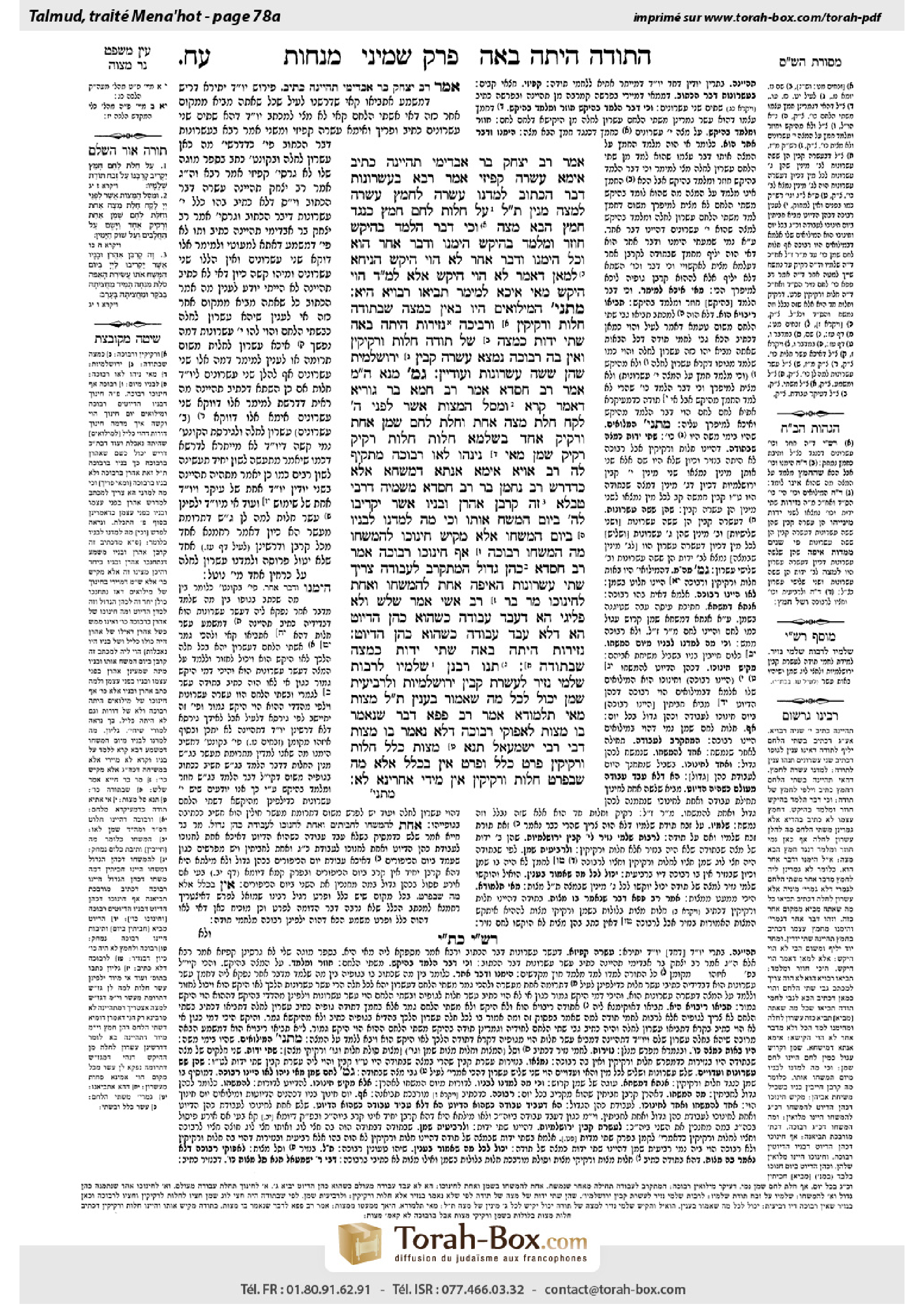
This page of Menachot includes the Aramaic text, an English translation and an AI-generated French translation, alongside the scan above.
מנחות ע״ח א · Aramaic and Hebrew text
אָמַר רַב יִצְחָק בַּר אַבְדִּימִי: ״תִּהְיֶינָה״ כְּתִיב. אֵימָא עֲשָׂרָה קְפִיזֵי? אָמַר רָבָא: בְּעֶשְׂרוֹנוֹת דִּבֵּר הַכָּתוּב.
לָמַדְנוּ עֲשָׂרָה לְחָמֵץ. עֲשָׂרָה לְמַצָּה מִנַּיִן? תַּלְמוּד לוֹמַר ״עַל חַלּוֹת לֶחֶם חָמֵץ״, כְּנֶגֶד חָמֵץ הָבֵא מַצָּה.
וְכִי דָּבָר הַלָּמֵד בְּהֶיקֵּשׁ, חוֹזֵר וּמְלַמֵּד בְּהֶיקֵּשׁ? הֵימֶנּוּ וְדָבָר אַחֵר הוּא, וְכֹל הֵימֶנּוּ וְדָבָר אַחֵר – לָא הָוֵי הֶיקֵּשׁ.
הָנִיחָא לְמַאן דְּאָמַר לָא הָוֵי הֶיקֵּשׁ, אֶלָּא לְמַאן דְּאָמַר הָוֵי הֶיקֵּשׁ, מַאי אִיכָּא לְמֵימַר? ״תָּבִיאוּ״ רִבּוּיָא הִיא.
מַתְנִי׳ הַמִּילּוּאִים הָיוּ בָּאִין כַּמַּצָּה שֶׁבַּתּוֹדָה – חַלּוֹת, וּרְקִיקִין, (וּרְבִיכָה) [וּרְבוּכָה].
נְזִירוּת הָיְתָה בָּאָה שְׁתֵּי יָדוֹת כְּמַצָּה שֶׁל תּוֹדָה, חַלּוֹת וּרְקִיקִין, וְאֵין בָּהּ רְבוּכָה, נִמְצָא עֲשָׂרָה קַבִּין יְרוּשַׁלְמִית, שֶׁהֵן שִׁשָּׁה עֶשְׂרוֹנוֹת וְעוֹדְיִין.
גְּמָ׳ מְנָא הָנֵי מִילֵּי? אָמַר רַב חִסְדָּא, אָמַר רַב חָמָא בַּר גּוּרְיָא: דְּאָמַר קְרָא ״וּמִסַּל הַמַּצּוֹת אֲשֶׁר לִפְנֵי ה׳ לָקַח חַלַּת מַצָּה אַחַת וְחַלַּת לֶחֶם שֶׁמֶן אַחַת וְרָקִיק אֶחָד״. בִּשְׁלָמָא ״חַלּוֹת״ – חַלּוֹת, ״רָקִיק״ – רָקִיק, ״שֶׁמֶן״ מַאי נִינְהוּ? לָאו רְבוּכָה.
מַתְקֵיף לַהּ רַב אַוְיָא: אֵימָא אַנְתָּא דְּמִשְׁחָא! אֶלָּא, כִּדְדָרֵשׁ רַב נַחְמָן בַּר רַב חִסְדָּא מִשְּׁמֵיהּ דְּרַבִּי טַבְלָא: ״זֶה קׇרְבַּן אַהֲרֹן וּבָנָיו אֲשֶׁר יַקְרִיבוּ לַה׳ בְּיוֹם הִמָּשַׁח אֹתוֹ״.
וְכִי מָה לָמַדְנוּ לְבָנָיו בְּיוֹם הִמָּשְׁחוֹ? אֶלָּא מַקִּישׁ חִינּוּכוֹ לְהִמָּשְׁחוֹ: מָה הִמָּשְׁחוֹ רְבוּכָה, אַף חִינּוּכוֹ רְבוּכָה.
אָמַר רַב חִסְדָּא: כֹּהֵן גָּדוֹל הַמִּתְקָרֵב לַעֲבוֹדָה צָרִיךְ שְׁתֵּי עֶשְׂרוֹנוֹת הָאֵיפָה, אַחַת לְהִמָּשְׁחוֹ, וְאַחַת לְחִינּוּכוֹ. מָר בַּר רַב אָשֵׁי אָמַר: שָׁלֹשׁ.
וְלָא פְּלִיגִי, הָא – דַּעֲבַד עֲבוֹדָה כְּשֶׁהוּא כֹּהֵן הֶדְיוֹט, הָא – דְּלָא עֲבַד עֲבוֹדָה כְּשֶׁהוּא כֹּהֵן הֶדְיוֹט.
נְזִירוּת הָיְתָה בָּאָה שְׁתֵּי יָדוֹת, כַּמַּצָּה שֶׁבַּתּוֹדָה.
תָּנוּ רַבָּנַן: ״שְׁלָמָיו״ – לְרַבּוֹת שַׁלְמֵי נָזִיר, לַעֲשֶׂרֶת קַבִּין יְרוּשַׁלְמִיּוֹת וְלִרְבִיעִית שֶׁמֶן.
יָכוֹל לְכׇל מָה שֶׁאָמוּר בָּעִנְיָן, תַּלְמוּד לוֹמַר ״מַצּוֹת״.
מַאי תַּלְמוּדָא? אָמַר רַב פָּפָּא: דָּבָר שֶׁנֶּאֱמַר בּוֹ ״מַצּוֹת״, לְאַפּוֹקֵי רְבוּכָה דְּלֹא נֶאֱמַר בּוֹ ״מַצּוֹת״. דְּבֵי רַבִּי יִשְׁמָעֵאל תָּנָא: ״מַצּוֹת״ – כָּלַל, ״חַלּוֹת וּרְקִיקִין״ – פָּרַט, כְּלָל וּפְרָט אֵין בַּכְּלָל אֶלָּא מָה שֶׁבַּפְּרָט, חַלּוֹת וּרְקִיקִין – אִין, מִידֵּי אַחֲרִינָא – לָא.
Menachot 78a · English translation
Rav Yitzḥak bar Avdimi said: “They shall be” [tihyena] is written with two instances of the letter yod. The superfluous yod, whose numerical value is ten, is interpreted to indicate that the loaves of leavened bread of the thanks offering must be prepared from ten tenths of flour. The Gemara raises an objection: Say that the superfluous yod indicates that the loaves must be prepared with ten half-kav, a smaller measure than ten tenths of an ephah? Rava says: One cannot say this, since the verse habitually spoke of tenths of an ephah and not other measures.
§ The Gemara continues its analysis of the baraita: We have learned that there are ten tenths of an ephah of flour for the loaves of leavened bread accompanying the thanks offering. From where is it derived that there are ten tenths of an ephah for the thirty loaves of matza? The verse states: “With cakes of leavened bread,” after mentioning the three types of matza accompanying the thanks offering (Leviticus 7:12–13), indicating that one must bring the matza in a measure corresponding to the measure of the loaves of leavened bread.
The Gemara asks: But can a matter that was derived by comparison then come back and teach the matter by comparison with regard to consecrated matters? Since the halakha that the loaves of leavened bread of the thanks offering are prepared from ten tenths of an ephah is itself derived by comparison to the two loaves, can one then derive from it that the matza loaves of the thanks offering consist of ten tenths of an ephah? The Gemara responds: The halakha that the loaves of leavened bread consist of ten loaves made from ten tenths of an ephah is not derived solely by comparison to the two loaves; rather, it is derived from itself, as the halakha that there are ten loaves is stated in the verse concerning the thanks offering, and from another matter, and any halakha derived from itself and from another matter is not considered a comparison. Consequently, the halakha with regard to the matza loaves may be derived from it.
The Gemara asks: This works out well according to the one who says that a halakha derived from itself and from another matter does not constitute a comparison, but according to the one who says that a halakha derived from itself and from another matter does constitute a comparison, what is there to say? The Gemara responds: According to that opinion, the halakha that each loaf is prepared from a tenth of an ephah is derived from that which the verse states with regard to the two loaves: “You shall bring” (Leviticus 23:17), which is a term of amplification that serves to teach that the loaves of leavened bread of the thanks offering consist of ten tenths of an ephah of flour. Since this halakha is derived not by comparison but by amplification from the two loaves, one can derive the halakha with regard to the matza loaves by comparison to the loaves of leavened bread.
MISHNA: The loaves that accompanied the ram of the inauguration of the Tabernacle would come parallel to the three types of matza that accompany the thanks offering: Loaves, wafers, and loaves poached in water and made with oil (see Leviticus 8:26). The loaves of leavened bread that accompany the thanks offering were not brought with the ram of inauguration.
The loaves that accompany the offering that the nazirite brings upon completion of his period of naziriteship would come with only two parts of the three types of matza that accompany the thanks offering, namely, loaves and wafers, but there is no matza poached in water (see Numbers 6:15). Consequently, the loaves of the offering of a nazirite are from ten kav of fine flour according to the Jerusalem measure, as taught in the previous mishna that each type of the loaves of matza comes from five kav of flour, which equal six-and-two-thirds tenths of an ephah according to the wilderness measure, as each type of the loaves of matza comes from three-and-one-third tenths of an ephah.
GEMARA: The mishna teaches that the loaves that accompanied the ram of the inauguration of the Tabernacle consisted of the three types of matza brought with a thanks offering: Loaves, wafers, and loaves poached in water and made with oil. The Gemara asks: From where are these matters derived? Rav Ḥisda said that Rav Ḥama bar Gurya said: It is derived from that which the verse states: “And out of the basket of unleavened bread that was before the Lord, he took one unleavened cake, and one cake of oiled bread, and one wafer” (Leviticus 8:26). Granted, “cakes” are cakes, and “wafer” is a wafer. But what is “oiled bread” referring to? Is this not referring to matza poached in water and made with oil?
Rav Avya objects to this: One can say that “oiled bread” is referring to a cake of oil. Rather, derive it as Rav Naḥman bar Rav Ḥisda taught in the name of Rabbi Tavla, that the verse states: “This is the offering of Aaron and of his sons, which they shall bring to the Lord on the day when he is anointed: The tenth part of an ephah of fine flour for a meal offering perpetually, half of it in the morning and half of it in the evening. On a pan it shall be made with oil; when it is poached, you shall bring it in; in broken pieces shall you bring the meal offering for a pleasing aroma to the Lord. And the anointed priest that shall be in his stead from among his sons shall bring it” (Leviticus 6:13–15).
One can ask: And what have we learned with regard to Aaron’s sons, i.e., the ordinary priests, from the instructions for the High Priest on the day that he is anointed? Rather, the verse juxtaposes the meal offering brought by an ordinary priest during his inauguration with the meal offering brought by the High Priest when he is anointed. This juxtaposition teaches that just as the meal offering brought by the High Priest when he is anointed is poached in water, so too the meal offering brought by an ordinary priest during his inauguration is poached in water. Similarly, the loaves brought with the ram of the inauguration of the Tabernacle included loaves poached in water.
§ Concerning the matter of the High Priest’s meal offering on the day of his inaugural service in the Temple, Rav Ḥisda says: A High Priest who approaches the Temple service on the day that he is anointed is required to bring two meal offerings consisting of two tenths of an ephah, one for the fact that he is anointed as the High Priest and must bring the daily meal offering of the High Priest, and one for his inauguration. Mar bar Rav Ashi says: He requires three tenths of an ephah.
And they do not disagree. This one, Rav Ḥisda, is referring to a High Priest who already performed the Temple service as an ordinary priest. Accordingly, he has already brought a meal offering for his inauguration as an ordinary priest. He therefore brings only two tenths of flour, one for his inauguration as High Priest and one for the daily meal offering of the High Priest. And that one, Mar bar Rav Ashi, is referring to a High Priest who has not yet performed the Temple service as an ordinary priest. He must therefore bring three tenths, one for his inauguration as an ordinary priest, one for his inauguration as High Priest, and one for the daily meal offering of the High Priest.
§ The mishna teaches: The loaves that accompany the offering that the nazirite brings upon completion of his period of naziriteship would come with only two parts, parallel to the types of matza that come with the thanks offering, i.e., loaves and wafers, but not matza poached in water.
The Sages taught in a baraita: The verse states with regard to the loaves brought with a thanks offering: “If he sacrifices it for a thanks offering, then he shall sacrifice with the thanks offering unleavened cakes mingled with oil, and unleavened wafers spread with oil, and cakes mingled with oil, of fine flour poached. With cakes of leavened bread he shall present his offering with the sacrifice of his peace offerings for thanks” (Leviticus 7:12–13). “His peace offerings” serves to include the nazirite’s peace offering in the halakhot that its accompanying meal offerings must consist of ten Jerusalem kav and one-quarter of a log of oil, just like the measurements required for the cakes and wafers of the thanks offering.
The baraita continues: One might have thought that the verse indicates that the meal offering of the nazirite’s peace offering is equivalent to the loaves of the thanks offering concerning all that is stated with regard to the matter of the thanks offering, and that one brings three types of matza consisting of fifteen Jerusalem kav and half a log of oil. Therefore, the verse states with regard to the nazirite’s peace offering: “And a basket of unleavened bread, loaves of fine flour mingled with oil, and unleavened wafers spread with oil” (Numbers 6:15), to indicate that the nazirite’s meal offering consists only of matza loaves and matza wafers, and not matza poached in water.
The Gemara clarifies: What is the biblical derivation by which “matza” indicates that loaves poached in water were not brought? Rav Pappa says: The verse indicates that the nazirite brings matza specifically from an item of which it was stated: “Matzot.” This serves to exclude loaves poached in water, of which it is not stated: Matzot. In addition, the school of Rabbi Yishmael taught: “Unleavened bread” is a generalization; “loaves of fine flour mingled with oil, and unleavened wafers spread with oil” is a detail. When the Torah states a generalization and a detail, the generalization includes only what is in the detail. Therefore, loaves and wafers are included in the nazirite’s meal offering, while other items are not.
Menachot 78a · Traduction française (IA)
Rav Yitzḥak bar Avdimi dit : « Elles seront » [tihyena] s’écrit avec deux yod. Le yod superflu, dont la valeur numérique est dix, est interprété comme indiquant que les pains levés de l’offrande de gratitude doivent être préparés avec dix dixièmes d’épha de farine. La Guemara objecte : peut-on dire que le yod superflu indique que les pains doivent être préparés avec dix demi-kav, une mesure inférieure à dix dixièmes d’épha ? Rava répond : cela est impossible, car le verset s’exprime habituellement en dixièmes d’épha et non en d’autres mesures.
§ La Guemara poursuit son analyse de la baraïta : nous avons appris qu’il faut dix dixièmes d’épha de farine pour les pains levés qui accompagnent l’offrande de gratitude. D’où apprend-on qu’il faut dix dixièmes d’épha pour les trente pains azymes ? Le verset dit : « Avec des pains levés », après avoir mentionné les trois sortes de pains azymes qui accompagnent l’offrande de gratitude (Lévitique 7:12–13), ce qui indique qu’il faut apporter les pains azymes dans une mesure correspondant à celle des pains levés.
La Guemara demande : mais une règle déduite par comparaison peut-elle ensuite servir à en déduire une autre par comparaison en matière de choses consacrées ? Puisque la halakha selon laquelle les pains levés de l’offrande de gratitude sont préparés avec dix dixièmes d’épha est elle-même déduite par comparaison avec les deux pains, peut-on en déduire que les pains azymes de l’offrande de gratitude représentent dix dixièmes d’épha ? La Guemara répond : la halakha selon laquelle les pains levés sont constitués de dix pains préparés avec dix dixièmes d’épha n’est pas déduite uniquement par comparaison avec les deux pains ; elle est déduite du verset lui-même, puisque la règle des dix pains figure dans le verset relatif à l’offrande de gratitude, et d’un autre sujet. Or, une halakha déduite d’elle-même et d’un autre sujet n’est pas considérée comme une comparaison. Par conséquent, on peut en déduire la halakha relative aux pains azymes.
La Guemara demande : cela convient selon celui qui dit qu’une halakha déduite d’elle-même et d’un autre sujet ne constitue pas une comparaison ; mais, selon celui qui dit qu’une halakha déduite d’elle-même et d’un autre sujet constitue une comparaison, que répondre ? La Guemara répond : selon cette opinion, la halakha selon laquelle chaque pain est préparé avec un dixième d’épha est déduite de ce que le verset dit au sujet des deux pains : « Vous apporterez » (Lévitique 23:17), expression qui sert à ajouter un élément et enseigne que les pains levés de l’offrande de gratitude sont constitués de dix dixièmes d’épha de farine. Puisque cette halakha est déduite non par comparaison, mais par amplification à partir des deux pains, on peut déduire par comparaison avec les pains levés la halakha relative aux pains azymes.
Michna : Les pains qui accompagnaient le bélier de l’inauguration du Tabernacle correspondaient aux trois sortes de pains azymes qui accompagnent l’offrande de gratitude : des pains, des galettes et des pains pochés à l’eau et préparés avec de l’huile (voir Lévitique 8:26). Les pains levés qui accompagnent l’offrande de gratitude n’étaient pas apportés avec le bélier de l’inauguration.
Les pains qui accompagnent l’offrande apportée par le nazir à la fin de sa période de naziréat ne comprenaient que deux des trois sortes de pains azymes qui accompagnent l’offrande de gratitude, à savoir des pains et des galettes, mais pas de pain azyme poché à l’eau (voir Nombres 6:15). Par conséquent, les pains de l’offrande du nazir nécessitent dix kav de farine fine selon la mesure de Jérusalem, comme l’enseigne la Michna précédente : chaque sorte de pain azyme nécessite cinq kav de farine, soit six et deux tiers dixièmes d’épha selon la mesure du désert, puisque chaque sorte de pain azyme nécessite trois et un tiers dixièmes d’épha.
Guemara : La Michna enseigne que les pains qui accompagnaient le bélier de l’inauguration du Tabernacle comprenaient les trois sortes de pains azymes apportées avec une offrande de gratitude : des pains, des galettes et des pains pochés à l’eau et préparés avec de l’huile. La Guemara demande : d’où tire-t-on ces règles ? Rav Ḥisda dit au nom de Rav Ḥama bar Gurya : elles sont déduites de ce que dit le verset : « Il prit dans la corbeille de pains azymes qui était devant l’Éternel un gâteau azyme, un gâteau de pain huilé et une galette » (Lévitique 8:26). Il est vrai que les « gâteaux » désignent des gâteaux et que la « galette » désigne une galette. Mais à quoi renvoie le « pain huilé » ? Ne désigne-t-il pas le pain azyme poché à l’eau et préparé avec de l’huile ?
Rav Avya objecte : on peut dire que le « pain huilé » désigne un gâteau à l’huile. Il faut plutôt déduire la règle de ce que Rav Naḥman bar Rav Ḥisda a enseigné au nom de Rabbi Tavla, car le verset dit : « Voici l’offrande d’Aaron et de ses fils, qu’ils présenteront à l’Éternel le jour où il sera oint : un dixième d’épha de farine fine pour une offrande de farine perpétuelle, une moitié le matin et l’autre moitié le soir. Elle sera préparée avec de l’huile sur une plaque ; lorsqu’elle sera pochée, tu l’apporteras ; tu présenteras l’offrande de farine en morceaux, en odeur agréable à l’Éternel. Le prêtre oint qui prendra sa place parmi ses fils l’apportera » (Lévitique 6:13–15).
On peut demander : qu’avons-nous appris au sujet des fils d’Aaron, c’est-à-dire des prêtres ordinaires, à partir des instructions concernant le Grand Prêtre le jour où il est oint ? Le verset juxtapose plutôt l’offrande de farine qu’un prêtre ordinaire apporte lors de son investiture à celle que le Grand Prêtre apporte lorsqu’il est oint. Cette juxtaposition enseigne que, de même que l’offrande de farine apportée par le Grand Prêtre lorsqu’il est oint est pochée à l’eau, de même l’offrande de farine apportée par un prêtre ordinaire lors de son investiture est pochée à l’eau. De même, les pains apportés avec le bélier de l’inauguration du Tabernacle comprenaient des pains pochés à l’eau.
§ À propos de l’offrande de farine du Grand Prêtre le jour de son entrée en fonction dans le Temple, Rav Ḥisda dit : un Grand Prêtre qui commence le service du Temple le jour où il est oint doit apporter deux offrandes de farine, chacune constituée de deux dixièmes d’épha : l’une parce qu’il est oint comme Grand Prêtre et doit apporter l’offrande de farine quotidienne du Grand Prêtre, et l’autre pour son investiture. Mar bar Rav Ashi dit : il lui faut trois dixièmes d’épha.
Ils ne sont pas en désaccord. Rav Ḥisda parle d’un Grand Prêtre qui a déjà effectué le service du Temple en tant que prêtre ordinaire. Il a donc déjà apporté une offrande de farine pour son investiture comme prêtre ordinaire. Il n’apporte par conséquent que deux dixièmes de farine : l’un pour son investiture comme Grand Prêtre, l’autre pour l’offrande de farine quotidienne du Grand Prêtre. Mar bar Rav Ashi, lui, parle d’un Grand Prêtre qui n’a pas encore effectué le service du Temple en tant que prêtre ordinaire. Il doit donc apporter trois dixièmes : l’un pour son investiture comme prêtre ordinaire, l’un pour son investiture comme Grand Prêtre et l’un pour l’offrande de farine quotidienne du Grand Prêtre.
§ La Michna enseigne : les pains qui accompagnent l’offrande qu’apporte le nazir à la fin de sa période de naziréat ne comprenaient que deux sortes correspondant à celles des pains azymes apportés avec l’offrande de gratitude, à savoir des pains et des galettes, mais pas de pain azyme poché à l’eau.
Les Sages ont enseigné dans une baraïta : au sujet des pains apportés avec une offrande de gratitude, le verset dit : « S’il l’offre en sacrifice de gratitude, il offrira avec le sacrifice de gratitude des gâteaux azymes pétris avec de l’huile, des galettes azymes enduites d’huile et des gâteaux pétris avec de l’huile, de farine fine, pochés. Avec des pains levés, il présentera son offrande avec le sacrifice de ses offrandes de paix pour gratitude » (Lévitique 7:12–13). L’expression « ses offrandes de paix » inclut l’offrande de paix du nazir dans les règles selon lesquelles les offrandes de farine qui l’accompagnent doivent totaliser dix kav selon la mesure de Jérusalem et un quart de log d’huile, comme les mesures requises pour les gâteaux et les galettes de l’offrande de gratitude.
La baraïta poursuit : on aurait pu penser que le verset indique que l’offrande de farine accompagnant l’offrande de paix du nazir est équivalente, à tous égards, à celle de l’offrande de gratitude, et qu’il faut apporter trois sortes de pains azymes totalisant quinze kav selon la mesure de Jérusalem et un demi-log d’huile. Le verset dit donc au sujet de l’offrande de paix du nazir : « Un panier de pains azymes, des pains de farine fine pétris avec de l’huile et des galettes azymes enduites d’huile » (Nombres 6:15), afin d’indiquer que l’offrande de farine du nazir ne comprend que des pains azymes et des galettes azymes, et non du pain azyme poché à l’eau.
La Guemara précise : quelle déduction biblique permet de comprendre que le terme « pain azyme » indique que les pains pochés à l’eau n’étaient pas apportés ? Rav Pappa dit : le verset indique que le nazir apporte du pain azyme provenant précisément d’un élément au sujet duquel il est écrit « pains azymes ». Cela exclut les pains pochés à l’eau, au sujet desquels il n’est pas écrit « pains azymes ». En outre, l’école de Rabbi Yishmael a enseigné : « Pain azyme » est une formulation générale ; « des pains de farine fine pétris avec de l’huile et des galettes azymes enduites d’huile » est une formulation particulière. Lorsque la Torah énonce une formulation générale puis une formulation particulière, la formulation générale ne comprend que ce qui figure dans la formulation particulière. Par conséquent, les pains et les galettes sont inclus dans l’offrande de farine du nazir, tandis que les autres éléments en sont exclus.
Traduction française générée par IA à partir de l’édition anglaise de Sefaria. Vérifie toujours un passage avec le texte source.
Text from Sefaria: William Davidson Edition - Vocalized Aramaic (unknown); William Davidson Edition - English (CC BY NC).