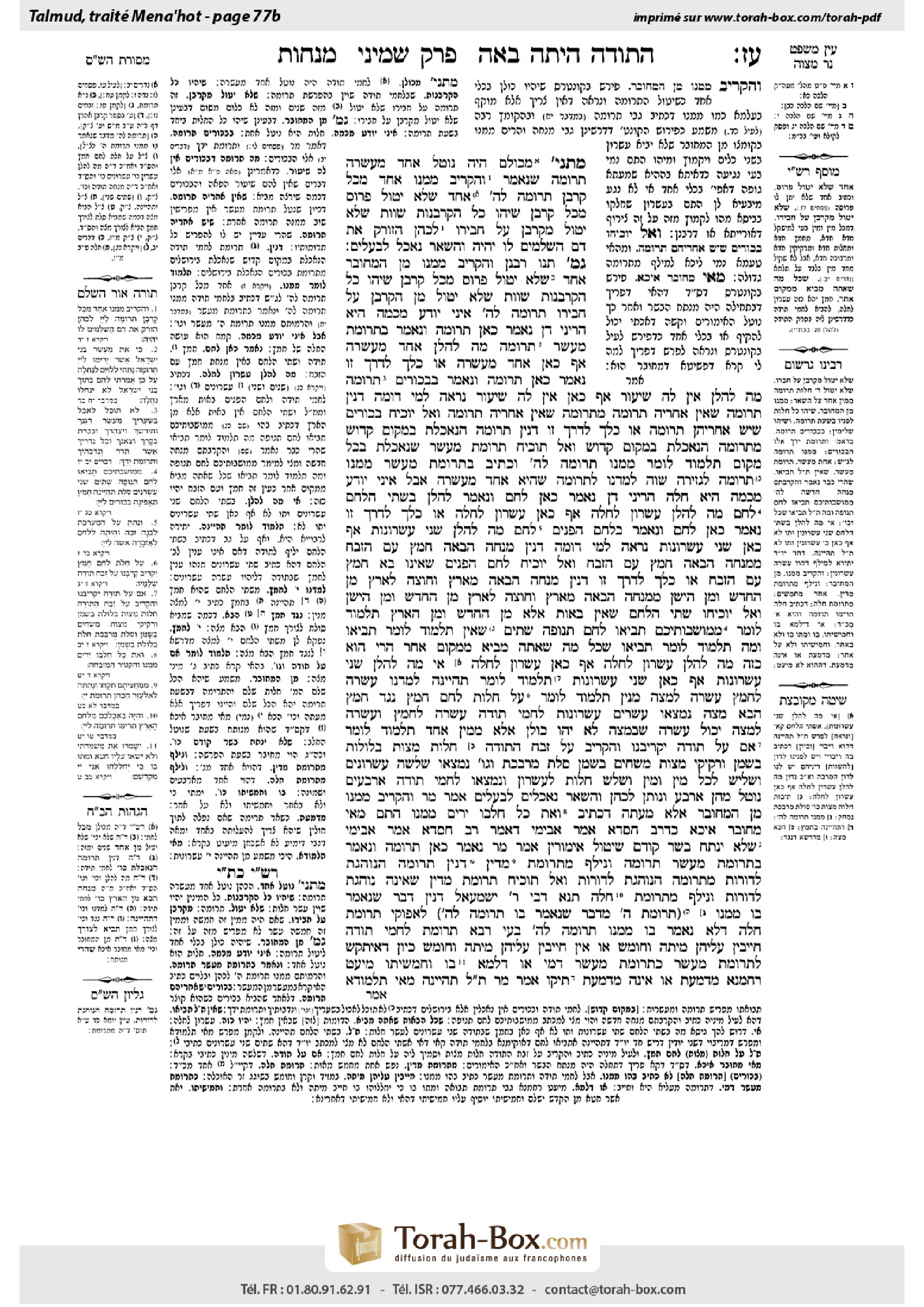
Menachot 77b: Talmud study for Daf Yomi
Daf Yomi is the daily study of one Talmud folio. Explore 37 tractates with scans, Hebrew text, Sefaria English and AI-generated French translations where annotated.
Passage selection and English or AI-generated French translation are available where the scan has annotations. Daf Study is independent of Torah-Box and Sefaria.
Browse Menachot · מנחות · All tractatesMenachot 77b text and translations
This page of Menachot includes the Aramaic text, an English translation and an AI-generated French translation, alongside the scan above.
מנחות ע״ז ב · Aramaic and Hebrew text
מַתְנִי׳ מִכּוּלָּם הָיָה נוֹטֵל אֶחָד מֵעֲשָׂרָה תְּרוּמָה, שֶׁנֶּאֱמַר: ״וְהִקְרִיב מִמֶּנּוּ אֶחָד מִכׇּל קׇרְבָּן תְּרוּמָה לַה׳״, ״אֶחָד״ – שֶׁלֹּא יִטּוֹל פָּרוּס, ״מִכׇּל קׇרְבָּן״ – שֶׁיְּהוּ כׇּל הַקָּרְבָּנוֹת שָׁוִין, שֶׁלֹּא יִטּוֹל מִקׇּרְבָּן עַל חֲבֵירוֹ. ״לַכֹּהֵן הַזֹּרֵק אֶת דַּם הַשְּׁלָמִים לוֹ יִהְיֶה״, וְהַשְּׁאָר נֶאֱכָל לַבְּעָלִים.
גְּמָ׳ תָּנוּ רַבָּנַן: ״וְהִקְרִיב מִמֶּנּוּ״ – מִן הַמְחוּבָּר, ״אֶחָד״ – שֶׁלֹּא יִטּוֹל פָּרוּס, ״מִכׇּל קׇרְבָּן״ – שֶׁיְּהוּ כׇּל הַקָּרְבָּנוֹת (שָׁווֹת) [שָׁוִוין], שֶׁלֹּא יִטּוֹל מִן הַקׇּרְבָּן עַל חֲבֵירוֹ, ״תְּרוּמָה לַה׳״ – אֵינִי יוֹדֵעַ מִכַּמָּה הִיא,
הֲרֵינִי דָּן: נֶאֱמַר כָּאן ״תְּרוּמָה״, וְנֶאֱמַר בִּתְרוּמַת מַעֲשֵׂר ״תְּרוּמָה״, מָה לְהַלָּן אֶחָד מֵעֲשָׂרָה, אַף כָּאן אֶחָד מֵעֲשָׂרָה.
אוֹ כְּלָךְ לְדֶרֶךְ זוֹ: נֶאֱמַר כָּאן ״תְּרוּמָה״, וְנֶאֱמַר בְּבִכּוּרִים ״תְּרוּמָה״, מָה לְהַלָּן אֵין לָהּ שִׁיעוּר, אַף כָּאן אֵין לָהּ שִׁיעוּר.
נִרְאֶה לְמִי דּוֹמֶה: דָּנִין תְּרוּמָה שֶׁאֵין אַחֲרֶיהָ תְּרוּמָה, מִתְּרוּמָה שֶׁאֵין אַחֲרֶיהָ תְּרוּמָה, וְאַל יוֹכִיחַ בִּכּוּרִים, שֶׁיֵּשׁ אַחֲרֵיהֶן תְּרוּמָה.
אוֹ כְּלָךְ לְדֶרֶךְ זוֹ: דָּנִין תְּרוּמָה הַנֶּאֱכֶלֶת בְּמָקוֹם קָדוֹשׁ, מִתְּרוּמָה הַנֶּאֱכֶלֶת בְּמָקוֹם קָדוֹשׁ, וְאַל תּוֹכִיחַ תְּרוּמַת מַעֲשֵׂר, שֶׁנֶּאֱכֶלֶת בְּכׇל מָקוֹם.
תַּלְמוּד לוֹמַר ״מִמֶּנּוּ תְּרוּמָה לַה׳״, וּכְתִיב בִּתְרוּמַת מַעֲשֵׂר ״מִמֶּנּוּ תְּרוּמָה״ – לִגְזֵירָה שָׁוָה.
לָמַדְנוּ לִתְרוּמָה שֶׁהִיא אֶחָד מֵעֲשָׂרָה, אֲבָל אֵינִי יוֹדֵעַ מִכַּמָּה הִיא חַלָּה. הֲרֵינִי דָּן: נֶאֱמַר כָּאן ״לֶחֶם״, וְנֶאֱמַר לְהַלָּן בִּשְׁתֵּי הַלֶּחֶם ״לֶחֶם״, מָה לְהַלָּן עִשָּׂרוֹן לְחַלָּה, אַף כָּאן עִשָּׂרוֹן לְחַלָּה.
אוֹ כְּלָךְ לְדֶרֶךְ זוֹ, נֶאֱמַר כָּאן ״לֶחֶם״, וְנֶאֱמַר בְּלֶחֶם הַפָּנִים ״לֶחֶם״, מָה לְהַלָּן שְׁנֵי עֶשְׂרוֹנוֹת, אַף כָּאן שְׁנֵי עֶשְׂרוֹנוֹת.
נִרְאֶה לְמִי דּוֹמֶה? דָּנִין מִנְחָה הַבָּאָה חָמֵץ עִם הַזֶּבַח, מִמִּנְחָה הַבָּאָה חָמֵץ עִם הַזֶּבַח, וְאַל יוֹכִיחַ לֶחֶם הַפָּנִים, שֶׁאֵינוֹ בָּא חָמֵץ עִם הַזֶּבַח.
אוֹ כְּלָךְ לְדֶרֶךְ זוֹ, דָּנִין מִנְחָה הַבָּאָה מֵאָרֶץ וְחוּצָה לָאָרֶץ, מִן הֶחָדָשׁ וּמִן הַיָּשָׁן, מִמִּנְחָה הַבָּאָה מֵאָרֶץ וְחוּצָה לָאָרֶץ, מִן הֶחָדָשׁ וּמִן הַיָּשָׁן, וְאַל יוֹכִיחוּ שְׁתֵּי הַלֶּחֶם, שֶׁאֵין בָּאוֹת אֶלָּא מִן הֶחָדָשׁ וּמִן הָאָרֶץ.
תַּלְמוּד לוֹמַר ״מִמּוֹשְׁבֹתֵיכֶם תָּבִיאּוּ לֶחֶם תְּנוּפָה שְׁתַּיִם״, שֶׁאֵין תַּלְמוּד לוֹמַר ״תָּבִיאוּ״, וּמָה תַּלְמוּד לוֹמַר ״תָּבִיאוּ״? שֶׁכׇּל מַה שֶּׁאַתָּה מֵבִיא מִמָּקוֹם אַחֵר הֲרֵי הוּא כָּזֶה, מַה לְּהַלָּן עִשָּׂרוֹן לְחַלָּה אַף כָּאן עִשָּׂרוֹן לְחַלָּה.
אִי מָה לְהַלָּן שְׁנֵי עֶשְׂרוֹנוֹת, אַף כָּאן שְׁנֵי עֶשְׂרוֹנוֹת? תַּלְמוּד לוֹמַר ״תִּהְיֶינָה״.
לָמַדְנוּ עֲשָׂרָה לְחָמֵץ, עֲשָׂרָה לְמַצָּה מִנַּיִן? תַּלְמוּד לוֹמַר ״עַל חַלֹּת לֶחֶם חָמֵץ״.
נֶגֶד חָמֵץ, הָבֵא מַצָּה. נִמְצְאוּ עֶשְׂרִים עֶשְׂרוֹנוֹת לַחְמֵי תוֹדָה, עֲשָׂרָה לְחָמֵץ, וַעֲשָׂרָה לְמַצָּה.
יָכוֹל עֲשָׂרָה שֶׁבְּמַצָּה לֹא יְהוּ כּוּלָּן אֶלָּא מִמִּין אֶחָד? תַּלְמוּד לוֹמַר ״אִם עַל תּוֹדָה יַקְרִיבֶנּוּ וְהִקְרִיב עַל זֶבַח הַתּוֹדָה חַלּוֹת מַצּוֹת בְּלוּלֹת בַּשֶּׁמֶן וּרְקִיקֵי מַצּוֹת מְשֻׁחִים בַּשָּׁמֶן סֹלֶת מֻרְבֶּכֶת וְגוֹ׳״. נִמְצְאוּ שְׁלֹשָׁה עֶשְׂרוֹנִים וּשְׁלִישׁ לְכׇל מִין וּמִין, וְשָׁלֹשׁ חַלּוֹת לְעִשָּׂרוֹן, וְנִמְצְאוּ לַחְמֵי תוֹדָה אַרְבָּעִים. נוֹטֵל מֵהֶן אַרְבַּע וְנוֹתֵן לְכֹהֵן, וְהַשְּׁאָר נֶאֱכָלִים לַבְּעָלִים.
אָמַר מָר: ״וְהִקְרִיב מִמֶּנּוּ״ – מִן הַמְחוּבָּר. אֶלָּא מֵעַתָּה, דִּכְתִיב ״וְאֶת כׇּל חֶלְבּוֹ יָרִים מִמֶּנּוּ״ – הָתָם מַאי מְחוּבָּר אִיכָּא?
כִּדְרַב חִסְדָּא אָמַר אֲבִימִי, דְּאָמַר רַב חִסְדָּא אָמַר אֲבִימִי: שֶׁלֹּא יְנַתֵּחַ בָּשָׂר קוֹדֶם שֶׁיִּטּוֹל אֵימוּרִין.
אָמַר מָר: נֶאֱמַר כָּאן ״תְּרוּמָה״, וְנֶאֱמַר בִּתְרוּמַת מַעֲשֵׂר ״תְּרוּמָה״.
וְנֵילַף מִתְּרוּמַת מִדְיָן? דָּנִין תְּרוּמָה הַנּוֹהֶגֶת לְדוֹרוֹת מִתְּרוּמָה הַנּוֹהֶגֶת לְדוֹרוֹת, וְאַל תּוֹכִיחַ תְּרוּמַת מִדְיָן שֶׁאֵינָהּ נוֹהֶגֶת לְדוֹרוֹת.
וְנֵילַף מִתְּרוּמַת חַלָּה? תָּנָא דְּבֵי רַבִּי יִשְׁמָעֵאל: דָּנִין דָּבָר שֶׁנֶּאֱמַר בּוֹ ״מִמֶּנּוּ תְּרוּמַת ה׳״ מִדָּבָר שֶׁנֶּאֱמַר בּוֹ ״תְּרוּמָה לַה׳״, לְאַפּוֹקֵי תְּרוּמַת חַלָּה דְּלֹא נֶאֱמַר בּוֹ ״מִמֶּנּוּ תְּרוּמָה לַה׳״.
בָּעֵי רָבָא: תְּרוּמַת לַחְמֵי תוֹדָה, חַיָּיבִין עֲלֵיהֶן מִיתָה וָחוֹמֶשׁ, אוֹ אֵין חַיָּיבִין עֲלֵיהֶן מִיתָה וָחוֹמֶשׁ?
כֵּיוָן דְּאִיתַּקַּשׁ לִתְרוּמַת מַעֲשֵׂר, כִּתְרוּמַת מַעֲשֵׂר דָּמֵי, אוֹ דִלְמָא ״בּוֹ״ וַ״חֲמִשִּׁיתוֹ״ מִיעֵט רַחֲמָנָא?
מְדַמַּעַת, אוֹ אֵינָהּ מְדַמַּעַת? תֵּיקוּ.
אָמַר מָר: תַּלְמוּד לוֹמַר ״תִּהְיֶינָה״. מַאי תַּלְמוּדָא?
Menachot 77b · English translation
MISHNA: From all of the four types of loaves accompanying the thanks offering, one takes one loaf from each set of ten as teruma, to be given to a priest, as it is stated: “And he shall present from it one of each offering as a teruma unto the Lord; to the priest that sprinkles the blood of the peace offerings against the altar it shall be given” (Leviticus 7:14). The verse is analyzed: “One” indicates that one should not take a sliced loaf; “of each offering” indicates that all the offerings should be equal, i.e., that one should not take a loaf from one type of offering for another type; “to the priest that sprinkles the blood of the peace offerings against the altar it shall be given,” and the rest of the loaves are eaten by the owner.
GEMARA: The mishna teaches some of the halakhot of teruma to be taken from the loaves of the thanks offering that are derived from the verse: “And he shall present from it one of each offering as a teruma unto the Lord.” The Gemara cites a baraita that interprets the same verse: The Sages taught in a baraita: The phrase “And he shall present from it” indicates that the loaves must all be as one, i.e., teruma may be taken from the loaves only when they are joined together in one place. “One” indicates that one should not take a sliced loaf. “Of each offering” indicates that all the offerings should be equal, i.e., that one should not take a loaf from one type of offering for another type. When the verse states: “As a teruma unto the Lord,” I do not know from how many loaves the teruma is taken.
I therefore derive this from a verbal analogy: It is stated here, in the passage of the loaves describing the thanks offering: “Teruma,” and it is stated with regard to teruma of the tithe: “Then you shall set apart from it a teruma for the Lord, even a tithe of the tithe” (Numbers 18:26). Just as below, with regard to teruma of the tithe, one out of every ten is separated as teruma, so too here, with regard to the loaves of the thanks offering, one out of every ten loaves is separated as teruma.
Or perhaps, go this way and derive the measure from a different verbal analogy: It is stated here: “Teruma,” and it is stated with regard to first fruits: “Teruma” (Deuteronomy 12:17). Just as below, with regard to first fruits, it has no measure, so too here, say that it has no measure.
The baraita continues: Let us consider to which of the two cases, teruma of the tithe or the first fruits, the case of teruma of the loaves of the thanks offering is more similar. It is logical that one derives the halakha of a teruma that is not followed by another teruma, such as teruma of the loaves of the thanks offering, from a teruma that is not followed by another teruma, such as teruma of the tithe. And the case of the first fruits will not serve as proof, since they are followed by another teruma, as teruma and tithes are taken after the first fruits are separated.
Or perhaps, go this way and reason that one derives the halakha of teruma of the loaves of the thanks offering, which is eaten in a sacred place, in Jerusalem, from teruma of the first fruits, which is eaten in a sacred place, in Jerusalem. And the case of teruma of the tithe will not serve as proof, as it may be eaten anywhere.
Since both of these comparisons are equally plausible, the verse states with regard to the loaves of the thanks offering: “From it…a teruma unto the Lord,” and, similarly, it is written with regard to teruma of the tithe: “From it a teruma,” to indicate that there is a verbal analogy between the two, from which it can be derived that one separates one out of every ten loaves of the thanks offering as teruma.
The baraita continues: We have learned with regard to teruma of the loaves of the thanks offering that its measure is one out of every ten. But I do not know from this verbal analogy from how much flour each leavened loaf is to be prepared. I therefore derive this from a verbal analogy: It is stated here, in the passage concerning the loaves of the thanks offering: “Bread” (Leviticus 7:13), and it is stated there, with regard to the two loaves, i.e., the public offering on Shavuot of two loaves from the new wheat: “Bread” (Leviticus 23:17). Just as there, with regard to the two loaves, one prepares the loaves with a tenth of an ephah per loaf, so too here, with regard to the loaves of leavened bread of the thanks offering, one prepares the loaves with a tenth of an ephah per loaf.
Or perhaps, go this way and derive the halakha from a different verbal analogy: It is stated here, with regard to the loaves of the thanks offering: “Bread,” and it is stated there, with regard to the shewbread: “Bread” (Leviticus 24:7). One can conclude that just as there, with regard to the shewbread, each of the twelve loaves is baked from two-tenths of an ephah of flour, so too here, each of the loaves of leavened bread of the thanks offering should be baked from two-tenths of an ephah of flour.
The baraita continues: Let us consider to which of the two cases, the two loaves or the shewbread, the case of the leavened loaves of the thanks offering is more similar. It is logical that one derives the halakha of the loaves of leavened bread of the thanks offering, which is a meal offering that comes as leavened bread along with an animal offering, from another meal offering that comes as leavened bread along with an animal offering, such as the two loaves, which are also leavened, and which come with animal offerings (see Leviticus 23:17–19). And the shewbread will not serve as proof, since it does not come as leavened bread, nor does it come with an animal offering.
Or perhaps, go this way and reason that one derives the halakha of the loaves of leavened bread of the thanks offering, which is a meal offering that can come from the grain of Eretz Yisrael or of outside of Eretz Yisrael, from new grain or from old grain; from the halakha of the shewbread, which is also a meal offering that can come from the grain of Eretz Yisrael or from outside of Eretz Yisrael, from new grain or from old grain. And the two loaves will not serve as proof, since they can come only from new grain and from Eretz Yisrael.
Since both of these comparisons are equally plausible, the verse states concerning the two loaves: “You shall bring out of your dwellings two loaves of waving” (Leviticus 23:17). As there is no need for the verse to state: “You shall bring,” what, then, is the meaning when the verse states: “You shall bring”? This indicates that whatever, i.e., any meal offering, you bring from a different place, it must be like this, i.e., the two loaves. Therefore, just as there, in the case of the two loaves, the measure is a tenth of an ephah per loaf, so too here, in the case of the loaves of leavened bread of the thanks offering, the measure is a tenth of an ephah per loaf.
But if so, perhaps one can derive that just as there, in the case of the two loaves, the entire measure for the two loaves is two-tenths of an ephah, so too here, in the case of the loaves of leavened bread of the thanks offering, the entire measure for all ten loaves of leavened bread is two-tenths. To exclude this possibility, the same verse states: “They shall be,” to indicate that each leavened loaf is prepared from a tenth of an ephah. Accordingly, the ten loaves of leavened bread of the thanks offering are prepared with a total of ten tenths of an ephah.
The baraita continues: We have learned that there are ten tenths of an ephah of flour for the loaves of leavened bread accompanying the thanks offering. From where is it derived that there are ten tenths of an ephah for the thirty loaves of matza? The verse states: “If he brings it for a thanks offering, then he shall bring with the thanks offering unleavened cakes mingled with oil, and unleavened wafers spread with oil, and cakes mingled with oil, of fine flour poached. With cakes of leavened bread he shall present his offering, with the sacrifice of his peace offerings for thanks” (Leviticus 7:12–13).
By mentioning all the loaves of unleavened bread in one verse and the loaves of leavened bread in the subsequent verse, it is indicated that one must bring the matza in a measure corresponding to the measure of the loaves of leavened bread. Consequently, there are twenty tenths of flour for the loaves of the thanks offering, ten for the loaves of leavened bread, and ten for the matza.
One might have thought that one brings ten loaves of matza, and that all of them shall be of only one type. Therefore, the verse states: “If he brings it for a thanks offering, then he shall bring with the thanks offering unleavened cakes mingled with oil, and unleavened wafers spread with oil, and cakes mingled with oil, of fine flour poached. With cakes of leavened bread he shall present his offering.” The verse indicates that one must bring three types of matza. Consequently, there are three-and-one-third of a tenth of an ephah of flour for each and every type, and three loaves to a tenth of an ephah. And consequently, there are a total of forty loaves of the thanks offering. The owner of the offering takes four of them, one loaf of each type, and gives them to the priest, and the remaining loaves are eaten by the owner and any ritually pure Jew to whom he wishes to give the loaves. This concludes the baraita.
§ The Gemara analyzes the baraita: The Master said: “And he shall present from it,” indicates that the teruma may be taken from the loaves only when they are joined together in one place. The Gemara asks: If that is so, then concerning that which is written in the verse with regard to the sacrificial portions of the sin offering consumed on the altar: “And all the fat thereof he shall take off from it and make it smoke upon the altar” (Leviticus 4:19), there, what is there to be joined together?
The Gemara responds: The sacrificial portions of the sin offering must be sacrificed from that which is joined together, in accordance with that which Rav Ḥisda says that Avimi says, as Rav Ḥisda says that Avimi says: The priest may not cut up the meat of the offering before taking from it the sacrificial portions that are to be burned upon the altar.
§ The Master said: It is stated here, in the passage of the loaves of the thanks offering: “Teruma,” and it is stated with regard to teruma of the tithe: “Teruma.” Just as one-tenth of the tithe is separated as teruma of the tithe, so too one out of every ten loaves of the thanks offering is separated as teruma.
The Gemara challenges: And let us derive the halakha of teruma of the loaves of the thanks offering from teruma that was taken following the war of the Jewish people against Midian, where the word teruma also appears (see Numbers 31:28–30). The measure of the teruma there was not one of ten. The Gemara responds: One derives the halakha with regard to teruma of the loaves of the thanks offering, which is practiced for all generations, from teruma of the tithe, which is also practiced for all generations. And teruma of Midian shall not serve as proof, as it is not practiced for all generations.
The Gemara challenges: And let us derive the halakha of teruma of the loaves of the thanks offering from teruma of ḥalla, i.e., the portion of dough given to the priest, as the verse refers to it as a teruma (see Numbers 15:19–20). That measure is one in twenty-four. The Gemara responds: The school of Rabbi Yishmael taught that one derives a matter, i.e., teruma of the loaves of the thanks offering, of which it is stated: “From it a teruma unto the Lord” (Leviticus 7:14), from a matter, i.e., teruma of the tithe, of which it is stated: “From it a teruma for the Lord” (Numbers 18:26). This serves to exclude teruma of ḥalla, of which it is not stated: From it a teruma for the Lord.
§ Rava raises a dilemma: With regard to teruma of the loaves of the thanks offering, is a non-priest who intentionally partakes of it liable to receive death at the hand of Heaven, as is the halakha concerning a non-priest who intentionally consumes teruma of the tithe? And similarly, is a non-priest who unwittingly partakes of teruma of the loaves of the thanks offering liable to pay the value of what he consumed as well as an additional one-fifth of that value, as is the halakha concerning a non-priest who partakes of teruma of the tithe unwittingly (see Leviticus 22:9, 14)? Or is one not liable to receive death at the hand of Heaven or to pay an additional one-fifth for their consumption?
Rava elaborates: Since teruma of the loaves of the thanks offering is compared to teruma of the tithe, perhaps it is considered like teruma of the tithe, and the same penalties are incurred. Or perhaps, since the verse uses restrictive terms with regard to teruma of the tithe, as the verse states of one who intentionally partakes of it: “They shall die due to it” (Leviticus 22:9), and the verse states with regard to one who unwittingly partakes of it: “Then he shall put its fifth-part unto it” (Leviticus 22:14), the Merciful One restricted this halakha specifically to the case of teruma of the tithe.
Rava raises another dilemma based on the comparison of teruma of the loaves of the thanks offering and teruma of the tithe: Does teruma of the loaves of the thanks offering that fell into non-sacred produce render the mixture forbidden, as is the halakha concerning teruma of the tithe? Or does the comparison of teruma of the loaves to teruma of the tithe apply only with regard to the proper measure, and it does not render the mixture forbidden? The Gemara comments: These dilemmas shall stand unresolved.
§ The Master said in the baraita: The verse states: “They shall be,” indicating that each leavened loaf must come from a tenth of an ephah, so that the loaves of matza of the thanks offering are prepared from ten tenths of an ephah. The Gemara asks: What is the biblical derivation for this? How is this derived from “they shall be”?
Menachot 77b · Traduction française (IA)
MICHNA : Parmi les quatre sortes de pains qui accompagnent le sacrifice d’action de grâce, on prélève un pain sur chacun des quatre lots de dix, à titre de terouma destinée à un prêtre, comme il est dit : « Il en prélèvera un de chaque offrande comme terouma pour le Seigneur ; il sera donné au prêtre qui fait l’aspersion du sang des sacrifices de paix contre l’autel » (Lévitique 7:14). Le verset est interprété ainsi : « Un » indique qu’on ne doit pas prélever un pain tranché ; « de chaque offrande » indique que toutes les offrandes doivent être égales, c’est-à-dire qu’on ne doit pas prélever un pain d’une sorte d’offrande pour une autre sorte ; « il sera donné au prêtre qui fait l’aspersion du sang des sacrifices de paix contre l’autel » ; le reste des pains est mangé par le propriétaire.
GUEMARA : La Michna enseigne certaines halakhot concernant la terouma prélevée sur les pains du sacrifice d’action de grâce, déduites du verset : « Il en prélèvera un de chaque offrande comme terouma pour le Seigneur. » La Guemara cite une baraïta qui interprète le même verset. Les Sages ont enseigné dans une baraïta : L’expression « Il en prélèvera » indique que tous les pains doivent être réunis, c’est-à-dire qu’on ne peut prélever la terouma sur les pains que lorsqu’ils sont rassemblés au même endroit. « Un » indique qu’on ne doit pas prélever un pain tranché. « De chaque offrande » indique que toutes les offrandes doivent être égales, c’est-à-dire qu’on ne doit pas prélever un pain d’une sorte d’offrande pour une autre sorte. Lorsque le verset dit : « Comme terouma pour le Seigneur », je ne sais pas sur combien de pains la terouma doit être prélevée.
Je le déduis donc par une analogie verbale : ici, dans le passage des pains du sacrifice d’action de grâce, il est dit « terouma », et, à propos de la terouma de la dîme, il est dit : « Vous en prélèverez une terouma pour le Seigneur, un dixième de la dîme » (Nombres 18:26). De même que là, à propos de la terouma de la dîme, on prélève un dixième comme terouma, de même ici, à propos des pains du sacrifice d’action de grâce, on prélève un pain sur dix comme terouma.
Ou peut-être faut-il procéder ainsi et déduire la mesure d’une autre analogie verbale : ici, il est dit « terouma », et, à propos des prémices, il est dit « terouma » (Deutéronome 12:17). De même que là, à propos des prémices, il n’y a pas de mesure déterminée, de même ici, disons qu’il n’y a pas de mesure déterminée.
La baraïta poursuit : Examinons auquel des deux cas — la terouma de la dîme ou les prémices — la terouma des pains du sacrifice d’action de grâce ressemble le plus. Il est logique de déduire la halakha concernant une terouma qui n’est pas suivie d’une autre terouma, comme celle des pains du sacrifice d’action de grâce, d’une terouma qui n’est pas suivie d’une autre terouma, comme celle de la dîme. Les prémices ne peuvent servir de preuve, puisqu’elles sont suivies d’une autre terouma : la terouma et les dîmes sont prélevées après leur mise à part.
Ou peut-être faut-il procéder ainsi et déduire la halakha concernant la terouma des pains du sacrifice d’action de grâce, qui se consomme dans un lieu saint, à Jérusalem, de la terouma des prémices, qui se consomme dans un lieu saint, à Jérusalem. La terouma de la dîme ne peut servir de preuve, car elle peut être consommée n’importe où.
Comme ces deux comparaisons sont tout aussi plausibles, le verset dit, à propos des pains du sacrifice d’action de grâce : « Il en prélèvera […] une terouma pour le Seigneur » ; de même, il est écrit à propos de la terouma de la dîme : « Il en prélèvera une terouma », pour indiquer qu’il existe une analogie verbale entre les deux, d’où l’on déduit qu’on prélève un pain sur dix des pains du sacrifice d’action de grâce à titre de terouma.
La baraïta poursuit : Nous avons appris que la mesure de la terouma des pains du sacrifice d’action de grâce est d’un pain sur dix. Mais cette analogie verbale ne m’apprend pas quelle quantité de farine doit servir à préparer chaque pain levé. Je le déduis donc par une analogie verbale : ici, dans le passage concernant les pains du sacrifice d’action de grâce, il est dit « pain » (Lévitique 7:13), et là, à propos des deux pains, c’est-à-dire l’offrande publique de deux pains de blé nouveau à Chavouot, il est dit « pain » (Lévitique 23:17). De même que là, à propos des deux pains, on prépare chaque pain avec un dixième d’épha, de même ici, à propos des pains levés du sacrifice d’action de grâce, on prépare chaque pain avec un dixième d’épha.
Ou peut-être faut-il procéder ainsi et déduire la halakha d’une autre analogie verbale : ici, à propos des pains du sacrifice d’action de grâce, il est dit « pain », et là, à propos des pains de proposition, il est dit « pain » (Lévitique 24:7). On peut en conclure que, de même que là, à propos des pains de proposition, chacun des douze pains est préparé avec deux dixièmes d’épha de farine, de même ici, chacun des pains levés du sacrifice d’action de grâce doit être préparé avec deux dixièmes d’épha de farine.
La baraïta poursuit : Examinons auquel des deux cas — les deux pains ou les pains de proposition — les pains levés du sacrifice d’action de grâce ressemblent le plus. Il est logique de déduire la halakha concernant les pains levés du sacrifice d’action de grâce, qui est une offrande végétale accompagnée de pain levé et d’une offrande animale, d’une autre offrande végétale accompagnée de pain levé et d’une offrande animale, comme les deux pains, qui sont eux aussi levés et accompagnent des offrandes animales (voir Lévitique 23:17–19). Les pains de proposition ne peuvent servir de preuve, puisqu’ils ne sont pas levés et n’accompagnent pas d’offrande animale.
Ou peut-être faut-il procéder ainsi et déduire la halakha concernant les pains levés du sacrifice d’action de grâce, qui est une offrande végétale pouvant être faite avec du grain provenant d’Eretz Israël ou de l’extérieur d’Eretz Israël, nouveau ou ancien, de la halakha concernant les pains de proposition, qui sont eux aussi une offrande végétale pouvant être faite avec du grain provenant d’Eretz Israël ou de l’extérieur d’Eretz Israël, nouveau ou ancien. Les deux pains ne peuvent servir de preuve, puisqu’ils ne peuvent être faits qu’avec du grain nouveau provenant d’Eretz Israël.
Comme ces deux comparaisons sont tout aussi plausibles, le verset dit, au sujet des deux pains : « Vous apporterez de vos demeures deux pains à balancer » (Lévitique 23:17). Le verset n’ayant pas besoin de dire « Vous apporterez », que signifie donc cette expression ? Elle indique que tout ce que vous apportez d’un autre lieu, c’est-à-dire toute offrande végétale, doit être comme ceux-ci, les deux pains. Ainsi, de même que là, dans le cas des deux pains, la mesure est d’un dixième d’épha par pain, de même ici, dans le cas des pains levés du sacrifice d’action de grâce, la mesure est d’un dixième d’épha par pain.
Mais si tel est le cas, on pourrait peut-être en déduire que, de même que là, dans le cas des deux pains, la mesure totale des deux pains est de deux dixièmes d’épha, de même ici, dans le cas des pains levés du sacrifice d’action de grâce, la mesure totale des dix pains levés est de deux dixièmes. Pour exclure cette possibilité, le même verset dit : « Ils seront », afin d’indiquer que chaque pain levé est préparé avec un dixième d’épha. Ainsi, les dix pains levés du sacrifice d’action de grâce sont préparés avec un total de dix dixièmes d’épha.
La baraïta poursuit : Nous avons appris que les pains levés qui accompagnent le sacrifice d’action de grâce nécessitent dix dixièmes d’épha de farine. D’où déduit-on qu’il faut dix dixièmes d’épha pour les trente pains azymes ? Le verset dit : « S’il l’offre en sacrifice d’action de grâce, il offrira avec le sacrifice d’action de grâce des gâteaux azymes pétris à l’huile, des galettes azymes enduites d’huile, ainsi que des gâteaux pétris à l’huile, de fleur de farine, cuits dans l’eau. Avec des gâteaux de pain levé, il présentera son offrande, avec le sacrifice de ses offrandes de paix en action de grâce » (Lévitique 7:12–13).
En mentionnant tous les pains azymes dans un verset, puis les pains levés dans le verset suivant, le texte indique qu’il faut apporter les pains azymes en une quantité correspondant à celle des pains levés. Par conséquent, les pains du sacrifice d’action de grâce nécessitent vingt dixièmes d’épha de farine : dix pour les pains levés et dix pour les pains azymes.
On aurait pu penser qu’on apporte dix pains azymes, tous d’une seule sorte. Le verset dit donc : « S’il l’offre en sacrifice d’action de grâce, il offrira avec le sacrifice d’action de grâce des gâteaux azymes pétris à l’huile, des galettes azymes enduites d’huile, ainsi que des gâteaux pétris à l’huile, de fleur de farine, cuits dans l’eau. Avec des gâteaux de pain levé, il présentera son offrande. » Le verset indique qu’il faut apporter trois sortes de pains azymes. Par conséquent, chacune des trois sortes représente trois dixièmes d’épha et un tiers de dixième d’épha de farine, soit trois pains par dixième d’épha. Le sacrifice d’action de grâce comporte donc quarante pains au total. Le propriétaire du sacrifice en prend quatre, un pain de chaque sorte, et les donne au prêtre ; les pains restants sont mangés par le propriétaire et par tout Juif rituellement pur à qui il souhaite les donner. C’est la fin de la baraïta.
§ La Guemara analyse la baraïta : Le Maître a dit que l’expression « Il en prélèvera » indique que la terouma ne peut être prélevée sur les pains que lorsqu’ils sont réunis au même endroit. La Guemara demande : Si tel est le cas, à propos de ce qui est écrit dans le verset concernant les parties sacrificielles du sacrifice expiatoire brûlées sur l’autel — « Il en enlèvera toute la graisse et la fera fumer sur l’autel » (Lévitique 4:19) —, que faut-il donc y réunir ?
La Guemara répond : Les parties sacrificielles du sacrifice expiatoire doivent être offertes à partir de ce qui est réuni, conformément à l’enseignement de Rav Ḥisda au nom d’Avimi. En effet, Rav Ḥisda dit au nom d’Avimi : Le prêtre ne peut pas découper la viande du sacrifice avant d’en avoir prélevé les parties sacrificielles destinées à être brûlées sur l’autel.
§ Le Maître a dit : Ici, dans le passage des pains du sacrifice d’action de grâce, il est dit « terouma », et, à propos de la terouma de la dîme, il est dit « terouma ». De même que l’on prélève un dixième de la dîme à titre de terouma de la dîme, de même on prélève un pain sur dix des pains du sacrifice d’action de grâce à titre de terouma.
La Guemara objecte : Déduisons la halakha concernant la terouma des pains du sacrifice d’action de grâce de la terouma prélevée à la suite de la guerre du peuple juif contre Madian, où apparaît également le mot « terouma » (voir Nombres 31:28–30). La mesure de cette terouma n’était pas d’un dixième. La Guemara répond : On déduit la halakha concernant la terouma des pains du sacrifice d’action de grâce, qui s’applique à toutes les générations, de la terouma de la dîme, qui s’applique elle aussi à toutes les générations. La terouma prélevée après la guerre contre Madian ne peut servir de preuve, car elle ne s’applique pas à toutes les générations.
La Guemara objecte : Déduisons la halakha concernant la terouma des pains du sacrifice d’action de grâce de la terouma de la ḥalla, c’est-à-dire la portion de pâte donnée au prêtre, puisque le verset la désigne comme une terouma (voir Nombres 15:19–20). Sa mesure est d’un vingt-quatrième. La Guemara répond : L’école de Rabbi Yishmael a enseigné qu’on déduit une chose — la terouma des pains du sacrifice d’action de grâce — à propos de laquelle il est dit : « Il en prélèvera une terouma pour le Seigneur » (Lévitique 7:14), d’une chose — la terouma de la dîme — à propos de laquelle il est dit : « Vous en prélèverez une terouma pour le Seigneur » (Nombres 18:26). Cela exclut la terouma de la ḥalla, à propos de laquelle il n’est pas dit : « Il en prélèvera une terouma pour le Seigneur. »
§ Rava soulève une question : Concernant la terouma des pains du sacrifice d’action de grâce, un non-prêtre qui en consomme intentionnellement est-il passible de mort par la main du Ciel, comme l’est un non-prêtre qui consomme intentionnellement la terouma de la dîme ? De même, un non-prêtre qui consomme par inadvertance la terouma des pains du sacrifice d’action de grâce est-il tenu de payer la valeur de ce qu’il a consommé, augmentée d’un cinquième de cette valeur, comme l’est un non-prêtre qui consomme par inadvertance la terouma de la dîme (voir Lévitique 22:9, 14) ? Ou bien n’est-on passible ni de mort par la main du Ciel ni du paiement d’un cinquième supplémentaire pour cette consommation ?
Rava développe : Puisque la terouma des pains du sacrifice d’action de grâce est comparée à la terouma de la dîme, peut-être est-elle considérée comme celle-ci et entraîne-t-elle les mêmes peines. Ou peut-être le Miséricordieux, puisque le verset emploie des termes restrictifs à propos de la terouma de la dîme — car, au sujet de celui qui en consomme intentionnellement, le verset dit : « Ils mourront à cause d’elle » (Lévitique 22:9), et, au sujet de celui qui en consomme par inadvertance : « Il y ajoutera son cinquième » (Lévitique 22:14) — a-t-il limité cette halakha précisément au cas de la terouma de la dîme.
Rava soulève une autre question fondée sur la comparaison entre la terouma des pains du sacrifice d’action de grâce et la terouma de la dîme : la terouma des pains du sacrifice d’action de grâce qui tombe dans des produits non consacrés rend-elle le mélange interdit, comme c’est le cas pour la terouma de la dîme ? Ou bien la comparaison avec la terouma de la dîme ne vaut-elle que pour la mesure requise, sans rendre le mélange interdit ? La Guemara conclut : Ces questions restent sans réponse.
§ Le Maître a dit dans la baraïta : Le verset dit : « Ils seront », ce qui indique que chaque pain levé doit être préparé avec un dixième d’épha, de sorte que les pains azymes du sacrifice d’action de grâce sont préparés avec dix dixièmes d’épha. La Guemara demande : Quelle est la déduction biblique à cet égard ? Comment cela se déduit-il de « Ils seront » ?
Traduction française générée par IA à partir de l’édition anglaise de Sefaria. Vérifie toujours un passage avec le texte source.
Text from Sefaria: William Davidson Edition - Vocalized Aramaic (unknown); William Davidson Edition - English (CC BY NC).