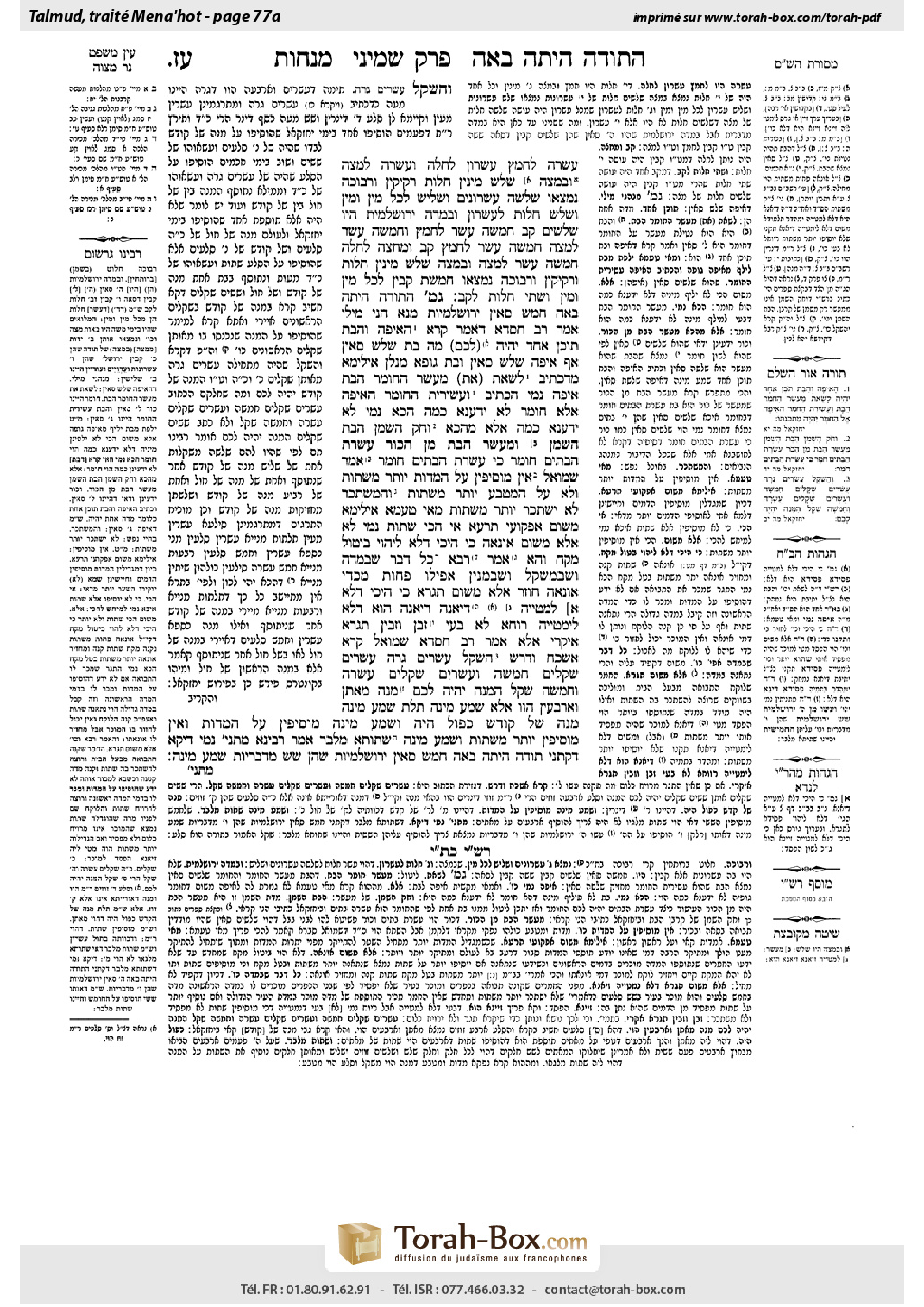
Menachot 77a: Talmud study for Daf Yomi
Daf Yomi is the daily study of one Talmud folio. Explore 37 tractates with scans, Hebrew text, Sefaria English and AI-generated French translations where annotated.
Passage selection and English or AI-generated French translation are available where the scan has annotations. Daf Study is independent of Torah-Box and Sefaria.
Browse Menachot · מנחות · All tractatesMenachot 77a text and translations
This page of Menachot includes the Aramaic text, an English translation and an AI-generated French translation, alongside the scan above.
מנחות ע״ז א · Aramaic and Hebrew text
עֲשָׂרָה לְחָמֵץ – עִשָּׂרוֹן לְחַלָּה, וַעֲשָׂרָה לְמַצָּה – וּבְמַצָּה שָׁלֹשׁ מִינִין: חַלּוֹת, רְקִיקִין, וּרְבוּכָה. נִמְצְאוּ שְׁלֹשָׁה עֶשְׂרוֹנִים וּשְׁלִישׁ לְכׇל מִין וּמִין, וְשָׁלֹשׁ חַלּוֹת לְעִשָּׂרוֹן.
וּבְמִדָּה יְרוּשַׁלְמִית הָיוּ שְׁלֹשִׁים קַב, חֲמִשָּׁה עָשָׂר לְחָמֵץ וַחֲמִשָּׁה עָשָׂר לְמַצָּה. חֲמִשָּׁה עָשָׂר לְחָמֵץ – קַב וּמֶחֱצָה לְחַלָּה, חֲמִשָּׁה עָשָׂר לְמַצָּה. וּבְמַצָּה שָׁלֹשׁ מִינִין: חַלּוֹת, וּרְקִיקִין, וּרְבוּכָה. נִמְצְאוּ חֲמֵשֶׁת קַבִּין לְכׇל מִין וּמִין, וּשְׁתֵּי חַלּוֹת לְקַב.
גְּמָ׳ הַתּוֹדָה הָיְתָה בָּאָה חָמֵשׁ סְאִין יְרוּשַׁלְמִיּוֹת. מְנָא הָנֵי מִילֵּי? אָמַר רַב חִסְדָּא: דְּאָמַר קְרָא ״הָאֵיפָה וְהַבַּת תֹּכֶן אֶחָד יִהְיֶה (לָכֶם)״. מָה בַּת שָׁלֹשׁ סְאִין, אַף אֵיפָה שָׁלֹשׁ סְאִין.
וּבַת גּוּפַהּ מְנָלַן? אִילֵּימָא מִדִּכְתִיב ״לָשֵׂאת (אֶת) מַעְשַׂר הַחֹמֶר הַבָּת״, אֵיפָה נָמֵי הָכְתִיב ״וַעֲשִׂירִית הַחֹמֶר הָאֵיפָה״! אֶלָּא חוֹמֶר לָא יָדַעְנָא כַּמָּה, הָכָא נָמֵי לָא יָדַעְנָא כַּמָּה.
אֶלָּא מֵהָכָא: ״וְחֹק הַשֶּׁמֶן הַבַּת הַשֶּׁמֶן וּמַעְשַׂר הַבַּת מִן הַכּוֹר עֲשֶׂרֶת הַבַּתִּים חוֹמֶר כִּי עֲשֶׂרֶת הַבַּתִּים חוֹמֶר״.
אָמַר שְׁמוּאֵל: אֵין מוֹסִיפִין עַל הַמִּדּוֹת יוֹתֵר מִשְּׁתוּת, וְלֹא עַל הַמַּטְבֵּעַ יוֹתֵר מִשְּׁתוּת, וְהַמִּשְׂתַּכֵּר לֹא יִשְׂתַּכֵּר יוֹתֵר מִשְּׁתוּת.
מַאי טַעְמָא? אִילֵּימָא מִשּׁוּם אַפְקוֹעֵי תַּרְעָא – אִי הָכִי, שְׁתוּת נָמֵי לָא!
אֶלָּא מִשּׁוּם אוֹנָאָה, כִּי הֵיכִי דְּלָא לֶיהֱוֵי בִּיטּוּל מִקָּח, וְהָא אָמַר רָבָא: כׇּל דָּבָר שֶׁבְּמִדָּה וְשֶׁבְּמִשְׁקָל וְשֶׁבְּמִנְיָן, אֲפִילּוּ פָּחוֹת מִכְּדֵי אוֹנָאָה – חוֹזֵר!
אֶלָּא מִשּׁוּם תַּגָּרָא, כִּי הֵיכִי דְּלָא לִמְטְיֵיהּ דְּיָאנָה. דְּיָאנָה הוּא דְּלָא לִימְטְיֵיהּ, רְוָחָא לָא בָּעֵי? זְבֵן וְזַבֵּין – תַּגָּרָא אִיקְּרִי?!
אֶלָּא אָמַר רַב חִסְדָּא: שְׁמוּאֵל קְרָא אַשְׁכַּח וּדְרַשׁ, ״הַשֶּׁקֶל עֶשְׂרִים גֵּרָה עֶשְׂרִים שְׁקָלִים חֲמִשָּׁה וְעֶשְׂרִים שְׁקָלִים עֲשָׂרָה וַחֲמִשָּׁה שֶׁקֶל הַמָּנֶה יִהְיֶה לָכֶם״, מָנֶה מָאתָן וְאַרְבְּעִין הָווּ.
אֶלָּא שְׁמַע מִינַּהּ תְּלָת: שְׁמַע מִינַּהּ מָנֶה שֶׁל קוֹדֶשׁ כָּפוּל הָיָה, וּשְׁמַע מִינַּהּ מוֹסִיפִין עַל הַמִּדּוֹת וְאֵין מוֹסִיפִין יוֹתֵר מִשְּׁתוּת, וּשְׁמַע מִינַּהּ שְׁתוּתָא מִלְּבַר.
אָמַר רָבִינָא: מַתְנִיתִין נָמֵי דַּיְקָא, דְּקָתָנֵי: תּוֹדָה הָיְתָה בָּאָה חָמֵשׁ סְאִין יְרוּשַׁלְמִיּוֹת שֶׁהֵן שֵׁשׁ מִדְבָּרִיּוֹת, שְׁמַע מִינַּהּ.
Menachot 77a · English translation
The mishna elaborates: There are ten tenths for the loaves of leavened bread, a tenth of an ephah per loaf. And there are ten tenths for the loaves of matza. And among the loaves of matza there are three types: Loaves, wafers, and those poached in water, ten loaves of each type. Consequently, there are three-and-one-third tenths of an ephah for each and every type, three loaves per tenth of an ephah.
And in the Jerusalem measure there were thirty kav, fifteen kav for the loaves of leavened bread and fifteen for the loaves of matza. The mishna elaborates: There are fifteen kav for the loaves of leavened bread, one and one-half kav per loaf. And there are fifteen kav for the loaves of matza. And among the loaves of matza there are three types: Loaves, wafers, and those poached in water. Consequently, there are five kav for each and every type, two loaves per kav.
GEMARA: The mishna teaches: The flour for the loaves accompanying the thanks offering would come from a measure of five Jerusalem se’a, which are equivalent to six wilderness se’a. The se’a referred to in the Bible when the Jewish people were in the wilderness is smaller than the se’a used later in Jerusalem. This is equivalent to two ephahs, each ephah being three wilderness se’a. The Gemara asks: From where are these matters, i.e., that there are three se’a in an ephah, derived? Rav Ḥisda said: They are derived from a verse, as the verse states: “The ephah and the bat shall be of one measure” (Ezekiel 45:11). Therefore, just as the bat, a measure for liquids, is three se’a, so too the ephah, a measure for dry goods, is three se’a.
The Gemara asks: And as for the bat itself, from where do we derive its measure? If we say that we derive it from that which is written in the same verse: “That the bat may contain the tenth-part of a ḥomer,” and since one ḥomer consists of thirty se’a, one bat is equivalent to three se’a, there is a difficulty: With regard to an ephah as well, isn’t it written in the same verse: “And the ephah the tenth-part of a ḥomer”? Why, then, must the measure of an ephah be derived from that of a bat? Rather, I do not know how much the measure of a ḥomer is; consequently, when the verse states that the ephah is one-tenth of one ḥomer, this does not demonstrate the measure of the ephah. Here too, I do not know how much the measure of the bat is.
Rather, derive the volume of the ephah from here, from a subsequent verse, where it is written with regard to separating teruma: “And the set portion of oil, the bat of oil, shall be the tithe of the bat out of the kor, which is ten bat, even a ḥomer; for ten bat are a ḥomer” (Ezekiel 45:14). The verse states that there are ten bat in one kor and ten bat in one ḥomer. Since it is known that one kor is equivalent to thirty se’a, the verse indicates that there are also thirty se’a in one ḥomer. It can therefore be derived from the verse that there are three se’a in one bat, and consequently, three se’a in one ephah.
§ The mishna teaches that the Sages increased the size of the measures so that five Jerusalem measures are equal to six wilderness measures. With regard to the practice of augmenting measures, Shmuel says: If the residents of a certain place want to change the standard of their measures and augment them by a certain fraction, they may not increase the measures by more than one-sixth, and they may not increase the value of a coin by more than one-sixth of its previous value. And one who profits from his sales may not profit by more than one-sixth.
The Gemara analyzes these statements. When Shmuel said: They may not increase the measures by more than one-sixth, what is the reason for this? If we say it is because doing so causes market prices to rise, the same concern should apply to raising the prices by one-sixth, and therefore that should also not be allowed.
Rather, one might say that the prohibition is due to concern for exploitation; and they may increase the measures only by up to one-sixth so that there will not be nullification of the transaction, as the transaction is nullified only when the disparity is more than one-sixth of the value of the item. The Gemara raises an objection: But doesn’t Rava say: With regard to any item that is otherwise subject to the halakhot of exploitation, and it is sold by measure, or by weight, or by number, even if the disparity was less than the measure of exploitation in the transaction, the transaction is reversed? A disparity of one-sixth between the value of an item and its price constitutes exploitation only in cases where there is room for error in assessing the value of an item. In a case where the details of the item are easily quantifiable, any deviation from the designated quantity results in a nullification of the transaction. The statement of Shmuel concerns sales involving measures.
Rather, the prohibition is for the benefit of the merchant, so that there will not be a loss suffered by a merchant who might not realize that a new standard was issued, and might sell in accordance with the old standard. Since a merchant usually enjoys a profit of one-sixth of the value of an item, if the standard is not increased by more than this amount he will not suffer a loss, as at worst he will forfeit his profit margin. The Gemara notes: This explanation is also difficult, since even if the aim is to ensure that there will not be a loss for the merchant, does he not need to earn a profit? There is a well-known adage in this regard: If you buy and sell without earning any profit, will you be called a merchant? A merchant must profit from his sales; therefore, if this decree was instituted for the protection of merchants, the Sages should have ensured that they earn a profit.
Rather, Rav Ḥisda said: The prohibition is not based on logical reasoning. Instead, Shmuel found a verse and interpreted it homiletically: “And the shekel shall be twenty gera; twenty shekels, five and twenty shekels, ten, and five shekels, shall be your maneh” (Ezekiel 45:12). According to this verse, the sum of all of these numbers, sixty shekels, is equivalent to a maneh. This is problematic: How can a maneh consist of sixty shekels? Since each biblical shekel is equivalent to four dinars, if a maneh is equal to sixty shekels, a maneh is two hundred and forty dinars. But a maneh is actually equal to twenty-five shekels, which are one hundred dinars.
Rather, one can learn from the verse three matters: Learn from it that the sacred maneh was doubled, so that it equaled two hundred, not one hundred, dinars. And furthermore, as Ezekiel stated that the maneh will be sixty shekels, not fifty, learn from it that a community may increase measures, but they may not increase them by more than one-sixth. And learn from it that the one-sixth is calculated from the outside, i.e., it is one-sixth of the final sum, which is one-fifth of the previous sum.
Ravina said: The mishna is also precisely formulated so as to reflect the fact that the one-sixth increase is calculated from the outside, as it teaches: The flour for the loaves accompanying the thanks offering would come from a measure of five Jerusalem se’a of flour, which are equivalent to six wilderness se’a. One can infer that the se’a could be increased by only one-sixth from the outside. The Gemara affirms: Indeed, conclude from it that this is the halakha.
Menachot 77a · Traduction française (IA)
La Michna précise : il y a dix dixièmes pour les pains levés, soit un dixième d’épha par pain. Il y a également dix dixièmes pour les pains de matsa. Parmi ces pains de matsa, il y a trois sortes : des pains, des galettes minces et des pains pochés dans l’eau, dix pains de chaque sorte. Il y a donc trois dixièmes et un tiers d’épha pour chaque sorte, soit trois pains par dixième d’épha.
Selon la mesure de Jérusalem, il y avait trente kav : quinze kav pour les pains levés et quinze pour les pains de matsa. La Michna précise : il y a quinze kav pour les pains levés, soit un kav et demi par pain. Il y a également quinze kav pour les pains de matsa. Parmi ces pains de matsa, il y a trois sortes : des pains, des galettes minces et des pains pochés dans l’eau. Il y a donc cinq kav pour chaque sorte, soit deux pains par kav.
GUEMARA : La Michna enseigne que la farine des pains qui accompagnent le sacrifice de reconnaissance provenait d’une mesure de cinq séa de Jérusalem, équivalant à six séa du désert. Le séa mentionné dans la Bible, à l’époque où le peuple juif se trouvait dans le désert, est plus petit que le séa utilisé plus tard à Jérusalem. Cela équivaut à deux épha, chaque épha correspondant à trois séa du désert. La Guemara demande : D’où sait-on que trois séa font un épha ? Rav Ḥisda dit : On le déduit d’un verset, car il est écrit : « L’épha et le bath auront la même mesure » (Ézéchiel 45:11). Ainsi, de même que le bath, mesure pour les liquides, contient trois séa, de même l’épha, mesure pour les denrées sèches, contient trois séa.
La Guemara demande : Et quant au bath lui-même, d’où déduit-on sa mesure ? Si l’on dit qu’on la déduit de ce qui est écrit dans le même verset : « Le bath contiendra le dixième d’un ḥomer », et qu’un ḥomer étant composé de trente séa, un bath équivaut à trois séa, une difficulté se pose : au sujet de l’épha aussi, n’est-il pas écrit dans ce même verset : « Et l’épha, le dixième d’un ḥomer » ? Pourquoi, dès lors, faut-il déduire la mesure de l’épha de celle du bath ? En réalité, je ne sais pas quelle est la mesure d’un ḥomer ; par conséquent, lorsque le verset dit que l’épha représente un dixième d’un ḥomer, cela ne permet pas d’établir la mesure de l’épha. Ici aussi, je ne sais pas quelle est la mesure du bath.
Mais déduis le volume de l’épha d’ici, d’un verset ultérieur où il est écrit à propos du prélèvement de la terouma : « La part fixée de l’huile, le bath d’huile, sera le dixième d’un bath pris sur le kor, qui contient dix baths, c’est-à-dire un ḥomer ; car dix baths font un ḥomer » (Ézéchiel 45:14). Le verset indique qu’il y a dix baths dans un kor et dix baths dans un ḥomer. Puisqu’on sait qu’un kor équivaut à trente séa, le verset indique qu’il y a aussi trente séa dans un ḥomer. On peut donc déduire du verset qu’un bath contient trois séa et, par conséquent, qu’un épha contient trois séa.
§ La Michna enseigne que les Sages ont augmenté la capacité des mesures, de sorte que cinq mesures de Jérusalem équivalent à six mesures du désert. À propos de la pratique consistant à augmenter les mesures, Chmouel dit : si les habitants d’un lieu donné veulent modifier l’étalon de leurs mesures et les augmenter d’une certaine fraction, ils ne peuvent pas les augmenter de plus d’un sixième ; ils ne peuvent pas non plus augmenter la valeur d’une pièce de plus d’un sixième de sa valeur précédente. Et celui qui tire profit de ses ventes ne peut pas réaliser un bénéfice supérieur à un sixième.
La Guemara examine ces propos. Lorsque Chmouel dit : « Ils ne peuvent pas augmenter les mesures de plus d’un sixième », quelle en est la raison ? Si l’on dit que c’est parce que cela entraîne une hausse des prix sur le marché, la même préoccupation devrait s’appliquer à une augmentation des prix d’un sixième ; cela ne devrait donc pas non plus être autorisé.
Mais on pourrait plutôt dire que l’interdiction vise à prévenir la fraude et qu’ils ne peuvent augmenter les mesures que jusqu’à un sixième afin que la transaction ne soit pas annulée, car elle ne l’est que lorsque l’écart dépasse un sixième de la valeur de l’article. La Guemara objecte : Mais Rava ne dit-il pas que, pour tout article auquel s’appliquent par ailleurs les lois relatives à la fraude, lorsqu’il est vendu à la mesure, au poids ou au nombre, la transaction est annulée même si l’écart est inférieur au seuil de fraude ? Un écart d’un sixième entre la valeur d’un article et son prix constitue une fraude uniquement dans les cas où l’évaluation de sa valeur peut comporter une erreur. Lorsque les caractéristiques de l’article sont faciles à quantifier, tout écart par rapport à la quantité convenue entraîne l’annulation de la transaction. Le propos de Chmouel concerne les ventes effectuées à la mesure.
Mais l’interdiction vise à protéger le commerçant, afin qu’il ne subisse pas de perte s’il ne sait pas qu’un nouvel étalon a été adopté et vend selon l’ancien étalon. Puisqu’un commerçant réalise habituellement un bénéfice d’un sixième de la valeur d’un article, si l’étalon n’est pas augmenté de plus que cela, il ne subira pas de perte, car, au pire, il perdra sa marge bénéficiaire. La Guemara relève que cette explication aussi est difficile : même si l’objectif est de faire en sorte que le commerçant ne subisse pas de perte, n’a-t-il pas besoin de réaliser un bénéfice ? À cet égard, un dicton bien connu dit : « Si tu achètes et revends sans faire de bénéfice, te considérera-t-on comme un commerçant ? » Un commerçant doit tirer un bénéfice de ses ventes ; par conséquent, si ce décret a été institué pour protéger les commerçants, les Sages auraient dû veiller à ce qu’ils réalisent un bénéfice.
Mais Rav Ḥisda dit : l’interdiction ne repose pas sur un raisonnement logique. Chmouel a plutôt trouvé un verset et l’a interprété selon la méthode homilétique : « Le sicle sera de vingt guéras ; vingt sicles, vingt-cinq sicles, dix et cinq sicles formeront votre maneh » (Ézéchiel 45:12). D’après ce verset, la somme de tous ces nombres, soit soixante sicles, équivaut à un maneh. Cela pose problème : comment un maneh peut-il être composé de soixante sicles ? Puisque chaque sicle biblique équivaut à quatre dinars, si un maneh équivaut à soixante sicles, il vaut deux cent quarante dinars. Or, un maneh équivaut en réalité à vingt-cinq sicles, soit cent dinars.
Mais on peut déduire du verset trois éléments : on en déduit que le maneh sacré a été doublé, de sorte qu’il équivaut à deux cents dinars, et non à cent. En outre, puisque Ézéchiel dit que le maneh sera de soixante sicles, et non de cinquante, on en déduit qu’une communauté peut augmenter les mesures, mais pas de plus d’un sixième. On en déduit également que ce sixième se calcule à partir de l’extérieur, c’est-à-dire qu’il représente un sixième du total final, soit un cinquième du total antérieur.
Ravina dit : la formulation de la Michna est elle aussi précise et reflète le fait que l’augmentation d’un sixième se calcule à partir de l’extérieur, puisqu’elle enseigne que la farine des pains qui accompagnent le sacrifice de reconnaissance provenait d’une mesure de cinq séa de Jérusalem, équivalant à six séa du désert. On peut en déduire que le séa ne pouvait être augmenté que d’un sixième calculé à partir de l’extérieur. La Guemara confirme : en effet, conclus de cela que telle est la halakha.
Traduction française générée par IA à partir de l’édition anglaise de Sefaria. Vérifie toujours un passage avec le texte source.
Text from Sefaria: William Davidson Edition - Vocalized Aramaic (unknown); William Davidson Edition - English (CC BY NC).