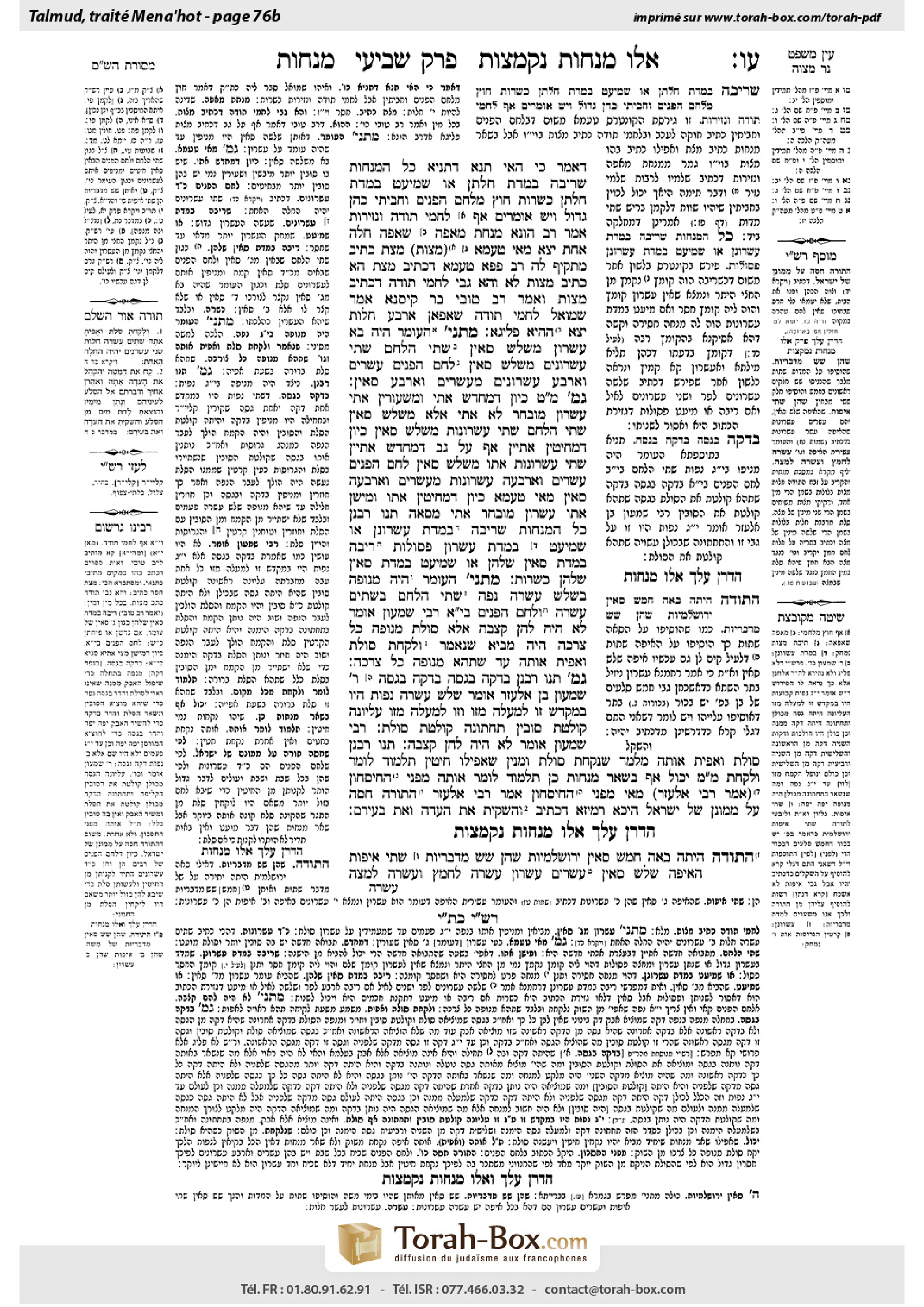
Menachot 76b: Talmud study for Daf Yomi
Daf Yomi is the daily study of one Talmud folio. Explore 37 tractates with scans, Hebrew text, Sefaria English and AI-generated French translations where annotated.
Passage selection and English or AI-generated French translation are available where the scan has annotations. Daf Study is independent of Torah-Box and Sefaria.
Browse Menachot · מנחות · All tractatesMenachot 76b text and translations
This page of Menachot includes the Aramaic text, an English translation and an AI-generated French translation, alongside the scan above.
מנחות ע״ו ב · Aramaic and Hebrew text
דְּאָמַר כִּי הַאי תַּנָּא, דְּתַנְיָא: כׇּל הַמְּנָחוֹת שֶׁרִיבָּה בְּמִדַּת חַלָּתָן, אוֹ שֶׁמִּיעֵט בְּמִדַּת חַלָּתָן – כְּשֵׁרוֹת, חוּץ מִלֶּחֶם הַפָּנִים וַחֲבִיתֵּי כֹּהֵן גָּדוֹל, וְיֵשׁ אוֹמְרִים: אַף לַחְמֵי תוֹדָה וּנְזִירוּת.
אָמַר רַב הוּנָא: מִנְחַת מַאֲפֶה (שאפה) [שֶׁאֲפָאָהּ] חַלָּה אַחַת – יָצָא. מַאי טַעְמָא? (מַצּוֹת) ״מַצָּת״ כְּתִיב.
מַתְקֵיף לַהּ רַב פָּפָּא: טַעְמָא דִּכְתִיב ״מַצָּת״, הָא כְּתִיב ״מַצּוֹת״ – לָא? וְהָא גַּבֵּי לַחְמֵי תוֹדָה דִּכְתִיב ״מַצּוֹת״, וְאָמַר רַב טוֹבִי בַּר קִיסְנָא אָמַר שְׁמוּאֵל: לַחְמֵי תוֹדָה שֶׁאֲפָאָן אַרְבַּע חַלּוֹת – יָצָא! הָהִיא פְּלִיגָא.
מַתְנִי׳ הָעוֹמֶר הָיָה בָּא עִשָּׂרוֹן מִשָּׁלֹשׁ סְאִין, שְׁתֵּי הַלֶּחֶם שְׁתֵּי עֶשְׂרוֹנִים מִשָּׁלֹשׁ סְאִין, לֶחֶם הַפָּנִים עֶשְׂרִים וְאַרְבַּע עֶשְׂרוֹנִים מֵעֶשְׂרִים וְאַרְבַּע סְאִין.
גְּמָ׳ מַאי טַעְמָא? כֵּיוָן דְּמֵחָדָשׁ אָתֵי, וּמִשְּׂעוֹרִין אָתֵי, עִשָּׂרוֹן מוּבְחָר לָא אָתֵי אֶלָּא מִשָּׁלֹשׁ סְאִין.
שְׁתֵּי הַלֶּחֶם שְׁתֵּי עֶשְׂרוֹנוֹת מִשָּׁלֹשׁ סְאִין – כֵּיוָן דְּמֵחִיטִּין אָתְיָין, אַף עַל גַּב דְּמֵחָדָשׁ אָתְיָין, שְׁתֵּי עֶשְׂרוֹנוֹת אָתוּ מִשָּׁלֹשׁ סְאִין.
לֶחֶם הַפָּנִים עֶשְׂרִים וְאַרְבָּעָה עֶשְׂרוֹנוֹת מֵעֶשְׂרִים וְאַרְבָּעָה סְאִין – מַאי טַעְמָא? כֵּיוָן דְּמֵחִיטִּין אָתוּ, וּמִיָּשָׁן אָתוּ, עִשָּׂרוֹן מוּבְחָר אָתֵי מִסְּאָה.
תָּנוּ רַבָּנַן: כׇּל הַמְּנָחוֹת שֶׁרִיבָּה בְּמִדַּת עֶשְׂרוֹנָן, אוֹ שֶׁמִּיעֵט בְּמִדַּת עִשָּׂרוֹן – פְּסוּלוֹת. רִיבָּה בְּמִדַּת סְאִין שֶׁלָּהֶן, אוֹ שֶׁמִּיעֵט בְּמִדַּת סְאִין שֶׁלָּהֶן – כְּשֵׁרוֹת.
מַתְנִי׳ הָעוֹמֶר הָיָה מְנוּפֶּה בִּשְׁלֹשׁ עֶשְׂרֵה נָפָה, שְׁתֵּי הַלֶּחֶם בִּשְׁתֵּים עֶשְׂרֵה, וְלֶחֶם הַפָּנִים בְּאַחַת עֶשְׂרֵה. רַבִּי שִׁמְעוֹן אוֹמֵר: לֹא הָיָה לָהֶן קִצְבָה, אֶלָּא סוֹלֶת מְנוּפָּה כָּל צׇרְכָּהּ הָיָה מֵבִיא, שֶׁנֶּאֱמַר: ״וְלָקַחְתָּ סֹלֶת וְאָפִיתָ אֹתָהּ״, עַד שֶׁתְּהֵא מְנוּפָּה כָּל צׇרְכָּהּ.
גְּמָ׳ תָּנוּ רַבָּנַן: בְּדַּקָּה בְּגַסָּה, בְּדַּקָּה בְּגַסָּה. רַבִּי שִׁמְעוֹן בֶּן אֶלְעָזָר אוֹמֵר: שְׁלֹשׁ עֶשְׂרֵה נָפוֹת הָיוּ בַּמִּקְדָּשׁ, זוֹ לְמַעְלָה מִזּוֹ וְזוֹ לְמַעְלָה מִזּוֹ, עֶלְיוֹנָה קוֹלֶטֶת סוּבִּין, תַּחְתּוֹנָה קוֹלֶטֶת סוֹלֶת.
רַבִּי שִׁמְעוֹן אוֹמֵר: לֹא הָיָה לָהֶן קִצְבָה. תָּנוּ רַבָּנַן: ״סֹלֶת וְאָפִיתָ אֹתָהּ״ – מְלַמֵּד שֶׁנִּקַּחַת סוֹלֶת.
וּמִנַּיִן שֶׁאֲפִילּוּ חִיטִּין? תַּלְמוּד לוֹמַר ״וְלָקַחְתָּ״ – מִכׇּל מָקוֹם. יָכוֹל אַף בִּשְׁאָר מְנָחוֹת כֵּן? תַּלְמוּד לוֹמַר ״אֹתָהּ״, מִפְּנֵי הַחִיסָּחוֹן.
אָמַר רַבִּי אֶלְעָזָר: מַאי ״מִפְּנֵי הַחִיסָּחוֹן״? אָמַר רַבִּי אֶלְעָזָר: הַתּוֹרָה חָסָה עַל מָמוֹנָן שֶׁל יִשְׂרָאֵל. הֵיכָא רְמִיזָא? דִּכְתִיב: ״וְהִשְׁקִיתָ אֶת הָעֵדָה וְאֶת בְּעִירָם״.
הֲדַרַן עֲלָךְ אֵלּוּ מְנָחוֹת נִקְמָצוֹת.
מַתְנִי׳ הַתּוֹדָה הָיְתָה בָּאָה חָמֵשׁ סְאִין יְרוּשַׁלְמִיּוֹת, שֶׁהֵן שֵׁשׁ מִדְבָּרִיּוֹת. שְׁתֵּי אֵיפוֹת, הָאֵיפָה שָׁלֹשׁ סְאִין, עֶשְׂרִים עִשָּׂרוֹן – עֲשָׂרָה לֶחָמֵץ וַעֲשָׂרָה לַמַּצָּה.
Menachot 76b · English translation
states his opinion in accordance with the opinion of that tanna, as it is taught in a baraita: All the meal offerings where one increased the measure of their loaves or where one decreased the measure of their loaves are nevertheless fit, except for the twelve loaves of the shewbread and the twelve loaves of the High Priest’s griddle-cake offering. And some say: Even the ten loaves of each variety of the thanks offering and the ten loaves that accompany the guilt offering of naziriteship are fit only when brought in their prescribed measures. Shmuel agrees with the first tanna, according to whom the loaves of the thanks offering and the loaves of naziriteship are fit even when not offered in the proper quantities.
§ Rav Huna says: With regard to an oven-baked meal offering that one baked as only one loaf, although he did not bring the mandated quantity, he has fulfilled his obligation. What is the reason? It is that the verse states with regard to the oven-baked meal offering: “And when you bring a meal offering baked in the oven, it shall be unleavened loaves of fine flour” (Leviticus 2:4). The term “unleavened loaves [matzot]” is written without the letter vav, which is generally used with regard to the plural form. Therefore, it may be read in the singular as unleavened loaf [matzat], which teaches that even one unleavened loaf is fit.
Rav Pappa objects to this derivation: The reason Rav Huna gives is that it is written in the singular form of matzat. But if it were written: Matzot, would this not be the halakha? But what about the verse concerning the loaves of the thanks offering, where it is written “matzot” with a vav, indicating the plural form, in the verse: “Then he shall offer with the sacrifice of thanksgiving unleavened loaves mixed with oil” (Leviticus 7:12), and yet Rav Tovi bar Kisna said that Shmuel said: In the case of loaves of the thanks offering that were baked as four loaves, such that each of the four varieties of loaves is baked as only one loaf, he has fulfilled his obligation. The Gemara answers: That statement of Shmuel disagrees with the opinion of Rav Huna, according to whom four loaves are not fit for the thanks offering.
MISHNA: The omer offering, i.e., the measure of barley brought as a communal offering on the sixteenth of Nisan, would come from a tenth of an ephah of flour sifted from three se’a of barley. The two loaves would come from two-tenths of an ephah of flour sifted from three se’a of wheat. The shewbread would come from twenty-four tenths of an ephah of flour sifted from twenty-four se’a of wheat.
GEMARA: The Gemara asks: What is the reason that according to the mishna, the relatively large amount of three se’a of barley is necessary to yield a single tenth of an ephah of flour for the omer offering? The Gemara answers: Since it comes from the fresh new crop, which contains a large amount of refuse, and it comes from barley, which is coarser than wheat, a choice tenth of an ephah of flour comes only from a minimum of three se’a of barley.
The Gemara asks: Why does the mishna rule that the two loaves would come from two-tenths of an ephah of flour sifted from three se’a of wheat, whereas only a tenth of an ephah is used from the same amount of grain for the omer? The Gemara answers: Since the loaves come from wheat, which is of superior quality to barley, although they come from the new crop and require sifting, the grains are clean enough that two-tenths of an ephah come from the sifting of three se’a of grain.
The mishna stated that the shewbread would come from twenty-four tenths of an ephah of flour sifted from twenty-four se’a of wheat. What is the reason? The Gemara answers: Since they come from wheat, and they come from the old crop, which contains relatively little refuse, the grains are so clean that a choice tenth of an ephah of flour comes from one se’a of grain, and twenty-four tenths of an ephah come from twenty-four se’a.
The Sages taught in a baraita: All the meal offerings where one increased the measure of their tenth of an ephah of flour by collecting it with a vessel larger than a tenth of an ephah, or where one decreased the measure of their tenth of an ephah of flour by collecting it with a vessel smaller than a tenth of an ephah, are disqualified. If he increased the measure of their se’a of grain or decreased the measure of their se’a of grain, e.g., if he used two or four se’a instead of three, but sifted until he was left with the correct measure of a tenth of an ephah of flour, they are fit offerings. This is because the number of se’a mentioned in the mishna is necessary only for the optimal fulfillment of the mitzva, but is not indispensable.
MISHNA: The flour of the omer was sifted with thirteen sifters, each finer than its predecessor, and the flour that emerged from the final sifter was sacrificed. The flour of the two loaves was sifted with twelve sifters, and the flour of the shewbread was sifted with eleven sifters. Rabbi Shimon says: They have no fixed number of sifters; rather, it was fine flour that was completely sifted that one would bring for all of these offerings, as it is stated: “And you shall take fine flour and bake it” (Leviticus 24:5), indicating that one does not fulfill his obligation until the flour will be completely sifted.
GEMARA: When a fine sifter was used, the small, dust-like particles emerged and the fine flour was caught in the sifter, and when a coarse sifter was used, the fine flour emerged and the bran was caught in the sifter. With regard to the sifting of the flour, the Sages taught in a baraita: The sifting would begin in a sifter of slight holes, and the flour that remained would then be sifted in a sifter of large holes. The flour that emerged would again be sifted in a sifter with slight holes that were not quite as small as the first one with small holes, and again in a sifter of large holes that were not quite as large as the first one with large holes. All the sifting would proceed in this manner. Rabbi Shimon ben Elazar says: There were thirteen sifters in the Temple, this one above, i.e., preceding, that one, and this one above that one. The highest sifter would collect bran, parts of the kernel aside from the actual pure flour, and the lowest sifter would collect fine flour.
§ The mishna teaches that in contrast to the first tanna, Rabbi Shimon says: They have no fixed number of sifters; but the flour would be sifted as many times as was necessary, based on the verse: “And you shall take fine flour, and bake it.” In addition, the Sages taught: When the verse states with regard to the shewbread: “And you shall take fine flour and bake it,” this teaches that fine flour is acquired after it has been sifted for the baking of the shewbread.
And from where is it derived that even wheat kernels may be purchased before they are ground and sifted? The verse states: “And you shall take,” indicating that the grain should be taken in any case and in any state. One might have thought that it is so even for other meal offerings. Therefore, the verse states: “And you shall take fine flour and bake it,” indicating that the shewbread alone may be acquired as kernels because of the sparing [haḥissaḥon].
Rabbi Elazar says: What is the meaning of: Because of the sparing? Rabbi Elazar says: The Torah spared the money of the Jewish people. Due to the large quantity of grain needed for the shewbread every week, purchasing sifted fine flour would be a substantial expense. The Gemara explains: Where is the allusion to this principle? It is found in a verse, as it is written that when the Jewish people were thirsty in the wilderness in the aftermath of Miriam’s death, God instructed Moses: “And speak to the rock before their eyes, so that it will give forth its water; and you shall bring forth to them water out of the rock; so you shall give drink for the congregation and for their cattle” (Numbers 20:8). Evidently, the miracle of extracting water from the rock was performed even for the purpose of providing water for the livestock.
MISHNA: The flour for the loaves accompanying the thanks offering would come from a measure of five Jerusalem se’a offering, which are equivalent to six wilderness se’a. The se’a referred to in the Bible when the Jewish people were in the wilderness is smaller than the se’a used later in Jerusalem. This is equivalent to two ephahs, each ephah being three wilderness se’a. These two ephahs are twenty measures of a tenth of an ephah. Ten of these tenths were used to make leavened loaves and ten of these tenths were used to make unleavened loaves, i.e., matza.
Menachot 76b · Traduction française (IA)
Il énonce son opinion conformément à celle de ce tanna, comme il est enseigné dans une baraïta : Toutes les offrandes de farine dont on a augmenté ou diminué la mesure des pains restent néanmoins valides, à l’exception des douze pains du pain de proposition et des douze pains de l’offrande à la poêle du grand prêtre. Certains disent : même les dix pains de chaque variété de l’offrande de reconnaissance et les dix pains qui accompagnent le sacrifice de culpabilité pour naziréat ne sont valides que s’ils sont apportés dans les mesures prescrites. Chmouel est d’accord avec le premier tanna, selon lequel les pains de l’offrande de reconnaissance et ceux du naziréat sont valides même lorsqu’ils ne sont pas apportés dans les quantités requises.
§ Rav Houna dit : Pour une offrande de farine cuite au four que l’on a préparée sous la forme d’un seul pain, on s’est acquitté de son obligation, bien qu’on n’ait pas apporté la quantité requise. Pour quelle raison ? Car il est écrit au sujet de l’offrande de farine cuite au four : « Et lorsque tu apporteras une offrande de farine cuite au four, ce seront des pains azymes de fleur de farine » (Lévitique 2:4). Le terme « pains azymes [matzot] » est écrit sans la lettre vav, généralement utilisée pour marquer le pluriel. On peut donc le lire au singulier, « pain azyme [matzat] », ce qui enseigne qu’un seul pain azyme est également valide.
Rav Pappa objecte à cette déduction : Rav Houna fonde son raisonnement sur le fait que le mot matzat est écrit au singulier. Mais si le texte disait matzot, cela ne serait-il pas également la halakha ? Or, au sujet des pains de l’offrande de reconnaissance, le mot « matzot » est écrit avec un vav, indiquant le pluriel, dans le verset : « Il présentera avec le sacrifice de reconnaissance des pains azymes pétris à l’huile » (Lévitique 7:12). Pourtant, Rav Tovi bar Kisna a dit que Chmouel a dit : Lorsque les pains de l’offrande de reconnaissance ont été cuits en quatre pains, de sorte que chacun des quatre types de pains n’a été cuit qu’en un seul pain, on s’est acquitté de son obligation. La Guemara répond : Cette déclaration de Chmouel est en désaccord avec l’opinion de Rav Houna, selon laquelle quatre pains ne sont pas valides pour l’offrande de reconnaissance.
MICHNA : L’offrande de l’omer, c’est-à-dire la mesure d’orge apportée comme offrande communautaire le seize nissan, provenait d’un dixième d’épha de farine tamisée à partir de trois séa d’orge. Les deux pains provenaient de deux dixièmes d’épha de farine tamisée à partir de trois séa de blé. Le pain de proposition provenait de vingt-quatre dixièmes d’épha de farine tamisée à partir de vingt-quatre séa de blé.
GUEMARA : La Guemara demande : Pourquoi, selon la Michna, faut-il une quantité relativement importante de trois séa d’orge pour obtenir un seul dixième d’épha de farine destiné à l’offrande de l’omer ? La Guemara répond : Comme l’orge provient de la nouvelle récolte, qui contient beaucoup de déchets, et qu’elle est plus grossière que le blé, il faut au moins trois séa d’orge pour obtenir un dixième d’épha de farine de premier choix.
La Guemara demande : Pourquoi la Michna indique-t-elle que les deux pains provenaient de deux dixièmes d’épha de farine tamisée à partir de trois séa de blé, alors que, pour l’omer, on n’obtient qu’un dixième d’épha à partir de la même quantité de céréales ? La Guemara répond : Comme les pains sont faits de blé, de meilleure qualité que l’orge, même s’il provient de la nouvelle récolte et doit être tamisé, le grain est suffisamment propre pour que le tamisage de trois séa produise deux dixièmes d’épha de farine.
La Michna indique que le pain de proposition provenait de vingt-quatre dixièmes d’épha de farine tamisée à partir de vingt-quatre séa de blé. Pour quelle raison ? La Guemara répond : Comme il s’agit de blé issu de l’ancienne récolte, qui contient relativement peu de déchets, le grain est si propre qu’un séa donne un dixième d’épha de farine de premier choix ; vingt-quatre séa en donnent donc vingt-quatre dixièmes d’épha.
Les Sages ont enseigné dans une baraïta : Toutes les offrandes de farine dont on a augmenté la mesure du dixième d’épha de farine en le prélevant avec un récipient d’une capacité supérieure à un dixième d’épha, ou dont on a diminué cette mesure en le prélevant avec un récipient d’une capacité inférieure à un dixième d’épha, sont invalides. Si l’on a augmenté ou diminué la quantité de séa de grain — par exemple, si l’on en a utilisé deux ou quatre au lieu de trois — mais qu’on a tamisé jusqu’à obtenir la mesure exacte d’un dixième d’épha de farine, les offrandes sont valides. En effet, le nombre de séa indiqué dans la Michna n’est nécessaire que pour accomplir la mitsva de manière optimale, mais il n’est pas indispensable.
MICHNA : La farine de l’omer était tamisée au moyen de treize tamis, chacun plus fin que le précédent, et la farine issue du dernier tamis était offerte. La farine des deux pains était tamisée au moyen de douze tamis, et celle du pain de proposition au moyen de onze tamis. Rabbi Chimon dit : Le nombre de tamis n’est pas fixé ; on apportait plutôt, pour toutes ces offrandes, de la fleur de farine entièrement tamisée, comme il est dit : « Tu prendras de la fleur de farine et tu la feras cuire » (Lévitique 24:5), ce qui indique qu’on ne s’acquitte de son obligation que lorsque la farine a été entièrement tamisée.
GUEMARA : Avec un tamis fin, les petites particules semblables à de la poussière passaient à travers, tandis que la fleur de farine restait dans le tamis ; avec un tamis grossier, la fleur de farine passait à travers et le son restait dans le tamis. Au sujet du tamisage de la farine, les Sages ont enseigné dans une baraïta : Le tamisage commençait avec un tamis aux ouvertures étroites, puis la farine qui y restait était tamisée dans un tamis aux grandes ouvertures. La farine qui en sortait était ensuite tamisée à nouveau dans un tamis aux ouvertures étroites, mais un peu plus grandes que celles du premier tamis à ouvertures étroites, puis dans un tamis aux grandes ouvertures, mais un peu plus petites que celles du premier tamis à grandes ouvertures. Tout le tamisage se poursuivait de cette manière. Rabbi Chimon ben Elazar dit : Il y avait treize tamis dans le Temple, chacun placé au-dessus, c’est-à-dire avant, du suivant. Le tamis le plus haut retenait le son, les parties du grain autres que la farine pure proprement dite, tandis que le tamis le plus bas retenait la fleur de farine.
§ La Michna enseigne que, contrairement au premier tanna, Rabbi Chimon dit : Le nombre de tamis n’est pas fixé ; la farine était tamisée autant de fois que nécessaire, conformément au verset : « Tu prendras de la fleur de farine et tu la feras cuire. » En outre, les Sages ont enseigné : Lorsque le verset dit, au sujet du pain de proposition : « Tu prendras de la fleur de farine et tu la feras cuire », cela enseigne que la fleur de farine est acquise après avoir été tamisée en vue de la confection du pain de proposition.
D’où apprend-on que même des grains de blé peuvent être achetés avant d’être moulus et tamisés ? Le verset dit : « Tu prendras », ce qui indique qu’on peut les prendre dans tous les cas et sous n’importe quelle forme. On aurait pu penser que cela vaut également pour les autres offrandes de farine. C’est pourquoi le verset dit : « Tu prendras de la fleur de farine et tu la feras cuire », ce qui indique que seul le pain de proposition peut être acheté sous forme de grains, en raison de l’économie [haḥissaḥon].
Rabbi Elazar dit : Que signifie « en raison de l’économie » ? Rabbi Elazar dit : La Torah a ménagé les ressources du peuple juif. Étant donné la grande quantité de céréales nécessaire chaque semaine pour le pain de proposition, acheter de la fleur de farine déjà tamisée représenterait une dépense considérable. La Guemara explique : Où trouve-t-on une allusion à ce principe ? Dans un verset. Il est écrit que, lorsque le peuple juif eut soif dans le désert après la mort de Miriam, Dieu ordonna à Moïse : « Parle au rocher sous leurs yeux, afin qu’il donne son eau ; tu feras jaillir pour eux de l’eau du rocher et tu donneras à boire à l’assemblée et à son bétail » (Nombres 20:8). Il ressort de là que le miracle consistant à faire jaillir de l’eau du rocher fut accompli également pour fournir de l’eau au bétail.
MICHNA : La farine des pains accompagnant l’offrande de reconnaissance provenait d’une mesure de cinq séa de Jérusalem, équivalant à six séa du désert. Le séa mentionné dans la Bible à l’époque où le peuple juif se trouvait dans le désert est plus petit que le séa utilisé plus tard à Jérusalem. Cette mesure équivaut à deux épha, chacune correspondant à trois séa du désert. Ces deux épha représentent vingt dixièmes d’épha. Dix de ces dixièmes servaient à confectionner des pains levés, et dix autres, des pains azymes, c’est-à-dire de la matsa.
Traduction française générée par IA à partir de l’édition anglaise de Sefaria. Vérifie toujours un passage avec le texte source.
Text from Sefaria: William Davidson Edition - Vocalized Aramaic (unknown); William Davidson Edition - English (CC BY NC).