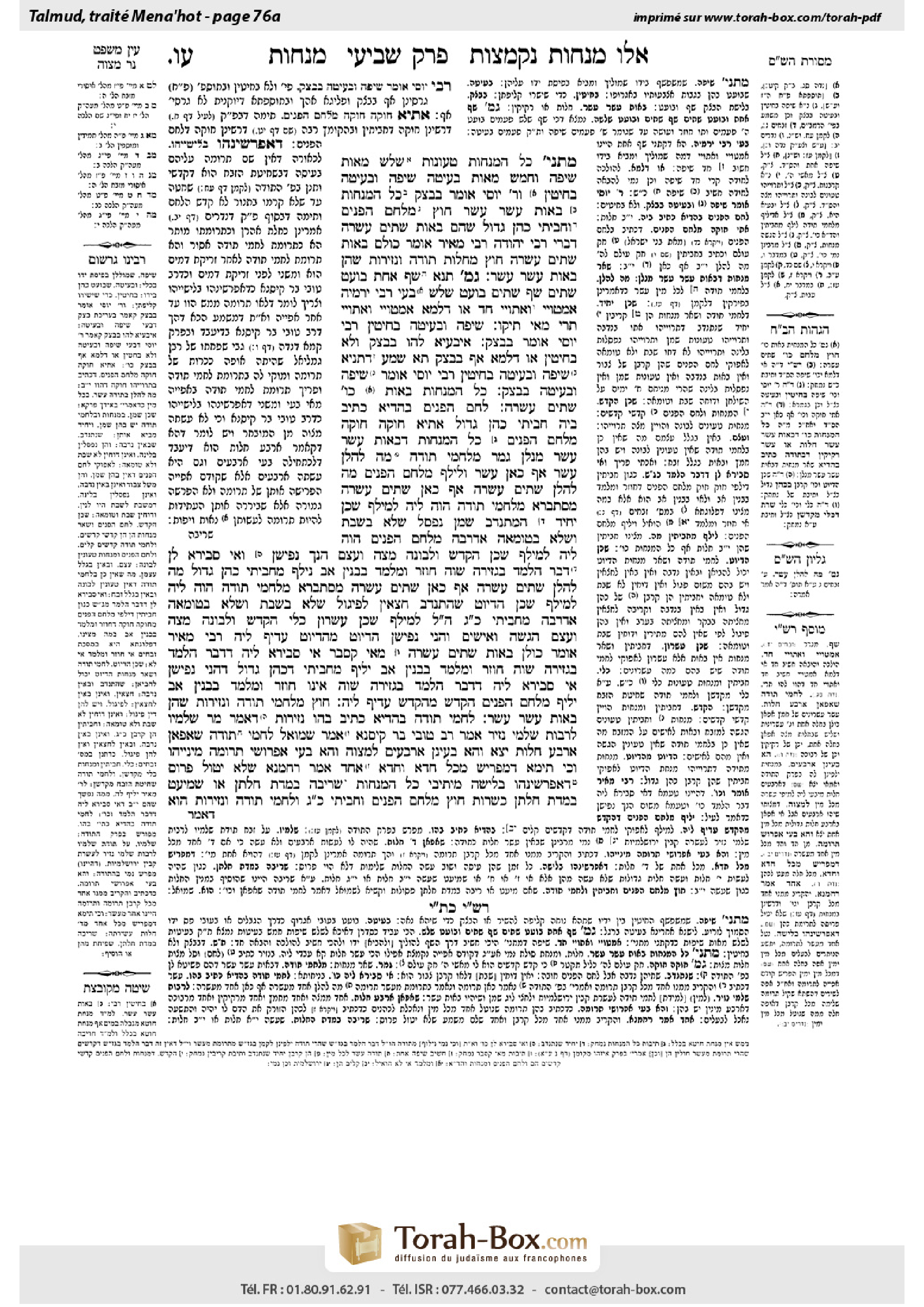
Menachot 76a: Talmud study for Daf Yomi
Daf Yomi is the daily study of one Talmud folio. Explore 37 tractates with scans, Hebrew text, Sefaria English and AI-generated French translations where annotated.
Passage selection and English or AI-generated French translation are available where the scan has annotations. Daf Study is independent of Torah-Box and Sefaria.
Browse Menachot · מנחות · All tractatesMenachot 76a text and translations
This page of Menachot includes the Aramaic text, an English translation and an AI-generated French translation, alongside the scan above.
מנחות ע״ו א · Aramaic and Hebrew text
מַתְנִי׳ כׇּל הַמְּנָחוֹת טְעוּנוֹת שְׁלֹשׁ מֵאוֹת שִׁיפָה וַחֲמֵשׁ מֵאוֹת בְּעִיטָה, שִׁיפָה וּבְעִיטָה בַּחִיטִּין. וְרַבִּי יוֹסֵי אוֹמֵר: בַּבָּצֵק. כׇּל הַמְּנָחוֹת בָּאוֹת עֶשֶׂר עֶשֶׂר, חוּץ מִלֶּחֶם הַפָּנִים וַחֲבִיתֵּי כֹּהֵן גָּדוֹל שֶׁהֵם בָּאוֹת שְׁתֵּים עֶשְׂרֵה, דִּבְרֵי רַבִּי יְהוּדָה. רַבִּי מֵאִיר אוֹמֵר: כּוּלָּם בָּאוֹת שְׁתֵּים עֶשְׂרֵה, חוּץ מֵחַלּוֹת תּוֹדָה וּנְזִירוּת שֶׁהֵן בָּאוֹת עֶשֶׂר עֶשֶׂר.
גְּמָ׳ תָּנָא: שָׁף אַחַת, בּוֹעֵט שְׁתַּיִם. שָׁף שְׁתַּיִם, בּוֹעֵט שָׁלֹשׁ. בָּעֵי רַבִּי יִרְמְיָה: אַמְטוֹיֵי וְאֵתוֹיֵי חַד, אוֹ דִלְמָא אַמְטוֹיֵי וְאֵתוֹיֵי תְּרֵי? מַאי? תֵּיקוּ.
שִׁיפָה וּבְעִיטָה בַּחִיטִּין, רַבִּי יוֹסֵי אוֹמֵר: בַּבָּצֵק. אִיבַּעְיָא לְהוּ: בַּבָּצֵק וְלֹא בַּחִיטִּין, אוֹ דִלְמָא אַף בַּבָּצֵק? תָּא שְׁמַע, דְּתַנְיָא: שִׁיפָה וּבְעִיטָה בַּחִיטִּין, רַבִּי יוֹסֵי אוֹמֵר: שִׁיפָה וּבְעִיטָה בַּבָּצֵק.
כׇּל הַמְּנָחוֹת בָּאוֹת כּוּ׳. שְׁתֵּים עֶשְׂרֵה לֶחֶם הַפָּנִים – בְּהֶדְיָא כְּתִיב בֵּיהּ.
חֲבִיתֵּי כֹּהֵן גָּדוֹל – אָתְיָא ״חֻקָּה״ ״חֻקָּה״ מִלֶּחֶם הַפָּנִים.
כׇּל הַמְּנָחוֹת דְּבָאוֹת עֶשֶׂר עֶשֶׂר, מְנָלַן? גָּמַר מִלַּחְמֵי תוֹדָה – מָה לְהַלָּן עֶשֶׂר, אַף כָּאן עֶשֶׂר. וְלֵילַף מִלֶּחֶם הַפָּנִים – מָה לְהַלָּן שְׁתֵּים עֶשְׂרֵה, אַף כָּאן שְׁתֵּים עֶשְׂרֵה!
מִסְתַּבְּרָא מִלַּחְמֵי תוֹדָה הֲוָה לֵיהּ לְמֵילַף, שֶׁכֵּן יָחִיד, הַמִּתְנַדֵּב, שֶׁמֶן, נִפְסָל, שֶׁלֹּא בְּשַׁבָּת, וְשֶׁלֹּא בְּטוּמְאָה.
אַדְּרַבָּה, מִלֶּחֶם הַפָּנִים הֲוָה לֵיהּ לְמֵילַף, שֶׁכֵּן הֶקְדֵּשׁ, וּלְבוֹנָה, מַצָּה, וָעֶצֶם!
הָנָךְ נְפִישָׁן.
וְאִי סְבִירָא לַן דָּבָר הַלָּמֵד בִּגְזֵירָה שָׁוָה חוֹזֵר וּמְלַמֵּד בְּבִנְיַן אָב, נֵילַף מֵחֲבִיתֵּי כֹּהֵן גָּדוֹל: מָה לְהַלָּן – שְׁתֵּים עֶשְׂרֵה, אַף כָּאן – שְׁתֵּים עֶשְׂרֵה?
מִסְתַּבְּרָא מִלַּחְמֵי תוֹדָה הֲוָה לֵיהּ לְמֵילַף, שֶׁכֵּן הֶדְיוֹט שֶׁהִתְנַדֵּב חֲצָאִין;
לְפִיגּוּל, שֶׁלֹּא בְּשַׁבָּת, וְשֶׁלֹּא בְּטוּמְאָה.
אַדְּרַבָּה, מֵחֲבִיתֵּי כֹּהֵן גָּדוֹל הֲוָה לֵיהּ לְמֵילַף, שֶׁכֵּן עִשָּׂרוֹן, כְּלִי הֶקְדֵּשׁ, וּלְבוֹנָה;
מַצָּה וָעֶצֶם, הַגָּשָׁה וְאִישִּׁים, וְהָנֵי נְפִישָׁן.
הֶדְיוֹט מֵהֶדְיוֹט עֲדִיף לֵיהּ.
רַבִּי מֵאִיר אוֹמֵר: כּוּלָּן בָּאוֹת שְׁתֵּים עֶשְׂרֵה. מַאי קָסָבַר? אִי סְבִירָא לֵיהּ דְּדָבָר הַלָּמֵד בִּגְזֵירָה שָׁוָה חוֹזֵר וּמְלַמֵּד בְּבִנְיַן אָב – יָלֵיף מֵחֲבִיתֵּי (דכהן) [כֹהֵן] גָּדוֹל, דְּהָנֵי נְפִישָׁן.
אִי סְבִירָא לֵיהּ דְּדָבָר הַלָּמֵד בִּגְזֵירָה שָׁוָה אֵינוֹ חוֹזֵר וּמְלַמֵּד בְּבִנְיַן אָב – יָלֵיף מִלֶּחֶם הַפָּנִים, הֶקְדֵּשׁ מֵהֶקְדֵּשׁ עֲדִיף לֵיהּ.
חוּץ מִלַּחְמֵי תוֹדָה וּנְזִירוּת, שֶׁהֵן בָּאוֹת עֶשֶׂר עֶשֶׂר. לַחְמֵי תוֹדָה – בְּהֶדְיָא כְּתִיב בְּהוּ.
נְזִירוּת – דְּאָמַר מָר: ״שְׁלָמָיו״ – לְרַבּוֹת שַׁלְמֵי נָזִיר.
אָמַר רַב טוֹבִי בַּר קִיסְנָא, אָמַר שְׁמוּאֵל: לַחְמֵי תוֹדָה שֶׁאֲפָאָן אַרְבַּע חַלּוֹת – יָצָא. וְהָא בָּעֵינַן אַרְבָּעִים לְמִצְוָה!
וְהָא בָּעֵי אַפְרוֹשֵׁי תְּרוּמָה מִינַּיְיהוּ! וְכִי תֵּימָא דְּמַפְרֵישׁ מִכֹּל חֲדָא וַחֲדָא – ״אֶחָד״ אָמַר רַחֲמָנָא, שֶׁלֹּא יִטּוֹל פָּרוּס, דְּאַפְרְשִׁינְהוּ בְּלֵישָׁה.
מֵיתִיבִי: כׇּל הַמְּנָחוֹת שֶׁרִיבָּה בְּמִדַּת חַלָּתָן, אוֹ שֶׁמִּיעֵט בְּמִדַּת חַלָּתָן – כְּשֵׁרוֹת, חוּץ מִלֶּחֶם הַפָּנִים, וַחֲבִיתֵּי כֹּהֵן גָּדוֹל, וְלַחְמֵי תוֹדָה וּנְזִירוּת! הוּא
Menachot 76a · English translation
MISHNA: All the meal offerings require rubbing three hundred times and striking five hundred times with one’s fist or palm. Rubbing and striking are performed on the wheat kernels to remove their husks prior to grinding them into flour. And Rabbi Yosei says: They are performed on the dough to ensure a smooth product. All of the meal offerings come as ten loaves or ten wafers from each one tenth of an ephah of flour, except for the shewbread and the griddle-cake offering of the High Priest, which come as twelve loaves or wafers; this is the statement of Rabbi Yehuda. Rabbi Meir says: They all come as twelve loaves except for the four types of loaves that accompany the thanks offering and the two types of loaves that accompany the peace offering of naziriteship, which come as ten each.
GEMARA: A tanna taught in a baraita that the rubbing and striking are done in the following manner: He rubs once and strikes twice. Then he rubs twice and strikes three times. This sequence is repeated one hundred times, so that he rubs three hundred times and strikes five hundred times. Rabbi Yirmeya raises a dilemma with regard to the rubbing: Is the rubbing of the hand back and forth over the surface of the item considered one rubbing, or is perhaps rubbing back and forth considered two distinct rubbings? What is the correct count? The Gemara states: The dilemma shall stand unresolved.
§ The mishna teaches: Rubbing and striking are performed on the wheat kernels, while Rabbi Yosei says: They are performed on the dough. The Gemara comments: A dilemma was raised before the Sages: Does Rabbi Yosei mean that these actions are performed on the dough and not on the wheat kernels? Or perhaps he means that they are performed not only on the kernels but also on the dough. The Gemara suggests: Come and hear a resolution, as it is taught in a baraita: Rubbing and striking are performed on the wheat kernels. Rabbi Yosei says: Rubbing and striking are performed on the dough.
§ The mishna teaches that according to the opinion of Rabbi Yehuda, all of the meal offerings come as ten loaves or wafers, except for the shewbread and the griddle-cake offering of the High Priest, which come as twelve loaves or wafers. The Gemara examines the sources for these exceptions: With regard to the shewbread, it is written explicitly of it: “And you shall take fine flour and bake twelve cakes of it” (Leviticus 24:5).
That the griddle-cake offering of the High Priest is also offered as twelve units is derived from a verbal analogy of the word “obligation,” written in the context of the verse discussing the shewbread. With regard to the griddle-cake offering, the verse states: “And the anointed priest…shall offer it; it is an obligation forever” (Leviticus 6:15), and the verse states with regard to the twelve loaves of the shewbread: “And it shall be for Aaron and his sons…a perpetual obligation” (Leviticus 24:9).
§ The Gemara asks: According to Rabbi Yehuda, who states in the mishna with regard to all the meal offerings that they come as ten loaves or ten wafers, from where do we derive this halakha? The Gemara answers that he derives it from the loaves of the thanks offering. Just as there, there are ten loaves, so too here, with regard to all other meal offerings, there are ten loaves. The Gemara challenges: But let him derive it from the shewbread: Just as there, there are twelve loaves, so too here, with regard to all other meal offerings, there must be twelve.
The Gemara explains: It stands to reason that Rabbi Yehuda should derive the halakha of the other meal offerings from the loaves of the thanks offering, as the other meal offerings resemble the loaves of the thanks offering and differ from the shewbread in several respects: They are offered by an individual and not by the public; they are brought by one who donates and not as obligatory offerings; oil is used in their preparation; they are disqualified when left overnight, whereas, by contrast, the rite of the shewbread demands that it be left on the Table for eight days; they are not brought on the Sabbath, unlike the shewbread, whose rite is performed on the Sabbath; and they are not brought in a state of ritual impurity, unlike the shewbread, which is brought even in a state of impurity.
The Gemara responds: On the contrary, Rabbi Yehuda should derive the halakha of the other meal offerings from the shewbread, as they resemble the shewbread in several respects: They are consecrated property of the most sacred order, whereas the loaves of the thanks offering are of lesser sanctity; and they are brought with frankincense, whereas the loaves of the thanks offering are not; they are brought only as unleavened bread, whereas the loaves of the thanks offering include some leavened bread; and each is brought as an offering by itself, whereas the loaves of the thanks offering are brought together with an animal sacrifice.
The Gemara explains: These analogies between other meal offerings and the loaves of the thanks offering are more numerous than the analogies between other meal offerings and the shewbread. Therefore, the halakha of other meal offerings is derived from the loaves of the thanks offering.
The Gemara posited previously that according to Rabbi Yehuda, a verbal analogy teaches that, like the shewbread, the griddle-cake offering of the High Priest is brought as twelve units. The Gemara asks: And if we hold that a matter learned through a verbal analogy may subsequently teach as a paradigm, let us derive the halakha of the other meal offerings from the griddle-cake offering of the High Priest: Just as there, the meal offering comprises twelve units, so too here, other meal offerings should consist of twelve units.
The Gemara responds: It stands to reason that Rabbi Yehuda should derive their halakha from the halakha of the loaves of the thanks offering, as the other meal offerings resemble the loaves of the thanks offering and differ from the griddle-cake offering in several respects: They are brought by an ordinary person and not by the High Priest; they are brought by one who donates and not as obligatory offerings; and they are only brought whole, while the High Priest’s griddle-cake offering is brought in halves, half in the morning and half in the afternoon.
In addition, they are disqualified as piggul, i.e., when they are sacrificed with the intent to be consumed after their appointed time, unlike the griddle-cake offering, which is not eaten at all; they are not brought on the Sabbath, unlike the griddle-cake offering; and they are not brought in a state of ritual impurity, whereas the griddle-cake offering is brought by the High Priest even while impure.
The Gemara challenges: On the contrary, Rabbi Yehuda should have derived the halakha of the other meal offerings from the High Priest’s griddle-cake offering, as the other meal offerings resemble the griddle-cake offering in several respects: They both contain a tenth of an ephah of fine flour, whereas the loaves of the thanks offering contain several tenths of an ephah; they are consecrated when placed in a service vessel, whereas the loaves of the thanks offering are consecrated when the thanks offering is slaughtered; they are consecrated property of the most sacred order, whereas the loaves of the thanks offering are of lesser sanctity; and they are brought with frankincense, whereas the loaves of the thanks offering are not.
In addition, they are brought only of unleavened bread, whereas the loaves of the thanks offering include some leavened bread; and each is brought as an offering itself, whereas the loaves of the thanks offering are brought together with an animal sacrifice; part of their rite is bringing them near the southwest corner of the altar, unlike the loaves of the thanks offering; and parts or all of them are placed on the fires of the altar, unlike the loaves of the thanks offering. The Gemara comments: And indeed, these similarities between other meal offerings and the griddle-cake offering are more numerous than the similarities between other meal offerings and the loaves of the thanks offering. Therefore, it seems more appropriate to derive the number of loaves from the griddle-cake offering.
The Gemara answers: Nevertheless, Rabbi Yehuda prefers to learn the halakha of the other meal offerings, which are brought by an ordinary person, from the loaves of the thanks offering, which are brought by an ordinary person.
§ The mishna teaches that Rabbi Meir says: They all come as twelve loaves. The Gemara explains: What does he hold? If he holds that a matter learned through a verbal analogy is subsequently used to teach as a paradigm, he derives the number of loaves in other meal offerings from the High Priest’s griddle-cake offering, which was itself derived from a verbal analogy, as these similarities between other meal offerings and the griddle-cake offering enumerated above are more numerous.
And if he holds that a matter learned through a verbal analogy is not subsequently used to teach as a paradigm, then he derives the number of loaves in other meal offerings from the twelve loaves of the shewbread. This is because Rabbi Meir prefers to derive the status of the other meal offerings, which are consecrated property of the highest order, from the shewbread, which is also consecrated property of the highest order, in contrast to the loaves of the thanks offering, which are of lesser sanctity.
§ The mishna teaches that Rabbi Meir says: They all come as twelve loaves except for the loaves of the thanks offering and the loaves that accompany the guilt offering of naziriteship, which come as ten each. The Gemara explains the exceptions: With regard to the loaves of the thanks offering, it is written explicitly of them that these loaves are brought in units of ten, based on a verbal analogy: With regard to the thanks offering, the verse states: “And of it he shall present one out of each offering for a gift [teruma] to the Lord” (Leviticus 7:14), and with regard to teruma of the tithe it is stated: “You shall set apart of it a gift [teruma] for the Lord, a tithe of the tithe” (Numbers 18:26). Just as the teruma of the tithe consists of one portion of ten, so too, the loaves of the thanks offering are brought in units of ten (see 77b).
That ten loaves accompany the guilt offering of naziriteship is derived from a verse, as the Master says: The verse describing the thanks offering states: “With cakes of leavened bread he shall present his offering with the sacrifice of his peace offerings for thanksgiving” (Leviticus 7:13). The term “his peace offerings” serves to include the loaves of the peace offering of the nazirite. Just as each of the four varieties of loaves accompanying the thanks offering are brought in units of ten loaves, so too, the peace offering of the nazirite comprises ten loaves.
§ The loaves of the thanks offering consist of ten of each of the following four types: Leavened loaves, unleavened wafers, standard unleavened loaves, and unleavened loaves made from flour mixed with water and oil. With regard to these loaves, Rav Tovi bar Kisna says that Shmuel says: In the case of loaves of the thanks offering that one baked as only four loaves, one of each of the four types, where each loaf is the size of ten loaves, he has fulfilled his obligation. The Gemara asks: But do we not require forty loaves? The Gemara answers: Forty loaves are brought in order to fulfill the mitzva in the optimal fashion, but he has nevertheless fulfilled his obligation with four loaves, one of each type.
The Gemara challenges this: But an individual who brings the loaves as an offering is required to separate teruma from them by designating one loaf of each type to be given to the priests, which cannot be done where only one loaf of each type exists. And if you would say that he may separate a tenth-sized piece from each and every loaf, that is difficult: Doesn’t the Merciful One state: “And of it he shall present one out of each offering for a gift [teruma] to the Lord,” which teaches that he may not take sliced bread, but rather a whole loaf? The Gemara answers: This is a case where he separated it while kneading, so that it is not considered separating a slice.
The Gemara raises an objection to the opinion of Shmuel from a baraita: All the meal offerings where one increased the measure of their loaves or where one decreased the measure of their loaves are nevertheless fit, except for the twelve loaves of shewbread, and the twelve loaves of the High Priest’s griddle-cake offering, and the ten loaves of each variety for the thanks offering and the ten loaves that accompany the guilt offering of naziriteship. Evidently, no fewer than forty loaves are fit for the thanks offering, in contradiction to the statement of Shmuel. The Gemara answers: He
Menachot 76a · Traduction française (IA)
MICHNA : Toutes les offrandes de farine exigent que l’on frotte trois cents fois et que l’on frappe cinq cents fois avec le poing ou la paume. On frotte et frappe les grains de blé pour en retirer les enveloppes avant de les moudre en farine. Rabbi Yossei dit : ces opérations sont effectuées sur la pâte afin d’obtenir un produit lisse. Toutes les offrandes de farine se composent de dix pains ou galettes pour chaque dixième d’épha de farine, à l’exception du pain de proposition et de l’offrande cuite sur la plaque du grand prêtre, qui se composent de douze pains ou galettes ; telle est l’opinion de Rabbi Yehouda. Rabbi Meïr dit : elles se composent toutes de douze pains, à l’exception des quatre sortes de pains qui accompagnent l’offrande de reconnaissance et des deux sortes de pains qui accompagnent l’offrande de paix du naziréat, qui en comptent chacune dix.
GUEMARA : Un tanna enseigne dans une baraïta que le frottement et les coups s’effectuent de la manière suivante : on frotte une fois et on frappe deux fois, puis on frotte deux fois et on frappe trois fois. Cette séquence est répétée cent fois, de sorte que l’on frotte trois cents fois et que l’on frappe cinq cents fois. Rabbi Yirmeya soulève une question au sujet du frottement : le mouvement de la main d’avant en arrière sur la surface de l’objet compte-t-il comme un seul frottement, ou le mouvement d’avant en arrière compte-t-il comme deux frottements distincts ? Quel est le décompte exact ? La Guemara conclut que la question demeure sans réponse.
§ La Michna enseigne que le frottement et les coups sont effectués sur les grains de blé, tandis que Rabbi Yossei dit qu’ils sont effectués sur la pâte. La Guemara fait remarquer : les Sages ont soulevé une question : Rabbi Yossei veut-il dire que ces opérations sont effectuées sur la pâte et non sur les grains de blé ? Ou veut-il peut-être dire qu’elles sont effectuées non seulement sur les grains, mais aussi sur la pâte ? La Guemara propose : examinons la question, car il est enseigné dans une baraïta : le frottement et les coups sont effectués sur les grains de blé. Rabbi Yossei dit : le frottement et les coups sont effectués sur la pâte.
§ La Michna enseigne que, selon l’opinion de Rabbi Yehouda, toutes les offrandes de farine se composent de dix pains ou galettes, à l’exception du pain de proposition et de l’offrande cuite sur la plaque du grand prêtre, qui se composent de douze pains ou galettes. La Guemara examine les sources de ces exceptions : concernant le pain de proposition, il est explicitement écrit à son sujet : « Tu prendras de la fleur de farine et tu en feras cuire douze gâteaux » (Lévitique 24:5).
Le fait que l’offrande cuite sur la plaque du grand prêtre soit également offerte en douze unités est déduit d’une analogie verbale fondée sur le terme « obligation », employé dans le contexte du verset traitant du pain de proposition. Au sujet de l’offrande cuite sur la plaque, le verset dit : « Le prêtre oint […] la présentera ; c’est une obligation perpétuelle » (Lévitique 6:15), et au sujet des douze pains du pain de proposition, le verset dit : « Elle appartiendra à Aaron et à ses fils […] comme une obligation perpétuelle » (Lévitique 24:9).
§ La Guemara demande : selon Rabbi Yehouda, qui affirme dans la Michna que toutes les offrandes de farine se composent de dix pains ou galettes, d’où déduit-on cette halakha ? La Guemara répond qu’il la déduit des pains de l’offrande de reconnaissance. De même que, dans ce cas, il y a dix pains, de même, pour toutes les autres offrandes de farine, il y a dix pains. La Guemara objecte : mais qu’il la déduise du pain de proposition ! De même que, dans ce cas, il y a douze pains, de même, pour toutes les autres offrandes de farine, il devrait y avoir douze pains.
La Guemara explique : il est logique que Rabbi Yehouda déduise la halakha des autres offrandes de farine des pains de l’offrande de reconnaissance, car les autres offrandes de farine ressemblent aux pains de l’offrande de reconnaissance et diffèrent du pain de proposition à plusieurs égards : elles sont offertes par un particulier et non par la collectivité ; elles sont apportées par celui qui les offre volontairement et non comme des offrandes obligatoires ; de l’huile est utilisée dans leur préparation ; elles sont invalidées si elles sont laissées pendant la nuit, tandis que le rite du pain de proposition exige au contraire qu’il reste sur la Table pendant huit jours ; elles ne sont pas apportées le Chabbat, contrairement au pain de proposition, dont le rite s’accomplit le Chabbat ; et elles ne sont pas apportées en état d’impureté rituelle, contrairement au pain de proposition, qui est apporté même en état d’impureté.
La Guemara répond : au contraire, Rabbi Yehouda devrait déduire la halakha des autres offrandes de farine du pain de proposition, car elles lui ressemblent à plusieurs égards : elles sont des biens sacrés de très haute sainteté, tandis que les pains de l’offrande de reconnaissance sont de moindre sainteté ; elles sont apportées avec de l’encens, contrairement aux pains de l’offrande de reconnaissance ; elles sont apportées uniquement sous forme de pain sans levain, alors que les pains de l’offrande de reconnaissance comprennent aussi du pain levé ; et chacune est apportée comme une offrande à part entière, tandis que les pains de l’offrande de reconnaissance sont apportés avec un sacrifice animal.
La Guemara explique : les ressemblances entre les autres offrandes de farine et les pains de l’offrande de reconnaissance sont plus nombreuses que celles entre les autres offrandes de farine et le pain de proposition. Par conséquent, la halakha concernant les autres offrandes de farine est déduite des pains de l’offrande de reconnaissance.
La Guemara a précédemment avancé que, selon Rabbi Yehouda, une analogie verbale enseigne que, comme le pain de proposition, l’offrande cuite sur la plaque du grand prêtre est apportée en douze unités. La Guemara demande : et si nous considérons qu’une question tranchée par analogie verbale peut ensuite servir de modèle, pourquoi ne pas déduire la halakha des autres offrandes de farine de l’offrande cuite sur la plaque du grand prêtre ? De même que, dans ce cas, l’offrande de farine comprend douze unités, de même, les autres offrandes de farine devraient en comprendre douze.
La Guemara répond : il est logique que Rabbi Yehouda déduise leur halakha de celle des pains de l’offrande de reconnaissance, car les autres offrandes de farine ressemblent aux pains de l’offrande de reconnaissance et diffèrent de l’offrande cuite sur la plaque à plusieurs égards : elles sont apportées par un particulier et non par le grand prêtre ; elles sont apportées par celui qui les offre volontairement et non comme des offrandes obligatoires ; et elles ne sont apportées qu’en entier, tandis que l’offrande cuite sur la plaque du grand prêtre est apportée en deux moitiés, l’une le matin et l’autre l’après-midi.
De plus, elles sont invalidées comme piggoul, c’est-à-dire lorsqu’elles sont sacrifiées avec l’intention d’être consommées après le délai prescrit, contrairement à l’offrande cuite sur la plaque, qui n’est pas consommée du tout ; elles ne sont pas apportées le Chabbat, contrairement à l’offrande cuite sur la plaque ; et elles ne sont pas apportées en état d’impureté rituelle, tandis que l’offrande cuite sur la plaque est apportée par le grand prêtre même lorsqu’il est impur.
La Guemara objecte : au contraire, Rabbi Yehouda aurait dû déduire la halakha des autres offrandes de farine de l’offrande cuite sur la plaque du grand prêtre, car les autres offrandes de farine lui ressemblent à plusieurs égards : toutes deux contiennent un dixième d’épha de fleur de farine, tandis que les pains de l’offrande de reconnaissance contiennent plusieurs dixièmes d’épha ; elles sont sanctifiées lorsqu’elles sont placées dans un ustensile de service, tandis que les pains de l’offrande de reconnaissance sont sanctifiés lorsque l’offrande de reconnaissance est égorgée ; elles sont des biens sacrés de très haute sainteté, tandis que les pains de l’offrande de reconnaissance sont de moindre sainteté ; et elles sont apportées avec de l’encens, contrairement aux pains de l’offrande de reconnaissance.
De plus, elles sont apportées uniquement sous forme de pain sans levain, tandis que les pains de l’offrande de reconnaissance comprennent aussi du pain levé ; chacune est apportée comme une offrande à part entière, tandis que les pains de l’offrande de reconnaissance sont apportés avec un sacrifice animal ; une partie de leur rite consiste à les présenter à l’angle sud-ouest de l’autel, contrairement aux pains de l’offrande de reconnaissance ; et une partie ou la totalité de ces offrandes est placée sur les feux de l’autel, contrairement aux pains de l’offrande de reconnaissance. La Guemara fait remarquer : en effet, les ressemblances entre les autres offrandes de farine et l’offrande cuite sur la plaque sont plus nombreuses que celles entre les autres offrandes de farine et les pains de l’offrande de reconnaissance. Il semble donc plus approprié de déduire le nombre de pains de l’offrande cuite sur la plaque.
La Guemara répond : néanmoins, Rabbi Yehouda préfère déduire la halakha des autres offrandes de farine, qui sont apportées par un particulier, des pains de l’offrande de reconnaissance, qui sont eux aussi apportés par un particulier.
§ La Michna enseigne que Rabbi Meïr dit : elles se composent toutes de douze pains. La Guemara explique : quelle est son opinion ? S’il considère qu’une question tranchée par analogie verbale peut ensuite servir de modèle, il déduit le nombre de pains des autres offrandes de farine de l’offrande cuite sur la plaque du grand prêtre, qui a elle-même été déduite par analogie verbale, car les ressemblances entre les autres offrandes de farine et l’offrande cuite sur la plaque, énumérées ci-dessus, sont plus nombreuses.
Et s’il considère qu’une question tranchée par analogie verbale ne peut pas ensuite servir de modèle, il déduit le nombre de pains des autres offrandes de farine des douze pains du pain de proposition. En effet, Rabbi Meïr préfère déduire le statut des autres offrandes de farine, qui sont des biens sacrés de très haute sainteté, de celui du pain de proposition, qui est lui aussi un bien sacré de très haute sainteté, plutôt que des pains de l’offrande de reconnaissance, qui sont de moindre sainteté.
§ La Michna enseigne que Rabbi Meïr dit : elles se composent toutes de douze pains, à l’exception des pains de l’offrande de reconnaissance et des pains qui accompagnent le sacrifice de culpabilité du naziréat, qui en comptent chacun dix. La Guemara explique ces exceptions : concernant les pains de l’offrande de reconnaissance, il est explicitement établi qu’ils sont apportés par groupes de dix, sur la base d’une analogie verbale : au sujet de l’offrande de reconnaissance, le verset dit : « Il en présentera un de chaque offrande, comme prélèvement [terouma] pour le Seigneur » (Lévitique 7:14), et au sujet de la terouma de la dîme, il est dit : « Vous en prélèverez un prélèvement [terouma] pour le Seigneur, un dixième de la dîme » (Nombres 18:26). De même que la terouma de la dîme consiste en une part sur dix, de même, les pains de l’offrande de reconnaissance sont apportés par groupes de dix (voir 77b).
Le fait que dix pains accompagnent le sacrifice de culpabilité du naziréat est déduit d’un verset, comme le dit le maître : le verset qui décrit l’offrande de reconnaissance dit : « Avec des gâteaux de pain levé, il présentera son offrande avec le sacrifice de ses offrandes de paix en action de grâce » (Lévitique 7:13). L’expression « ses offrandes de paix » inclut les pains de l’offrande de paix du nazir. De même que chacune des quatre sortes de pains qui accompagnent l’offrande de reconnaissance est apportée par groupes de dix pains, de même, l’offrande de paix du nazir comprend dix pains.
§ Les pains de l’offrande de reconnaissance comprennent dix pains de chacune des quatre sortes suivantes : des pains levés, des galettes sans levain, des pains ordinaires sans levain et des pains sans levain faits de farine mélangée à de l’eau et à de l’huile. Au sujet de ces pains, Rav Tovi bar Kisna rapporte au nom de Shmuel : si quelqu’un a fait cuire les pains de l’offrande de reconnaissance en seulement quatre pains, un de chacune des quatre sortes, chaque pain ayant la taille de dix pains, il s’est acquitté de son obligation. La Guemara demande : mais ne faut-il pas quarante pains ? La Guemara répond : les quarante pains sont apportés afin d’accomplir la mitsva de la manière optimale ; néanmoins, il s’est acquitté de son obligation avec quatre pains, un de chaque sorte.
La Guemara objecte : mais un particulier qui apporte les pains en offrande doit en prélever la terouma en désignant un pain de chaque sorte pour les prêtres, ce qui est impossible lorsqu’il n’existe qu’un seul pain de chaque sorte. Et si tu dis qu’il peut prélever un morceau équivalant à un dixième de chacun des pains, cela pose une difficulté : le Miséricordieux ne dit-il pas : « Il en présentera un de chaque offrande, comme prélèvement [terouma] pour le Seigneur », ce qui enseigne qu’il ne peut pas prendre un morceau de pain, mais doit présenter un pain entier ? La Guemara répond : il s’agit d’un cas où il l’a séparé au cours du pétrissage ; cela n’est donc pas considéré comme le prélèvement d’un morceau.
La Guemara soulève une objection à l’opinion de Shmuel à partir d’une baraïta : toutes les offrandes de farine dont on a augmenté ou diminué la mesure des pains restent néanmoins valides, à l’exception des douze pains du pain de proposition, des douze pains de l’offrande cuite sur la plaque du grand prêtre, des dix pains de chacune des sortes de l’offrande de reconnaissance et des dix pains qui accompagnent le sacrifice de culpabilité du naziréat. Il ressort de là qu’un nombre inférieur à quarante pains n’est pas valide pour l’offrande de reconnaissance, ce qui contredit l’affirmation de Shmuel. La Guemara répond : il…
Traduction française générée par IA à partir de l’édition anglaise de Sefaria. Vérifie toujours un passage avec le texte source.
Text from Sefaria: William Davidson Edition - Vocalized Aramaic (unknown); William Davidson Edition - English (CC BY NC).