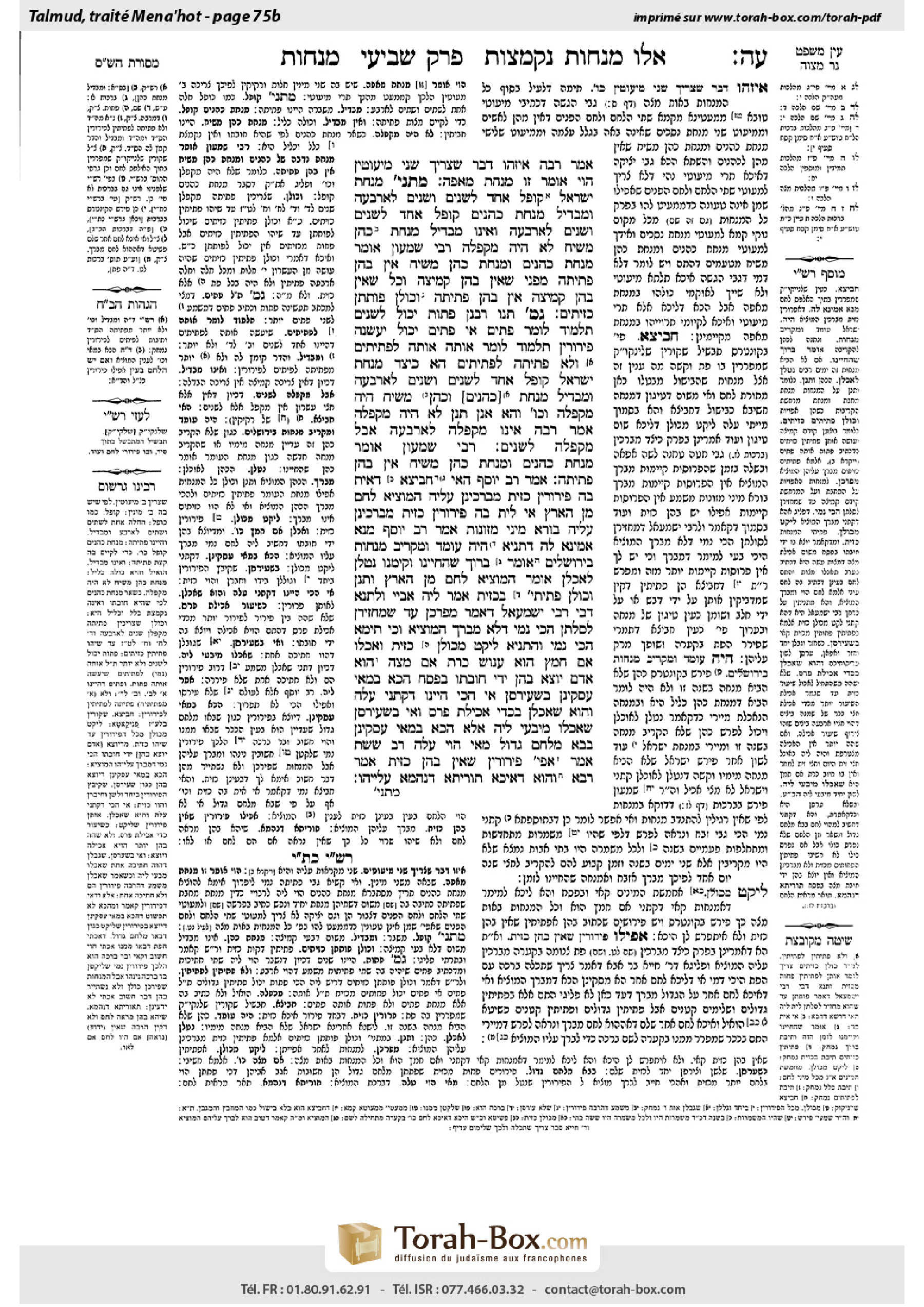
Menachot 75b: Talmud study for Daf Yomi
Daf Yomi is the daily study of one Talmud folio. Explore 37 tractates with scans, Hebrew text, Sefaria English and AI-generated French translations where annotated.
Passage selection and English or AI-generated French translation are available where the scan has annotations. Daf Study is independent of Torah-Box and Sefaria.
Browse Menachot · מנחות · All tractatesMenachot 75b text and translations
This page of Menachot includes the Aramaic text, an English translation and an AI-generated French translation, alongside the scan above.
מנחות ע״ה ב · Aramaic and Hebrew text
אָמַר רַבָּה: אֵיזֶהוּ דָּבָר שֶׁצָּרִיךְ שְׁנֵי מִיעוּטִין? הֱוֵי אוֹמֵר זוֹ מִנְחַת מַאֲפֶה.
מַתְנִי׳ מִנְחַת יִשְׂרָאֵל – קוֹפֵל אֶחָד לִשְׁנַיִם, וּשְׁנַיִם לְאַרְבָּעָה, וּמַבְדִּיל. מִנְחַת כֹּהֲנִים – קוֹפֵל אֶחָד לִשְׁנַיִם, וּשְׁנַיִם לְאַרְבָּעָה, וְאֵינוֹ מַבְדִּיל. מִנְחַת כֹּהֵן מָשִׁיחַ – לֹא הָיָה מְקַפְּלָה. רַבִּי שִׁמְעוֹן אוֹמֵר: מִנְחַת כֹּהֲנִים וּמִנְחַת כֹּהֵן מָשִׁיחַ אֵין בָּהֶן פְּתִיתָה, מִפְּנֵי שֶׁאֵין בָּהֶן קְמִיצָה, וְכֹל שֶׁאֵין בָּהֶן קְמִיצָה – אֵין בָּהֶן פְּתִיתָה. וְכוּלָּן פּוֹתְתָן כְּזֵיתִים.
גְּמָ׳ תָּנוּ רַבָּנַן: ״פָּתוֹת״ – יָכוֹל לִשְׁנַיִם? תַּלְמוּד לוֹמַר ״פִּתִּים״. אִי ״פִּתִּים״ – יָכוֹל יַעֲשֶׂנָּה פֵּירוּרִין? תַּלְמוּד לוֹמַר ״אֹתָהּ״ – אוֹתָהּ לִפְתִיתִים, וְלֹא פְּתִיתָה לִפְתִיתִים.
הָא כֵּיצַד? מִנְחַת יִשְׂרָאֵל – קוֹפֵל אֶחָד לִשְׁנַיִם וּשְׁנַיִם לְאַרְבָּעָה וּמַבְדִּיל. מִנְחַת כֹּהֲנִים וְכֹהֵן מָשִׁיחַ – הָיָה מְקַפְּלָה וְכוּ׳. וְהָא אֲנַן תְּנַן: לֹא הָיָה מְקַפְּלָה! אָמַר רַבָּה: אֵינוֹ מְקַפְּלָה לְאַרְבָּעָה, אֲבָל מְקַפְּלָה לִשְׁנַיִם.
רַבִּי שִׁמְעוֹן אוֹמֵר: מִנְחַת כֹּהֲנִים וּמִנְחַת כֹּהֵן מָשִׁיחַ אֵין בָּהֶן פְּתִיתָה. אָמַר רַב יוֹסֵף: הַאי חֲבִיצָא דְּאִית בַּהּ פֵּירוּרִין כְּזַיִת – מְבָרְכִינַן עֲלֵיהּ ״הַמּוֹצִיא לֶחֶם מִן הָאָרֶץ״, אִי לֵית בַּהּ פֵּירוּרִין כְּזַיִת – מְבָרְכִינַן עֲלֵיהּ ״בּוֹרֵא מִינֵי מְזוֹנוֹת״.
אָמַר רַב יוֹסֵף: מְנָא אָמֵינָא לַהּ? דְּתַנְיָא: הָיָה עוֹמֵד וּמַקְרִיב מְנָחוֹת בִּירוּשָׁלַיִם, אוֹמֵר: ״בָּרוּךְ שֶׁהֶחֱיָינוּ וְקִיְּמָנוּ״, נְטָלָן לְאׇכְלָן אוֹמֵר: ״הַמּוֹצִיא לֶחֶם מִן הָאָרֶץ״, וּתְנַן: וְכוּלָּן פְּתִיתִים בִּכְזַיִת.
אֲמַר לֵיהּ אַבָּיֵי: וּלְתַנָּא דְּבֵי רַבִּי יִשְׁמָעֵאל, דְּאָמַר מְפָרְכָן עַד שֶׁמַּחְזִירָן לְסׇלְתָּן, הָכִי נָמֵי דְּלָא מְבָרֵךְ ״הַמּוֹצִיא״?
וְכִי תֵּימָא הָכִי נָמֵי, וְהָתַנְיָא: לִיקֵּט מִכּוּלָּן כְּזַיִת וַאֲכָלוֹ, אִם חָמֵץ הוּא – עָנוּשׁ כָּרֵת, אִם מַצָּה הוּא – אָדָם יוֹצֵא בָּהֶן יְדֵי חוֹבָתוֹ בַּפֶּסַח.
הָכָא בְּמַאי עָסְקִינַן? בְּשֶׁעֵירְסָן.
אִי הָכִי, הַיְינוּ דְּקָתָנֵי עֲלַהּ: וְהוּא שֶׁאֲכָלָן בִּכְדֵי אֲכִילַת פְּרָס, וְאִי בְּשֶׁעֵירְסָן – ״שֶׁאֲכָלוֹ״ מִיבְּעֵי לֵיהּ! אֶלָּא הָכָא בְּמַאי עָסְקִינַן? בְּבָא מִלֶּחֶם גָּדוֹל.
מַאי הָוֵי עֲלַהּ? רַב שֵׁשֶׁת אָמַר: אֲפִילּוּ פֵּירוּרִין שֶׁאֵין בָּהֶן כְּזַיִת. אָמַר רָבָא: וְהוּא דְּאִיכָּא תּוֹרִיתָא דְּנַהְמָא עֲלַיְיהוּ.
Menachot 75b · English translation
Rabba says: This is the reason that wafers are also excluded from the mitzva of pouring, while a meal offering brought by a priest is not excluded: The verse uses two expressions of exclusion: “Upon it,” and: “It is a meal offering.” What is the matter that requires two exclusions? You must say: It is the oven-baked meal offering, of which there are two types of offerings: Wafers and loaves.
MISHNA: In breaking the meal offering of an Israelite into pieces, the priest folds [kofel] one into two and two into four and separates it at the folds. In breaking into pieces the meal offering of priests, the priest folds one into two and two into four and does not separate it at the folds. Because no handful is removed, separation is unnecessary. In the case of the griddle-cake meal offering of the anointed priest, he would not fold it. Rabbi Shimon says: In neither the meal offering of priests nor the meal offering of the anointed priest is there breaking into pieces, because in those meal offerings there is no removal of a handful. And any meal offering in which there is no removal of a handful there is no breaking into pieces. And in all meal offerings that are broken into pieces, the priest breaks them into olive-bulk-sized pieces.
GEMARA: With regard to the difference between the meal offering of an Israelite and that of a priest detailed in the mishna, the Sages taught in a baraita: The verse states: “You shall break it in pieces” (Leviticus 2:6). One might have thought that it should be broken into only two pieces. Therefore, the verse states: “Break it in pieces,” indicating that each of these two pieces is subsequently broken into more pieces. If the Torah requires pieces, one might have thought that he should repeatedly break it into pieces until he renders it into crumbs. Therefore, the verse states: “Break it,” i.e., break it in pieces, and do not break its pieces into additional pieces.
How so? In the case of the meal offering of an Israelite, the priest folds one into two and two into four and separates the pieces. In breaking into pieces the meal offering of priests and the anointed priest, the priest folds it into two, as it is stated: “In broken pieces you shall sacrifice the offering” (Leviticus 6:14). The Gemara asks: With regard to the meal offering of the anointed priest, didn’t we learn in the mishna: He would not fold it? Rabba says: He does not fold it into four, as it does not use the doubled phrase: “You shall break it in pieces [patot otah pitim],” but he does fold it into two.
The mishna teaches: Rabbi Shimon says: In neither the meal offering of priests nor the meal offering of the anointed priest is there breaking into pieces…and in all meal offerings that are broken into pieces, one breaks them into olive-bulk pieces. Rav Yosef said: Over this cooked dish, which contains pieces of bread that are the size of an olive-bulk, before eating it one recites upon it the blessing of: Who brings forth bread from the earth. Over that same cooked dish, if it does not contain pieces of bread that are the size of an olive-bulk, before eating it one recites upon it the blessing of: Who creates the various kinds of nourishment.
Rav Yosef said: From where do I say this halakha? As it is taught in a baraita: The first time an Israelite would stand and instruct a priest to sacrifice meal offerings in Jerusalem on his behalf, he would recite: Blessed are You, Lord our God, King of the universe, Who has given us life and sustained us and brought us to this time, as it is the first time that the Israelite fulfills the mitzva of bringing that offering. Following the removal of the handful, when the priest would take the meal offerings in order to eat them, he would first recite the blessing of: Who brings forth bread from the earth. And we learned in the mishna: And in all meal offerings that are broken into pieces, the priest breaks them into pieces the size of an olive-bulk. This proves that over pieces of bread that are the volume of an olive-bulk, one recites the blessing of: Who brings forth bread from the earth.
Abaye said to Rav Yosef: But according to the tanna of the school of Rabbi Yishmael, who said with regard to meal offerings: He crushes them continuously until he restores them to the form they had when they were flour, would you say that so too, in that case, one who eats a meal offering so prepared does not recite the blessing of: Who brings forth bread from the earth?
And if you would say that indeed, one does not recite that blessing over these meal offerings, that is difficult: But isn’t it taught in a baraita: With regard to one who gathered a portion the volume of an olive-bulk from all of the crumbs of the meal offerings and ate it, if it was an offering of leavened bread like that of a thanks offering, and he ate it on Passover, his act is punishable by karet. If it was an offering of unleavened bread, a person fulfills his obligation to eat matza on Passover through the consumption of those pieces. This indicates that pieces of bread, regardless of their volume, are always considered bread.
Rav Yosef answered him that this is not the halakha, and one does not recite a blessing over crumbs of bread as he would over actual bread. Rather, what are we dealing with here? We are dealing with a case where one kneaded the crumbs of bread together and pressed them [beshe’eirsan] into a single mass.
The Gemara challenges this: If so, that which is taught about the ruling in the baraita: And this is the halakha when he ate all of the crumbs that constitute the volume of an olive-bulk in the time it takes to eat a half-loaf [peras] of bread, is difficult. As, if it is a case where he pressed them into a single mass, the baraita should have taught: When he ate it, in the singular, as it is a single item. Rather, what are we dealing with here? We are dealing with a case where the crumbs came from a large loaf of bread. Although the crumbs themselves are each smaller than an olive-bulk, since they were broken from a large loaf, they are considered significant.
The Gemara asks: With regard to the blessing recited on the cooked dish with pieces less than an olive-bulk in volume, what halakhic conclusion was reached about it? Rav Sheshet says: Even when eating pieces of bread that do not have the volume of an olive-bulk, one recites the blessing of: Who brings forth bread from the earth. Rava said: And this is limited to a case where the crumbs still have the appearance [torita] of bread, and they did not dissolve completely.
Menachot 75b · Traduction française (IA)
Rabba dit : Telle est la raison pour laquelle les galettes sont elles aussi exclues de la mitsva de verser l’huile, tandis qu’une offrande de farine apportée par un prêtre ne l’est pas : le verset emploie deux expressions d’exclusion, « sur elle » et « c’est une offrande de farine ». Quel cas nécessite deux exclusions ? Il faut nécessairement dire qu’il s’agit de l’offrande de farine cuite au four, qui comprend deux sortes d’offrandes : les galettes et les pains.
MICHNA : Pour morceler l’offrande végétale d’un Israélite, le prêtre plie [kofel] un morceau en deux, puis chaque moitié en deux, et la sépare au niveau des plis. Pour morceler l’offrande végétale des prêtres, le prêtre plie un morceau en deux, puis chaque moitié en deux, mais ne la sépare pas au niveau des plis. Comme on n’en prélève pas de poignée, il n’est pas nécessaire de la séparer. Quant à l’offrande végétale cuite sur plaque du grand prêtre oint, il ne la pliait pas. Rabbi Shimon dit : Il n’y a de morcellement ni pour l’offrande végétale des prêtres ni pour celle du grand prêtre oint, car on ne prélève pas de poignée de ces offrandes. Et toute offrande végétale dont on ne prélève pas de poignée n’est pas morcelée. Dans toutes les offrandes végétales qui sont morcelées, le prêtre les casse en morceaux de la taille d’une olive.
GUEMARA : Au sujet de la différence entre l’offrande de farine d’un Israélite et celle d’un prêtre, exposée dans la Michna, les Sages enseignent dans une baraïta : Le verset dit : « Tu la briseras en morceaux » (Lévitique 2,6). On aurait pu penser qu’il fallait la briser en deux morceaux seulement. Le verset dit donc : « Tu la briseras en morceaux », ce qui indique que chacun de ces deux morceaux doit ensuite être brisé en plusieurs morceaux. Puisque la Torah exige des morceaux, on aurait pu penser qu’il fallait continuer à les briser jusqu’à les réduire en miettes. Le verset dit donc : « Tu la briseras », c’est-à-dire que tu la briseras en morceaux, mais que tu ne briseras pas ces morceaux en morceaux supplémentaires.
Comment cela ? Dans le cas de l’offrande de farine d’un Israélite, le prêtre en plie un morceau en deux, puis plie les deux morceaux en quatre, et les sépare. Pour briser en morceaux l’offrande de farine des prêtres et celle du prêtre oint, le prêtre la plie en deux, comme il est dit : « Tu présenteras l’offrande en morceaux brisés » (Lévitique 6,14). La Guemara demande : Au sujet de l’offrande de farine du prêtre oint, n’avons-nous pas appris dans la Michna qu’il ne la pliait pas ? Rabba dit : Il ne la plie pas en quatre, car l’expression redoublée « Tu la briseras en morceaux [patot otah pitim] » n’est pas employée à son sujet ; mais il la plie bien en deux.
La Michna enseigne : Rabbi Shimon dit qu’il n’y a de brisure ni pour l’offrande de farine des prêtres ni pour celle du prêtre oint… et que, pour toutes les offrandes de farine que l’on brise en morceaux, on les brise en morceaux de la taille d’une olive. Rav Yossef dit : Pour ce plat cuit qui contient des morceaux de pain de la taille d’une olive, on récite, avant de le manger, la bénédiction : « Qui fait sortir le pain de la terre ». Pour ce même plat cuit, s’il ne contient pas de morceaux de pain de la taille d’une olive, on récite, avant de le manger, la bénédiction : « Qui crée les diverses sortes de nourriture ».
Rav Yossef dit : D’où est-ce que je déduis cette halakha ? De ce qui est enseigné dans une baraïta : La première fois qu’un Israélite se tenait devant un prêtre à Jérusalem et lui demandait de présenter des offrandes de farine en son nom, il récitait : « Béni sois-Tu, Seigneur notre Dieu, Roi de l’univers, qui nous as fait vivre, nous as soutenus et nous as permis d’atteindre cette époque », car c’était la première fois que l’Israélite accomplissait la mitsva d’apporter cette offrande. Après le prélèvement de la poignée, lorsque le prêtre prenait les offrandes de farine pour les manger, il récitait d’abord la bénédiction : « Qui fait sortir le pain de la terre ». Et nous avons appris dans la Michna : « Pour toutes les offrandes de farine qui sont divisées en morceaux, le prêtre les divise en morceaux de la taille d’une olive. » Cela prouve que, pour des morceaux de pain ayant le volume d’une olive, on récite la bénédiction : « Qui fait sortir le pain de la terre ».
Abayé dit à Rav Yossef : Mais, selon le tanna de l’école de Rabbi Yishmaël, qui dit au sujet des offrandes de farine : « On les broie continuellement jusqu’à leur rendre la forme qu’elles avaient lorsqu’elles étaient de la farine », dirais-tu que, dans ce cas aussi, celui qui mange une offrande de farine préparée ainsi ne récite pas la bénédiction : « Qui fait sortir le pain de la terre » ?
Et si tu dis qu’en effet, on ne récite pas cette bénédiction sur ces offrandes de farine, cela pose une difficulté : N’est-il pas enseigné dans une baraïta que celui qui a rassemblé une quantité équivalant au volume d’une olive parmi toutes les miettes des offrandes de farine et l’a mangée est passible de karet si c’était une offrande de pain levé, comme celle de l’offrande de remerciement, et qu’il l’a mangée à Pessa’h ? Si c’était une offrande de pain azyme, on s’acquitte de son obligation de manger de la matsa à Pessa’h en consommant ces morceaux. Cela indique que les morceaux de pain sont toujours considérés comme du pain, quel que soit leur volume.
Rav Yossef lui répondit que telle n’est pas la halakha et qu’on ne récite pas sur des miettes de pain la bénédiction qu’on réciterait sur du pain proprement dit. De quel cas s’agit-il donc ? D’un cas où l’on a pétri les miettes de pain ensemble et les a pressées [beshe’eirsan] en une seule masse.
La Guemara objecte : Si c’est ainsi, l’enseignement de la baraïta concernant la règle suivante pose une difficulté : « Et telle est la halakha lorsqu’il a mangé toutes les miettes représentant le volume d’une olive dans le temps nécessaire pour manger un demi-pain [peras]. » En effet, s’il s’agit d’un cas où il les a pressées en une seule masse, la baraïta aurait dû enseigner : « lorsqu’il l’a mangée », au singulier, puisqu’il s’agit d’un seul élément. De quel cas s’agit-il donc ? D’un cas où les miettes proviennent d’un gros pain. Bien que chacune des miettes soit plus petite que le volume d’une olive, puisqu’elles ont été détachées d’un gros pain, elles sont considérées comme significatives.
La Guemara demande : Quelle conclusion halakhique a-t-on tirée au sujet de la bénédiction récitée sur le plat cuit contenant des morceaux dont le volume est inférieur à celui d’une olive ? Rav Sheshet dit : Même lorsqu’on mange des morceaux de pain qui n’ont pas le volume d’une olive, on récite la bénédiction : « Qui fait sortir le pain de la terre ». Rava dit : Cela ne vaut que dans le cas où les miettes ont encore l’apparence [torita] du pain et ne se sont pas entièrement dissoutes.
Traduction française générée par IA à partir de l’édition anglaise de Sefaria. Vérifie toujours un passage avec le texte source.
Text from Sefaria: William Davidson Edition - Vocalized Aramaic (unknown); William Davidson Edition - English (CC BY NC).