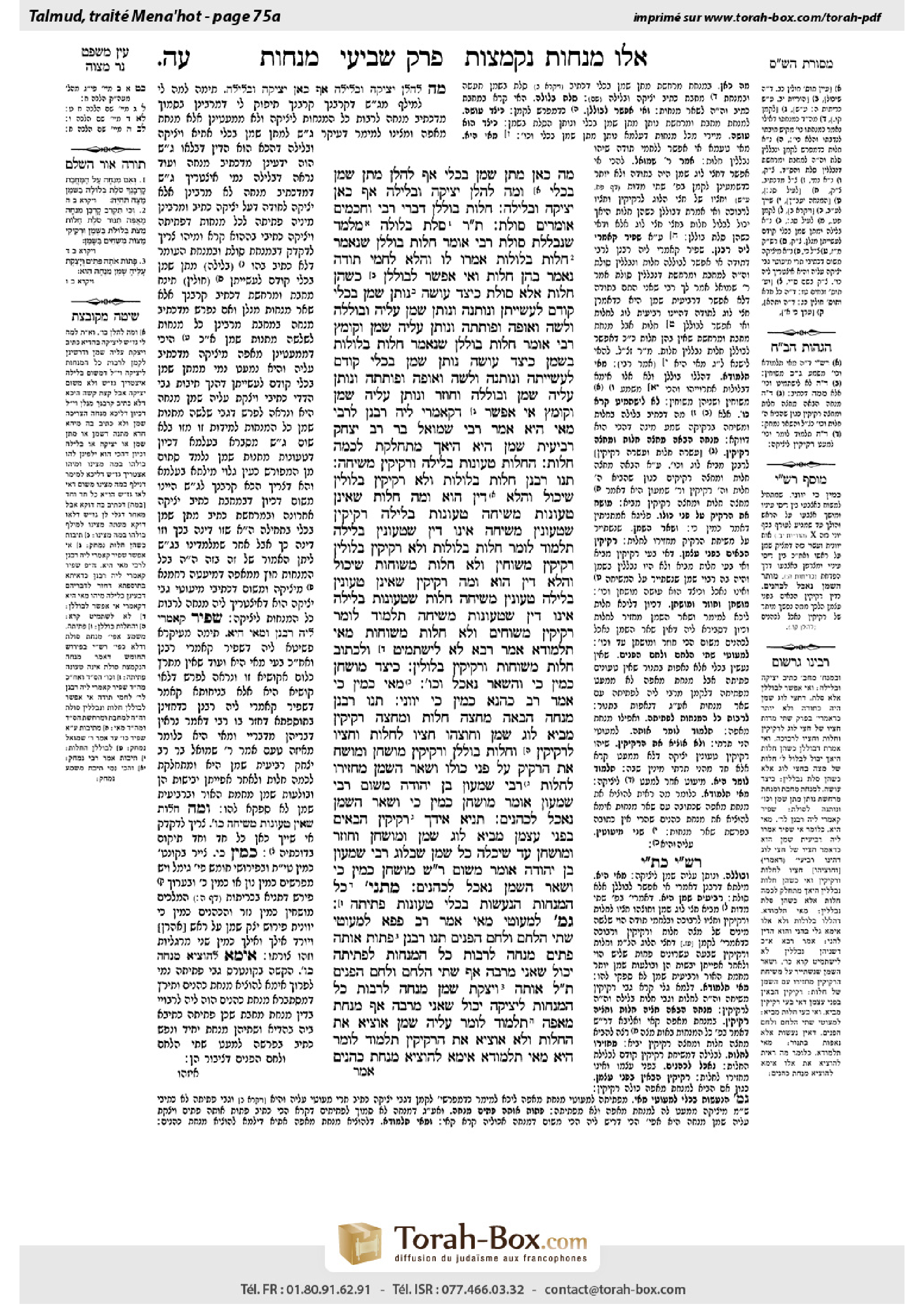
Menachot 75a: Talmud study for Daf Yomi
Daf Yomi is the daily study of one Talmud folio. Explore 37 tractates with scans, Hebrew text, Sefaria English and AI-generated French translations where annotated.
Passage selection and English or AI-generated French translation are available where the scan has annotations. Daf Study is independent of Torah-Box and Sefaria.
Browse Menachot · מנחות · All tractatesMenachot 75a text and translations
This page of Menachot includes the Aramaic text, an English translation and an AI-generated French translation, alongside the scan above.
מנחות ע״ה א · Aramaic and Hebrew text
מָה כָּאן – מַתַּן שֶׁמֶן בִּכְלִי, אַף לְהַלָּן – מַתַּן שֶׁמֶן בִּכְלִי. וּמָה לְהַלָּן – יְצִיקָה וּבְלִילָה, אַף כָּאן יְצִיקָה וּבְלִילָה.
חַלּוֹת – בּוֹלְלָן, דִּבְרֵי רַבִּי, וַחֲכָמִים אוֹמְרִים: סוֹלֶת.
תָּנוּ רַבָּנַן: ״סֹלֶת בְּלוּלָה״, מְלַמֵּד שֶׁנִּבְלֶלֶת סוֹלֶת. רַבִּי אוֹמֵר: חַלּוֹת בּוֹלְלָן, שֶׁנֶּאֱמַר: ״חַלּוֹת בְּלוּלֹת״. אָמְרוּ לוֹ: וַהֲלֹא לַחְמֵי תוֹדָה נֶאֱמַר בָּהֶן ״חַלּוֹת״, וְאִי אֶפְשָׁר לְבוֹלְלָן כְּשֶׁהֵן חַלּוֹת, אֶלָּא סוֹלֶת!
כֵּיצַד עוֹשֶׂה? נוֹתֵן שֶׁמֶן בִּכְלִי קוֹדֶם לַעֲשִׂיָּיתָן, וְנוֹתְנָהּ, וְנוֹתֵן שֶׁמֶן עָלֶיהָ וּבוֹלְלָהּ, וְלָשָׁהּ, וְאוֹפָהּ, וּפוֹתְתָהּ, וְנוֹתֵן עָלֶיהָ שֶׁמֶן, וְקוֹמֵץ.
רַבִּי אוֹמֵר: חַלּוֹת בּוֹלְלָן, שֶׁנֶּאֱמַר: ״חַלּוֹת בְּלוּלֹת בַּשֶּׁמֶן״. כֵּיצַד עוֹשֶׂה? נוֹתֵן שֶׁמֶן בִּכְלִי קוֹדֶם לַעֲשִׂיָּיתָהּ, וְנוֹתְנָהּ, וְלָשָׁהּ, וְאוֹפָהּ, וּפוֹתְתָהּ, וְנוֹתֵן עָלֶיהָ שֶׁמֶן, וּבוֹלְלָהּ, וְחוֹזֵר וְנוֹתֵן עָלֶיהָ שֶׁמֶן, וְקוֹמֵץ.
״אִי אֶפְשָׁר״ דְּקָאָמְרִי לֵיהּ רַבָּנַן לְרַבִּי, מַאי הִיא? אָמַר רַבִּי שְׁמוּאֵל בַּר רַב יִצְחָק: רְבִיעִית שֶׁמֶן הִיא, הֵיאַךְ מִתְחַלֶּקֶת לְכַמָּה חַלּוֹת?
הַחַלּוֹת טְעוּנוֹת בְּלִילָה, וּרְקִיקִין מְשִׁיחָה. תָּנוּ רַבָּנַן: ״חַלּוֹת בְּלוּלֹת״, וְלֹא רְקִיקִין בְּלוּלִין. שֶׁיָּכוֹל וַהֲלֹא דִּין הוּא: וּמָה חַלּוֹת שֶׁאֵינָן טְעוּנוֹת מְשִׁיחָה – טְעוּנוֹת בְּלִילָה, רְקִיקִין שֶׁטְּעוּנִין מְשִׁיחָה – אֵינוֹ דִּין שֶׁטְּעוּנִין בְּלִילָה! תַּלְמוּד לוֹמַר: ״חַלּוֹת בְּלוּלֹת״ – וְלֹא רְקִיקִין בְּלוּלִין.
״רְקִיקִין מְשׁוּחִין״, וְלֹא חַלּוֹת מְשׁוּחוֹת. שֶׁיָּכוֹל – וַהֲלֹא דִּין הוּא: וּמָה רְקִיקִין שֶׁאֵינָן טְעוּנִין בְּלִילָה – טְעוּנִין מְשִׁיחָה, חַלּוֹת שֶׁטְּעוּנוֹת בְּלִילָה – אֵינוֹ דִּין שֶׁטְּעוּנוֹת מְשִׁיחָה! תַּלְמוּד לוֹמַר ״רְקִיקִין מְשׁוּחִים״ – וְלֹא חַלּוֹת מְשׁוּחוֹת.
מַאי תַּלְמוּדָא? אָמַר רָבָא: לָא לִישְׁתְּמִיט וְלִכְתּוֹב ״חַלּוֹת מְשׁוּחוֹת וּרְקִיקִין בְּלוּלִין״.
כֵּיצַד מוֹשְׁחָן? כְּמִין כִּי, וְהַשְּׁאָר נֶאֱכָל וְכוּ׳. מַאי ״כְּמִין כִּי״? אָמַר רַב כָּהֲנָא: כְּמִין כִּי יְוָונִי.
תָּנוּ רַבָּנַן: מִנְחָה הַבָּאָה מֶחֱצָה חַלּוֹת וּמֶחֱצָה רְקִיקִין, מֵבִיא לוֹג שֶׁמֶן, וְחוֹצֵהוּ – חֶצְיוֹ לַחַלּוֹת וְחֶצְיוֹ לָרְקִיקִין.
וְחַלּוֹת בּוֹלְלָן, וּרְקִיקִין מוֹשְׁחָן, וּמוֹשֵׁחַ אֶת הָרָקִיק עַל פְּנֵי כּוּלּוֹ, וּשְׁאָר הַשֶּׁמֶן מַחְזִירוֹ לַחַלּוֹת. רַבִּי שִׁמְעוֹן בֶּן יְהוּדָה מִשּׁוּם רַבִּי שִׁמְעוֹן אוֹמֵר: מוֹשְׁחָן כְּמִין כִּי, וּשְׁאָר הַשֶּׁמֶן נֶאֱכָל לַכֹּהֲנִים.
תַּנְיָא אִידַּךְ: רְקִיקִין הַבָּאִים בִּפְנֵי עַצְמָן, מֵבִיא לוֹג שֶׁמֶן וּמוֹשְׁחָן, וְחוֹזֵר וּמוֹשְׁחָן, עַד שֶׁיִּכְלֶה כׇּל שֶׁמֶן שֶׁבַּלּוֹג. רַבִּי שִׁמְעוֹן בֶּן יְהוּדָה אוֹמֵר מִשּׁוּם רַבִּי שִׁמְעוֹן: מוֹשְׁחָן כְּמִין כִּי, וּשְׁאָר הַשֶּׁמֶן נֶאֱכָל לַכֹּהֲנִים.
מַתְנִי׳ כׇּל הַמְּנָחוֹת הַנַּעֲשׂוֹת בִּכְלִי טְעוּנוֹת פְּתִיתָה.
גְּמָ׳ לְמַעוֹטֵי מַאי? אָמַר רַב פָּפָּא: לְמַעוֹטֵי שְׁתֵּי הַלֶּחֶם וְלֶחֶם הַפָּנִים.
תָּנוּ רַבָּנַן: ״פָּתוֹת אֹתָהּ פִּתִּים מִנְחָה״ – לְרַבּוֹת כׇּל הַמְּנָחוֹת לִפְתִיתָה. יָכוֹל שֶׁאֲנִי מְרַבֶּה אַף שְׁתֵּי הַלֶּחֶם וְלֶחֶם הַפָּנִים? תַּלְמוּד לוֹמַר: ״אֹתָהּ״.
״וְיָצַקְתָּ ... שָׁמֶן מִנְחָה״ – לְרַבּוֹת כׇּל הַמְּנָחוֹת לִיצִיקָה. יָכוֹל שֶׁאֲנִי מְרַבֶּה אַף מִנְחַת מַאֲפֶה? תַּלְמוּד לוֹמַר ״עָלֶיהָ שָׁמֶן״.
אוֹצִיא אֶת הַחַלּוֹת וְלֹא אוֹצִיא אֶת הָרְקִיקִין? תַּלְמוּד לוֹמַר ״הִיא״. מַאי תַּלְמוּדָא? אֵימָא לְהוֹצִיא מִנְחַת כֹּהֲנִים!
Menachot 75a · English translation
Just as here, with regard to the deep-pan meal offering, the placement of oil in an empty utensil is required, to which the flour is added only afterward, so too there, with regard to the meal offering prepared in a shallow pan, the placement of oil in an empty utensil is required. And just as there, with regard to the meal offering prepared in a shallow pan, pouring and mixing are required, as the verse states: “Mixed with oil…and pour oil upon it” (Leviticus 2:5–6), so too here, with regard to the deep-pan meal offering, pouring and mixing are required.
§ The mishna teaches: With regard to meal offerings that come as loaves, i.e., those prepared in a shallow pan or deep pan or those baked in an oven, it is after the flour has been baked into loaves that one breaks them into pieces and mixes them with oil; this is the statement of Rabbi Yehuda HaNasi. And the Rabbis say: It is with fine flour, before the baking, that one mixes the oil.
The Sages taught in a baraita: With regard to the meal offering prepared in a shallow pan, the verse states: “It shall be of fine flour unleavened, mixed with oil.” This teaches that it is mixed while still flour. Rabbi Yehuda HaNasi says: It is after the flour has been baked into loaves that he mixes them, as it is stated: “And when you bring a meal offering baked in the oven, it shall be unleavened loaves of fine flour mixed with oil” (Leviticus 2:4). The Rabbis said to him: But is it not with regard to loaves of a thanks offering that it is stated: “Unleavened loaves mixed with oil…and loaves mixed with oil, of fine flour soaked” (Leviticus 7:12), and it is not possible to mix them when they are loaves, but only when they are fine flour?
The Gemara explains the procedure of mixing the oven-baked meal offerings according to the Rabbis. How does the priest perform the rite? He places oil in a utensil before the placement of the flour is done, and then he places the flour into the utensil. And he then places oil upon it and mixes it, and kneads it in lukewarm water, and bakes it in a shallow pan or a deep pan, in accordance with his vow. And then he breaks it into pieces, and he again places oil upon the pieces, which constitutes the required pouring, and he removes a handful for the altar.
Rabbi Yehuda HaNasi says: After the meal offerings have been baked into loaves, one breaks them into pieces and mixes them with oil, as it is stated: “Loaves of fine flour mixed with oil.” How does the priest perform the rite? He places oil in a utensil before the placement of the flour is done, and then he places the flour into the utensil. And then he kneads it in lukewarm water, and bakes it in a shallow pan or deep pan, and breaks the loaves into pieces, and places oil upon the pieces and mixes them, and again places oil upon the pieces, which constitutes the pouring of the oil, and removes a handful to be burned on the altar.
The Gemara asks: With regard to the difficulty that it is not possible to mix them when they are loaves, which the Rabbis said to Rabbi Yehuda HaNasi, what is it that makes it impossible? The Gemara answers that Rabbi Shmuel bar Rav Yitzḥak says: Since only a quarter-log of oil is used, how could it be divided among a number of loaves? As this is not sufficient oil to mix with baked offerings, it must be that the oil is mixed with the unbaked flour.
§ The mishna teaches: The loaves of the meal offering baked in an oven require mixing of their flour with oil, and wafers require only smearing. The Sages taught in a baraita: The verse specifies with regard to the oven-baked meal offering: “And when you bring a meal offering baked in the oven, it shall be unleavened loaves of fine flour mixed with oil” (Leviticus 2:4). This indicates that only the loaves are mixed, but the wafers are not mixed. This derivation is necessary, as one might have thought: Could the opposite conclusion not be derived through logical inference? And if loaves, which do not require smearing, do require mixing, then is it not logical that wafers, which require smearing, also require mixing? To counter this inference, the verse states: “Loaves of fine flour mixed,” but wafers are not mixed.
With regard to wafers, the same verse teaches that wafers are smeared with oil, but loaves are not smeared. This derivation is necessary, as one might have thought: Could the opposite conclusion not be derived through logical inference, namely: And if wafers, which do not require mixing, do require smearing, then is it not logical that loaves, which require mixing, also require smearing? To counter this inference, the verse states that wafers are smeared with oil, but loaves are not smeared.
The Gemara asks: What is the biblical derivation? Why are the terms “mixed” and “smeared” not interpreted to be referring to both varieties of oven-baked meal offerings? The Gemara answers: Rava said: If this were the intention, then the Torah should not omit this description completely, and let it write in some other verse: Smeared loaves and mixed wafers. The fact that the Torah never describes the loaves as smeared and wafers as mixed indicates that loaves are not smeared and wafers are not mixed.
§ The mishna teaches: How does one smear oil on them? He does so in a shape similar to chi, and the rest of the oil is eaten by priests. The Gemara asks: What is the meaning of: Similar to chi? Rav Kahana said: It is smeared in a shape similar to the Greek letter chi, Χ.
§ Concerning the mixing of oil into the loaves and the smearing of oil upon the wafers, the Sages taught in a baraita: An oven-baked meal offering that comes as half loaves and half wafers, i.e., five of each, may be brought according to the opinion of Rabbi Shimon, who does not require ten items of a uniform type. How is the oil applied to this offering? According to one opinion, he brings a log of oil, which is the requisite quantity to accompany a tenth of an ephah of flour, and divides it into two parts. Half of the oil is used for the loaves, and half of the oil is used for the wafers.
As for the loaves, he mixes them with the oil, and as for the wafers, he smears them. And he smears the oil on the wafer over the entire surface, not in the shape of the letter chi, and he returns the rest of the oil to mix into the loaves. Rabbi Shimon ben Yehuda says in the name of Rabbi Shimon: He smears them in a shape similar to the letter chi, and the rest of the oil is eaten by the priests.
It is taught in another baraita: In the case of ten wafers that come by themselves as a meal offering baked in the oven, and not as part of another offering, he brings a log of oil and smears them, and he again smears them repeatedly until all the oil in the log is finished. Rabbi Shimon ben Yehuda says in the name of Rabbi Shimon: He smears them in a shape similar to the letter chi, and the rest of the oil is eaten by the priests.
MISHNA: All the meal offerings that are prepared in a vessel require breaking into pieces.
GEMARA: The Gemara asks: To exclude what does the mishna state that this halakha applies specifically to meal offerings prepared in vessels? Rav Pappa said: The mishna serves to exclude the two loaves, i.e., the public offering on Shavuot of two loaves baked from new wheat, and the shewbread, the twelve loaves that were placed on the Table in the Sanctuary each Shabbat. Since these are baked in an oven and not prepared in vessels, they do not require breaking into pieces.
§ The Sages taught in a baraita that the verse discussing a meal offering prepared in a pan states: “You shall break it in pieces, and pour oil upon it; it is a meal offering” (Leviticus 2:6). The fact that the verse concludes with the phrase: “It is a meal offering,” indicates that the Torah means to include all the meal offerings in the requirement of breaking into pieces. One might have thought that I should include even the two loaves and the shewbread. Therefore, the verse states: “You shall break it in pieces”; i.e., the meal offering baked in a pan, but not the two loaves and the shewbread.
The baraita continues that the same verse states: “And you shall pour oil upon it; it is a meal offering.” The fact that the verse concludes with the phrase “It is a meal offering” indicates that the Torah means to include all the meal offerings in the requirement of pouring. One might have thought that I should include even the oven-baked meal offering. Therefore, the verse states: “And you shall pour oil upon it,” i.e., upon this meal offering, but not upon the oven-baked meal offering.
The baraita concludes: Perhaps I should exclude only the loaves from the requirement of pouring, but I should not exclude the wafers. Therefore, the verse states: “It is a meal offering,” indicating that wafers are also excluded. The Gemara asks: What is the biblical derivation, by which the term “it” excludes wafers specifically? Perhaps I will say: The term serves to exclude the meal offering of priests from the requirement of pouring.
Menachot 75a · Traduction française (IA)
De même qu’ici, à propos de l’offrande de farine préparée dans une poêle profonde, il faut verser l’huile dans un ustensile vide, puis seulement y ajouter la farine, de même là, à propos de l’offrande de farine préparée dans une poêle plate, il faut verser l’huile dans un ustensile vide. Et de même que là, à propos de l’offrande de farine préparée dans une poêle plate, il faut verser l’huile et mélanger, comme le dit le verset : « mêlée d’huile… et verse de l’huile dessus » (Lévitique 2, 5-6), de même ici, à propos de l’offrande de farine préparée dans une poêle profonde, il faut verser l’huile et mélanger.
§ La Michna enseigne : Pour les offrandes de farine apportées sous forme de pains, c’est-à-dire celles préparées dans une poêle plate ou profonde, ou celles cuites au four, on brise les pains en morceaux et on les mélange à l’huile après leur cuisson ; telle est l’opinion de Rabbi Yehouda HaNassi. Les Sages disent : on mélange l’huile à la farine fine avant la cuisson.
Les Sages ont enseigné dans une baraïta : À propos de l’offrande de farine préparée dans une poêle plate, le verset dit : « Elle sera de farine fine sans levain, mêlée d’huile. » Cela enseigne qu’on la mélange alors qu’elle est encore sous forme de farine. Rabbi Yehouda HaNassi dit : on la mélange après que la farine a été cuite en pains, comme il est dit : « Lorsque tu présenteras une offrande de farine cuite au four, elle sera composée de pains sans levain de farine fine mêlée d’huile » (Lévitique 2, 4). Les Sages lui dirent : N’est-il pas dit, à propos des pains de l’offrande de reconnaissance : « des pains sans levain mêlés d’huile… et des pains mêlés d’huile, de farine fine imbibée » (Lévitique 7, 12) ? Or, il n’est pas possible de les mélanger lorsqu’ils sont déjà des pains, mais seulement lorsqu’ils sont encore de la farine fine.
La Guemara explique la procédure de préparation des offrandes de farine cuites au four selon les Sages. Comment le prêtre accomplit-il le rite ? Il met de l’huile dans un ustensile avant d’y placer la farine, puis il y met la farine. Ensuite, il verse de l’huile dessus, mélange et pétrit le tout dans de l’eau tiède, puis le fait cuire dans une poêle plate ou profonde, selon son vœu. Puis il le brise en morceaux, verse de nouveau de l’huile sur les morceaux — ce qui constitue le versement requis — et en prélève une poignée pour l’autel.
Rabbi Yehouda HaNassi dit : Après que les offrandes de farine ont été cuites en pains, on les brise en morceaux et on les mélange à l’huile, comme il est dit : « des pains de farine fine mêlée d’huile ». Comment le prêtre accomplit-il le rite ? Il met de l’huile dans un ustensile avant d’y placer la farine, puis il y met la farine. Ensuite, il la pétrit dans de l’eau tiède, la fait cuire dans une poêle plate ou profonde, brise les pains en morceaux, verse de l’huile sur les morceaux et les mélange, puis verse de nouveau de l’huile sur les morceaux — ce qui constitue le versement de l’huile — et prélève une poignée destinée à être brûlée sur l’autel.
La Guemara demande : Concernant la difficulté soulevée par les Sages à Rabbi Yehouda HaNassi — à savoir qu’il n’est pas possible de mélanger les pains lorsqu’ils sont déjà cuits —, qu’est-ce qui rend cela impossible ? La Guemara répond que Rabbi Shmuel bar Rav Yitzḥak dit : Puisqu’on n’utilise qu’un quart de log d’huile, comment pourrait-on le répartir entre plusieurs pains ? Cette quantité d’huile ne suffit pas pour mélanger des offrandes déjà cuites ; il faut donc que l’huile soit mélangée à la farine avant la cuisson.
§ La Michna enseigne : Les pains de l’offrande de farine cuite au four doivent être mélangés à l’huile, tandis que les galettes ne nécessitent qu’un badigeonnage. Les Sages ont enseigné dans une baraïta : À propos de l’offrande de farine cuite au four, le verset précise : « Lorsque tu présenteras une offrande de farine cuite au four, elle sera composée de pains sans levain de farine fine mêlée d’huile » (Lévitique 2, 4). Cela indique que seuls les pains sont mélangés, mais pas les galettes. Cette déduction est nécessaire, car on aurait pu penser qu’une conclusion inverse se déduit par raisonnement logique : si les pains, qui ne nécessitent pas de badigeonnage, doivent être mélangés, n’est-il pas logique que les galettes, qui nécessitent un badigeonnage, doivent elles aussi être mélangées ? Pour écarter cette déduction, le verset dit : « des pains de farine fine mêlée » ; les galettes, elles, ne sont pas mélangées.
À propos des galettes, le même verset enseigne qu’elles sont badigeonnées d’huile, mais que les pains ne le sont pas. Cette déduction est nécessaire, car on aurait pu penser qu’une conclusion inverse se déduise par raisonnement logique, à savoir : si les galettes, qui ne nécessitent pas d’être mélangées, doivent être badigeonnées, n’est-il pas logique que les pains, qui doivent être mélangés, soient eux aussi badigeonnés ? Pour écarter cette déduction, le verset enseigne que les galettes sont badigeonnées d’huile, mais que les pains ne le sont pas.
La Guemara demande : Quelle est la déduction tirée de la Torah ? Pourquoi les termes « mêlée » et « badigeonnée » ne sont-ils pas interprétés comme s’appliquant aux deux sortes d’offrandes de farine cuites au four ? La Guemara répond : Rava dit : Si telle était l’intention, la Torah n’aurait pas omis complètement cette description ; elle aurait pu l’indiquer dans un autre verset en disant : « pains badigeonnés et galettes mélangées ». Le fait que la Torah ne décrive jamais les pains comme badigeonnés ni les galettes comme mélangées indique que les pains ne sont pas badigeonnés et que les galettes ne sont pas mélangées.
§ La Michna enseigne : Comment les badigeonne-t-on d’huile ? On le fait en forme de khi, et le reste de l’huile est consommé par les prêtres. La Guemara demande : Que signifie « en forme de khi » ? Rav Kahana dit : On badigeonne en forme de la lettre grecque khi, Χ.
§ À propos du mélange de l’huile aux pains et du badigeonnage des galettes, les Sages ont enseigné dans une baraïta : Une offrande de farine cuite au four composée pour moitié de pains et pour moitié de galettes, c’est-à-dire de cinq de chaque sorte, peut être apportée selon l’opinion de Rabbi Shimon, qui n’exige pas dix éléments tous du même type. Comment applique-t-on l’huile à cette offrande ? Selon un avis, on apporte un log d’huile, quantité requise pour accompagner un dixième d’épha de farine, et on le divise en deux parts. La moitié de l’huile sert pour les pains et l’autre moitié pour les galettes.
Pour les pains, on les mélange à l’huile ; pour les galettes, on les badigeonne. On étale l’huile sur toute la surface de chaque galette, et non en forme de la lettre khi, puis on remet le reste de l’huile dans le mélange des pains. Rabbi Shimon ben Yehouda dit au nom de Rabbi Shimon : On les badigeonne en forme de la lettre khi, et le reste de l’huile est consommé par les prêtres.
Il est enseigné dans une autre baraïta : Dans le cas de dix galettes apportées seules comme offrande de farine cuite au four, et non dans le cadre d’une autre offrande, on apporte un log d’huile et on les badigeonne, puis on continue à les badigeonner jusqu’à ce que tout le log d’huile ait été utilisé. Rabbi Shimon ben Yehouda dit au nom de Rabbi Shimon : On les badigeonne en forme de la lettre khi, et le reste de l’huile est consommé par les prêtres.
MICHNA : Toutes les offrandes de farine préparées dans un ustensile doivent être brisées en morceaux.
GUEMARA : La Guemara demande : Qu’est-ce que la Michna entend exclure en précisant que cette halakha s’applique aux offrandes de farine préparées dans des ustensiles ? Rav Pappa dit : La Michna entend exclure les deux pains, c’est-à-dire l’offrande publique de Chavouot composée de deux pains cuits avec du blé nouveau, ainsi que le pain de proposition, les douze pains placés sur la Table dans le Sanctuaire chaque Chabbat. Puisqu’ils sont cuits au four et non préparés dans des ustensiles, ils ne doivent pas être brisés en morceaux.
§ Les Sages ont enseigné dans une baraïta que le verset relatif à une offrande de farine préparée dans une poêle dit : « Tu la briseras en morceaux et tu verseras de l’huile dessus ; c’est une offrande de farine » (Lévitique 2, 6). Le fait que le verset se termine par l’expression « c’est une offrande de farine » indique que la Torah entend inclure toutes les offrandes de farine dans l’obligation d’être brisées en morceaux. On aurait pu penser qu’il fallait inclure aussi les deux pains et le pain de proposition. Le verset dit donc : « Tu la briseras en morceaux », c’est-à-dire l’offrande de farine cuite dans une poêle, mais pas les deux pains ni le pain de proposition.
La baraïta poursuit : Le même verset dit : « Et tu verseras de l’huile dessus ; c’est une offrande de farine. » Le fait que le verset se termine par l’expression « c’est une offrande de farine » indique que la Torah entend inclure toutes les offrandes de farine dans l’obligation de verser de l’huile. On aurait pu penser qu’il fallait inclure aussi l’offrande de farine cuite au four. Le verset dit donc : « Et tu verseras de l’huile dessus », c’est-à-dire sur cette offrande de farine, mais pas sur l’offrande de farine cuite au four.
La baraïta conclut : Peut-être faudrait-il exclure uniquement les pains de l’obligation de verser de l’huile, mais pas les galettes. Le verset dit donc : « C’est une offrande de farine », ce qui indique que les galettes sont elles aussi exclues. La Guemara demande : Quelle déduction tirée de la Torah permet au terme « c’est » d’exclure précisément les galettes ? Peut-être dirai-je que ce terme sert à exclure l’offrande de farine des prêtres de l’obligation de verser de l’huile.
Traduction française générée par IA à partir de l’édition anglaise de Sefaria. Vérifie toujours un passage avec le texte source.
Text from Sefaria: William Davidson Edition - Vocalized Aramaic (unknown); William Davidson Edition - English (CC BY NC).