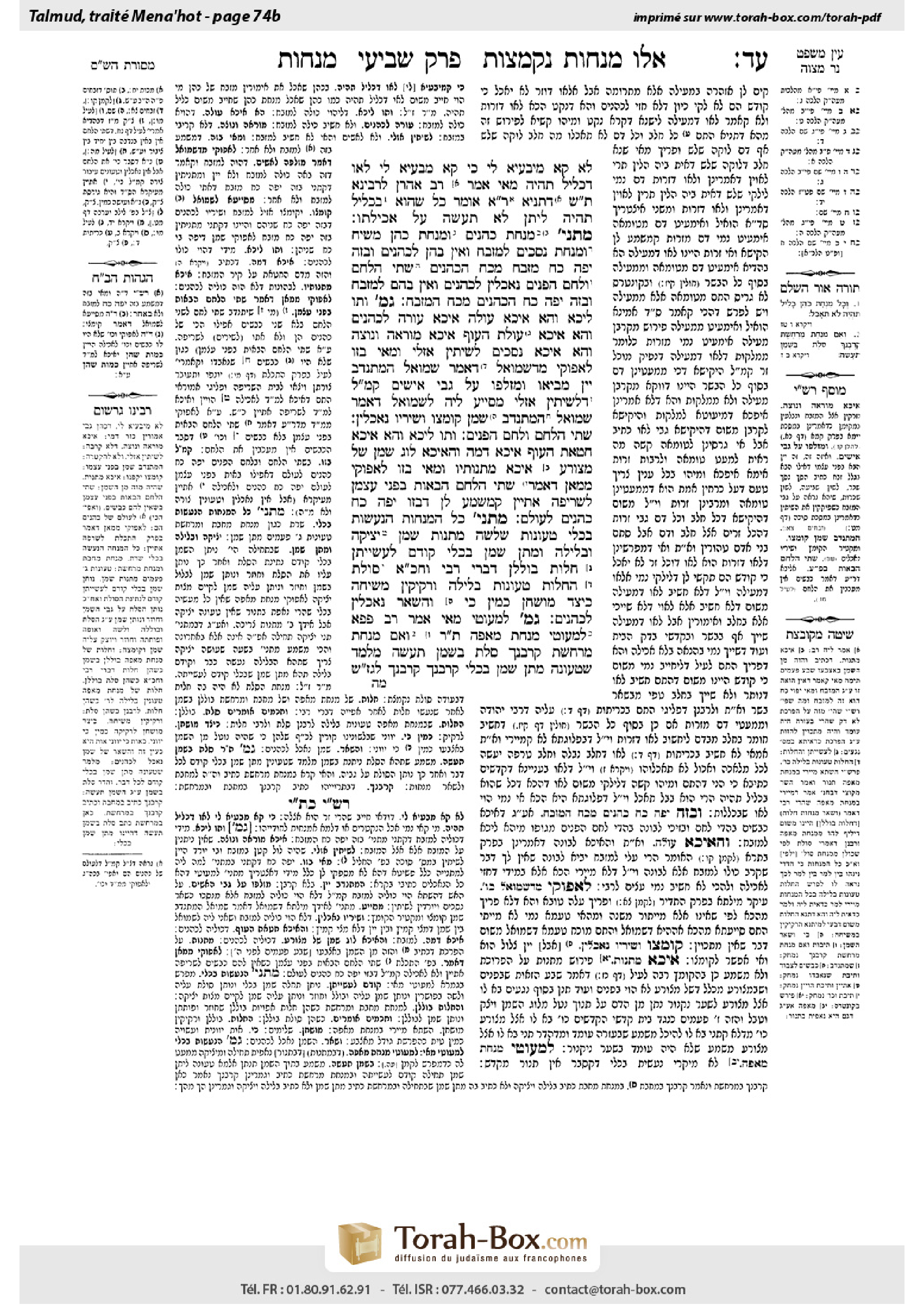
Menachot 74b: Talmud study for Daf Yomi
Daf Yomi is the daily study of one Talmud folio. Explore 37 tractates with scans, Hebrew text, Sefaria English and AI-generated French translations where annotated.
Passage selection and English or AI-generated French translation are available where the scan has annotations. Daf Study is independent of Torah-Box and Sefaria.
Browse Menachot · מנחות · All tractatesMenachot 74b text and translations
This page of Menachot includes the Aramaic text, an English translation and an AI-generated French translation, alongside the scan above.
מנחות ע״ד ב · Aramaic and Hebrew text
לָא קָא מִיבַּעְיָא לִי, כִּי קָא מִבַּעְיָא לִי לָאו דְּ״כָלִיל תִּהְיֶה״, מַאי?
אָמַר רַב אַהֲרֹן לְרָבִינָא: תָּא שְׁמַע דְּתַנְיָא, רַבִּי אֱלִיעֶזֶר אוֹמֵר: כֹּל שֶׁהוּא בְּ״כָלִיל תִּהְיֶה״, לִיתֵּן לֹא תַעֲשֶׂה עַל אֲכִילָתוֹ.
מַתְנִי׳ מִנְחַת כֹּהֲנִים, וּמִנְחַת כֹּהֵן מָשִׁיחַ, וּמִנְחַת נְסָכִים – לַמִּזְבֵּחַ, וְאֵין בָּהֶן לַכֹּהֲנִים. וּבָזֶה יִפָּה כֹּחַ מִזְבֵּחַ מִכֹּחַ הַכֹּהֲנִים. שְׁתֵּי הַלֶּחֶם וְלֶחֶם הַפָּנִים – נֶאֱכָלִין לַכֹּהֲנִים, וְאֵין בָּהֶם לַמִּזְבֵּחַ. וּבָזֶה יִפָּה כֹּחַ הַכֹּהֲנִים מִכֹּחַ הַמִּזְבֵּחַ.
גְּמָ׳ וְתוּ לֵיכָּא? וְהָא אִיכָּא עוֹלָה! אִיכָּא עוֹרָהּ לַכֹּהֲנִים. וְהָא אִיכָּא עוֹלַת הָעוֹף! אִיכָּא מוּרְאָה וְנוֹצָה. וְהָא אִיכָּא נְסָכִים! לְשִׁיתִין אָזְלִי.
וּמַאי ״בָּזוֹ״? לְאַפּוֹקֵי מִדִּשְׁמוּאֵל, דְּאָמַר שְׁמוּאֵל: הַמִּתְנַדֵּב יַיִן מְבִיאוֹ וּמְזַלְּפוֹ עַל גַּבֵּי אִישִּׁים, קָא מַשְׁמַע לַן דִּלְשִׁיתִין אָזְלִי.
מְסַיַּיע לֵיהּ לִשְׁמוּאֵל, דְּאָמַר שְׁמוּאֵל: הַמִּתְנַדֵּב שֶׁמֶן – קוֹמְצוֹ, וּשְׁיָרָיו נֶאֱכָלִין.
שְׁתֵּי הַלֶּחֶם וְלֶחֶם הַפָּנִים, וְתוּ לֵיכָּא? וְהָא אִיכָּא חַטַּאת הָעוֹף! אִיכָּא דָּמָהּ.
וְהָאִיכָּא לוֹג שֶׁמֶן שֶׁל מְצוֹרָע! אִיכָּא מַתְּנוֹתָיו.
וּמַאי ״בָּזוֹ״? לְאַפּוֹקֵי מִמַּאן דְּאָמַר: שְׁתֵּי הַלֶּחֶם הַבָּאוֹת בִּפְנֵי עַצְמָן לִשְׂרֵיפָה אָתְיָין, קָמַשְׁמַע לַן דְּבָזוֹ יִפָּה כֹּחַ כֹּהֲנִים לְעוֹלָם.
מַתְנִי׳ כׇּל הַמְּנָחוֹת הַנַּעֲשׂוֹת בִּכְלִי, טְעוּנוֹת שְׁלֹשָׁה מַתָּנוֹת שֶׁמֶן: יְצִיקָה, וּבְלִילָה, וּמַתַּן שֶׁמֶן בִּכְלִי קוֹדֵם לַעֲשִׂיָּיתָן.
חַלּוֹת בּוֹלְלָן, דִּבְרֵי רַבִּי, וַחֲכָמִים אוֹמְרִים: סוֹלֶת. הַחַלּוֹת טְעוּנוֹת בְּלִילָה, וּרְקִיקִין – מְשִׁיחָה. כֵּיצַד מוֹשְׁחָן? כְּמִין כִּי, וְהַשְּׁאָר נֶאֱכָלִין לַכֹּהֲנִים.
גְּמָ׳ לְמַעוֹטֵי מַאי? אָמַר רַב פָּפָּא: לְמַעוֹטֵי מִנְחַת מַאֲפֶה.
תָּנוּ רַבָּנַן: ״וְאִם מִנְחַת מַרְחֶשֶׁת קׇרְבָּנֶךָ סֹלֶת בַּשֶּׁמֶן תֵּעָשֶׂה״, מְלַמֵּד שֶׁטְּעוּנָה מַתַּן שֶׁמֶן בִּכְלִי. ״קׇרְבָּנֶךָ״ ״קׇרְבָּנֶךָ״ לִגְזֵרָה שָׁוָה,
Menachot 74b · English translation
I do not raise the dilemma. When I raise the dilemma, it is with regard to the prohibition of: “Shall be offered in its entirety; it shall not be eaten.” What is the halakha? Is this prohibition applicable only to the meal offering of a priest mentioned in the verse, or does it apply to a priest who eats from the sacrificial portions as well?
Rav Aharon said to Ravina: Come and hear an answer to this question from that which is taught in a baraita: Rabbi Eliezer says: With regard to every sacrificial item, not just the meal offering of a priest, such as the sacrificial portions, which is included in the category of “shall be offered in its entirety” that requires it to be burned, the verse serves to impose a prohibition against eating it.
MISHNA: The meal offering of priests, the meal offering of the anointed priest, i.e., the High Priest, and the meal offering brought with libations that accompany burnt offerings and peace offerings are burned in their entirety on the altar, and there is no part of them for the priests. And in the case of those offerings, the power of the altar is greater than the power of the priests. The two loaves, i.e., the public offering on Shavuot of two loaves baked from new wheat, and the shewbread, i.e., the twelve loaves that were placed on the sacred Table in the Sanctuary each Shabbat, are eaten by the priests, and there is no part of them burned on the altar. And in the case of those offerings, the power of the priests is greater than the power of the altar.
GEMARA: The Gemara asks: And are there no additional cases of sacrificial items that are completely placed on the altar, with none of their parts given to the priests? But isn’t there the burnt offering, which is completely burned on the altar? The Gemara answers: There is the burnt offering’s hide, which is given to the priests. The Gemara asks: But isn’t there the bird sacrificed as a burnt offering, whose skin is not given to the priests? The Gemara answers: There is the bird burnt offering’s crop and its feathers, which are not burned upon the altar. The Gemara asks: But aren’t there wine libations, which are completely poured onto the altar? The Gemara answers: The libations go to the drainpipes, and pouring the wine into the drainpipes is not considered placing it upon the altar.
The Gemara asks: And what is meant when the mishna emphasizes: And in the case of those offerings, the power of the altar is greater than the power of the priests, indicating that there are other items that one might have thought are burned entirely on the altar as well? The Gemara answers: The mishna’s wording serves to exclude the opinion of Shmuel, as Shmuel said: One who donates wine brings it and pours it over the fires of the altar, such that it is offered in the manner of an animal offering and not as a libation. Therefore, the mishna’s wording teaches us that wine donated in this manner goes to the drainpipes, unlike according to the opinion of Shmuel that it is entirely burned.
The Gemara adds: With regard to another ruling, the mishna supports a different statement of Shmuel. As Shmuel said: One who donates oil to the Temple removes a handful and sacrifices it on the altar, and its remainder is eaten by the priests. Shmuel’s ruling is in accordance with the mishna, which does not list a donation of oil as one of the offerings given completely to the altar.
§ According to the mishna, with regard to the two loaves and the shewbread, the power of the priests is greater than the power of the altar. The Gemara asks: And are there no more cases of sacrificial items that are given completely to the priests, with none of their parts placed upon the altar? But isn’t there the bird sacrificed as a sin offering, which is eaten entirely by the priests, and none of it is placed upon the altar? The Gemara answers: There is its blood, which is sprinkled upon the altar.
The Gemara asks: But isn’t there the log of oil of a leper that he brings on the day that he becomes ritually clean, which is given completely to the priests? The Gemara answers: It is not given completely to the priests, as there are its placements, when oil is sprinkled seven times “before the Lord” (Leviticus 14:16), and applied to the leper’s right ear, thumb, and big toe (see Leviticus 14:17).
The Gemara asks: And what is meant when the mishna emphasizes: And in the case of those offerings, the power of the priests is greater than the power of the altar? The Gemara answers: This wording serves to exclude the opinion of the one who says: The two loaves that are brought by themselves, unaccompanied by the requisite two lambs, may not be offered, and instead of being eaten they go to be burned. By emphasizing that the two loaves and the shewbread are eaten by the priests and not placed on the altar, the mishna teaches us that in this case, the power of the priests is always greater, even if the two lambs are not offered with the two loaves.
MISHNA: All the meal offerings that are prepared in a vessel, e.g., the offerings prepared in a pan or deep pan, require three placements of oil, listed here in the reverse order of their placement: Pouring oil on the cakes after they have been cooked, and mixing oil into the flour, and placement of oil into the vessel prior to preparation of the meal offerings.
In the meal offerings that come as loaves, it is after the flour has been baked into loaves that one breaks them into pieces and mixes them with oil; this is the statement of Rabbi Yehuda HaNasi. And the Rabbis say: It is with fine flour that one mixes the oil. Although the loaves of the meal offering baked in an oven require mixing of their flour with oil, wafers do not require mixing, but rather a smearing of oil on them after baking. How does one smear oil on them? He does so in a shape similar to the Greek letter chi, Χ, and the rest of the oil remaining after smearing is eaten by priests.
GEMARA: With regard to the statement of the mishna that all the meal offerings prepared in a vessel require three placements of oil, the Gemara asks: To exclude what does the mishna specify: Meal offerings prepared in a vessel? Rav Pappa said: The mishna serves to exclude the oven-baked meal offering, whose preparation does not require the use of a service vessel, as it is merely baked in an oven. Such a meal offering does not require the pouring of the oil.
With regard to the three placements of oil in a pan meal offering and a deep-pan meal offering, the Sages taught that the verse states: “And if your offering is a deep-pan meal offering, it shall be made of fine flour in oil” (Leviticus 2:7). This teaches that it requires the placement of oil in an empty vessel, and the flour is added afterward. In addition, the term “your offering” in this verse and the term “your offering” (Leviticus 2:5), written with regard to the meal offering prepared in a pan, are understood to teach a verbal analogy:
Menachot 74b · Traduction française (IA)
Je ne soulève pas cette question. Lorsque je la soulève, c’est au sujet de l’interdiction : « Elle sera offerte tout entière ; elle ne sera pas mangée. » Quelle est la halakha ? Cette interdiction s’applique-t-elle uniquement à l’oblation d’un prêtre mentionnée dans le verset, ou également au prêtre qui mange des portions sacrificielles ?
Rav Aharon dit à Ravina : « Viens et écoute une réponse à cette question, tirée de ce qui est enseigné dans une baraïta : Rabbi Eliezer dit : Pour tout élément sacrificiel, et pas seulement pour l’oblation d’un prêtre, comme les portions sacrificielles qui relèvent de la catégorie de ce qui « sera offert tout entier » et doit être brûlé, le verset établit une interdiction de le manger. »
MICHNA : L’oblation des prêtres, l’oblation du prêtre oint, c’est-à-dire du grand prêtre, et l’oblation apportée avec les libations qui accompagnent les holocaustes et les sacrifices de paix sont entièrement brûlées sur l’autel, et aucune part ne revient aux prêtres. Dans le cas de ces offrandes, le pouvoir de l’autel l’emporte sur celui des prêtres. Les deux pains, c’est-à-dire l’offrande publique de Chavouot composée de deux pains cuits avec du blé nouveau, et les pains de proposition, c’est-à-dire les douze pains placés chaque Chabbat sur la Table sacrée dans le Sanctuaire, sont mangés par les prêtres, et aucune part n’en est brûlée sur l’autel. Dans le cas de ces offrandes, le pouvoir des prêtres l’emporte sur celui de l’autel.
GUEMARA : La Guemara demande : N’y a-t-il pas d’autres éléments sacrificiels entièrement placés sur l’autel, sans qu’aucune de leurs parts soit donnée aux prêtres ? Mais l’holocauste n’en est-il pas un, puisqu’il est entièrement brûlé sur l’autel ? La Guemara répond : La peau de l’holocauste est donnée aux prêtres. La Guemara demande : Mais l’oiseau offert en holocauste n’en est-il pas un, puisque sa peau n’est pas donnée aux prêtres ? La Guemara répond : Le jabot et les plumes de l’oiseau offert en holocauste ne sont pas brûlés sur l’autel. La Guemara demande : Mais les libations de vin n’en sont-elles pas un exemple, puisqu’elles sont entièrement versées sur l’autel ? La Guemara répond : Les libations vont dans les conduits d’évacuation, et verser le vin dans ces conduits n’est pas considéré comme le placer sur l’autel.
La Guemara demande : Que signifie l’insistance de la Michna lorsqu’elle dit : « Dans le cas de ces offrandes, le pouvoir de l’autel l’emporte sur celui des prêtres » ? Cela laisse entendre qu’il existe d’autres éléments que l’on aurait pu croire également entièrement brûlés sur l’autel. La Guemara répond : Cette formulation de la Michna vise à exclure l’opinion de Chmouel, car Chmouel a dit : Celui qui fait don de vin l’apporte et le verse sur les feux de l’autel, de sorte que le vin est offert à la manière d’une offrande animale, et non comme une libation. La formulation de la Michna nous enseigne donc que le vin offert de cette manière va dans les conduits d’évacuation, contrairement à l’opinion de Chmouel, selon laquelle il est entièrement brûlé.
La Guemara ajoute : À propos d’une autre règle, la Michna étaye une autre déclaration de Chmouel. Chmouel a dit : Celui qui fait don d’huile au Temple en prélève une poignée et l’offre sur l’autel ; le reste est mangé par les prêtres. La décision de Chmouel concorde avec la Michna, qui ne mentionne pas le don d’huile parmi les offrandes entièrement attribuées à l’autel.
§ Selon la Michna, pour les deux pains et les pains de proposition, le pouvoir des prêtres l’emporte sur celui de l’autel. La Guemara demande : N’y a-t-il pas d’autres éléments sacrificiels entièrement donnés aux prêtres, sans qu’aucune de leurs parts soit placée sur l’autel ? Mais l’oiseau offert en sacrifice expiatoire n’en est-il pas un exemple, puisqu’il est entièrement mangé par les prêtres et qu’aucune partie n’en est placée sur l’autel ? La Guemara répond : Son sang est aspergé sur l’autel.
La Guemara demande : Mais le log d’huile du lépreux, qu’il apporte le jour où il retrouve la pureté rituelle, n’est-il pas entièrement donné aux prêtres ? La Guemara répond : Il n’est pas entièrement donné aux prêtres, car une partie de l’huile est utilisée pour les aspersions : elle est aspergée sept fois « devant le Seigneur » (Lévitique 14:16), puis appliquée sur l’oreille droite, le pouce et le gros orteil du lépreux (voir Lévitique 14:17).
La Guemara demande : Que signifie l’insistance de la Michna lorsqu’elle dit : « Dans le cas de ces offrandes, le pouvoir des prêtres l’emporte sur celui de l’autel » ? La Guemara répond : Cette formulation vise à exclure l’opinion de celui qui dit que les deux pains apportés seuls, sans les deux agneaux qui doivent les accompagner, ne peuvent pas être offerts et doivent être brûlés au lieu d’être mangés. En soulignant que les deux pains et les pains de proposition sont mangés par les prêtres et non placés sur l’autel, la Michna nous enseigne que, dans ce cas, le pouvoir des prêtres l’emporte toujours, même si les deux agneaux ne sont pas offerts avec les deux pains.
MICHNA : Toutes les oblations préparées dans un récipient, par exemple celles préparées dans une poêle ou une poêle profonde, nécessitent trois apports d’huile, énumérés ici dans l’ordre inverse de leur réalisation : verser de l’huile sur les gâteaux après leur cuisson, mélanger de l’huile à la farine et verser de l’huile dans le récipient avant la préparation des oblations.
Pour les oblations présentées sous forme de pains, c’est après que la farine a été cuite en pains qu’on les rompt en morceaux et qu’on les mélange à l’huile ; telle est la déclaration de Rabbi Yehouda HaNassi. Les Sages disent : On mélange l’huile à la farine fine. Bien que les pains de l’oblation cuite au four nécessitent que leur farine soit mélangée à l’huile, les galettes n’ont pas besoin d’être mélangées à l’huile ; on les enduit plutôt d’huile après la cuisson. Comment les enduit-on d’huile ? On trace une forme semblable à la lettre grecque khi, Χ, et le reste de l’huile qui demeure après l’onction est mangé par les prêtres.
GUEMARA : À propos de la déclaration de la Michna selon laquelle toutes les oblations préparées dans un récipient nécessitent trois apports d’huile, la Guemara demande : Qu’est-ce que la Michna entend exclure en précisant « les oblations préparées dans un récipient » ? Rav Pappa dit : La Michna vise à exclure l’oblation cuite au four, dont la préparation ne nécessite pas l’emploi d’un ustensile de service, puisqu’elle est simplement cuite au four. Une telle oblation ne nécessite pas qu’on y verse de l’huile.
Au sujet des trois apports d’huile dans une oblation préparée à la poêle et une oblation préparée dans une poêle profonde, les Sages ont enseigné que le verset dit : « Et si ton offrande est une oblation à la poêle profonde, elle sera faite de farine fine avec de l’huile » (Lévitique 2:7). Cela enseigne qu’il faut verser l’huile dans un récipient vide, puis ajouter la farine. En outre, l’expression « ton offrande » dans ce verset et l’expression « ton offrande » (Lévitique 2:5), écrite à propos de l’oblation préparée à la poêle, sont interprétées comme établissant une analogie verbale :
Traduction française générée par IA à partir de l’édition anglaise de Sefaria. Vérifie toujours un passage avec le texte source.
Text from Sefaria: William Davidson Edition - Vocalized Aramaic (unknown); William Davidson Edition - English (CC BY NC).