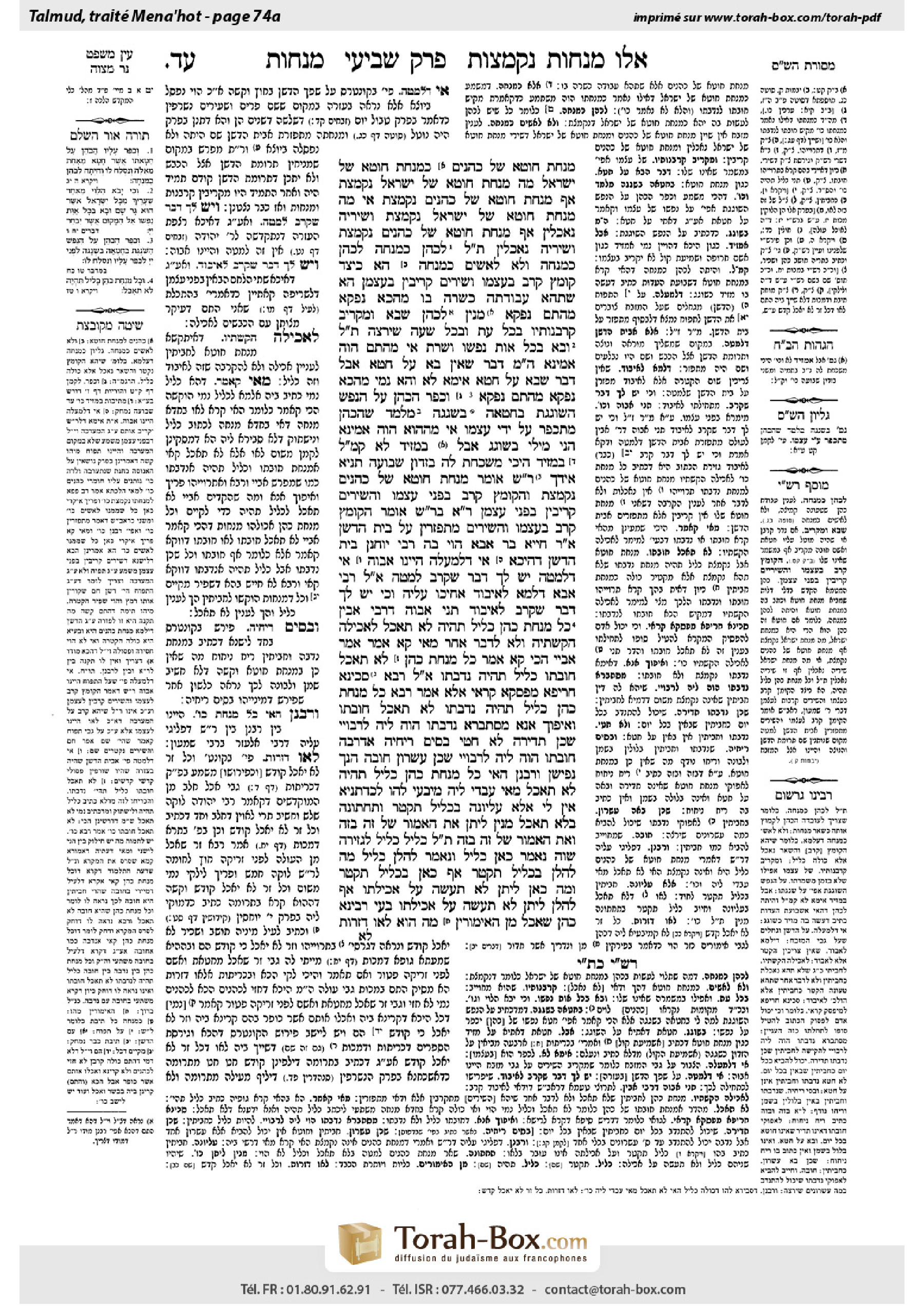
Menachot 74a: Talmud study for Daf Yomi
Daf Yomi is the daily study of one Talmud folio. Explore 37 tractates with scans, Hebrew text, Sefaria English and AI-generated French translations where annotated.
Passage selection and English or AI-generated French translation are available where the scan has annotations. Daf Study is independent of Torah-Box and Sefaria.
Browse Menachot · מנחות · All tractatesMenachot 74a text and translations
This page of Menachot includes the Aramaic text, an English translation and an AI-generated French translation, alongside the scan above.
מנחות ע״ד א · Aramaic and Hebrew text
מִנְחַת חוֹטֵא שֶׁל כֹּהֲנִים כְּמִנְחַת חוֹטֵא שֶׁל יִשְׂרָאֵל – מָה מִנְחַת חוֹטֵא שֶׁל יִשְׂרָאֵל נִקְמֶצֶת, אַף מִנְחַת חוֹטֵא שֶׁל כֹּהֲנִים נִקְמֶצֶת.
אִי מָה מִנְחַת חוֹטֵא שֶׁל יִשְׂרָאֵל נִקְמֶצֶת וּשְׁיָרֶיהָ נֶאֱכָלִין, אַף מִנְחַת חוֹטֵא שֶׁל כֹּהֲנִים נִקְמֶצֶת וּשְׁיָרֶיהָ נֶאֱכָלִין?
תַּלְמוּד לוֹמַר ״לַכֹּהֵן כַּמִּנְחָה״, לַכֹּהֵן כַּמִּנְחָה, וְלֹא לָאִשִּׁים כַּמִּנְחָה. הָא כֵּיצַד? קוֹמֶץ קָרֵב בְּעַצְמוֹ, וְשִׁירַיִם קְרֵיבִין בְּעַצְמָן.
הָא שֶׁתְּהֵא עֲבוֹדָתָהּ כְּשֵׁרָה בּוֹ, מֵהָכָא נָפְקָא?
מֵהָתָם נָפְקָא, מִנַּיִן לַכֹּהֵן שֶׁבָּא וּמַקְרִיב קׇרְבְּנוֹתָיו בְּכׇל עֵת וּבְכׇל שָׁעָה שֶׁיִּרְצֶה? תַּלְמוּד לוֹמַר: ״וּבָא בְּכׇל אַוַּת נַפְשׁוֹ וְשֵׁרֵת״.
אִי מֵהָתָם, הֲוָה אָמֵינָא: הָנֵי מִילֵּי – דָּבָר שֶׁאֵין בָּא עַל חֵטְא, אֲבָל דָּבָר שֶׁבָּא עַל חֵטְא – אֵימָא לָא.
וְהָא נָמֵי מֵהָכָא נָפְקָא? מֵהָתָם נָפְקָא: ״וְכִפֶּר הַכֹּהֵן עַל הַנֶּפֶשׁ הַשֹּׁגֶגֶת בְּחֶטְאָה בִשְׁגָגָה״, מְלַמֵּד שֶׁהַכֹּהֵן מִתְכַּפֵּר עַל יְדֵי עַצְמוֹ!
אִי מֵהָהוּא, הֲוָה אָמֵינָא: הָנֵי מִילֵּי – בְּשׁוֹגֵג, אֲבָל בְּמֵזִיד – לָא, קָא מַשְׁמַע לַן.
בְּמֵזִיד, הֵיכִי מַשְׁכַּחַתְּ לַהּ? בִּזְדוֹן שְׁבוּעָה.
תַּנְיָא אִידַּךְ, רַבִּי שִׁמְעוֹן אוֹמֵר: מִנְחַת חוֹטֵא שֶׁל כֹּהֲנִים נִקְמֶצֶת, וְהַקּוֹמֵץ קָרֵב בִּפְנֵי עַצְמוֹ, וְהַשִּׁירַיִם קְרֵיבִין בִּפְנֵי עַצְמָן. רַבִּי אֶלְעָזָר בְּרַבִּי שִׁמְעוֹן אוֹמֵר: הַקּוֹמֶץ קָרֵב בְּעַצְמוֹ, וְהַשִּׁירַיִם מִתְפַּזְּרִין עַל בֵּית הַדֶּשֶׁן.
אָמַר רַבִּי חִיָּיא בַּר אַבָּא: הָוֵי בַּהּ רַבִּי יוֹחָנָן, בֵּית הַדֶּשֶׁן דְּהֵיכָא? אִי דִּלְמַעְלָה – הַיְינוּ אֲבוּהּ, אִי דִּלְמַטָּה – יֵשׁ לְךָ דָּבָר שֶׁקָּרֵב לְמַטָּה?
אֲמַר לֵיהּ רַבִּי אַבָּא: דִּלְמָא לְאִיבּוּד? אַחִיכוּ עֲלֵיהּ, וְכִי יֵשׁ לְךָ דָּבָר שֶׁקָּרֵב לְאִיבּוּד?
תָּנֵי אֲבוּהּ דְּרַבִּי אָבִין: ״כׇּל מִנְחַת כֹּהֵן כָּלִיל תִּהְיֶה לֹא תֵאָכֵל״ – לַאֲכִילָה הִקַּשְׁתִּיהָ, וְלֹא לְדָבָר אַחֵר.
מַאי קָא אָמַר? אָמַר אַבָּיֵי: הָכִי קָא אָמַר – ״כׇּל מִנְחַת כֹּהֵן ... לֹא תֵאָכֵל״ – חוֹבָתוֹ, ״כָּלִיל תִּהְיֶה״ – נִדְבָתוֹ. אֲמַר לֵיהּ רָבָא: סַכִּינָא חֲרִיפָא מַפְסְקָא קְרָאֵי!
אֶלָּא אָמַר רָבָא: ״כׇּל מִנְחַת כֹּהֵן כָּלִיל תִּהְיֶה״ – נִדְבָתוֹ, ״לֹא תֵאָכֵל״ – חוֹבָתוֹ.
וְאֵיפוֹךְ אֲנָא? מִסְתַּבְּרָא נִדְבָתוֹ הֲוָה לֵיהּ לְרַבּוֹיֵי, שֶׁכֵּן תְּדִירָה, לָא חָטֵי, בְּסִים רֵיחֵיהּ.
אַדְּרַבָּה, חוֹבָתוֹ הֲוָה לֵיהּ לְרַבּוֹיֵי, שֶׁכֵּן עִשָּׂרוֹן חוֹבָה! הָנָךְ נְפִישָׁן.
וְרַבָּנַן, הַאי ״כׇּל מִנְחַת כֹּהֵן כָּלִיל תִּהְיֶה לֹא תֵאָכֵל״, מַאי עָבְדִי לֵיהּ?
מִיבְּעֵי לְהוּ לְכִדְתַנְיָא: אֵין לִי אֶלָּא עֶלְיוֹנָה בְּ״כָלִיל תׇּקְטָר״, וְתַחְתּוֹנָה בְּ״לֹא תֵאָכֵל״.
מִנַּיִן לִיתֵּן אֶת הָאָמוּר שֶׁל זֶה בָּזֶה, וְאֶת הָאָמוּר שֶׁל זֶה בָּזֶה? תַּלְמוּד לוֹמַר ״כָּלִיל״ ״כָּלִיל״ לִגְזֵירָה שָׁוָה: נֶאֱמַר כָּאן ״כָּלִיל״, וְנֶאֱמַר לְהַלָּן ״כָּלִיל״,
מָה לְהַלָּן בְּ״כָלִיל תׇּקְטָר״, אַף כָּאן בְּ״כָלִיל תׇּקְטָר״. וּמָה כָּאן לִיתֵּן לֹא תַעֲשֶׂה עַל אֲכִילָתוֹ, אַף לְהַלָּן לִיתֵּן לֹא תַעֲשֶׂה עַל אֲכִילָתוֹ.
בָּעֵי רָבִינָא: כֹּהֵן שֶׁאָכַל מִן הָאֵימוּרִין, מָה הוּא? לָאו דְּזָרוּת
Menachot 74a · English translation
the meal offering of a sinner brought by one of the priests as equivalent to the status of a meal offering of a sinner brought by an Israelite. Just as with regard to the meal offering of a sinner brought by an Israelite, a handful is removed, so too, with regard to the meal offering of a sinner brought by one of the priests, a handful is removed.
The baraita challenges this: If so, then say as follows: Just as with regard to the meal offering of a sinner brought by an Israelite, a handful is removed and its remainder is eaten, so too, with regard to the meal offering of a sinner brought by one of the priests, a handful should be removed and its remainder eaten.
Therefore, the verse states: “And the remainder shall be the priest’s, as the meal offering,” which is interpreted to mean that with regard to the rite performed by the priest, his meal offering is like the meal offering of the Israelite, but it is not like the meal offering of the Israelite with regard to consumption by the fires of the altar. How is this possible? In what ways does the meal offering of a priest resemble that of an Israelite in some respects and not in others? The priest’s handful is sacrificed by itself, like that of the Israelite, and the remainder is sacrificed by itself, unlike those of the Israelite, which are eaten.
§ According to the opinion of the first tanna in the baraita cited earlier, a priest may perform the rites of a meal offering of a sinner that he brings for himself based on the verse “And the remainder shall be the priest’s, as the meal offering.” The Gemara now asks: With regard to this halakha that its rite is valid when performed by him, is it derived from here?
It is derived from there, another verse cited in a baraita, which states: From where is it derived with regard to a priest that he may come and sacrifice his offerings at any time and at any hour that he desires, even when it is not during the period of his priestly watch? The verse states: “And if a Levite comes from any of your gates from all of Israel, where he lives, and comes with all the desire of his soul to the place which the Lord shall choose, then he shall serve in the name of the Lord his God, as all his brothers the Levites do, who stand there before the Lord” (Deuteronomy 18:6–7).
The Gemara answers: If the halakha were derived from there, the verse in Deuteronomy, I would say: This statement, that a priest may perform his rites whenever he chooses, applies only to a matter that does not come to atone for a sin, as the verse is referring to an offering that he desires to bring. But with regard to a matter that comes to atone for a sin, I would say that he may not perform the rite himself. Therefore, the halakha of the meal offering of a sinner must be derived from the verse in Leviticus: “And the remainder shall be the priest’s, as the meal offering.”
The Gemara asks: And is this halakha that a priest may perform the rite of his own sin offering also derived from here, i.e., the verse: “And the remainder shall be the priest’s, as the meal offering”? It is derived from there: “And the priest shall effect atonement for the soul that sins unwittingly, when he sins unwittingly” (Numbers 15:28). The term “for the soul that sins unwittingly” teaches that the priest may effect atonement even through himself, when he performs the rite.
The Gemara answers: If the halakha were derived from that latter verse, I would say: This statement, permitting him to effect his own atonement, applies when the offering is brought for a sin committed unwittingly. But with regard to an offering brought for a sin committed intentionally, the priest may not effect his own atonement. Therefore, the verse that states: “And the remainder shall be the priest’s, as the meal offering,” teaches us that the priest may perform the rite even for an offering that he brings for an intentional sin.
The Gemara clarifies: With regard to an offering brought for a sin committed intentionally, how can you find these circumstances? The Gemara answers: You can find them in the instance of a meal offering brought as atonement for intentionally taking a false oath of testimony that he was not aware of a certain incident involving another individual. The priest may perform the rites for a meal offering that he brings to atone for such a sin.
§ With regard to the opinion of Rabbi Shimon that a handful of the meal offering of a sinner brought by a priest is separated and offered upon the altar, it is taught in another baraita that Rabbi Shimon says: With regard to the meal offering of a sinner brought by one of the priests, a handful is removed; and the handful is sacrificed by itself, and the remainder is sacrificed by itself. Rabbi Elazar, son of Rabbi Shimon, says: The handful is sacrificed by itself, and the remainder is scattered upon the place of the ashes.
With regard to the opinion of Rabbi Elazar, son of Rabbi Shimon, Rabbi Ḥiyya bar Abba said that Rabbi Yoḥanan discusses it and asks: To which place of the ashes in the Temple is he referring? If he is referring to the one that is above, upon the altar, his opinion is identical to that of his father, Rabbi Shimon, who stated that the remainder is offered and burned upon the altar, after which the ashes are swept onto the ash heap upon the altar. If so, according to both opinions, the remainder is taken to the same place. And if Rabbi Elazar, son of Rabbi Shimon, is referring to the ash heap that is below the altar, that is difficult: Do you have any item that is sacrificed below the altar?
Rabbi Abba said to Rabbi Ḥiyya bar Abba: Perhaps Rabbi Elazar, son of Rabbi Shimon, means that the remainder is scattered there to be wasted. When the Sages heard this, they laughed at him, saying: But do you have any item that is sacrificed as part of the Temple service in order to be wasted?
The Gemara answers that there are consecrated items that are intentionally wasted. With regard to such items, the father of Rabbi Avin teaches: “And every meal offering of the priest shall be offered in its entirety; it shall not be eaten” (Leviticus 6:16). Why must this verse, which follows those discussing the High Priest’s daily griddle-cake offering, state that it shall not be eaten, after it already states that it is entirely offered? The verse teaches: I have likened the meal offering of a sinner brought by a priest to the daily griddle-cake offering brought by the High Priest with regard to eating, insofar as it is not eaten, but I have not likened it with regard to another matter, i.e., that the meal offering of a sinner is not burned in the manner of the griddle-cake offering.
The Gemara asks: What is he saying, as the verse states explicitly that it must be entirely offered? Abaye said that this is what he is saying: This is how the verse is to be read: “Every meal offering of the priest…shall not be eaten,” when the offering is sacrificed to fulfill his obligation, such as the meal offering of a sinner. It is neither eaten nor completely burned, but rather placed on the ash heap. When the verse states: “Shall be offered in its entirety,” this is referring to his gift offering, which is completely burned in the manner of a griddle-cake offering. Rava said to him: This reading is like a sharp knife cutting the verses to pieces, as it interprets the beginning and end of the verse together, ignoring the middle.
Rather, Rava says: When the verse states: “Every meal offering of the priest shall be offered in its entirety,” this is referring to his gift offering, which is entirely offered. When the verse states that it “shall not be eaten,” this is referring to his obligatory meal offering, which is neither eaten nor entirely offered.
The Gemara asks: But why should the verse be read that way? I can reverse the interpretation and say that the priest’s obligatory meal offering is entirely offered, and his gift offering shall be neither eaten nor entirely offered. The Gemara answers: It stands to reason that his gift offering should be included in the phrase “shall be offered in its entirety,” as it resembles the griddle-cake offering and differs from the meal offering of a sinner in several respects, namely, that it is frequent, that the priest bringing it did not sin, and that its scent is fragrant, as it is mixed with oil, and frankincense is added to it.
The Gemara asks: On the contrary, the verse should be interpreted to include his obligatory meal offering, as the obligatory meal offering is similar to the griddle-cake offering in that, unlike the gift offering, it comprises a tenth of an ephah and bringing it is an obligation. The Gemara responds: Because these similarities between the gift offering and the griddle-cake offering are more numerous than those between the obligatory offering and the griddle-cake offering, it is logical that the verse is comparing the gift offering to the griddle-cake offering.
§ After discussing the opinions of Rabbi Shimon and Rabbi Elazar, son of Rabbi Shimon, the Gemara asks: And as for the opinion of the Rabbis that no handful is removed from any of the meal offerings of the priests, with regard to this verse: “And every meal offering of the priest shall be offered in its entirety; it shall not be eaten,” what do they do with it? How do they interpret the superfluous phrase: “It shall not be eaten”?
The Gemara answers: They require it for that which is taught in a baraita: Concerning the griddle-cake offering, the verse states: “It shall be entirely smoked for the Lord” (Leviticus 6:15). From this verse and the verse that follows it, which states: “And every meal offering of the priest shall be offered in its entirety; it shall not be eaten,” I have derived only that the griddle-cake offering mentioned above, in the first verse, is subject to: “It shall be entirely smoked,” and that other meal offerings of priests mentioned below, in the second verse, are subject to: “It shall not be eaten.”
From where is it derived to apply the prohibition that was said about this case to that case, and the prohibition that was said about that case to this case, to teach that the priests’ meal offerings shall be entirely smoked and the griddle-cake offering shall not be eaten? The verse states: “Entirely,” in the first verse, and: “Entirely,” in the second, to be utilized as a verbal analogy: It is stated here, with regard to the priests’ meal offerings: “Entirely,” and it is stated there, with regard to the griddle-cake offering: “Entirely.”
Just as there, the offering is subject to the prohibition of: “It shall be entirely smoked,” so too here, the offerings are subject to the prohibition of: “It shall be entirely smoked.” And just as here, with regard to the meal offering of the priest, the verse serves to impose a prohibition upon eating it, so too there, with regard to the griddle-cake offering, the verse serves to impose a prohibition upon eating it.
§ With regard to the prohibition against eating from certain offerings derived from the verse that states: “Shall be offered in its entirety; it shall not be eaten,” Ravina asks: In the case of a priest who ate from the sacrificial portions, what is the halakha? As to whether this priest violates the prohibition of a non-priest eating certain types of sacrificial meat, expressed in the verse: “No non-priest shall eat of the sacrificial meat” (Leviticus 22:10),
Menachot 74a · Traduction française (IA)
le sacrifice expiatoire apporté par l’un des prêtres comme équivalent, quant à son statut, au sacrifice expiatoire apporté par un Israélite. De même que, pour le sacrifice expiatoire apporté par un Israélite, on prélève une poignée, de même, pour le sacrifice expiatoire apporté par l’un des prêtres, on prélève une poignée.
La baraïta objecte : Si tel est le cas, dis plutôt ceci : de même que, pour le sacrifice expiatoire apporté par un Israélite, on prélève une poignée et le reste est consommé, de même, pour le sacrifice expiatoire apporté par l’un des prêtres, on devrait prélever une poignée et consommer le reste.
C’est pourquoi le verset énonce : « Et le reste sera au prêtre, comme l’oblation », ce qui s’interprète ainsi : quant au rite accompli par le prêtre, son oblation est semblable à celle de l’Israélite, mais elle ne lui est pas semblable quant à sa consommation par les feux de l’autel. Comment cela est-il possible ? En quoi l’oblation du prêtre ressemble-t-elle à celle de l’Israélite sous certains aspects, mais pas sous d’autres ? La poignée du prêtre est offerte à part, comme celle de l’Israélite, et le reste est offert à part, contrairement au reste de l’oblation de l’Israélite, qui est consommé.
§ Selon l’opinion du premier tanna de la baraïta citée précédemment, un prêtre peut accomplir les rites du sacrifice expiatoire qu’il apporte pour lui-même, en vertu du verset : « Et le reste sera au prêtre, comme l’oblation. » La Guemara demande maintenant : Cette halakha, selon laquelle le rite est valide lorsqu’il l’accomplit lui-même, est-elle déduite de ce verset ?
Elle est déduite d’un autre verset, cité dans une baraïta, qui enseigne : D’où sait-on qu’un prêtre peut venir offrir ses sacrifices à tout moment et à toute heure qu’il désire, même en dehors de la période de son tour de service sacerdotal ? Le verset énonce : « Si un Lévite vient de l’une de tes villes, de tout Israël, où il réside, et vient avec tout le désir de son âme au lieu que l’Éternel choisira, il servira au nom de l’Éternel, son Dieu, comme tous ses frères les Lévites qui se tiennent là devant l’Éternel » (Deutéronome 18, 6-7).
La Guemara répond : Si cette halakha était déduite de là, du verset du Deutéronome, je dirais que cette règle — selon laquelle un prêtre peut accomplir ses rites quand il le souhaite — ne s’applique qu’à une offrande qui ne vient pas expier un péché, puisque le verset parle d’une offrande qu’il désire apporter. Mais, pour une offrande qui vient expier un péché, je dirais qu’il ne peut pas en accomplir lui-même le rite. C’est pourquoi la halakha relative au sacrifice expiatoire doit être déduite du verset du Lévitique : « Et le reste sera au prêtre, comme l’oblation. »
La Guemara demande : Cette halakha, selon laquelle un prêtre peut aussi accomplir lui-même le rite de son propre sacrifice expiatoire, est-elle également déduite de ce verset, à savoir : « Et le reste sera au prêtre, comme l’oblation » ? Elle est déduite d’un autre verset : « Le prêtre fera expiation pour la personne qui pèche par inadvertance, lorsqu’elle pèche par inadvertance » (Nombres 15, 28). L’expression « pour la personne qui pèche par inadvertance » enseigne que le prêtre peut faire expiation pour lui-même en accomplissant le rite.
La Guemara répond : Si cette halakha était déduite de ce dernier verset, je dirais que cette permission de faire expiation pour lui-même ne s’applique que lorsque l’offrande est apportée pour un péché commis par inadvertance. Mais, pour une offrande apportée en expiation d’un péché commis intentionnellement, le prêtre ne pourrait pas faire expiation pour lui-même. C’est pourquoi le verset qui énonce : « Et le reste sera au prêtre, comme l’oblation » nous enseigne que le prêtre peut accomplir le rite même pour une offrande qu’il apporte en expiation d’un péché intentionnel.
La Guemara précise : Dans quel cas peut-on trouver une offrande apportée en expiation d’un péché commis intentionnellement ? On peut trouver un tel cas lorsqu’une oblation est apportée en expiation du fait d’avoir prêté intentionnellement un faux serment de témoignage, en déclarant qu’on n’avait pas connaissance d’un incident concernant une autre personne. Le prêtre peut accomplir les rites d’une oblation qu’il apporte pour expier un tel péché.
§ Au sujet de l’opinion de Rabbi Shimon, selon laquelle on prélève une poignée du sacrifice expiatoire apporté par un prêtre et on l’offre sur l’autel, une autre baraïta enseigne que Rabbi Shimon dit : Pour le sacrifice expiatoire apporté par l’un des prêtres, on prélève une poignée ; celle-ci est offerte à part, et le reste est offert à part. Rabbi Elazar, fils de Rabbi Shimon, dit : La poignée est offerte à part, et le reste est dispersé sur l’emplacement des cendres.
Au sujet de l’opinion de Rabbi Elazar, fils de Rabbi Shimon, Rabbi Ḥiyya bar Abba rapporte que Rabbi Yoḥanan examine la question et demande : De quel emplacement des cendres dans le Temple parle-t-il ? S’il parle de celui qui se trouve en haut, sur l’autel, son opinion est identique à celle de son père, Rabbi Shimon, qui a déclaré que le reste est offert et brûlé sur l’autel, après quoi les cendres sont balayées vers le tas de cendres sur l’autel. Dans ce cas, selon les deux opinions, le reste est conduit au même endroit. Et si Rabbi Elazar, fils de Rabbi Shimon, parle du tas de cendres qui se trouve au-dessous de l’autel, cela pose difficulté : existe-t-il un élément qui soit offert au-dessous de l’autel ?
Rabbi Abba dit à Rabbi Ḥiyya bar Abba : Peut-être Rabbi Elazar, fils de Rabbi Shimon, veut-il dire que le reste est dispersé là pour être perdu. Lorsque les Sages entendirent cela, ils se moquèrent de lui en disant : Existe-t-il donc un élément qui soit offert dans le cadre du service du Temple pour être perdu ?
La Guemara répond qu’il existe des éléments consacrés qui sont intentionnellement perdus. À leur sujet, le père de Rabbi Avin enseigne : « Toute oblation du prêtre sera offerte entièrement ; elle ne sera pas consommée » (Lévitique 6, 16). Pourquoi ce verset, qui suit ceux qui traitent de l’oblation quotidienne du grand prêtre cuite sur la plaque, précise-t-il qu’elle ne sera pas consommée, alors qu’il indique déjà qu’elle sera offerte entièrement ? Le verset enseigne : J’ai assimilé le sacrifice expiatoire apporté par un prêtre à l’oblation quotidienne du grand prêtre cuite sur la plaque quant à sa consommation, en ce qu’il n’est pas consommé ; mais je ne l’ai pas assimilé à elle sur un autre point, à savoir que le sacrifice expiatoire n’est pas brûlé à la manière de l’oblation cuite sur la plaque.
La Guemara demande : Que veut-il dire, puisque le verset énonce explicitement que l’oblation doit être offerte entièrement ? Abaye dit qu’il veut dire ceci : Il faut lire ainsi le verset : « Toute oblation du prêtre… ne sera pas consommée », lorsqu’elle est apportée pour s’acquitter de son obligation, comme dans le cas du sacrifice expiatoire. Elle n’est ni consommée ni entièrement brûlée ; elle est plutôt déposée sur le tas de cendres. Quand le verset énonce : « Elle sera offerte entièrement », cela se rapporte à son offrande volontaire, qui est entièrement brûlée à la manière d’une oblation cuite sur la plaque. Rava lui dit : Cette lecture revient à découper les versets au couteau, puisqu’elle interprète ensemble le début et la fin du verset tout en ignorant le milieu.
Rava dit plutôt : Lorsque le verset énonce : « Toute oblation du prêtre sera offerte entièrement », cela se rapporte à son offrande volontaire, qui est entièrement offerte. Lorsqu’il énonce qu’« elle ne sera pas consommée », cela se rapporte à son oblation obligatoire, qui n’est ni consommée ni entièrement offerte.
La Guemara demande : Mais pourquoi faudrait-il lire le verset ainsi ? Je peux inverser l’interprétation et dire que l’oblation obligatoire du prêtre est entièrement offerte, tandis que son offrande volontaire n’est ni consommée ni entièrement offerte. La Guemara répond : Il est logique que l’expression « sera offerte entièrement » vise son offrande volontaire, car celle-ci ressemble à l’oblation cuite sur la plaque et diffère du sacrifice expiatoire à plusieurs égards : elle est fréquente, le prêtre qui l’apporte n’a pas péché et son odeur est agréable, puisqu’elle est mélangée à de l’huile et qu’on y ajoute de l’encens.
La Guemara demande : Au contraire, le verset devrait être interprété comme visant son oblation obligatoire, car celle-ci ressemble à l’oblation cuite sur la plaque en ce qu’elle, contrairement à l’offrande volontaire, représente un dixième d’épha et que son apport est obligatoire. La Guemara répond : Comme les ressemblances entre l’offrande volontaire et l’oblation cuite sur la plaque sont plus nombreuses que celles entre l’offrande obligatoire et l’oblation cuite sur la plaque, il est logique que le verset compare l’offrande volontaire à l’oblation cuite sur la plaque.
§ Après avoir discuté des opinions de Rabbi Shimon et de Rabbi Elazar, fils de Rabbi Shimon, la Guemara demande : Et, selon l’opinion des Rabbins, d’après laquelle on ne prélève aucune poignée des oblations des prêtres, que font-ils de ce verset : « Toute oblation du prêtre sera offerte entièrement ; elle ne sera pas consommée » ? Comment interprètent-ils l’expression apparemment superflue : « Elle ne sera pas consommée » ?
La Guemara répond : Ils en ont besoin pour enseigner ce qui est dit dans une baraïta : au sujet de l’oblation cuite sur la plaque, le verset énonce : « Elle sera entièrement consumée par le feu pour l’Éternel » (Lévitique 6, 15). De ce verset et du verset qui le suit, qui énonce : « Toute oblation du prêtre sera offerte entièrement ; elle ne sera pas consommée », je n’ai déduit que ceci : l’oblation cuite sur la plaque, mentionnée plus haut dans le premier verset, est soumise à la règle : « Elle sera entièrement consumée par le feu », et les autres oblations des prêtres, mentionnées plus bas dans le second verset, sont soumises à la règle : « Elle ne sera pas consommée ».
D’où déduit-on qu’il faut appliquer à un cas l’interdiction énoncée à propos de l’autre cas, et à l’autre cas l’interdiction énoncée à propos du premier, afin d’enseigner que les oblations des prêtres doivent être entièrement consumées par le feu et que l’oblation cuite sur la plaque ne doit pas être consommée ? Le verset répète le terme « entièrement » dans chacun des deux versets, afin de servir d’analogie verbale : il est dit ici, au sujet des oblations des prêtres, « entièrement », et il est dit là, au sujet de l’oblation cuite sur la plaque, « entièrement ».
De même que là, l’offrande est soumise à l’interdiction de ne pas être entièrement consumée par le feu, de même ici, les offrandes sont soumises à cette interdiction. Et de même qu’ici, à propos de l’oblation du prêtre, le verset impose l’interdiction de la consommer, de même là, à propos de l’oblation cuite sur la plaque, le verset impose l’interdiction de la consommer.
§ Au sujet de l’interdiction de consommer certaines offrandes, déduite du verset qui énonce : « Sera offerte entièrement ; elle ne sera pas consommée », Ravina demande : Quelle est la halakha dans le cas d’un prêtre qui a consommé des portions sacrificielles ? Ce prêtre transgresse-t-il l’interdiction faite à un non-prêtre de consommer certains types de viande sacrificielle, exprimée dans le verset : « Aucun non-prêtre ne mangera de la viande sacrificielle » (Lévitique 22, 10) ?
Traduction française générée par IA à partir de l’édition anglaise de Sefaria. Vérifie toujours un passage avec le texte source.
Text from Sefaria: William Davidson Edition - Vocalized Aramaic (unknown); William Davidson Edition - English (CC BY NC).